METABOLISM OF
PROTEINS AND AMINO
ACIDS
Prepared by : Rabia Khan Baber
Course Title : Biochemistry
Topic : Nitrogen Excretion, Ammonia and Urea Cycle
AIMS AND OBJECTIVES OF PPT
Nitrogen excretion from an aa
 What is ammonia and its role
Urea cycle introduction
Important enzymes of urea cycle
Reactions of urea cycle
Regulation of urea cycle
Related diseases of urea cycle
NITROGEN EXCRETION FROM AN AA
During fasting, muscle protein is cleaved to amino acids, some of which
are partially oxidized to produce energy. Portions of these amino acids
are converted to alanine and glutamine, which, along with other amino
acids are released into the blood. Glutamine is oxidized by various
tissues, including the gut and kidney, which convert some of its carbons
and nitrogen to alanine. Alanine and other amino acids travel to the
liver, where the carbons are converted to glucose and ketone bodies and
the nitrogen is converted to urea, which is excreted by the kidneys.
Several enzymes are important in the process of interconverting amino
acids and in removing nitrogen so that the carbon skeletons can be
utilized. These include transaminases, glutamate dehydrogenase and
deaminases. Because reactions catalyzed by transaminases and
glutamate dehydrogenase are reversible, they can supply amino groups
for the synthesis of non-essential amino acids.
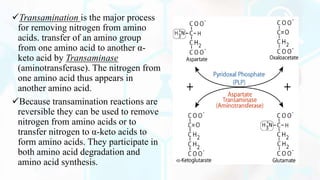
Transamination is the major process
for removing nitrogen from amino
acids. transfer of an amino group
from one amino acid to another α-
keto acid by Transaminase
(aminotransferase). The nitrogen from
one amino acid thus appears in
another amino acid.
Because transamination reactions are
reversible they can be used to remove
nitrogen from amino acids or to
transfer nitrogen to α-keto acids to
form amino acids. They participate in
both amino acid degradation and
amino acid synthesis.
AMMONIA
Ammonia (NH3) is a metabolite that results predominantly from protein
and amino acid degradation. Ammonia is an extremely toxic base and its
accumulation in the body would quickly be fatal so it is converted to
urea, which is nontoxic, very soluble, and readily excreted by the
kidneys through urine.
ROLE AND SIGNIFICANCE OF
AMMONIA
Ammonia does not have a physiologic function. However, it is
important clinically because it is highly toxic to the nervous system.
Because ammonia is being formed constantly from the deamination of
amino acids derived from proteins, it is important that mechanisms exist
to provide for the timely and efficient disposal of this molecule. The
liver is critical for ammonia catabolism because it is the only tissue in
which all elements of the urea cycle, providing for the conversion of
ammonia to urea. Ammonia is also consumed in the synthesis of
nonessential amino acids, and in various facets of intermediary
metabolism.
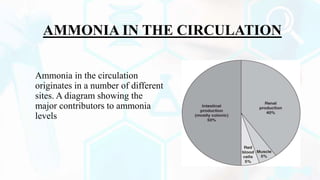
Ammonia in the circulation
originates in a number of different
sites. A diagram showing the
major contributors to ammonia
levels
AMMONIA IN THE CIRCULATION
UREA CYCLE
(KREBS–HENSELEIT CYCLE)
The urea cycle is the metabolic pathway that transforms nitrogen to
urea for excretion from the body. Liver cells play a critical role in
disposing of nitrogenous waste by forming urea hrough the action of
the urea cycle.
Nitrogenous excretory products are then removed from the body
through in the urine.
The urea excreted each day by a healthy adult (about 30 g) accounts
for about 90% of the nitrogenous excretory products.
The cycle occurs mainly in the liver.
 Location of Urea Cycle:
Cytosol and mitochondria of hepatocytes.
 Substrates:
NH3 (as derived from oxidative deamination of glutamate); CO2;
aspartate; three ATP.
 Products:
Urea; fumarate; H2O.
 Purpose of the Urea Cycle:
The urea cycle allows for the excretion of NH4
+ by transforming
ammonia into urea, which is then excreted by the kidneys.
IMPORTANT ENZYMES IN UREA CYCLE
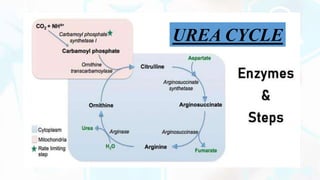
Carbamoyl phosphate synthetase I: Converts ammonium and bicarbonate
into carbamoyl phosphate. This is the rate-limiting step in the urea cycle.
This reaction requires two ATP and occurs in the mitochondria.
Ornithine transcarbamoylase: Combines ornithine and carbamoyl
phosphate to form citrulline. Located in mitochondria.
Argininosuccinate synthetase: Condenses citrulline with aspartate to form
arginosuccinate. This reaction occurs in the cytosol and requires one ATP.
Argininosuccinate lyase: Splits argininosuccinate into arginine and
fumarate. Occurs in the cytosol.
Arginase: Cleaves arginine into one molecule of urea and ornithine in the
cytosol. The ornithine is then transported back into the mitochondria for
entry back into the cycle.
REACTIONS OF THE
UREA CYCLE
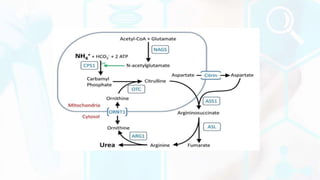
 Step #1; Synthesis of Carbomyl phosphate
Carbamoyl phosphate is synthesized in the first reaction This is the rate-
limiting step in the urea cycle. This reaction requires two ATP and occurs in
the mitochondria.
Enzyme: carbamoyl phosphate synthetase I, which is located in mitochondria
and is activated by N-acetylglutamate.
NH3 + CO2 + 2ATP → carbamoyl phosphate + 2ADP + Pi
 Step#2:Synthesis of Citruline
Ornithine reacts with carbamoyl phosphate to form citrulline. Inorganic
phosphate is released.
Enzyme: ornithine transcarbamoylase, which is found in mitochondria. The
product, citrulline, is transported to the cytosol in exchange for cytoplasmic
ornithine.
Carbamoyl phosphate + ornithine → citrulline + Pi
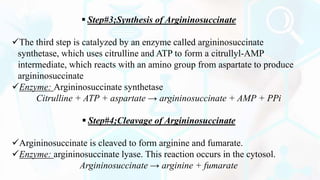
 Step#3;Synthesis of Argininosuccinate
The third step is catalyzed by an enzyme called argininosuccinate
synthetase, which uses citrulline and ATP to form a citrullyl-AMP
intermediate, which reacts with an amino group from aspartate to produce
argininosuccinate
Enzyme: Argininosuccinate synthetase
Citrulline + ATP + aspartate → argininosuccinate + AMP + PPi
 Step#4;Cleavage of Argininosuccinate
Argininosuccinate is cleaved to form arginine and fumarate.
Enzyme: argininosuccinate lyase. This reaction occurs in the cytosol.
Argininosuccinate → arginine + fumarate
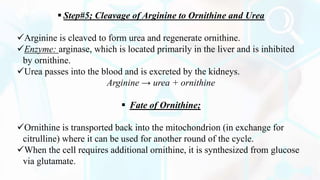
 Step#5; Cleavage of Arginine to Ornithine and Urea
Arginine is cleaved to form urea and regenerate ornithine.
Enzyme: arginase, which is located primarily in the liver and is inhibited
by ornithine.
Urea passes into the blood and is excreted by the kidneys.
Arginine → urea + ornithine
 Fate of Ornithine;
Ornithine is transported back into the mitochondrion (in exchange for
citrulline) where it can be used for another round of the cycle.
When the cell requires additional ornithine, it is synthesized from glucose
via glutamate.
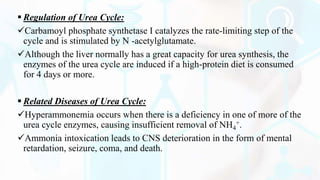
 Regulation of Urea Cycle:
Carbamoyl phosphate synthetase I catalyzes the rate-limiting step of the
cycle and is stimulated by N -acetylglutamate.
Although the liver normally has a great capacity for urea synthesis, the
enzymes of the urea cycle are induced if a high-protein diet is consumed
for 4 days or more.
 Related Diseases of Urea Cycle:
Hyperammonemia occurs when there is a deficiency in one of more of the
urea cycle enzymes, causing insufficient removal of NH4
+.
Ammonia intoxication leads to CNS deterioration in the form of mental
retardation, seizure, coma, and death.
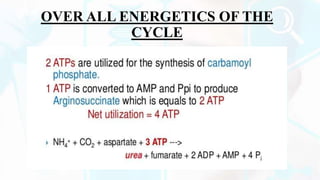
OVER ALL ENERGETICS OF THE
CYCLE
SIGNIFICANCE OF THE UREA CYCLE
The main purpose of the urea cycle is to eliminate toxic ammonia from
the body. About 10 to 20 g of ammonia is removed from the body of a
healthy adult every day. A dysfunctional urea cycle would mean excess
amount of ammonia in the body, which can lead to hyperammonemia
and related diseases. The deficiency of one or more of the key enzymes
catalyzing various reactions in the urea cycle can cause disorders related
to the cycle. Defects in the urea cycle can cause vomiting, coma and
convulsions in new born babies. This is often misdiagnosed as
septicemia and treated with antibiotics in vain. Even 1mm of excess
ammonia can cause severe and irreversible damages.
UREA CYCLE
REFERENCES
 Text book of medical biochemistry, MN Chatterjee
•Smith, C. M., Marks, A. D., Lieberman, M. A., Marks, D. B., & Marks,
D. B. (2005). Marks’ basic medical biochemistry: A clinical approach.
Philadelphia: Lippincott Williams & Wilkins.
•Lehninger, A. L., Nelson, D. L., & Cox, M. M. (2000). Lehninger
principles of biochemistry. New York: Worth Publishers.

UREA CYCLE

  • 1.
    METABOLISM OF PROTEINS ANDAMINO ACIDS Prepared by : Rabia Khan Baber Course Title : Biochemistry Topic : Nitrogen Excretion, Ammonia and Urea Cycle
  • 2.
    AIMS AND OBJECTIVESOF PPT Nitrogen excretion from an aa  What is ammonia and its role Urea cycle introduction Important enzymes of urea cycle Reactions of urea cycle Regulation of urea cycle Related diseases of urea cycle
  • 3.
    NITROGEN EXCRETION FROMAN AA During fasting, muscle protein is cleaved to amino acids, some of which are partially oxidized to produce energy. Portions of these amino acids are converted to alanine and glutamine, which, along with other amino acids are released into the blood. Glutamine is oxidized by various tissues, including the gut and kidney, which convert some of its carbons and nitrogen to alanine. Alanine and other amino acids travel to the liver, where the carbons are converted to glucose and ketone bodies and the nitrogen is converted to urea, which is excreted by the kidneys. Several enzymes are important in the process of interconverting amino acids and in removing nitrogen so that the carbon skeletons can be utilized. These include transaminases, glutamate dehydrogenase and deaminases. Because reactions catalyzed by transaminases and glutamate dehydrogenase are reversible, they can supply amino groups for the synthesis of non-essential amino acids.
  • 4.
    Transamination is themajor process for removing nitrogen from amino acids. transfer of an amino group from one amino acid to another α- keto acid by Transaminase (aminotransferase). The nitrogen from one amino acid thus appears in another amino acid. Because transamination reactions are reversible they can be used to remove nitrogen from amino acids or to transfer nitrogen to α-keto acids to form amino acids. They participate in both amino acid degradation and amino acid synthesis.
  • 5.
    AMMONIA Ammonia (NH3) isa metabolite that results predominantly from protein and amino acid degradation. Ammonia is an extremely toxic base and its accumulation in the body would quickly be fatal so it is converted to urea, which is nontoxic, very soluble, and readily excreted by the kidneys through urine.
  • 6.
    ROLE AND SIGNIFICANCEOF AMMONIA Ammonia does not have a physiologic function. However, it is important clinically because it is highly toxic to the nervous system. Because ammonia is being formed constantly from the deamination of amino acids derived from proteins, it is important that mechanisms exist to provide for the timely and efficient disposal of this molecule. The liver is critical for ammonia catabolism because it is the only tissue in which all elements of the urea cycle, providing for the conversion of ammonia to urea. Ammonia is also consumed in the synthesis of nonessential amino acids, and in various facets of intermediary metabolism.
  • 7.
    Ammonia in thecirculation originates in a number of different sites. A diagram showing the major contributors to ammonia levels AMMONIA IN THE CIRCULATION
  • 8.
    UREA CYCLE (KREBS–HENSELEIT CYCLE) Theurea cycle is the metabolic pathway that transforms nitrogen to urea for excretion from the body. Liver cells play a critical role in disposing of nitrogenous waste by forming urea hrough the action of the urea cycle. Nitrogenous excretory products are then removed from the body through in the urine. The urea excreted each day by a healthy adult (about 30 g) accounts for about 90% of the nitrogenous excretory products. The cycle occurs mainly in the liver.
  • 9.
     Location ofUrea Cycle: Cytosol and mitochondria of hepatocytes.  Substrates: NH3 (as derived from oxidative deamination of glutamate); CO2; aspartate; three ATP.  Products: Urea; fumarate; H2O.  Purpose of the Urea Cycle: The urea cycle allows for the excretion of NH4 + by transforming ammonia into urea, which is then excreted by the kidneys.
  • 10.
    IMPORTANT ENZYMES INUREA CYCLE Carbamoyl phosphate synthetase I: Converts ammonium and bicarbonate into carbamoyl phosphate. This is the rate-limiting step in the urea cycle. This reaction requires two ATP and occurs in the mitochondria. Ornithine transcarbamoylase: Combines ornithine and carbamoyl phosphate to form citrulline. Located in mitochondria. Argininosuccinate synthetase: Condenses citrulline with aspartate to form arginosuccinate. This reaction occurs in the cytosol and requires one ATP. Argininosuccinate lyase: Splits argininosuccinate into arginine and fumarate. Occurs in the cytosol. Arginase: Cleaves arginine into one molecule of urea and ornithine in the cytosol. The ornithine is then transported back into the mitochondria for entry back into the cycle.
  • 11.
  • 12.
     Step #1;Synthesis of Carbomyl phosphate Carbamoyl phosphate is synthesized in the first reaction This is the rate- limiting step in the urea cycle. This reaction requires two ATP and occurs in the mitochondria. Enzyme: carbamoyl phosphate synthetase I, which is located in mitochondria and is activated by N-acetylglutamate. NH3 + CO2 + 2ATP → carbamoyl phosphate + 2ADP + Pi  Step#2:Synthesis of Citruline Ornithine reacts with carbamoyl phosphate to form citrulline. Inorganic phosphate is released. Enzyme: ornithine transcarbamoylase, which is found in mitochondria. The product, citrulline, is transported to the cytosol in exchange for cytoplasmic ornithine. Carbamoyl phosphate + ornithine → citrulline + Pi
  • 13.
     Step#3;Synthesis ofArgininosuccinate The third step is catalyzed by an enzyme called argininosuccinate synthetase, which uses citrulline and ATP to form a citrullyl-AMP intermediate, which reacts with an amino group from aspartate to produce argininosuccinate Enzyme: Argininosuccinate synthetase Citrulline + ATP + aspartate → argininosuccinate + AMP + PPi  Step#4;Cleavage of Argininosuccinate Argininosuccinate is cleaved to form arginine and fumarate. Enzyme: argininosuccinate lyase. This reaction occurs in the cytosol. Argininosuccinate → arginine + fumarate
  • 14.
     Step#5; Cleavageof Arginine to Ornithine and Urea Arginine is cleaved to form urea and regenerate ornithine. Enzyme: arginase, which is located primarily in the liver and is inhibited by ornithine. Urea passes into the blood and is excreted by the kidneys. Arginine → urea + ornithine  Fate of Ornithine; Ornithine is transported back into the mitochondrion (in exchange for citrulline) where it can be used for another round of the cycle. When the cell requires additional ornithine, it is synthesized from glucose via glutamate.
  • 15.
     Regulation ofUrea Cycle: Carbamoyl phosphate synthetase I catalyzes the rate-limiting step of the cycle and is stimulated by N -acetylglutamate. Although the liver normally has a great capacity for urea synthesis, the enzymes of the urea cycle are induced if a high-protein diet is consumed for 4 days or more.  Related Diseases of Urea Cycle: Hyperammonemia occurs when there is a deficiency in one of more of the urea cycle enzymes, causing insufficient removal of NH4 +. Ammonia intoxication leads to CNS deterioration in the form of mental retardation, seizure, coma, and death.
  • 16.
    OVER ALL ENERGETICSOF THE CYCLE
  • 17.
    SIGNIFICANCE OF THEUREA CYCLE The main purpose of the urea cycle is to eliminate toxic ammonia from the body. About 10 to 20 g of ammonia is removed from the body of a healthy adult every day. A dysfunctional urea cycle would mean excess amount of ammonia in the body, which can lead to hyperammonemia and related diseases. The deficiency of one or more of the key enzymes catalyzing various reactions in the urea cycle can cause disorders related to the cycle. Defects in the urea cycle can cause vomiting, coma and convulsions in new born babies. This is often misdiagnosed as septicemia and treated with antibiotics in vain. Even 1mm of excess ammonia can cause severe and irreversible damages.
  • 18.
  • 20.
    REFERENCES  Text bookof medical biochemistry, MN Chatterjee •Smith, C. M., Marks, A. D., Lieberman, M. A., Marks, D. B., & Marks, D. B. (2005). Marks’ basic medical biochemistry: A clinical approach. Philadelphia: Lippincott Williams & Wilkins. •Lehninger, A. L., Nelson, D. L., & Cox, M. M. (2000). Lehninger principles of biochemistry. New York: Worth Publishers.