
CMB MODULE-Class-2019
Gene therapy is the use of DNA as a
pharmaceutical agent to treat disease
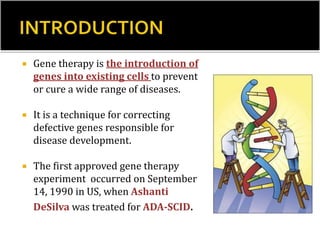
 Gene therapy is the introduction of
genes into existing cells to prevent
or cure a wide range of diseases.
 It is a technique for correcting
defective genes responsible for
disease development.
 The first approved gene therapy
experiment occurred on September
14, 1990 in US, when Ashanti
DeSilva was treated for ADA-SCID.
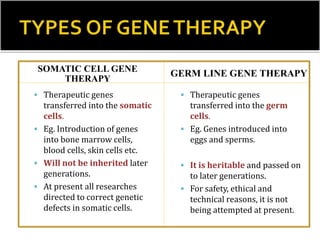
SOMATIC CELL GENE
THERAPY
 Therapeutic genes
transferred into the somatic
cells.
 Eg. Introduction of genes
into bone marrow cells,
blood cells, skin cells etc.
 Will not be inherited later
generations.
 At present all researches
directed to correct genetic
defects in somatic cells.
GERM LINE GENE THERAPY
 Therapeutic genes
transferred into the germ
cells.
 Eg. Genes introduced into
eggs and sperms.
 It is heritable and passed on
to later generations.
 For safety, ethical and
technical reasons, it is not
being attempted at present.
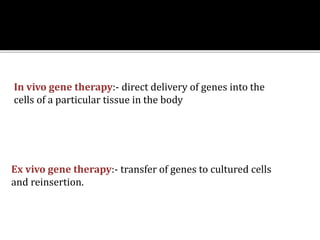
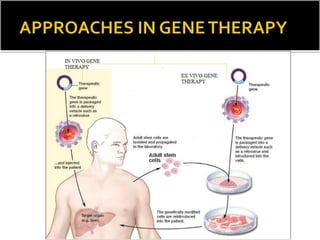
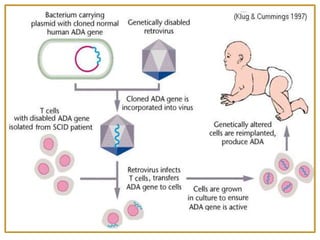
Ex vivo gene therapy:- transfer of genes to cultured cells
and reinsertion.
In vivo gene therapy:- direct delivery of genes into the
cells of a particular tissue in the body
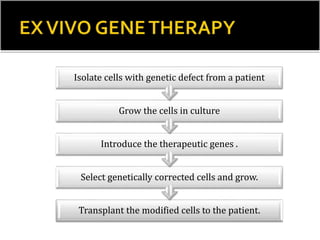
Transplant the modified cells to the patient.
Select genetically corrected cells and grow.
Introduce the therapeutic genes .
Grow the cells in culture
Isolate cells with genetic defect from a patient
 1st gene therapy – to correct deficiency of enzyme,
Adenosine deaminase (ADA).
 Performed on a 4yr old girl Ashanthi DeSilva.
 Was suffering from SCID- Severe Combined
Immunodeficiency.
 Caused due to defect in gene coding for ADA.
 Deoxy adenosine accumulate and destroys T lymphocytes.
 Disrupts immunity , suffer from infectious diseases and die
at young age.
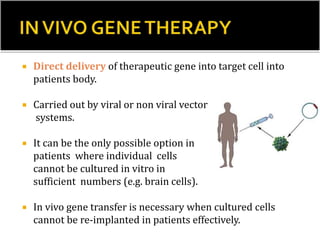
 Direct delivery of therapeutic gene into target cell into
patients body.
 Carried out by viral or non viral vector
systems.
 It can be the only possible option in
patients where individual cells
cannot be cultured in vitro in
sufficient numbers (e.g. brain cells).
 In vivo gene transfer is necessary when cultured cells
cannot be re-implanted in patients effectively.
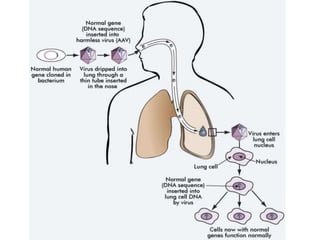
 In patients with cystic fibrosis, a protein called cystic
fibrosis transmembrane regulator (CFTR) is absent
due to a gene defect.
 In the absence of CFTR chloride ions concentrate within
the cells and it draws water from surrounding.
 This leads to the accumulation of sticky mucous in
respiratory tract and lungs.
 Treated by in vivo replacement of defective gene by
adenovirus vector .
-Therapy for cystic fibrosis
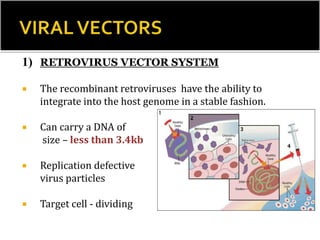
1) RETROVIRUS VECTOR SYSTEM
 The recombinant retroviruses have the ability to
integrate into the host genome in a stable fashion.
 Can carry a DNA of
size – less than 3.4kb
 Replication defective
virus particles
 Target cell - dividing
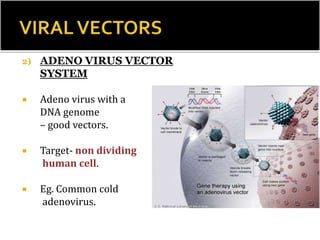
2) ADENO VIRUS VECTOR
SYSTEM
 Adeno virus with a
DNA genome
– good vectors.
 Target- non dividing
human cell.
 Eg. Common cold
adenovirus.
3) ADENO ASSOCIATED VIRUS VECTOR
 It is a human virus that can integrate into chromosome 19.
 It is a single stranded, non pathogenic small DNA virus.
 AAV enters host cell, becomes double stranded and gets
integrated into chromosome.
4) HERPEX SIMPLEX VIRUS VECTOR
 Viruses which have natural tendency to infect a particular
type of cell.
 They infect and persist in nervous cells.
1. PURE DNA CONSTRUCT
 Direct introduction of pure DNA construct into target tissue .
 Efficiency of DNA uptake by cells and expression rather low.
 Consequently, large quantities of DNA have to be injected
periodically.
2. LIPOPLEXES
 Lipid DNA complexes; DNA construct surrounded by artificial
lipid layer.
 Most of it gets degraded by lysosomes.
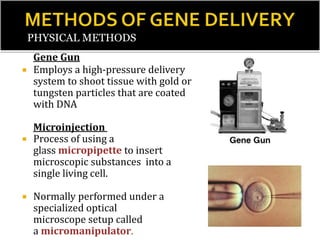
Gene Gun
 Employs a high-pressure delivery
system to shoot tissue with gold or
tungsten particles that are coated
with DNA
Microinjection
 Process of using a
glass micropipette to insert
microscopic substances into a
single living cell.
 Normally performed under a
specialized optical
microscope setup called
a micromanipulator.
PHYSICAL METHODS
 USING DETERGENT MIXTURES
 Certain charged chemical compounds like Calcium phosphates
are mixed with functional cDNA of desired function.
 The mixture is introduced near the vicinity of recipient cells.
 The chemicals disturbs the cell membrane, widens the pore size
and allows cDNA to pass through the cell.
 LIPOFECTION
 It is a technique used to inject genetic materials into a cell by
means of liposomes.
 Liposomes are artificial phospholipid vesicles used to deliver a
variety of molecules including DNA into the cells.
GENE AUGMENTATION THERAPY
 Most common form of gene therapy
 Foreign gene replaces missing or defective gene.
 Eg. Replacement of defective p53 gene by a normal one in
liver cancer.
GENE INHIBITION THERAPY
 Done to block the overproduction of some proteins.
 2 types – Antigene and antisense therapy.
 Antigene – blocks transcription using antigene oligonucleotide
 Antisense – blocks transalation using antisense oligonucleotide.
 Long lasting therapy is not achieved by gene therapy; Due
to rapid dividing of cells benefits of gene therapy is short
lived.
 Immune response to the transferred gene stimulates a
potential risk to gene therapy.
 Viruses used as vectors for gene transfer may cause
toxicity, immune responses, and inflammatory reactions in
the host.
 Disorders caused by defects in multiple genes cannot be
treated effectively using gene therapy.
 Gene therapy has the potential to eliminate and prevent
hereditary diseases such as cystic fibrosis, ADA- SCID etc.
 It is a possible cure for heart disease, AIDS and cancer.
 It gives someone born with a genetic disease a chance to
life.
 It can be used to eradicate diseases from the future
generations.
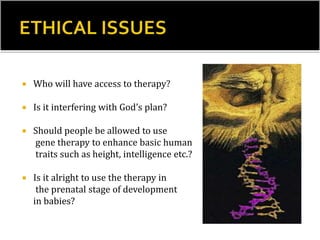
 Who will have access to therapy?
 Is it interfering with God’s plan?
 Should people be allowed to use
gene therapy to enhance basic human
traits such as height, intelligence etc.?
 Is it alright to use the therapy in
the prenatal stage of development
in babies?
 Theoretically, gene therapy is the permanent solution for
genetic diseases.
 But it has several complexities. At its current stage, it is not
accessible to most people due to its huge cost.
 A breakthrough may come anytime and a day may come
when almost every disease will have a gene therapy
 Gene therapy have the potential to revolutionize the
practice of medicine.
Lgis  gene therapy

Lgis gene therapy

  • 1.
  • 2.
    Gene therapy isthe use of DNA as a pharmaceutical agent to treat disease
  • 3.
     Gene therapyis the introduction of genes into existing cells to prevent or cure a wide range of diseases.  It is a technique for correcting defective genes responsible for disease development.  The first approved gene therapy experiment occurred on September 14, 1990 in US, when Ashanti DeSilva was treated for ADA-SCID.
  • 4.
    SOMATIC CELL GENE THERAPY Therapeutic genes transferred into the somatic cells.  Eg. Introduction of genes into bone marrow cells, blood cells, skin cells etc.  Will not be inherited later generations.  At present all researches directed to correct genetic defects in somatic cells. GERM LINE GENE THERAPY  Therapeutic genes transferred into the germ cells.  Eg. Genes introduced into eggs and sperms.  It is heritable and passed on to later generations.  For safety, ethical and technical reasons, it is not being attempted at present.
  • 5.
    Ex vivo genetherapy:- transfer of genes to cultured cells and reinsertion. In vivo gene therapy:- direct delivery of genes into the cells of a particular tissue in the body
  • 7.
    Transplant the modifiedcells to the patient. Select genetically corrected cells and grow. Introduce the therapeutic genes . Grow the cells in culture Isolate cells with genetic defect from a patient
  • 8.
     1st genetherapy – to correct deficiency of enzyme, Adenosine deaminase (ADA).  Performed on a 4yr old girl Ashanthi DeSilva.  Was suffering from SCID- Severe Combined Immunodeficiency.  Caused due to defect in gene coding for ADA.  Deoxy adenosine accumulate and destroys T lymphocytes.  Disrupts immunity , suffer from infectious diseases and die at young age.
  • 10.
     Direct deliveryof therapeutic gene into target cell into patients body.  Carried out by viral or non viral vector systems.  It can be the only possible option in patients where individual cells cannot be cultured in vitro in sufficient numbers (e.g. brain cells).  In vivo gene transfer is necessary when cultured cells cannot be re-implanted in patients effectively.
  • 11.
     In patientswith cystic fibrosis, a protein called cystic fibrosis transmembrane regulator (CFTR) is absent due to a gene defect.  In the absence of CFTR chloride ions concentrate within the cells and it draws water from surrounding.  This leads to the accumulation of sticky mucous in respiratory tract and lungs.  Treated by in vivo replacement of defective gene by adenovirus vector . -Therapy for cystic fibrosis
  • 13.
    1) RETROVIRUS VECTORSYSTEM  The recombinant retroviruses have the ability to integrate into the host genome in a stable fashion.  Can carry a DNA of size – less than 3.4kb  Replication defective virus particles  Target cell - dividing
  • 14.
    2) ADENO VIRUSVECTOR SYSTEM  Adeno virus with a DNA genome – good vectors.  Target- non dividing human cell.  Eg. Common cold adenovirus.
  • 15.
    3) ADENO ASSOCIATEDVIRUS VECTOR  It is a human virus that can integrate into chromosome 19.  It is a single stranded, non pathogenic small DNA virus.  AAV enters host cell, becomes double stranded and gets integrated into chromosome. 4) HERPEX SIMPLEX VIRUS VECTOR  Viruses which have natural tendency to infect a particular type of cell.  They infect and persist in nervous cells.
  • 16.
    1. PURE DNACONSTRUCT  Direct introduction of pure DNA construct into target tissue .  Efficiency of DNA uptake by cells and expression rather low.  Consequently, large quantities of DNA have to be injected periodically. 2. LIPOPLEXES  Lipid DNA complexes; DNA construct surrounded by artificial lipid layer.  Most of it gets degraded by lysosomes.
  • 17.
    Gene Gun  Employsa high-pressure delivery system to shoot tissue with gold or tungsten particles that are coated with DNA Microinjection  Process of using a glass micropipette to insert microscopic substances into a single living cell.  Normally performed under a specialized optical microscope setup called a micromanipulator. PHYSICAL METHODS
  • 18.
     USING DETERGENTMIXTURES  Certain charged chemical compounds like Calcium phosphates are mixed with functional cDNA of desired function.  The mixture is introduced near the vicinity of recipient cells.  The chemicals disturbs the cell membrane, widens the pore size and allows cDNA to pass through the cell.  LIPOFECTION  It is a technique used to inject genetic materials into a cell by means of liposomes.  Liposomes are artificial phospholipid vesicles used to deliver a variety of molecules including DNA into the cells.
  • 19.
    GENE AUGMENTATION THERAPY Most common form of gene therapy  Foreign gene replaces missing or defective gene.  Eg. Replacement of defective p53 gene by a normal one in liver cancer. GENE INHIBITION THERAPY  Done to block the overproduction of some proteins.  2 types – Antigene and antisense therapy.  Antigene – blocks transcription using antigene oligonucleotide  Antisense – blocks transalation using antisense oligonucleotide.
  • 20.
     Long lastingtherapy is not achieved by gene therapy; Due to rapid dividing of cells benefits of gene therapy is short lived.  Immune response to the transferred gene stimulates a potential risk to gene therapy.  Viruses used as vectors for gene transfer may cause toxicity, immune responses, and inflammatory reactions in the host.  Disorders caused by defects in multiple genes cannot be treated effectively using gene therapy.
  • 21.
     Gene therapyhas the potential to eliminate and prevent hereditary diseases such as cystic fibrosis, ADA- SCID etc.  It is a possible cure for heart disease, AIDS and cancer.  It gives someone born with a genetic disease a chance to life.  It can be used to eradicate diseases from the future generations.
  • 22.
     Who willhave access to therapy?  Is it interfering with God’s plan?  Should people be allowed to use gene therapy to enhance basic human traits such as height, intelligence etc.?  Is it alright to use the therapy in the prenatal stage of development in babies?
  • 23.
     Theoretically, genetherapy is the permanent solution for genetic diseases.  But it has several complexities. At its current stage, it is not accessible to most people due to its huge cost.  A breakthrough may come anytime and a day may come when almost every disease will have a gene therapy  Gene therapy have the potential to revolutionize the practice of medicine.