What is urbanization?
   The migration of people from rural areas and villages
    into high-population-density “cities”, and the
    associated growth of these cities and the
    transformation of their physical, social and economic
    environment (Elie’s)


   Another definition is thus: “An increasing concentration
    of the population in cities and a transformation of land
    use to an urban pattern of organization.”
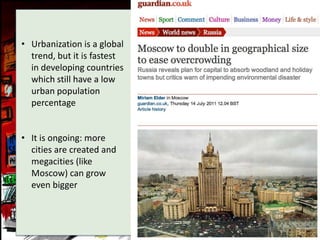
• Urbanization is a global
  trend, but it is fastest
  in developing countries
  which still have a low
  urban population
  percentage


• It is ongoing: more
  cities are created and
  megacities (like
  Moscow) can grow
  even bigger
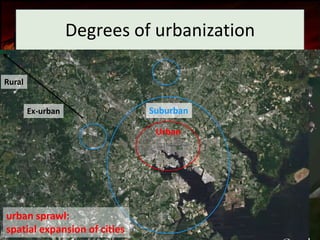
Degrees of urbanization

Rural


        Ex-urban              Suburban

                               Urban


urban sprawl:
spatial expansion of cities
When and why did humanity start
             urbanizing?
 http://en.wikipedia.org/wiki/List_of_cities_by_time_of_continuous
  _habitation
 Homo sapiens have existed on earth for about 200,000 years, but
  cities have existed for less than 10,000 years.
 A long time ago: ~5000 BC large permanent settlements started
  appearing around the Mediterranean. Cities needed developed
  agriculture to produce surplus food outside of cities for them.

 Maybe because we found cities to be more stable, prosperous and
  safe (back when cities were better defended against invaders)
 … in any case the, the main motivations for people to move to
  urban areas today are economic, and the incentives remain very
  strong
 Thus urbanization will continue
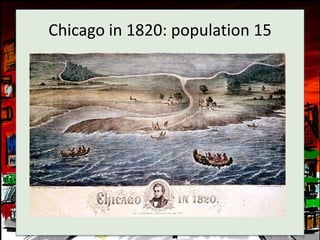
Chicago in 1820: population 15
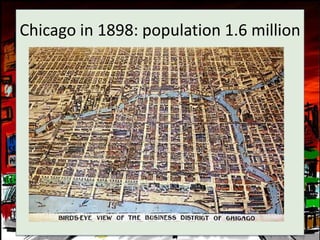
Chicago in 1898: population 1.6 million
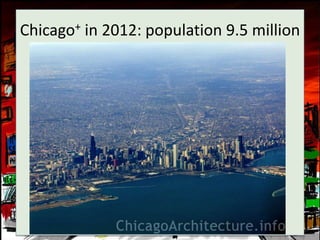
Chicago+ in 2012: population 9.5 million
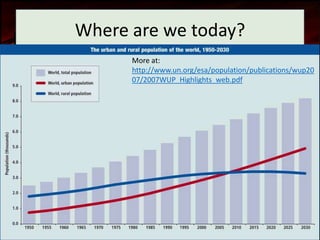
Where are we today?
      More at:
      http://www.un.org/esa/population/publications/wup20
      07/2007WUP_Highlights_web.pdf
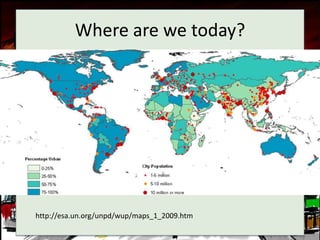
Where are we today?


http://esa.un.org/unpd/wup/maps_1_2009.htm
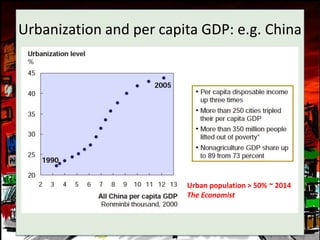
Urbanization and per capita GDP: e.g. China


         http://www.mckinsey.com/mgi/reports/pdfs/c
         hina_urban_billion/China_urban_billion_full_r
         eport.pdf


                                       Urban population > 50% ~ 2014
                                       The Economist
So where does this leave us?
 Urbanization will continue and eventually, at
     some point, most countries will have urbanization
     rates > 80%

 Thus the question is How to Urbanize? And
1. preserve the environmental quality in cities
2. avoid significant regional and global impacts of
   urban areas
  This is where a combination of
policy, science, engineering is needed
How does it affect the environment?
 Changes the surface to solid, impervious material
  with different thermal properties
 Changes the topology of the surfaces from low
  roughness vegetation or porous forests to
  complex bluff bodies (buildings)
 Reduces natural water vapor release to the
  atmosphere (surfaces do not hold water), but
 Increases the anthropogenic production of heat
  and water vapor
 Increases the emissions of air pollutants and
  greenhouse gases
So is it “bad”?
Not necessarily:
1. Buildings, with small apartments and shared walls, need less
    energy to heat and cool than big houses.
2. Compact cities reduce commuting and transportation
    impacts (but create traffic jams that can take back some of
    these advantages), are more amenable to public
    transportation solutions (but food and other things might
    have to be transported from far away)
 So on average, city residents pollute less and emit less GHG,
 http://eau.sagepub.com/content/early/2011/01/08/095624781039
  2270
 http://siteresources.worldbank.org/INTUWM/Resources/GHG_Inde
  x_Mar_9_2011.pdf
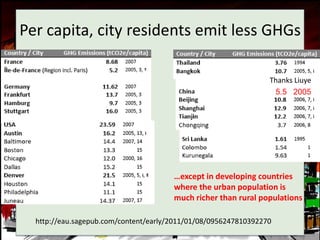
Per capita, city residents emit less GHGs

                                                                 Thanks Liuye
                                                                  5.5 2005


                                       …except in developing countries
                                       where the urban population is
                                       much richer than rural populations

  http://eau.sagepub.com/content/early/2011/01/08/0956247810392270
But it is concentrated
   Higher density means all of these impacts are concentrated
    rather than diluted.
   Urban environmental problems are very local: cities cover ~
    3-4% of the earth’s land surface
    (http://www.livescience.com/6893-cities-cover-earth-
    realized.html)
   Cities can have an impact on regional climate and
    environment, especially if large or concentrated (10% of
    coastal areas are urbanized  coastal cities)
   Cities can have serious impacts on water quality in adjacent
    water bodies and need very large waste landfills
   Unlikely to have a major direct impact on global climate!
    …yet
Environmental Footprint of Cities 1
   An environmental footprint, of a product, city, or process, is the equivalent
    land surface needed to sustainably produce the material, food, and other
    items needed to make the product, sustain the city’s activity, or perform
    the process. (Read “Our ecological Footprint: Reducing Human Impact on
    the Earth” by Wackernagel and Rees)
   London has an area of 170,000 ha but an environmental footprint of
    21,000,000 ha.
   On average, slum dwellers in New Delhi, India, require only 0.8 hectares of
    land per capita to maintain their minimal lifestyles, while Americans in
    Boston or New York need 8.4 hectares of land per capita to support their
    consumption levels.
    http://ww2.unhabitat.org/cdrom/wuf/documents/Dialogues/Added%20m
    aterial%20during%20WUF%20II/Urban%20Sustainability/Presentation%20
    by%20Mr.%20Bakary%20Kante.pdf
Environmental Footprint of Cities 2
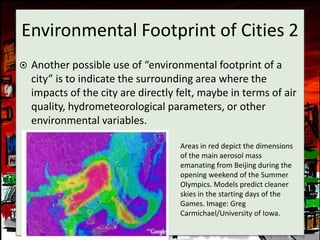
   Another possible use of “environmental footprint of a
    city” is to indicate the surrounding area where the
    impacts of the city are directly felt, maybe in terms of air
    quality, hydrometeorological parameters, or other
    environmental variables.

                                     Areas in red depict the dimensions
                                     of the main aerosol mass
                                     emanating from Beijing during the
                                     opening weekend of the Summer
                                     Olympics. Models predict cleaner
                                     skies in the starting days of the
                                     Games. Image: Greg
                                     Carmichael/University of Iowa.
So the question is
         How to Urbanize more
             sustainably?
 Improve the functioning of existing cities
 Building better future cities


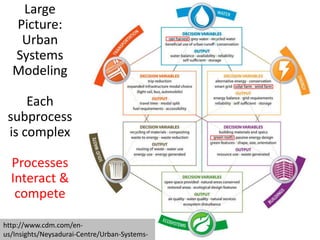
 But cities are complex and we need to
  understand individual processes, how they
  interact, and how they function together in
  the “urban system”
Large
  Picture:
   Urban
  Systems
  Modeling

     Each
 subprocess
 is complex

  Processes
  Interact &
   compete

http://www.cdm.com/en-
us/Insights/Neysadurai-Centre/Urban-Systems-

Urbanization: Brief History & Future Outlooks

  • 2.
    What is urbanization?  The migration of people from rural areas and villages into high-population-density “cities”, and the associated growth of these cities and the transformation of their physical, social and economic environment (Elie’s)  Another definition is thus: “An increasing concentration of the population in cities and a transformation of land use to an urban pattern of organization.”
  • 3.
    • Urbanization isa global trend, but it is fastest in developing countries which still have a low urban population percentage • It is ongoing: more cities are created and megacities (like Moscow) can grow even bigger
  • 4.
    Degrees of urbanization Rural Ex-urban Suburban Urban urban sprawl: spatial expansion of cities
  • 5.
    When and whydid humanity start urbanizing?  http://en.wikipedia.org/wiki/List_of_cities_by_time_of_continuous _habitation  Homo sapiens have existed on earth for about 200,000 years, but cities have existed for less than 10,000 years.  A long time ago: ~5000 BC large permanent settlements started appearing around the Mediterranean. Cities needed developed agriculture to produce surplus food outside of cities for them.  Maybe because we found cities to be more stable, prosperous and safe (back when cities were better defended against invaders)  … in any case the, the main motivations for people to move to urban areas today are economic, and the incentives remain very strong  Thus urbanization will continue
  • 6.
    Chicago in 1820:population 15
  • 7.
    Chicago in 1898:population 1.6 million
  • 8.
    Chicago+ in 2012:population 9.5 million
  • 9.
    Where are wetoday? More at: http://www.un.org/esa/population/publications/wup20 07/2007WUP_Highlights_web.pdf
  • 10.
    Where are wetoday? http://esa.un.org/unpd/wup/maps_1_2009.htm
  • 11.
    Urbanization and percapita GDP: e.g. China http://www.mckinsey.com/mgi/reports/pdfs/c hina_urban_billion/China_urban_billion_full_r eport.pdf Urban population > 50% ~ 2014 The Economist
  • 12.
    So where doesthis leave us?  Urbanization will continue and eventually, at some point, most countries will have urbanization rates > 80%  Thus the question is How to Urbanize? And 1. preserve the environmental quality in cities 2. avoid significant regional and global impacts of urban areas This is where a combination of policy, science, engineering is needed
  • 13.
    How does itaffect the environment?  Changes the surface to solid, impervious material with different thermal properties  Changes the topology of the surfaces from low roughness vegetation or porous forests to complex bluff bodies (buildings)  Reduces natural water vapor release to the atmosphere (surfaces do not hold water), but  Increases the anthropogenic production of heat and water vapor  Increases the emissions of air pollutants and greenhouse gases
  • 14.
    So is it“bad”? Not necessarily: 1. Buildings, with small apartments and shared walls, need less energy to heat and cool than big houses. 2. Compact cities reduce commuting and transportation impacts (but create traffic jams that can take back some of these advantages), are more amenable to public transportation solutions (but food and other things might have to be transported from far away)  So on average, city residents pollute less and emit less GHG,  http://eau.sagepub.com/content/early/2011/01/08/095624781039 2270  http://siteresources.worldbank.org/INTUWM/Resources/GHG_Inde x_Mar_9_2011.pdf
  • 15.
    Per capita, cityresidents emit less GHGs Thanks Liuye 5.5 2005 …except in developing countries where the urban population is much richer than rural populations http://eau.sagepub.com/content/early/2011/01/08/0956247810392270
  • 16.
    But it isconcentrated  Higher density means all of these impacts are concentrated rather than diluted.  Urban environmental problems are very local: cities cover ~ 3-4% of the earth’s land surface (http://www.livescience.com/6893-cities-cover-earth- realized.html)  Cities can have an impact on regional climate and environment, especially if large or concentrated (10% of coastal areas are urbanized  coastal cities)  Cities can have serious impacts on water quality in adjacent water bodies and need very large waste landfills  Unlikely to have a major direct impact on global climate! …yet
  • 17.
    Environmental Footprint ofCities 1  An environmental footprint, of a product, city, or process, is the equivalent land surface needed to sustainably produce the material, food, and other items needed to make the product, sustain the city’s activity, or perform the process. (Read “Our ecological Footprint: Reducing Human Impact on the Earth” by Wackernagel and Rees)  London has an area of 170,000 ha but an environmental footprint of 21,000,000 ha.  On average, slum dwellers in New Delhi, India, require only 0.8 hectares of land per capita to maintain their minimal lifestyles, while Americans in Boston or New York need 8.4 hectares of land per capita to support their consumption levels. http://ww2.unhabitat.org/cdrom/wuf/documents/Dialogues/Added%20m aterial%20during%20WUF%20II/Urban%20Sustainability/Presentation%20 by%20Mr.%20Bakary%20Kante.pdf
  • 18.
    Environmental Footprint ofCities 2  Another possible use of “environmental footprint of a city” is to indicate the surrounding area where the impacts of the city are directly felt, maybe in terms of air quality, hydrometeorological parameters, or other environmental variables. Areas in red depict the dimensions of the main aerosol mass emanating from Beijing during the opening weekend of the Summer Olympics. Models predict cleaner skies in the starting days of the Games. Image: Greg Carmichael/University of Iowa.
  • 19.
    So the questionis How to Urbanize more sustainably?  Improve the functioning of existing cities  Building better future cities  But cities are complex and we need to understand individual processes, how they interact, and how they function together in the “urban system”
  • 20.
    Large Picture: Urban Systems Modeling Each subprocess is complex Processes Interact & compete http://www.cdm.com/en- us/Insights/Neysadurai-Centre/Urban-Systems-