Metamorphises for
Making Cities Cool
Ar. J.K.GUPTA,
Email---- jit.kumar1944@gmail.com, Mob- 90410-26414
Options for Making Cities Cool
Cities and their Context
• Cities have been part of human history.
• - Cities- known to command power and authority
• Cities -- known for their dualities and contradictions.
• Cities- known for both -- positivities and negativities
• Cities -- known to be areas of concentration of population/ activities,
infrastructures, services, healthcare, education
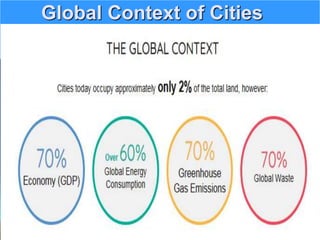
• Cities -- known to be Engines of economic growth-70%
• Cities - generators of employment , wealth and prosperity,
• Cities – also known for their negativities,
• Cities – large consumers of resources/energy/ land
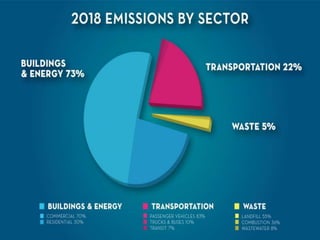
• Cities- generators of - 70% waste;-- consume 60% global energy -
generating 70% of carbon footprints- large amount of heat-
• --98% /56% cities in low& middle/high income economies - do not meet
air quality WHO norms Cities- remain a manmade , mechanical habitat
• Cities- destroy natural habitat-anti-thesis to bio-diversity
• Cities- known to be creator of best/ worst living conditions
• cities – house both rich and poor
Cities and their Context
• Cities- home to large migrants
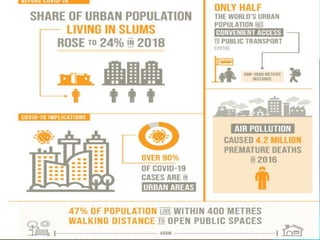
• Cities- home to slums
• Cities- remain in crisis- both -natural and manmade
• Crisis-- of population, poverty, pollution
• Cities – ever evolving and devolving, never static
• Cities – will dominate in future also
• Cities- drivers/definers of nation’s future
• Cities largely responsible for climate change ,global
warming, manmade disasters etc-
• However Cities - needs rationalization
• Cities --need to be made Cool– by making them more
bio-diverse; productive, effective, efficient, humane,
• - livable, inclusive, safe, Resilient ,sustainable, Healthy
place to live /work
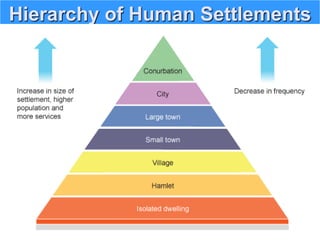
Hierarchy of Human Settlements
Global Context of Cities
Urban Crisis
• Urban crisis/ problems has genesis in--
• – uncontrolled/ unplanned rapid growth /development
• - Irrational way in which built environment is created
• -Way people are made to travel large distances
• --Urbanization & global warming remain positively related,
• Cities getting warmer with rising temperature
• Research shows - urban areas can be 20 F hotter- surrounding/Rural areas
• - even within cities-- one neighborhood 15 degrees hotter than another.
• poor neighborhoods-- hotter than rich neighborhood.
• Intensity/duration of heat waves increasing
• Majority of cities on boil
• - Large causalities happening due to excessive heat
• Globally cities getting into crisis.
• --Jakarta -- sinking;
• --New Delhi-- shutting down due to air pollution;
• - Marseille, France- residential buildings collapsing - lack of
maintenance
Impact of Urban Crisis
• By 250; seven in 10 people will live in cities
• Rising urban temperature impact -humanity/communities /cities--
• - Making human beings most vulnerable
• --Rising Mortality- due to- strokes - when temperatures head above 25C.
• - Cities exposed to extreme temperatures-- Triple over next decades.
• -970 cities-- experiencing average summer temperature of 35˚C (95°F).
• • People exposed to heat waves jumped by --125 mil- between 2000 -2016
(WHO)
• America- Extreme heat --killing more Americans than any other natural
disaster.
• Extreme heatwave in summer 2018, --declared natural disaster with--
thousands hospitalized in Tokyo city,
• UK-heat-related deaths - to increase 257% by 2050 and 535% by 2080.
• • Moscow- recorded about 11,000 people due to heatwave in 2010.
• • India- lost 4.3% working hours -1995; & 5.8% in 2030- due to stress
caused by excess heat(IMD).
Impact of Urban Crisis
• Studies say-- average summer temperatures -to rise rapidly in both
hemispheres in next 40 years
• - In Northern hemisphere- high temp- above 35C (95F) between June -August
• - In Southern hemisphere- average summer temperatures above 35 C-- first
time since records began
• . India -- also getting hotter
• -Rajasthan/ Madhya Pradesh/ Gujrat and Haryana- 54% of total heat waves.
• April, 2022 --recorded hottest month in north-west/central India - third hottest
since past 122 years.
• 15% population-- living in 13% of districts -- vulnerable to heat waves.
• Rising temperatures – threat to- existence / survival of- humanity , flora &
fauna and planet earth.
• Despite Adverse results-- rising urban temperature - received less attention
• -- by professionals / stakeholders,- to Control heat/ flooding, storms,
drought.
• professionals/ communities need attention- threat/risk posed by heat
seriously.
•
Urban Heat- Genesis
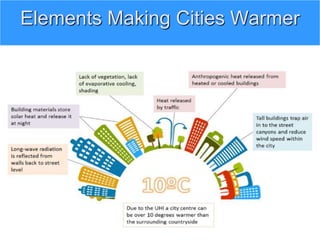
• -- Deadly heat baking cities because ;;
• -Rapid population growth/massive migration in hotter regions of world.
• -High population density-- buildings concentrated in limited area.
• --- Urban canyons formed -between buildings, trapping heat - making
urban streets warm
• - Cities being metalled / made impervious,- with concrete /asphalt
roads/pavements
• -- urban surface, absorbing/radiating sun’s rays.
• • Less open spaces/ less green covers
• -- Reduced number of trees /flora & fauna.
• --Heat emitted by vehicles -moving/stuck in traffic on urban roads
• • Extensive use of air-conditioning in buildings for cooling
• waste heat generated by air conditioners- pumped into air;
• -- heating outdoors -- to cool indoors,
• -- making external spaces hot /more uncomfortable.
• • Large consumption of energy to make buildings cool,
• with estimated energy needed for cooling buildings to triple by 2050.
Elements Making Cities Warmer
Options for
Making
cities
Sustainable
URBAN
INDIA- 2030
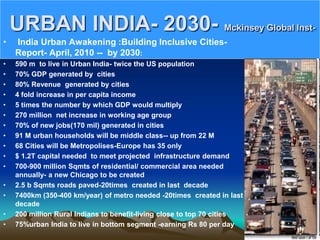
URBAN INDIA- 2030- Mckinsey Global Inst-
• India Urban Awakening :Building Inclusive Cities-
Report- April, 2010 -- by 2030:
• 590 m to live in Urban India- twice the US population
• 70% GDP generated by cities
• 80% Revenue generated by cities
• 4 fold increase in per capita income
• 5 times the number by which GDP would multiply
• 270 million net increase in working age group
• 70% of new jobs(170 mil) generated in cities
• 91 M urban households will be middle class-- up from 22 M
• 68 Cities will be Metropolises-Europe has 35 only
• $ 1.2T capital needed to meet projected infrastructure demand
• 700-900 million Sqmts of residential/ commercial area needed
annually- a new Chicago to be created
• 2.5 b Sqmts roads paved-20times created in last decade
• 7400km (350-400 km/year) of metro needed -20times created in last
decade
• 200 million Rural Indians to benefit-living close to top 70 cities
• 75%urban India to live in bottom segment -earning Rs 80 per day
Opting for
SDG 11-
Making cities
Sustainable
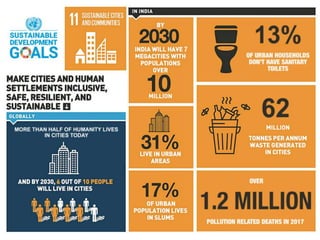
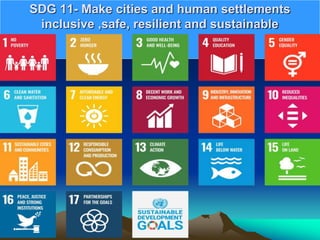
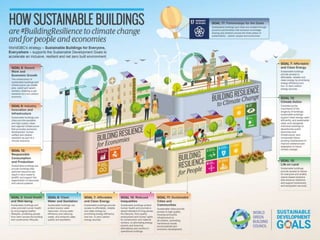
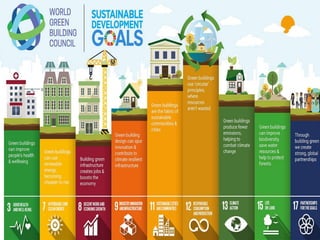
SDG 11- Make cities and human settlements
inclusive ,safe, resilient and sustainable
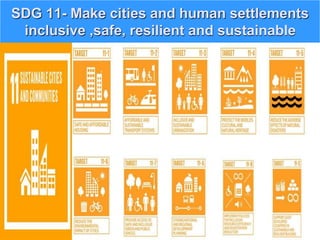
SDG 11- Make cities and human settlements
inclusive ,safe, resilient and sustainable
Options for
Making
cities
Sustainable
Options for Urban Sustainability
• Empowering cities- to increase resilience to climate change by;
• -Redefining Urban Planning- by Making urban planning responsive to
Urban cooling
• -Fostering decarbonization across energy, transport, building •
• -Planning with Nature, Sun , Space, Greenery
• -Undertaking Heat & vulnerability mapping -for measuring urban heat
• Finding Heat mitigation Solutions including
• -Greening Cities
• -Rationalizing/Re-ordering Transportation
• - Valuing Orientation/ Wind
• -Making cities Porous
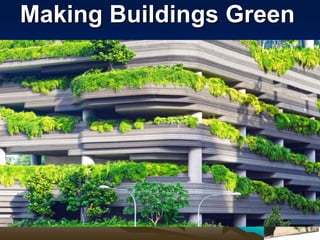
• - Making Buildings Green
• - Greening/ Making Roof Cool
• -Creating Urban forests
• - Making optimum use of water
• - Managing Heat wave emergency --- creating Cooling Centers
• - Using Alternative cooling techniques.
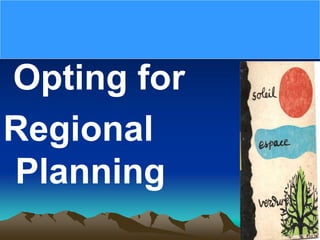
Opting for
Regional
Planning
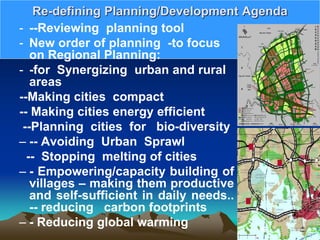
Re-defining Planning/Development Agenda
- --Reviewing planning tool
- New order of planning -to focus
on Regional Planning:
- -for Synergizing urban and rural
areas
--Making cities compact
-- Making cities energy efficient
--Planning cities for bio-diversity
– -- Avoiding Urban Sprawl
-- Stopping melting of cities
– - Empowering/capacity building of
villages – making them productive
and self-sufficient in daily needs..
-- reducing carbon footprints
– - Reducing global warming
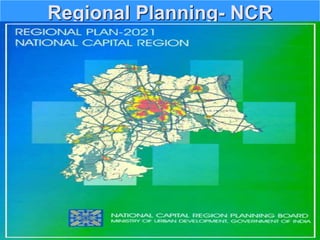
Regional Planning- NCR
Planning with
Nature&
Natural
Resources
CO
BS
WO
RKING
LIVING
CIRCULATIO
N
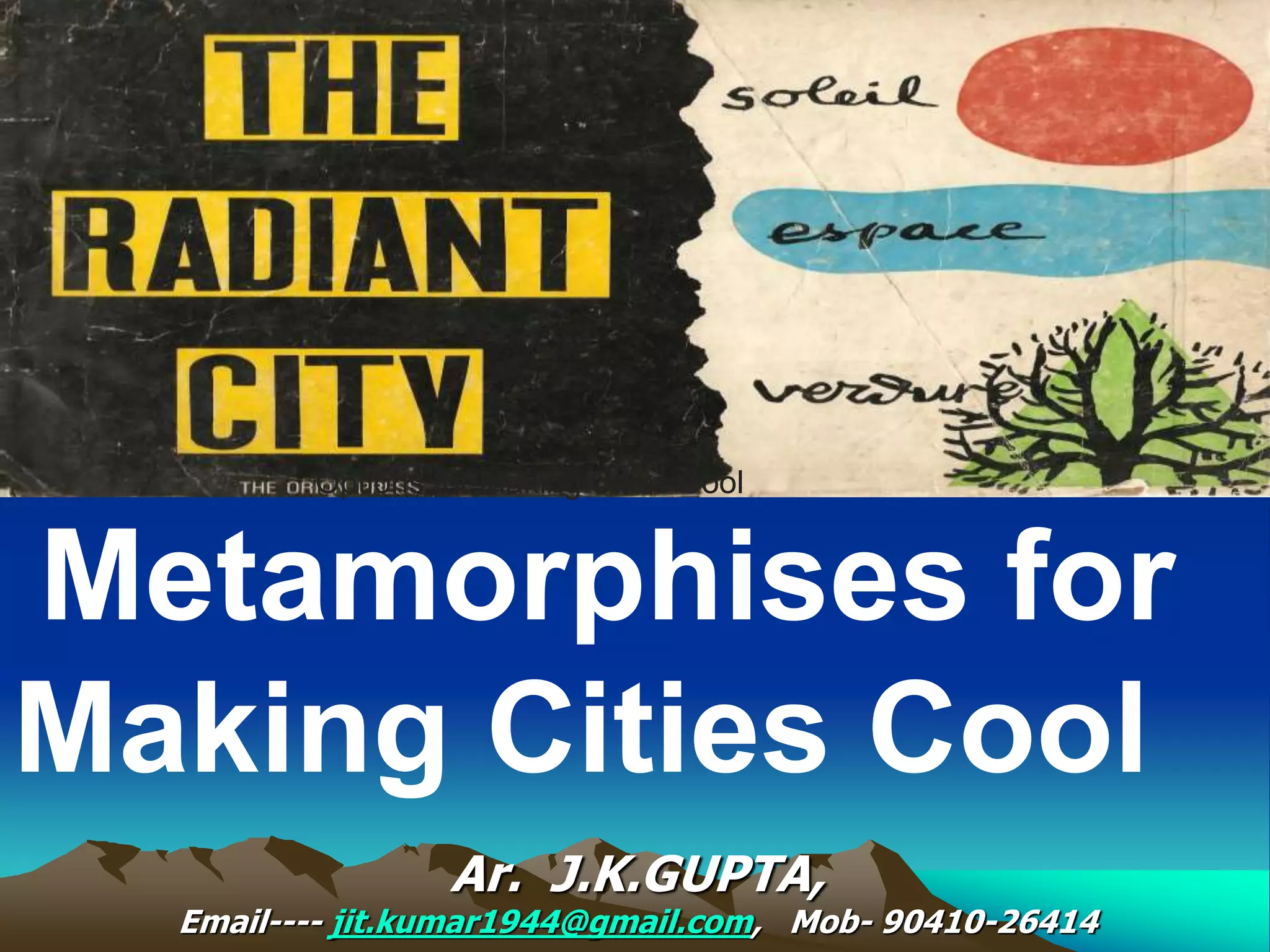
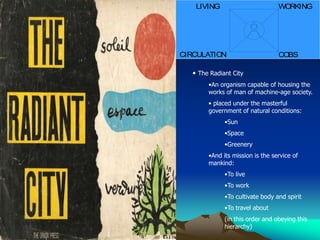
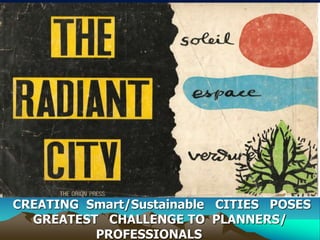
• The Radiant City
•An organism capable of housing the
works of man of machine-age society.
• placed under the masterful
government of natural conditions:
•Sun
•Space
•Greenery
•And its mission is the service of
mankind:
•To live
•To work
•To cultivate body and spirit
•To travel about
(in this order and obeying this
hierarchy)
Making cities
Compact
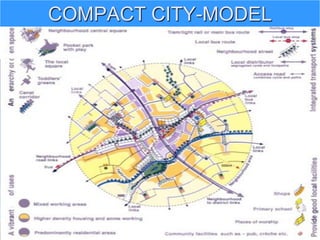
COMPACT CITY-MODEL
Compact City- Heat Reduction
• Heat reduction ignored in urban planning/architecture- temperatures rising
• All citizens entitled to- thermally safe indoor/ outdoor environment
• Making Cities Cool-Changing City planning /Building design options - from
expanding / sprawling
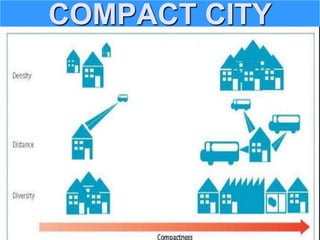
• Compact Cities -offer distinct advantages-
• Minimize expositing earth surface to solar radiation.
• Promoting walkability- Minimising area under road – replacing roads by
streets, easily shaded by adjoining buildings
• - Changing materials/ built form- responsible for heating cities.
• Cities dominated by dark/hard materials – concrete, asphalt, paving – absorb
solar radiation- conventional paving heated up to 67 C & roofs up to 50–90 C,
on hot day.
• Phasing out -- use of black or dark roofs, in warm climates,
• Applying white- coloured coatings to roads, roofs / facades,
• - Reflect more solar energy/ save city from prevailing high temperature.
• For promoting Cool cities ;- Making buildings Green
• -Paris, rationalized mobility by- creating new bike lanes / limiting speed limit to
30 km/h for motorized traffic.
• - Havana, Cuba-- promoted urban agriculture on large scale
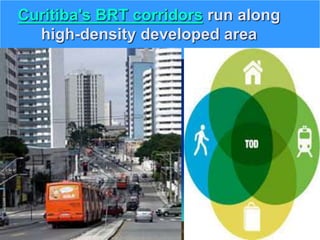
• --Curitiba, Brazil, -- pioneered art of bus based mass transportation,
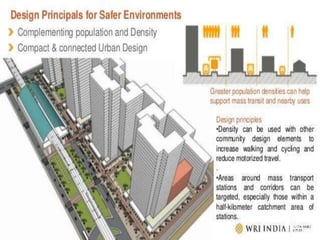
PLANNING COMPACT CITIES
Make cities compact by;
– promoting High-density development
-- adopting Transit oriented development
-- Raising Height and
-Rationalizing land uses / Building bye-laws
-Building inside not outside
--- Building vertical not horizontal
--- Building High not low
--- Building mix not pure
---Building dense not shallow
----- optimizing current infrastructure.
.
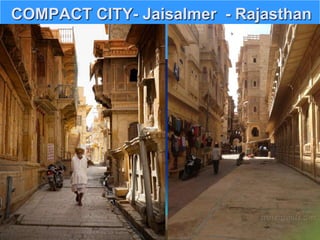
COMPACT CITY
COMPACT CITY- Jaisalmer - Rajasthan
Curitiba's BRT corridors run along
high-density developed area
Valuing
Orientation
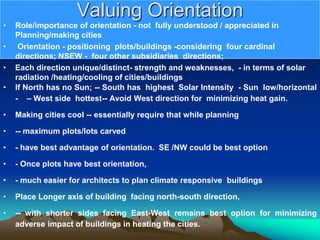
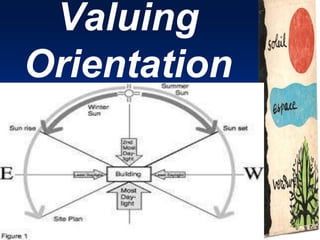
Valuing Orientation
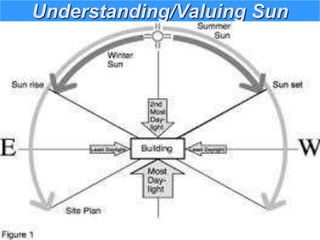
• Role/importance of orientation - not fully understood / appreciated in
Planning/making cities
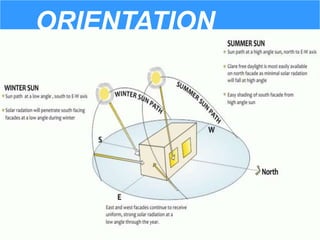
• Orientation - positioning plots/buildings -considering four cardinal
directions; NSEW - four other subsidiaries directions;
• Each direction unique/distinct- strength and weaknesses, - in terms of solar
radiation /heating/cooling of cities/buildings
• If North has no Sun; -- South has highest Solar Intensity - Sun low/horizontal
- – West side hottest-- Avoid West direction for minimizing heat gain.
• Making cities cool -- essentially require that while planning
• -- maximum plots/lots carved
• - have best advantage of orientation. SE /NW could be best option
• - Once plots have best orientation,
• - much easier for architects to plan climate responsive buildings
• Place Longer axis of building facing north-south direction,
• -- with shorter sides facing East-West remains best option for minimizing
adverse impact of buildings in heating the cities.
Understanding/Valuing Sun
ORIENTATION
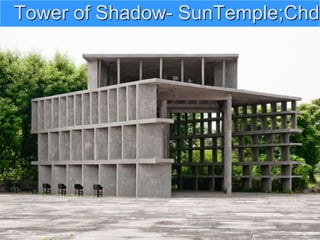
Tower of Shadow- SunTemple;Chd.
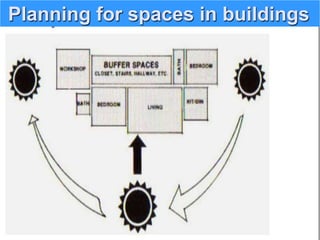
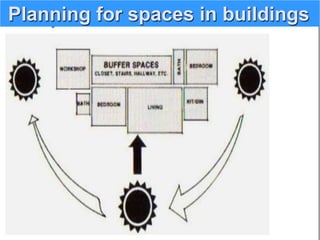
Planning for spaces in buildings
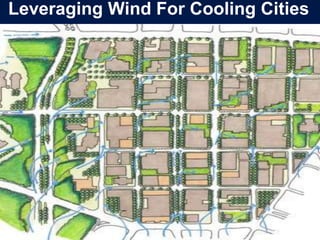
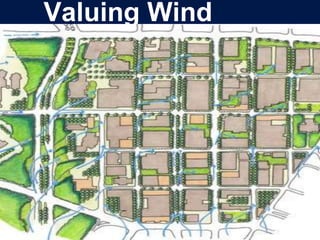
Leveraging Wind For Cooling Cities
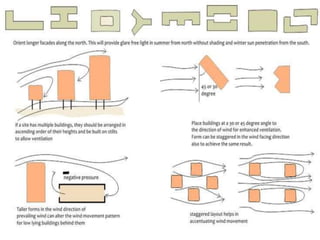
- Leveraging Potential of wind -in cooling cities / reducing temperature by;
• - mapping prevailing direction of wind-flow
• - integrating wind flow in planning process of city/NHs.
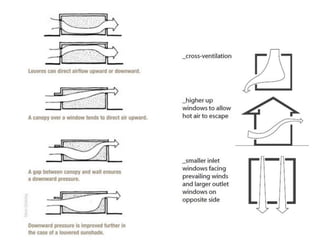
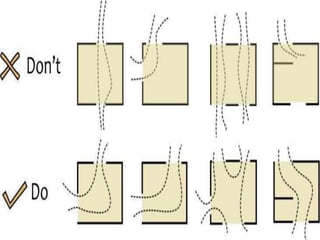
• - Orienting urban roads /streets/houses to face wind direction.
- for washing away/ siphoning off excessive heat trapped in
streets/buildings
--making cities cool- specially in coastal areas
-settlements located close to water bodies; - remain warm/ high degree
of humidity, throughout year.
- Staggering positioning of buildings - for reducing urban heat island
effect
 -- by taking away heat trapped within high rise buildings.
 --Accordingly, existing air flow pattern – essential/ integral component
 --- while planning of cities;
 -- undertaking sub-division of land and
 -- positioning of buildings.
 -- designing of Buildings
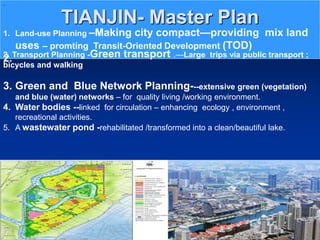
TIANJIN- Master Plan
..
1. Land-use Planning –Making city compact—providing mix land
uses – promting Transit-Oriented Development (TOD)
2.
2. Transport Planning -Green transport .—Large trips via public transport ;
bicycles and walking
3. Green and Blue Network Planning---extensive green (vegetation)
and blue (water) networks – for quality living /working environment.
4. Water bodies --linked for circulation – enhancing ecology , environment ,
recreational activities.
5. A wastewater pond -rehabilitated /transformed into a clean/beautiful lake.
Green City of World –Musdar –
Abu Dhabi-UAE
 A city of 50,000population
 City of no cars , no waste
Planned to make use of cool sea winds
Using solar energy on rooftop
Narrow streets shading houses
Total recycling of waste/water
 working/ living area-- not farther
than200 mts from transportation nodes.
Electric powered light rail on elevated
track to permit easy transport between
Musdar and Abu Dhabi.
•for Intra-city travel people use
personal rapid transit pods (PRT) run on
magnetic tracks using electric power.
•Aim is to create:
Zero Carbon
Zero Waste
Zero Car city
Valuing Wind
GREEN
TRANSPORTATION
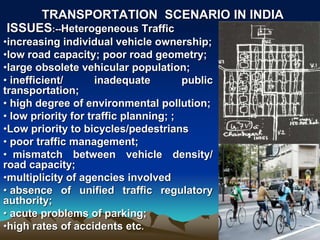
ISSUES:--Heterogeneous Traffic
•increasing individual vehicle ownership;
•low road capacity; poor road geometry;
•large obsolete vehicular population;
• inefficient/ inadequate public
transportation;
• high degree of environmental pollution;
• low priority for traffic planning; ;
•Low priority to bicycles/pedestrians
• poor traffic management;
• mismatch between vehicle density/
road capacity;
•multiplicity of agencies involved
• absence of unified traffic regulatory
authority;
• acute problems of parking;
•high rates of accidents etc.
TRANSPORTATION SCENARIO IN INDIA
Transportation- Options
• Minimize travel- Making cities compact-
• Planning for mixed land-use/ TOD
• Changing priority for travel-
• Planning for People-- not for vehicles
• Promoting Accessibility-- Not Mobility
• Promoting Cycling- not Cars
• Promoting Mass Transportation
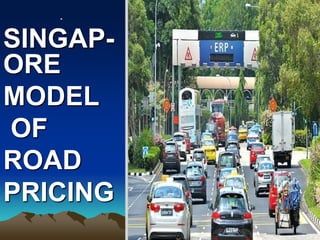
• Pricing Roads
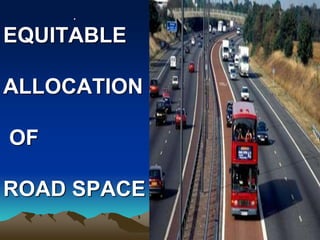
• Making Equitable allocation of road space
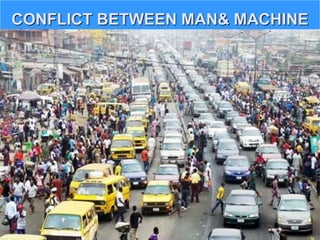
CONFLICT BETWEEN MAN& MACHINE
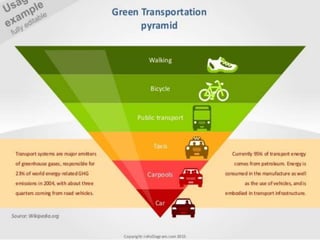
Defining Sustainable Transport
• Sustainable Transport --
• -- sometimes known as Green Transport
• -- form of transport that does not use / rely
on dwindling natural resources.
• -- relies on renewable /regenerated energy
• -- rather than fossil fuels that have a finite life
expectancy
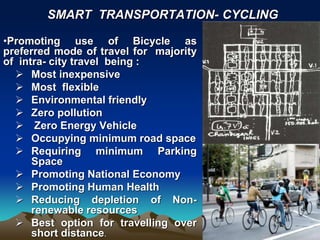
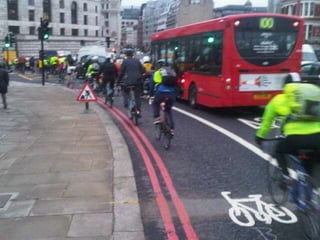
•Promoting use of Bicycle as
preferred mode of travel for majority
of intra- city travel being :
 Most inexpensive
 Most flexible
 Environmental friendly
 Zero pollution
 Zero Energy Vehicle
 Occupying minimum road space
 Requiring minimum Parking
Space
 Promoting National Economy
 Promoting Human Health
 Reducing depletion of Non-
renewable resources
 Best option for travelling over
short distance.
SMART TRANSPORTATION- CYCLING
Cycling
JANMARG AHMEDABAD
.
EQUITABLE
ALLOCATION
OF
ROAD SPACE
.
SINGAP-
ORE
MODEL
OF
ROAD
PRICING
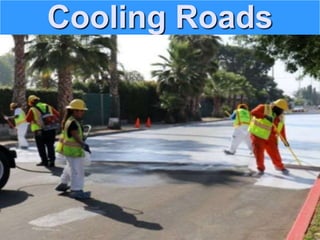
Cooling Roads
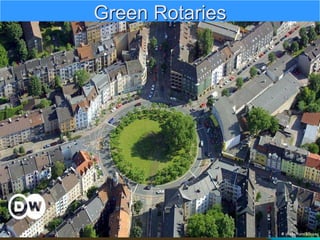
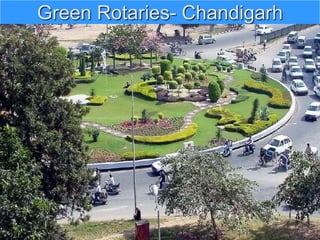
Green Rotaries
Green Rotaries- Chandigarh
Cool Roads
• If white roofs in New York- In Los Angeles- it is
roads, as major cause of heating cities.
• Occupying > 10 % city area with black asphalt-
absorbing up to 95% of sun’s energy – creating
heat island
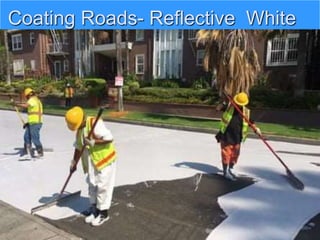
• Painting roads -- with white-coloured sealant
with high reflectivity --reduction of 10- 23F
cooler after painting.
• Opt for lighter clay tiles—reflect sunlight quite
well.
• .
Coating Roads- Reflective White
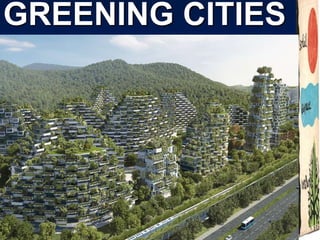
GREENING CITIES
Green Spaces- Cooling Cities
• Green spaces - known for distinct advantage in urban setting;;
 lowering urban temperature
 Making Cities Cool
 reducing demand for air- conditioning
 - reducing & absorbing - heat
 Acting as sponge- for absorbing floodwaters/minimize flooding
 making neighborhood qualitative / beautiful,
 providing shade -during a heat wave,
 promoting good mental health.
 Creating jobs - planning, developing/ maintaining green
spaces.
 ,
Green Spaces- Cooling Cities
 , Trees, vegetation – best, efficient/cost-effective option to cool cities,
 - not by reflecting but by absorbing heat which falls on them.
 on a hot day, vegetation- powerful tool to fight against excessive city heat ,
 greenery - provides & stimulates evapotranspiration
 - absorbing pollutants from air /producing oxygen,
 - developing parks / growing trees- creating calm spaces
 - deploying “cool” roofs- making walls green - shading pavements – create
light colour -known for absorbing/reflecting sunlight
• -Prioritising trees in EWS/LIG communities –saving from ill effects of heat.
--Creating city forest- regenerative nature of forests, attract birds / lower urban
temperature
• involve local residents/communities for greening
• - Making Greening integral part of city planning.
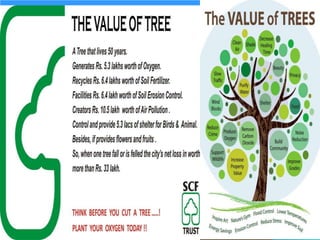
• Each mature tree generates seven cylinders of oxygen besides
creating cooling equivalent to 5 tonnes of air conditioning on daily basis
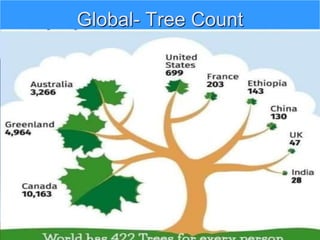
Global- Tree Count
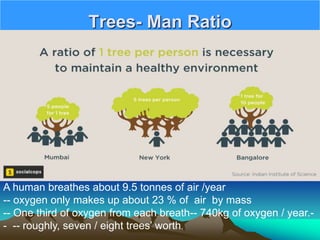
Trees- Man Ratio
A human breathes about 9.5 tonnes of air /year
-- oxygen only makes up about 23 % of air by mass
-- One third of oxygen from each breath-- 740kg of oxygen / year.-
- -- roughly, seven / eight trees’ worth.
Open Spaces
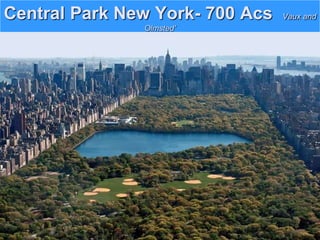
Central Park New York- 700 Acs Vaux and
Olmsted'
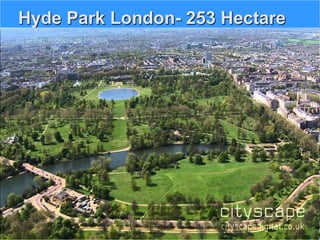
Hyde Park London- 253 Hectare
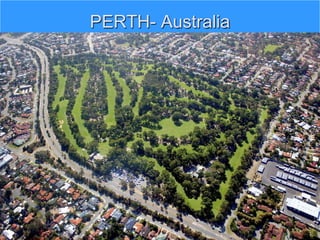
PERTH- Australia
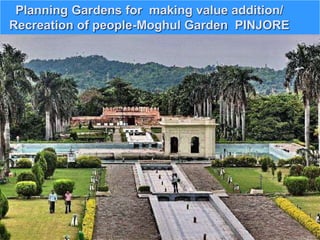
Planning Gardens for making value addition/
Recreation of people-Moghul Garden PINJORE
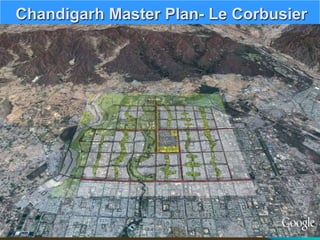
Chandigarh Master Plan- Le Corbusier
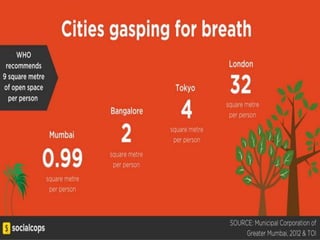
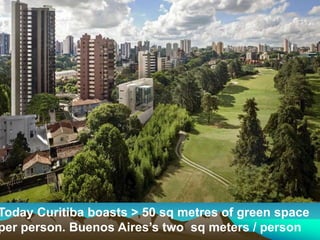
Today Curitiba boasts > 50 sq metres of green space
per person. Buenos Aires’s two sq meters / person
Making Buildings Green
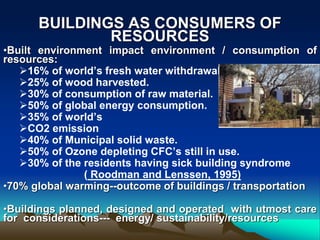
BUILDINGS AS CONSUMERS OF
RESOURCES
•Built environment impact environment / consumption of
resources:
16% of world’s fresh water withdrawal.
25% of wood harvested.
30% of consumption of raw material.
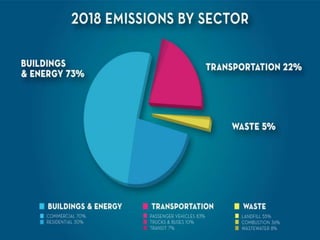
50% of global energy consumption.
35% of world’s
CO2 emission
40% of Municipal solid waste.
50% of Ozone depleting CFC’s still in use.
30% of the residents having sick building syndrome
( Roodman and Lenssen, 1995)
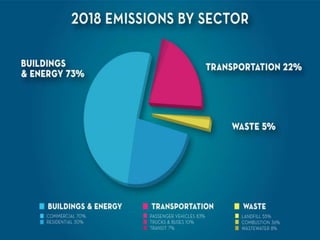
•70% global warming--outcome of buildings / transportation
•Buildings planned, designed and operated with utmost care
for considerations--- energy/ sustainability/resources
Buildings and Climate
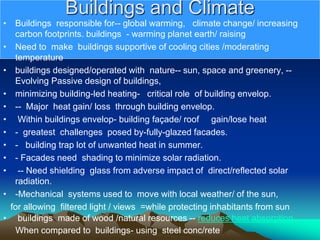
• Buildings responsible for-- global warming, climate change/ increasing
carbon footprints. buildings - warming planet earth/ raising
• Need to make buildings supportive of cooling cities /moderating
temperature
• buildings designed/operated with nature-- sun, space and greenery, --
Evolving Passive design of buildings,
• minimizing building-led heating- critical role of building envelop.
• -- Major heat gain/ loss through building envelop.
• Within buildings envelop- building façade/ roof gain/lose heat
• - greatest challenges posed by-fully-glazed facades.
• - building trap lot of unwanted heat in summer.
• - Facades need shading to minimize solar radiation.
• -- Need shielding glass from adverse impact of direct/reflected solar
radiation.
• -Mechanical systems used to move with local weather/ of the sun,
for allowing filtered light / views =while protecting inhabitants from sun
• buildings made of wood /natural resources -- reduces heat absorption
When compared to buildings- using steel conc/rete
Defining- Green Buildings
•Buildings can achieve zero carbon by; Adopting Integrated
approach to design-Planning with nature, natural elements,
Climate, Evolving passive building design,- eliminating using
fossil fuel --for heating, cooling /air conditioning
• using on-site/off-site renewable energy,Retrofitting Buildings
•reducing use of high global warming potential refrigerants
Daylighting
Local materials
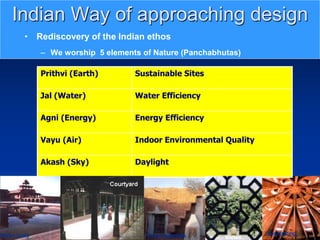
Indian Way of approaching design
• Rediscovery of the Indian ethos
– We worship 5 elements of Nature (Panchabhutas)
Prithvi (Earth) Sustainable Sites
Jal (Water) Water Efficiency
Agni (Energy) Energy Efficiency
Vayu (Air) Indoor Environmental Quality
Akash (Sky) Daylight
Views
Water body
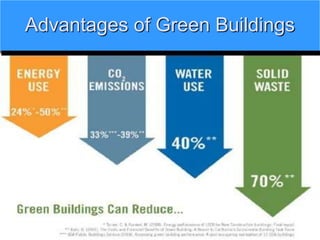
Advantages of Green Buildings
Designing Green Buildings
• Green building design involves :
• i. Designing building in harmony with nature– using natural resources
ii. Optimizing use of site potential
• iii Specify 'green' building materials sourced locally
• Iv Reducing structural loads---
• V Optimize systems---
• Vi Generating on-site renewable energy.
vii Finding balance between building and environment
viii Promoting energy reduction
• ix Preparing plans with energy as focus,
• x Making best use of sun and wind energy
xi Involving cooperation of design team at all stages– Architects,
Engineers, Promoters
• xii Minimizing water consumption
• xiii Using non-toxic, sustainable materials
• xiv Preserving/promoting environment in design, construction and operation
• xv Promoting quality of life-- of occupants in design, construction and operation
xvi Promoting re-use and recycling
xvii Ensuring Good indoor environmental air quality
Green Building practice expands/ complements
- economy,
-utility,
-durability,
-comfort.
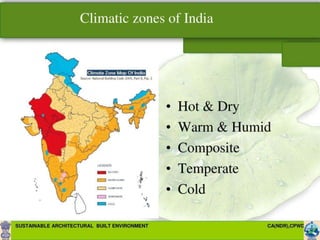
INDIAN CLIMATIC ZONES
Planning for spaces in buildings
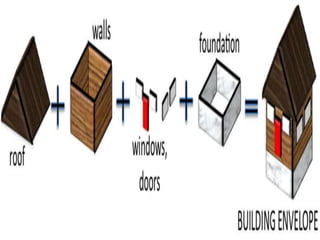
Building Envelope
• Building envelope;
• -Divides – natural / Manmade Environment
• -First line of defense- against natural forces – rain , heat,
cold, storm
• Barrier-- between interior/exterior of a building
• Controls-- exchange of air/water/heating/ cooling in
interior.
• Components constituting Envelope;-- Roof, Walls, Doors,
Windows, Foundations, Projections, Recesses, Louvers;
shading devices
• Envelop- Involves structural loads , air, heat, moisture
loads.
• Colour/texture- contributes to heat gain/loss within
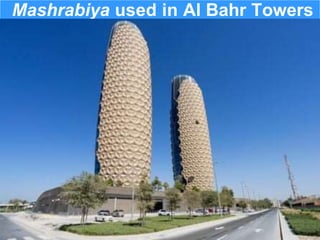
Mashrabiya used in Al Bahr Towers
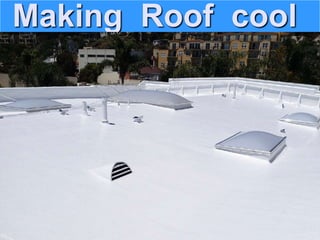
Making Roof cool
Cool Roof- Advantages
 Reducing temperature within/outside buildings by minimizing heat
island effect,
 Decreasing energy use /energy costs within buildings
 Improving air & water quality within/outside neighborhood
 Sequestering carbon,
 Providing habitat for wildlife -- in urban areas
 Meeting deficiency of green spaces in walled cities/congested areas
 Avoiding flooding cities- Reducing amount/ intensity/
 duration of storm water release
 Creating space for socialization - for families and communities
 Increasing life of roof-- by protecting them from adverse impact of
climate
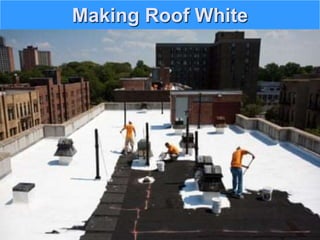
 New York Cool Roofs initiative - more than 500,000m² of roof space
covered in white reflective coating,- saving an estimated 2,282 tonnes
of CO2 per year
 NASA concluded - white roof could be-- 23C (42F) cooler than a typical
black roof --on hottest day of New York summer
Making Roof White
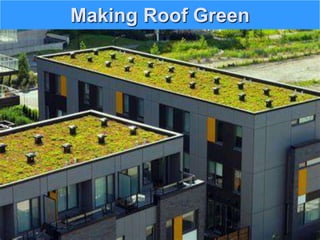
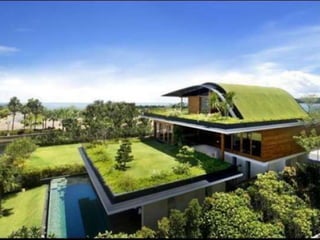
Making Roof Green
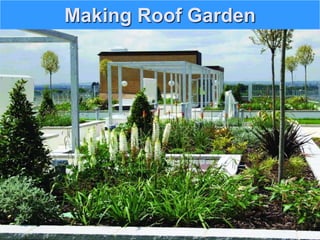
Making Roof Garden
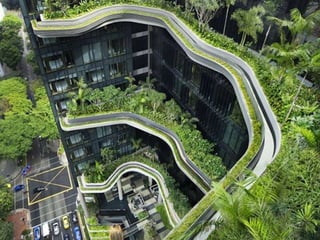
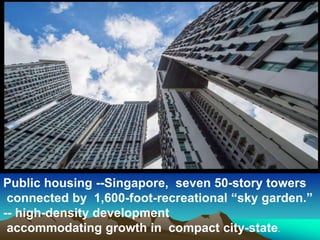
Public housing --Singapore, seven 50-story towers
connected by 1,600-foot-recreational “sky garden.”
-- high-density development
accommodating growth in compact city-state.
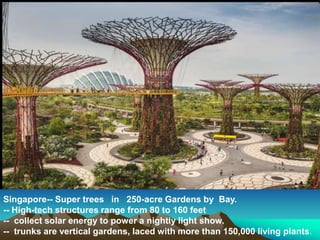
Singapore-- Super trees in 250-acre Gardens by Bay.
-- High-tech structures range from 80 to 160 feet
-- collect solar energy to power a nightly light show.
-- trunks are vertical gardens, laced with more than 150,000 living plants.
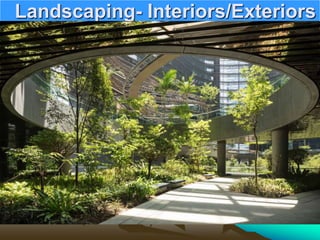
Landscaping- Interiors/Exteriors
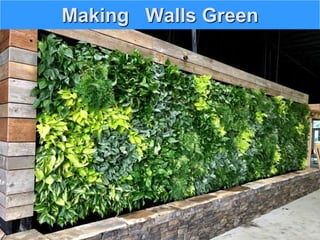
Making Walls Green
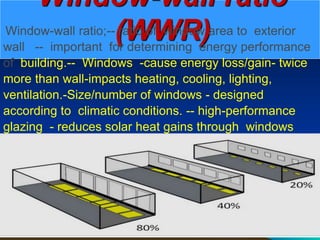
Window-wall ratio
(WWR)
Window-wall ratio;-- ratio of window area to exterior
wall -- important for determining energy performance
of building.-- Windows -cause energy loss/gain- twice
more than wall-impacts heating, cooling, lighting,
ventilation.-Size/number of windows - designed
according to climatic conditions. -- high-performance
glazing - reduces solar heat gains through windows
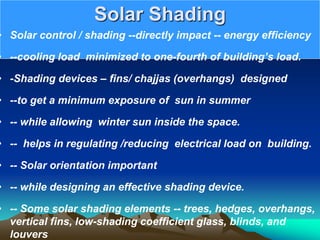
Solar Shading
• Solar control / shading --directly impact -- energy efficiency
• --cooling load minimized to one-fourth of building’s load.
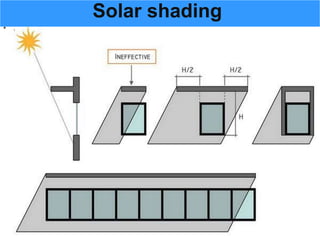
• -Shading devices – fins/ chajjas (overhangs) designed
• --to get a minimum exposure of sun in summer
• -- while allowing winter sun inside the space.
• -- helps in regulating /reducing electrical load on building.
• -- Solar orientation important
• -- while designing an effective shading device.
• -- Some solar shading elements -- trees, hedges, overhangs,
vertical fins, low-shading coefficient glass, blinds, and
louvers
Solar shading
• .
• Cooling
Cities with
water
Cooling Cities with Water
• Principle- Evaporation causes cooling
• used in old buildings - leveraged strength of water in
promoting cooling /lowering the temperature
• - Making cities spongy -retaining water in soil
• -- lowers temperature by releasing moistures
• - help in making trees/vegetation grow
• - Temperatures taken adjacent to water features - up to 10
C lower
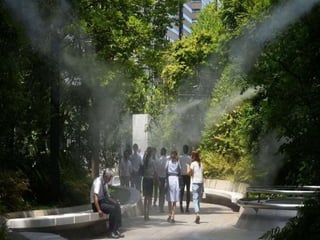
• - Leveraging existing water bodies, pools, fountains,
sprinklers and misting system
• -Creating new water bodies
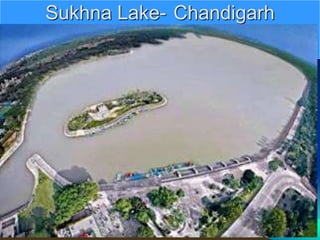
• - Chandigarh modulate city temperature by creating
inartificial Sukhna lake
• - Chongqing /China , known for heat provided cooling
by using water misters – created cooling by 5-7 C,
Sukhna Lake- Chandigarh
•FUTURE
CITIES
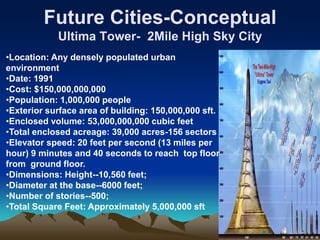
Future Cities-Conceptual
Ultima Tower- 2Mile High Sky City
•Location: Any densely populated urban
environment
•Date: 1991
•Cost: $150,000,000,000
•Population: 1,000,000 people
•Exterior surface area of building: 150,000,000 sft.
•Enclosed volume: 53,000,000,000 cubic feet
•Total enclosed acreage: 39,000 acres-156 sectors
•Elevator speed: 20 feet per second (13 miles per
hour) 9 minutes and 40 seconds to reach top floor
from ground floor.
•Dimensions: Height--10,560 feet;
•Diameter at the base--6000 feet;
•Number of stories--500;
•Total Square Feet: Approximately 5,000,000 sft
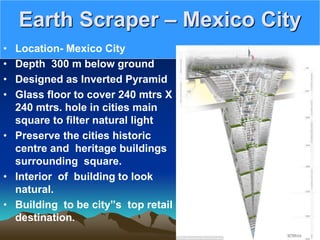
Earth Scraper – Mexico City
• Location- Mexico City
• Depth 300 m below ground
• Designed as Inverted Pyramid
• Glass floor to cover 240 mtrs X
240 mtrs. hole in cities main
square to filter natural light
• Preserve the cities historic
centre and heritage buildings
surrounding square.
• Interior of building to look
natural.
• Building to be city”s top retail
destination.
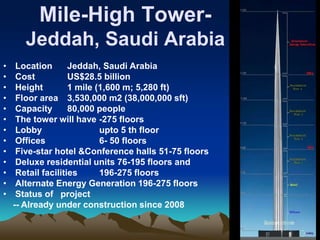
Mile-High Tower-
Jeddah, Saudi Arabia
• Location Jeddah, Saudi Arabia
• Cost US$28.5 billion
• Height 1 mile (1,600 m; 5,280 ft)
• Floor area 3,530,000 m2 (38,000,000 sft)
• Capacity 80,000 people
• The tower will have -275 floors
• Lobby upto 5 th floor
• Offices 6- 50 floors
• Five-star hotel &Conference halls 51-75 floors
• Deluxe residential units 76-195 floors and
• Retail facilities 196-275 floors
• Alternate Energy Generation 196-275 floors
• Status of project
-- Already under construction since 2008
SMART
TECHNOLOGIES
Using Smart Technologies-
Implementing IOT- Traffic, Transportation, Urban
Planning, managing infrastructures/services, solid
waste management, parking, pollutions, payments etc
- digital --bus stops- bus schedule,
--sensor based garbage bins
- Promoting accessibility
-Managing Traffic/parking – Managing services
Minimizing travel --Tackling noise- Planning
cities-
Preparing Master Plans/ Development Plans
- Making amendment in MP/DP
- Monitoring Delivery of services- water supply
--Tackling air pollution
--creating platform for efficiency--breaking silos
-- lodging complaints/ --making payments on line
--rendering services on line
QUALITY
LEADERSHIP
•
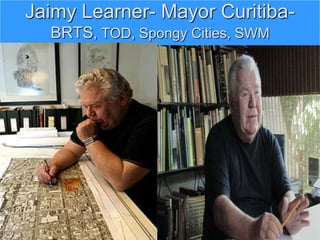
Jaimy Learner- Mayor Curitiba-
BRTS, TOD, Spongy Cities, SWM
•
• Three Mantra for Sustainable/
Inclusive/ Resilient cities
1. Achieve smart growth
• -- finding best options to do things sustainably
• -- promote economic growth for people –
• -- making them earn good livelihood
• -- make them enjoy a good quality of life.
• 2. Do more with less–
• -- cities need money-- to accomplish all wants .
• Cities to collect, manage/spend resources effectively/ efficiently
• 3. Win support for change-
• - City leaders need to;-- deliver fast, positive & visible results,
• - build support for changes.
• -- Based on high-performing civil servants-- made accountable
for their work—Singapore model
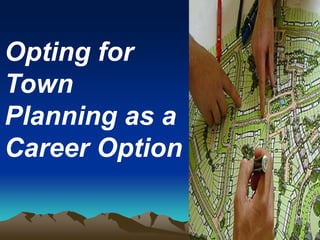
Opting for
Town
Planning as a
Career Option
TOWN PLANNING- CONTEXT
• Regional Planning / Urban Planning / Rural Planning revolves around;
• Land , land use, land development;
infrastructure transportation, accessibility.
• Promoting Planned development- Regions/ urban, / rural areas
• Making cities/towns/human settlements better places to live /work
• Focus on -People, communities, Society& State
• Promote Social, physical, economical sustainability
• Preserving environment; culture , art & Architecture,
• Town Planning remains an- Interdisciplinary field
• involving- Architecture; Civil Engineering ;
• Transportation, Infrastructures; Heritage ; Geography, History, Culture
Land Scaping, Technology; Sociology, Urban Design Environment
• Involves detailed studies/research / analysis; Strategic Thinking, Public
consultation
• Focus of Government- Promoting Planned/orderly Urban/Rural
Development
• Enormous potential in Indie with- 7933 cities;-- 6.41 lakh villages;
• 766 districts;-- 53 / 100 Metro cities
• --- 1.6 billion people in 2050;
• 9-Ten million plus population cities by 2050
• – Cities generating 75% GDP
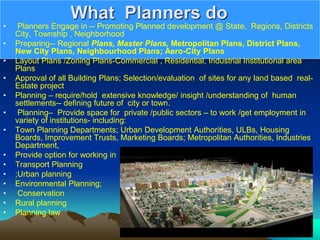
What Planners do
• Planners Engage in -- Promoting Planned development @ State, Regions, Districts
City, Township , Neighborhood
• Preparing-- Regional Plans, Master Plans, Metropolitan Plans, District Plans,
New City Plans, Neighbourhood Plans; Aero-City Plans
• Layout Plans /Zoning Plans-Commercial , Residential, Industrial Institutional area
Plans
• Approval of all Building Plans; Selection/evaluation of sites for any land based real-
Estate project
• Planning – require/hold extensive knowledge/ insight /understanding of human
settlements-- defining future of city or town.
• Planning– Provide space for private /public sectors – to work /get employment in
variety of institutions- including:
• Town Planning Departments; Urban Development Authorities, ULBs, Housing
Boards, Improvement Trusts, Marketing Boards; Metropolitan Authorities, Industries
Department,
• Provide option for working in
• Transport Planning
• ;Urban planning
• Environmental Planning;
• Conservation
• Rural planning
• Planning law
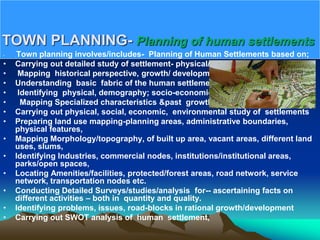
TOWN PLANNING- Planning of human settlements
• ;Town planning involves/includes- Planning of Human Settlements based on;
• Carrying out detailed study of settlement- physical/ social
• Mapping historical perspective, growth/ development.
• Understanding basic fabric of the human settlements
• Identifying physical, demography; socio-economic features
• Mapping Specialized characteristics &past growth trends,
• Carrying out physical, social, economic, environmental study of settlements
• Preparing land use mapping-planning areas, administrative boundaries,
physical features,
• Mapping Morphology/topography, of built up area, vacant areas, different land
uses, slums,
• Identifying Industries, commercial nodes, institutions/institutional areas,
parks/open spaces,
• Locating Amenities/facilities, protected/forest areas, road network, service
network, transportation nodes etc.
• Conducting Detailed Surveys/studies/analysis for-- ascertaining facts on
different activities – both in quantity and quality.
• Identifying problems, issues, road-blocks in rational growth/development
• Carrying out SWOT analysis of human settlement,
Reforms -Urban Planning Capacity-Niti Ayog
1. Programmatic Intervention for Planning of Healthy Cities: --
Besides 100 Smart cities; Every city to become a ‘Healthy
City for All’ by 2030 – Launching Scheme to make ‘500
Healthy Cities Programme’, for a period of 5 years-
Rurban Mission- Master Plans of 65% cities yet to be
prepared
2. Rationalizing Building Bye-laws for Optimum
Utilization of Urban Land: ‘Preparation/Revision of
Development Control Regulations’
3. Sourcing Human Resources in Town Planning
Deptts.: Combating shortage-
a) expedite filling up of vacant positions of town planners-
3945 sanctioned posts b) additionally sanction 8268 town
planners’ posts for a minimum period of 3/ 5 years..
4. Ensuring Qualified Professionals to Undertake Urban
Planning:
5. Revision of Town and Country Planning Acts: .
6. Enhancing Role of Private Sector- Planning ; Urban
Development
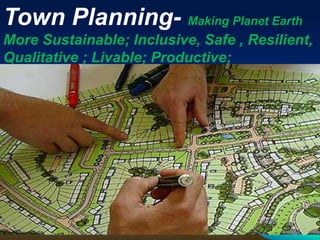
Town Planning- Making Planet Earth
More Sustainable; Inclusive, Safe , Resilient,
Qualitative ; Livable; Productive;
CREATING Smart/Sustainable CITIES POSES
GREATEST CHALLENGE TO PLANNERS/
PROFESSIONALS

Metamorphosis For Making Cities Cool

  • 1.
    Metamorphises for Making CitiesCool Ar. J.K.GUPTA, Email---- jit.kumar1944@gmail.com, Mob- 90410-26414 Options for Making Cities Cool Options for Making Cities Cool
  • 2.
    Cities and theirContext • Cities have been part of human history. • - Cities- known to command power and authority • Cities -- known for their dualities and contradictions. • Cities- known for both -- positivities and negativities • Cities -- known to be areas of concentration of population/ activities, infrastructures, services, healthcare, education • Cities -- known to be Engines of economic growth-70% • Cities - generators of employment , wealth and prosperity, • Cities – also known for their negativities, • Cities – large consumers of resources/energy/ land • Cities- generators of - 70% waste;-- consume 60% global energy - generating 70% of carbon footprints- large amount of heat- • --98% /56% cities in low& middle/high income economies - do not meet air quality WHO norms Cities- remain a manmade , mechanical habitat • Cities- destroy natural habitat-anti-thesis to bio-diversity • Cities- known to be creator of best/ worst living conditions • cities – house both rich and poor
  • 3.
    Cities and theirContext • Cities- home to large migrants • Cities- home to slums • Cities- remain in crisis- both -natural and manmade • Crisis-- of population, poverty, pollution • Cities – ever evolving and devolving, never static • Cities – will dominate in future also • Cities- drivers/definers of nation’s future • Cities largely responsible for climate change ,global warming, manmade disasters etc- • However Cities - needs rationalization • Cities --need to be made Cool– by making them more bio-diverse; productive, effective, efficient, humane, • - livable, inclusive, safe, Resilient ,sustainable, Healthy place to live /work
  • 6.
    Hierarchy of HumanSettlements
  • 8.
  • 12.
    Urban Crisis • Urbancrisis/ problems has genesis in-- • – uncontrolled/ unplanned rapid growth /development • - Irrational way in which built environment is created • -Way people are made to travel large distances • --Urbanization & global warming remain positively related, • Cities getting warmer with rising temperature • Research shows - urban areas can be 20 F hotter- surrounding/Rural areas • - even within cities-- one neighborhood 15 degrees hotter than another. • poor neighborhoods-- hotter than rich neighborhood. • Intensity/duration of heat waves increasing • Majority of cities on boil • - Large causalities happening due to excessive heat • Globally cities getting into crisis. • --Jakarta -- sinking; • --New Delhi-- shutting down due to air pollution; • - Marseille, France- residential buildings collapsing - lack of maintenance
  • 13.
    Impact of UrbanCrisis • By 250; seven in 10 people will live in cities • Rising urban temperature impact -humanity/communities /cities-- • - Making human beings most vulnerable • --Rising Mortality- due to- strokes - when temperatures head above 25C. • - Cities exposed to extreme temperatures-- Triple over next decades. • -970 cities-- experiencing average summer temperature of 35˚C (95°F). • • People exposed to heat waves jumped by --125 mil- between 2000 -2016 (WHO) • America- Extreme heat --killing more Americans than any other natural disaster. • Extreme heatwave in summer 2018, --declared natural disaster with-- thousands hospitalized in Tokyo city, • UK-heat-related deaths - to increase 257% by 2050 and 535% by 2080. • • Moscow- recorded about 11,000 people due to heatwave in 2010. • • India- lost 4.3% working hours -1995; & 5.8% in 2030- due to stress caused by excess heat(IMD).
  • 14.
    Impact of UrbanCrisis • Studies say-- average summer temperatures -to rise rapidly in both hemispheres in next 40 years • - In Northern hemisphere- high temp- above 35C (95F) between June -August • - In Southern hemisphere- average summer temperatures above 35 C-- first time since records began • . India -- also getting hotter • -Rajasthan/ Madhya Pradesh/ Gujrat and Haryana- 54% of total heat waves. • April, 2022 --recorded hottest month in north-west/central India - third hottest since past 122 years. • 15% population-- living in 13% of districts -- vulnerable to heat waves. • Rising temperatures – threat to- existence / survival of- humanity , flora & fauna and planet earth. • Despite Adverse results-- rising urban temperature - received less attention • -- by professionals / stakeholders,- to Control heat/ flooding, storms, drought. • professionals/ communities need attention- threat/risk posed by heat seriously. •
  • 15.
    Urban Heat- Genesis •-- Deadly heat baking cities because ;; • -Rapid population growth/massive migration in hotter regions of world. • -High population density-- buildings concentrated in limited area. • --- Urban canyons formed -between buildings, trapping heat - making urban streets warm • - Cities being metalled / made impervious,- with concrete /asphalt roads/pavements • -- urban surface, absorbing/radiating sun’s rays. • • Less open spaces/ less green covers • -- Reduced number of trees /flora & fauna. • --Heat emitted by vehicles -moving/stuck in traffic on urban roads • • Extensive use of air-conditioning in buildings for cooling • waste heat generated by air conditioners- pumped into air; • -- heating outdoors -- to cool indoors, • -- making external spaces hot /more uncomfortable. • • Large consumption of energy to make buildings cool, • with estimated energy needed for cooling buildings to triple by 2050.
  • 16.
  • 17.
  • 18.
  • 19.
    URBAN INDIA- 2030-Mckinsey Global Inst- • India Urban Awakening :Building Inclusive Cities- Report- April, 2010 -- by 2030: • 590 m to live in Urban India- twice the US population • 70% GDP generated by cities • 80% Revenue generated by cities • 4 fold increase in per capita income • 5 times the number by which GDP would multiply • 270 million net increase in working age group • 70% of new jobs(170 mil) generated in cities • 91 M urban households will be middle class-- up from 22 M • 68 Cities will be Metropolises-Europe has 35 only • $ 1.2T capital needed to meet projected infrastructure demand • 700-900 million Sqmts of residential/ commercial area needed annually- a new Chicago to be created • 2.5 b Sqmts roads paved-20times created in last decade • 7400km (350-400 km/year) of metro needed -20times created in last decade • 200 million Rural Indians to benefit-living close to top 70 cities • 75%urban India to live in bottom segment -earning Rs 80 per day
  • 20.
    Opting for SDG 11- Makingcities Sustainable
  • 21.
    SDG 11- Makecities and human settlements inclusive ,safe, resilient and sustainable
  • 22.
    SDG 11- Makecities and human settlements inclusive ,safe, resilient and sustainable
  • 23.
  • 24.
    Options for UrbanSustainability • Empowering cities- to increase resilience to climate change by; • -Redefining Urban Planning- by Making urban planning responsive to Urban cooling • -Fostering decarbonization across energy, transport, building • • -Planning with Nature, Sun , Space, Greenery • -Undertaking Heat & vulnerability mapping -for measuring urban heat • Finding Heat mitigation Solutions including • -Greening Cities • -Rationalizing/Re-ordering Transportation • - Valuing Orientation/ Wind • -Making cities Porous • - Making Buildings Green • - Greening/ Making Roof Cool • -Creating Urban forests • - Making optimum use of water • - Managing Heat wave emergency --- creating Cooling Centers • - Using Alternative cooling techniques.
  • 25.
  • 26.
    Re-defining Planning/Development Agenda ---Reviewing planning tool - New order of planning -to focus on Regional Planning: - -for Synergizing urban and rural areas --Making cities compact -- Making cities energy efficient --Planning cities for bio-diversity – -- Avoiding Urban Sprawl -- Stopping melting of cities – - Empowering/capacity building of villages – making them productive and self-sufficient in daily needs.. -- reducing carbon footprints – - Reducing global warming
  • 27.
  • 28.
  • 29.
    CO BS WO RKING LIVING CIRCULATIO N • The RadiantCity •An organism capable of housing the works of man of machine-age society. • placed under the masterful government of natural conditions: •Sun •Space •Greenery •And its mission is the service of mankind: •To live •To work •To cultivate body and spirit •To travel about (in this order and obeying this hierarchy)
  • 30.
  • 31.
  • 32.
    Compact City- HeatReduction • Heat reduction ignored in urban planning/architecture- temperatures rising • All citizens entitled to- thermally safe indoor/ outdoor environment • Making Cities Cool-Changing City planning /Building design options - from expanding / sprawling • Compact Cities -offer distinct advantages- • Minimize expositing earth surface to solar radiation. • Promoting walkability- Minimising area under road – replacing roads by streets, easily shaded by adjoining buildings • - Changing materials/ built form- responsible for heating cities. • Cities dominated by dark/hard materials – concrete, asphalt, paving – absorb solar radiation- conventional paving heated up to 67 C & roofs up to 50–90 C, on hot day. • Phasing out -- use of black or dark roofs, in warm climates, • Applying white- coloured coatings to roads, roofs / facades, • - Reflect more solar energy/ save city from prevailing high temperature. • For promoting Cool cities ;- Making buildings Green • -Paris, rationalized mobility by- creating new bike lanes / limiting speed limit to 30 km/h for motorized traffic. • - Havana, Cuba-- promoted urban agriculture on large scale • --Curitiba, Brazil, -- pioneered art of bus based mass transportation,
  • 33.
    PLANNING COMPACT CITIES Makecities compact by; – promoting High-density development -- adopting Transit oriented development -- Raising Height and -Rationalizing land uses / Building bye-laws -Building inside not outside --- Building vertical not horizontal --- Building High not low --- Building mix not pure ---Building dense not shallow ----- optimizing current infrastructure. .
  • 34.
  • 36.
  • 37.
    Curitiba's BRT corridorsrun along high-density developed area
  • 38.
  • 39.
    Valuing Orientation • Role/importanceof orientation - not fully understood / appreciated in Planning/making cities • Orientation - positioning plots/buildings -considering four cardinal directions; NSEW - four other subsidiaries directions; • Each direction unique/distinct- strength and weaknesses, - in terms of solar radiation /heating/cooling of cities/buildings • If North has no Sun; -- South has highest Solar Intensity - Sun low/horizontal - – West side hottest-- Avoid West direction for minimizing heat gain. • Making cities cool -- essentially require that while planning • -- maximum plots/lots carved • - have best advantage of orientation. SE /NW could be best option • - Once plots have best orientation, • - much easier for architects to plan climate responsive buildings • Place Longer axis of building facing north-south direction, • -- with shorter sides facing East-West remains best option for minimizing adverse impact of buildings in heating the cities.
  • 40.
  • 41.
  • 42.
    Tower of Shadow-SunTemple;Chd.
  • 43.
    Planning for spacesin buildings
  • 44.
    Leveraging Wind ForCooling Cities
  • 45.
    Leveraging Wind ForCooling Cities - Leveraging Potential of wind -in cooling cities / reducing temperature by; • - mapping prevailing direction of wind-flow • - integrating wind flow in planning process of city/NHs. • - Orienting urban roads /streets/houses to face wind direction. - for washing away/ siphoning off excessive heat trapped in streets/buildings --making cities cool- specially in coastal areas -settlements located close to water bodies; - remain warm/ high degree of humidity, throughout year. - Staggering positioning of buildings - for reducing urban heat island effect  -- by taking away heat trapped within high rise buildings.  --Accordingly, existing air flow pattern – essential/ integral component  --- while planning of cities;  -- undertaking sub-division of land and  -- positioning of buildings.  -- designing of Buildings
  • 46.
    TIANJIN- Master Plan .. 1.Land-use Planning –Making city compact—providing mix land uses – promting Transit-Oriented Development (TOD) 2. 2. Transport Planning -Green transport .—Large trips via public transport ; bicycles and walking 3. Green and Blue Network Planning---extensive green (vegetation) and blue (water) networks – for quality living /working environment. 4. Water bodies --linked for circulation – enhancing ecology , environment , recreational activities. 5. A wastewater pond -rehabilitated /transformed into a clean/beautiful lake.
  • 47.
    Green City ofWorld –Musdar – Abu Dhabi-UAE  A city of 50,000population  City of no cars , no waste Planned to make use of cool sea winds Using solar energy on rooftop Narrow streets shading houses Total recycling of waste/water  working/ living area-- not farther than200 mts from transportation nodes. Electric powered light rail on elevated track to permit easy transport between Musdar and Abu Dhabi. •for Intra-city travel people use personal rapid transit pods (PRT) run on magnetic tracks using electric power. •Aim is to create: Zero Carbon Zero Waste Zero Car city
  • 48.
  • 52.
  • 54.
    ISSUES:--Heterogeneous Traffic •increasing individualvehicle ownership; •low road capacity; poor road geometry; •large obsolete vehicular population; • inefficient/ inadequate public transportation; • high degree of environmental pollution; • low priority for traffic planning; ; •Low priority to bicycles/pedestrians • poor traffic management; • mismatch between vehicle density/ road capacity; •multiplicity of agencies involved • absence of unified traffic regulatory authority; • acute problems of parking; •high rates of accidents etc. TRANSPORTATION SCENARIO IN INDIA
  • 55.
    Transportation- Options • Minimizetravel- Making cities compact- • Planning for mixed land-use/ TOD • Changing priority for travel- • Planning for People-- not for vehicles • Promoting Accessibility-- Not Mobility • Promoting Cycling- not Cars • Promoting Mass Transportation • Pricing Roads • Making Equitable allocation of road space
  • 57.
  • 58.
    Defining Sustainable Transport •Sustainable Transport -- • -- sometimes known as Green Transport • -- form of transport that does not use / rely on dwindling natural resources. • -- relies on renewable /regenerated energy • -- rather than fossil fuels that have a finite life expectancy
  • 59.
    •Promoting use ofBicycle as preferred mode of travel for majority of intra- city travel being :  Most inexpensive  Most flexible  Environmental friendly  Zero pollution  Zero Energy Vehicle  Occupying minimum road space  Requiring minimum Parking Space  Promoting National Economy  Promoting Human Health  Reducing depletion of Non- renewable resources  Best option for travelling over short distance. SMART TRANSPORTATION- CYCLING
  • 60.
  • 62.
  • 64.
  • 65.
  • 66.
  • 67.
  • 68.
  • 69.
    Cool Roads • Ifwhite roofs in New York- In Los Angeles- it is roads, as major cause of heating cities. • Occupying > 10 % city area with black asphalt- absorbing up to 95% of sun’s energy – creating heat island • Painting roads -- with white-coloured sealant with high reflectivity --reduction of 10- 23F cooler after painting. • Opt for lighter clay tiles—reflect sunlight quite well. • .
  • 70.
  • 71.
  • 72.
    Green Spaces- CoolingCities • Green spaces - known for distinct advantage in urban setting;;  lowering urban temperature  Making Cities Cool  reducing demand for air- conditioning  - reducing & absorbing - heat  Acting as sponge- for absorbing floodwaters/minimize flooding  making neighborhood qualitative / beautiful,  providing shade -during a heat wave,  promoting good mental health.  Creating jobs - planning, developing/ maintaining green spaces.  ,
  • 73.
    Green Spaces- CoolingCities  , Trees, vegetation – best, efficient/cost-effective option to cool cities,  - not by reflecting but by absorbing heat which falls on them.  on a hot day, vegetation- powerful tool to fight against excessive city heat ,  greenery - provides & stimulates evapotranspiration  - absorbing pollutants from air /producing oxygen,  - developing parks / growing trees- creating calm spaces  - deploying “cool” roofs- making walls green - shading pavements – create light colour -known for absorbing/reflecting sunlight • -Prioritising trees in EWS/LIG communities –saving from ill effects of heat. --Creating city forest- regenerative nature of forests, attract birds / lower urban temperature • involve local residents/communities for greening • - Making Greening integral part of city planning. • Each mature tree generates seven cylinders of oxygen besides creating cooling equivalent to 5 tonnes of air conditioning on daily basis
  • 74.
  • 75.
    Trees- Man Ratio Ahuman breathes about 9.5 tonnes of air /year -- oxygen only makes up about 23 % of air by mass -- One third of oxygen from each breath-- 740kg of oxygen / year.- - -- roughly, seven / eight trees’ worth.
  • 76.
  • 78.
    Central Park NewYork- 700 Acs Vaux and Olmsted'
  • 79.
    Hyde Park London-253 Hectare
  • 80.
  • 81.
    Planning Gardens formaking value addition/ Recreation of people-Moghul Garden PINJORE
  • 82.
  • 83.
    Today Curitiba boasts> 50 sq metres of green space per person. Buenos Aires’s two sq meters / person
  • 84.
  • 85.
    BUILDINGS AS CONSUMERSOF RESOURCES •Built environment impact environment / consumption of resources: 16% of world’s fresh water withdrawal. 25% of wood harvested. 30% of consumption of raw material. 50% of global energy consumption. 35% of world’s CO2 emission 40% of Municipal solid waste. 50% of Ozone depleting CFC’s still in use. 30% of the residents having sick building syndrome ( Roodman and Lenssen, 1995) •70% global warming--outcome of buildings / transportation •Buildings planned, designed and operated with utmost care for considerations--- energy/ sustainability/resources
  • 87.
    Buildings and Climate •Buildings responsible for-- global warming, climate change/ increasing carbon footprints. buildings - warming planet earth/ raising • Need to make buildings supportive of cooling cities /moderating temperature • buildings designed/operated with nature-- sun, space and greenery, -- Evolving Passive design of buildings, • minimizing building-led heating- critical role of building envelop. • -- Major heat gain/ loss through building envelop. • Within buildings envelop- building façade/ roof gain/lose heat • - greatest challenges posed by-fully-glazed facades. • - building trap lot of unwanted heat in summer. • - Facades need shading to minimize solar radiation. • -- Need shielding glass from adverse impact of direct/reflected solar radiation. • -Mechanical systems used to move with local weather/ of the sun, for allowing filtered light / views =while protecting inhabitants from sun • buildings made of wood /natural resources -- reduces heat absorption When compared to buildings- using steel conc/rete
  • 88.
    Defining- Green Buildings •Buildingscan achieve zero carbon by; Adopting Integrated approach to design-Planning with nature, natural elements, Climate, Evolving passive building design,- eliminating using fossil fuel --for heating, cooling /air conditioning • using on-site/off-site renewable energy,Retrofitting Buildings •reducing use of high global warming potential refrigerants
  • 89.
    Daylighting Local materials Indian Wayof approaching design • Rediscovery of the Indian ethos – We worship 5 elements of Nature (Panchabhutas) Prithvi (Earth) Sustainable Sites Jal (Water) Water Efficiency Agni (Energy) Energy Efficiency Vayu (Air) Indoor Environmental Quality Akash (Sky) Daylight Views Water body
  • 90.
  • 91.
    Designing Green Buildings •Green building design involves : • i. Designing building in harmony with nature– using natural resources ii. Optimizing use of site potential • iii Specify 'green' building materials sourced locally • Iv Reducing structural loads--- • V Optimize systems--- • Vi Generating on-site renewable energy. vii Finding balance between building and environment viii Promoting energy reduction • ix Preparing plans with energy as focus, • x Making best use of sun and wind energy xi Involving cooperation of design team at all stages– Architects, Engineers, Promoters • xii Minimizing water consumption • xiii Using non-toxic, sustainable materials • xiv Preserving/promoting environment in design, construction and operation • xv Promoting quality of life-- of occupants in design, construction and operation xvi Promoting re-use and recycling xvii Ensuring Good indoor environmental air quality Green Building practice expands/ complements - economy, -utility, -durability, -comfort.
  • 92.
  • 93.
    Planning for spacesin buildings
  • 95.
    Building Envelope • Buildingenvelope; • -Divides – natural / Manmade Environment • -First line of defense- against natural forces – rain , heat, cold, storm • Barrier-- between interior/exterior of a building • Controls-- exchange of air/water/heating/ cooling in interior. • Components constituting Envelope;-- Roof, Walls, Doors, Windows, Foundations, Projections, Recesses, Louvers; shading devices • Envelop- Involves structural loads , air, heat, moisture loads. • Colour/texture- contributes to heat gain/loss within
  • 97.
    Mashrabiya used inAl Bahr Towers
  • 100.
  • 101.
    Cool Roof- Advantages Reducing temperature within/outside buildings by minimizing heat island effect,  Decreasing energy use /energy costs within buildings  Improving air & water quality within/outside neighborhood  Sequestering carbon,  Providing habitat for wildlife -- in urban areas  Meeting deficiency of green spaces in walled cities/congested areas  Avoiding flooding cities- Reducing amount/ intensity/  duration of storm water release  Creating space for socialization - for families and communities  Increasing life of roof-- by protecting them from adverse impact of climate  New York Cool Roofs initiative - more than 500,000m² of roof space covered in white reflective coating,- saving an estimated 2,282 tonnes of CO2 per year  NASA concluded - white roof could be-- 23C (42F) cooler than a typical black roof --on hottest day of New York summer
  • 102.
  • 103.
  • 104.
  • 105.
    Public housing --Singapore,seven 50-story towers connected by 1,600-foot-recreational “sky garden.” -- high-density development accommodating growth in compact city-state.
  • 106.
    Singapore-- Super treesin 250-acre Gardens by Bay. -- High-tech structures range from 80 to 160 feet -- collect solar energy to power a nightly light show. -- trunks are vertical gardens, laced with more than 150,000 living plants.
  • 108.
  • 109.
  • 110.
    Window-wall ratio (WWR) Window-wall ratio;--ratio of window area to exterior wall -- important for determining energy performance of building.-- Windows -cause energy loss/gain- twice more than wall-impacts heating, cooling, lighting, ventilation.-Size/number of windows - designed according to climatic conditions. -- high-performance glazing - reduces solar heat gains through windows
  • 111.
    Solar Shading • Solarcontrol / shading --directly impact -- energy efficiency • --cooling load minimized to one-fourth of building’s load. • -Shading devices – fins/ chajjas (overhangs) designed • --to get a minimum exposure of sun in summer • -- while allowing winter sun inside the space. • -- helps in regulating /reducing electrical load on building. • -- Solar orientation important • -- while designing an effective shading device. • -- Some solar shading elements -- trees, hedges, overhangs, vertical fins, low-shading coefficient glass, blinds, and louvers
  • 112.
  • 113.
  • 114.
    Cooling Cities withWater • Principle- Evaporation causes cooling • used in old buildings - leveraged strength of water in promoting cooling /lowering the temperature • - Making cities spongy -retaining water in soil • -- lowers temperature by releasing moistures • - help in making trees/vegetation grow • - Temperatures taken adjacent to water features - up to 10 C lower • - Leveraging existing water bodies, pools, fountains, sprinklers and misting system • -Creating new water bodies • - Chandigarh modulate city temperature by creating inartificial Sukhna lake • - Chongqing /China , known for heat provided cooling by using water misters – created cooling by 5-7 C,
  • 116.
  • 117.
  • 118.
    Future Cities-Conceptual Ultima Tower-2Mile High Sky City •Location: Any densely populated urban environment •Date: 1991 •Cost: $150,000,000,000 •Population: 1,000,000 people •Exterior surface area of building: 150,000,000 sft. •Enclosed volume: 53,000,000,000 cubic feet •Total enclosed acreage: 39,000 acres-156 sectors •Elevator speed: 20 feet per second (13 miles per hour) 9 minutes and 40 seconds to reach top floor from ground floor. •Dimensions: Height--10,560 feet; •Diameter at the base--6000 feet; •Number of stories--500; •Total Square Feet: Approximately 5,000,000 sft
  • 119.
    Earth Scraper –Mexico City • Location- Mexico City • Depth 300 m below ground • Designed as Inverted Pyramid • Glass floor to cover 240 mtrs X 240 mtrs. hole in cities main square to filter natural light • Preserve the cities historic centre and heritage buildings surrounding square. • Interior of building to look natural. • Building to be city”s top retail destination.
  • 120.
    Mile-High Tower- Jeddah, SaudiArabia • Location Jeddah, Saudi Arabia • Cost US$28.5 billion • Height 1 mile (1,600 m; 5,280 ft) • Floor area 3,530,000 m2 (38,000,000 sft) • Capacity 80,000 people • The tower will have -275 floors • Lobby upto 5 th floor • Offices 6- 50 floors • Five-star hotel &Conference halls 51-75 floors • Deluxe residential units 76-195 floors and • Retail facilities 196-275 floors • Alternate Energy Generation 196-275 floors • Status of project -- Already under construction since 2008
  • 121.
  • 122.
    Using Smart Technologies- ImplementingIOT- Traffic, Transportation, Urban Planning, managing infrastructures/services, solid waste management, parking, pollutions, payments etc - digital --bus stops- bus schedule, --sensor based garbage bins - Promoting accessibility -Managing Traffic/parking – Managing services Minimizing travel --Tackling noise- Planning cities- Preparing Master Plans/ Development Plans - Making amendment in MP/DP - Monitoring Delivery of services- water supply --Tackling air pollution --creating platform for efficiency--breaking silos -- lodging complaints/ --making payments on line --rendering services on line
  • 123.
  • 124.
    Jaimy Learner- MayorCuritiba- BRTS, TOD, Spongy Cities, SWM
  • 125.
    • • Three Mantrafor Sustainable/ Inclusive/ Resilient cities 1. Achieve smart growth • -- finding best options to do things sustainably • -- promote economic growth for people – • -- making them earn good livelihood • -- make them enjoy a good quality of life. • 2. Do more with less– • -- cities need money-- to accomplish all wants . • Cities to collect, manage/spend resources effectively/ efficiently • 3. Win support for change- • - City leaders need to;-- deliver fast, positive & visible results, • - build support for changes. • -- Based on high-performing civil servants-- made accountable for their work—Singapore model
  • 126.
  • 127.
    TOWN PLANNING- CONTEXT •Regional Planning / Urban Planning / Rural Planning revolves around; • Land , land use, land development; infrastructure transportation, accessibility. • Promoting Planned development- Regions/ urban, / rural areas • Making cities/towns/human settlements better places to live /work • Focus on -People, communities, Society& State • Promote Social, physical, economical sustainability • Preserving environment; culture , art & Architecture, • Town Planning remains an- Interdisciplinary field • involving- Architecture; Civil Engineering ; • Transportation, Infrastructures; Heritage ; Geography, History, Culture Land Scaping, Technology; Sociology, Urban Design Environment • Involves detailed studies/research / analysis; Strategic Thinking, Public consultation • Focus of Government- Promoting Planned/orderly Urban/Rural Development • Enormous potential in Indie with- 7933 cities;-- 6.41 lakh villages; • 766 districts;-- 53 / 100 Metro cities • --- 1.6 billion people in 2050; • 9-Ten million plus population cities by 2050 • – Cities generating 75% GDP
  • 128.
    What Planners do •Planners Engage in -- Promoting Planned development @ State, Regions, Districts City, Township , Neighborhood • Preparing-- Regional Plans, Master Plans, Metropolitan Plans, District Plans, New City Plans, Neighbourhood Plans; Aero-City Plans • Layout Plans /Zoning Plans-Commercial , Residential, Industrial Institutional area Plans • Approval of all Building Plans; Selection/evaluation of sites for any land based real- Estate project • Planning – require/hold extensive knowledge/ insight /understanding of human settlements-- defining future of city or town. • Planning– Provide space for private /public sectors – to work /get employment in variety of institutions- including: • Town Planning Departments; Urban Development Authorities, ULBs, Housing Boards, Improvement Trusts, Marketing Boards; Metropolitan Authorities, Industries Department, • Provide option for working in • Transport Planning • ;Urban planning • Environmental Planning; • Conservation • Rural planning • Planning law
  • 129.
    TOWN PLANNING- Planningof human settlements • ;Town planning involves/includes- Planning of Human Settlements based on; • Carrying out detailed study of settlement- physical/ social • Mapping historical perspective, growth/ development. • Understanding basic fabric of the human settlements • Identifying physical, demography; socio-economic features • Mapping Specialized characteristics &past growth trends, • Carrying out physical, social, economic, environmental study of settlements • Preparing land use mapping-planning areas, administrative boundaries, physical features, • Mapping Morphology/topography, of built up area, vacant areas, different land uses, slums, • Identifying Industries, commercial nodes, institutions/institutional areas, parks/open spaces, • Locating Amenities/facilities, protected/forest areas, road network, service network, transportation nodes etc. • Conducting Detailed Surveys/studies/analysis for-- ascertaining facts on different activities – both in quantity and quality. • Identifying problems, issues, road-blocks in rational growth/development • Carrying out SWOT analysis of human settlement,
  • 131.
    Reforms -Urban PlanningCapacity-Niti Ayog 1. Programmatic Intervention for Planning of Healthy Cities: -- Besides 100 Smart cities; Every city to become a ‘Healthy City for All’ by 2030 – Launching Scheme to make ‘500 Healthy Cities Programme’, for a period of 5 years- Rurban Mission- Master Plans of 65% cities yet to be prepared 2. Rationalizing Building Bye-laws for Optimum Utilization of Urban Land: ‘Preparation/Revision of Development Control Regulations’ 3. Sourcing Human Resources in Town Planning Deptts.: Combating shortage- a) expedite filling up of vacant positions of town planners- 3945 sanctioned posts b) additionally sanction 8268 town planners’ posts for a minimum period of 3/ 5 years.. 4. Ensuring Qualified Professionals to Undertake Urban Planning: 5. Revision of Town and Country Planning Acts: . 6. Enhancing Role of Private Sector- Planning ; Urban Development
  • 132.
    Town Planning- MakingPlanet Earth More Sustainable; Inclusive, Safe , Resilient, Qualitative ; Livable; Productive;
  • 133.
    CREATING Smart/Sustainable CITIESPOSES GREATEST CHALLENGE TO PLANNERS/ PROFESSIONALS