Pattern Multiplication Principle
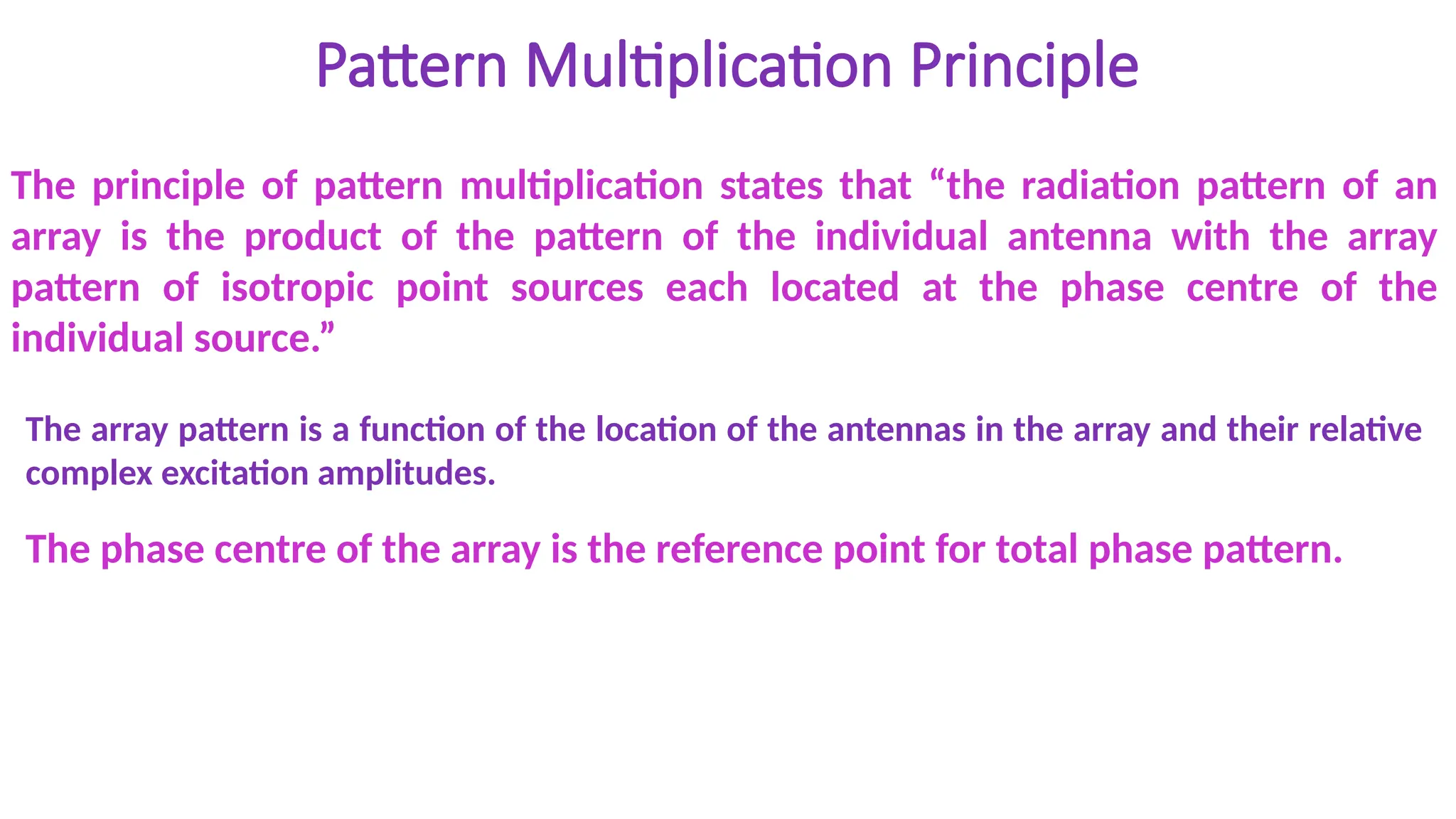
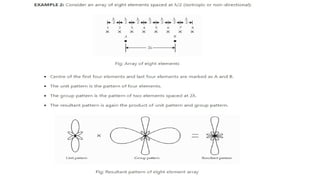
Theprinciple of pattern multiplication states that “the radiation pattern of an
array is the product of the pattern of the individual antenna with the array
pattern of isotropic point sources each located at the phase centre of the
individual source.”
The array pattern is a function of the location of the antennas in the array and their relative
complex excitation amplitudes.
The phase centre of the array is the reference point for total phase pattern.
2.
Advantage: It helpsto sketch the radiation pattern of array antennas rapidly from the simple
product of element pattern and array pattern.
Disadvantage: This principle is only applicable for arrays containing identical elements.
The principle of pattern multiplication is true for any number of similar sources.
Total phase pattern is the addition of the phase pattern of the individual sources and that of
the array of isotropic point sources.
E = [f (θ, ϕ) × F (θ, ϕ)] × [fP (θ, ϕ) + FP (θ, ϕ)]
where,
f (θ, ϕ) = element field pattern
fP (θ, ϕ) = element phase pattern
F (θ, ϕ) = array factor of isotropic elements
FP (θ, ϕ) = phase pattern of the array of isotropic elements.
The angles θ and ϕ respectively represent the polar and azimuth angles.
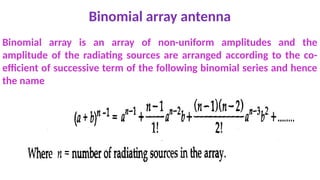
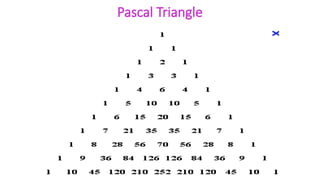
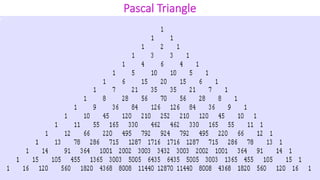
Binomial array antenna
Binomialarray is an array of non-uniform amplitudes and the
amplitude of the radiating sources are arranged according to the co-
efficient of successive term of the following binomial series and hence
the name
![Advantage: It helps to sketch the radiation pattern of array antennas rapidly from the simple
product of element pattern and array pattern.
Disadvantage: This principle is only applicable for arrays containing identical elements.
The principle of pattern multiplication is true for any number of similar sources.
Total phase pattern is the addition of the phase pattern of the individual sources and that of
the array of isotropic point sources.
E = [f (θ, ϕ) × F (θ, ϕ)] × [fP (θ, ϕ) + FP (θ, ϕ)]
where,
f (θ, ϕ) = element field pattern
fP (θ, ϕ) = element phase pattern
F (θ, ϕ) = array factor of isotropic elements
FP (θ, ϕ) = phase pattern of the array of isotropic elements.
The angles θ and ϕ respectively represent the polar and azimuth angles.](https://image.slidesharecdn.com/binomialantennaarrays-250510055931-cb4abcba/85/Pattern-multiplication-and-binomial-antenna-array-2-320.jpg)




![3_Antenna Array [Modlue 4] (1).pdf](https://cdn.slidesharecdn.com/ss_thumbnails/3antennaarraymodlue41-220419112111-thumbnail.jpg?width=640&height=640&fit=bounds)
![Antenna lecture course CHapter 2_(2)[1].pdf](https://cdn.slidesharecdn.com/ss_thumbnails/antennach221-240525095938-532f47be-thumbnail.jpg?width=640&height=640&fit=bounds)


