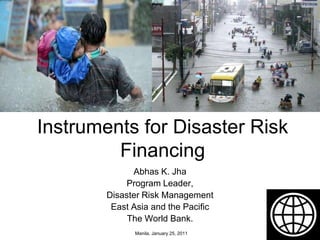
Instruments for Disaster Risk FinancingAbhas K. JhaProgram Leader,Disaster Risk Management East Asia and the PacificThe World Bank.Manila, January 25, 2011
Three Objectives TodayDemonstrate the rising impact of disasters in developing countries2. 	Provide an overview of the 	markets for 	disaster risk financing.3. 	Provide some examples of World 	Bank 	disaster risk financing 	instruments.
Main MessagesDisaster risks, economic and insured and non-Insured Losses are increasingGovernments cannot and should not fund ex-ante DRM and recovery costs alone.There are a number of innovative catastrophe risk financing instruments available that fund liquidity and risk transfer to the private sector.
1. The Impacts of Disasters
Natural Events Becoming More Extreme                                                                                                                                      Source: Munich Re
Climate Change and DRMDecreasing  ConfidenceHumans are affecting climateModels are predicting significant warming (Global Mean Temperature)Models are predicting sea level rise (magnitude and timing considerably uncertain)Models are predicting slight drop overall hurricanes but a higher percent of Cat 4 and 5.
Climate change and insurance“Stationarity is dead‟	–“Climate is what you expect, weather is what you get” no longer appliesAgriculture becomes riskier•Roles for insurance:–Protect against catastrophic events–Signal risk through price–Provide cash to adapt (after event)–Promote new (adaptive) technology
 Catastrophe Bonds
Parametric Insurance
Traditional insuranceProbable Maximum LossTransferContingent lines of credit
Loans (Standard or Emergency)
Budget reallocationsRetentionReserves/Calamity fundsLiquidity gaps often emerge in the early days after a disasterNeed for an instrument to provide liquidity early on until other sources of funds can be accessed
The Financial Protection of the State :Source of Financing Post-Disaster	 	Availability 	Cost 		               Instruments	of funds	 (multiplier)                  Reserves 	Immediate	1-2	                  Budget reallocations	- 	1-2	                 Contingent lines of credit	Immediate 	1-2	                  Emergency loans	3-6 months 	1-2	                  Donor contributions	3-6 months	0-1	                  Traditional insurance	3-6 months	3-6	                   Parametric insurance	Immediate	2-5	                   Catastrophe Bonds	Immediate	2-5	How do we combine these instruments to protect the fiscal balance of the state and improve its capacity to respond in case of a natural disaster ?
2. The Market for Disaster Risk Finance
people, assetssocial/econ/physconditionsgeophysicaldriversExposureHazard probabilityVulnerabilityThe Standard Risk Assessment Model
Developing Countries Have an Insurance GapInsured	UninsuredPeril / Event 	Country	Loss ($bn)	Loss (% Loss)	 Loss %  GDP	% Govt. RevenuesEarthquake - Izmit (1999)	Turkey	22.0		5		5		21
Hurricane - Mitch (1998)	Honduras	3.0		6		34		158
Floods - (1997)	Poland	3.5		6		3		11
Earthquake - Gujarat/Bhuj (2001)	India	0.6		2		1		7
Earthquake – Northridge (1992)	USA	43.0		47		0.3		2
Winter Storm – (1999)	France	6.2		100		–		–Benefits: Rate on Line VolatilityThe World ROL index (Rate On Line) of broker traces historical catastrophe reinsurance premiums Catastrophe reinsurance premium volatility over the 1990-2010 period has been about 29%In the recent period premiums have experienced a post-Katrina increase of 36% in 200614Source : reinsurance brokerage firm Guy Carpenter Rate On Line Index
A viable alternative and complement to insurance for dealing with disaster reliefCat Bonds have shown resilience and diversification value throughout the crisisCat Bond issuance has restarted in 201015Benefits: Update on cat bond marketsTotal Non-Life Bonds Outstanding, By Year (As of End 2010) Cumulative Performance from January 2002  Source:  BloombergSource:  Goldman Sachs and Swiss Re
The Weather MarketFirst weather derivative transaction in U.S. 1997Deregulation of the energy industryMarket has rapidly grown, well over $100b transacted to date (PWC Survey 2008)Non-energy applicationsNew participantsGlobal developmentBroader product offeringKey Players: (Re)insurersBanksHedge FundsMarket wants to diversify and grow their portfolios, wants new risks
3. World Bank Disaster Risk Financing Instruments
Caribbean Catastrophe Risk Insurance Facility16 Caribbean countries covered against hurricane and earthquake risks18
19

Instruments for Disaster Risk Financing

  • 1.
    Instruments for DisasterRisk FinancingAbhas K. JhaProgram Leader,Disaster Risk Management East Asia and the PacificThe World Bank.Manila, January 25, 2011
  • 2.
    Three Objectives TodayDemonstratethe rising impact of disasters in developing countries2. Provide an overview of the markets for disaster risk financing.3. Provide some examples of World Bank disaster risk financing instruments.
  • 3.
    Main MessagesDisaster risks,economic and insured and non-Insured Losses are increasingGovernments cannot and should not fund ex-ante DRM and recovery costs alone.There are a number of innovative catastrophe risk financing instruments available that fund liquidity and risk transfer to the private sector.
  • 4.
    1. The Impactsof Disasters
  • 5.
    Natural Events BecomingMore Extreme                                                                                                                                      Source: Munich Re
  • 6.
    Climate Change andDRMDecreasing ConfidenceHumans are affecting climateModels are predicting significant warming (Global Mean Temperature)Models are predicting sea level rise (magnitude and timing considerably uncertain)Models are predicting slight drop overall hurricanes but a higher percent of Cat 4 and 5.
  • 7.
    Climate change andinsurance“Stationarity is dead‟ –“Climate is what you expect, weather is what you get” no longer appliesAgriculture becomes riskier•Roles for insurance:–Protect against catastrophic events–Signal risk through price–Provide cash to adapt (after event)–Promote new (adaptive) technology
  • 8.
  • 9.
  • 10.
    Traditional insuranceProbable MaximumLossTransferContingent lines of credit
  • 11.
  • 12.
    Budget reallocationsRetentionReserves/Calamity fundsLiquiditygaps often emerge in the early days after a disasterNeed for an instrument to provide liquidity early on until other sources of funds can be accessed
  • 13.
    The Financial Protectionof the State :Source of Financing Post-Disaster Availability Cost Instruments of funds (multiplier) Reserves Immediate 1-2 Budget reallocations - 1-2 Contingent lines of credit Immediate 1-2 Emergency loans 3-6 months 1-2 Donor contributions 3-6 months 0-1 Traditional insurance 3-6 months 3-6 Parametric insurance Immediate 2-5 Catastrophe Bonds Immediate 2-5 How do we combine these instruments to protect the fiscal balance of the state and improve its capacity to respond in case of a natural disaster ?
  • 14.
    2. The Marketfor Disaster Risk Finance
  • 15.
  • 16.
    Developing Countries Havean Insurance GapInsured UninsuredPeril / Event Country Loss ($bn) Loss (% Loss) Loss % GDP % Govt. RevenuesEarthquake - Izmit (1999) Turkey 22.0 5 5 21
  • 17.
    Hurricane - Mitch(1998) Honduras 3.0 6 34 158
  • 18.
  • 19.
    Earthquake - Gujarat/Bhuj(2001) India 0.6 2 1 7
  • 20.
    Earthquake – Northridge(1992) USA 43.0 47 0.3 2
  • 21.
    Winter Storm –(1999) France 6.2 100 – –Benefits: Rate on Line VolatilityThe World ROL index (Rate On Line) of broker traces historical catastrophe reinsurance premiums Catastrophe reinsurance premium volatility over the 1990-2010 period has been about 29%In the recent period premiums have experienced a post-Katrina increase of 36% in 200614Source : reinsurance brokerage firm Guy Carpenter Rate On Line Index
  • 22.
    A viable alternativeand complement to insurance for dealing with disaster reliefCat Bonds have shown resilience and diversification value throughout the crisisCat Bond issuance has restarted in 201015Benefits: Update on cat bond marketsTotal Non-Life Bonds Outstanding, By Year (As of End 2010) Cumulative Performance from January 2002 Source: BloombergSource: Goldman Sachs and Swiss Re
  • 23.
    The Weather MarketFirstweather derivative transaction in U.S. 1997Deregulation of the energy industryMarket has rapidly grown, well over $100b transacted to date (PWC Survey 2008)Non-energy applicationsNew participantsGlobal developmentBroader product offeringKey Players: (Re)insurersBanksHedge FundsMarket wants to diversify and grow their portfolios, wants new risks
  • 24.
    3. World BankDisaster Risk Financing Instruments
  • 25.
    Caribbean Catastrophe RiskInsurance Facility16 Caribbean countries covered against hurricane and earthquake risks18
  • 26.

Editor's Notes

  • #22 Modeling and pricing of property risk Insurance policy design Developing TCIP policy distribution and accounting systemsUnderwriting, rating and operational guidelines Public relations campaignTrainingInvestment policy and fund managementImproving regulatory framework and enforcement of building codes