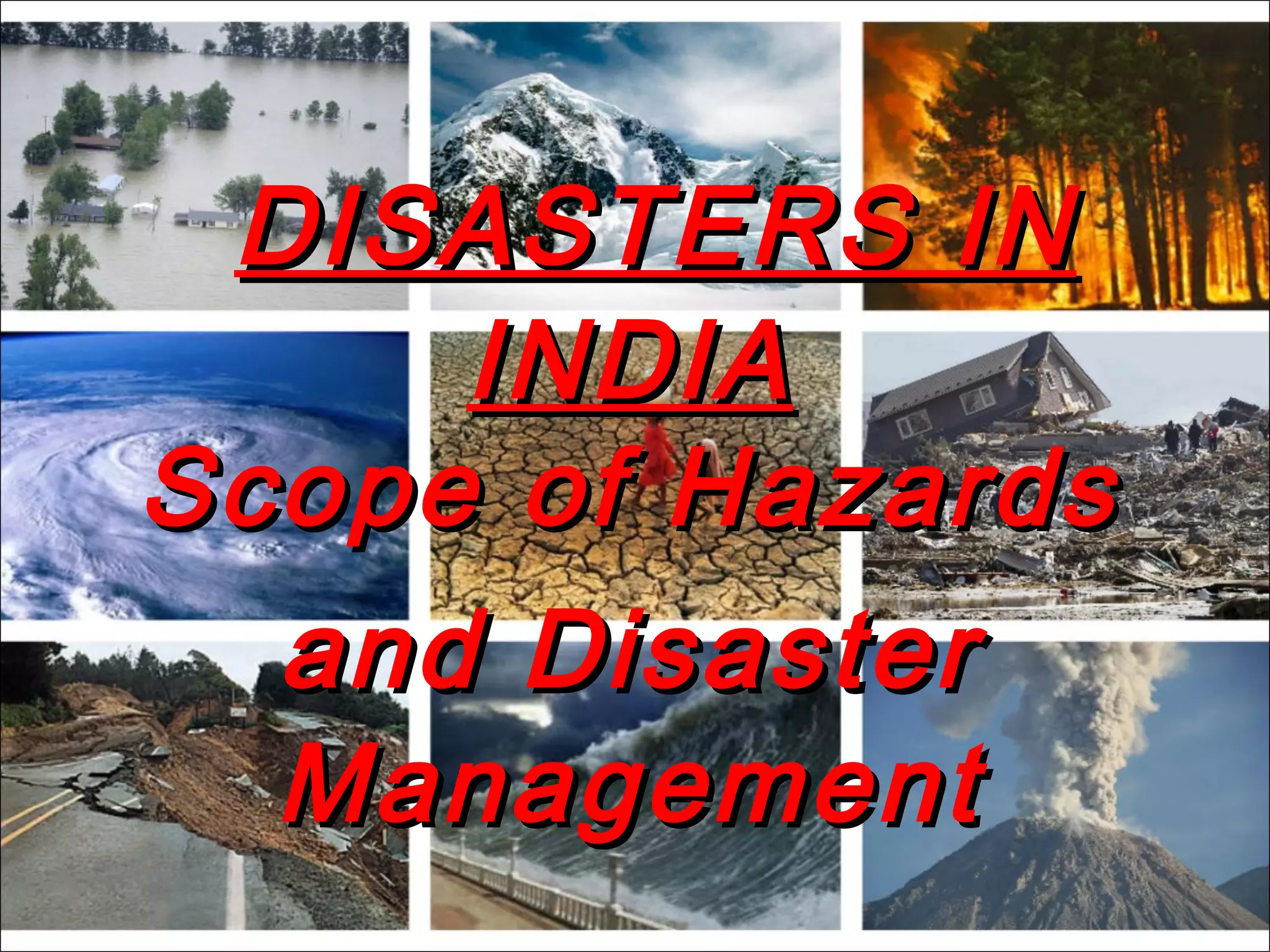
DISASTERS INDISASTERS IN
INDIAINDIA
Scope of HazardsScope of Hazards
and Disasterand Disaster
ManagementManagement
India and Natural DisastersIndia and Natural Disasters
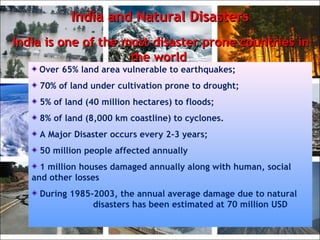
India is one of the most disaster prone countries inIndia is one of the most disaster prone countries in
the worldthe world..
Over 65% land area vulnerable to earthquakes;
70% of land under cultivation prone to drought;
5% of land (40 million hectares) to floods;
8% of land (8,000 km coastline) to cyclones.
A Major Disaster occurs every 2-3 years;
50 million people affected annually
1 million houses damaged annually along with human, social
and other losses
During 1985-2003, the annual average damage due to natural
disasters has been estimated at 70 million USD
Definition of DisasterDefinition of Disaster
A Disaster is an event that occurs in mostA Disaster is an event that occurs in most
cases suddenly and unexpectedly, causingcases suddenly and unexpectedly, causing
severe disturbances to people, objects andsevere disturbances to people, objects and
environment, resulting in loss of life ,propertyenvironment, resulting in loss of life ,property
and health of the population. Such a situationand health of the population. Such a situation
causes disruption in normal pattern of life,causes disruption in normal pattern of life,
generating misfortune, helplessness andgenerating misfortune, helplessness and
suffering affecting the socio-economicsuffering affecting the socio-economic
structure of a region/country to such an extentstructure of a region/country to such an extent
that there is a need for assistance orthat there is a need for assistance or
immediate outside intervention.immediate outside intervention.
 AA phenomenon or eventphenomenon or event whichwhich
constitutes a trauma for aconstitutes a trauma for a
population/environment.population/environment.
 AA vulnerable point/areavulnerable point/area that will bear thethat will bear the
brunt of the traumatizing event.brunt of the traumatizing event.
 TheThe failure of local & surroundingfailure of local & surrounding
resourcesresources to cope with the problemsto cope with the problems
created by the phenomenon.created by the phenomenon.
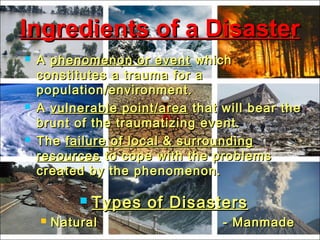
 Types of DisastersTypes of Disasters
 Natural - ManmadeNatural - Manmade
Ingredients of a DisasterIngredients of a Disaster
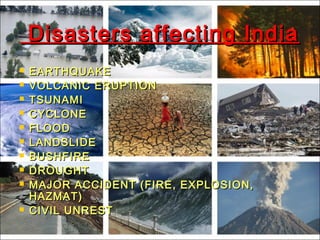
Disasters affecting IndiaDisasters affecting India
 EARTHQUAKEEARTHQUAKE
 VOLCANIC ERUPTIONVOLCANIC ERUPTION
 TSUNAMITSUNAMI
 CYCLONECYCLONE
 FLOODFLOOD
 LANDSLIDELANDSLIDE
 BUSHFIREBUSHFIRE
 DROUGHTDROUGHT
 MAJOR ACCIDENT (FIRE, EXPLOSION,MAJOR ACCIDENT (FIRE, EXPLOSION,
HAZMAT)HAZMAT)
 CIVIL UNRESTCIVIL UNREST
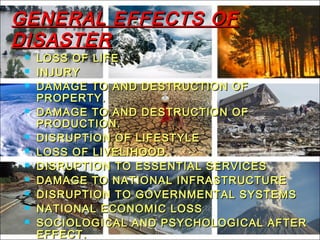
GENERAL EFFECTS OFGENERAL EFFECTS OF
DISASTERDISASTER
 LOSS OF LIFELOSS OF LIFE
 INJURYINJURY
 DAMAGE TO AND DESTRUCTION OFDAMAGE TO AND DESTRUCTION OF
PROPERTY.PROPERTY.
 DAMAGE TO AND DESTRUCTION OFDAMAGE TO AND DESTRUCTION OF
PRODUCTION.PRODUCTION.
 DISRUPTION OF LIFESTYLEDISRUPTION OF LIFESTYLE
 LOSS OF LIVELIHOOD.LOSS OF LIVELIHOOD.
 DISRUPTION TO ESSENTIAL SERVICESDISRUPTION TO ESSENTIAL SERVICES
 DAMAGE TO NATIONAL INFRASTRUCTUREDAMAGE TO NATIONAL INFRASTRUCTURE
 DISRUPTION TO GOVERNMENTAL SYSTEMSDISRUPTION TO GOVERNMENTAL SYSTEMS
 NATIONAL ECONOMIC LOSSNATIONAL ECONOMIC LOSS
 SOCIOLOGICAL AND PSYCHOLOGICAL AFTERSOCIOLOGICAL AND PSYCHOLOGICAL AFTER
EFFECT.EFFECT.
DISASTER MANAGEMENTDISASTER MANAGEMENT
““AN APPLIEDSCIENCEWHICHSEEKS,AN APPLIEDSCIENCEWHICHSEEKS,
BYTHESYSTEMATIC OBSERVATIONBYTHESYSTEMATIC OBSERVATION
ANDANALYSISOFDISASTERS, TOANDANALYSISOFDISASTERS, TO
IMPROVEMEASURESRELATINGTOIMPROVEMEASURESRELATINGTO
PREVENTION, MITIGATION,PREVENTION, MITIGATION,
PREPAREDNESS, EMERGENCYPREPAREDNESS, EMERGENCY
RESPONSEANDRECOVERY.”RESPONSEANDRECOVERY.”
The MythsThe Myths
 It Can’t Happen to Us.It Can’t Happen to Us.
 The Nature’s forces are soThe Nature’s forces are so
Deadly the Victims will DieDeadly the Victims will Die
anyway.anyway.
 There is Nothing We Can Do.There is Nothing We Can Do.
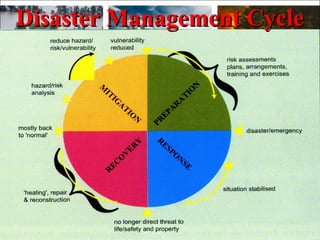
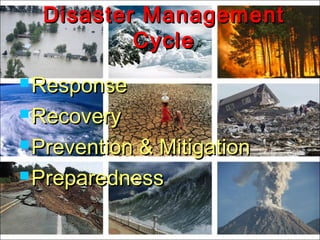
Disaster Management CycleDisaster Management Cycle
 ResponseResponse
 RecoveryRecovery
 Prevention & MitigationPrevention & Mitigation
 PreparednessPreparedness
Disaster ManagementDisaster Management
CycleCycle
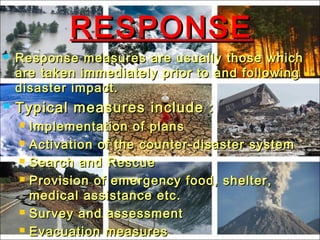
RESPONSERESPONSE
 Response measures are usually those whichResponse measures are usually those which
are taken immediately prior to and followingare taken immediately prior to and following
disaster impact.disaster impact.
 Typical measures include :Typical measures include :
 Implementation of plansImplementation of plans
 Activation of the counter-disaster systemActivation of the counter-disaster system
 Search and RescueSearch and Rescue
 Provision of emergency food, shelter,Provision of emergency food, shelter,
medical assistance etc.medical assistance etc.
 Survey and assessmentSurvey and assessment
 Evacuation measuresEvacuation measures
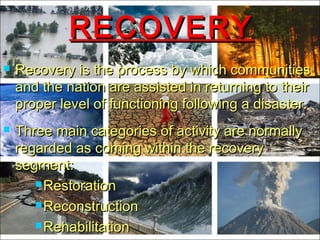
RECOVERYRECOVERY
 Recovery is the process by which communitiesRecovery is the process by which communities
and the nation are assisted in returning to theirand the nation are assisted in returning to their
proper level of functioning following a disaster.proper level of functioning following a disaster.
 Three main categories of activity are normallyThree main categories of activity are normally
regarded as coming within the recoveryregarded as coming within the recovery
segment:segment:
 RestorationRestoration
 ReconstructionReconstruction
 RehabilitationRehabilitation
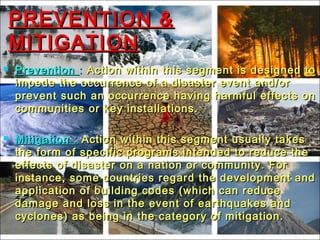
PREVENTION &PREVENTION &
MITIGATIONMITIGATION
 PreventionPrevention :: Action within this segment is designed toAction within this segment is designed to
impede the occurrence of a disaster event and/orimpede the occurrence of a disaster event and/or
prevent such an occurrence having harmful effects onprevent such an occurrence having harmful effects on
communities or key installations.communities or key installations.
 Mitigation :Mitigation : Action within this segment usually takesAction within this segment usually takes
the form of specific programs intended to reduce thethe form of specific programs intended to reduce the
effects of disaster on a nation or community. Foreffects of disaster on a nation or community. For
instance, some countries regard the development andinstance, some countries regard the development and
application of building codes (which can reduceapplication of building codes (which can reduce
damage and loss in the event of earthquakes anddamage and loss in the event of earthquakes and
cyclones) as being in the category of mitigation.cyclones) as being in the category of mitigation.
PREPAREDNESSPREPAREDNESS
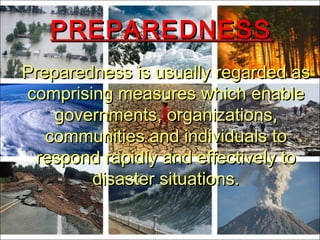
Preparedness is usually regarded asPreparedness is usually regarded as
comprising measures which enablecomprising measures which enable
governments, organizations,governments, organizations,
communities and individuals tocommunities and individuals to
respond rapidly and effectively torespond rapidly and effectively to
disaster situations.disaster situations.
PREPAREDNESS (PREPAREDNESS ( ContdContd))
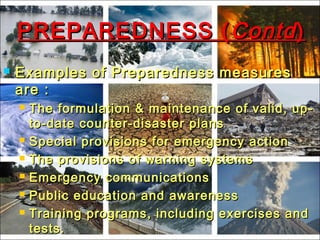
 Examples of Preparedness measuresExamples of Preparedness measures
are :are :
 The formulation & maintenance of valid, up-The formulation & maintenance of valid, up-
to-date counter-disaster plansto-date counter-disaster plans
 Special provisions for emergency actionSpecial provisions for emergency action
 The provisions of warning systemsThe provisions of warning systems
 Emergency communicationsEmergency communications
 Public education and awarenessPublic education and awareness
 Training programs, including exercises andTraining programs, including exercises and
tests.tests.
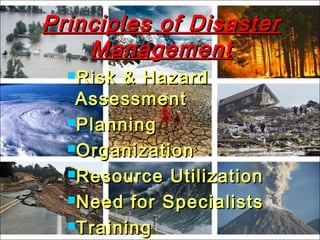
Principles of DisasterPrinciples of Disaster
ManagementManagement
Risk & HazardRisk & Hazard
AssessmentAssessment
PlanningPlanning
OrganizationOrganization
Resource UtilizationResource Utilization
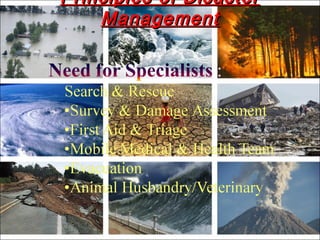
Need for SpecialistsNeed for Specialists
TrainingTraining
RISK AND HAZARDRISK AND HAZARD
ASSESSMENTASSESSMENT
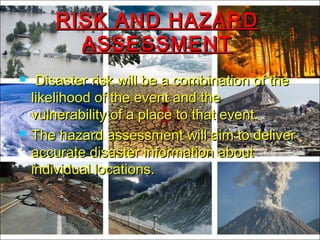
 Disaster risk will be a combination of theDisaster risk will be a combination of the
likelihood of the event and thelikelihood of the event and the
vulnerability of a place to that event.vulnerability of a place to that event.
 The hazard assessment will aim to deliverThe hazard assessment will aim to deliver
accurate disaster information aboutaccurate disaster information about
individual locations.individual locations.
HAZARD ASSESSMENTHAZARD ASSESSMENT
Vulnerability to a particular hazard will include :Vulnerability to a particular hazard will include :
 Critical products, services, records and operations.Critical products, services, records and operations.
 Hazardous materialsHazardous materials
 Potential effects of damage on stakeholders.Potential effects of damage on stakeholders.
 Likely financial costs.Likely financial costs.
 Resources personnel and time available to makeResources personnel and time available to make
preparations.preparations.
 Level of insurance cover.Level of insurance cover.
The combination of hazard and vulnerabilityThe combination of hazard and vulnerability
assessments will result in formulating totalassessments will result in formulating total
risk assessment.risk assessment.
Principles of DisasterPrinciples of Disaster
ManagementManagement
 Planning :Planning :
 to have a clear and logical approach to dealingto have a clear and logical approach to dealing
with disasters.with disasters.
 to provide common reference for all departmentsto provide common reference for all departments
and authorities with roles.and authorities with roles.
 to assist with information for sitting-up a multi-to assist with information for sitting-up a multi-
functional organizational structure.functional organizational structure.
 to form a basis for coordinated action.to form a basis for coordinated action.
 to provide clear allocation of responsibilities.to provide clear allocation of responsibilities.
 to form a basis for reviewing and evaluatingto form a basis for reviewing and evaluating
current and future disaster managementcurrent and future disaster management
requirements.requirements.
 to give a focus for disaster related training.to give a focus for disaster related training.
 Organisation :Organisation :
 the nature of National Disaster Managementthe nature of National Disaster Management
Authority (NDMA)Authority (NDMA)
 Utilization of total governmental structures/Utilization of total governmental structures/
resources i.e. National, State & Local level.resources i.e. National, State & Local level.
 Co-ordination of non governmental resourcesCo-ordination of non governmental resources
 Community involvementCommunity involvement
 Clear lines of Authority and unity ofClear lines of Authority and unity of
commandcommand
 Special system requirements.Special system requirements.
Principles of DisasterPrinciples of Disaster
ManagementManagement
Organisation (Contd.) :Organisation (Contd.) :
 Special system requirements.Special system requirements.
 Emergency Operation Center/Control CenterEmergency Operation Center/Control Center
 Direction & Coordinating AuthorityDirection & Coordinating Authority
 CommunicationsCommunications
 Warning SystemsWarning Systems
 Survey & AssessmentsSurvey & Assessments
 Information ManagementInformation Management
 Emergency LogisticsEmergency Logistics
Principles of DisasterPrinciples of Disaster
ManagementManagement
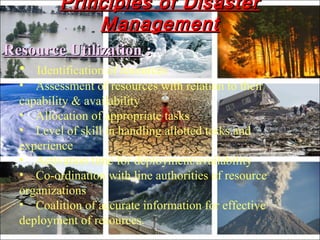
Resource UtilizationResource Utilization ::
• Identification of resources
• Assessment of resources with relation to their
capability & availability
• Allocation of appropriate tasks
• Level of skill in handling allotted tasks and
experience
• Activation time for deployment/availability
• Co-ordination with line authorities of resource
organizations
• Coalition of accurate information for effective
deployment of resources.
Principles of DisasterPrinciples of Disaster
ManagementManagement
AGENCIESAGENCIES
 Governmental (Including MilitaryGovernmental (Including Military
both at National & State Level).both at National & State Level).
 Non Governmental Organizations.Non Governmental Organizations.
 Community groups both social &Community groups both social &
religious.religious.
 International Volunteer organisation.International Volunteer organisation.
Principles of DisasterPrinciples of Disaster
ManagementManagement
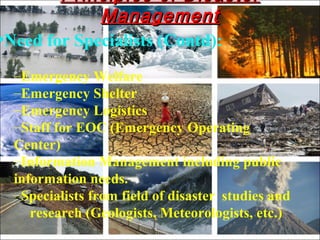
•Need for Specialists (Contd):
–Emergency Welfare
–Emergency Shelter
–Emergency Logistics
–Staff for EOC (Emergency Operating
Center)
–Information Management including public
information needs.
–Specialists from field of disaster studies and
research (Geologists, Meteorologists, etc.)
Principles of DisasterPrinciples of Disaster
ManagementManagement
Training :Training :
•Identification of Training needs.
•Scope of Training programmes.
•Training policy.
•Implementation of training.
Principles of DisasterPrinciples of Disaster
ManagementManagement
•Training (Contd.):Training (Contd.):
–Design of training should be compatible to
support tasks required to be performed after
a Disaster at three levels.
•Foundational Training
•Team Training
•Combined Organizational Training.
Principles of DisasterPrinciples of Disaster
ManagementManagement
National Disaster Management FrameworkNational Disaster Management Framework
Ministry of Home Affairs - GoIMinistry of Home Affairs - GoI
To make Disaster Management an integral part of National
Development Agenda
To promote Awareness and Education in Disaster Management
To promote Human Resource Development in Disaster Management
(master plan for training and capacity building)
To develop Institutional Frameworks at the National and State levels
for mainstreaming disaster management
To establish multi-hazard preparedness, mitigation and prevention
plans at all levels
To enhance capacities at all levels for multi-hazard preparedness and
response
GOI-UNDP Disaster Risk Management Programme (DRM)GOI-UNDP Disaster Risk Management Programme (DRM)
will be the platform to launch these activities.will be the platform to launch these activities.
Made byMade by
Parul BhartiParul Bharti
ClassClass 1010thth
THETHE
ENDEND

Disaster management

  • 1.
    DISASTERS INDISASTERS IN INDIAINDIA Scopeof HazardsScope of Hazards and Disasterand Disaster ManagementManagement
  • 2.
    India and NaturalDisastersIndia and Natural Disasters India is one of the most disaster prone countries inIndia is one of the most disaster prone countries in the worldthe world.. Over 65% land area vulnerable to earthquakes; 70% of land under cultivation prone to drought; 5% of land (40 million hectares) to floods; 8% of land (8,000 km coastline) to cyclones. A Major Disaster occurs every 2-3 years; 50 million people affected annually 1 million houses damaged annually along with human, social and other losses During 1985-2003, the annual average damage due to natural disasters has been estimated at 70 million USD
  • 3.
    Definition of DisasterDefinitionof Disaster A Disaster is an event that occurs in mostA Disaster is an event that occurs in most cases suddenly and unexpectedly, causingcases suddenly and unexpectedly, causing severe disturbances to people, objects andsevere disturbances to people, objects and environment, resulting in loss of life ,propertyenvironment, resulting in loss of life ,property and health of the population. Such a situationand health of the population. Such a situation causes disruption in normal pattern of life,causes disruption in normal pattern of life, generating misfortune, helplessness andgenerating misfortune, helplessness and suffering affecting the socio-economicsuffering affecting the socio-economic structure of a region/country to such an extentstructure of a region/country to such an extent that there is a need for assistance orthat there is a need for assistance or immediate outside intervention.immediate outside intervention.
  • 4.
     AA phenomenonor eventphenomenon or event whichwhich constitutes a trauma for aconstitutes a trauma for a population/environment.population/environment.  AA vulnerable point/areavulnerable point/area that will bear thethat will bear the brunt of the traumatizing event.brunt of the traumatizing event.  TheThe failure of local & surroundingfailure of local & surrounding resourcesresources to cope with the problemsto cope with the problems created by the phenomenon.created by the phenomenon.  Types of DisastersTypes of Disasters  Natural - ManmadeNatural - Manmade Ingredients of a DisasterIngredients of a Disaster
  • 5.
    Disasters affecting IndiaDisastersaffecting India  EARTHQUAKEEARTHQUAKE  VOLCANIC ERUPTIONVOLCANIC ERUPTION  TSUNAMITSUNAMI  CYCLONECYCLONE  FLOODFLOOD  LANDSLIDELANDSLIDE  BUSHFIREBUSHFIRE  DROUGHTDROUGHT  MAJOR ACCIDENT (FIRE, EXPLOSION,MAJOR ACCIDENT (FIRE, EXPLOSION, HAZMAT)HAZMAT)  CIVIL UNRESTCIVIL UNREST
  • 6.
    GENERAL EFFECTS OFGENERALEFFECTS OF DISASTERDISASTER  LOSS OF LIFELOSS OF LIFE  INJURYINJURY  DAMAGE TO AND DESTRUCTION OFDAMAGE TO AND DESTRUCTION OF PROPERTY.PROPERTY.  DAMAGE TO AND DESTRUCTION OFDAMAGE TO AND DESTRUCTION OF PRODUCTION.PRODUCTION.  DISRUPTION OF LIFESTYLEDISRUPTION OF LIFESTYLE  LOSS OF LIVELIHOOD.LOSS OF LIVELIHOOD.  DISRUPTION TO ESSENTIAL SERVICESDISRUPTION TO ESSENTIAL SERVICES  DAMAGE TO NATIONAL INFRASTRUCTUREDAMAGE TO NATIONAL INFRASTRUCTURE  DISRUPTION TO GOVERNMENTAL SYSTEMSDISRUPTION TO GOVERNMENTAL SYSTEMS  NATIONAL ECONOMIC LOSSNATIONAL ECONOMIC LOSS  SOCIOLOGICAL AND PSYCHOLOGICAL AFTERSOCIOLOGICAL AND PSYCHOLOGICAL AFTER EFFECT.EFFECT.
  • 7.
    DISASTER MANAGEMENTDISASTER MANAGEMENT ““ANAPPLIEDSCIENCEWHICHSEEKS,AN APPLIEDSCIENCEWHICHSEEKS, BYTHESYSTEMATIC OBSERVATIONBYTHESYSTEMATIC OBSERVATION ANDANALYSISOFDISASTERS, TOANDANALYSISOFDISASTERS, TO IMPROVEMEASURESRELATINGTOIMPROVEMEASURESRELATINGTO PREVENTION, MITIGATION,PREVENTION, MITIGATION, PREPAREDNESS, EMERGENCYPREPAREDNESS, EMERGENCY RESPONSEANDRECOVERY.”RESPONSEANDRECOVERY.”
  • 8.
    The MythsThe Myths It Can’t Happen to Us.It Can’t Happen to Us.  The Nature’s forces are soThe Nature’s forces are so Deadly the Victims will DieDeadly the Victims will Die anyway.anyway.  There is Nothing We Can Do.There is Nothing We Can Do.
  • 9.
  • 10.
     ResponseResponse  RecoveryRecovery Prevention & MitigationPrevention & Mitigation  PreparednessPreparedness Disaster ManagementDisaster Management CycleCycle
  • 11.
    RESPONSERESPONSE  Response measuresare usually those whichResponse measures are usually those which are taken immediately prior to and followingare taken immediately prior to and following disaster impact.disaster impact.  Typical measures include :Typical measures include :  Implementation of plansImplementation of plans  Activation of the counter-disaster systemActivation of the counter-disaster system  Search and RescueSearch and Rescue  Provision of emergency food, shelter,Provision of emergency food, shelter, medical assistance etc.medical assistance etc.  Survey and assessmentSurvey and assessment  Evacuation measuresEvacuation measures
  • 12.
    RECOVERYRECOVERY  Recovery isthe process by which communitiesRecovery is the process by which communities and the nation are assisted in returning to theirand the nation are assisted in returning to their proper level of functioning following a disaster.proper level of functioning following a disaster.  Three main categories of activity are normallyThree main categories of activity are normally regarded as coming within the recoveryregarded as coming within the recovery segment:segment:  RestorationRestoration  ReconstructionReconstruction  RehabilitationRehabilitation
  • 13.
    PREVENTION &PREVENTION & MITIGATIONMITIGATION PreventionPrevention :: Action within this segment is designed toAction within this segment is designed to impede the occurrence of a disaster event and/orimpede the occurrence of a disaster event and/or prevent such an occurrence having harmful effects onprevent such an occurrence having harmful effects on communities or key installations.communities or key installations.  Mitigation :Mitigation : Action within this segment usually takesAction within this segment usually takes the form of specific programs intended to reduce thethe form of specific programs intended to reduce the effects of disaster on a nation or community. Foreffects of disaster on a nation or community. For instance, some countries regard the development andinstance, some countries regard the development and application of building codes (which can reduceapplication of building codes (which can reduce damage and loss in the event of earthquakes anddamage and loss in the event of earthquakes and cyclones) as being in the category of mitigation.cyclones) as being in the category of mitigation.
  • 14.
    PREPAREDNESSPREPAREDNESS Preparedness is usuallyregarded asPreparedness is usually regarded as comprising measures which enablecomprising measures which enable governments, organizations,governments, organizations, communities and individuals tocommunities and individuals to respond rapidly and effectively torespond rapidly and effectively to disaster situations.disaster situations.
  • 15.
    PREPAREDNESS (PREPAREDNESS (ContdContd))  Examples of Preparedness measuresExamples of Preparedness measures are :are :  The formulation & maintenance of valid, up-The formulation & maintenance of valid, up- to-date counter-disaster plansto-date counter-disaster plans  Special provisions for emergency actionSpecial provisions for emergency action  The provisions of warning systemsThe provisions of warning systems  Emergency communicationsEmergency communications  Public education and awarenessPublic education and awareness  Training programs, including exercises andTraining programs, including exercises and tests.tests.
  • 16.
    Principles of DisasterPrinciplesof Disaster ManagementManagement Risk & HazardRisk & Hazard AssessmentAssessment PlanningPlanning OrganizationOrganization Resource UtilizationResource Utilization Need for SpecialistsNeed for Specialists TrainingTraining
  • 17.
    RISK AND HAZARDRISKAND HAZARD ASSESSMENTASSESSMENT  Disaster risk will be a combination of theDisaster risk will be a combination of the likelihood of the event and thelikelihood of the event and the vulnerability of a place to that event.vulnerability of a place to that event.  The hazard assessment will aim to deliverThe hazard assessment will aim to deliver accurate disaster information aboutaccurate disaster information about individual locations.individual locations.
  • 18.
    HAZARD ASSESSMENTHAZARD ASSESSMENT Vulnerabilityto a particular hazard will include :Vulnerability to a particular hazard will include :  Critical products, services, records and operations.Critical products, services, records and operations.  Hazardous materialsHazardous materials  Potential effects of damage on stakeholders.Potential effects of damage on stakeholders.  Likely financial costs.Likely financial costs.  Resources personnel and time available to makeResources personnel and time available to make preparations.preparations.  Level of insurance cover.Level of insurance cover. The combination of hazard and vulnerabilityThe combination of hazard and vulnerability assessments will result in formulating totalassessments will result in formulating total risk assessment.risk assessment.
  • 19.
    Principles of DisasterPrinciplesof Disaster ManagementManagement  Planning :Planning :  to have a clear and logical approach to dealingto have a clear and logical approach to dealing with disasters.with disasters.  to provide common reference for all departmentsto provide common reference for all departments and authorities with roles.and authorities with roles.  to assist with information for sitting-up a multi-to assist with information for sitting-up a multi- functional organizational structure.functional organizational structure.  to form a basis for coordinated action.to form a basis for coordinated action.  to provide clear allocation of responsibilities.to provide clear allocation of responsibilities.  to form a basis for reviewing and evaluatingto form a basis for reviewing and evaluating current and future disaster managementcurrent and future disaster management requirements.requirements.  to give a focus for disaster related training.to give a focus for disaster related training.
  • 20.
     Organisation :Organisation:  the nature of National Disaster Managementthe nature of National Disaster Management Authority (NDMA)Authority (NDMA)  Utilization of total governmental structures/Utilization of total governmental structures/ resources i.e. National, State & Local level.resources i.e. National, State & Local level.  Co-ordination of non governmental resourcesCo-ordination of non governmental resources  Community involvementCommunity involvement  Clear lines of Authority and unity ofClear lines of Authority and unity of commandcommand  Special system requirements.Special system requirements. Principles of DisasterPrinciples of Disaster ManagementManagement
  • 21.
    Organisation (Contd.) :Organisation(Contd.) :  Special system requirements.Special system requirements.  Emergency Operation Center/Control CenterEmergency Operation Center/Control Center  Direction & Coordinating AuthorityDirection & Coordinating Authority  CommunicationsCommunications  Warning SystemsWarning Systems  Survey & AssessmentsSurvey & Assessments  Information ManagementInformation Management  Emergency LogisticsEmergency Logistics Principles of DisasterPrinciples of Disaster ManagementManagement
  • 22.
    Resource UtilizationResource Utilization:: • Identification of resources • Assessment of resources with relation to their capability & availability • Allocation of appropriate tasks • Level of skill in handling allotted tasks and experience • Activation time for deployment/availability • Co-ordination with line authorities of resource organizations • Coalition of accurate information for effective deployment of resources. Principles of DisasterPrinciples of Disaster ManagementManagement
  • 23.
    AGENCIESAGENCIES  Governmental (IncludingMilitaryGovernmental (Including Military both at National & State Level).both at National & State Level).  Non Governmental Organizations.Non Governmental Organizations.  Community groups both social &Community groups both social & religious.religious.  International Volunteer organisation.International Volunteer organisation.
  • 24.
    Principles of DisasterPrinciplesof Disaster ManagementManagement
  • 25.
    •Need for Specialists(Contd): –Emergency Welfare –Emergency Shelter –Emergency Logistics –Staff for EOC (Emergency Operating Center) –Information Management including public information needs. –Specialists from field of disaster studies and research (Geologists, Meteorologists, etc.) Principles of DisasterPrinciples of Disaster ManagementManagement
  • 26.
    Training :Training : •Identificationof Training needs. •Scope of Training programmes. •Training policy. •Implementation of training. Principles of DisasterPrinciples of Disaster ManagementManagement
  • 27.
    •Training (Contd.):Training (Contd.): –Designof training should be compatible to support tasks required to be performed after a Disaster at three levels. •Foundational Training •Team Training •Combined Organizational Training. Principles of DisasterPrinciples of Disaster ManagementManagement
  • 28.
    National Disaster ManagementFrameworkNational Disaster Management Framework Ministry of Home Affairs - GoIMinistry of Home Affairs - GoI To make Disaster Management an integral part of National Development Agenda To promote Awareness and Education in Disaster Management To promote Human Resource Development in Disaster Management (master plan for training and capacity building) To develop Institutional Frameworks at the National and State levels for mainstreaming disaster management To establish multi-hazard preparedness, mitigation and prevention plans at all levels To enhance capacities at all levels for multi-hazard preparedness and response GOI-UNDP Disaster Risk Management Programme (DRM)GOI-UNDP Disaster Risk Management Programme (DRM) will be the platform to launch these activities.will be the platform to launch these activities.
  • 29.
    Made byMade by ParulBhartiParul Bharti ClassClass 1010thth
  • 30.