Development of
Evolutionary
Thought
Isn’t evolution “just” a
theory?
•Scientific theories are explanations
that are based on lines of evidence,
enable valid predictions, and have
been tested in many ways.
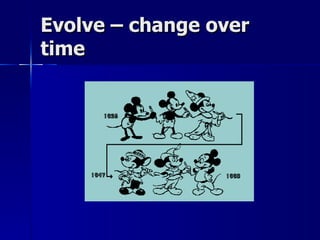
Evolve – change over
time
What is Evolution?
 Evolution- a change in
 the genetic composition
 of a population over time.
Paleontology & Evolution
   Older layers of sedimentary rock (the
    layers on the bottom) contain fossil
    species very dissimilar from modern life.
   Each layer (stratum) is characterized by
    a unique group of fossil species.
   As you move upward through the
    layers, you find species more and more
    similar to modern life.
James Hutton - 1795
   A Scottish geologist
   proposed that it was possible to explain
    the various landforms by looking at
    mechanisms currently operating in the
    world
   Proposed that the earth was much
    more than a few thousand years old
Jean Baptiste Lamarck
   Theory of evolution in 1809
   mechanism:
    – use and disuse - the idea that the parts
      used the most grow stronger; the parts
      that don’t get used deteriorate
    – inheritance of acquired characteristics - the
      modifications that an organism acquires
      during its lifetime can be passed along to
      its offspring
   recognized adaptation to environment
    as a primary product of evolution
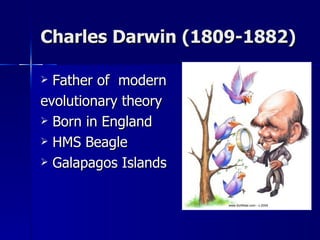
Charles Darwin (1809-1882)

 Father of modern
evolutionary theory
 Born in England

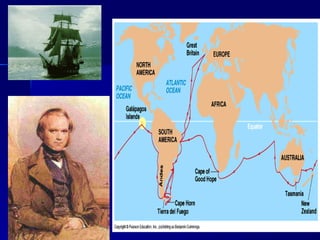
 HMS Beagle

 Galapagos Islands
What is an adaptation?

   An inherited characteristic that
    increases an organism’s ability to
    survive and reproduce in its specific
    environment.
Darwin’s Observations
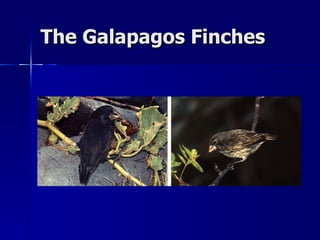
 Darwin noticed that every bird on the
  Galapagos Islands was a modified finch.
 The only differences in the birds were their
  beaks and what they ate.
 These finches looked very similar to one
  type on South American continent, but none
  of these were found in S.A.
“How did one species change into a different
  species?”
The Galapagos Finches
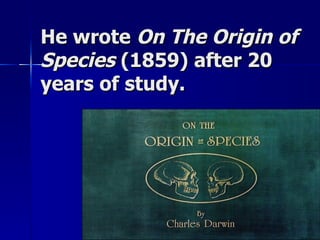
He wrote On The Origin of
Species (1859) after 20
years of study.
Darwin’s Four Postulates

   Individuals within a population vary in
    their traits.
   Some of these traits are heritable.
   More offspring are produced than can
    survive because of limited resources.
   Individuals with advantageous traits
    will survive and reproduce.
What is natural selection?
     Natural selection - a population of
      organisms can change over
      generations if individuals having
      certain heritable traits leave more
      offspring than others
     Natural selection is the mechanism
      by which evolution is proposed to
      occur
What is “artificial
selection”?
   Nature provides the variation among
    different organisms, and humans
    select variations that they find useful.
   Example: breeding cows, horses,
    hogs
   Darwin used this to help support his
    case for natural selection.
Descent with
modification
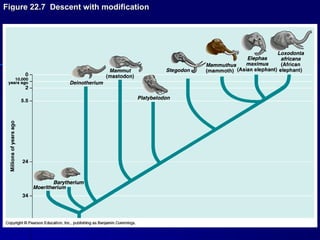
 the history of life is like a tree, with
  multiple branching and re-branching from
  a common trunk all the way to the tips of
  the youngest twigs
 most branches of evolution are dead
  ends; about 99% of all species that have
  ever lived are extinct
Figure 22.7 Descent with modification
Survival of the Fittest

•    Another name for Darwin’s theory of
     natural selection.
    •Biologists use the word fitness to
    describe how good a particular
    genotype is at leaving offspring in the
    next generation relative to how good
    other genotypes are at it.
Mechanisms of
Evolution
Natural Selection &
Survival of the Fittest
(already discussed with Darwin)
Modern Ideas
   Darwin + Mendel’s work and the work
    of others, have lead to modern ideas
    about evolution.
Another mechanism of evolution is
 Genetic Drift (random changes in
 genes) which occurs through natural
 selection.
Modern Ideas

   Speciation – formation of new species is
    due to gradual genetic changes, and that
    large scale evolution is the result of a lot of
    small scale evolution.
   Microevolution – process responsible
    for the variations that exist within a species,
    or a change in the allele frequency.
Modern Ideas

   Macroevolution – evolution that
    occurs between species.
   Examples: the separation of a species
    to form two distinct species or the
    development of a new species from
    many small changes within an existing
    species
Gene Flow

   The change in occurrence of genes in
    a population. This occurs when an
    individual leaves a population
    (emigration) or new individual joins a
    population (immigration).
Genetic Drift
   Random changes in the occurrence of genes
    through chance events.
   Can occur when a few individuals of a
    population break off from the original group
    and start their own population (founder
    effect).
   Large number of population is killed due to
    disease, starvation, natural disaster, etc.
    (bottle necking)
Punctuated Equilibrium
   Darwin felt that biological change was slow
    and steady as indicated in the fossil record.
   Modern scientists see that this pattern does
    not always hold. (Darwin’s finches)
   The term punctuated equilibrium is used to
    describe a pattern of long, stable periods
    interrupted by brief periods of more rapid
    change. This is still controversial today.
Evidence of
Evolution
Fossil Evidence

   Fossils provided a detailed record of
    evolution.
   Fossils formed in different layers of
    rock were evidence of gradual change
    over time.
Homologous Body
Structures
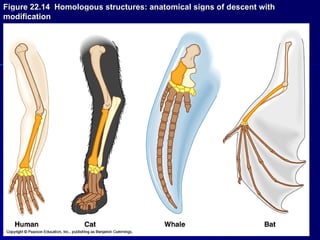
   Structures in different species that may
    perform different functions but are
    similar because of their common
    ancestry
   Vestigial organs - structures of no
    apparent function to an organism;
    leftover from ancestry; ex - snakes
    have leg & pelvis bones
Figure 22.14 Homologous structures: anatomical signs of descent with
modification
More homology…
   Molecular homology - similarity in DNA
    sequence between an ancestor and its
    progeny
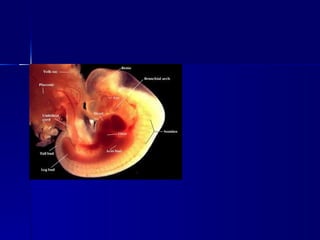
   Embryological homology - similarities
    only apparent in embryological
    development
    – ex: all vertebrate embryos have
      “pharyngeal pouches” which later become
      gills or Eustachian tubes
Patterns of
Evolution
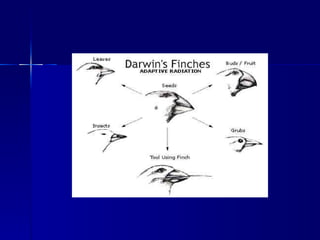
Adaptive Radiation

   When a single species or a small group
    of species has evolved into several
    different forms that live in different
    ways.
   Example: Darwin’s finches (more than
    a dozen evolved from a single species)
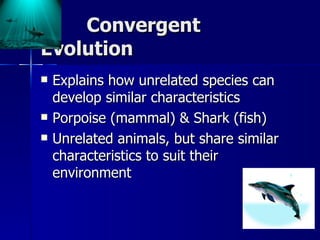
Convergent
Evolution
   Explains how unrelated species can
    develop similar characteristics
   Porpoise (mammal) & Shark (fish)
   Unrelated animals, but share similar
    characteristics to suit their
    environment
Analogous structures

   Show similarity in structure based
    on adaptation for the same
    function, not common descent.
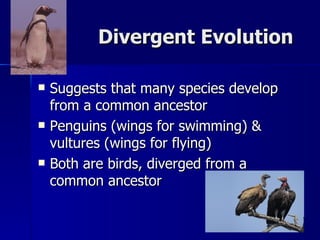
Divergent Evolution

   Suggests that many species develop
    from a common ancestor
   Penguins (wings for swimming) &
    vultures (wings for flying)
   Both are birds, diverged from a
    common ancestor
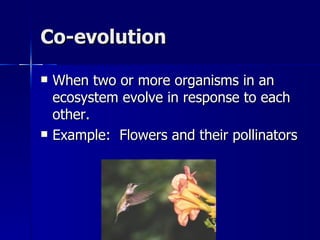
Co-evolution

   When two or more organisms in an
    ecosystem evolve in response to each
    other.
   Example: Flowers and their pollinators
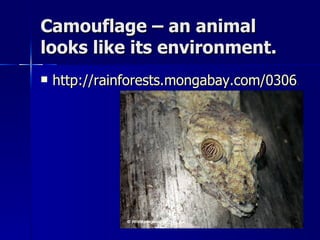
Camouflage – an animal
looks like its environment.
   http://rainforests.mongabay.com/0306.htm
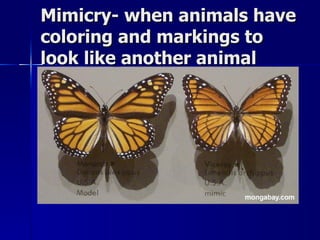
Mimicry- when animals have
coloring and markings to
look like another animal
Warm Up!

1.   What is the difference between
     “evidence” of evolution and
     “mechanisms” of evolution?
2.   What is biological fitness?
3.   Explain in your own words the term
     “natural selection”

Evolution notes #1

  • 1.
  • 2.
    Isn’t evolution “just”a theory? •Scientific theories are explanations that are based on lines of evidence, enable valid predictions, and have been tested in many ways.
  • 3.
  • 4.
    What is Evolution? Evolution- a change in the genetic composition of a population over time.
  • 5.
    Paleontology & Evolution  Older layers of sedimentary rock (the layers on the bottom) contain fossil species very dissimilar from modern life.  Each layer (stratum) is characterized by a unique group of fossil species.  As you move upward through the layers, you find species more and more similar to modern life.
  • 6.
    James Hutton -1795  A Scottish geologist  proposed that it was possible to explain the various landforms by looking at mechanisms currently operating in the world  Proposed that the earth was much more than a few thousand years old
  • 7.
    Jean Baptiste Lamarck  Theory of evolution in 1809  mechanism: – use and disuse - the idea that the parts used the most grow stronger; the parts that don’t get used deteriorate – inheritance of acquired characteristics - the modifications that an organism acquires during its lifetime can be passed along to its offspring  recognized adaptation to environment as a primary product of evolution
  • 8.
    Charles Darwin (1809-1882) Father of modern evolutionary theory  Born in England  HMS Beagle  Galapagos Islands
  • 10.
    What is anadaptation?  An inherited characteristic that increases an organism’s ability to survive and reproduce in its specific environment.
  • 11.
    Darwin’s Observations  Darwinnoticed that every bird on the Galapagos Islands was a modified finch.  The only differences in the birds were their beaks and what they ate.  These finches looked very similar to one type on South American continent, but none of these were found in S.A. “How did one species change into a different species?”
  • 12.
  • 13.
    He wrote OnThe Origin of Species (1859) after 20 years of study.
  • 14.
    Darwin’s Four Postulates  Individuals within a population vary in their traits.  Some of these traits are heritable.  More offspring are produced than can survive because of limited resources.  Individuals with advantageous traits will survive and reproduce.
  • 15.
    What is naturalselection?  Natural selection - a population of organisms can change over generations if individuals having certain heritable traits leave more offspring than others  Natural selection is the mechanism by which evolution is proposed to occur
  • 16.
    What is “artificial selection”?  Nature provides the variation among different organisms, and humans select variations that they find useful.  Example: breeding cows, horses, hogs  Darwin used this to help support his case for natural selection.
  • 17.
    Descent with modification thehistory of life is like a tree, with multiple branching and re-branching from a common trunk all the way to the tips of the youngest twigs most branches of evolution are dead ends; about 99% of all species that have ever lived are extinct
  • 18.
    Figure 22.7 Descentwith modification
  • 19.
    Survival of theFittest • Another name for Darwin’s theory of natural selection. •Biologists use the word fitness to describe how good a particular genotype is at leaving offspring in the next generation relative to how good other genotypes are at it.
  • 20.
  • 21.
    Natural Selection & Survivalof the Fittest (already discussed with Darwin)
  • 22.
    Modern Ideas  Darwin + Mendel’s work and the work of others, have lead to modern ideas about evolution. Another mechanism of evolution is Genetic Drift (random changes in genes) which occurs through natural selection.
  • 23.
    Modern Ideas  Speciation – formation of new species is due to gradual genetic changes, and that large scale evolution is the result of a lot of small scale evolution.  Microevolution – process responsible for the variations that exist within a species, or a change in the allele frequency.
  • 24.
    Modern Ideas  Macroevolution – evolution that occurs between species.  Examples: the separation of a species to form two distinct species or the development of a new species from many small changes within an existing species
  • 25.
    Gene Flow  The change in occurrence of genes in a population. This occurs when an individual leaves a population (emigration) or new individual joins a population (immigration).
  • 26.
    Genetic Drift  Random changes in the occurrence of genes through chance events.  Can occur when a few individuals of a population break off from the original group and start their own population (founder effect).  Large number of population is killed due to disease, starvation, natural disaster, etc. (bottle necking)
  • 27.
    Punctuated Equilibrium  Darwin felt that biological change was slow and steady as indicated in the fossil record.  Modern scientists see that this pattern does not always hold. (Darwin’s finches)  The term punctuated equilibrium is used to describe a pattern of long, stable periods interrupted by brief periods of more rapid change. This is still controversial today.
  • 28.
  • 29.
    Fossil Evidence  Fossils provided a detailed record of evolution.  Fossils formed in different layers of rock were evidence of gradual change over time.
  • 30.
    Homologous Body Structures  Structures in different species that may perform different functions but are similar because of their common ancestry  Vestigial organs - structures of no apparent function to an organism; leftover from ancestry; ex - snakes have leg & pelvis bones
  • 31.
    Figure 22.14 Homologousstructures: anatomical signs of descent with modification
  • 32.
    More homology…  Molecular homology - similarity in DNA sequence between an ancestor and its progeny  Embryological homology - similarities only apparent in embryological development – ex: all vertebrate embryos have “pharyngeal pouches” which later become gills or Eustachian tubes
  • 34.
  • 35.
    Adaptive Radiation  When a single species or a small group of species has evolved into several different forms that live in different ways.  Example: Darwin’s finches (more than a dozen evolved from a single species)
  • 37.
    Convergent Evolution  Explains how unrelated species can develop similar characteristics  Porpoise (mammal) & Shark (fish)  Unrelated animals, but share similar characteristics to suit their environment
  • 38.
    Analogous structures  Show similarity in structure based on adaptation for the same function, not common descent.
  • 39.
    Divergent Evolution  Suggests that many species develop from a common ancestor  Penguins (wings for swimming) & vultures (wings for flying)  Both are birds, diverged from a common ancestor
  • 40.
    Co-evolution  When two or more organisms in an ecosystem evolve in response to each other.  Example: Flowers and their pollinators
  • 41.
    Camouflage – ananimal looks like its environment.  http://rainforests.mongabay.com/0306.htm
  • 42.
    Mimicry- when animalshave coloring and markings to look like another animal
  • 43.
    Warm Up! 1. What is the difference between “evidence” of evolution and “mechanisms” of evolution? 2. What is biological fitness? 3. Explain in your own words the term “natural selection”