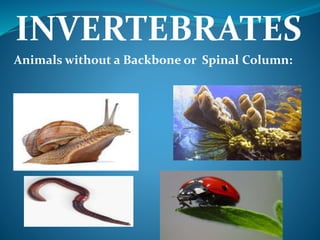
INVERTEBRATES
Animals without a Backbone or Spinal Column:
Different Phyla
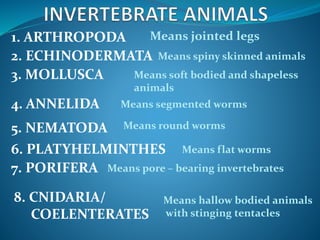
1. ARTHROPODA
3. MOLLUSCA
8. CNIDARIA/
COELENTERATES
7. PORIFERA
6. PLATYHELMINTHES
5. NEMATODA
2. ECHINODERMATA
4. ANNELIDA
Characteristics of Each Groups of Invertebrate
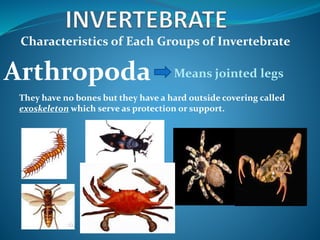
Arthropoda Means jointed legs
They have no bones but they have a hard outside covering called
exoskeleton which serve as protection or support.
ARTHROPODA
CRUSTACEAN
INSECTA
ARACHNIDA
CHILIPODA
DIPLOPODA
Arthropoda) are the largest phylum of animals and include
the insects, arachnids, crustaceans, and other similar creatures.
Insects-
Insects are generally small in size and possess segmented
bodies supported by an exoskeleton made mostly of chitin.
The body is divided into a head, a thorax, and an abdomen.
The head supports a pair of sensory antennae, a pair
ofcompound eyes as well as the mouth; the thorax has six legs
(one pair per segment) and wings (if present in the species).
The abdomen has excretory and reproductive structures.
Arthropoda) are the largest phylum of animals and include
the insects, arachnids, crustaceans, and other similar creatures.
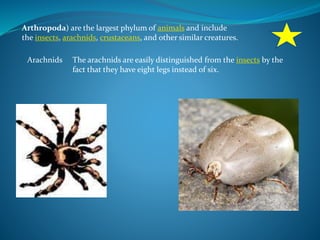
Arachnids The arachnids are easily distinguished from the insects by the
fact that they have eight legs instead of six.
Arthropoda) are the largest phylum of animals and include
the insects, arachnids, crustaceans, and other similar creatures.
Crustaceans They include various familiar animals, such
as lobsters, crabs, shrimp and barnacles. They are
variously found in marine and freshwater, with a few
terrestrial members
Characteristics of Each Groups of Invertebrate
ECHINODERMATA Means spiny skinned animals
Their hard bodies are covered with spines and have a design know as radial
symmetry
Characteristics of Each Groups of Invertebrate
MOLLUSCA Means soft bodied animals
They have soft bodied and are shapeless.
Characteristics of Each Groups of Invertebrate
ANNELIDA Means segmented worms
They live in fresh and marine water as well in the soil.
Characteristics of Each Groups of Invertebrate
NEMATODA Means round worms
They are long slender and smooth. Some of them are parasitic and can be deadly.
Characteristics of Each Groups of Invertebrate
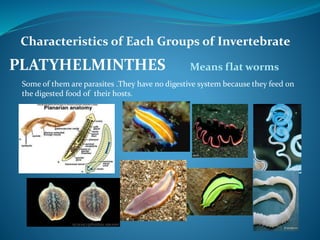
PLATYHELMINTHES Means flat worms
Some of them are parasites .They have no digestive system because they feed on
the digested food of their hosts.
Characteristics of Each Groups of Invertebrate
PORIFERA Means pore – bearing invertebrates
They have pores all over their bodies. They take in food and oxygen through
their pores
Characteristics of Each Groups of Invertebrate
CNIDARIA/COELENTERATA
Means hallow bodied animals with stinging tentacles
Their tentacles have sting cells with poison-filled thread called
nematocysts
NEMATOCYST- A capsule within specialized cells of certain coelenterates a threadlike
tube that delivers a paralyzing sting when propelled into attackers and prey.
1. ARTHROPODA
3. MOLLUSCA
8. CNIDARIA/
COELENTERATES
7. PORIFERA
6. PLATYHELMINTHES
5. NEMATODA
2. ECHINODERMATA
4. ANNELIDA
Means jointed legs
Means spiny skinned animals
Means soft bodied and shapeless
animals
Means segmented worms
Means round worms
Means flat worms
Means pore – bearing invertebrates
Means hallow bodied animals
with stinging tentacles
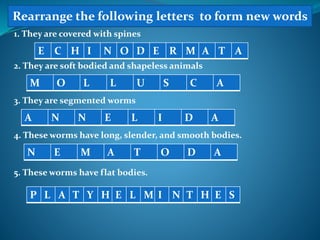
Rearrange the following letters to form new words
1. They are covered with spines
A T A M R E D O N I C H E
2. They are soft bodied and shapeless animals
A C S U L L O M
3. They are segmented worms
A D E N L I N A
4. These worms have long, slender, and smooth bodies.
A D O T A N E M
5. These worms have flat bodies.
S E T H N I M L E H P L A T Y
E C H I N O D E R M A T A
M O L L U S C A
A N N E L I D A
N E M A T O D A
P L A T Y H E L M I N T H E S
Rearrange the following letters to form new words
6. They have pores all over their bodies
7. They are hallow bodied animals with sting tentacles.
A T A R E T N E L E C O
8. The largest phylum and they have jointed legs.
R A P E R I F OP O R I F E R A
C O E L E N T E R A T A
R O H O T A R P A DA R T H R O P O D A
1. ARTHROPODA
3. MOLLUSCA
8. CNIDARIA/
COELENTERATES
7. PORIFERA
6. PLATYHELMINTES
5. NEMATODA
2. ECHINODERMATA
4. ANNELIDA

Invertebrates

  • 1.
    INVERTEBRATES Animals without aBackbone or Spinal Column:
  • 2.
    Different Phyla 1. ARTHROPODA 3.MOLLUSCA 8. CNIDARIA/ COELENTERATES 7. PORIFERA 6. PLATYHELMINTHES 5. NEMATODA 2. ECHINODERMATA 4. ANNELIDA
  • 3.
    Characteristics of EachGroups of Invertebrate Arthropoda Means jointed legs They have no bones but they have a hard outside covering called exoskeleton which serve as protection or support.
  • 4.
  • 5.
    Arthropoda) are thelargest phylum of animals and include the insects, arachnids, crustaceans, and other similar creatures. Insects- Insects are generally small in size and possess segmented bodies supported by an exoskeleton made mostly of chitin. The body is divided into a head, a thorax, and an abdomen. The head supports a pair of sensory antennae, a pair ofcompound eyes as well as the mouth; the thorax has six legs (one pair per segment) and wings (if present in the species). The abdomen has excretory and reproductive structures.
  • 6.
    Arthropoda) are thelargest phylum of animals and include the insects, arachnids, crustaceans, and other similar creatures. Arachnids The arachnids are easily distinguished from the insects by the fact that they have eight legs instead of six.
  • 7.
    Arthropoda) are thelargest phylum of animals and include the insects, arachnids, crustaceans, and other similar creatures. Crustaceans They include various familiar animals, such as lobsters, crabs, shrimp and barnacles. They are variously found in marine and freshwater, with a few terrestrial members
  • 8.
    Characteristics of EachGroups of Invertebrate ECHINODERMATA Means spiny skinned animals Their hard bodies are covered with spines and have a design know as radial symmetry
  • 9.
    Characteristics of EachGroups of Invertebrate MOLLUSCA Means soft bodied animals They have soft bodied and are shapeless.
  • 10.
    Characteristics of EachGroups of Invertebrate ANNELIDA Means segmented worms They live in fresh and marine water as well in the soil.
  • 11.
    Characteristics of EachGroups of Invertebrate NEMATODA Means round worms They are long slender and smooth. Some of them are parasitic and can be deadly.
  • 12.
    Characteristics of EachGroups of Invertebrate PLATYHELMINTHES Means flat worms Some of them are parasites .They have no digestive system because they feed on the digested food of their hosts.
  • 13.
    Characteristics of EachGroups of Invertebrate PORIFERA Means pore – bearing invertebrates They have pores all over their bodies. They take in food and oxygen through their pores
  • 14.
    Characteristics of EachGroups of Invertebrate CNIDARIA/COELENTERATA Means hallow bodied animals with stinging tentacles Their tentacles have sting cells with poison-filled thread called nematocysts NEMATOCYST- A capsule within specialized cells of certain coelenterates a threadlike tube that delivers a paralyzing sting when propelled into attackers and prey.
  • 17.
    1. ARTHROPODA 3. MOLLUSCA 8.CNIDARIA/ COELENTERATES 7. PORIFERA 6. PLATYHELMINTHES 5. NEMATODA 2. ECHINODERMATA 4. ANNELIDA Means jointed legs Means spiny skinned animals Means soft bodied and shapeless animals Means segmented worms Means round worms Means flat worms Means pore – bearing invertebrates Means hallow bodied animals with stinging tentacles
  • 18.
    Rearrange the followingletters to form new words 1. They are covered with spines A T A M R E D O N I C H E 2. They are soft bodied and shapeless animals A C S U L L O M 3. They are segmented worms A D E N L I N A 4. These worms have long, slender, and smooth bodies. A D O T A N E M 5. These worms have flat bodies. S E T H N I M L E H P L A T Y E C H I N O D E R M A T A M O L L U S C A A N N E L I D A N E M A T O D A P L A T Y H E L M I N T H E S
  • 19.
    Rearrange the followingletters to form new words 6. They have pores all over their bodies 7. They are hallow bodied animals with sting tentacles. A T A R E T N E L E C O 8. The largest phylum and they have jointed legs. R A P E R I F OP O R I F E R A C O E L E N T E R A T A R O H O T A R P A DA R T H R O P O D A
  • 20.
    1. ARTHROPODA 3. MOLLUSCA 8.CNIDARIA/ COELENTERATES 7. PORIFERA 6. PLATYHELMINTES 5. NEMATODA 2. ECHINODERMATA 4. ANNELIDA