Ecology I Community Ecology
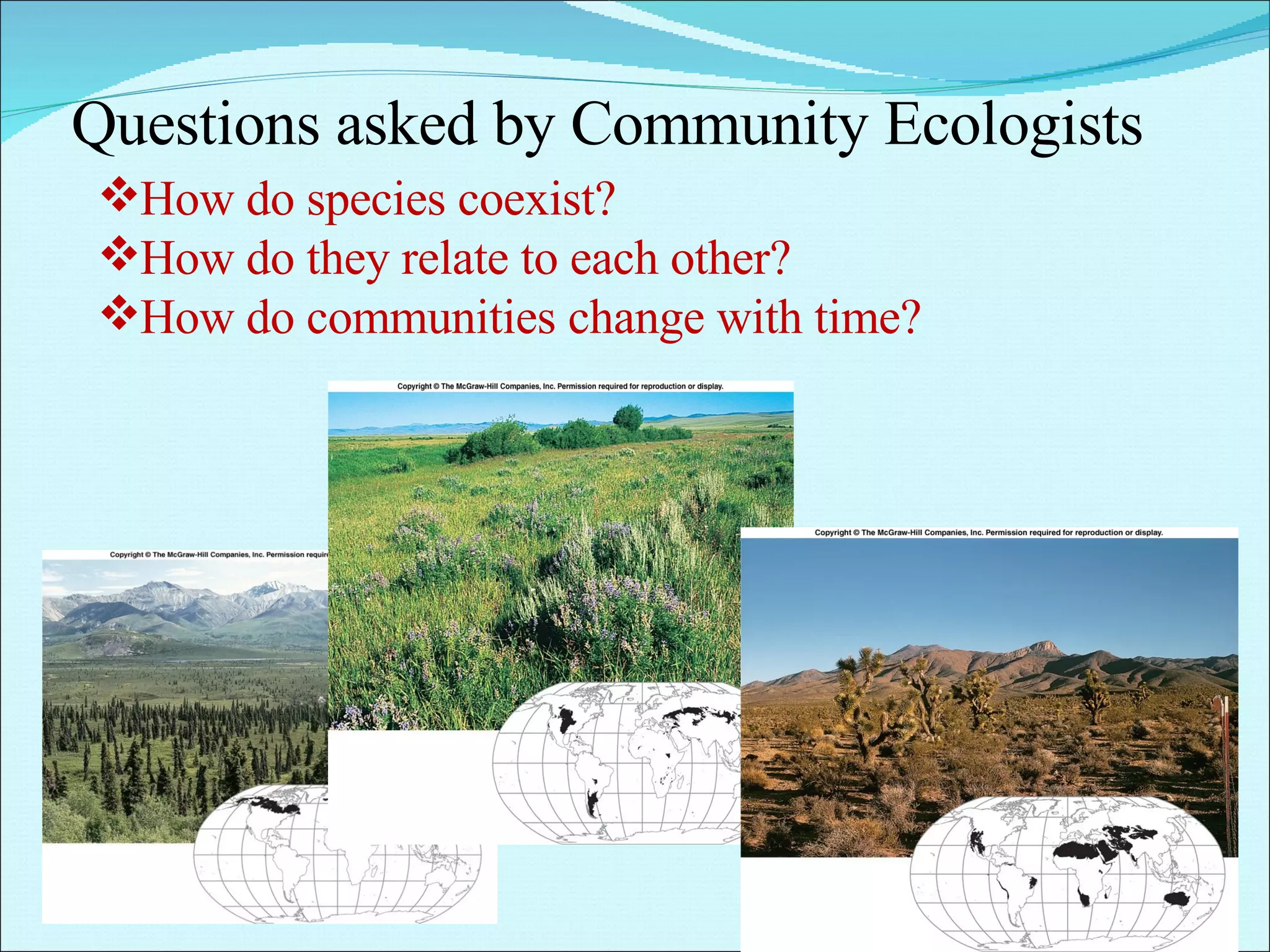
Questions asked by Community Ecologists How do species coexist? How do they relate to each other? How do communities change with time?
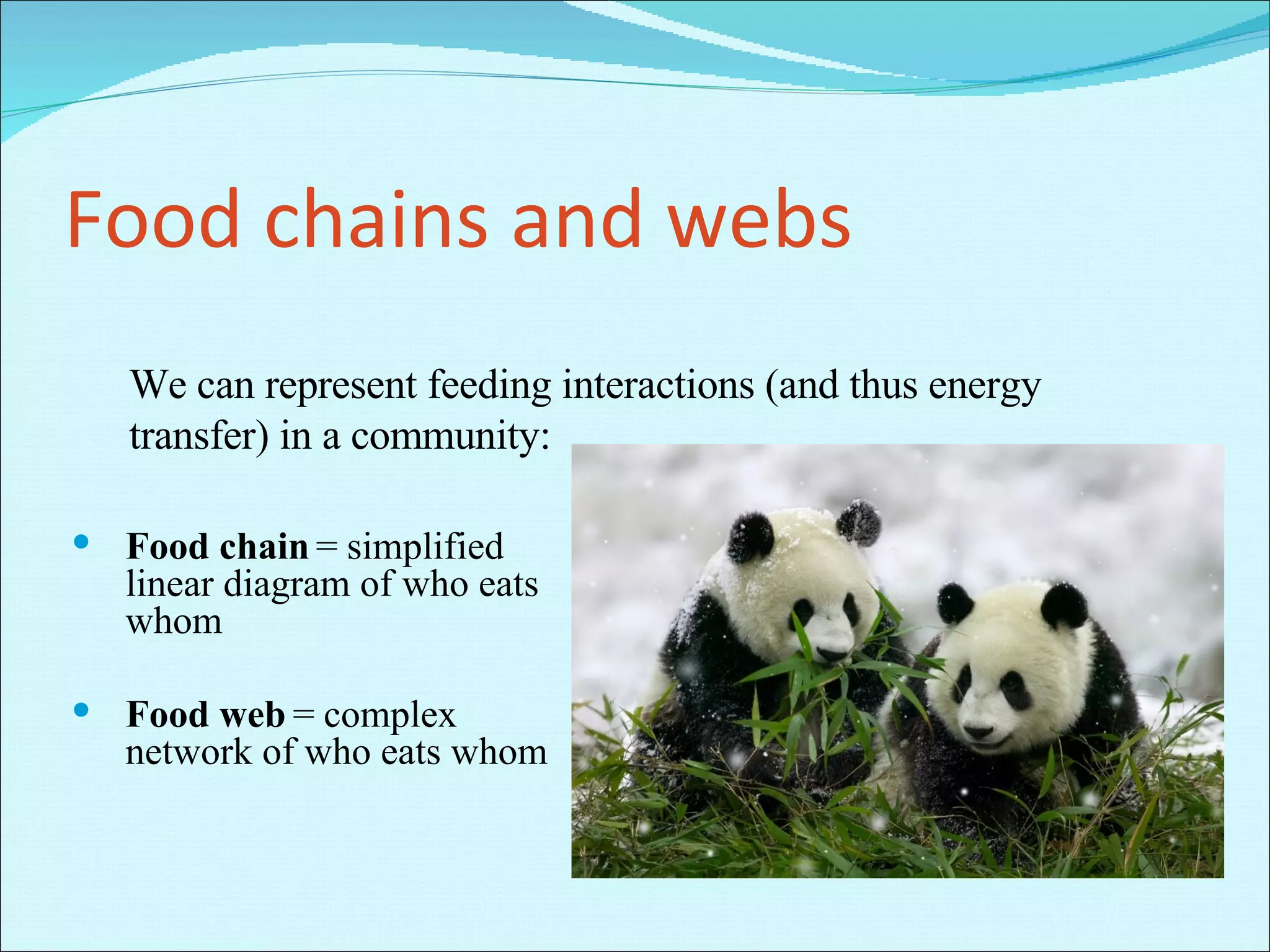
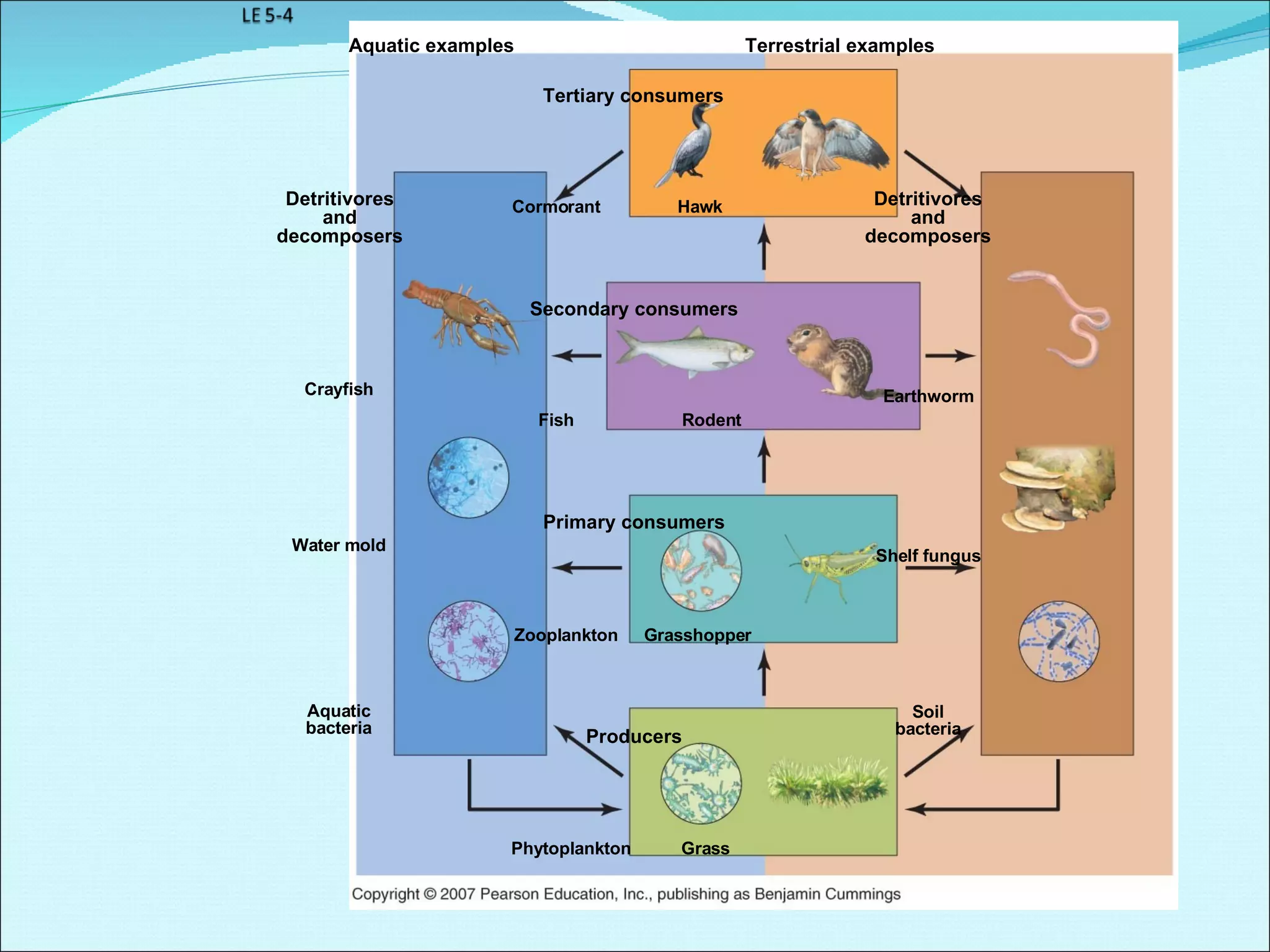
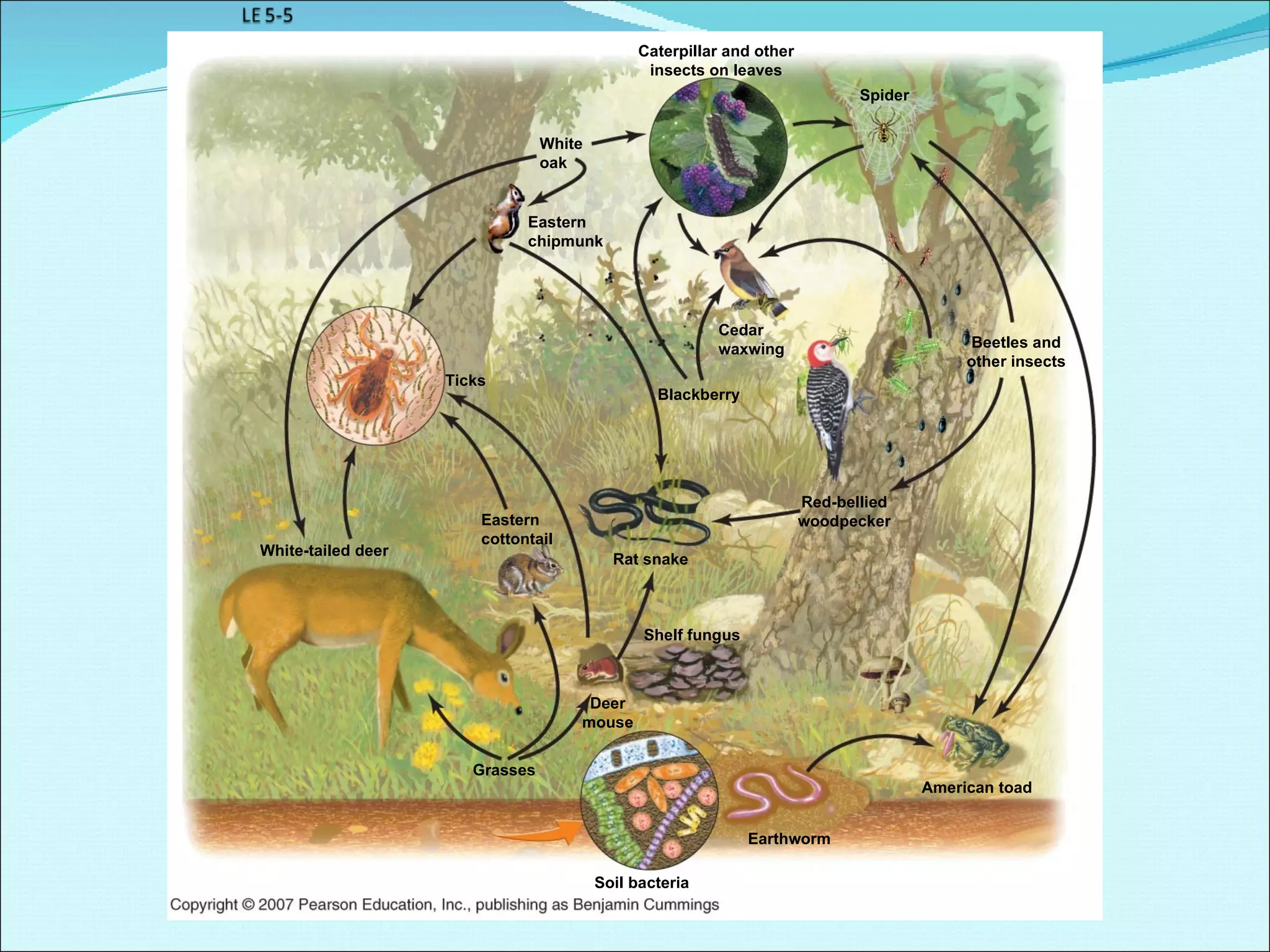
Food chains and webs Food chain  =   simplified linear diagram of who eats whom Food web  = complex network of who eats whom We can represent feeding interactions (and thus energy transfer) in a community:
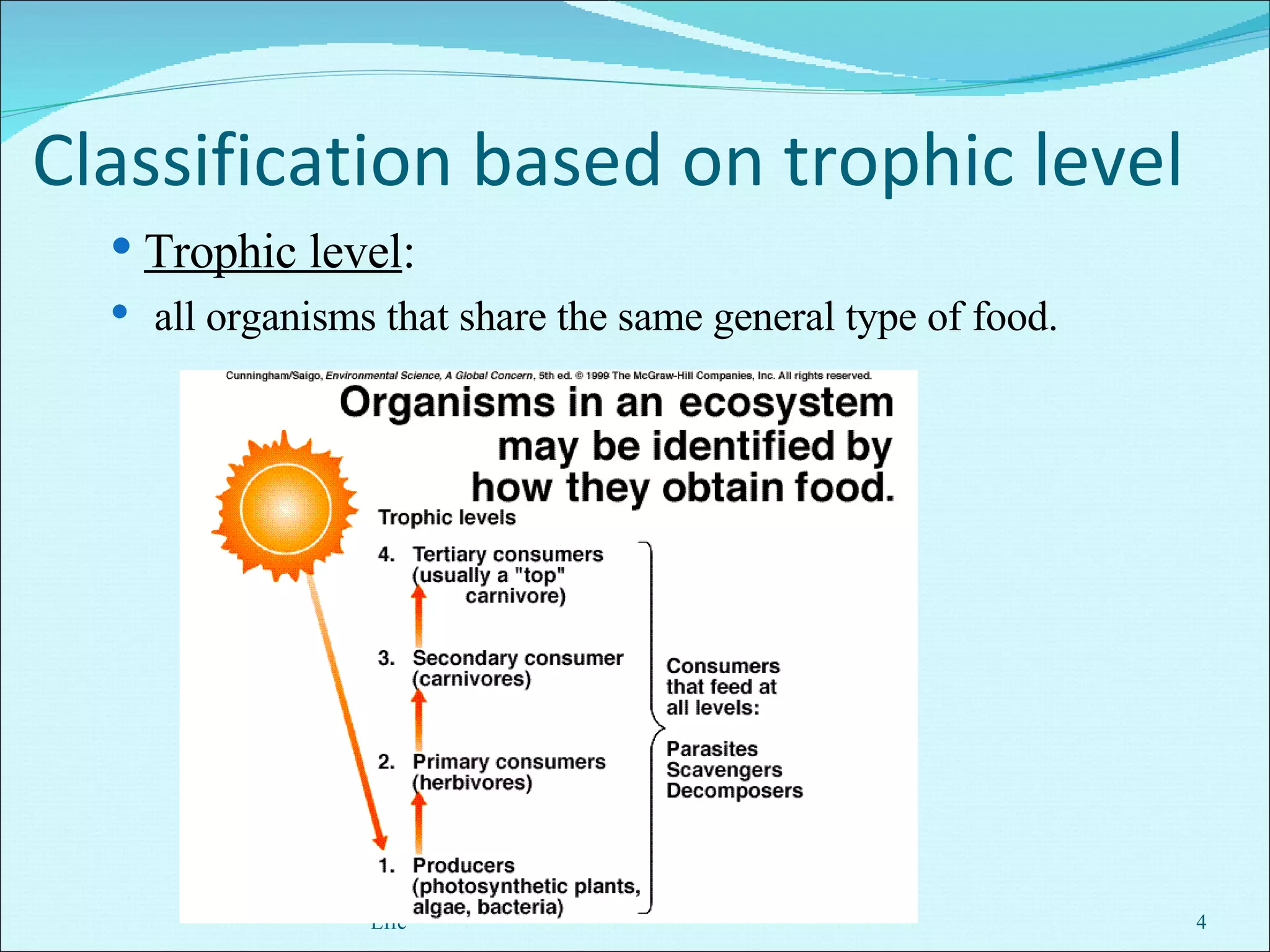
Classification based on trophic level  Trophic level :  all organisms that share the same general type of food. Unit 2:  Ecology 1:  Principles of Matter, Energy and LIfe
Aquatic examples Terrestrial examples Detritivores and decomposers Crayfish Water mold Aquatic bacteria Tertiary consumers Cormorant Hawk Secondary consumers Fish Rodent Primary consumers Zooplankton Grasshopper Producers Phytoplankton Grass Detritivores and decomposers Earthworm Shelf fungus Soil bacteria
White oak Caterpillar and other insects on leaves Spider Eastern chipmunk Cedar waxwing Beetles and other insects Blackberry Ticks Eastern cottontail White-tailed deer Rat snake Red-bellied woodpecker Shelf fungus Deer mouse Grasses Earthworm Soil bacteria American toad
Community Disturbance Natural vs. Human Caused
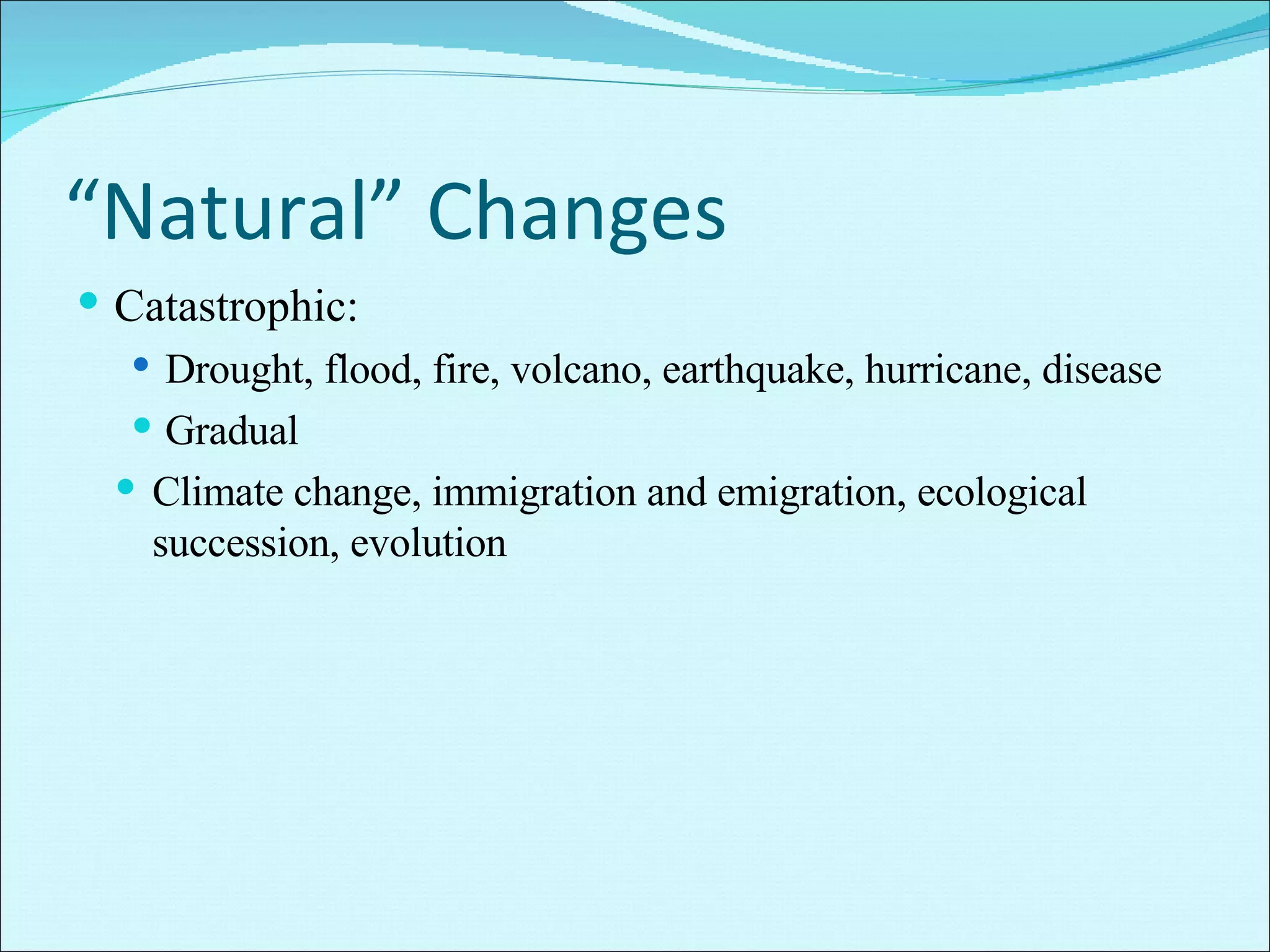
“ Natural” Changes Catastrophic: Drought, flood, fire, volcano, earthquake, hurricane, disease Gradual Climate change, immigration and emigration, ecological succession, evolution
Human-caused Changes Catastrophic: Deforestation, overgrazing, soil erosion, pesticides, urbanization, mining, toxic releases, etc. Gradual Habitat loss, introduced species, overharvesting, pest control, salinization, waterlogging, compaction
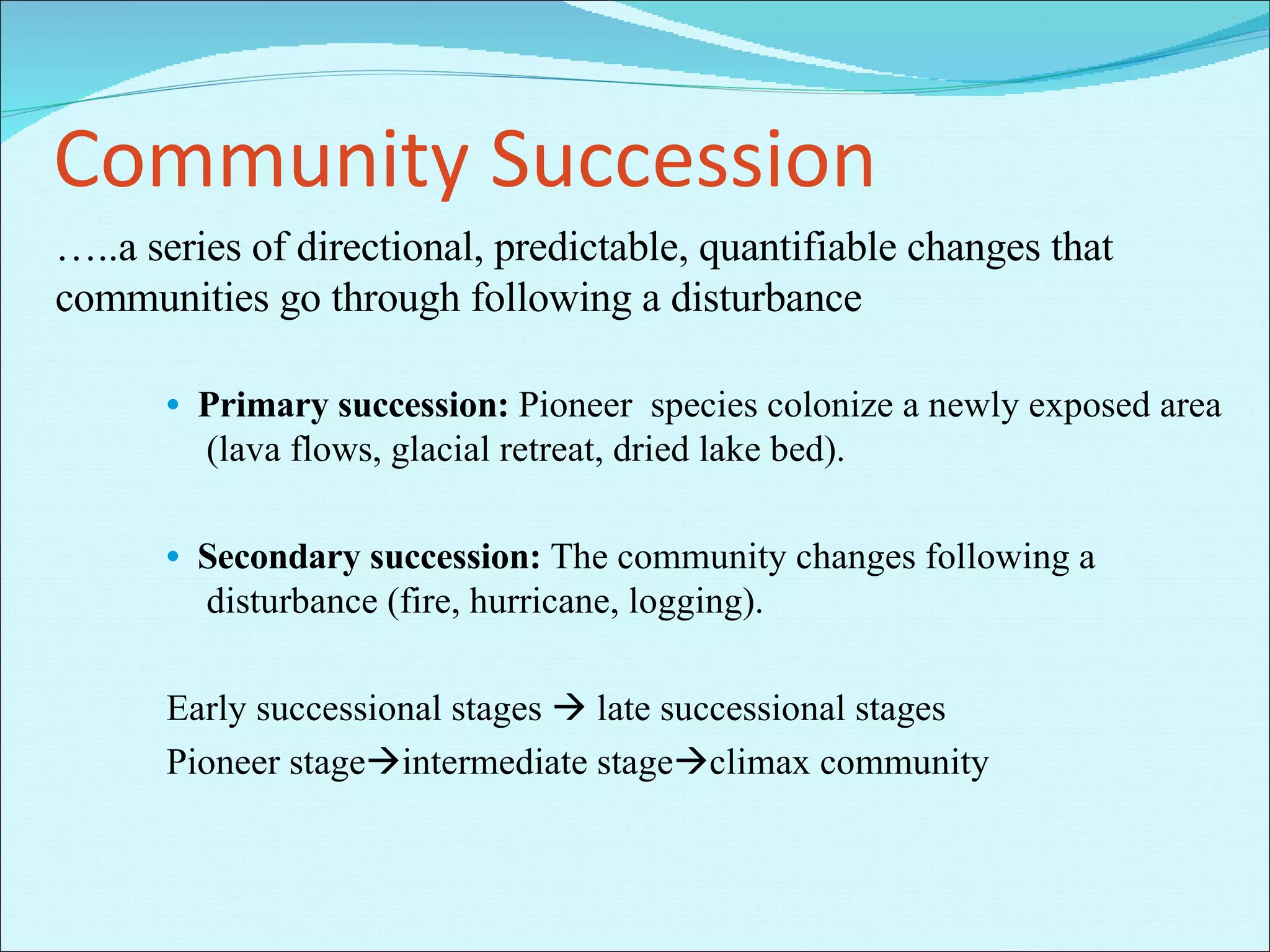
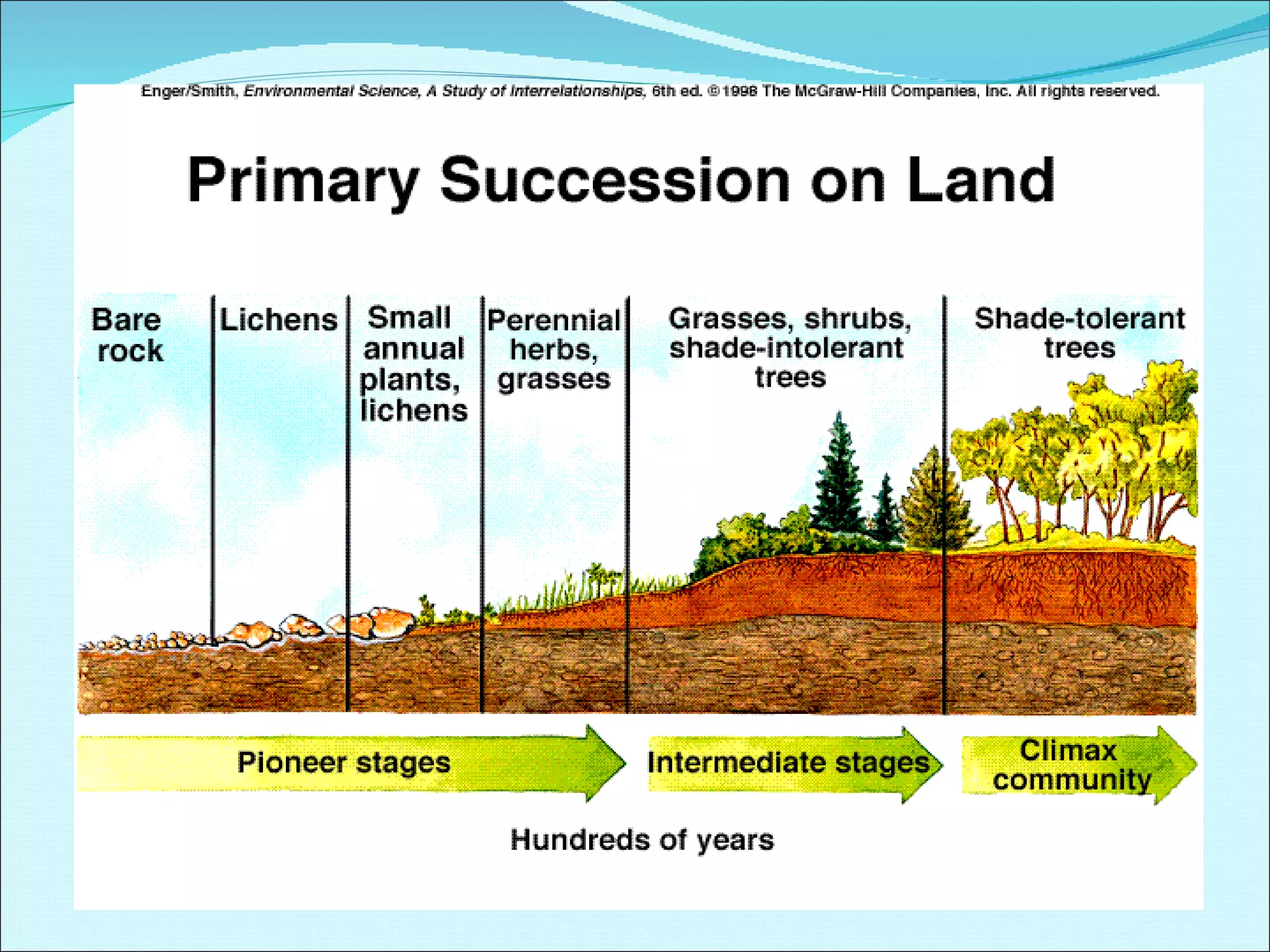
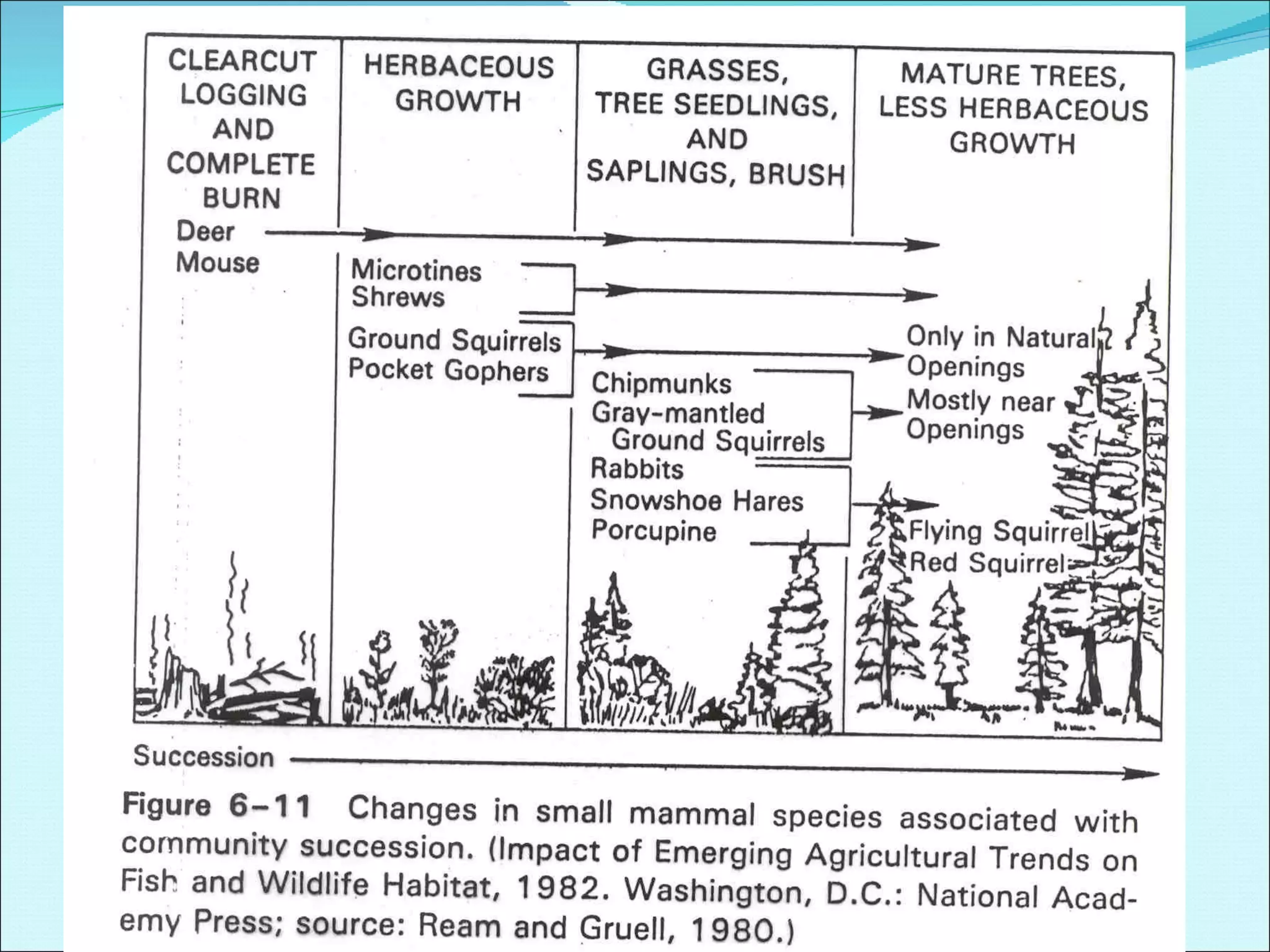
Community Succession … ..a series of directional, predictable, quantifiable changes that communities go through following a disturbance •   Primary succession:  Pioneer  species colonize a newly exposed area (lava flows, glacial retreat, dried lake bed). •   Secondary succession:  The community changes following a disturbance (fire, hurricane, logging). Early successional stages    late successional stages Pioneer stage  intermediate stage  climax community
 
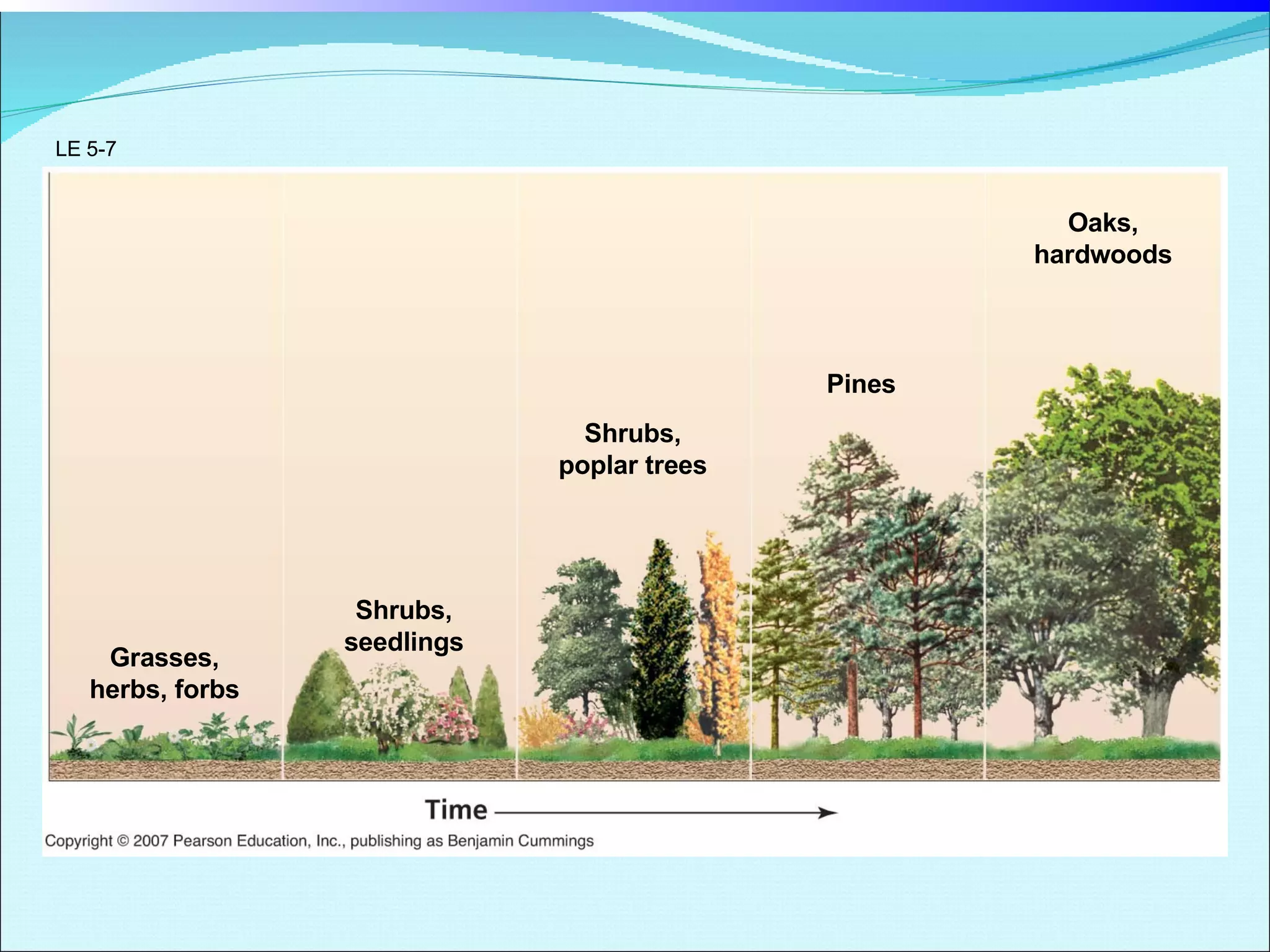
Secondary terrestrial succession Grasses, herbs, forbs Shrubs, seedlings Shrubs, poplar trees Pines Oaks, hardwoods LE 5-7
 
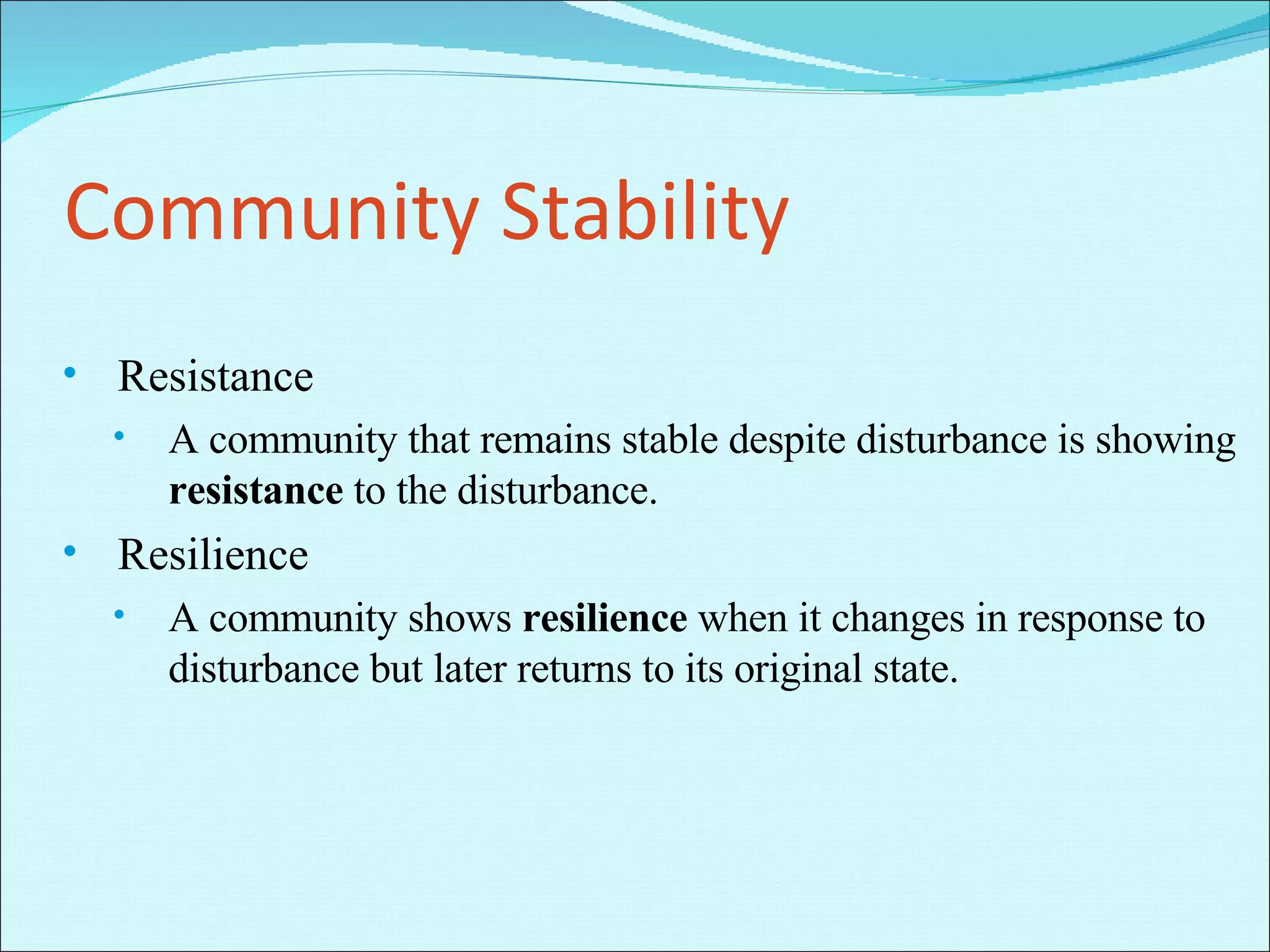
Community Stability Resistance A community that remains stable despite disturbance is showing  resistance  to the disturbance. Resilience A community shows  resilience  when it changes in response to disturbance but later returns to its original state.
Community Organizers Keystone species Ecosystem Engineer Foundation Species
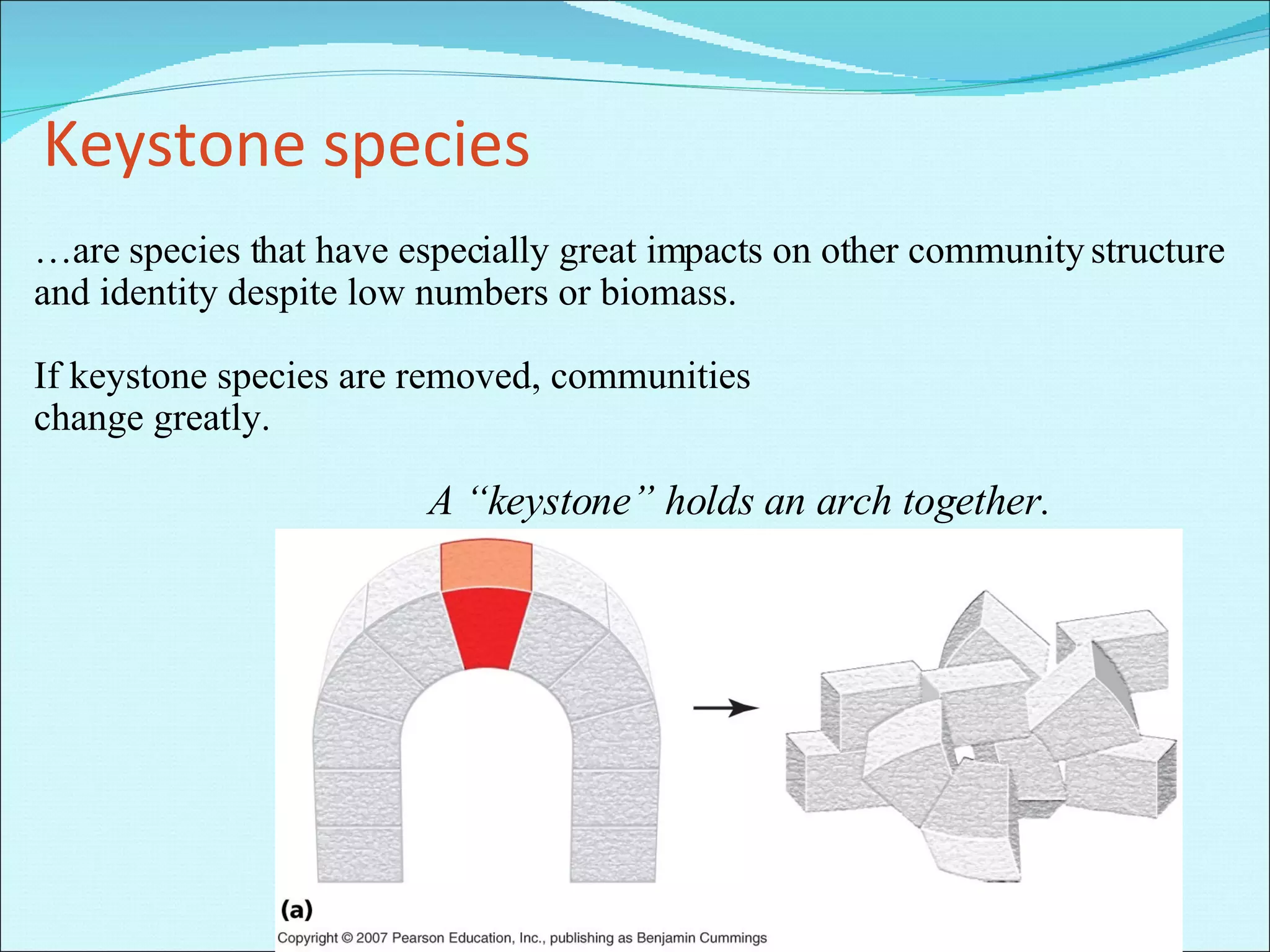
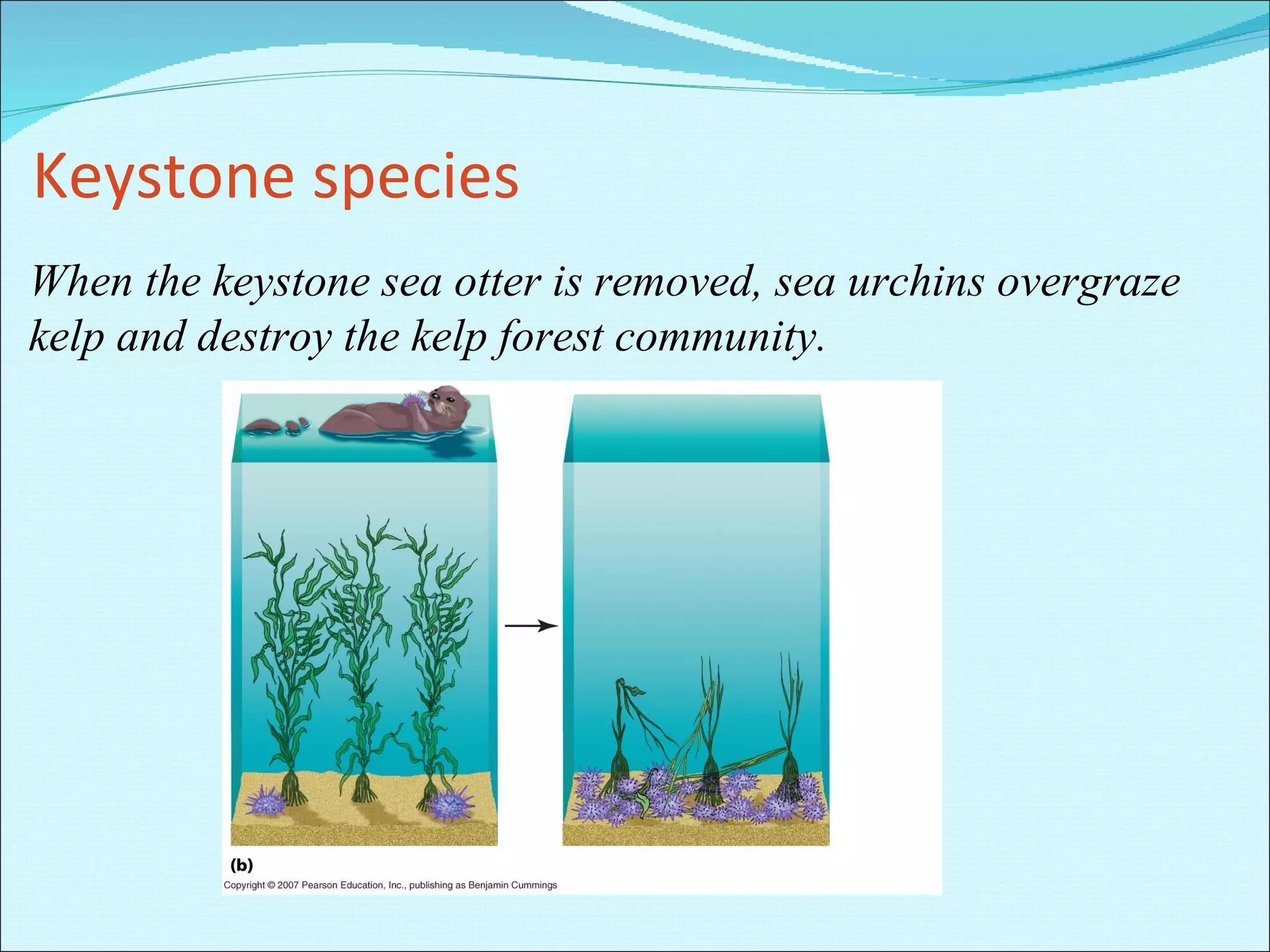
Keystone species … are species that have especially great impacts on other community structure and identity despite low numbers or biomass. If keystone species are removed, communities  change greatly. A “keystone” holds an arch together.
Keystone species When the keystone sea otter is removed, sea urchins overgraze kelp and destroy the kelp forest community.
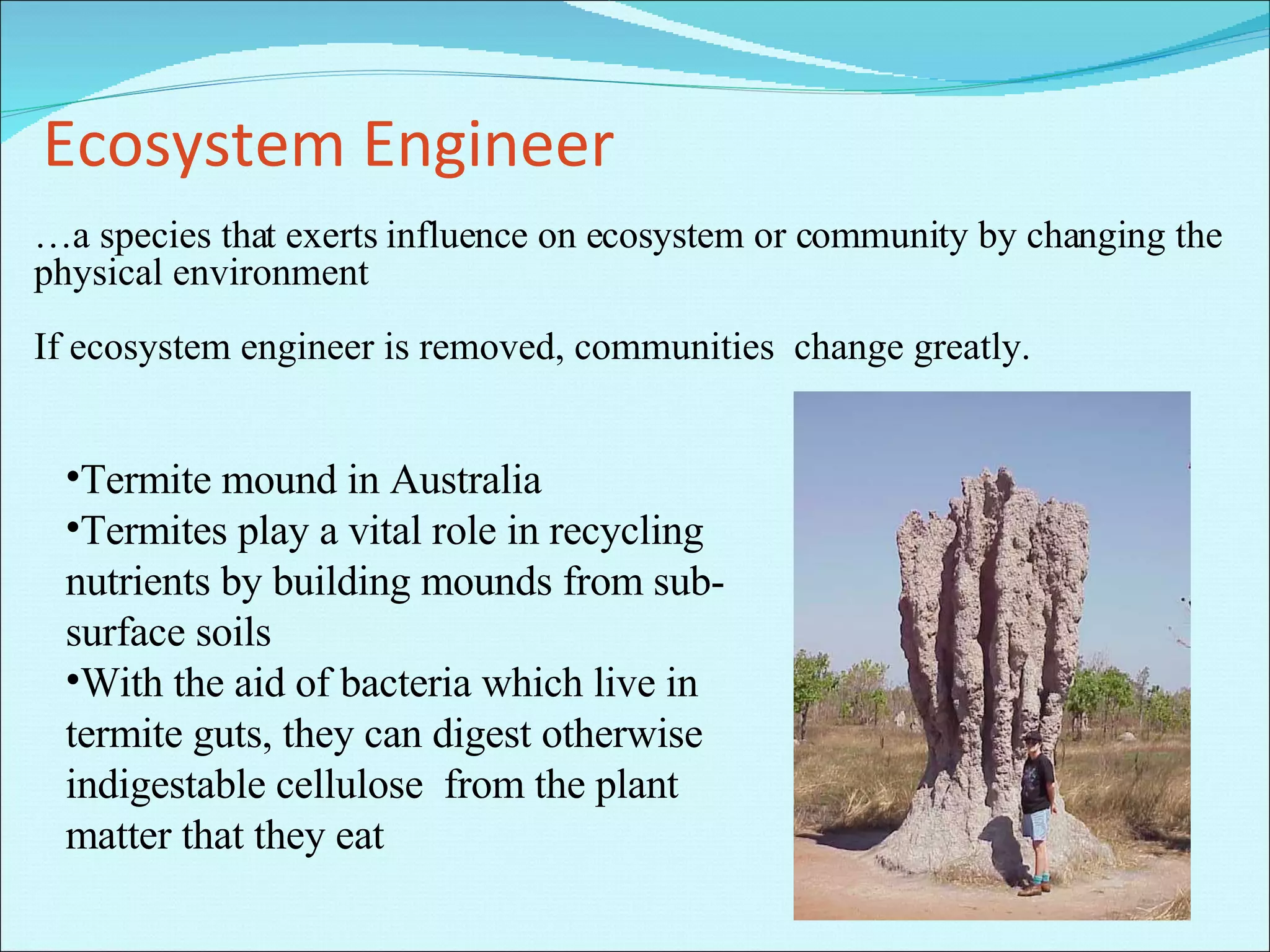
Ecosystem Engineer … a species that exerts influence on ecosystem or community by changing the physical environment If ecosystem engineer is removed, communities  change greatly. Termite mound in Australia Termites play a vital role in recycling nutrients by building mounds from sub-surface soils  With the aid of bacteria which live in termite guts, they can digest otherwise indigestable cellulose  from the plant matter that they eat
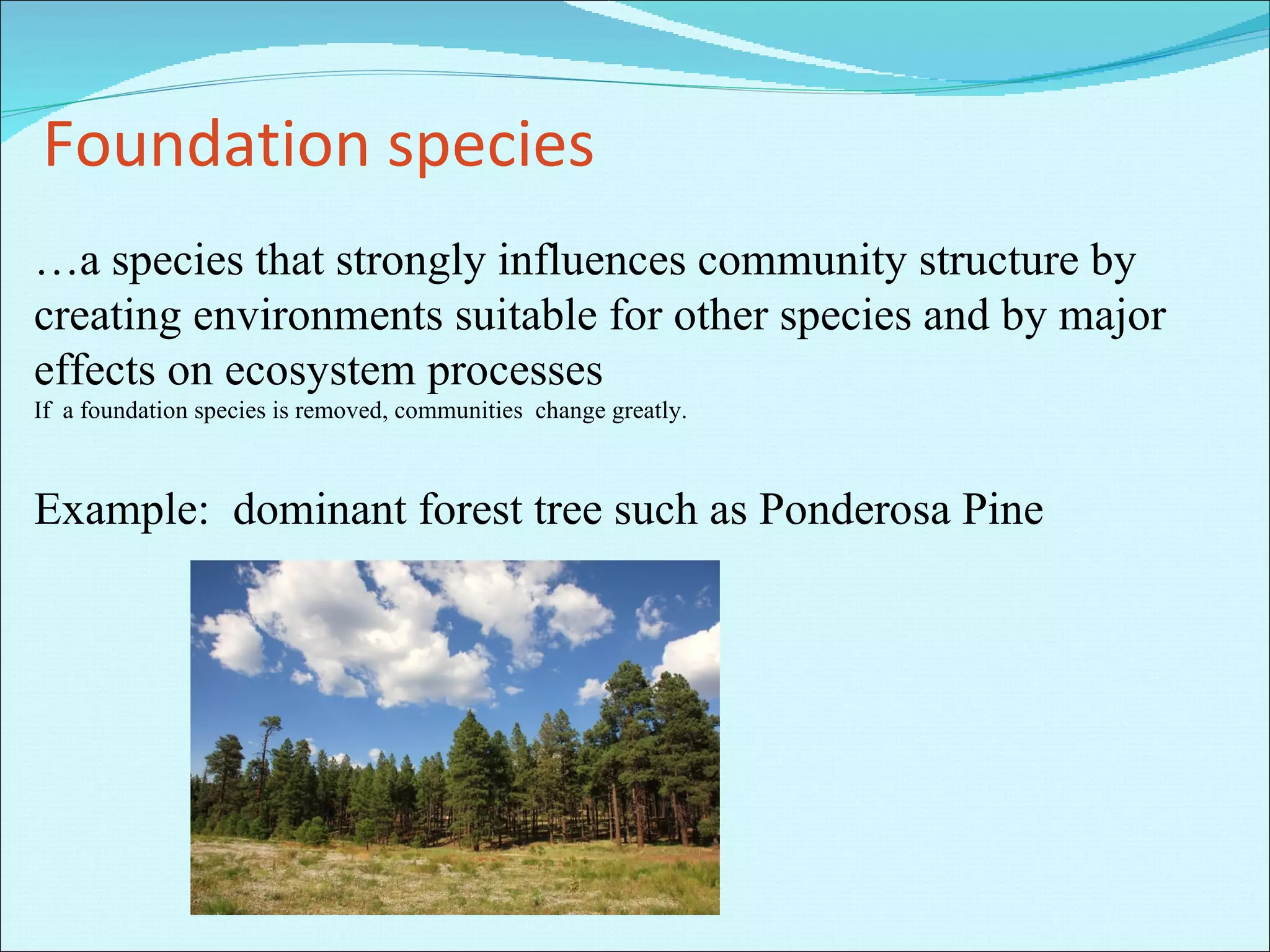
Foundation species … a species that strongly influences community structure by creating environments suitable for other species and by major effects on ecosystem processes If  a foundation species is removed, communities  change greatly. Example:  dominant forest tree such as Ponderosa Pine
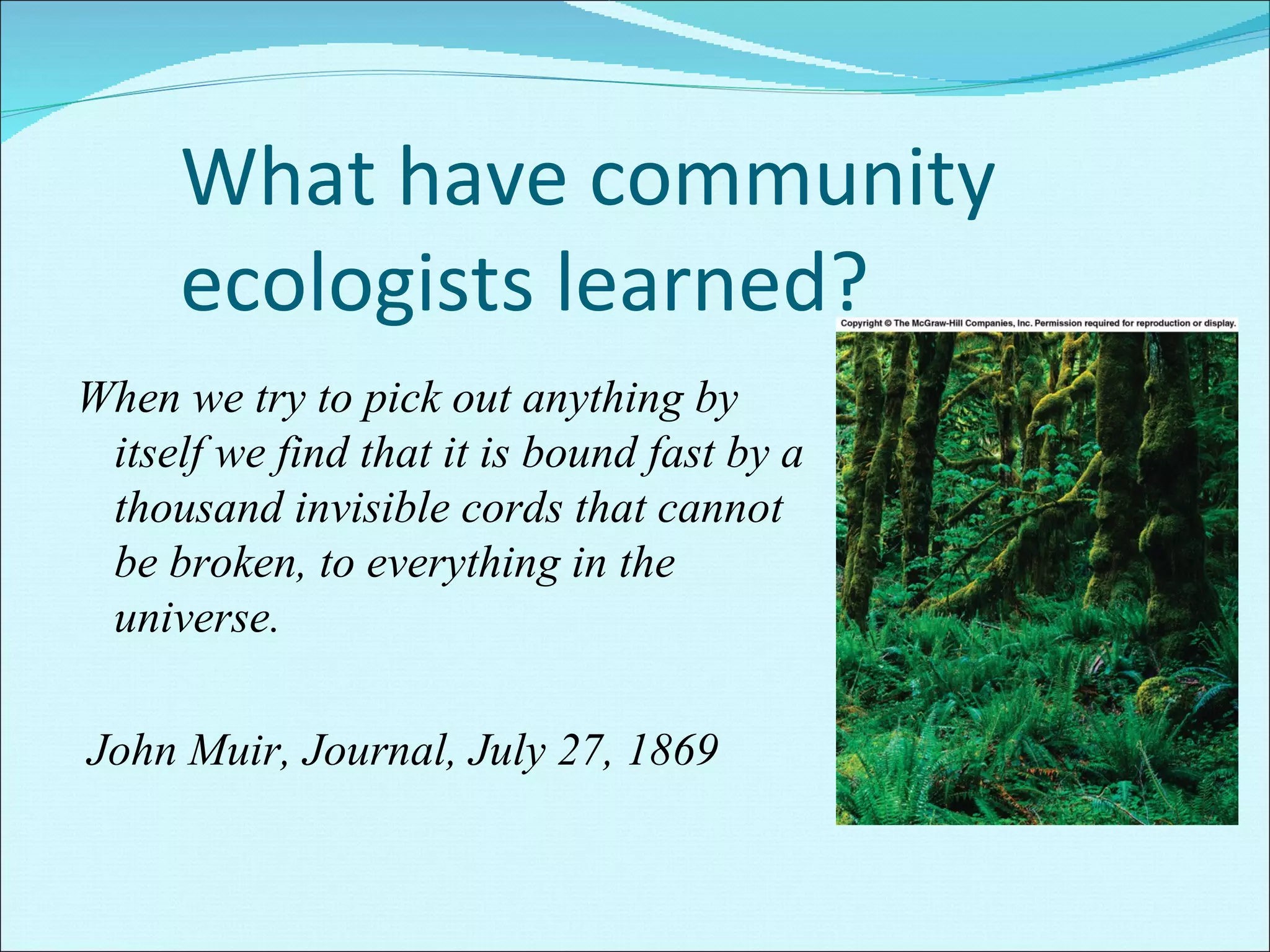
What have community ecologists learned? When we try to pick out anything by itself we find that it is bound fast by a thousand invisible cords that cannot be broken, to everything in the universe.  John Muir, Journal, July 27, 1869

Unit2 Ecology Ic Communities

  • 1.
  • 2.
    Questions asked byCommunity Ecologists How do species coexist? How do they relate to each other? How do communities change with time?
  • 3.
    Food chains andwebs Food chain = simplified linear diagram of who eats whom Food web = complex network of who eats whom We can represent feeding interactions (and thus energy transfer) in a community:
  • 4.
    Classification based ontrophic level Trophic level : all organisms that share the same general type of food. Unit 2: Ecology 1: Principles of Matter, Energy and LIfe
  • 5.
    Aquatic examples Terrestrialexamples Detritivores and decomposers Crayfish Water mold Aquatic bacteria Tertiary consumers Cormorant Hawk Secondary consumers Fish Rodent Primary consumers Zooplankton Grasshopper Producers Phytoplankton Grass Detritivores and decomposers Earthworm Shelf fungus Soil bacteria
  • 6.
    White oak Caterpillarand other insects on leaves Spider Eastern chipmunk Cedar waxwing Beetles and other insects Blackberry Ticks Eastern cottontail White-tailed deer Rat snake Red-bellied woodpecker Shelf fungus Deer mouse Grasses Earthworm Soil bacteria American toad
  • 7.
  • 8.
    “ Natural” ChangesCatastrophic: Drought, flood, fire, volcano, earthquake, hurricane, disease Gradual Climate change, immigration and emigration, ecological succession, evolution
  • 9.
    Human-caused Changes Catastrophic:Deforestation, overgrazing, soil erosion, pesticides, urbanization, mining, toxic releases, etc. Gradual Habitat loss, introduced species, overharvesting, pest control, salinization, waterlogging, compaction
  • 10.
    Community Succession …..a series of directional, predictable, quantifiable changes that communities go through following a disturbance • Primary succession: Pioneer species colonize a newly exposed area (lava flows, glacial retreat, dried lake bed). • Secondary succession: The community changes following a disturbance (fire, hurricane, logging). Early successional stages  late successional stages Pioneer stage  intermediate stage  climax community
  • 11.
  • 12.
    Secondary terrestrial successionGrasses, herbs, forbs Shrubs, seedlings Shrubs, poplar trees Pines Oaks, hardwoods LE 5-7
  • 13.
  • 14.
    Community Stability ResistanceA community that remains stable despite disturbance is showing resistance to the disturbance. Resilience A community shows resilience when it changes in response to disturbance but later returns to its original state.
  • 15.
    Community Organizers Keystonespecies Ecosystem Engineer Foundation Species
  • 16.
    Keystone species …are species that have especially great impacts on other community structure and identity despite low numbers or biomass. If keystone species are removed, communities change greatly. A “keystone” holds an arch together.
  • 17.
    Keystone species Whenthe keystone sea otter is removed, sea urchins overgraze kelp and destroy the kelp forest community.
  • 18.
    Ecosystem Engineer …a species that exerts influence on ecosystem or community by changing the physical environment If ecosystem engineer is removed, communities change greatly. Termite mound in Australia Termites play a vital role in recycling nutrients by building mounds from sub-surface soils With the aid of bacteria which live in termite guts, they can digest otherwise indigestable cellulose from the plant matter that they eat
  • 19.
    Foundation species …a species that strongly influences community structure by creating environments suitable for other species and by major effects on ecosystem processes If a foundation species is removed, communities change greatly. Example: dominant forest tree such as Ponderosa Pine
  • 20.
    What have communityecologists learned? When we try to pick out anything by itself we find that it is bound fast by a thousand invisible cords that cannot be broken, to everything in the universe. John Muir, Journal, July 27, 1869