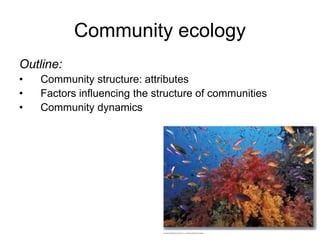
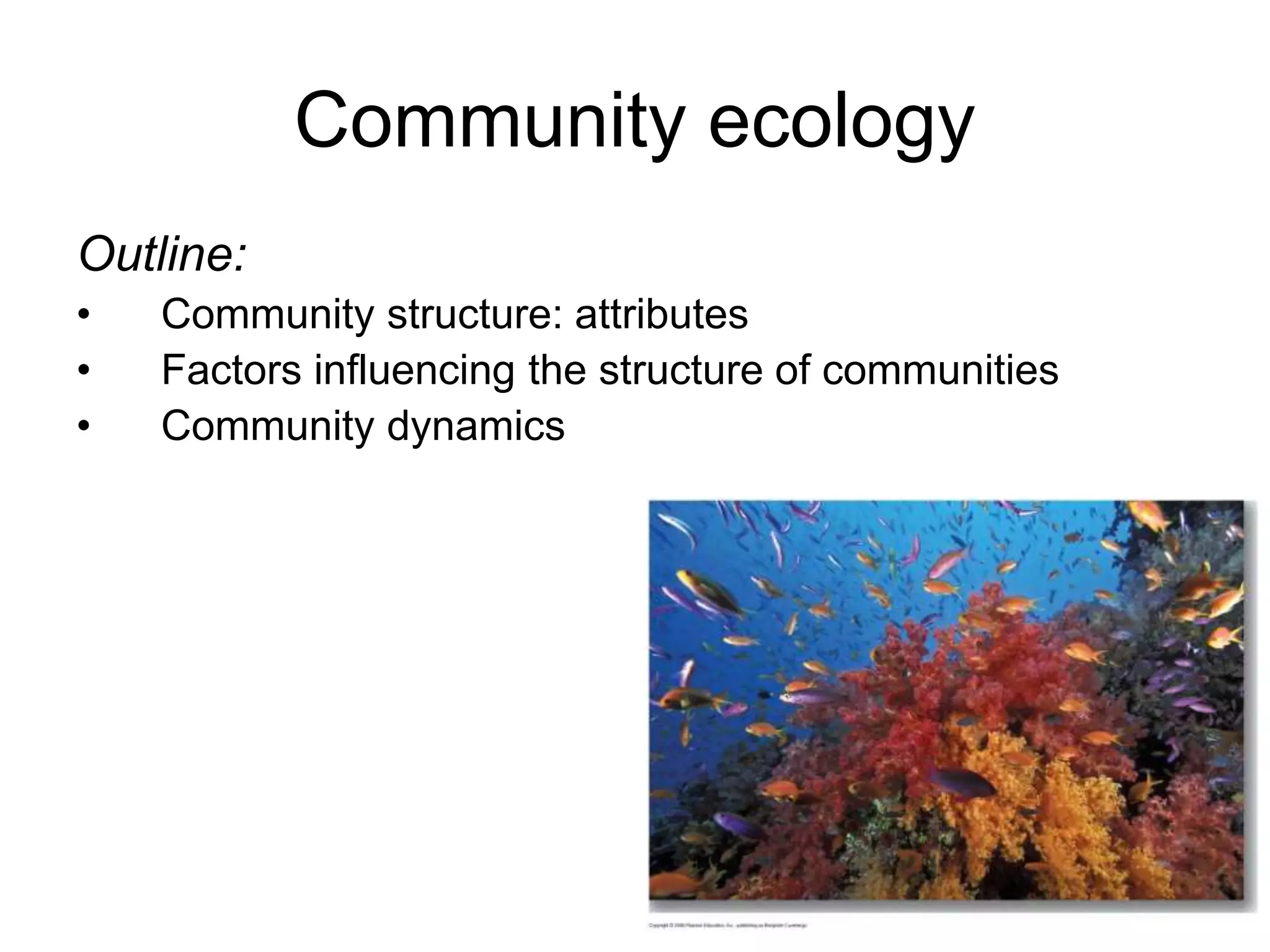
Community ecology
Outline:
• Community structure: attributes
• Factors influencing the structure of communities
• Community dynamics
Community attributes
• Numbers of species
• Relative abundance of species
• Nature of species interactions (food webs)
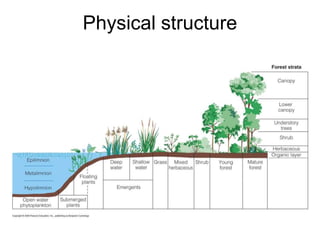
• Physical structure
Community structure
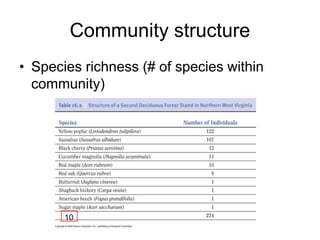
• Species richness (# of species within
community)
10
Community structure
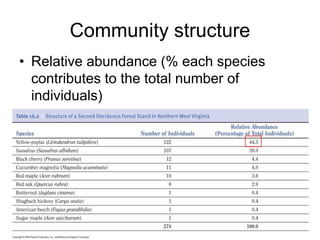
• Relative abundance (% each species
contributes to the total number of
individuals)
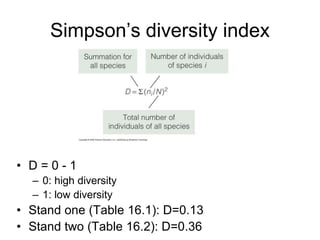
Simpson’s diversity index
• D = 0 - 1
– 0: high diversity
– 1: low diversity
• Stand one (Table 16.1): D=0.13
• Stand two (Table 16.2): D=0.36
Functional groups
• Feeding level
• Exploitation of common resources (guilds)
• Photosynthetic pathway
• Shade tolerance
• Life history
Physical structure
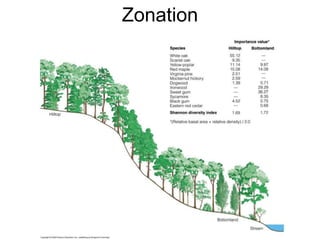
Zonation
Association
• Relatively consistent species composition
• Uniform general appearance
• Distribution that is characteristic of a
particular habitat
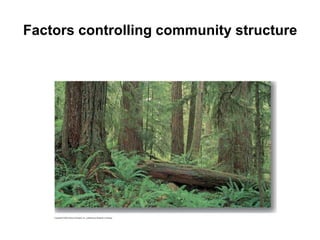
Factors controlling community structure
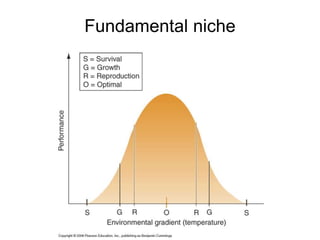
Fundamental niche
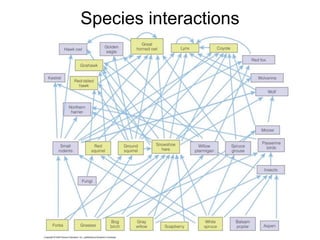
Species interactions
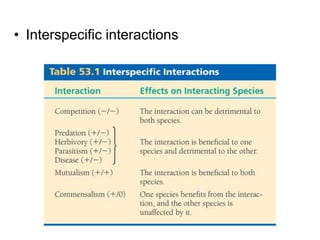
• Interspecific interactions
Predation
• Predation refers to an interaction
– Where one species, the predator, kills and eats
the other, the prey
• Feeding adaptations of predators include
– Claws, teeth, fangs, stingers, and poison
• Animals also display
– A great variety of defensive adaptations
Herbivory
• Herbivory, the process in which an herbivore
eats parts of a plant
– Has led to the evolution of plant mechanical and
chemical defenses and consequent adaptations
by herbivores
Parasitism
• In parasitism, one organism, the parasite
– Derives its nourishment from another organism,
its host, which is harmed in the process
Disease
• The effects of disease on populations and
communities
– Is similar to that of parasites
• Pathogens, disease-causing agents
– Are typically bacteria, viruses, or protists
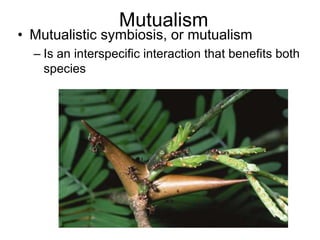
Mutualism
• Mutualistic symbiosis, or mutualism
– Is an interspecific interaction that benefits both
species
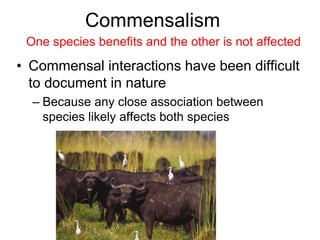
Commensalism
One species benefits and the other is not affected
• Commensal interactions have been difficult
to document in nature
– Because any close association between
species likely affects both species
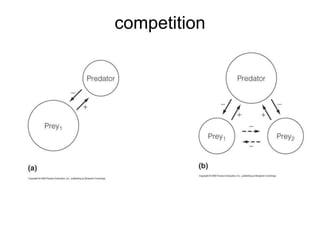
competition
Species Diversity
• The species diversity of a community
– Is the variety of different kinds of organisms that
make up the community
– Has two components
• Species richness
– Is the total number of different species in the
community
• Relative abundance
– Is the proportion each species represents of the
total individuals in the community
Dominant Species
• Dominant species
– Are those species in a community that are most
abundant or have the highest biomass
– Exert powerful control over the occurrence and
distribution of other species
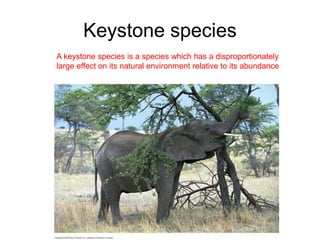
Keystone species
A keystone species is a species which has a disproportionately
large effect on its natural environment relative to its abundance
Keystone Species
– Are not necessarily abundant in a community
– Exert strong control on a community by their
ecological roles, or niches
Ecosystem “Engineers”
(Foundation Species)
• Some organisms exert their influence
– By causing physical changes in the environment
that affect community structure
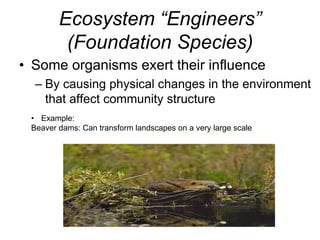
• Example:
Beaver dams: Can transform landscapes on a very large scale
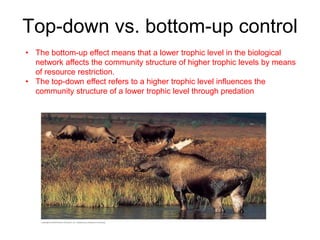
Top-down vs. bottom-up control
• The bottom-up effect means that a lower trophic level in the biological
network affects the community structure of higher trophic levels by means
of resource restriction.
• The top-down effect refers to a higher trophic level influences the
community structure of a lower trophic level through predation
Bottom-Up Controls
• The bottom-up model of community
organization
– Proposes a unidirectional influence from lower
to higher trophic levels
• In this case, the presence or absence of
abiotic nutrients
– Determines community structure, including the
abundance of primary producers
Top-Down Controls
• The top-down model of community
organization
– Proposes that control comes from the trophic
level above
• In this case, predators control herbivores
– Which in turn control primary producers
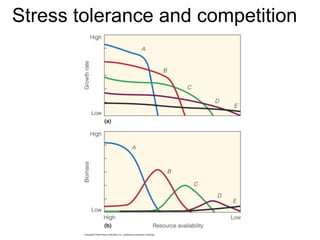
Stress tolerance and competition
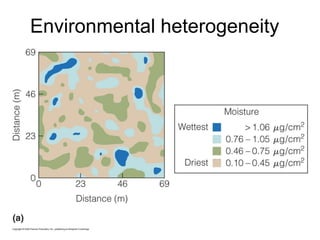
Environmental heterogeneity
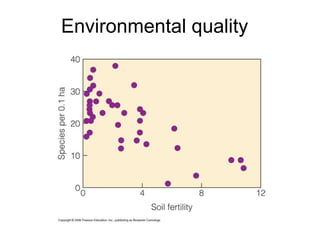
Environmental quality
Community stability
Types of stability:
1. Resilient community: returns to former
state after disturbance
2. Resistant community: changes little in
response to disturbance
What Is Disturbance?
• A disturbance
– Is an event that changes a community
– Removes organisms from a community
– Alters resource availability
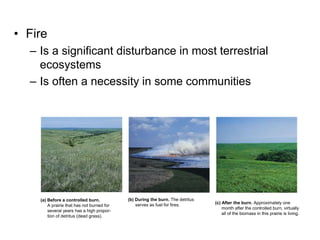
• Fire
– Is a significant disturbance in most terrestrial
ecosystems
– Is often a necessity in some communities
(a) Before a controlled burn.
A prairie that has not burned for
several years has a high propor-
tion of detritus (dead grass).
(b) During the burn. The detritus
serves as fuel for fires. (c) After the burn. Approximately one
month after the controlled burn, virtually
all of the biomass in this prairie is living.
Human Disturbance
• Humans
– Are the most widespread agents of disturbance
• Human disturbance to communities
– Usually reduces species diversity
• Humans also prevent some naturally
occurring disturbances
– Which can be important to community structure
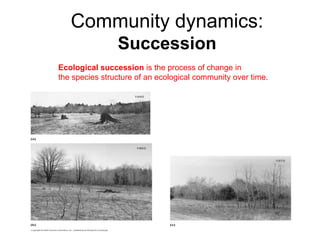
Community dynamics:
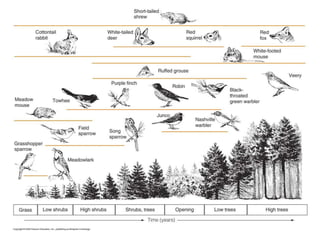
Succession
Ecological succession is the process of change in
the species structure of an ecological community over time.
Ecological Succession
• Ecological succession
– Is the sequence of community and ecosystem
changes after a disturbance
• Primary succession
– Occurs where no soil exists when succession
begins
• Secondary succession
– Begins in an area where soil remains after a
disturbance
Pioneer species
Primary succession
• Primary succession is the beginning step of ecological
succession after an extreme disturbance, which usually occurs in an
environment devoid of vegetation and other organisms. These
environments are typically lacking in soil, as disturbances like lava
flow or retreating glaciers shred the environment of nutrients.
Secondary succession
Secondary succession is the secondary ecological succession of a
plant's life. As opposed to the first, primary succession, secondary
succession is a process started by an event (e.g. forest
fire, harvesting, hurricane, etc.) that reduces an already
established ecosystem (e.g. a forest or a wheat field) to a smaller
population of species, and as such secondary succession occurs on
preexisting soil.
Pioneer species are hardy species that are the first
to colonize barren environments or previously biodiverse steady-
state ecosystems that have been disrupted, such as by wildfire.
1. Nudation: Succession begins with the development of a bare site,
called Nudation (disturbance).
2. Migration: refers to arrival of propagules
3. Ecesis: involves establishment and initial growth of vegetation.
4. Competition: as vegetation becomes well established, grows, and
spreads, various species begin to compete for space, light and
nutrients.
5. Reaction: during this phase autogenic changes such as the buildup
of humus affect the habitat, and one plant community replaces
another.
6. Stabilization: a supposedly stable climax community forms.
Mechanisms of succession
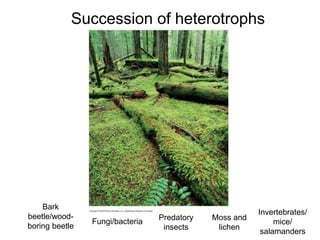
Bark
beetle/wood-
boring beetle
Fungi/bacteria
Predatory
insects
Moss and
lichen
Invertebrates/
mice/
salamanders
Succession of heterotrophs
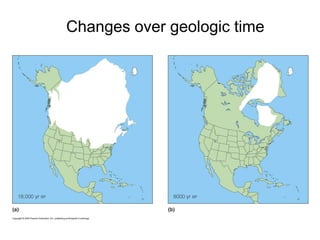
Changes over geologic time

Community ecology.ppt

  • 1.
    Community ecology Outline: • Communitystructure: attributes • Factors influencing the structure of communities • Community dynamics
  • 3.
    Community attributes • Numbersof species • Relative abundance of species • Nature of species interactions (food webs) • Physical structure
  • 4.
    Community structure • Speciesrichness (# of species within community) 10
  • 5.
    Community structure • Relativeabundance (% each species contributes to the total number of individuals)
  • 6.
    Simpson’s diversity index •D = 0 - 1 – 0: high diversity – 1: low diversity • Stand one (Table 16.1): D=0.13 • Stand two (Table 16.2): D=0.36
  • 7.
    Functional groups • Feedinglevel • Exploitation of common resources (guilds) • Photosynthetic pathway • Shade tolerance • Life history
  • 8.
  • 9.
  • 10.
    Association • Relatively consistentspecies composition • Uniform general appearance • Distribution that is characteristic of a particular habitat
  • 11.
  • 12.
  • 13.
  • 14.
  • 15.
    Predation • Predation refersto an interaction – Where one species, the predator, kills and eats the other, the prey • Feeding adaptations of predators include – Claws, teeth, fangs, stingers, and poison • Animals also display – A great variety of defensive adaptations
  • 16.
    Herbivory • Herbivory, theprocess in which an herbivore eats parts of a plant – Has led to the evolution of plant mechanical and chemical defenses and consequent adaptations by herbivores
  • 17.
    Parasitism • In parasitism,one organism, the parasite – Derives its nourishment from another organism, its host, which is harmed in the process
  • 18.
    Disease • The effectsof disease on populations and communities – Is similar to that of parasites • Pathogens, disease-causing agents – Are typically bacteria, viruses, or protists
  • 19.
    Mutualism • Mutualistic symbiosis,or mutualism – Is an interspecific interaction that benefits both species
  • 20.
    Commensalism One species benefitsand the other is not affected • Commensal interactions have been difficult to document in nature – Because any close association between species likely affects both species
  • 21.
  • 22.
    Species Diversity • Thespecies diversity of a community – Is the variety of different kinds of organisms that make up the community – Has two components
  • 23.
    • Species richness –Is the total number of different species in the community • Relative abundance – Is the proportion each species represents of the total individuals in the community
  • 24.
    Dominant Species • Dominantspecies – Are those species in a community that are most abundant or have the highest biomass – Exert powerful control over the occurrence and distribution of other species
  • 25.
    Keystone species A keystonespecies is a species which has a disproportionately large effect on its natural environment relative to its abundance
  • 26.
    Keystone Species – Arenot necessarily abundant in a community – Exert strong control on a community by their ecological roles, or niches
  • 27.
    Ecosystem “Engineers” (Foundation Species) •Some organisms exert their influence – By causing physical changes in the environment that affect community structure • Example: Beaver dams: Can transform landscapes on a very large scale
  • 28.
    Top-down vs. bottom-upcontrol • The bottom-up effect means that a lower trophic level in the biological network affects the community structure of higher trophic levels by means of resource restriction. • The top-down effect refers to a higher trophic level influences the community structure of a lower trophic level through predation
  • 29.
    Bottom-Up Controls • Thebottom-up model of community organization – Proposes a unidirectional influence from lower to higher trophic levels • In this case, the presence or absence of abiotic nutrients – Determines community structure, including the abundance of primary producers
  • 30.
    Top-Down Controls • Thetop-down model of community organization – Proposes that control comes from the trophic level above • In this case, predators control herbivores – Which in turn control primary producers
  • 31.
  • 32.
  • 33.
  • 34.
    Community stability Types ofstability: 1. Resilient community: returns to former state after disturbance 2. Resistant community: changes little in response to disturbance
  • 35.
    What Is Disturbance? •A disturbance – Is an event that changes a community – Removes organisms from a community – Alters resource availability
  • 36.
    • Fire – Isa significant disturbance in most terrestrial ecosystems – Is often a necessity in some communities (a) Before a controlled burn. A prairie that has not burned for several years has a high propor- tion of detritus (dead grass). (b) During the burn. The detritus serves as fuel for fires. (c) After the burn. Approximately one month after the controlled burn, virtually all of the biomass in this prairie is living.
  • 37.
    Human Disturbance • Humans –Are the most widespread agents of disturbance • Human disturbance to communities – Usually reduces species diversity • Humans also prevent some naturally occurring disturbances – Which can be important to community structure
  • 38.
    Community dynamics: Succession Ecological successionis the process of change in the species structure of an ecological community over time.
  • 39.
    Ecological Succession • Ecologicalsuccession – Is the sequence of community and ecosystem changes after a disturbance
  • 40.
    • Primary succession –Occurs where no soil exists when succession begins • Secondary succession – Begins in an area where soil remains after a disturbance
  • 41.
    Pioneer species Primary succession •Primary succession is the beginning step of ecological succession after an extreme disturbance, which usually occurs in an environment devoid of vegetation and other organisms. These environments are typically lacking in soil, as disturbances like lava flow or retreating glaciers shred the environment of nutrients. Secondary succession Secondary succession is the secondary ecological succession of a plant's life. As opposed to the first, primary succession, secondary succession is a process started by an event (e.g. forest fire, harvesting, hurricane, etc.) that reduces an already established ecosystem (e.g. a forest or a wheat field) to a smaller population of species, and as such secondary succession occurs on preexisting soil. Pioneer species are hardy species that are the first to colonize barren environments or previously biodiverse steady- state ecosystems that have been disrupted, such as by wildfire.
  • 42.
    1. Nudation: Successionbegins with the development of a bare site, called Nudation (disturbance). 2. Migration: refers to arrival of propagules 3. Ecesis: involves establishment and initial growth of vegetation. 4. Competition: as vegetation becomes well established, grows, and spreads, various species begin to compete for space, light and nutrients. 5. Reaction: during this phase autogenic changes such as the buildup of humus affect the habitat, and one plant community replaces another. 6. Stabilization: a supposedly stable climax community forms. Mechanisms of succession
  • 43.
  • 45.