12.How Nature Works in Harmony
8th class Science curiosity
By:K Sandeep Swamy(M.Sc,B.Ed)
For Online Classes (IITJEE & NEET foundation and academics) contact : 9491878325
Subscribe Samyans Eduhub youtube channel
Nature is a complex web of relationships where every organism plays a vital role. From the smallest microbes to the largest mammals, all living beings interact with each other and their environment in ways that maintain balance and harmony in ecosystems.
Understanding Our Surroundings
What is a Habitat?
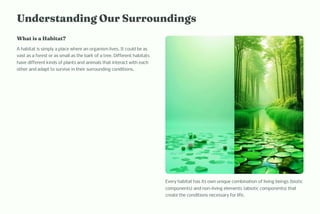
A habitat is simply a place where an organism lives. It could be as vast as a forest or as small as the bark of a tree. Different habitats have different kinds of plants and animals that interact with each other and adapt to survive in their surrounding conditions.
Every habitat has its own unique combination of living beings (biotic components) and non-living elements (abiotic components) that create the conditions necessary for life.
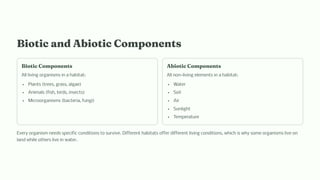
Biotic and Abiotic Components
Biotic Components
All living organisms in a habitat:
Plants (trees, grass, algae)
Animals (fish, birds, insects)
Microorganisms (bacteria, fungi)
Abiotic Components
All non-living elements in a habitat:
Water
Soil
Air
Sunlight
Temperature
Every organism needs specific conditions to survive. Different habitats offer different living conditions, which is why some organisms live on land while others live in water.
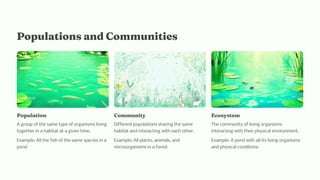
Populations and Communities
Population
A group of the same type of organisms living together in a habitat at a given time.
Example: All the fish of the same species in a pond
Community
Different populations sharing the same habitat and interacting with each other.
Example: All plants, animals, and microorganisms in a forest
Ecosystem
The community of living organisms interacting with their physical environment.
Example: A pond with all its living organisms and physical conditions
Types of Ecosystems
Aquatic Ecosystems
Ponds
Lakes
Rivers
Oceans
Terrestrial Ecosystems
Forests
Grasslands
Deserts
Mountains
Ecosystems can be large or small, natural or human-made. Human-made ecosystems include agricultural fields, fish ponds, and parks.
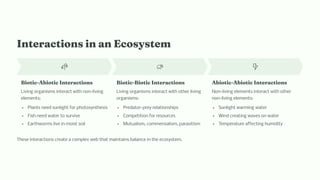
Interactions in an Ecosystem
Biotic-Abiotic Interactions
Living organisms interact with non-living elements:
Plants need sunlight for photosynthesis
Fish need water to survive
Earthworms live in moist soil
Biotic-Biotic Interactions
Living organisms interact with other living organisms:
Predator-prey relationships
Competition for resources
Mutualism, commensalism, parasitism
Abiotic-Abiotic Interactions
Non-living elements interact with other non-living elements:
Sunlight warming water
Wind creating waves on water
Temperature affecting humidity
These interactions create a complex web that maintains balance in the ecosystem.
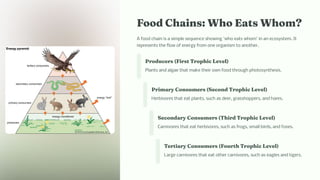
Food Chains: Who Eats Whom?
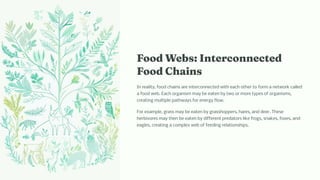
A food chain is a simple sequence showing 'who eats whom' in an ecosystem. It represents the flow of energy from one organism to ano