ENVIRONMENTAL PROBLEMS Why & how do we get into them? Attitudes Social traps How do we avoid them?
Attitudes—that get us into problems Rosy Optimism : ignore problems Frontier Attitude : believe we will never run out Tech Fix : trust science to solve all problems Gloom-And-Doom : feel useless to stop problems
Attitudes How do these attitudes lead to or perpetuate environmental problems? Each of these attitudes prevents people from taking action or doing something to fix problems.
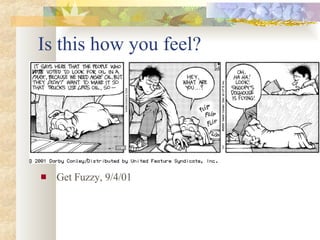
Is this how you feel? Get Fuzzy, 9/4/01
Attitudes—that avoid problems Sustainability : Attitude that supports continuation & renewal of life and life support systems Uses resources only at a rate that can be sustained (maintained) forever. An attempt to provide the best outcomes for the human and natural environments both now and into the indefinite future. It relates to the continuity of economic, social, institutional and environmental aspects of human society, as well as the non-human environment
Social Traps: Origin of Concept  Based on John Platt's 1973 paper in  American Psychologist .  Ideas continued to be developed in an interdisciplinary symposium held at the  University of Michigan  building upon the concept of the " tragedy of the commons " in  Garrett Hardin 's pivotal article in  Science  (1968) Platt, recognized that individuals operating for short-term positive  reinforcement  had a tendency to over-exploit the resource which led to a long-term negative loss to society.
Social Traps: Definition Any situation where what looks like a good choice to me right now turns out to be the wrong choice for society (usually including me) in the long run. A situation in which a person, if they make a decision based on “me-here-now” perspective makes the wrong decision in the long-term/global context
Collective Social Trap Also “Tragedy of the Commons” Occurs when there is a shared resource (e.g., air, water) Each individual’s small effect adds up to a big problem when many people’s effects add together.
Collective Social Trap Also “Tragedy of the Commons “ Commons” refers to community held pastures in colonial New England villages Each individual farmer’s cows only take a small amount of grass  As more cows are added the commons becomes overgrazed. It is in farmer’s best interest to increase numbers of cows Individual farmer gains wealth, however, costs of overgrazing shared by all.
Collective Social Trap Also “Tragedy of the Commons” Example: You and Air Pollution When you drive your car, you contribute only a small amount to the air pollution of your city However, the combined total of all the cars driving in a city add up to a big problem
Time Delay Social Trap An action today results in a negative effect in the future. The action only has to happen once to initate the long term negative effect. Something is gained in the short-term, but there are consequences to face in the long-term
Time Delay Social Trap Example 1:  Nuclear Waste In the short-term energy is gained, however in the long-term, there is the problem of radioactive waste disposal. Example 2:  Clear-cutting Clear-cutting a forest results in lumber production, however in the future there are problems of erosion, flooding and loss of biodiversity
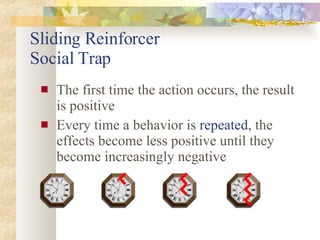
Sliding Reinforcer Social Trap The first time the action occurs, the result is positive Every time a behavior is  repeated , the effects become less positive until they become increasingly negative
Sliding Reinforcer Social Trap Example: Pesticides The first time a pesticide is used, it is very effective at killing pests As pesticides use continues, pest resistance increases, so the amount and kinds of pesticides is increased With each application of pesticides, pest resistance increases so more is used… And down the line….as more is used the negative effects on the environment increase while benefits decrease
Externality Social Trap The negative repercussions are put on someone else (including other generations.
Externality Social Trap Example 1: using fossil fuels today will leave little for future generations Example 2:  River dumping…pollution affects those downstream
Avoiding Social Traps Education : Let people know about all the long term consequences and the social trap that is before them. Pros? People willingly cooperate Cons? People may not cooperate
Avoiding Social Traps Rules/Laws : Make rules/laws to stop people from doing the wrong thing. Pros? People will follow the law or suffer the consequences Cons? Laws are to be broken; hard to enforce
Avoiding Social Traps Change Trap to Tradeoff : Bring all the long term consequences up front. This way, even people only thinking of me-here-now still make the right decision. Pros? It works Cons? It is hard to determine long term and societal costs; all have to do it.

Unit1a Social Traps

  • 1.
    ENVIRONMENTAL PROBLEMS Why& how do we get into them? Attitudes Social traps How do we avoid them?
  • 2.
    Attitudes—that get usinto problems Rosy Optimism : ignore problems Frontier Attitude : believe we will never run out Tech Fix : trust science to solve all problems Gloom-And-Doom : feel useless to stop problems
  • 3.
    Attitudes How dothese attitudes lead to or perpetuate environmental problems? Each of these attitudes prevents people from taking action or doing something to fix problems.
  • 4.
    Is this howyou feel? Get Fuzzy, 9/4/01
  • 5.
    Attitudes—that avoid problemsSustainability : Attitude that supports continuation & renewal of life and life support systems Uses resources only at a rate that can be sustained (maintained) forever. An attempt to provide the best outcomes for the human and natural environments both now and into the indefinite future. It relates to the continuity of economic, social, institutional and environmental aspects of human society, as well as the non-human environment
  • 6.
    Social Traps: Originof Concept Based on John Platt's 1973 paper in American Psychologist . Ideas continued to be developed in an interdisciplinary symposium held at the University of Michigan building upon the concept of the " tragedy of the commons " in Garrett Hardin 's pivotal article in Science (1968) Platt, recognized that individuals operating for short-term positive reinforcement had a tendency to over-exploit the resource which led to a long-term negative loss to society.
  • 7.
    Social Traps: DefinitionAny situation where what looks like a good choice to me right now turns out to be the wrong choice for society (usually including me) in the long run. A situation in which a person, if they make a decision based on “me-here-now” perspective makes the wrong decision in the long-term/global context
  • 8.
    Collective Social TrapAlso “Tragedy of the Commons” Occurs when there is a shared resource (e.g., air, water) Each individual’s small effect adds up to a big problem when many people’s effects add together.
  • 9.
    Collective Social TrapAlso “Tragedy of the Commons “ Commons” refers to community held pastures in colonial New England villages Each individual farmer’s cows only take a small amount of grass As more cows are added the commons becomes overgrazed. It is in farmer’s best interest to increase numbers of cows Individual farmer gains wealth, however, costs of overgrazing shared by all.
  • 10.
    Collective Social TrapAlso “Tragedy of the Commons” Example: You and Air Pollution When you drive your car, you contribute only a small amount to the air pollution of your city However, the combined total of all the cars driving in a city add up to a big problem
  • 11.
    Time Delay SocialTrap An action today results in a negative effect in the future. The action only has to happen once to initate the long term negative effect. Something is gained in the short-term, but there are consequences to face in the long-term
  • 12.
    Time Delay SocialTrap Example 1: Nuclear Waste In the short-term energy is gained, however in the long-term, there is the problem of radioactive waste disposal. Example 2: Clear-cutting Clear-cutting a forest results in lumber production, however in the future there are problems of erosion, flooding and loss of biodiversity
  • 13.
    Sliding Reinforcer SocialTrap The first time the action occurs, the result is positive Every time a behavior is repeated , the effects become less positive until they become increasingly negative
  • 14.
    Sliding Reinforcer SocialTrap Example: Pesticides The first time a pesticide is used, it is very effective at killing pests As pesticides use continues, pest resistance increases, so the amount and kinds of pesticides is increased With each application of pesticides, pest resistance increases so more is used… And down the line….as more is used the negative effects on the environment increase while benefits decrease
  • 15.
    Externality Social TrapThe negative repercussions are put on someone else (including other generations.
  • 16.
    Externality Social TrapExample 1: using fossil fuels today will leave little for future generations Example 2: River dumping…pollution affects those downstream
  • 17.
    Avoiding Social TrapsEducation : Let people know about all the long term consequences and the social trap that is before them. Pros? People willingly cooperate Cons? People may not cooperate
  • 18.
    Avoiding Social TrapsRules/Laws : Make rules/laws to stop people from doing the wrong thing. Pros? People will follow the law or suffer the consequences Cons? Laws are to be broken; hard to enforce
  • 19.
    Avoiding Social TrapsChange Trap to Tradeoff : Bring all the long term consequences up front. This way, even people only thinking of me-here-now still make the right decision. Pros? It works Cons? It is hard to determine long term and societal costs; all have to do it.