Periodic Table of Elements
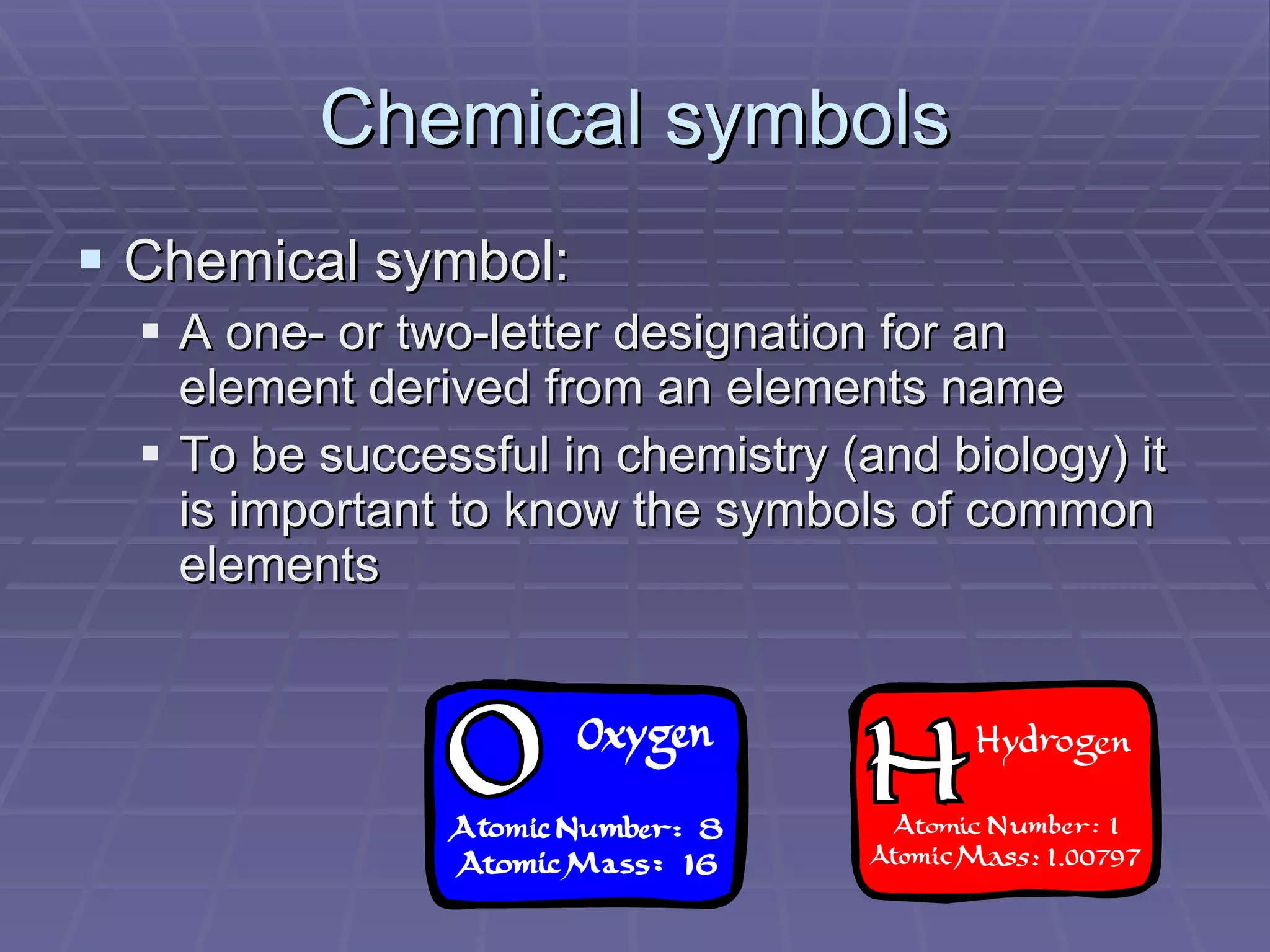
Chemical symbols Chemical symbol: A one- or two-letter designation for an element derived from an elements name To be successful in chemistry (and biology) it is important to know the symbols of common elements
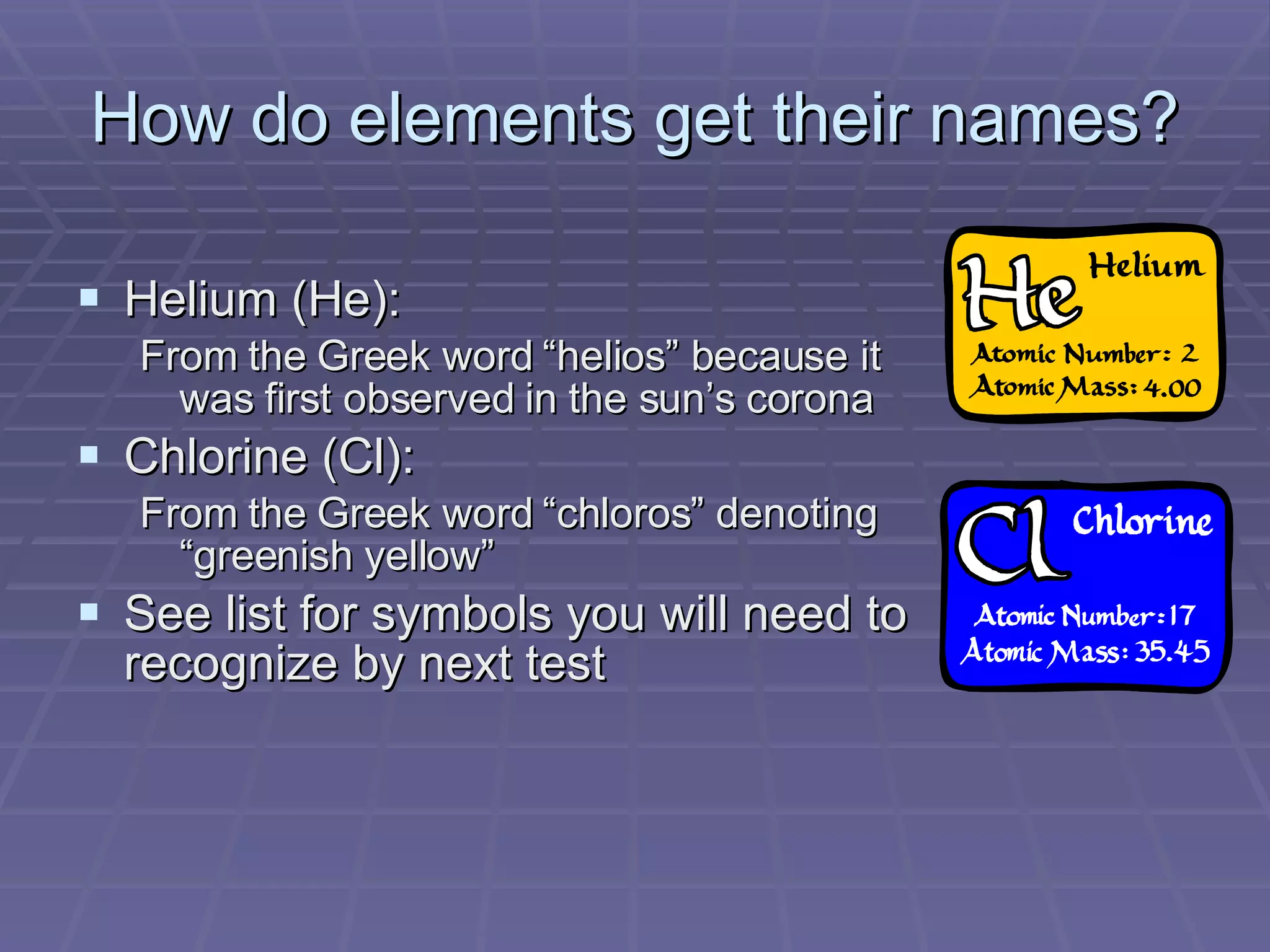
How do elements get their names? Helium (He): From the Greek word “helios” because it was first observed in the sun’s corona Chlorine (Cl): From the Greek word “chloros” denoting “greenish yellow” See list for symbols you will need to recognize by next test
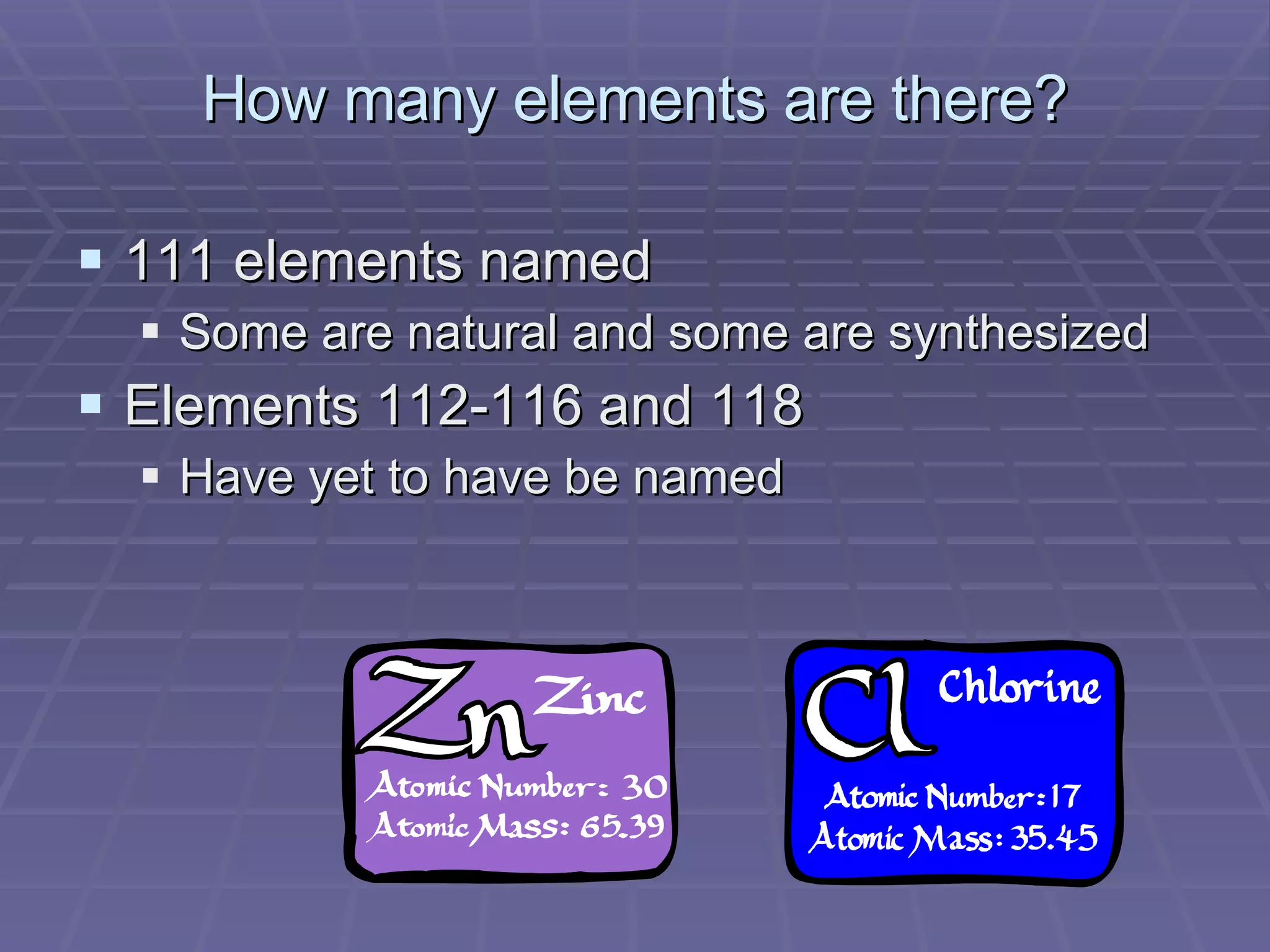
How many elements are there? 111 elements named Some are natural and some are synthesized Elements 112-116 and 118 Have yet to have be named
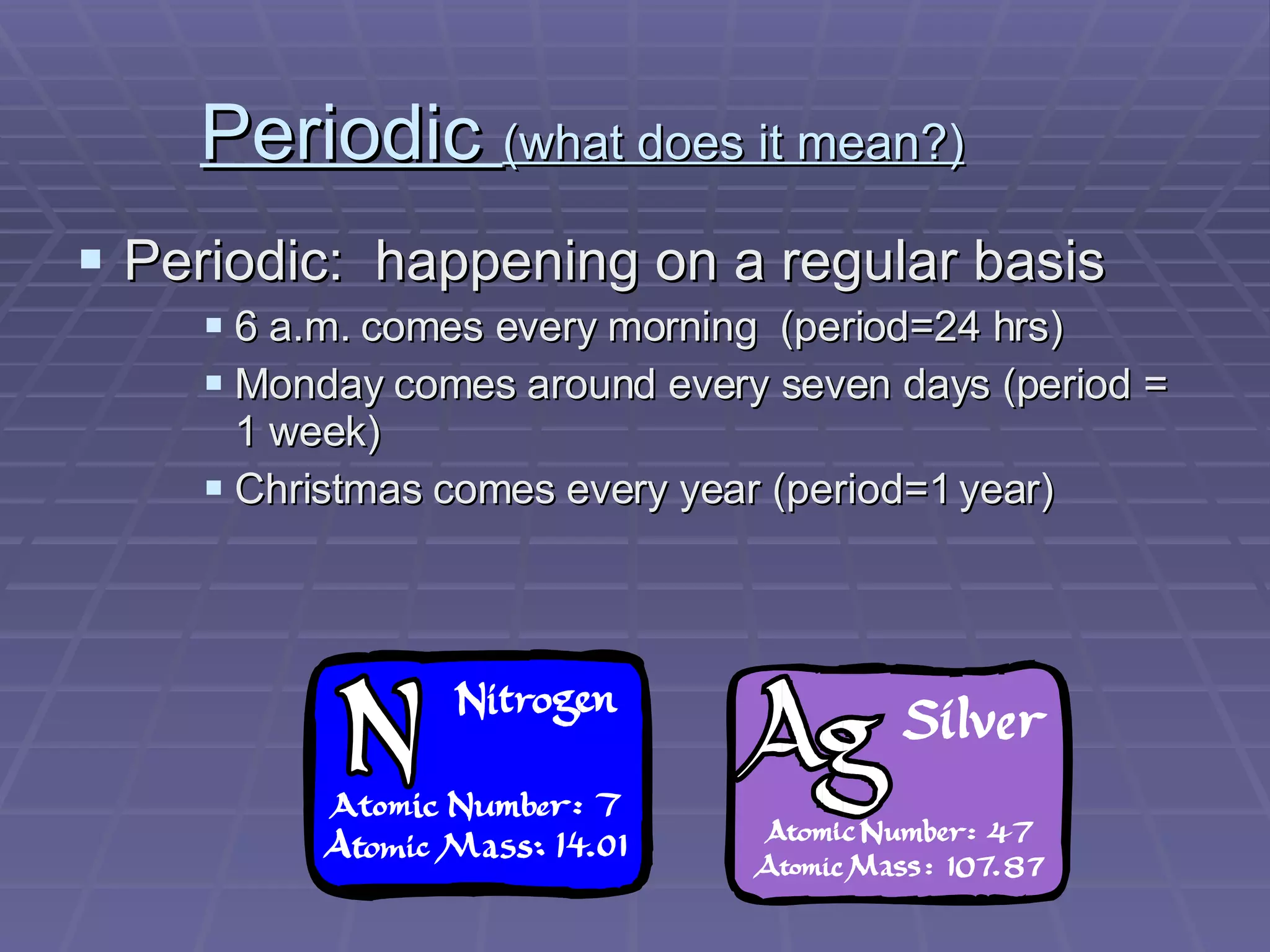
Periodic  (what does it mean?) Periodic:  happening on a regular basis 6 a.m. comes every morning  (period=24 hrs) Monday comes around every seven days (period = 1 week) Christmas comes every year (period=1 year)
Periodic Table A tabular arrangement of the elements in order of increasing atomic number Elements having similar chemical behavior are grouped in vertical columns Similar properties are found in every eighth element See  Periodic Table
Groups of elemental table Group:  a vertical column of elements in the periodic table Groups are commonly identified as IA through VIIIA and then IB through IIB
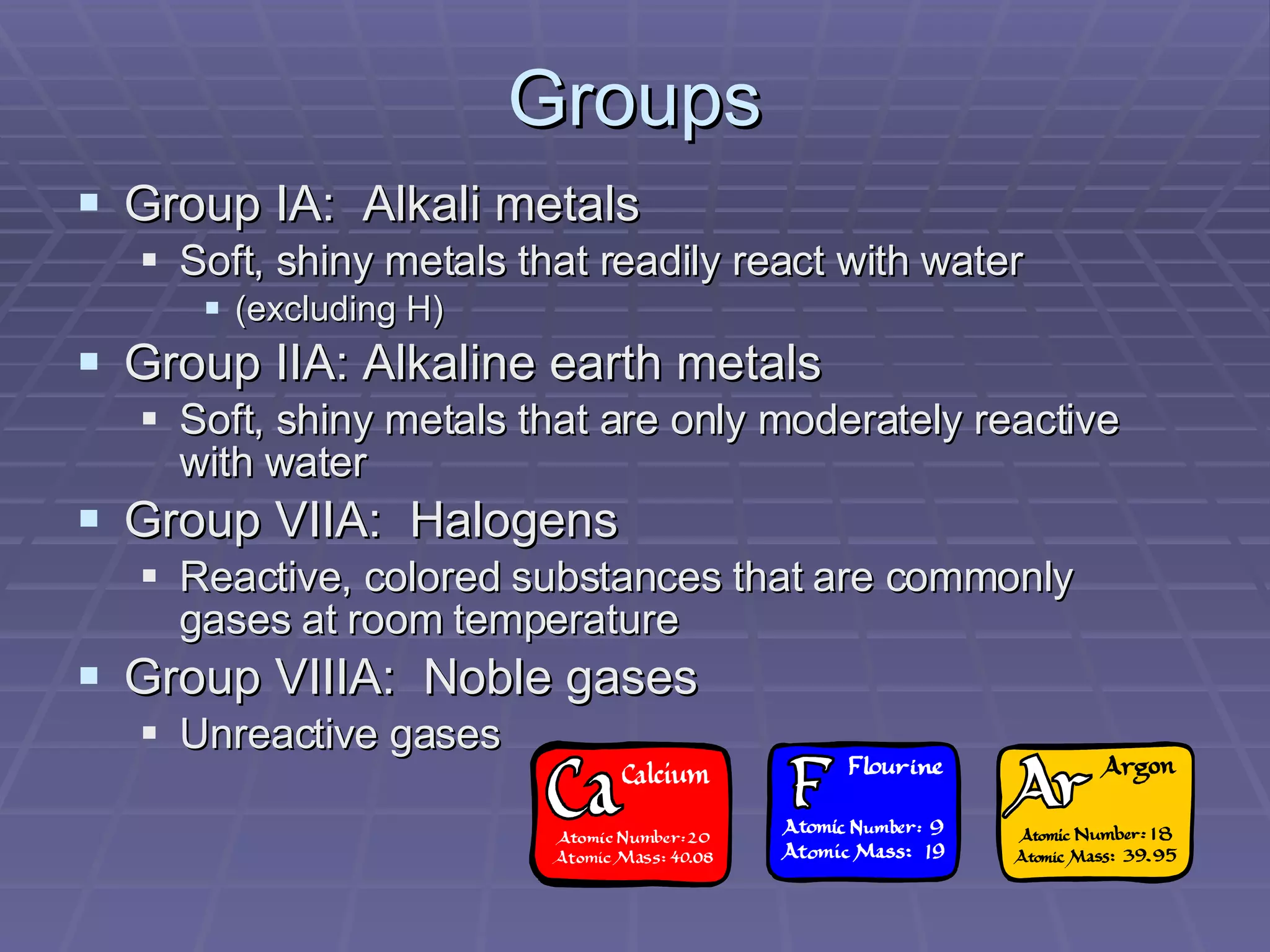
Groups Group IA:  Alkali metals Soft, shiny metals that readily react with water (excluding H) Group IIA: Alkaline earth metals Soft, shiny metals that are only moderately reactive with water Group VIIA:  Halogens Reactive, colored substances that are commonly gases at room temperature Group VIIIA:  Noble gases Unreactive gases
Chemical Basis of Life Most common elements in living organisms Carbon (C):  9.5% Hydrogen (H):  63% Oxygen (O):  25.5% Nitrogen (N):  1.4%
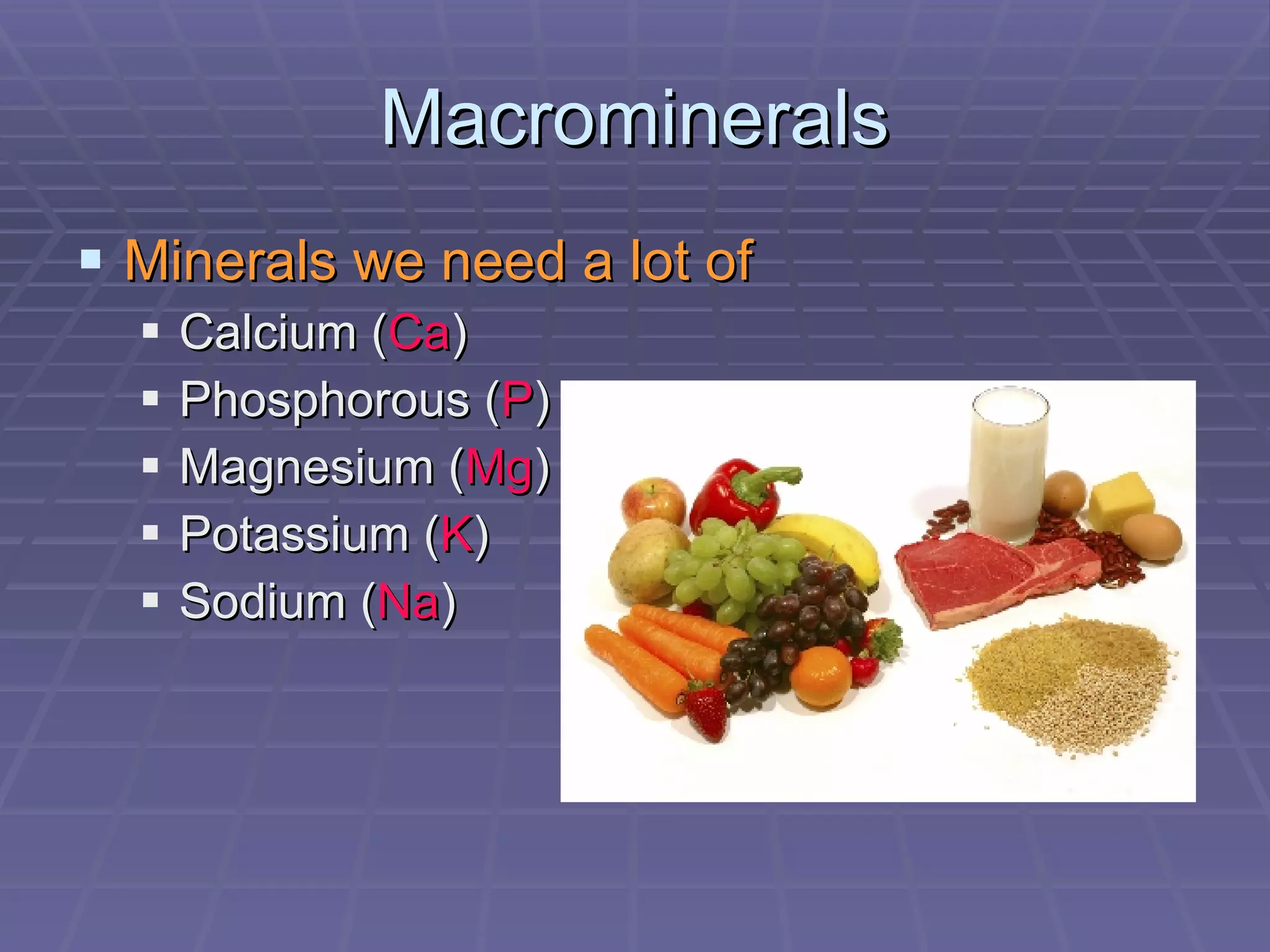
Macrominerals Minerals we need a lot of Calcium ( Ca ) Phosphorous ( P ) Magnesium ( Mg ) Potassium ( K ) Sodium ( Na )
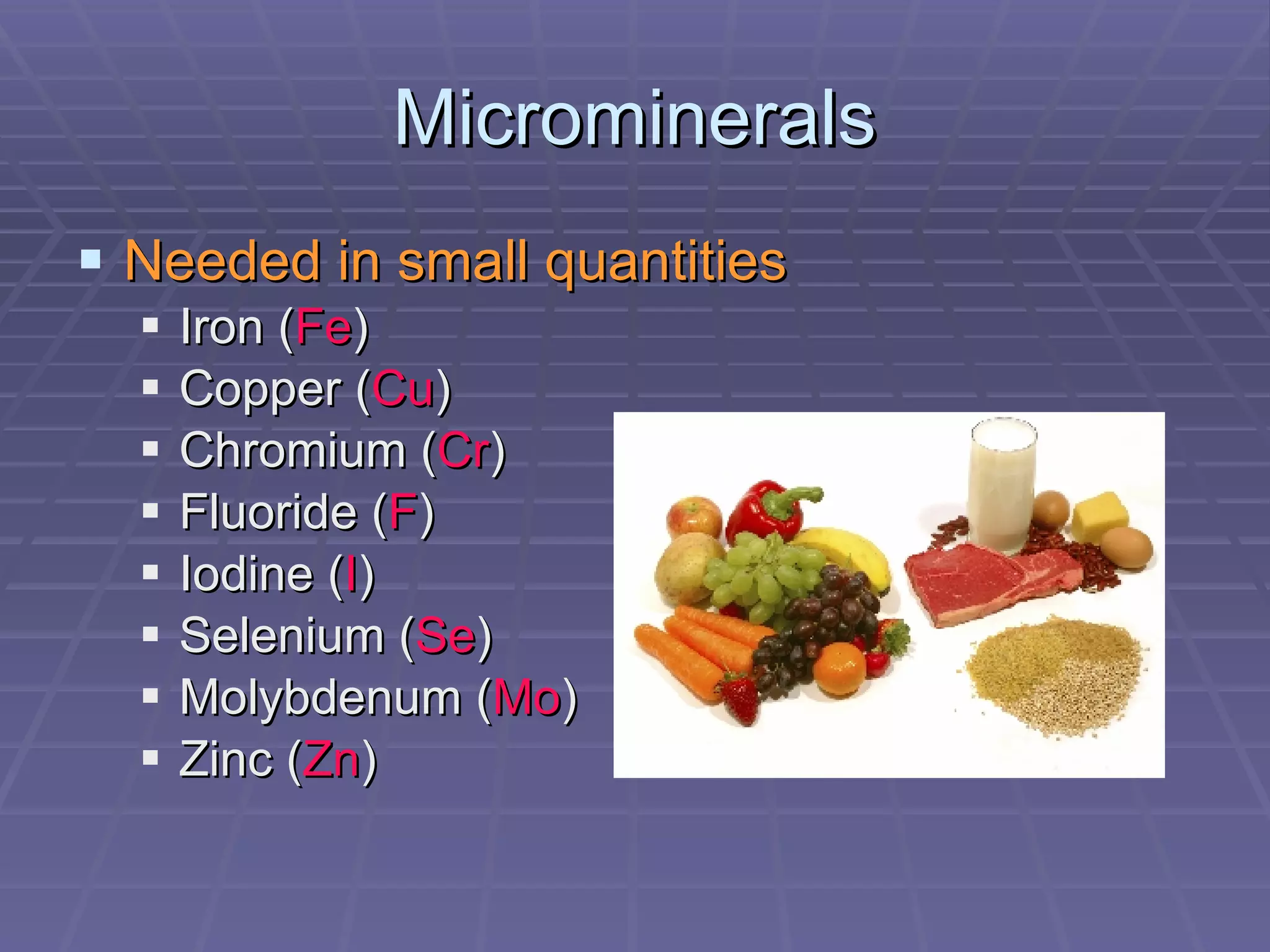
Microminerals Needed in small quantities Iron ( Fe ) Copper ( Cu ) Chromium ( Cr ) Fluoride ( F ) Iodine ( I ) Selenium ( Se ) Molybdenum ( Mo ) Zinc ( Zn )

Periodic Table Of Elements

  • 1.
  • 2.
    Chemical symbols Chemicalsymbol: A one- or two-letter designation for an element derived from an elements name To be successful in chemistry (and biology) it is important to know the symbols of common elements
  • 3.
    How do elementsget their names? Helium (He): From the Greek word “helios” because it was first observed in the sun’s corona Chlorine (Cl): From the Greek word “chloros” denoting “greenish yellow” See list for symbols you will need to recognize by next test
  • 4.
    How many elementsare there? 111 elements named Some are natural and some are synthesized Elements 112-116 and 118 Have yet to have be named
  • 5.
    Periodic (whatdoes it mean?) Periodic: happening on a regular basis 6 a.m. comes every morning (period=24 hrs) Monday comes around every seven days (period = 1 week) Christmas comes every year (period=1 year)
  • 6.
    Periodic Table Atabular arrangement of the elements in order of increasing atomic number Elements having similar chemical behavior are grouped in vertical columns Similar properties are found in every eighth element See Periodic Table
  • 7.
    Groups of elementaltable Group: a vertical column of elements in the periodic table Groups are commonly identified as IA through VIIIA and then IB through IIB
  • 8.
    Groups Group IA: Alkali metals Soft, shiny metals that readily react with water (excluding H) Group IIA: Alkaline earth metals Soft, shiny metals that are only moderately reactive with water Group VIIA: Halogens Reactive, colored substances that are commonly gases at room temperature Group VIIIA: Noble gases Unreactive gases
  • 9.
    Chemical Basis ofLife Most common elements in living organisms Carbon (C): 9.5% Hydrogen (H): 63% Oxygen (O): 25.5% Nitrogen (N): 1.4%
  • 10.
    Macrominerals Minerals weneed a lot of Calcium ( Ca ) Phosphorous ( P ) Magnesium ( Mg ) Potassium ( K ) Sodium ( Na )
  • 11.
    Microminerals Needed insmall quantities Iron ( Fe ) Copper ( Cu ) Chromium ( Cr ) Fluoride ( F ) Iodine ( I ) Selenium ( Se ) Molybdenum ( Mo ) Zinc ( Zn )