
COMMUNITY ECOLOGY
Chapter 6
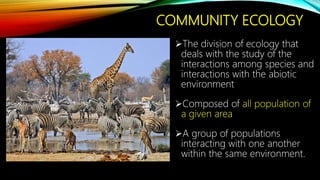
COMMUNITY ECOLOGY
The division of ecology that
deals with the study of the
interactions among species and
interactions with the abiotic
environment
Composed of all population of
a given area
A group of populations
interacting with one another
within the same environment.
RELATIONSHIP AMONG ORGANISMS
Symbiotic Relationship
 two entire different organisms live in close association that
benefits at least one of them.
Kinds of Symbiotic Relationship
Mutualism
Commensalism
Parasitism
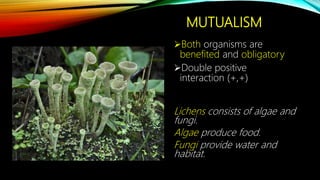
MUTUALISM
Both organisms are
benefited and obligatory
Double positive
interaction (+,+)
Lichens consists of algae and
fungi.
Algae produce food.
Fungi provide water and
habitat.
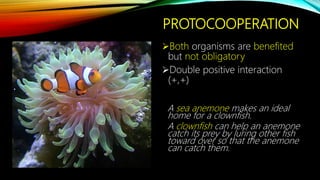
PROTOCOOPERATION
Both organisms are benefited
but not obligatory
Double positive interaction
(+,+)
A sea anemone makes an ideal
home for a clownfish.
A clownfish can help an anemone
catch its prey by luring other fish
toward over so that the anemone
can catch them.
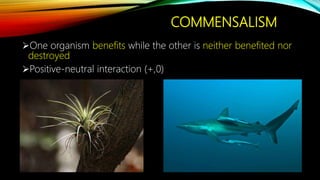
COMMENSALISM
One organism benefits while the other is neither benefited nor
destroyed
Positive-neutral interaction (+,0)
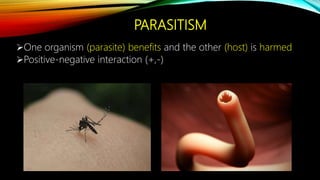
PARASITISM
One organism (parasite) benefits and the other (host) is harmed
Positive-negative interaction (+,-)
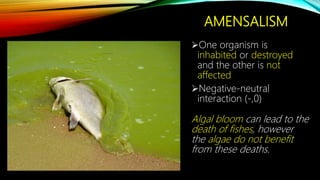
AMENSALISM
One organism is
inhabited or destroyed
and the other is not
affected
Negative-neutral
interaction (-,0)
Algal bloom can lead to the
death of fishes, however
the algae do not benefit
from these deaths.
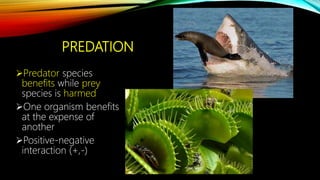
PREDATION
Predator species
benefits while prey
species is harmed
One organism benefits
at the expense of
another
Positive-negative
interaction (+,-)
COMPETITION
Both organisms are affected
Organisms struggle with each other to obtain limited resources
Can be interspecific or intraspecific
Negative-negative interaction (-,-)
Gause’s Principle (Interspecific Competition)
If two populations of organisms occupy the same ecological niche,
one of the populations will be eliminated.
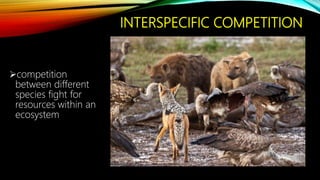
INTERSPECIFIC COMPETITION
competition
between different
species fight for
resources within an
ecosystem
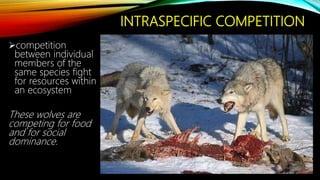
INTRASPECIFIC COMPETITION
competition
between individual
members of the
same species fight
for resources within
an ecosystem
These wolves are
competing for food
and for social
dominance.
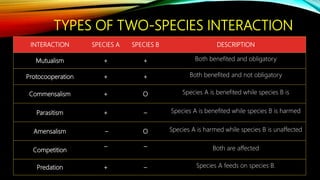
TYPES OF TWO-SPECIES INTERACTION
INTERACTION SPECIES A SPECIES B DESCRIPTION
Mutualism + + Both benefited and obligatory
Protocooperation + + Both benefited and not obligatory
Commensalism + O Species A is benefited while species B is
Parasitism + – Species A is benefited while species B is harmed
Amensalism – O Species A is harmed while species B is unaffected
Competition
– – Both are affected
Predation + – Species A feeds on species B.
HOW ECOSYSTEMS CHANGE
Ecological Succession
ECOLOGICAL SUCCESSION
It is a gradual process of change and replacement of the types
of species in a community
In nature, the process of ecological succession may take
hundreds or thousands of years.
Each new community that arises often makes it harder for the
previous community to survive.
PRIMARY SUCCESSION
It is a type of succession that occurs on a surface where no
ecosystem existed before.
Primary succession can occur on rocks, cliffs, and sand dunes.
Primary succession is much slower than secondary succession
because primary succession begins where there is no soil.
It can take several hundred to several thousand years to produce
fertile soil naturally.
SECONDARY SUCCESSION
It is the more common type of succession, occurs on a surface
where an ecosystem has previously existed
Secondary succession occurs in ecosystems that have been
disturbed or disrupted by humans, animals, or by natural
processes such as storms, floods, earthquakes, and volcanoes.
PIONEER SPECIES
 The first organisms to colonize any newly available area and begin
the process of ecological succession.
 Over time, pioneer species will make the new area habitable for
other species.
Climax Community
 It is a final stage and stable community.
 Even though a climax community continues to change in small
ways, this type of community may remain the same through time if
it is not disturbed.
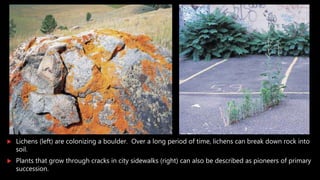
 Lichens (left) are colonizing a boulder. Over a long period of time, lichens can break down rock into
soil.
 Plants that grow through cracks in city sidewalks (right) can also be described as pioneers of primary
succession.
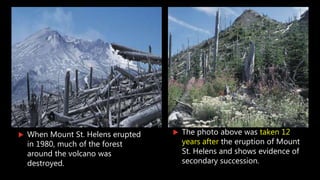
 When Mount St. Helens erupted
in 1980, much of the forest
around the volcano was
destroyed.
 The photo above was taken 12
years after the eruption of Mount
St. Helens and shows evidence of
secondary succession.
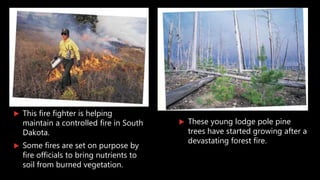
 This fire fighter is helping
maintain a controlled fire in South
Dakota.
 Some fires are set on purpose by
fire officials to bring nutrients to
soil from burned vegetation.
 These young lodge pole pine
trees have started growing after a
devastating forest fire.
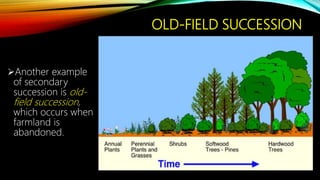
OLD-FIELD SUCCESSION
Another example
of secondary
succession is old-
field succession,
which occurs when
farmland is
abandoned.

ENVI 6 community ecology FINAL

  • 1.
  • 2.
    COMMUNITY ECOLOGY The divisionof ecology that deals with the study of the interactions among species and interactions with the abiotic environment Composed of all population of a given area A group of populations interacting with one another within the same environment.
  • 3.
    RELATIONSHIP AMONG ORGANISMS SymbioticRelationship  two entire different organisms live in close association that benefits at least one of them. Kinds of Symbiotic Relationship Mutualism Commensalism Parasitism
  • 4.
    MUTUALISM Both organisms are benefitedand obligatory Double positive interaction (+,+) Lichens consists of algae and fungi. Algae produce food. Fungi provide water and habitat.
  • 5.
    PROTOCOOPERATION Both organisms arebenefited but not obligatory Double positive interaction (+,+) A sea anemone makes an ideal home for a clownfish. A clownfish can help an anemone catch its prey by luring other fish toward over so that the anemone can catch them.
  • 6.
    COMMENSALISM One organism benefitswhile the other is neither benefited nor destroyed Positive-neutral interaction (+,0)
  • 7.
    PARASITISM One organism (parasite)benefits and the other (host) is harmed Positive-negative interaction (+,-)
  • 8.
    AMENSALISM One organism is inhabitedor destroyed and the other is not affected Negative-neutral interaction (-,0) Algal bloom can lead to the death of fishes, however the algae do not benefit from these deaths.
  • 9.
    PREDATION Predator species benefits whileprey species is harmed One organism benefits at the expense of another Positive-negative interaction (+,-)
  • 10.
    COMPETITION Both organisms areaffected Organisms struggle with each other to obtain limited resources Can be interspecific or intraspecific Negative-negative interaction (-,-) Gause’s Principle (Interspecific Competition) If two populations of organisms occupy the same ecological niche, one of the populations will be eliminated.
  • 11.
  • 12.
    INTRASPECIFIC COMPETITION competition between individual membersof the same species fight for resources within an ecosystem These wolves are competing for food and for social dominance.
  • 13.
    TYPES OF TWO-SPECIESINTERACTION INTERACTION SPECIES A SPECIES B DESCRIPTION Mutualism + + Both benefited and obligatory Protocooperation + + Both benefited and not obligatory Commensalism + O Species A is benefited while species B is Parasitism + – Species A is benefited while species B is harmed Amensalism – O Species A is harmed while species B is unaffected Competition – – Both are affected Predation + – Species A feeds on species B.
  • 14.
  • 15.
    ECOLOGICAL SUCCESSION It isa gradual process of change and replacement of the types of species in a community In nature, the process of ecological succession may take hundreds or thousands of years. Each new community that arises often makes it harder for the previous community to survive.
  • 16.
    PRIMARY SUCCESSION It isa type of succession that occurs on a surface where no ecosystem existed before. Primary succession can occur on rocks, cliffs, and sand dunes. Primary succession is much slower than secondary succession because primary succession begins where there is no soil. It can take several hundred to several thousand years to produce fertile soil naturally.
  • 17.
    SECONDARY SUCCESSION It isthe more common type of succession, occurs on a surface where an ecosystem has previously existed Secondary succession occurs in ecosystems that have been disturbed or disrupted by humans, animals, or by natural processes such as storms, floods, earthquakes, and volcanoes.
  • 18.
    PIONEER SPECIES  Thefirst organisms to colonize any newly available area and begin the process of ecological succession.  Over time, pioneer species will make the new area habitable for other species. Climax Community  It is a final stage and stable community.  Even though a climax community continues to change in small ways, this type of community may remain the same through time if it is not disturbed.
  • 19.
     Lichens (left)are colonizing a boulder. Over a long period of time, lichens can break down rock into soil.  Plants that grow through cracks in city sidewalks (right) can also be described as pioneers of primary succession.
  • 20.
     When MountSt. Helens erupted in 1980, much of the forest around the volcano was destroyed.  The photo above was taken 12 years after the eruption of Mount St. Helens and shows evidence of secondary succession.
  • 21.
     This firefighter is helping maintain a controlled fire in South Dakota.  Some fires are set on purpose by fire officials to bring nutrients to soil from burned vegetation.  These young lodge pole pine trees have started growing after a devastating forest fire.
  • 22.
    OLD-FIELD SUCCESSION Another example ofsecondary succession is old- field succession, which occurs when farmland is abandoned.

Editor's Notes

  • #6 A sea anemone makes an ideal home for a clownfish. Its poisonous tentacles provide protection from predators and a clownfish makes its meals from the anemone’s leftovers A clownfish can help an anemone catch its prey by luring other fish toward over so that the anemone can catch them. Clownfish also eat any dead tentacles keeping the anemone and the area around it clean. "
  • #7 Orchids form their base of attachment on the branches of trees, and benefit by getting adequate sunlight and nutrition that flows down the branches. The orchids do not grow to a large size, and thus the host tree is not harmed in any way. The remora forms a special relationship with sharks and other sea organisms like whales and turtles. It has special suckers attached to its fins. It attaches itself to the bodies of sharks, and uses the shark for transportation as well as protection from its predators. It also eats up the scraps of food that are left over when the shark eats its prey.
  • #13 A territory is an area defended by one or more individuals against other individuals. The territory is of value not only for the space but also for the shelter, food, or breeding sites it contains. A pack is an extended family group comprised of a the breeding, or “alpha” male and female pair and some of their  subordinate offspring and current pups from one or more years. The parent wolves are the leaders of the pack - the alpha male and alpha female. The alpha male and female are the oldest members of the pack and the ones with the most experience in hunting, defending territory, and other important activities. and normally are the first to eat at a kill. The pair’s offspring normally disperse into adjacent or available territories at 2 to 3 years of age.