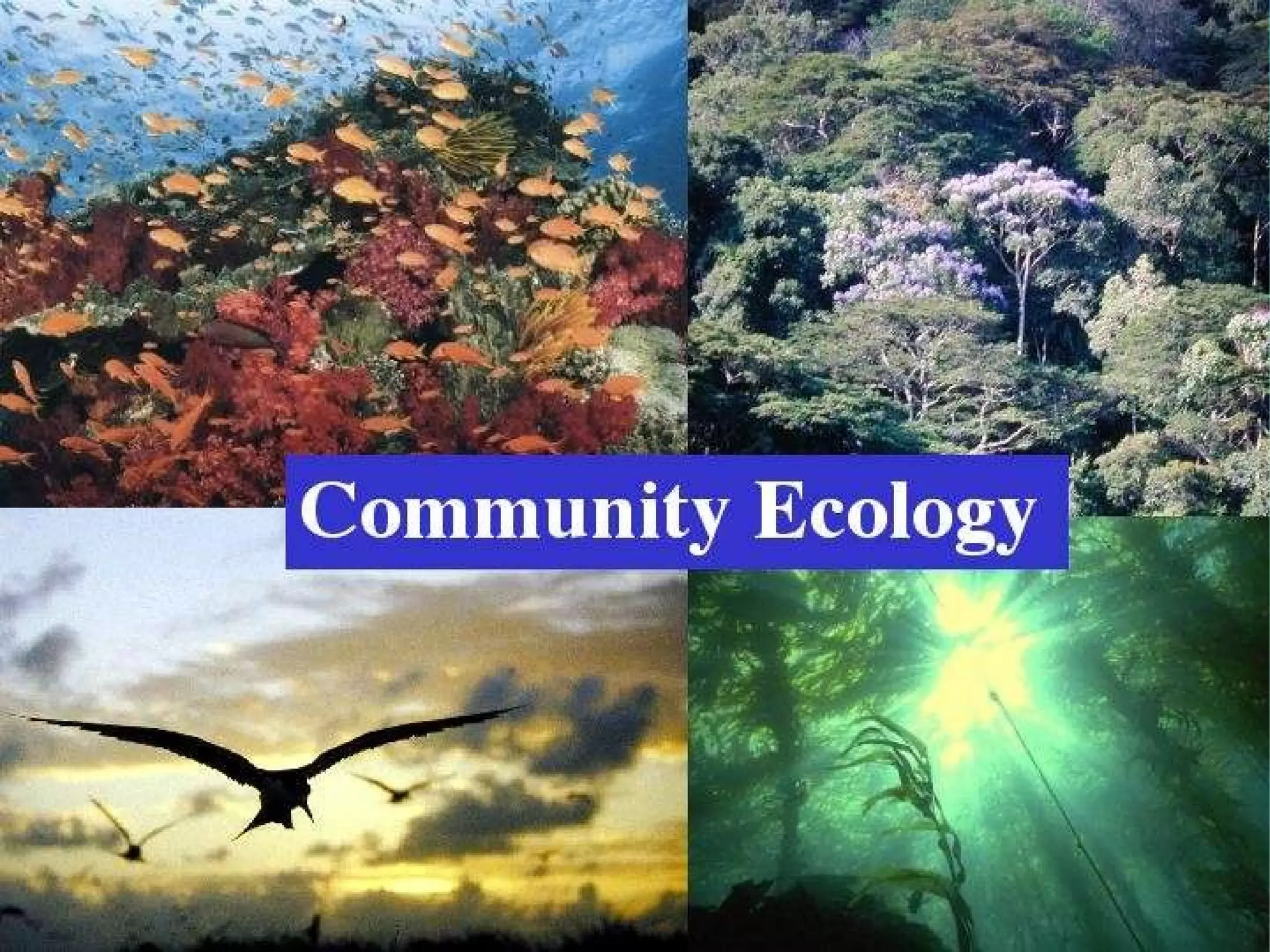
Ecological Communities An ecological  community  consists of all the species that live and interact in a given area. Ecological communities are not assemblages that move together as a unit.  Each species has unique interactions with its environment.
Organisms in a community can be divided into  trophic levels  based on their source of energy. Photosynthesizers or  primary producers  are  autotrophs  that get their energy directly from sunlight. All  heterotrophs  consume, directly or indirectly, the energy-rich molecules made by the primary producers. Ecological Communities
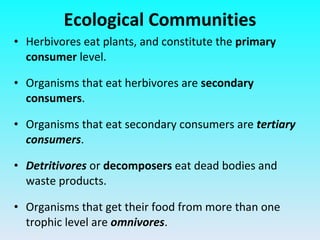
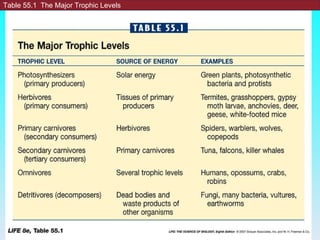
Herbivores eat plants, and constitute the  primary consumer  level. Organisms that eat herbivores are  secondary consumers . Organisms that eat secondary consumers are  tertiary consumers . Detritivores  or  decomposers  eat dead bodies and waste products. Organisms that get their food from more than one trophic level are  omnivores . Ecological Communities
Table 55.1  The Major Trophic Levels
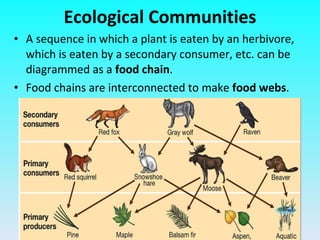
A sequence in which a plant is eaten by an herbivore, which is eaten by a secondary consumer, etc. can be diagrammed as a  food chain . Food chains are interconnected to make  food webs . Ecological Communities
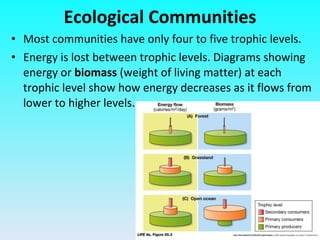
Most communities have only four to five trophic levels. Energy is lost between trophic levels. Diagrams showing energy or  biomass  (weight of living matter) at each trophic level show how energy decreases as it flows from lower to higher levels. Ecological Communities
Detritivores  include bacteria, fungi, worms, mites, and many insects. They transform  detritus  (dead remains and waste products) into free mineral nutrients that can be taken up and used again by plants. Continued ecosystem productivity depends on the decomposition of detritus. Ecological Communities
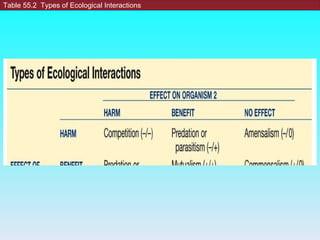
Community Structure Categories of species interactions: Predation  or  parasitism : one participant is harmed, the other benefits. Competition : two organisms using same resource that is insufficient to supply needs of both. Mutualism : both species benefit. Commensalism : one participant benefits and the other is unaffected. Amensalism : one participant is harmed, and the other is unaffected.
Table 55.2  Types of Ecological Interactions
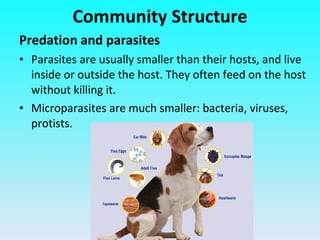
Predation and parasites Parasites are usually smaller than their hosts, and live inside or outside the host. They often feed on the host without killing it. Microparasites are much smaller: bacteria, viruses, protists. Community Structure
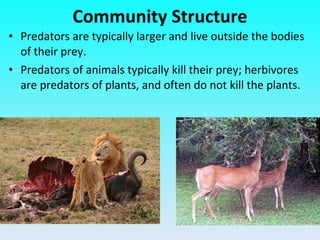
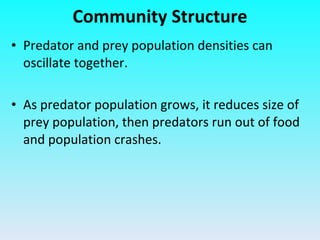
Predators are typically larger and live outside the bodies of their prey. Predators of animals typically kill their prey; herbivores are predators of plants, and often do not kill the plants. Community Structure
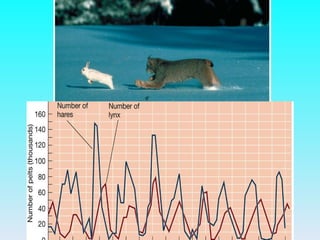
Predator and prey population densities can oscillate together. As predator population grows, it reduces size of prey population, then predators run out of food and population crashes. Community Structure
 
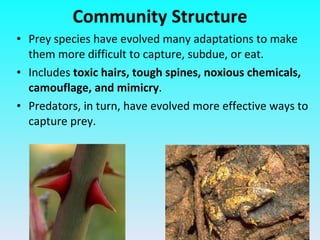
Prey species have evolved many adaptations to make them more difficult to capture, subdue, or eat. Includes  toxic hairs, tough spines, noxious chemicals, camouflage, and mimicry . Predators, in turn, have evolved more effective ways to capture prey. Community Structure
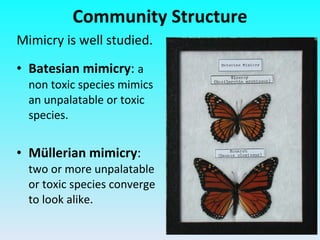
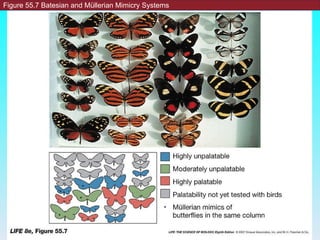
Mimicry is well studied. Batesian mimicry :  a non toxic species mimics an unpalatable or toxic species. M üllerian mimicry :  two or more unpalatable or toxic species converge to look alike. Community Structure
Figure 55.7 Batesian and Müllerian Mimicry Systems
Competition for resources can influence abundance and distribution of species. Interference competition :  one species interferes with the activities of another. Exploitation competition :  one species reduces the availability of a resource. Community Structure
Competition can occur between individuals of the same species:   intraspecific   competition. A primary cause of density-dependent birth and death rates. Interspecific   competition occurs between individuals of different species.  Competitive exclusion  occurs   when a superior competitor prevents another species from using a habitat. Community Structure
Competition can restrict a species’ habitat. Plants compete for space. The shoots need sunlight and the roots compete for water and minerals. Sessile animals also compete for space.  Community Structure
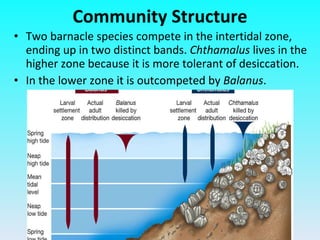
Two barnacle species compete in the intertidal zone, ending up in two distinct bands.  Chthamalus  lives in the higher zone because it is more tolerant of desiccation. In the lower zone it is outcompeted by  Balanus . Community Structure
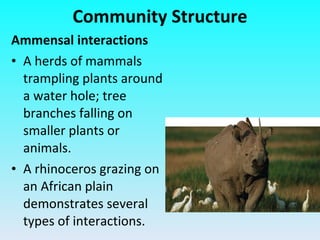
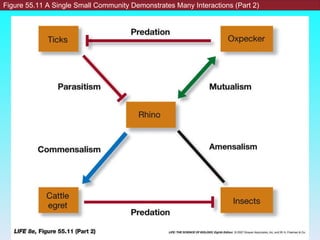
Ammensal interactions A herds of mammals trampling plants around a water hole; tree branches falling on smaller plants or animals. A rhinoceros grazing on an African plain demonstrates several types of interactions. Community Structure
Figure 55.11 A Single Small Community Demonstrates Many Interactions (Part 2)
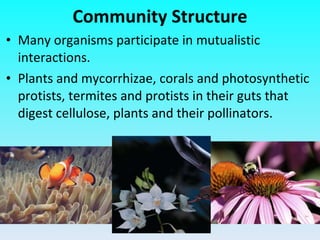
Many organisms participate in mutualistic interactions. Plants and mycorrhizae, corals and photosynthetic protists, termites and protists in their guts that digest cellulose, plants and their pollinators. Community Structure
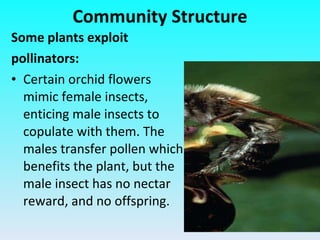
Some plants exploit pollinators: Certain orchid flowers mimic female insects, enticing male insects to copulate with them. The males transfer pollen which benefits the plant, but the male insect has no nectar reward, and no offspring. Community Structure
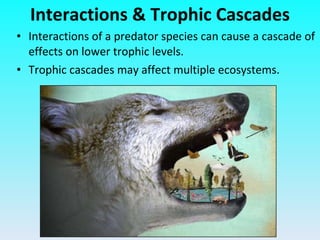
Interactions & Trophic Cascades Interactions of a predator species can cause a cascade of effects on lower trophic levels. Trophic cascades may affect multiple ecosystems.
Beavers can also cause trophic cascades; by preferentially cutting some species of trees they alter the species composition of the vegetation. They also create aquatic habitat for many other species by building dams. Organisms that build such structures are called  ecosystem engineers . Interactions & Trophic Cascades
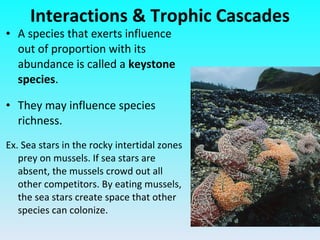
A species that exerts influence out of proportion with its abundance is called a  keystone species . They may influence species richness. Ex. Sea stars in the rocky intertidal zones prey on mussels. If sea stars are absent, the mussels crowd out all other competitors. By eating mussels, the sea stars create space that other species can colonize. Interactions & Trophic Cascades
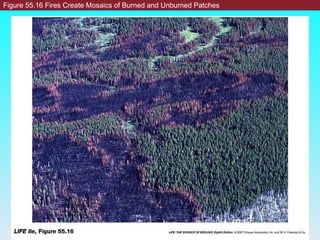
Disturbances & Communities A  disturbance  is an event that changes the survival rate of one or more species. For example, Fires in Yellowstone in 1988 created a mosaic of burned and unburned patches. Effects of disturbance depend on the size and duration of the disturbance.
Figure 55.16 Fires Create Mosaics of Burned and Unburned Patches
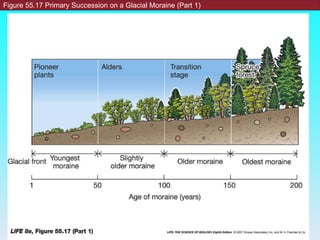
Change in community composition following a disturbance is called  succession . Primary succession  begins on sites that lack living organisms. Secondary succession  begins on sites where some organisms have survived. Disturbances & Communities
Figure 55.17 Primary Succession on a Glacial Moraine (Part 1)
The  intermediate disturbance hypothesis :  Communities with intermediate levels of disturbance tend to have more species that those with high or low levels of disturbance. Only species with great dispersal capabilities and high reproductive rates can survive in areas with high disturbance. Where disturbance levels are low, competitive species replace other species, reducing species richness. Disturbances & Communities
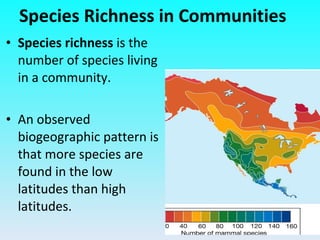
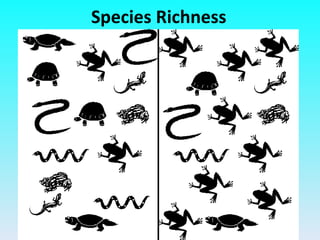
Species Richness in Communities Species richness  is the number of species living in a community. An observed biogeographic pattern is that more species are found in the low latitudes than high latitudes.
The mountainous regions also have greater species richness. More vegetation types and climates exist in these topographically diverse areas. Islands and peninsulas generally have fewer species than a similar area on the mainland (theory of island biogeography). Species Richness in Communities
Species richness might enhance productivity, because more species would be using all possible resources. If environment changes, a species-rich ecosystem is more likely to have species already adapted to new conditions. The species-rich ecosystem would be more  stable , or change less over time. Species Richness in Communities
Species Richness

Chapter 55

  • 1.
  • 2.
    Ecological Communities Anecological community consists of all the species that live and interact in a given area. Ecological communities are not assemblages that move together as a unit. Each species has unique interactions with its environment.
  • 3.
    Organisms in acommunity can be divided into trophic levels based on their source of energy. Photosynthesizers or primary producers are autotrophs that get their energy directly from sunlight. All heterotrophs consume, directly or indirectly, the energy-rich molecules made by the primary producers. Ecological Communities
  • 4.
    Herbivores eat plants,and constitute the primary consumer level. Organisms that eat herbivores are secondary consumers . Organisms that eat secondary consumers are tertiary consumers . Detritivores or decomposers eat dead bodies and waste products. Organisms that get their food from more than one trophic level are omnivores . Ecological Communities
  • 5.
    Table 55.1 The Major Trophic Levels
  • 6.
    A sequence inwhich a plant is eaten by an herbivore, which is eaten by a secondary consumer, etc. can be diagrammed as a food chain . Food chains are interconnected to make food webs . Ecological Communities
  • 7.
    Most communities haveonly four to five trophic levels. Energy is lost between trophic levels. Diagrams showing energy or biomass (weight of living matter) at each trophic level show how energy decreases as it flows from lower to higher levels. Ecological Communities
  • 8.
    Detritivores includebacteria, fungi, worms, mites, and many insects. They transform detritus (dead remains and waste products) into free mineral nutrients that can be taken up and used again by plants. Continued ecosystem productivity depends on the decomposition of detritus. Ecological Communities
  • 9.
    Community Structure Categoriesof species interactions: Predation or parasitism : one participant is harmed, the other benefits. Competition : two organisms using same resource that is insufficient to supply needs of both. Mutualism : both species benefit. Commensalism : one participant benefits and the other is unaffected. Amensalism : one participant is harmed, and the other is unaffected.
  • 10.
    Table 55.2 Types of Ecological Interactions
  • 11.
    Predation and parasitesParasites are usually smaller than their hosts, and live inside or outside the host. They often feed on the host without killing it. Microparasites are much smaller: bacteria, viruses, protists. Community Structure
  • 12.
    Predators are typicallylarger and live outside the bodies of their prey. Predators of animals typically kill their prey; herbivores are predators of plants, and often do not kill the plants. Community Structure
  • 13.
    Predator and preypopulation densities can oscillate together. As predator population grows, it reduces size of prey population, then predators run out of food and population crashes. Community Structure
  • 14.
  • 15.
    Prey species haveevolved many adaptations to make them more difficult to capture, subdue, or eat. Includes toxic hairs, tough spines, noxious chemicals, camouflage, and mimicry . Predators, in turn, have evolved more effective ways to capture prey. Community Structure
  • 16.
    Mimicry is wellstudied. Batesian mimicry : a non toxic species mimics an unpalatable or toxic species. M üllerian mimicry : two or more unpalatable or toxic species converge to look alike. Community Structure
  • 17.
    Figure 55.7 Batesianand Müllerian Mimicry Systems
  • 18.
    Competition for resourcescan influence abundance and distribution of species. Interference competition : one species interferes with the activities of another. Exploitation competition : one species reduces the availability of a resource. Community Structure
  • 19.
    Competition can occurbetween individuals of the same species: intraspecific competition. A primary cause of density-dependent birth and death rates. Interspecific competition occurs between individuals of different species. Competitive exclusion occurs when a superior competitor prevents another species from using a habitat. Community Structure
  • 20.
    Competition can restricta species’ habitat. Plants compete for space. The shoots need sunlight and the roots compete for water and minerals. Sessile animals also compete for space. Community Structure
  • 21.
    Two barnacle speciescompete in the intertidal zone, ending up in two distinct bands. Chthamalus lives in the higher zone because it is more tolerant of desiccation. In the lower zone it is outcompeted by Balanus . Community Structure
  • 22.
    Ammensal interactions Aherds of mammals trampling plants around a water hole; tree branches falling on smaller plants or animals. A rhinoceros grazing on an African plain demonstrates several types of interactions. Community Structure
  • 23.
    Figure 55.11 ASingle Small Community Demonstrates Many Interactions (Part 2)
  • 24.
    Many organisms participatein mutualistic interactions. Plants and mycorrhizae, corals and photosynthetic protists, termites and protists in their guts that digest cellulose, plants and their pollinators. Community Structure
  • 25.
    Some plants exploitpollinators: Certain orchid flowers mimic female insects, enticing male insects to copulate with them. The males transfer pollen which benefits the plant, but the male insect has no nectar reward, and no offspring. Community Structure
  • 26.
    Interactions & TrophicCascades Interactions of a predator species can cause a cascade of effects on lower trophic levels. Trophic cascades may affect multiple ecosystems.
  • 27.
    Beavers can alsocause trophic cascades; by preferentially cutting some species of trees they alter the species composition of the vegetation. They also create aquatic habitat for many other species by building dams. Organisms that build such structures are called ecosystem engineers . Interactions & Trophic Cascades
  • 28.
    A species thatexerts influence out of proportion with its abundance is called a keystone species . They may influence species richness. Ex. Sea stars in the rocky intertidal zones prey on mussels. If sea stars are absent, the mussels crowd out all other competitors. By eating mussels, the sea stars create space that other species can colonize. Interactions & Trophic Cascades
  • 29.
    Disturbances & CommunitiesA disturbance is an event that changes the survival rate of one or more species. For example, Fires in Yellowstone in 1988 created a mosaic of burned and unburned patches. Effects of disturbance depend on the size and duration of the disturbance.
  • 30.
    Figure 55.16 FiresCreate Mosaics of Burned and Unburned Patches
  • 31.
    Change in communitycomposition following a disturbance is called succession . Primary succession begins on sites that lack living organisms. Secondary succession begins on sites where some organisms have survived. Disturbances & Communities
  • 32.
    Figure 55.17 PrimarySuccession on a Glacial Moraine (Part 1)
  • 33.
    The intermediatedisturbance hypothesis : Communities with intermediate levels of disturbance tend to have more species that those with high or low levels of disturbance. Only species with great dispersal capabilities and high reproductive rates can survive in areas with high disturbance. Where disturbance levels are low, competitive species replace other species, reducing species richness. Disturbances & Communities
  • 34.
    Species Richness inCommunities Species richness is the number of species living in a community. An observed biogeographic pattern is that more species are found in the low latitudes than high latitudes.
  • 35.
    The mountainous regionsalso have greater species richness. More vegetation types and climates exist in these topographically diverse areas. Islands and peninsulas generally have fewer species than a similar area on the mainland (theory of island biogeography). Species Richness in Communities
  • 36.
    Species richness mightenhance productivity, because more species would be using all possible resources. If environment changes, a species-rich ecosystem is more likely to have species already adapted to new conditions. The species-rich ecosystem would be more stable , or change less over time. Species Richness in Communities
  • 37.