Ecology I:  Species, Populations, Communities and Ecosystems Ecology I Species interactions, Populations, Communities and Ecosystems
ECOLOGY Ecology :  the scientific study of relationships between organisms and their environment Includes the study of the ecosystem structure and function Ecology I:  Species, Populations, Communities and Ecosystems
Ecologist vs. Environmentalist Is an ecologist an environmentalist? No, not necessarily An ecologist is a scientist studying how ecosystems work and the relationship between organisms and their environment An environmentalist is an individual interested in the environment (and may or may not be a scientist) Ecology I:  Species, Populations, Communities and Ecosystems
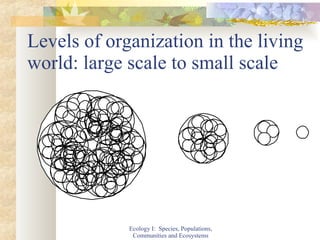
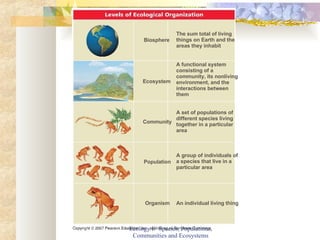
Levels of organization in the living world: large scale to small scale Ecology I:  Species, Populations, Communities and Ecosystems
Biosphere Ecosystem Community Population Organism The sum total of living things on Earth and the areas they inhabit A functional system consisting of a community, its nonliving environment, and the interactions between them A set of populations of different species living together in a particular area A group of individuals of a species that live in a particular area An individual living thing Ecology I:  Species, Populations, Communities and Ecosystems
Levels of organization in the living world Organism :  an individual living thing Classified by ancestry into species 1.75 million named so far Maybe 3-100 million total Ecology I:  Species, Populations, Communities and Ecosystems
Why are we still so unsure of the number of species on Earth? Some areas remain little explored (hydrothermal vents, rainforest canopies, tropical soils). Many species are tiny and inconspicuous (microbes, roundworms, protists, fungi…). Some species are very similar in appearance (many taxa, even trees, birds, whales). Levels of organization in the living world
Species One or more  populations Ecology I:  Species, Populations, Communities and Ecosystems
Species One or more populations whose members actually or potentially  interbreed  under natural conditions Ecology I:  Species, Populations, Communities and Ecosystems
Species One or more populations whose members actually or potentially interbreed under natural conditions and produce fertile offspring. Ecology I:  Species, Populations, Communities and Ecosystems
Levels of organization in the living world Organisms : Population :  group of individuals of same species occupying a given area at the same time Ecology I:  Species, Populations, Communities and Ecosystems
Levels of organization in the living world Organisms: Population: Community :  a set of populations of different species occupying a particular place Ecology I:  Species, Populations, Communities and Ecosystems
Levels of organization in the living world Organisms: Population: Community: Ecosystem:  community(ies) interacting with one another and with the  physical environment  in a particular place Ecology I:  Species, Populations, Communities and Ecosystems
Levels of organization in the living world Ecosystems : Include abiotic factors such as climate, water, minerals and sunlight as well as biotic factors such as organisms Ecosystems are the fundamental operational unit of ecology Ecology I:  Species, Populations, Communities and Ecosystems
Ecology I:  Species, Populations, Communities and Ecosystems Species:  Distribution & Interrelationships
What determines whether a species will occur at any given place and time? I. It must be able to get there Evolution, Immigration, Introduction II. It must be able to survive there Biological and Physical Environment III. It must be able to reproduce there Suitable mates and environment, etc. Ecology I:  Species, Populations, Communities and Ecosystems
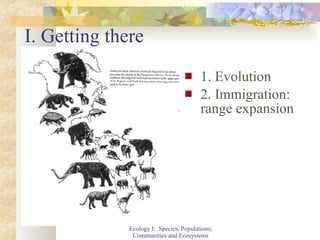
I. Getting there 1. Evolution  2. Immigration: range expansion Ecology I:  Species, Populations, Communities and Ecosystems
I. Getting there 1. Evolution  2. Immigration 3. Introduction introduced = exotic = alien species versus native and endemic species Ecology I:  Species, Populations, Communities and Ecosystems
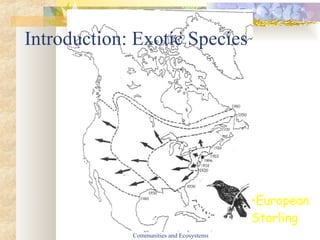
Introduction: Exotic Species Ecology I:  Species, Populations, Communities and Ecosystems European Starling
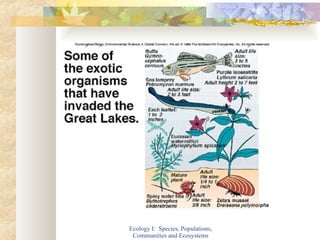
Ecology I:  Species, Populations, Communities and Ecosystems
II. Surviving there 1. Physical environment 2. Biological environment Ecology I:  Species, Populations, Communities and Ecosystems
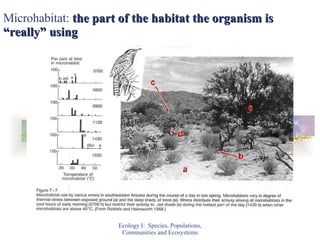
II. Surviving there:  Habitat An organism’s place or type of place in which it lives and thrives. Includes food, water, cover, and space Microhabitat :  the part of the habitat the organism is “really” using Ecology I:  Species, Populations, Communities and Ecosystems
Microhabitat:  the part of the habitat the organism is “really” using Ecology I:  Species, Populations, Communities and Ecosystems
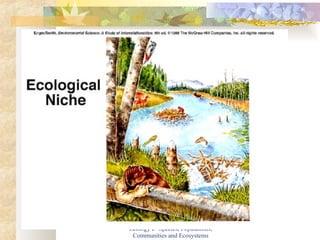
II. Surviving there:  Niche What the organism  does  in its habitat Includes all the physical and biological factors and interactions of the organism Ecology I:  Species, Populations, Communities and Ecosystems
Ecology I:  Species, Populations, Communities and Ecosystems
II. Surviving there:  Niche Specialists versus Generalists Plants and animals with narrow tolerance ranges and/or specific dietary constraints, etc. =  Specialists Plants and animals with wide variety of habitats, foods, etc =  Generalists Ecology I:  Species, Populations, Communities and Ecosystems
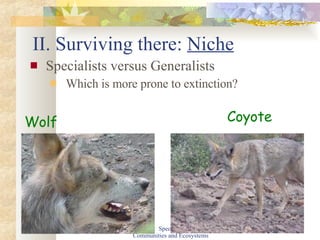
II. Surviving there:  Niche Specialists versus Generalists Which is more prone to extinction? Ecology I:  Species, Populations, Communities and Ecosystems Wolf Coyote
II. Surviving there: Niche Which is more prone to extinction? The wolf—a specialist (carnivore)? The coyote—a generalist (omnivore)? Answer:  the wolf Ecology I:  Species, Populations, Communities and Ecosystems
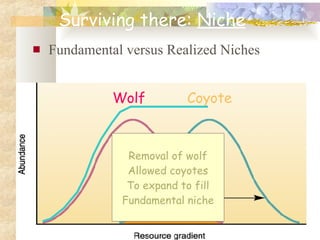
Fundamental versus Realized Niches Ecology I:  Species, Populations, Communities and Ecosystems Wolf Coyote Surviving there:  Niche Removal of wolf Allowed coyotes To expand to fill Fundamental niche
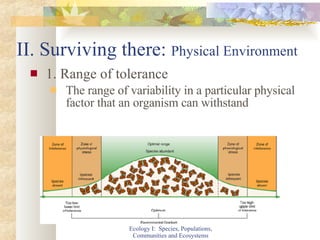
II. Surviving there:  Physical Environment 1. Range of tolerance The range of variability in a particular physical factor that an organism can withstand Ecology I:  Species, Populations, Communities and Ecosystems
II. Surviving there:  Physical Environment 1. Range of tolerance What an organism can tolerate depends on… Adaptation : (population level) due to past evolution Acclimation :  (individual level) Physiological changes within an individual to slowly changing new conditions Ecology I:  Species, Populations, Communities and Ecosystems
II.  Surviving there:   Physical Environment 2. Limiting Factors All it takes is one single factor to be outside of the range of tolerance to limit population growth This factor is called the  limiting factor Ecology I:  Species, Populations, Communities and Ecosystems
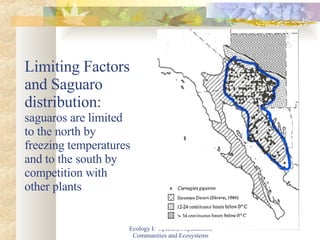
Limiting Factors and Saguaro distribution: saguaros are limited to the north by freezing temperatures and to the south by competition with other plants Ecology I:  Species, Populations, Communities and Ecosystems
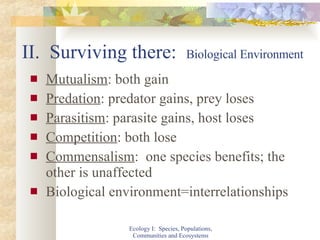
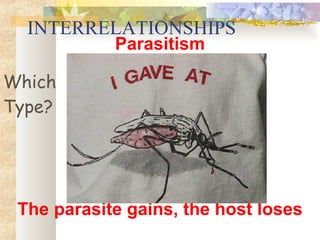
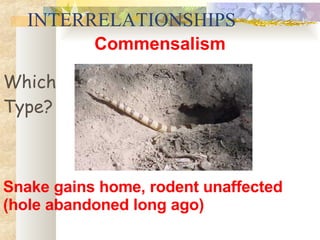
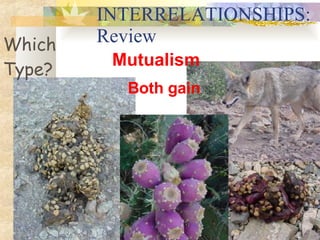
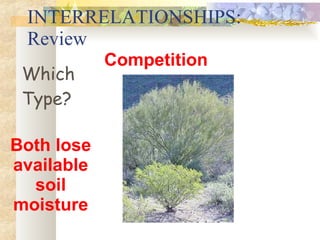
II.  Surviving there:  Biological Environment Mutualism : both gain Predation : predator gains, prey loses Parasitism : parasite gains, host loses Competition : both lose Commensalism :  one species benefits; the other is unaffected Biological environment=interrelationships Ecology I:  Species, Populations, Communities and Ecosystems
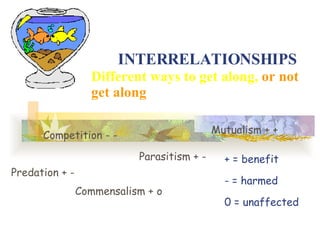
INTERRELATIONSHIPS Different ways to get along,   or not get along Predation + - Competition - - Parasitism + - Commensalism + o Mutualism + + + = benefit = harmed 0 = unaffected
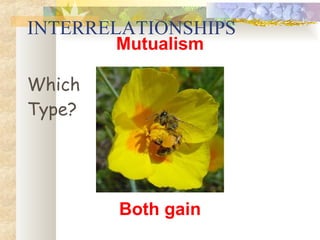
INTERRELATIONSHIPS Mutualism Which Type? Both gain
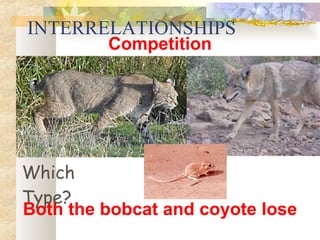
INTERRELATIONSHIPS Competition Which Type? Both the bobcat and coyote lose
INTERRELATIONSHIPS Parasitism Which Type? The parasite gains, the host loses
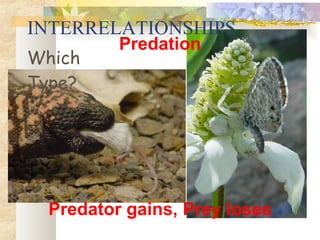
INTERRELATIONSHIPS Predation Which Type? Predator gains, Prey loses
INTERRELATIONSHIPS Commensalism Which Type? Snake gains home, rodent unaffected (hole abandoned long ago)
INTERRELATIONSHIPS: Review Mutualism Which Type? Both gain
INTERRELATIONSHIPS: Review Competition Which Type? Both lose available soil moisture
III.  Reproduce there Ecology I:  Species, Populations, Communities and Ecosystems Must find suitable mate Offspring must be able to survive to reproductive age in order to ensure on-going presence of population

Unit2 Ecology Ia Species

  • 1.
    Ecology I: Species, Populations, Communities and Ecosystems Ecology I Species interactions, Populations, Communities and Ecosystems
  • 2.
    ECOLOGY Ecology : the scientific study of relationships between organisms and their environment Includes the study of the ecosystem structure and function Ecology I: Species, Populations, Communities and Ecosystems
  • 3.
    Ecologist vs. EnvironmentalistIs an ecologist an environmentalist? No, not necessarily An ecologist is a scientist studying how ecosystems work and the relationship between organisms and their environment An environmentalist is an individual interested in the environment (and may or may not be a scientist) Ecology I: Species, Populations, Communities and Ecosystems
  • 4.
    Levels of organizationin the living world: large scale to small scale Ecology I: Species, Populations, Communities and Ecosystems
  • 5.
    Biosphere Ecosystem CommunityPopulation Organism The sum total of living things on Earth and the areas they inhabit A functional system consisting of a community, its nonliving environment, and the interactions between them A set of populations of different species living together in a particular area A group of individuals of a species that live in a particular area An individual living thing Ecology I: Species, Populations, Communities and Ecosystems
  • 6.
    Levels of organizationin the living world Organism : an individual living thing Classified by ancestry into species 1.75 million named so far Maybe 3-100 million total Ecology I: Species, Populations, Communities and Ecosystems
  • 7.
    Why are westill so unsure of the number of species on Earth? Some areas remain little explored (hydrothermal vents, rainforest canopies, tropical soils). Many species are tiny and inconspicuous (microbes, roundworms, protists, fungi…). Some species are very similar in appearance (many taxa, even trees, birds, whales). Levels of organization in the living world
  • 8.
    Species One ormore populations Ecology I: Species, Populations, Communities and Ecosystems
  • 9.
    Species One ormore populations whose members actually or potentially interbreed under natural conditions Ecology I: Species, Populations, Communities and Ecosystems
  • 10.
    Species One ormore populations whose members actually or potentially interbreed under natural conditions and produce fertile offspring. Ecology I: Species, Populations, Communities and Ecosystems
  • 11.
    Levels of organizationin the living world Organisms : Population : group of individuals of same species occupying a given area at the same time Ecology I: Species, Populations, Communities and Ecosystems
  • 12.
    Levels of organizationin the living world Organisms: Population: Community : a set of populations of different species occupying a particular place Ecology I: Species, Populations, Communities and Ecosystems
  • 13.
    Levels of organizationin the living world Organisms: Population: Community: Ecosystem: community(ies) interacting with one another and with the physical environment in a particular place Ecology I: Species, Populations, Communities and Ecosystems
  • 14.
    Levels of organizationin the living world Ecosystems : Include abiotic factors such as climate, water, minerals and sunlight as well as biotic factors such as organisms Ecosystems are the fundamental operational unit of ecology Ecology I: Species, Populations, Communities and Ecosystems
  • 15.
    Ecology I: Species, Populations, Communities and Ecosystems Species: Distribution & Interrelationships
  • 16.
    What determines whethera species will occur at any given place and time? I. It must be able to get there Evolution, Immigration, Introduction II. It must be able to survive there Biological and Physical Environment III. It must be able to reproduce there Suitable mates and environment, etc. Ecology I: Species, Populations, Communities and Ecosystems
  • 17.
    I. Getting there1. Evolution 2. Immigration: range expansion Ecology I: Species, Populations, Communities and Ecosystems
  • 18.
    I. Getting there1. Evolution 2. Immigration 3. Introduction introduced = exotic = alien species versus native and endemic species Ecology I: Species, Populations, Communities and Ecosystems
  • 19.
    Introduction: Exotic SpeciesEcology I: Species, Populations, Communities and Ecosystems European Starling
  • 20.
    Ecology I: Species, Populations, Communities and Ecosystems
  • 21.
    II. Surviving there1. Physical environment 2. Biological environment Ecology I: Species, Populations, Communities and Ecosystems
  • 22.
    II. Surviving there: Habitat An organism’s place or type of place in which it lives and thrives. Includes food, water, cover, and space Microhabitat : the part of the habitat the organism is “really” using Ecology I: Species, Populations, Communities and Ecosystems
  • 23.
    Microhabitat: thepart of the habitat the organism is “really” using Ecology I: Species, Populations, Communities and Ecosystems
  • 24.
    II. Surviving there: Niche What the organism does in its habitat Includes all the physical and biological factors and interactions of the organism Ecology I: Species, Populations, Communities and Ecosystems
  • 25.
    Ecology I: Species, Populations, Communities and Ecosystems
  • 26.
    II. Surviving there: Niche Specialists versus Generalists Plants and animals with narrow tolerance ranges and/or specific dietary constraints, etc. = Specialists Plants and animals with wide variety of habitats, foods, etc = Generalists Ecology I: Species, Populations, Communities and Ecosystems
  • 27.
    II. Surviving there: Niche Specialists versus Generalists Which is more prone to extinction? Ecology I: Species, Populations, Communities and Ecosystems Wolf Coyote
  • 28.
    II. Surviving there:Niche Which is more prone to extinction? The wolf—a specialist (carnivore)? The coyote—a generalist (omnivore)? Answer: the wolf Ecology I: Species, Populations, Communities and Ecosystems
  • 29.
    Fundamental versus RealizedNiches Ecology I: Species, Populations, Communities and Ecosystems Wolf Coyote Surviving there: Niche Removal of wolf Allowed coyotes To expand to fill Fundamental niche
  • 30.
    II. Surviving there: Physical Environment 1. Range of tolerance The range of variability in a particular physical factor that an organism can withstand Ecology I: Species, Populations, Communities and Ecosystems
  • 31.
    II. Surviving there: Physical Environment 1. Range of tolerance What an organism can tolerate depends on… Adaptation : (population level) due to past evolution Acclimation : (individual level) Physiological changes within an individual to slowly changing new conditions Ecology I: Species, Populations, Communities and Ecosystems
  • 32.
    II. Survivingthere: Physical Environment 2. Limiting Factors All it takes is one single factor to be outside of the range of tolerance to limit population growth This factor is called the limiting factor Ecology I: Species, Populations, Communities and Ecosystems
  • 33.
    Limiting Factors andSaguaro distribution: saguaros are limited to the north by freezing temperatures and to the south by competition with other plants Ecology I: Species, Populations, Communities and Ecosystems
  • 34.
    II. Survivingthere: Biological Environment Mutualism : both gain Predation : predator gains, prey loses Parasitism : parasite gains, host loses Competition : both lose Commensalism : one species benefits; the other is unaffected Biological environment=interrelationships Ecology I: Species, Populations, Communities and Ecosystems
  • 35.
    INTERRELATIONSHIPS Different waysto get along, or not get along Predation + - Competition - - Parasitism + - Commensalism + o Mutualism + + + = benefit = harmed 0 = unaffected
  • 36.
  • 37.
    INTERRELATIONSHIPS Competition WhichType? Both the bobcat and coyote lose
  • 38.
    INTERRELATIONSHIPS Parasitism WhichType? The parasite gains, the host loses
  • 39.
    INTERRELATIONSHIPS Predation WhichType? Predator gains, Prey loses
  • 40.
    INTERRELATIONSHIPS Commensalism WhichType? Snake gains home, rodent unaffected (hole abandoned long ago)
  • 41.
  • 42.
    INTERRELATIONSHIPS: Review CompetitionWhich Type? Both lose available soil moisture
  • 43.
    III. Reproducethere Ecology I: Species, Populations, Communities and Ecosystems Must find suitable mate Offspring must be able to survive to reproductive age in order to ensure on-going presence of population