Prof S S Jahagirdar, NKOCET

AIR POLLUTION
AND CONTROL
(Elective-I)
Problem set for
UNIT-VII
AIR POLLUTION
(PARTICULATE)CONTROL
EQUIPMENTS

Page | 1
BE (CIVIL)

L-

ROLL NO-

Air pollution (Elective -I)
Unit-VII
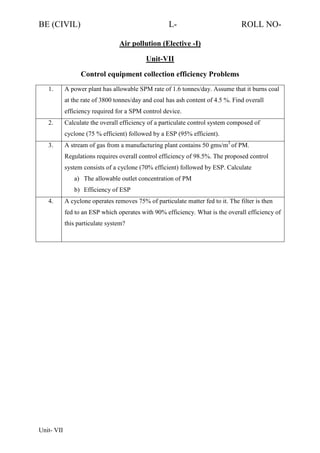
Control equipment collection efficiency Problems
1.

A power plant has allowable SPM rate of 1.6 tonnes/day. Assume that it burns coal
at the rate of 3800 tonnes/day and coal has ash content of 4.5 %. Find overall
efficiency required for a SPM control device.

2.

Calculate the overall efficiency of a particulate control system composed of
cyclone (75 % efficient) followed by a ESP (95% efficient).

3.

A stream of gas from a manufacturing plant contains 50 gms/m3 of PM.
Regulations requires overall control efficiency of 98.5%. The proposed control
system consists of a cyclone (70% efficient) followed by ESP. Calculate
a) The allowable outlet concentration of PM
b) Efficiency of ESP

4.

A cyclone operates removes 75% of particulate matter fed to it. The filter is then
fed to an ESP which operates with 90% efficiency. What is the overall efficiency of
this particulate system?

Unit- VII
BE (CIVIL)

L-

ROLL NO-

Air pollution (Elective -I)
Unit-VII
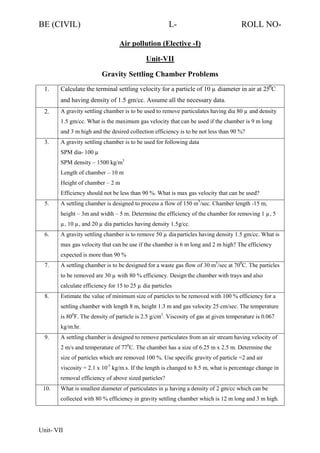
Gravity Settling Chamber Problems
1.

Calculate the terminal settling velocity for a particle of 10 µ diameter in air at 250C
and having density of 1.5 gm/cc. Assume all the necessary data.

2.

A gravity settling chamber is to be used to remove particulates having dia 80 µ and density
1.5 gm/cc. What is the maximum gas velocity that can be used if the chamber is 9 m long
and 3 m high and the desired collection efficiency is to be not less than 90 %?

3.

A gravity settling chamber is to be used for following data
SPM dia- 100 µ
SPM density – 1500 kg/m3
Length of chamber – 10 m
Height of chamber – 2 m
Efficiency should not be less than 90 %. What is max gas velocity that can be used?

5.

A settling chamber is designed to process a flow of 150 m3/sec. Chamber length -15 m,
height – 3m and width – 5 m. Determine the efficiency of the chamber for removing 1 µ, 5
µ, 10 µ, and 20 µ dia particles having density 1.5 g/cc.

6.

A gravity settling chamber is to remove 50 µ dia particles having density 1.5 gm/cc. What is
max gas velocity that can be use if the chamber is 6 m long and 2 m high? The efficiency
expected is more than 90 %

7.

A settling chamber is to be designed for a waste gas flow of 30 m3/sec at 700C. The particles
to be removed are 30 µ with 80 % efficiency. Design the chamber with trays and also
calculate efficiency for 15 to 25 µ dia particles

8.

Estimate the value of minimum size of particles to be removed with 100 % efficiency for a
settling chamber with length 8 m, height 1.3 m and gas velocity 25 cm/sec. The temperature
is 800F. The density of particle is 2.5 g/cm3. Viscosity of gas at given temperature is 0.067
kg/m.hr.

9.

A settling chamber is designed to remove particulates from an air stream having velocity of
2 m/s and temperature of 770C. The chamber has a size of 6.25 m x 2.5 m. Determine the
size of particles which are removed 100 %. Use specific gravity of particle =2 and air
viscosity = 2.1 x 10⁻⁵ kg/m.s. If the length is changed to 8.5 m, what is percentage change in
removal efficiency of above sized particles?

10.

What is smallest diameter of particulates in µ having a density of 2 gm/cc which can be
collected with 80 % efficiency in gravity settling chamber which is 12 m long and 3 m high.

Unit- VII
BE (CIVIL)

L-

ROLL NO-

Gas velocity is 0.78 m/sec. Mention how you can improve the efficiency?
11.

Calculate the terminal settling velocity for a particle of 1 µ diameter in air at 270C
and having density of 1.85 x 10⁻⁵N.S/m2. Assume all the necessary data.

12.

Determine minimum size of particulates that will be removed with 100 % efficiency from a
settling chamber, under following conditions
i.

Air : Horizontal velocity= 0.3 m/sec
Temp = 770C

ii.

Particles : Sp Gr = 2.0

iii.

Chamber : Length = 7.5 m
Height = 1.5 m

What will be efficiency for same particles if chamber length is 6 m?
13.

A settling chamber is designed for removing 80µ dia particles with 100 % efficiency. The
particulate matter density is 1500 kg/m3. Depth and width of chamber is 2 m each.
Determine:i.
ii.

Unit- VII

Length of chamber required without trays.
Length of chamber with 10 trays.
BE (CIVIL)

L-

ROLL NO-

Air pollution (Elective -I)
Unit-VII
Cyclone Problems
1.

A cyclone is designed with an inlet of 10 cm and 5 effective turns. The inlet gas
velocity is to be 10 m/s and particulate density is 1.7 gm/cc. Estimate the particle
size that will be collected with 50 % efficiency, if the gas is air and its temperature
is 3500 K. Viscosity of air is 0.075 kg/m.hr

2.

A cyclone is designed with an inlet of 13 cm and 4 effective turns. The inlet gas
velocity is to be 16 m/s and particulate density is 1.7 gm/cc. Estimate the particle
size that will be collected with 60 % efficiency, if the gas is air and its temperature
is 350 0K. Viscosity of air is 0.0748 kg/m.hr

3.

An air stream with flow rate of 7 m3/sec is passed through a cyclone of standard
proportions. The diameter of cyclone is 2m and air temperature is 770C and
numbers of effective turns are 5. Density of particle is 1500 kg/m3
i.
ii.

4.

Determine the particle size which can be removed with 50 % efficiency.
Sketch the cyclone giving all dimensions in meter.

A cyclone is designed with an inlet of 10 cm and 4 effective turns. The inlet gas
velocity is to be 15 m/s and particulate density is 1.5 gm/cc. Estimate the particle
size that will be collected with 50 % efficiency, if the gas is air and its temperature
is 3500 K. Viscosity of air is 0.075 kg/m.hr.

5.

An air stream with a flow rate of 7 m3/sec is passed through a cyclone of standard
proportions. The dia of cyclone is 2 m. µ = 2.1 x 10⁻⁵ kg/m-sec.
a) Determine the removal efficiency for a particle with a density of 1500
kg/m3 and a dia of 10 µ. Take Ne = 5 turns
b) Determine the collection efficiency base on the above if bank of 64

cyclones with diameters 24 cm are used instead of single cyclone.
6.

A conventional cyclone with dia. 1 m handles 3 m3/sec of standard air, carrying
particles with a density of 2000 kg/m3. For Ne = 6, determine the cut size and the
efficiency as function of particle diameter. µg = 1.81 x 10⁻⁵ kg/m-sec

Unit- VII
BE (CIVIL)

L-

ROLL NO-

Air pollution (Elective -I)
Unit-VII
Bag house filter Problems
1.

A filter bag house is to be designed for a gas flow of 150 m3/sec. Make necessary
assumptions and determine the size of bag and no. of bags. Draw neat sketch

2.

A fabric filter is to be constructed using bags having 22 cm diameter and 6 m height.
The bag house is to receive 12 m3/s of air and filtering velocity is restricted to 2
m/min. Determine the number of bags required for a continuously cleaned operation.

3.

A fabric filter is to be constructed using bags having 0.2 m diameter and 6 m height.
The bag house is to receive 10 m3/s of air and air to cloth ratio is 2 m/min. Determine
the cloth area and number of bags required.

4.

A fabric filter must process 15 m3/sec of waste gas. The bag house is to be divided
into 8 sections of equal cloth area, so that one section can shut down for cleaning
while other continues operations. Assume air to cloth ratio 9 m3/min/m2 and bag
diameter 0.25 m and 7 m long. Determine no of bags and physical arrangement

5.

Determine no of bags necessary to treat 16 m3/sec of polluted air laden with
particulates. The air/cloth ratio = 10 m/min. The bags have 0.25 m dia and 7 m length

Unit- VII
BE (CIVIL)

L-

ROLL NO-

Air pollution (Elective -I)
Unit-VII
Electrostatic Precipitator (ESP) Problems
1.

An ESP with overall spacing 23 cm and mean gas velocity of 1.5 m/s has collector
plate area of 6000 m2 gives 97 % efficiency in treating 200 m3/s of flue gas. To
achieve 98 % and 99 % efficiency what should be plate area required?

2.

For an ESP of given geometry and operating conditions, the collection efficiency
for 2 µ particle is 99.90 %. On the basis of Deutch equation for efficiency, estimate
the collection efficiency for
i.
ii.

0.5 µ

iii.
3.

1µ

0.1 µ.

Design the ESP are for controlling 40 m3/s of dirty gas containing 60 % particles of
1 µ dia, 40 % of 0.5 µ dia. The overall efficiency required is 99 %

Unit- VII

Unit vii problem set

  • 1.
    Prof S SJahagirdar, NKOCET AIR POLLUTION AND CONTROL (Elective-I) Problem set for UNIT-VII AIR POLLUTION (PARTICULATE)CONTROL EQUIPMENTS Page | 1
  • 2.
    BE (CIVIL) L- ROLL NO- Airpollution (Elective -I) Unit-VII Control equipment collection efficiency Problems 1. A power plant has allowable SPM rate of 1.6 tonnes/day. Assume that it burns coal at the rate of 3800 tonnes/day and coal has ash content of 4.5 %. Find overall efficiency required for a SPM control device. 2. Calculate the overall efficiency of a particulate control system composed of cyclone (75 % efficient) followed by a ESP (95% efficient). 3. A stream of gas from a manufacturing plant contains 50 gms/m3 of PM. Regulations requires overall control efficiency of 98.5%. The proposed control system consists of a cyclone (70% efficient) followed by ESP. Calculate a) The allowable outlet concentration of PM b) Efficiency of ESP 4. A cyclone operates removes 75% of particulate matter fed to it. The filter is then fed to an ESP which operates with 90% efficiency. What is the overall efficiency of this particulate system? Unit- VII
  • 3.
    BE (CIVIL) L- ROLL NO- Airpollution (Elective -I) Unit-VII Gravity Settling Chamber Problems 1. Calculate the terminal settling velocity for a particle of 10 µ diameter in air at 250C and having density of 1.5 gm/cc. Assume all the necessary data. 2. A gravity settling chamber is to be used to remove particulates having dia 80 µ and density 1.5 gm/cc. What is the maximum gas velocity that can be used if the chamber is 9 m long and 3 m high and the desired collection efficiency is to be not less than 90 %? 3. A gravity settling chamber is to be used for following data SPM dia- 100 µ SPM density – 1500 kg/m3 Length of chamber – 10 m Height of chamber – 2 m Efficiency should not be less than 90 %. What is max gas velocity that can be used? 5. A settling chamber is designed to process a flow of 150 m3/sec. Chamber length -15 m, height – 3m and width – 5 m. Determine the efficiency of the chamber for removing 1 µ, 5 µ, 10 µ, and 20 µ dia particles having density 1.5 g/cc. 6. A gravity settling chamber is to remove 50 µ dia particles having density 1.5 gm/cc. What is max gas velocity that can be use if the chamber is 6 m long and 2 m high? The efficiency expected is more than 90 % 7. A settling chamber is to be designed for a waste gas flow of 30 m3/sec at 700C. The particles to be removed are 30 µ with 80 % efficiency. Design the chamber with trays and also calculate efficiency for 15 to 25 µ dia particles 8. Estimate the value of minimum size of particles to be removed with 100 % efficiency for a settling chamber with length 8 m, height 1.3 m and gas velocity 25 cm/sec. The temperature is 800F. The density of particle is 2.5 g/cm3. Viscosity of gas at given temperature is 0.067 kg/m.hr. 9. A settling chamber is designed to remove particulates from an air stream having velocity of 2 m/s and temperature of 770C. The chamber has a size of 6.25 m x 2.5 m. Determine the size of particles which are removed 100 %. Use specific gravity of particle =2 and air viscosity = 2.1 x 10⁻⁵ kg/m.s. If the length is changed to 8.5 m, what is percentage change in removal efficiency of above sized particles? 10. What is smallest diameter of particulates in µ having a density of 2 gm/cc which can be collected with 80 % efficiency in gravity settling chamber which is 12 m long and 3 m high. Unit- VII
  • 4.
    BE (CIVIL) L- ROLL NO- Gasvelocity is 0.78 m/sec. Mention how you can improve the efficiency? 11. Calculate the terminal settling velocity for a particle of 1 µ diameter in air at 270C and having density of 1.85 x 10⁻⁵N.S/m2. Assume all the necessary data. 12. Determine minimum size of particulates that will be removed with 100 % efficiency from a settling chamber, under following conditions i. Air : Horizontal velocity= 0.3 m/sec Temp = 770C ii. Particles : Sp Gr = 2.0 iii. Chamber : Length = 7.5 m Height = 1.5 m What will be efficiency for same particles if chamber length is 6 m? 13. A settling chamber is designed for removing 80µ dia particles with 100 % efficiency. The particulate matter density is 1500 kg/m3. Depth and width of chamber is 2 m each. Determine:i. ii. Unit- VII Length of chamber required without trays. Length of chamber with 10 trays.
  • 5.
    BE (CIVIL) L- ROLL NO- Airpollution (Elective -I) Unit-VII Cyclone Problems 1. A cyclone is designed with an inlet of 10 cm and 5 effective turns. The inlet gas velocity is to be 10 m/s and particulate density is 1.7 gm/cc. Estimate the particle size that will be collected with 50 % efficiency, if the gas is air and its temperature is 3500 K. Viscosity of air is 0.075 kg/m.hr 2. A cyclone is designed with an inlet of 13 cm and 4 effective turns. The inlet gas velocity is to be 16 m/s and particulate density is 1.7 gm/cc. Estimate the particle size that will be collected with 60 % efficiency, if the gas is air and its temperature is 350 0K. Viscosity of air is 0.0748 kg/m.hr 3. An air stream with flow rate of 7 m3/sec is passed through a cyclone of standard proportions. The diameter of cyclone is 2m and air temperature is 770C and numbers of effective turns are 5. Density of particle is 1500 kg/m3 i. ii. 4. Determine the particle size which can be removed with 50 % efficiency. Sketch the cyclone giving all dimensions in meter. A cyclone is designed with an inlet of 10 cm and 4 effective turns. The inlet gas velocity is to be 15 m/s and particulate density is 1.5 gm/cc. Estimate the particle size that will be collected with 50 % efficiency, if the gas is air and its temperature is 3500 K. Viscosity of air is 0.075 kg/m.hr. 5. An air stream with a flow rate of 7 m3/sec is passed through a cyclone of standard proportions. The dia of cyclone is 2 m. µ = 2.1 x 10⁻⁵ kg/m-sec. a) Determine the removal efficiency for a particle with a density of 1500 kg/m3 and a dia of 10 µ. Take Ne = 5 turns b) Determine the collection efficiency base on the above if bank of 64 cyclones with diameters 24 cm are used instead of single cyclone. 6. A conventional cyclone with dia. 1 m handles 3 m3/sec of standard air, carrying particles with a density of 2000 kg/m3. For Ne = 6, determine the cut size and the efficiency as function of particle diameter. µg = 1.81 x 10⁻⁵ kg/m-sec Unit- VII
  • 6.
    BE (CIVIL) L- ROLL NO- Airpollution (Elective -I) Unit-VII Bag house filter Problems 1. A filter bag house is to be designed for a gas flow of 150 m3/sec. Make necessary assumptions and determine the size of bag and no. of bags. Draw neat sketch 2. A fabric filter is to be constructed using bags having 22 cm diameter and 6 m height. The bag house is to receive 12 m3/s of air and filtering velocity is restricted to 2 m/min. Determine the number of bags required for a continuously cleaned operation. 3. A fabric filter is to be constructed using bags having 0.2 m diameter and 6 m height. The bag house is to receive 10 m3/s of air and air to cloth ratio is 2 m/min. Determine the cloth area and number of bags required. 4. A fabric filter must process 15 m3/sec of waste gas. The bag house is to be divided into 8 sections of equal cloth area, so that one section can shut down for cleaning while other continues operations. Assume air to cloth ratio 9 m3/min/m2 and bag diameter 0.25 m and 7 m long. Determine no of bags and physical arrangement 5. Determine no of bags necessary to treat 16 m3/sec of polluted air laden with particulates. The air/cloth ratio = 10 m/min. The bags have 0.25 m dia and 7 m length Unit- VII
  • 7.
    BE (CIVIL) L- ROLL NO- Airpollution (Elective -I) Unit-VII Electrostatic Precipitator (ESP) Problems 1. An ESP with overall spacing 23 cm and mean gas velocity of 1.5 m/s has collector plate area of 6000 m2 gives 97 % efficiency in treating 200 m3/s of flue gas. To achieve 98 % and 99 % efficiency what should be plate area required? 2. For an ESP of given geometry and operating conditions, the collection efficiency for 2 µ particle is 99.90 %. On the basis of Deutch equation for efficiency, estimate the collection efficiency for i. ii. 0.5 µ iii. 3. 1µ 0.1 µ. Design the ESP are for controlling 40 m3/s of dirty gas containing 60 % particles of 1 µ dia, 40 % of 0.5 µ dia. The overall efficiency required is 99 % Unit- VII