Experiment No: 07 (A) Date:
DETERMINATION OF COEFFICIENT OF PERMEABILITY OF SOIL BY
CONSTANT HEAD TEST
Object & scope:
To determine the coefficient of permeability of soil in the laboratory by constant head test using Jodhpur
Permeameter.
Reference:
IS: 2720 (Part 17) -1986
Theory:
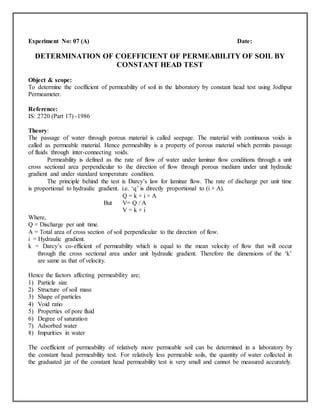
The passage of water through porous material is called seepage. The material with continuous voids is
called as permeable material. Hence permeability is a property of porous material which permits passage
of fluids through inter-connecting voids.
Permeability is defined as the rate of flow of water under laminar flow conditions through a unit
cross sectional area perpendicular to the direction of flow through porous medium under unit hydraulic
gradient and under standard temperature condition.
The principle behind the test is Darcy’s law for laminar flow. The rate of discharge per unit time
is proportional to hydraulic gradient. i.e. ‘q’ is directly proportional to (i × A).
Q = k × i × A
But V= Q / A
V = k × i
Where,
Q = Discharge per unit time.
A = Total area of cross section of soil perpendicular to the direction of flow.
i = Hydraulic gradient.
k = Darcy’s co-efficient of permeability which is equal to the mean velocity of flow that will occur
through the cross sectional area under unit hydraulic gradient. Therefore the dimensions of the ‘k’
are same as that of velocity.
Hence the factors affecting permeability are;
1) Particle size
2) Structure of soil mass
3) Shape of particles
4) Void ratio
5) Properties of pore fluid
6) Degree of saturation
7) Adsorbed water
8) Impurities in water
The coefficient of permeability of relatively more permeable soil can be determined in a laboratory by
the constant head permeability test. For relatively less permeable soils, the quantity of water collected in
the graduated jar of the constant head permeability test is very small and cannot be measured accurately.
For such soils, the variable head permeability test in used. This test is recommended for soils with
coefficient of permeability in the range 10-3 to 10-7 cm/s and maximum particle size of 9.5 mm.
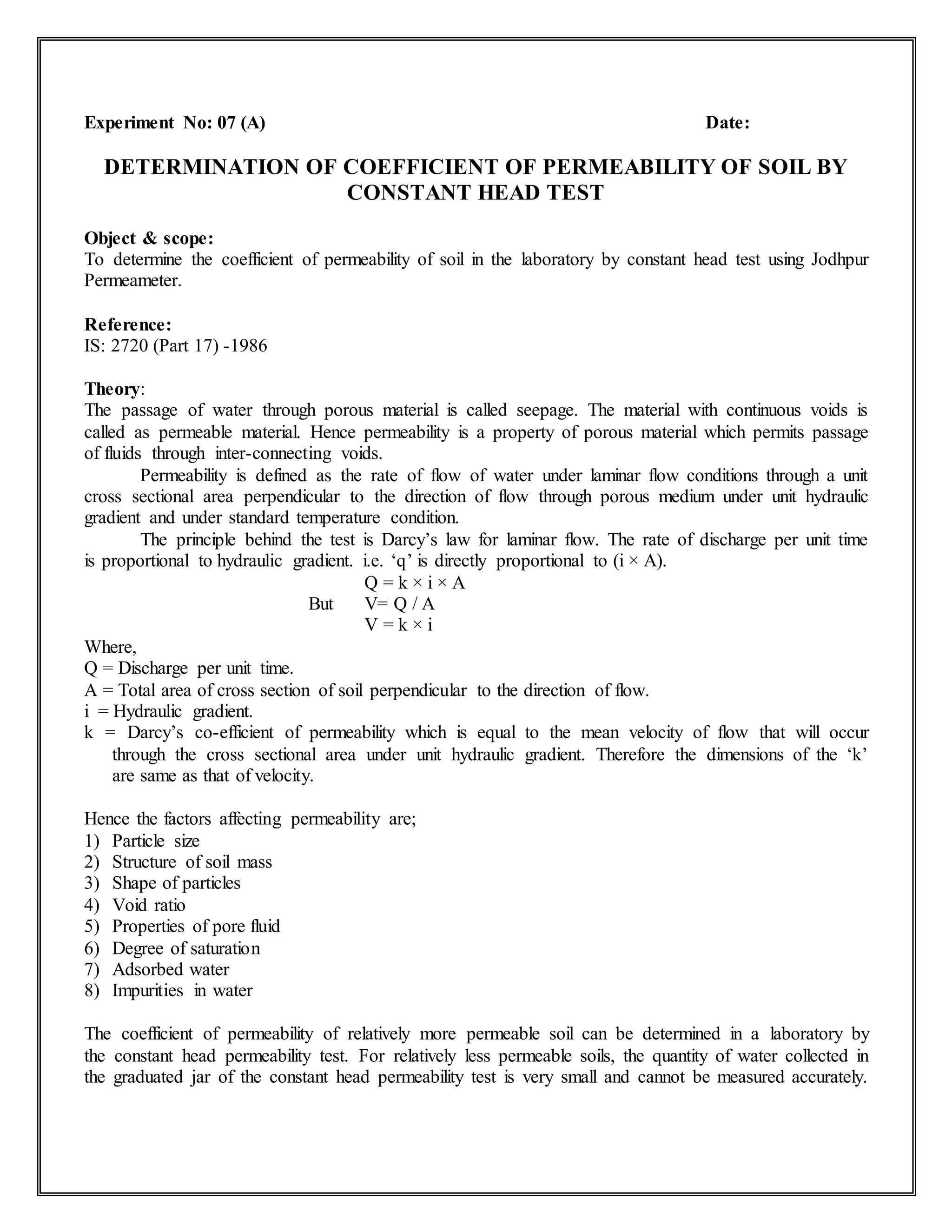
Typical values of permeability (k)
Sr.
No.
Soil type coefficient of
permeability
(mm/ sec)
Drainage property
1 Clean Gravel 10+1 to 10+2 Very Good
2 Coarse & medium sand 10-2 to 10+1 Good
3 Fine sands, loose silt 10-4 to 10-2 Fair
4 Dense silt, clayey silts 10-5 to 10-4 Poor
5 Silty clay, clay 10-8 to 10-5 Very Poor
The silts having the coefficient of permeability greater than 10-3 mm/sec are classified as pervious and
these with a value less than 10-5 to 10-3 mm/sec are designated as semi-pervious.
Equipment:
1) Permeameter mould including drainage base and drainage cap.
2) Constant head tank
3) Compaction rammer
4) Stopwatch
5) Meter scale
6) Straight edge or trimming knife.
7) Containers for water content determination
Procedure:
A. Preparation of remolded specimen:
1) Take 800 to 1000 gm of representative specimen of soil & add water to it so that its water content is
raised to the optimum water content.
2) Fix the base plate and collar to permeameter mould. Fill the mould with soil water mix and compact
it in three layers giving 25 blows of rammer per layer.
3) Trim the top surface of the soil to flush it with top of mould. Detach base plate and the collar from
the mould. Fix the mould with soil to the base plate and drainage cap.
4) Maintain the load for about 1min & then release it. Remove the top 3cm plug & collar. Place a filter
paper or fine wire gauge on the top of the specimen & fix the perforated base plate on it.
5) For soils of medium to high permeability the specimen is subjected to sufficient head flow or
immersion so as to obtained full saturation. Soils of low permeability require flow under a high head
for periods ranging from a day to week depending upon the permeability and the head. Alternatively,
in the case of soils of low permeability the specimen shall be subjected to a gradually increasing
vacuum with bottom outlet closed so as to remove air from the soil voids. The vacuum shall be
increased to at least 70 cm of mercury which shall be maintained for 15 minutes or more depending
upon the soil type. The evacuation shall be followed by a very slow saturation of the specimen with
desired water from the bottom upwards under full vacuum. When the specimen is saturated, both the
top and bottom outlets shall be closed.
B. Constant head test:
1) Connect the outlet tube of the constant head tank to the inlet nozzle of the permeameter, after
removing the air in the flexible rubber connecting tube.
2) Adjust the hydraulic head by adjusting the relative heights of the permeameter mould & the constant
head tank.
3) Start the stop watch and at the same time put the beaker under the outlet of the bottom tank. Run the
test for some convenient time interval. Measure the quantity of water collected in the beaker during
that time.
4) Repeat the test under the same head and for the same time interval to get more readings.
Observations:
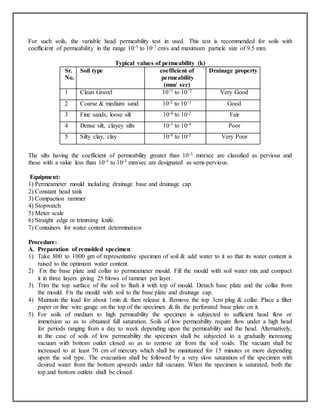
1) Diameter of Specimen = Diameter of mould = D =
2) Length of Specimen = Length of mould = L =
3) Area of Specimen = A =
4) Volume of Specimen = V =
5) Head Causing flow = h =
6) Hydraulic gradient = i = h/ L =
Observation Table:
Sr.
No.
Time ‘t’ sec Discharge ‘Q’ Coefficient of
permeability
‘k’ cm/ sec
1
2
3
4
5
Average kavg.
Calculations:
Coefficient of permeability K =
Q × L
A × t × h
Result:
The coefficient of permeability of soil is
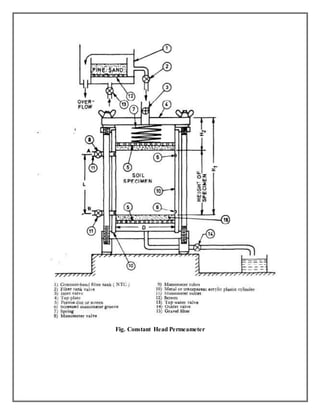
Fig. Constant Head Permeameter

Ex 7 a permeability by constant head

  • 1.
    Experiment No: 07(A) Date: DETERMINATION OF COEFFICIENT OF PERMEABILITY OF SOIL BY CONSTANT HEAD TEST Object & scope: To determine the coefficient of permeability of soil in the laboratory by constant head test using Jodhpur Permeameter. Reference: IS: 2720 (Part 17) -1986 Theory: The passage of water through porous material is called seepage. The material with continuous voids is called as permeable material. Hence permeability is a property of porous material which permits passage of fluids through inter-connecting voids. Permeability is defined as the rate of flow of water under laminar flow conditions through a unit cross sectional area perpendicular to the direction of flow through porous medium under unit hydraulic gradient and under standard temperature condition. The principle behind the test is Darcy’s law for laminar flow. The rate of discharge per unit time is proportional to hydraulic gradient. i.e. ‘q’ is directly proportional to (i × A). Q = k × i × A But V= Q / A V = k × i Where, Q = Discharge per unit time. A = Total area of cross section of soil perpendicular to the direction of flow. i = Hydraulic gradient. k = Darcy’s co-efficient of permeability which is equal to the mean velocity of flow that will occur through the cross sectional area under unit hydraulic gradient. Therefore the dimensions of the ‘k’ are same as that of velocity. Hence the factors affecting permeability are; 1) Particle size 2) Structure of soil mass 3) Shape of particles 4) Void ratio 5) Properties of pore fluid 6) Degree of saturation 7) Adsorbed water 8) Impurities in water The coefficient of permeability of relatively more permeable soil can be determined in a laboratory by the constant head permeability test. For relatively less permeable soils, the quantity of water collected in the graduated jar of the constant head permeability test is very small and cannot be measured accurately.
  • 2.
    For such soils,the variable head permeability test in used. This test is recommended for soils with coefficient of permeability in the range 10-3 to 10-7 cm/s and maximum particle size of 9.5 mm. Typical values of permeability (k) Sr. No. Soil type coefficient of permeability (mm/ sec) Drainage property 1 Clean Gravel 10+1 to 10+2 Very Good 2 Coarse & medium sand 10-2 to 10+1 Good 3 Fine sands, loose silt 10-4 to 10-2 Fair 4 Dense silt, clayey silts 10-5 to 10-4 Poor 5 Silty clay, clay 10-8 to 10-5 Very Poor The silts having the coefficient of permeability greater than 10-3 mm/sec are classified as pervious and these with a value less than 10-5 to 10-3 mm/sec are designated as semi-pervious. Equipment: 1) Permeameter mould including drainage base and drainage cap. 2) Constant head tank 3) Compaction rammer 4) Stopwatch 5) Meter scale 6) Straight edge or trimming knife. 7) Containers for water content determination Procedure: A. Preparation of remolded specimen: 1) Take 800 to 1000 gm of representative specimen of soil & add water to it so that its water content is raised to the optimum water content. 2) Fix the base plate and collar to permeameter mould. Fill the mould with soil water mix and compact it in three layers giving 25 blows of rammer per layer. 3) Trim the top surface of the soil to flush it with top of mould. Detach base plate and the collar from the mould. Fix the mould with soil to the base plate and drainage cap. 4) Maintain the load for about 1min & then release it. Remove the top 3cm plug & collar. Place a filter paper or fine wire gauge on the top of the specimen & fix the perforated base plate on it. 5) For soils of medium to high permeability the specimen is subjected to sufficient head flow or immersion so as to obtained full saturation. Soils of low permeability require flow under a high head for periods ranging from a day to week depending upon the permeability and the head. Alternatively, in the case of soils of low permeability the specimen shall be subjected to a gradually increasing vacuum with bottom outlet closed so as to remove air from the soil voids. The vacuum shall be increased to at least 70 cm of mercury which shall be maintained for 15 minutes or more depending upon the soil type. The evacuation shall be followed by a very slow saturation of the specimen with desired water from the bottom upwards under full vacuum. When the specimen is saturated, both the top and bottom outlets shall be closed.
  • 3.
    B. Constant headtest: 1) Connect the outlet tube of the constant head tank to the inlet nozzle of the permeameter, after removing the air in the flexible rubber connecting tube. 2) Adjust the hydraulic head by adjusting the relative heights of the permeameter mould & the constant head tank. 3) Start the stop watch and at the same time put the beaker under the outlet of the bottom tank. Run the test for some convenient time interval. Measure the quantity of water collected in the beaker during that time. 4) Repeat the test under the same head and for the same time interval to get more readings. Observations: 1) Diameter of Specimen = Diameter of mould = D = 2) Length of Specimen = Length of mould = L = 3) Area of Specimen = A = 4) Volume of Specimen = V = 5) Head Causing flow = h = 6) Hydraulic gradient = i = h/ L = Observation Table: Sr. No. Time ‘t’ sec Discharge ‘Q’ Coefficient of permeability ‘k’ cm/ sec 1 2 3 4 5 Average kavg. Calculations: Coefficient of permeability K = Q × L A × t × h Result: The coefficient of permeability of soil is
  • 4.
    Fig. Constant HeadPermeameter