TOBIN’S THEORY OF
PORTFOLIO DM
Prof. Prabha Panth,
Osmania University,
Hyderabad
KEYNES DEMAND FOR MONEY
• Keynes assumed that public holds its
assets either as bonds or cash.
• Tobin has criticised this assumption.
• People hold their assets or wealth in
many forms – or in various “Portfolios”
• This includes:
a) Money, b) Bonds, c) Property, etc.
• Transaction DM may also be affected by
rate of interest.
01/05/2016 Prabha Panth 2
Tobin’s Portfolio DM
• According to Tobin, people hold a Portfolio
of Assets – some cash, and some bonds.
– Idle cash is safe (no risk), but earns zero
income or interest.
– Bonds earn interest, but they are risky.
Therefore people hold a balanced
combination of both safe and risky
portfolio of assets.
Depends on the individual’s attitude to
Risk.
01/05/2016 Prabha Panth 3
Tobin’s Portfolio DM
• According to Tobin, individuals
show “Risk Aversion”.
• They prefer less risk to more risk
at a given rate of interest.
• Also, they are uncertain about the
future rate of interest
01/05/2016 Prabha Panth 4
Tobin’s Portfolio DM
• But holding cash is unproductive, as it
earns no income.
• So they have to choose a combination
or portfolio of assets
– some less risky (safe) but less productive
-- some more risky but more productive.
The portfolio of assets depends on
the nature of the individual
01/05/2016 Prabha Panth 5
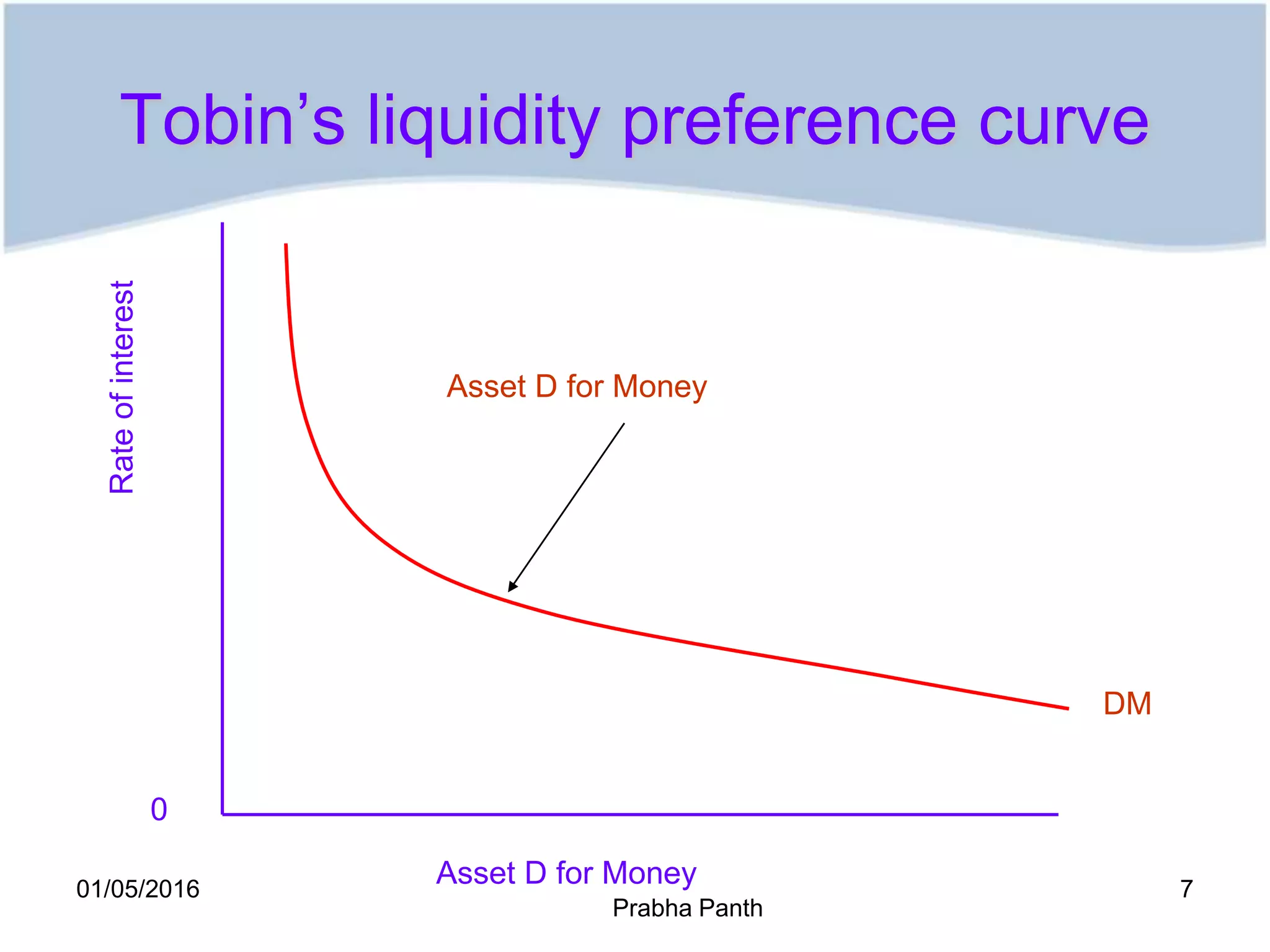
Tobin’s liquidity preference curve
• Like Keynes, Tobin shows the LP is
inversely related to rate of interest.
• When i is high, people change their
portfolio to bonds, and hold less cash
• When i is low, they prefer to hold
cash, and reduce the number of
bonds.
• Thus the Asset DM is inversely related
to the rate of interest.
01/05/2016 Prabha Panth 6
Tobin’s liquidity preference curveRateofinterest
Asset D for Money
0
DM
Asset D for Money
01/05/2016
Prabha Panth
7
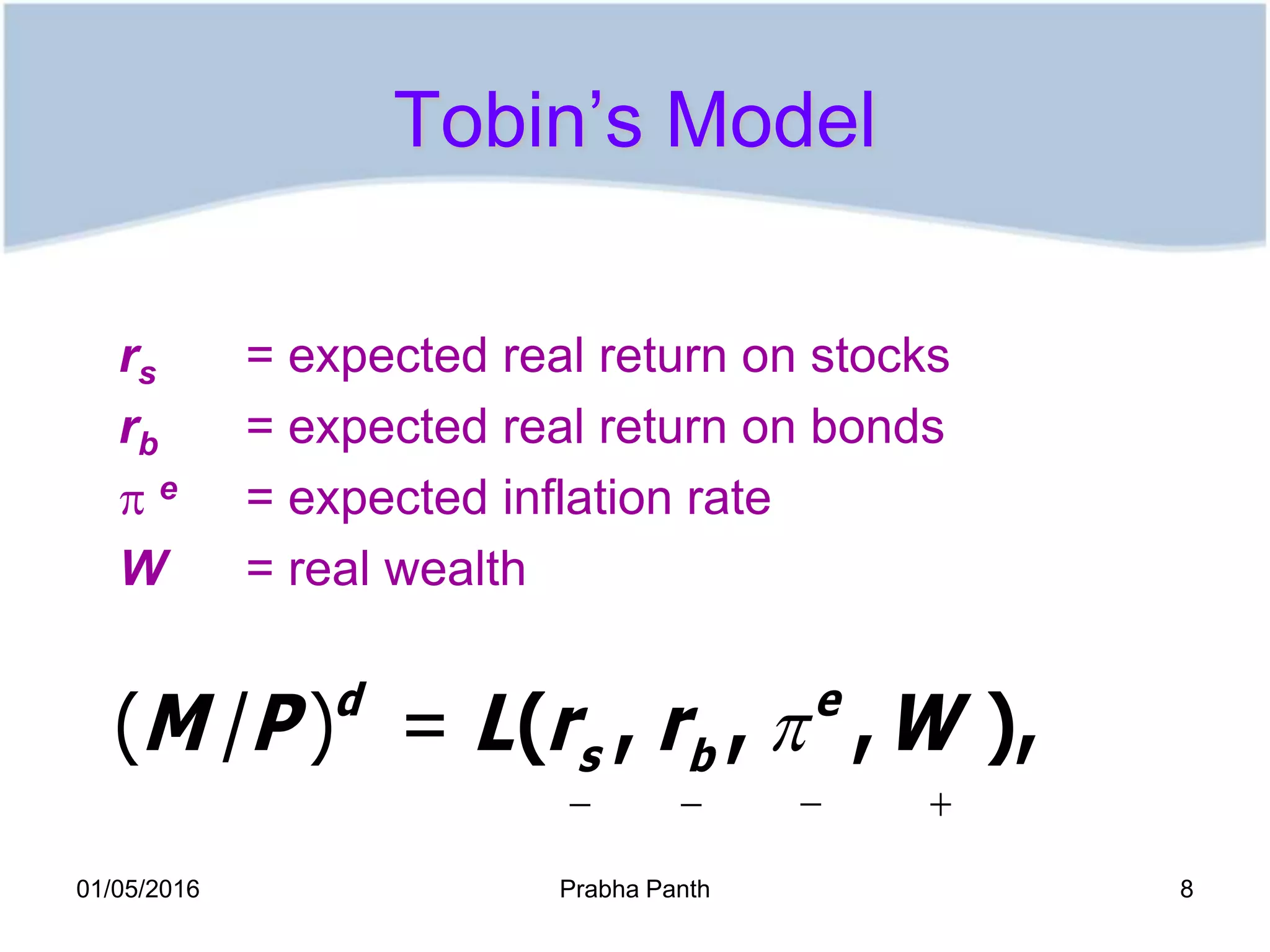
Tobin’s Model
rs = expected real return on stocks
rb = expected real return on bonds
 e = expected inflation rate
W = real wealth

  
( / ) = ( , , , ),d e
s bM P L r r W
01/05/2016 Prabha Panth 8
Tobin’s Model
• Stocks and bonds are alternatives to money.
• An increase in i makes money less attractive,
reduces desired money holdings.
• The real return to holding money is -e.
• An increase in e is decrease in real return to
holding money, and cause a decrease in desired
money balances.
• And finally, an increase in wealth causes an
increase in the demand for all assets.
01/05/2016 Prabha Panth 9

Tobin's Portfolio demand for money

  • 1.
    TOBIN’S THEORY OF PORTFOLIODM Prof. Prabha Panth, Osmania University, Hyderabad
  • 2.
    KEYNES DEMAND FORMONEY • Keynes assumed that public holds its assets either as bonds or cash. • Tobin has criticised this assumption. • People hold their assets or wealth in many forms – or in various “Portfolios” • This includes: a) Money, b) Bonds, c) Property, etc. • Transaction DM may also be affected by rate of interest. 01/05/2016 Prabha Panth 2
  • 3.
    Tobin’s Portfolio DM •According to Tobin, people hold a Portfolio of Assets – some cash, and some bonds. – Idle cash is safe (no risk), but earns zero income or interest. – Bonds earn interest, but they are risky. Therefore people hold a balanced combination of both safe and risky portfolio of assets. Depends on the individual’s attitude to Risk. 01/05/2016 Prabha Panth 3
  • 4.
    Tobin’s Portfolio DM •According to Tobin, individuals show “Risk Aversion”. • They prefer less risk to more risk at a given rate of interest. • Also, they are uncertain about the future rate of interest 01/05/2016 Prabha Panth 4
  • 5.
    Tobin’s Portfolio DM •But holding cash is unproductive, as it earns no income. • So they have to choose a combination or portfolio of assets – some less risky (safe) but less productive -- some more risky but more productive. The portfolio of assets depends on the nature of the individual 01/05/2016 Prabha Panth 5
  • 6.
    Tobin’s liquidity preferencecurve • Like Keynes, Tobin shows the LP is inversely related to rate of interest. • When i is high, people change their portfolio to bonds, and hold less cash • When i is low, they prefer to hold cash, and reduce the number of bonds. • Thus the Asset DM is inversely related to the rate of interest. 01/05/2016 Prabha Panth 6
  • 7.
    Tobin’s liquidity preferencecurveRateofinterest Asset D for Money 0 DM Asset D for Money 01/05/2016 Prabha Panth 7
  • 8.
    Tobin’s Model rs =expected real return on stocks rb = expected real return on bonds  e = expected inflation rate W = real wealth     ( / ) = ( , , , ),d e s bM P L r r W 01/05/2016 Prabha Panth 8
  • 9.
    Tobin’s Model • Stocksand bonds are alternatives to money. • An increase in i makes money less attractive, reduces desired money holdings. • The real return to holding money is -e. • An increase in e is decrease in real return to holding money, and cause a decrease in desired money balances. • And finally, an increase in wealth causes an increase in the demand for all assets. 01/05/2016 Prabha Panth 9