Contents : 
 Definition of Co-integration . 
 Different Approaches of Co-integration. 
 Johansen and Juselius (J.J) Co-integration. 
 Error Correction Model (ECM). 
 Interpretation of ECM term. 
 Long – Run Co-integration Equation.
Definition of Co-integration 
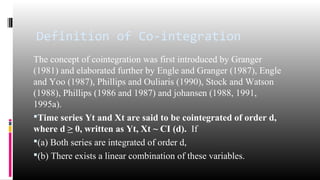
The concept of cointegration was first introduced by Granger 
(1981) and elaborated further by Engle and Granger (1987), Engle 
and Yoo (1987), Phillips and Ouliaris (1990), Stock and Watson 
(1988), Phillips (1986 and 1987) and johansen (1988, 1991, 
1995a). 
Time series Yt and Xt are said to be cointegrated of order d, 
where d > 0, written as Yt, Xt ~ CI (d). If 
(a) Both series are integrated of order d, 
(b) There exists a linear combination of these variables.
Examples : 
 The old woman and the boy are 
unrelated to one another, except 
that they are both on a random 
walk in the park. Information 
about the boy's location tells us 
nothing about the old woman's 
location. 
The old man and the dog are joined by one of 
those leashes that has the cord rolled up inside 
the handle on a spring. Individually, the dog and 
the man are each on a random walk. They cannot 
wander too far from one another because of the 
leash. We say that the random processes 
describing their paths are cointegrated.
Approaches of Co-integration : 
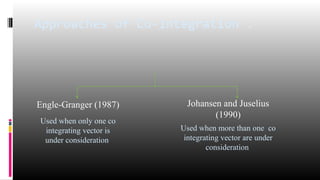
Engle-Granger (1987) 
Used when only one co 
integrating vector is 
under consideration 
Johansen and Juselius 
(1990) 
Used when more than one co 
integrating vector are under 
consideration
Conditions Of Co-integration : 
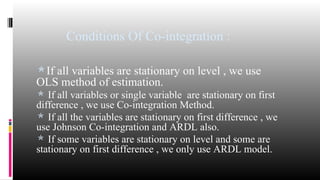
If all variables are stationary on level , we use 
OLS method of estimation. 
 If all variables or single variable are stationary on first 
difference , we use Co-integration Method. 
 If all the variables are stationary on first difference , we 
use Johnson Co-integration and ARDL also. 
 If some variables are stationary on level and some are 
stationary on first difference , we only use ARDL model.
Johansen and Juselius (1990) J.J 
Co-integration : 
 If all the variables are stationary on first difference , we 
use Johnson Co-integration. 
 Although Johansen’s methodology is typically used in a 
setting where all variables in the system are I(1), having 
stationary variables in the system is theoretically not an 
issue and Johansen (1995) states that there is little need to 
pre-test the variables in the system to establish their order 
of integration.
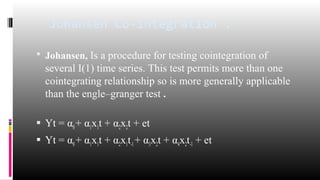
Johansen Co-integration : 
 Johansen, Is a procedure for testing cointegration of 
several I(1) time series. This test permits more than one 
cointegrating relationship so is more generally applicable 
than the engle–granger test . 
 Yt = α0 + α1x1t + α2x2t + et 
 Yt = α0 + α1x1t + α2x1t-1 + α3x2t + α4x2t-1 + et
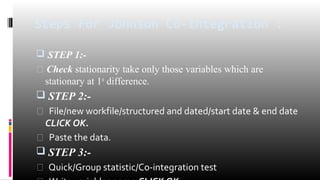
Steps For Johnson Co-integration : 
 STEP 1:- 
 Check stationarity take only those variables which are 
stationary at 1st difference. 
 STEP 2:- 
 File/new workfile/structured and dated/start date & end date 
CLICK OK. 
 Paste the data. 
 STEP 3:- 
 Quick/Group statistic/Co-integration test 
 Write variables name CLICK OK
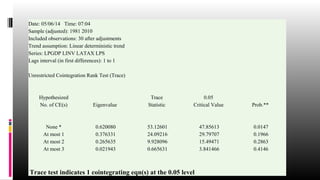
Date: 05/06/14 Time: 07:04 
Sample (adjusted): 1981 2010 
Included observations: 30 after adjustments 
Trend assumption: Linear deterministic trend 
Series: LPGDP LINV LATAX LPS 
Lags interval (in first differences): 1 to 1 
Steps of j-j cointegration 
Unrestricted Cointegration Rank Test (Trace) 
Hypothesized Trace 0.05 
No. of CE(s) Eigenvalue Statistic Critical Value Prob.** 
None * 0.620080 53.12601 47.85613 0.0147 
At most 1 0.376331 24.09216 29.79707 0.1966 
At most 2 0.265635 9.928096 15.49471 0.2863 
At most 3 0.021943 0.665631 3.841466 0.4146 
Trace test indicates 1 cointegrating eqn(s) at the 0.05 level
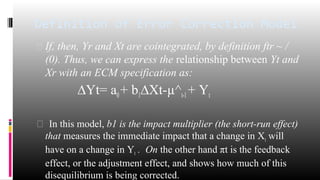
Definition of Error Correction Model 
 If, then, Yr and Xt are cointegrated, by definition ftr ~ / 
(0). Thus, we can express the relationship between Yt and 
Xr with an ECM specification as: 
ΔYt= a0 + b1ΔXt-μ^t-1 + Yt 
 In this model, b1 is the impact multiplier (the short-run effect) 
that measures the immediate impact that a change in Xt will 
have on a change in Yt . On the other hand πt is the feedback 
effect, or the adjustment effect, and shows how much of this 
disequilibrium is being corrected.
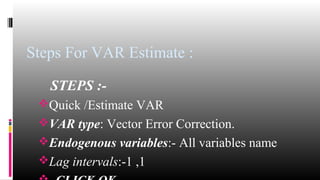
Steps For VAR Estimate : 
STEPS :- 
Quick /Estimate VAR 
VAR type: Vector Error Correction. 
Endogenous variables:- All variables name 
Lag intervals:-1 ,1 
 CLICK OK
Vector Error Correction Estimates 
Date: 05/26/14 Time: 22:36 
Sample (adjusted): 1981 2010 
Included observations: 30 after adjustments 
Standard errors in ( ) & t-statistics in [ ] 
Cointegrating Eq: CointEq1 
LPGDP(-1) 1.000000 
LINV(-1) -4.620559 
(0.47459) 
[-9.73587] 
LATAX(-1) -3.350165 
(1.20384) 
[-2.78289] 
LPS(-1) 1.274220 
(0.49822) 
[ 2.55755] 
C -3.861790 
Error Correction: D(LPGDP) D(LINV) D(LATAX) D(LPS) 
CointEq1 -0.011599 0.167417 -0.004750 -0.060848 
(0.02160) (0.04974) (0.02840) (0.03017) 
[-0.53695] [ 3.36570] [-0.16725] [-2.01682]
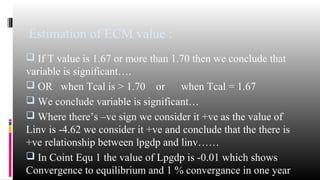
Estimation of ECM value : 
 If T value is 1.67 or more than 1.70 then we conclude that 
variable is significant…. 
 OR when Tcal is > 1.70 or when Tcal = 1.67 
 We conclude variable is significant… 
 Where there’s –ve sign we consider it +ve as the value of 
Linv is -4.62 we consider it +ve and conclude that the there is 
+ve relationship between lpgdp and linv…… 
 In Coint Equ 1 the value of Lpgdp is -0.01 which shows 
Convergence to equilibrium and 1 % convergance in one year
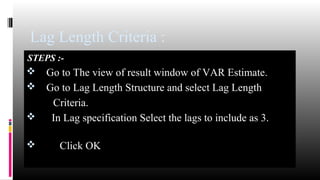
Lag Length Criteria : 
STEPS :- 
 Go to The view of result window of VAR Estimate. 
 Go to Lag Length Structure and select Lag Length 
Criteria. 
 In Lag specification Select the lags to include as 3. 
 Click OK
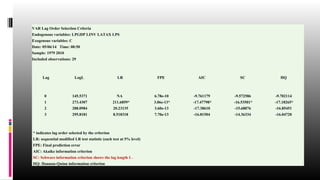
VAR Lag Order Selection Criteria 
Endogenous variables: LPGDP LINV LATAX LPS 
Exogenous variables: C 
Date: 05/06/14 Time: 08:50 
Sample: 1979 2010 
Included observations: 29 
Lag LogL LR FPE AIC SC HQ 
0 145.5371 NA 6.78e-10 -9.761179 -9.572586 -9.702114 
1 273.4307 211.6859* 3.06e-13* -17.47798* -16.53501* -17.18265* 
2 288.0984 20.23135 3.60e-13 -17.38610 -15.68876 -16.85451 
3 295.8181 8.518318 7.70e-13 -16.81504 -14.36334 -16.04720 
* indicates lag order selected by the criterion 
LR: sequential modified LR test statistic (each test at 5% level) 
FPE: Final prediction error 
AIC: Akaike information criterion 
SC: Schwarz information criterion shows the lag length 1 . 
HQ: Hannan-Quinn information criterion
Long Run Equation For Results : 
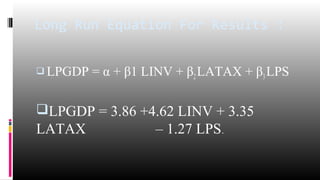
 LPGDP = α + β1 LINV + β2 LATAX + β3 LPS 
LPGDP = 3.86 +4.62 LINV + 3.35 
LATAX – 1.27 LPS.
REFRENCES : 
 http://www.google.com.pk/url? 
sa=t&rct=j&q=&esrc=s&source=web&cd=1&ved=0CCkQFjAA&url=http%3A%2F 
%2Fwww.eco.uc3m.es%2Fjgonzalo%2Fteaching%2FtimeseriesMA 
%2Fspuriousregandcointegration.ppt&ei=3IWDU8KIFKXm7Aa1q4GgAQ&usg=AFQjCNEM 
eDrxYrVbmOezMTPaUHqr7Fmsbw&sig2=oDcwQxDEQ64CZxFKeobvkg&bvm=bv.677202 
77,d.ZGU 
 powershow.com/view/9d319- 
MzYzM/TIME_SERIES_REGRESSION_COINTEGRATION_powerpoint_ppt_presentation 
 .google.com.pk/url? 
sa=t&rct=j&q=&esrc=s&source=web&cd=2&ved=0CDMQFjAB&url=http%3A%2F 
%2Fwww.uh.edu%2F~bsorense 
%2Fcoint.pdf&ei=SIiDU5vzFuSU7QbNpYC4Dw&usg=AFQjCNFCyaKrvkcaE_VVe8Gwmh 
EeMv46Iw&sig2=sRUVQeVm32aykeFpV2Ds7w 
 https://www.imf.org/external/pubs/ft/wp/2007/wp07141.pdf 
 Applied Economics By Esterio. 
 Basic Econometrics By Damodar Gujrati.
Co-integration
Co-integration

Co-integration

  • 3.
    Contents : Definition of Co-integration .  Different Approaches of Co-integration.  Johansen and Juselius (J.J) Co-integration.  Error Correction Model (ECM).  Interpretation of ECM term.  Long – Run Co-integration Equation.
  • 4.
    Definition of Co-integration The concept of cointegration was first introduced by Granger (1981) and elaborated further by Engle and Granger (1987), Engle and Yoo (1987), Phillips and Ouliaris (1990), Stock and Watson (1988), Phillips (1986 and 1987) and johansen (1988, 1991, 1995a). Time series Yt and Xt are said to be cointegrated of order d, where d > 0, written as Yt, Xt ~ CI (d). If (a) Both series are integrated of order d, (b) There exists a linear combination of these variables.
  • 5.
    Examples : The old woman and the boy are unrelated to one another, except that they are both on a random walk in the park. Information about the boy's location tells us nothing about the old woman's location. The old man and the dog are joined by one of those leashes that has the cord rolled up inside the handle on a spring. Individually, the dog and the man are each on a random walk. They cannot wander too far from one another because of the leash. We say that the random processes describing their paths are cointegrated.
  • 6.
    Approaches of Co-integration: Engle-Granger (1987) Used when only one co integrating vector is under consideration Johansen and Juselius (1990) Used when more than one co integrating vector are under consideration
  • 7.
    Conditions Of Co-integration: If all variables are stationary on level , we use OLS method of estimation.  If all variables or single variable are stationary on first difference , we use Co-integration Method.  If all the variables are stationary on first difference , we use Johnson Co-integration and ARDL also.  If some variables are stationary on level and some are stationary on first difference , we only use ARDL model.
  • 8.
    Johansen and Juselius(1990) J.J Co-integration :  If all the variables are stationary on first difference , we use Johnson Co-integration.  Although Johansen’s methodology is typically used in a setting where all variables in the system are I(1), having stationary variables in the system is theoretically not an issue and Johansen (1995) states that there is little need to pre-test the variables in the system to establish their order of integration.
  • 9.
    Johansen Co-integration :  Johansen, Is a procedure for testing cointegration of several I(1) time series. This test permits more than one cointegrating relationship so is more generally applicable than the engle–granger test .  Yt = α0 + α1x1t + α2x2t + et  Yt = α0 + α1x1t + α2x1t-1 + α3x2t + α4x2t-1 + et
  • 10.
    Steps For JohnsonCo-integration :  STEP 1:-  Check stationarity take only those variables which are stationary at 1st difference.  STEP 2:-  File/new workfile/structured and dated/start date & end date CLICK OK.  Paste the data.  STEP 3:-  Quick/Group statistic/Co-integration test  Write variables name CLICK OK
  • 11.
    Date: 05/06/14 Time:07:04 Sample (adjusted): 1981 2010 Included observations: 30 after adjustments Trend assumption: Linear deterministic trend Series: LPGDP LINV LATAX LPS Lags interval (in first differences): 1 to 1 Steps of j-j cointegration Unrestricted Cointegration Rank Test (Trace) Hypothesized Trace 0.05 No. of CE(s) Eigenvalue Statistic Critical Value Prob.** None * 0.620080 53.12601 47.85613 0.0147 At most 1 0.376331 24.09216 29.79707 0.1966 At most 2 0.265635 9.928096 15.49471 0.2863 At most 3 0.021943 0.665631 3.841466 0.4146 Trace test indicates 1 cointegrating eqn(s) at the 0.05 level
  • 12.
    Definition of ErrorCorrection Model  If, then, Yr and Xt are cointegrated, by definition ftr ~ / (0). Thus, we can express the relationship between Yt and Xr with an ECM specification as: ΔYt= a0 + b1ΔXt-μ^t-1 + Yt  In this model, b1 is the impact multiplier (the short-run effect) that measures the immediate impact that a change in Xt will have on a change in Yt . On the other hand πt is the feedback effect, or the adjustment effect, and shows how much of this disequilibrium is being corrected.
  • 13.
    Steps For VAREstimate : STEPS :- Quick /Estimate VAR VAR type: Vector Error Correction. Endogenous variables:- All variables name Lag intervals:-1 ,1  CLICK OK
  • 14.
    Vector Error CorrectionEstimates Date: 05/26/14 Time: 22:36 Sample (adjusted): 1981 2010 Included observations: 30 after adjustments Standard errors in ( ) & t-statistics in [ ] Cointegrating Eq: CointEq1 LPGDP(-1) 1.000000 LINV(-1) -4.620559 (0.47459) [-9.73587] LATAX(-1) -3.350165 (1.20384) [-2.78289] LPS(-1) 1.274220 (0.49822) [ 2.55755] C -3.861790 Error Correction: D(LPGDP) D(LINV) D(LATAX) D(LPS) CointEq1 -0.011599 0.167417 -0.004750 -0.060848 (0.02160) (0.04974) (0.02840) (0.03017) [-0.53695] [ 3.36570] [-0.16725] [-2.01682]
  • 15.
    Estimation of ECMvalue :  If T value is 1.67 or more than 1.70 then we conclude that variable is significant….  OR when Tcal is > 1.70 or when Tcal = 1.67  We conclude variable is significant…  Where there’s –ve sign we consider it +ve as the value of Linv is -4.62 we consider it +ve and conclude that the there is +ve relationship between lpgdp and linv……  In Coint Equ 1 the value of Lpgdp is -0.01 which shows Convergence to equilibrium and 1 % convergance in one year
  • 16.
    Lag Length Criteria: STEPS :-  Go to The view of result window of VAR Estimate.  Go to Lag Length Structure and select Lag Length Criteria.  In Lag specification Select the lags to include as 3.  Click OK
  • 17.
    VAR Lag OrderSelection Criteria Endogenous variables: LPGDP LINV LATAX LPS Exogenous variables: C Date: 05/06/14 Time: 08:50 Sample: 1979 2010 Included observations: 29 Lag LogL LR FPE AIC SC HQ 0 145.5371 NA 6.78e-10 -9.761179 -9.572586 -9.702114 1 273.4307 211.6859* 3.06e-13* -17.47798* -16.53501* -17.18265* 2 288.0984 20.23135 3.60e-13 -17.38610 -15.68876 -16.85451 3 295.8181 8.518318 7.70e-13 -16.81504 -14.36334 -16.04720 * indicates lag order selected by the criterion LR: sequential modified LR test statistic (each test at 5% level) FPE: Final prediction error AIC: Akaike information criterion SC: Schwarz information criterion shows the lag length 1 . HQ: Hannan-Quinn information criterion
  • 18.
    Long Run EquationFor Results :  LPGDP = α + β1 LINV + β2 LATAX + β3 LPS LPGDP = 3.86 +4.62 LINV + 3.35 LATAX – 1.27 LPS.
  • 19.
    REFRENCES : http://www.google.com.pk/url? sa=t&rct=j&q=&esrc=s&source=web&cd=1&ved=0CCkQFjAA&url=http%3A%2F %2Fwww.eco.uc3m.es%2Fjgonzalo%2Fteaching%2FtimeseriesMA %2Fspuriousregandcointegration.ppt&ei=3IWDU8KIFKXm7Aa1q4GgAQ&usg=AFQjCNEM eDrxYrVbmOezMTPaUHqr7Fmsbw&sig2=oDcwQxDEQ64CZxFKeobvkg&bvm=bv.677202 77,d.ZGU  powershow.com/view/9d319- MzYzM/TIME_SERIES_REGRESSION_COINTEGRATION_powerpoint_ppt_presentation  .google.com.pk/url? sa=t&rct=j&q=&esrc=s&source=web&cd=2&ved=0CDMQFjAB&url=http%3A%2F %2Fwww.uh.edu%2F~bsorense %2Fcoint.pdf&ei=SIiDU5vzFuSU7QbNpYC4Dw&usg=AFQjCNFCyaKrvkcaE_VVe8Gwmh EeMv46Iw&sig2=sRUVQeVm32aykeFpV2Ds7w  https://www.imf.org/external/pubs/ft/wp/2007/wp07141.pdf  Applied Economics By Esterio.  Basic Econometrics By Damodar Gujrati.