Unit Root and Unit Root
Tests
Pindyck and Rubinfeld, Chap 15
Testing for Random Walks
• Qus: Do economic variables like GDP, employment and interest rates
tend to revert back to some long-run trend after experiencing a shock
or do they follow random walks?
• This question is important for two reasons:
1. If they follow RW, a regression of one against another can lead to
spurious results.
• Remember, a RW does not have finite variance, so the Gauss Markov
theorem will not hold and OLS will not yield a consistent parameter
estimator.
• Detrending the variables before running the regression will not help—
the detrended series will still be non-stationary.
• Only first (higher order) differencing will yield a stationary series.
• Detrending: Run—
the residuals from this—
provide the de-trended series.
2. The answer has implications for our understanding of the economy
and forecasting.
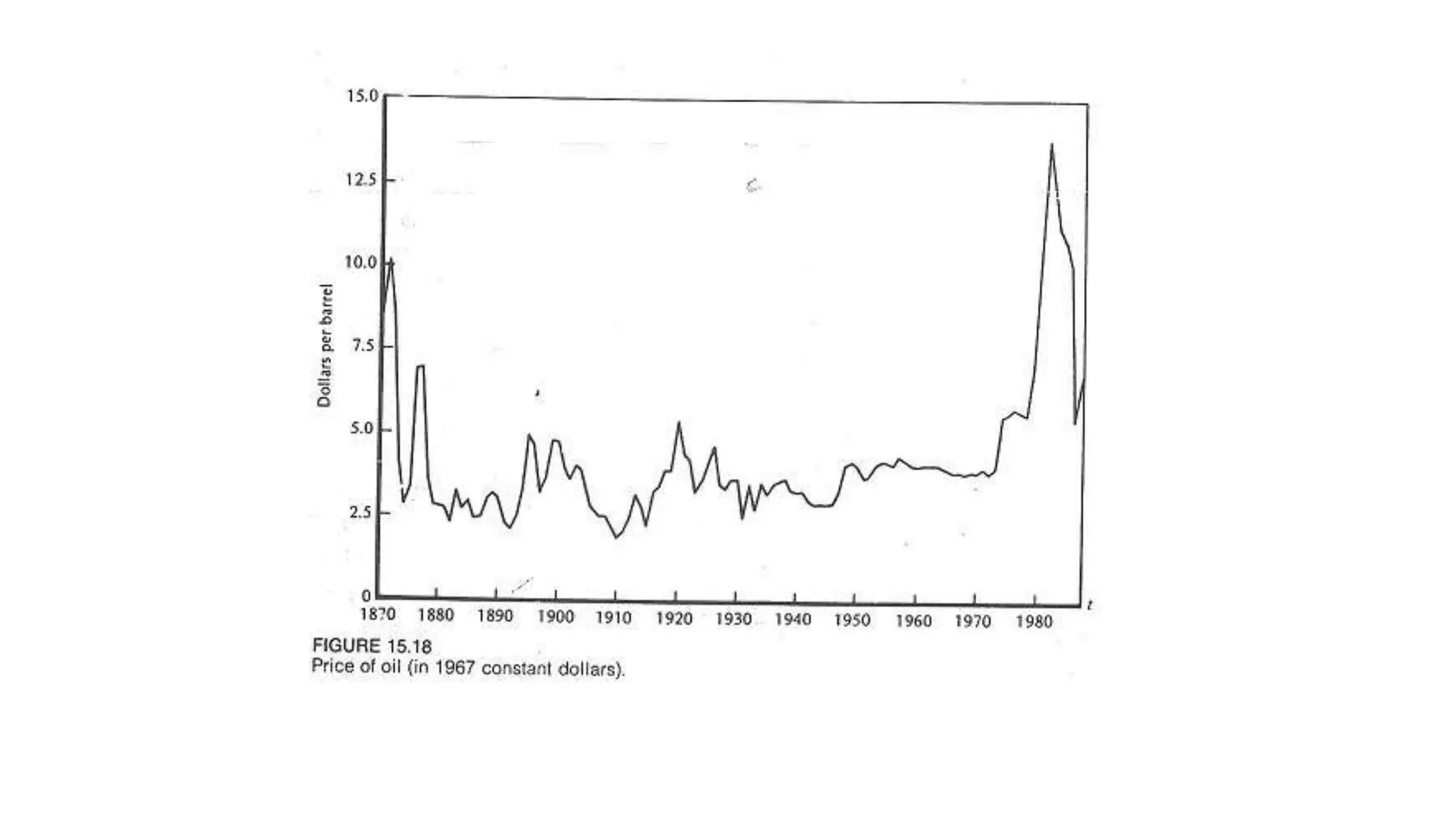
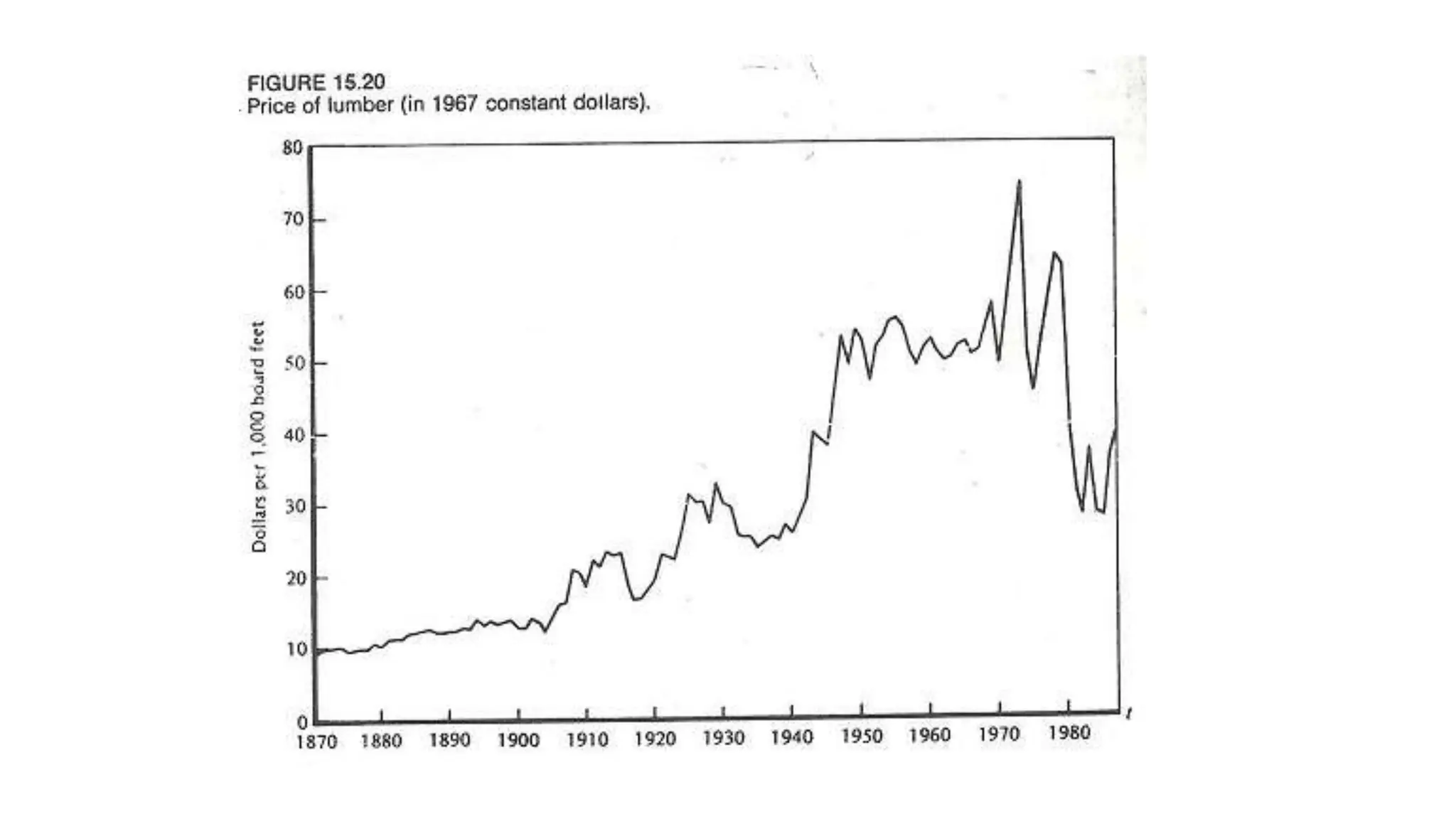
• If a variable like GDP follows a RW, the effects of a temporary shock
(oil price increase) will not dissipate after some years—it will become
permanent.
• Because only the lagged value that matters is the immediate one in
RW
and that too in its entire magnitude.
• In a study on macro time series, Nelson and Plosser found evidence
that GDP and other time series behave like RWs.
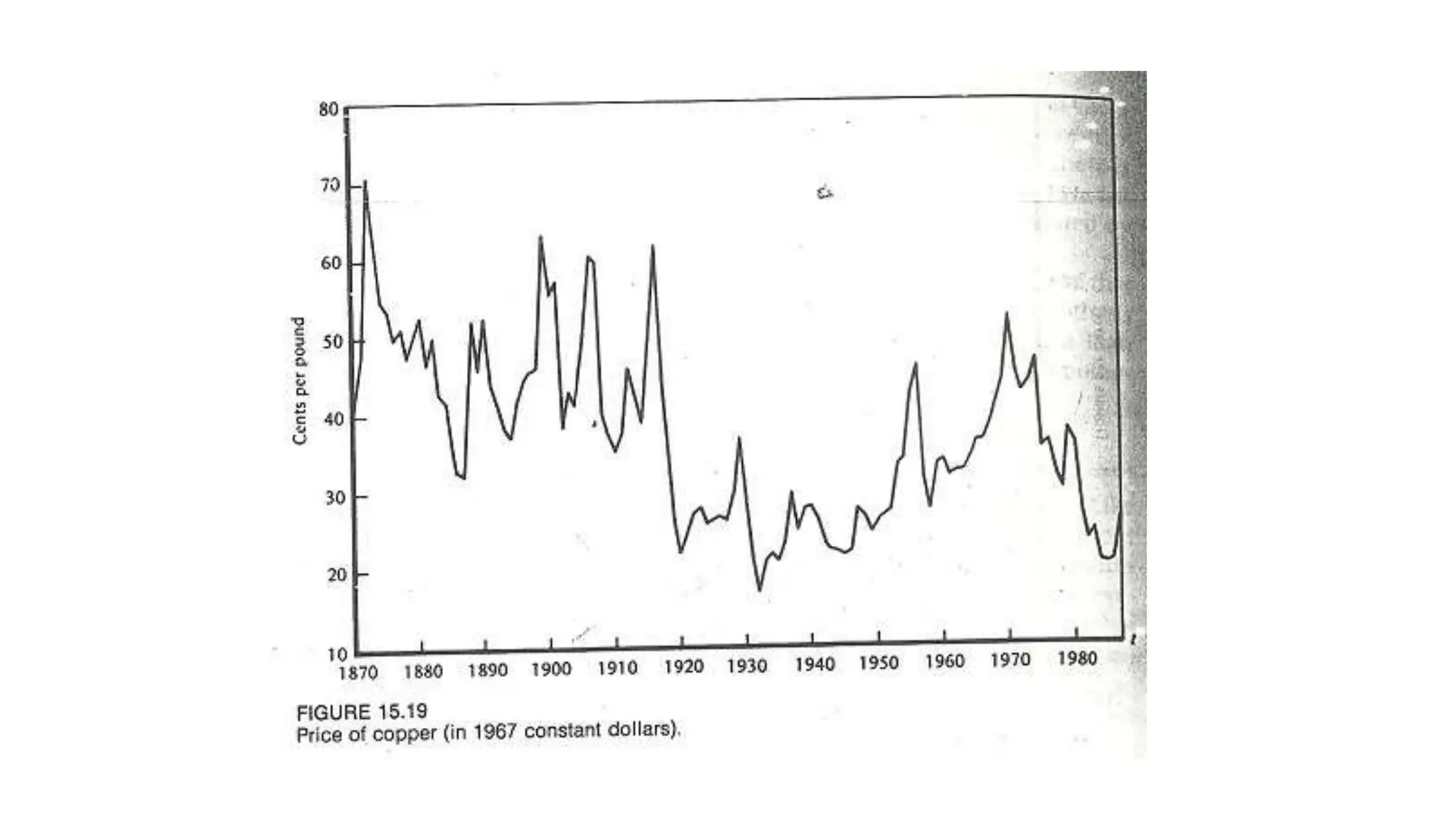
• Many studies followed and found that many economic time series do
appear to be RW or at least have RW components.
• Most of these studies use what are called “Unit Root Tests.”
• Introduced by David Dickey and Wayne Fuller. DF Test
• Philip Perron Test (PP), KPSS Test (Kwiatkowski, Phillips, Schmidt,
and Shin
Unit Root Tests
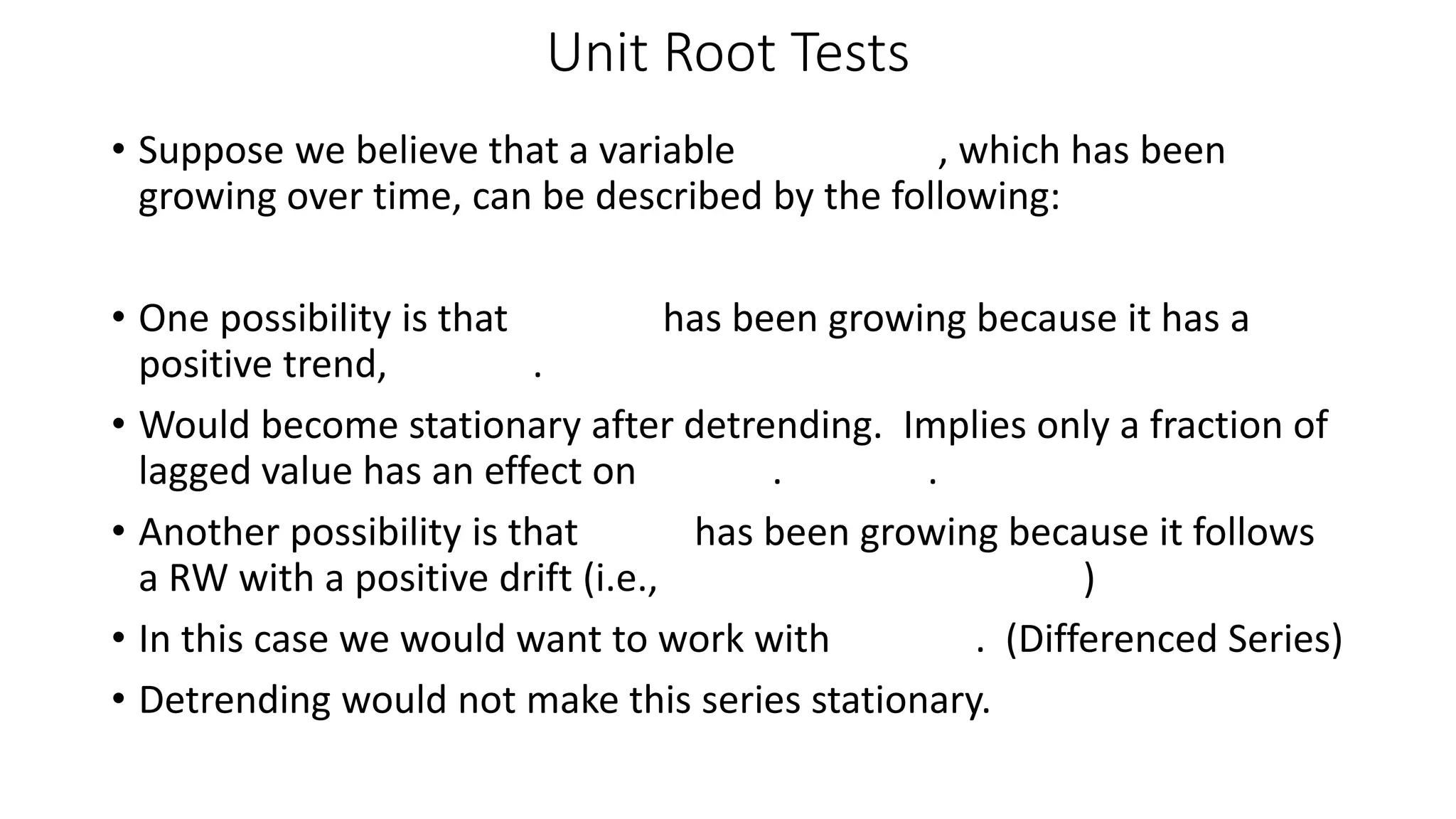
• Suppose we believe that a variable , which has been
growing over time, can be described by the following:
• One possibility is that has been growing because it has a
positive trend, .
• Would become stationary after detrending. Implies only a fraction of
lagged value has an effect on . .
• Another possibility is that has been growing because it follows
a RW with a positive drift (i.e., )
• In this case we would want to work with . (Differenced Series)
• Detrending would not make this series stationary.
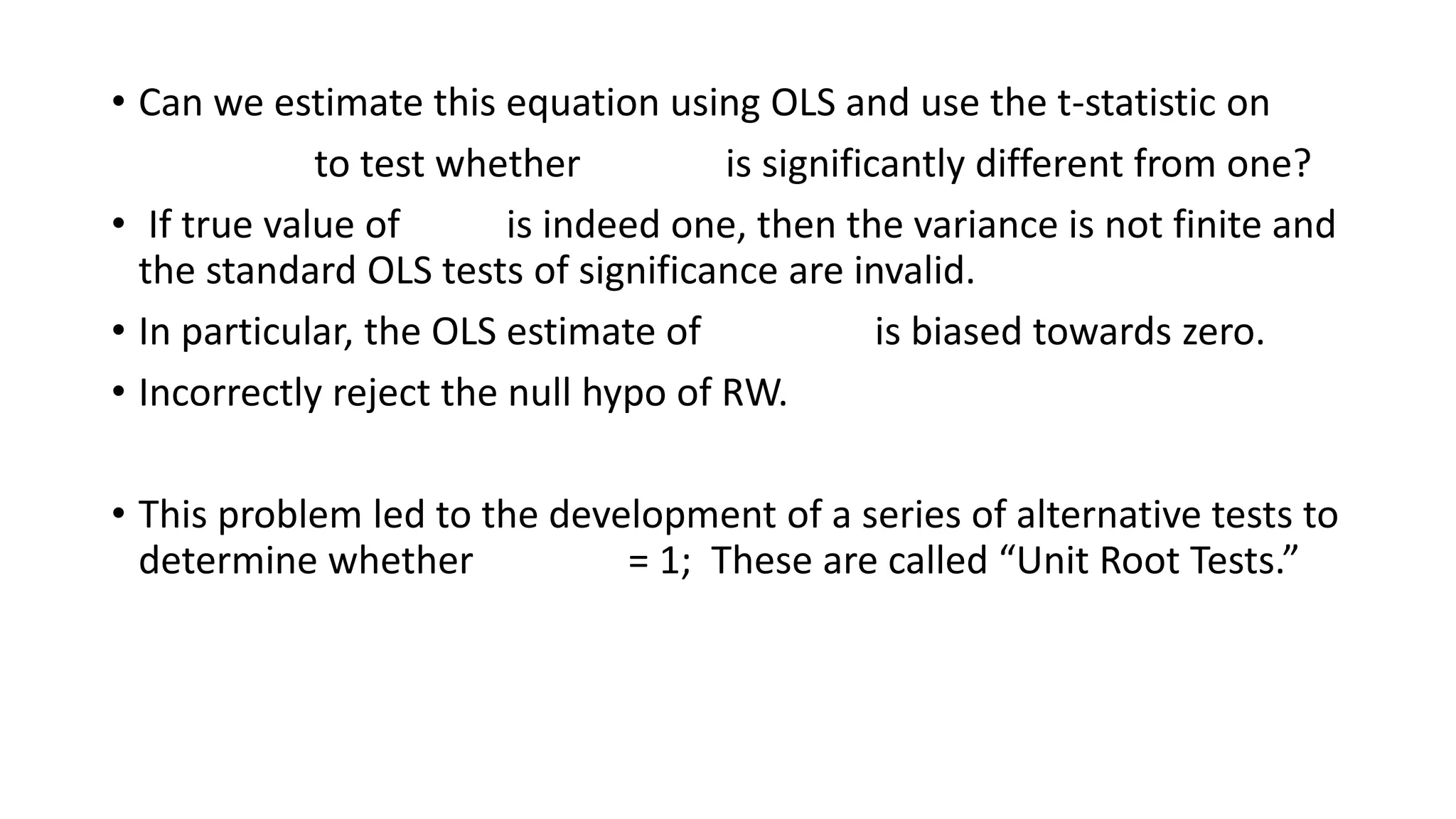
• Can we estimate this equation using OLS and use the t-statistic on
to test whether is significantly different from one?
• If true value of is indeed one, then the variance is not finite and
the standard OLS tests of significance are invalid.
• In particular, the OLS estimate of is biased towards zero.
• Incorrectly reject the null hypo of RW.
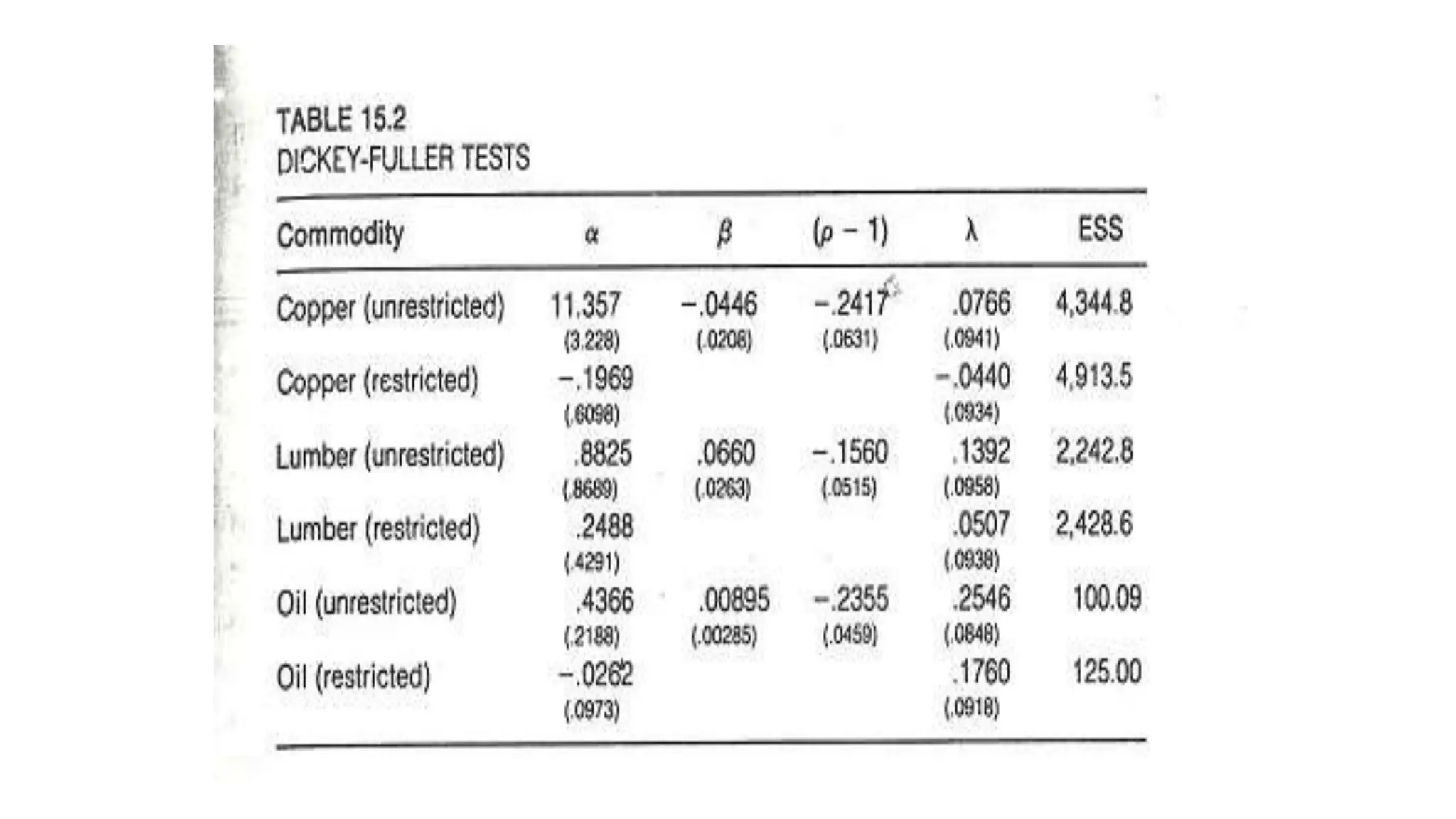
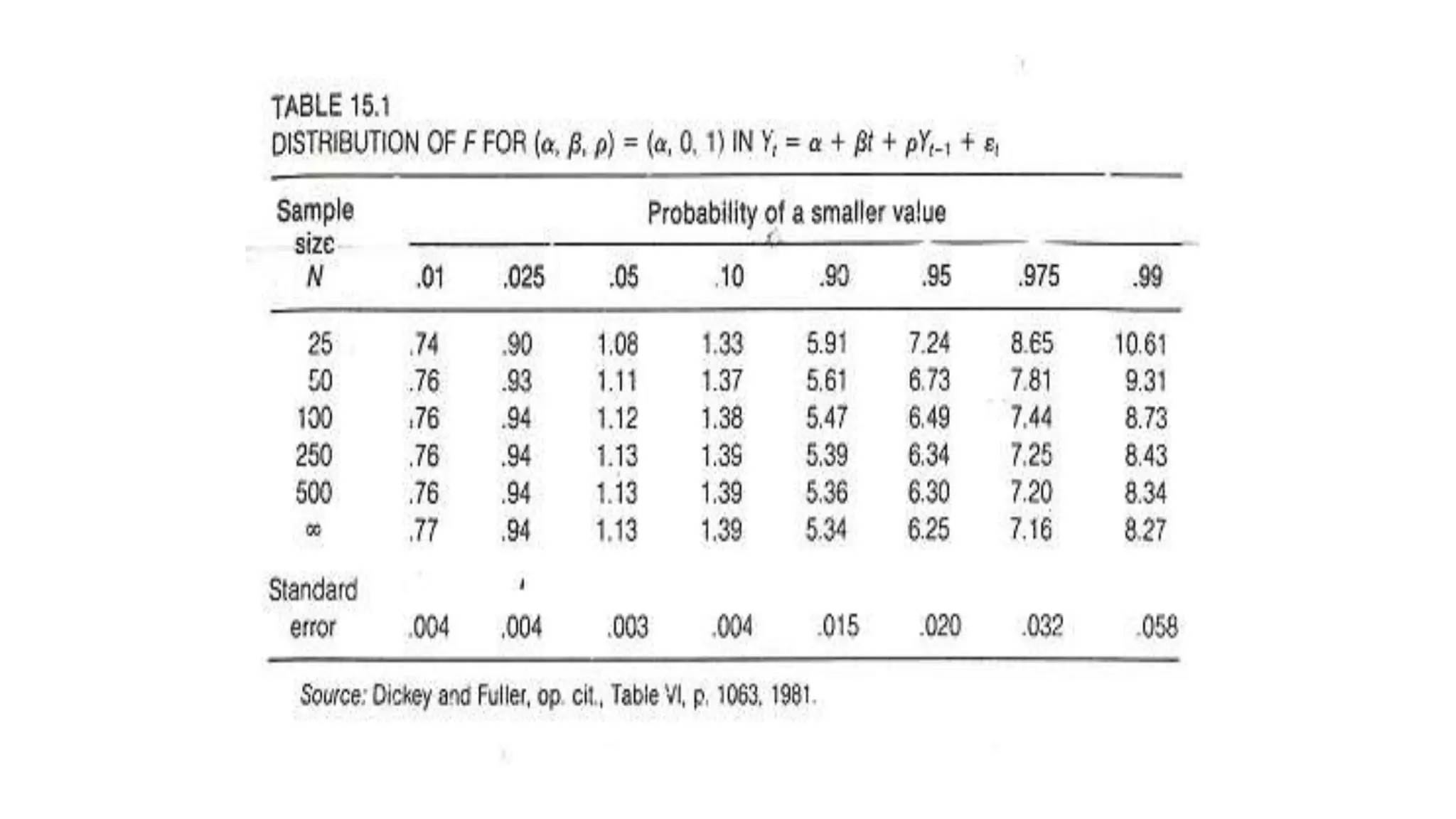
• This problem led to the development of a series of alternative tests to
determine whether = 1; These are called “Unit Root Tests.”
Augmented Dickey Fuller Test

Unit Roots and Unit Root Tests eononomatrix.pptx

  • 1.
    Unit Root andUnit Root Tests Pindyck and Rubinfeld, Chap 15
  • 2.
    Testing for RandomWalks • Qus: Do economic variables like GDP, employment and interest rates tend to revert back to some long-run trend after experiencing a shock or do they follow random walks?
  • 3.
    • This questionis important for two reasons: 1. If they follow RW, a regression of one against another can lead to spurious results. • Remember, a RW does not have finite variance, so the Gauss Markov theorem will not hold and OLS will not yield a consistent parameter estimator. • Detrending the variables before running the regression will not help— the detrended series will still be non-stationary. • Only first (higher order) differencing will yield a stationary series. • Detrending: Run— the residuals from this— provide the de-trended series.
  • 4.
    2. The answerhas implications for our understanding of the economy and forecasting. • If a variable like GDP follows a RW, the effects of a temporary shock (oil price increase) will not dissipate after some years—it will become permanent. • Because only the lagged value that matters is the immediate one in RW and that too in its entire magnitude.
  • 5.
    • In astudy on macro time series, Nelson and Plosser found evidence that GDP and other time series behave like RWs. • Many studies followed and found that many economic time series do appear to be RW or at least have RW components. • Most of these studies use what are called “Unit Root Tests.” • Introduced by David Dickey and Wayne Fuller. DF Test • Philip Perron Test (PP), KPSS Test (Kwiatkowski, Phillips, Schmidt, and Shin
  • 6.
    Unit Root Tests •Suppose we believe that a variable , which has been growing over time, can be described by the following: • One possibility is that has been growing because it has a positive trend, . • Would become stationary after detrending. Implies only a fraction of lagged value has an effect on . . • Another possibility is that has been growing because it follows a RW with a positive drift (i.e., ) • In this case we would want to work with . (Differenced Series) • Detrending would not make this series stationary.
  • 7.
    • Can weestimate this equation using OLS and use the t-statistic on to test whether is significantly different from one? • If true value of is indeed one, then the variance is not finite and the standard OLS tests of significance are invalid. • In particular, the OLS estimate of is biased towards zero. • Incorrectly reject the null hypo of RW. • This problem led to the development of a series of alternative tests to determine whether = 1; These are called “Unit Root Tests.”
  • 19.