


15 tips
to improve your
unit tests
Droidcon 2016 Barcamp
@PreusslerBerlin
What makes a clean test?
Three things.
Readability,
readability,
and readability
Uncle Bob, Clean Code
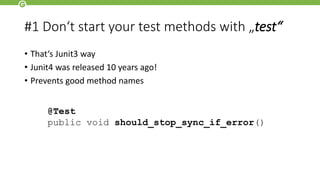
#1 Don‘t start your test methods with „test“
• That‘s Junit3 way
• Junit4 was released 10 years ago!
• Prevents good method names
@Test
public void should_stop_sync_if_error()
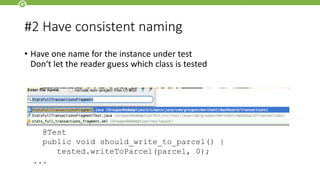
#2 Have consistent naming
• Have one name for the instance under test
Don‘t let the reader guess which class is tested
public class MessageTest {
Parcel parcel = mock(Parcel.class);
Message tested = new Message("subject", “text“);
@Test
public void should_write_to_parcel() {
tested.writeToParcel(parcel, 0);
...
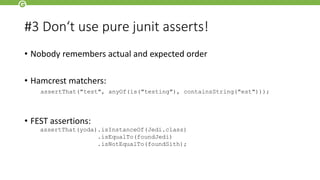
#3 Don‘t use pure junit asserts!
• Nobody remembers actual and expected order
• Hamcrest matchers:
• FEST assertions:
assertThat(yoda).isInstanceOf(Jedi.class)
.isEqualTo(foundJedi)
.isNotEqualTo(foundSith);
assertThat("test", anyOf(is("testing"), containsString("est")));
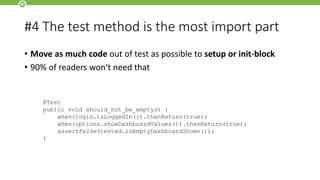
#4 The test method is the most import part
• Move as much code out of test as possible to setup or init-block
• 90% of readers won‘t need that
@Test
public void should_not_be_empty() {
when(login.isLoggedIn()).thenReturn(true);
when(options.showDashboardValues()).thenReturn(true);
assertFalse(tested.isEmptyDashboardShown());
}
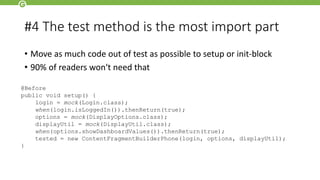
#4 The test method is the most import part
• Move as much code out of test as possible to setup or init-block
• 90% of readers won‘t need that
@Before
public void setup() {
login = mock(Login.class);
when(login.isLoggedIn()).thenReturn(true);
options = mock(DisplayOptions.class);
displayUtil = mock(DisplayUtil.class);
when(options.showDashboardValues()).thenReturn(true);
tested = new ContentFragmentBuilderPhone(login, options, displayUtil);
}
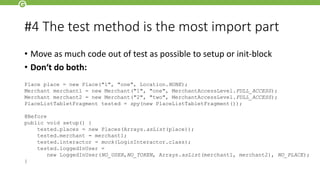
#4 The test method is the most import part
• Move as much code out of test as possible to setup or init-block
• Don‘t do both:
Place place = new Place("1", "one", Location.NONE);
Merchant merchant1 = new Merchant("1", "one", MerchantAccessLevel.FULL_ACCESS);
Merchant merchant2 = new Merchant("2", "two", MerchantAccessLevel.FULL_ACCESS);
PlaceListTabletFragment tested = spy(new PlaceListTabletFragment());
@Before
public void setup() {
tested.places = new Places(Arrays.asList(place));
tested.merchant = merchant1;
tested.interactor = mock(LoginInteractor.class);
tested.loggedInUser =
new LoggedInUser(NO_USER,NO_TOKEN, Arrays.asList(merchant1, merchant2), NO_PLACE);
}
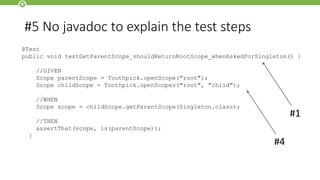
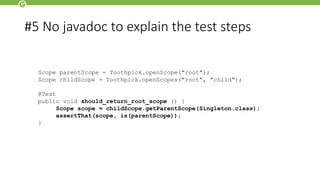
#5 No javadoc to explain the test steps
@Test
public void testGetParentScope_shouldReturnRootScope_whenAskedForSingleton() {
//GIVEN
Scope parentScope = Toothpick.openScope("root");
Scope childScope = Toothpick.openScopes("root", "child");
//WHEN
Scope scope = childScope.getParentScope(Singleton.class);
//THEN
assertThat(scope, is(parentScope));
}
#1
#4
Scope parentScope = Toothpick.openScope("root");
Scope childScope = Toothpick.openScopes("root", "child");
@Test
public void should_return_root_scope () {
Scope scope = childScope.getParentScope(Singleton.class);
assertThat(scope, is(parentScope));
}
#5 No javadoc to explain the test steps
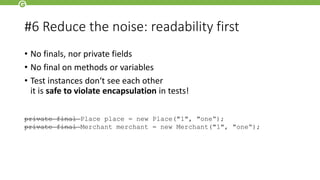
#6 Reduce the noise: readability first
• No finals, nor private fields
• No final on methods or variables
• Test instances don‘t see each other
it is safe to violate encapsulation in tests!
private final Place place = new Place("1", "one“);
private final Merchant merchant = new Merchant("1", "one“);
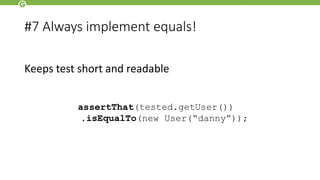
#7 Always implement equals!
Keeps test short and readable
assertThat(tested.getUser())
.isEqualTo(new User(“danny”));
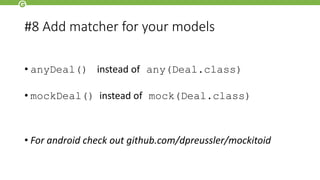
#8 Add matcher for your models
• anyDeal() instead of any(Deal.class)
• mockDeal() instead of mock(Deal.class)
• For android check out github.com/dpreussler/mockitoid
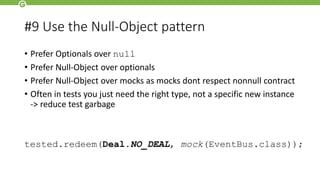
#9 Use the Null-Object pattern
• Prefer Optionals over null
• Prefer Null-Object over optionals
• Prefer Null-Object over mocks as mocks dont respect nonnull contract
• Often in tests you just need the right type, not a specific new instance
-> reduce test garbage
tested.redeem(Deal.NO_DEAL, mock(EventBus.class));
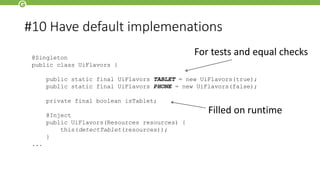
#10 Have default implemenations
@Singleton
public class UiFlavors {
public static final UiFlavors TABLET = new UiFlavors(true);
public static final UiFlavors PHONE = new UiFlavors(false);
private final boolean isTablet;
@Inject
public UiFlavors(Resources resources) {
this(detectTablet(resources));
}
...
Filled on runtime
For tests and equal checks
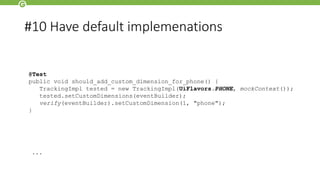
#10 Have default implemenations
@Singleton
public class UiFlavors {
public static final UiFlavors TABLET = new UiFlavors(true);
public static final UiFlavors PHONE = new UiFlavors(false);
private final boolean isTablet;
@Inject
public UiFlavors(Resources resources) {
this(detectTablet(resources));
}
...
@Test
public void should_add_custom_dimension_for_phone() {
TrackingImpl tested = new TrackingImpl(UiFlavors.PHONE, mockContext());
tested.setCustomDimensions(eventBuilder);
verify(eventBuilder).setCustomDimension(1, "phone");
}
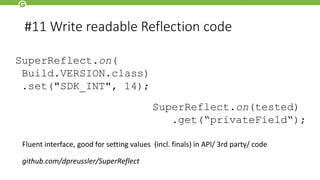
#11 Write readable Reflection code
SuperReflect.on(
Build.VERSION.class)
.set("SDK_INT", 14);
Fluent interface, good for setting values (incl. finals) in API/ 3rd party/ code
github.com/dpreussler/SuperReflect
SuperReflect.on(tested)
.get(“privateField“);
#11 Write readable Reflection code
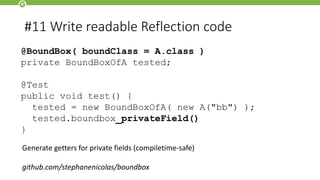
@BoundBox( boundClass = A.class )
private BoundBoxOfA tested;
@Test
public void test() {
tested = new BoundBoxOfA( new A("bb") );
tested.boundbox_privateField()
}
Generate getters for private fields (compiletime-safe)
github.com/stephanenicolas/boundbox
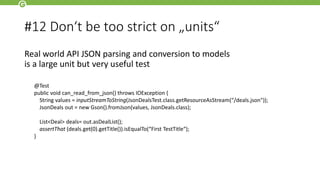
#12 Don‘t be too strict on „units“
Real world API JSON parsing and conversion to models
is a large unit but very useful test
@Test
public void can_read_from_json() throws IOException {
String values = inputStreamToString(JsonDealsTest.class.getResourceAsStream(“/deals.json"));
JsonDeals out = new Gson().fromJson(values, JsonDeals.class);
List<Deal> deals= out.asDealList();
assertThat (deals.get(0).getTitle()).isEqualTo(“First TestTitle“);
}
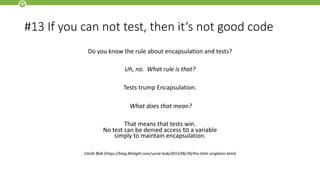
#13 If you can not test, then it‘s not good code
Do you know the rule about encapsulation and tests?
Uh, no. What rule is that?
Tests trump Encapsulation.
What does that mean?
That means that tests win.
No test can be denied access to a variable
simply to maintain encapsulation.
Uncle Bob (https://blog.8thlight.com/uncle-bob/2015/06/30/the-little-singleton.html)
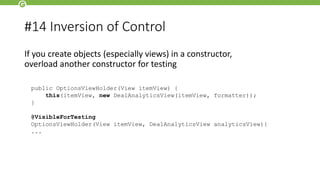
#14 Inversion of Control
If you create objects (especially views) in a constructor,
overload another constructor for testing
public OptionsViewHolder(View itemView) {
this(itemView, new DealAnalyticsView(itemView, formatter));
}
@VisibleForTesting
OptionsViewHolder(View itemView, DealAnalyticsView analyticsView){
...
#15 Make it fail!
The pupil went to the master programmer and said:
“All my tests pass all the time. Don’t I deserve a raise?”
The master slapped the pupil and replied:
“If all your tests pass, all the time, you need to write better tests.”
Good tests fail
The Way of Testivus, Alberto Savoia
http://www.agitar.com/downloads/TheWayOfTestivus.pdf
Unit testing is no
rocket science!
@PreusslerBerlin
Thank you!

15 tips to improve your unit tests (Droidcon Berlin 2016 Barcamp)

  • 1.
    15 tips to improveyour unit tests Droidcon 2016 Barcamp @PreusslerBerlin
  • 2.
    What makes aclean test? Three things. Readability, readability, and readability Uncle Bob, Clean Code
  • 3.
    #1 Don‘t startyour test methods with „test“ • That‘s Junit3 way • Junit4 was released 10 years ago! • Prevents good method names @Test public void should_stop_sync_if_error()
  • 4.
    #2 Have consistentnaming • Have one name for the instance under test Don‘t let the reader guess which class is tested public class MessageTest { Parcel parcel = mock(Parcel.class); Message tested = new Message("subject", “text“); @Test public void should_write_to_parcel() { tested.writeToParcel(parcel, 0); ...
  • 5.
    #3 Don‘t usepure junit asserts! • Nobody remembers actual and expected order • Hamcrest matchers: • FEST assertions: assertThat(yoda).isInstanceOf(Jedi.class) .isEqualTo(foundJedi) .isNotEqualTo(foundSith); assertThat("test", anyOf(is("testing"), containsString("est")));
  • 6.
    #4 The testmethod is the most import part • Move as much code out of test as possible to setup or init-block • 90% of readers won‘t need that @Test public void should_not_be_empty() { when(login.isLoggedIn()).thenReturn(true); when(options.showDashboardValues()).thenReturn(true); assertFalse(tested.isEmptyDashboardShown()); }
  • 7.
    #4 The testmethod is the most import part • Move as much code out of test as possible to setup or init-block • 90% of readers won‘t need that @Before public void setup() { login = mock(Login.class); when(login.isLoggedIn()).thenReturn(true); options = mock(DisplayOptions.class); displayUtil = mock(DisplayUtil.class); when(options.showDashboardValues()).thenReturn(true); tested = new ContentFragmentBuilderPhone(login, options, displayUtil); }
  • 8.
    #4 The testmethod is the most import part • Move as much code out of test as possible to setup or init-block • Don‘t do both: Place place = new Place("1", "one", Location.NONE); Merchant merchant1 = new Merchant("1", "one", MerchantAccessLevel.FULL_ACCESS); Merchant merchant2 = new Merchant("2", "two", MerchantAccessLevel.FULL_ACCESS); PlaceListTabletFragment tested = spy(new PlaceListTabletFragment()); @Before public void setup() { tested.places = new Places(Arrays.asList(place)); tested.merchant = merchant1; tested.interactor = mock(LoginInteractor.class); tested.loggedInUser = new LoggedInUser(NO_USER,NO_TOKEN, Arrays.asList(merchant1, merchant2), NO_PLACE); }
  • 9.
    #5 No javadocto explain the test steps @Test public void testGetParentScope_shouldReturnRootScope_whenAskedForSingleton() { //GIVEN Scope parentScope = Toothpick.openScope("root"); Scope childScope = Toothpick.openScopes("root", "child"); //WHEN Scope scope = childScope.getParentScope(Singleton.class); //THEN assertThat(scope, is(parentScope)); } #1 #4
  • 10.
    Scope parentScope =Toothpick.openScope("root"); Scope childScope = Toothpick.openScopes("root", "child"); @Test public void should_return_root_scope () { Scope scope = childScope.getParentScope(Singleton.class); assertThat(scope, is(parentScope)); } #5 No javadoc to explain the test steps
  • 11.
    #6 Reduce thenoise: readability first • No finals, nor private fields • No final on methods or variables • Test instances don‘t see each other it is safe to violate encapsulation in tests! private final Place place = new Place("1", "one“); private final Merchant merchant = new Merchant("1", "one“);
  • 12.
    #7 Always implementequals! Keeps test short and readable assertThat(tested.getUser()) .isEqualTo(new User(“danny”));
  • 13.
    #8 Add matcherfor your models • anyDeal() instead of any(Deal.class) • mockDeal() instead of mock(Deal.class) • For android check out github.com/dpreussler/mockitoid
  • 14.
    #9 Use theNull-Object pattern • Prefer Optionals over null • Prefer Null-Object over optionals • Prefer Null-Object over mocks as mocks dont respect nonnull contract • Often in tests you just need the right type, not a specific new instance -> reduce test garbage tested.redeem(Deal.NO_DEAL, mock(EventBus.class));
  • 15.
    #10 Have defaultimplemenations @Singleton public class UiFlavors { public static final UiFlavors TABLET = new UiFlavors(true); public static final UiFlavors PHONE = new UiFlavors(false); private final boolean isTablet; @Inject public UiFlavors(Resources resources) { this(detectTablet(resources)); } ... Filled on runtime For tests and equal checks
  • 16.
    #10 Have defaultimplemenations @Singleton public class UiFlavors { public static final UiFlavors TABLET = new UiFlavors(true); public static final UiFlavors PHONE = new UiFlavors(false); private final boolean isTablet; @Inject public UiFlavors(Resources resources) { this(detectTablet(resources)); } ... @Test public void should_add_custom_dimension_for_phone() { TrackingImpl tested = new TrackingImpl(UiFlavors.PHONE, mockContext()); tested.setCustomDimensions(eventBuilder); verify(eventBuilder).setCustomDimension(1, "phone"); }
  • 17.
    #11 Write readableReflection code SuperReflect.on( Build.VERSION.class) .set("SDK_INT", 14); Fluent interface, good for setting values (incl. finals) in API/ 3rd party/ code github.com/dpreussler/SuperReflect SuperReflect.on(tested) .get(“privateField“);
  • 18.
    #11 Write readableReflection code @BoundBox( boundClass = A.class ) private BoundBoxOfA tested; @Test public void test() { tested = new BoundBoxOfA( new A("bb") ); tested.boundbox_privateField() } Generate getters for private fields (compiletime-safe) github.com/stephanenicolas/boundbox
  • 19.
    #12 Don‘t betoo strict on „units“ Real world API JSON parsing and conversion to models is a large unit but very useful test @Test public void can_read_from_json() throws IOException { String values = inputStreamToString(JsonDealsTest.class.getResourceAsStream(“/deals.json")); JsonDeals out = new Gson().fromJson(values, JsonDeals.class); List<Deal> deals= out.asDealList(); assertThat (deals.get(0).getTitle()).isEqualTo(“First TestTitle“); }
  • 20.
    #13 If youcan not test, then it‘s not good code Do you know the rule about encapsulation and tests? Uh, no. What rule is that? Tests trump Encapsulation. What does that mean? That means that tests win. No test can be denied access to a variable simply to maintain encapsulation. Uncle Bob (https://blog.8thlight.com/uncle-bob/2015/06/30/the-little-singleton.html)
  • 21.
    #14 Inversion ofControl If you create objects (especially views) in a constructor, overload another constructor for testing public OptionsViewHolder(View itemView) { this(itemView, new DealAnalyticsView(itemView, formatter)); } @VisibleForTesting OptionsViewHolder(View itemView, DealAnalyticsView analyticsView){ ...
  • 22.
    #15 Make itfail! The pupil went to the master programmer and said: “All my tests pass all the time. Don’t I deserve a raise?” The master slapped the pupil and replied: “If all your tests pass, all the time, you need to write better tests.” Good tests fail The Way of Testivus, Alberto Savoia http://www.agitar.com/downloads/TheWayOfTestivus.pdf
  • 23.
    Unit testing isno rocket science! @PreusslerBerlin Thank you!

Editor's Notes

  • #6 Todo make same example
  • #7 Try to keep test to max 3 lines
  • #8 Try to keep test to max 3 lines
  • #11 Try to keep test to max 3 lines
  • #18 YES its fine to use reflection