jahangirabad institute of technology
Nuclear power plant
Jahangirabad institute of technology 2
NUCLEAR FUEL
Nuclear fuel is any material that can be consumed to
derive nuclear energy. The most common type of nuclear
fuel is fissile elements that can be made to undergo
nuclear fission chain reactions in a nuclear reactor
The most common nuclear fuels are 235U and 239Pu.
Not all nuclear fuels are used in fission chain reactions
Jahangirabad institute of technology 3
Nuclear fission
When a neutron strikes an atom of uranium, the uranium
splits into two lighter atoms and releases heat
simultaneously.
Fission of heavy elements is an exothermic reaction which
can release large amounts of energy both as
electromagnetic radiation and as kinetic energy of the
fragments
Jahangirabad institute of technology 4
Nuclear chain reactions
A chain reaction refers to a process in which neutrons
released in fission produce an additional fission in at least
one further nucleus. This nucleus in turn produces
neutrons, and the process repeats. If the process is
controlled it is used for nuclear power or if uncontrolled it
is used for nuclear weapons
Jahangirabad institute of technology 5
Jahangirabad institute of technology 6
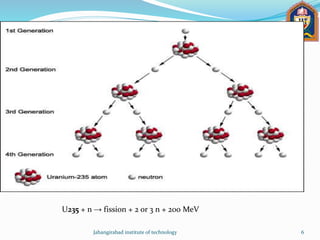
U235 + n → fission + 2 or 3 n + 200 MeV
Continue…
If each neutron releases two more neutrons, then the
number of fissions doubles each generation. In that case,
in 10 generations there are 1,024 fissions and in 80
generations about 6 x 10 23 (a mole) fissions.
Jahangirabad institute of technology 7
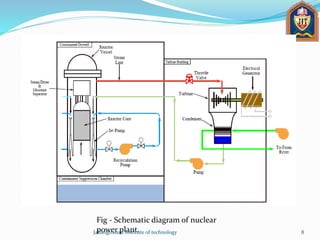
Fig - Schematic diagram of nuclear
power plant.Jahangirabad institute of technology 8
Nuclear reactor
A nuclear reactor is a device in which nuclear chain
reactions are initiated, controlled, and sustained at a steady
rate, as opposed to a nuclear bomb, in which the chain
reaction occurs in a fraction of a second and is
uncontrolled causing an explosion.
Jahangirabad institute of technology 9
CONTROL RODS
 Control rods made of a material that absorbs
neutrtons are inserted into the bundle using a
mechanism that can rise or lower the control rods
 The control rods essentially contain neutron absorbers
like, boron, cadmium or indium.
Jahangirabad institute of technology 10
STEAM GENERATORS
 Steam generators are heat exchangers used to convert
water into steam from heat produced in a nuclear reactor
core.
 Either ordinary water or heavy water is used as the
coolant.
Jahangirabad institute of technology 11
Steam turbine
A steam turbine is a mechanical device that extracts
thermal energy from pressurized steam, and converts it
into useful mechanical
 Various high-performance alloys and super alloys have
been used for steam generator tubing.
Jahangirabad institute of technology 12
Coolant pump
 The coolant pump pressurizes the coolant to pressures of
the order of 155bar.
 The pressure of the coolant loop is maintained almost
constant with the help of the pump and a pressurized unit.
Jahangirabad institute of technology 13
Feed pump
Steam coming out of the turbine, flows through the
condenser for condensation and re-circulated for the next
cycle of operation.
The feed pump circulates the condensed water in the
working fluid loop.
Jahangirabad institute of technology 14
Cooling tower
Cooling towers are heat removal devices used to transfer
process waste heat to the atmosphere.
Water circulating through the condenser is taken to the
cooling tower for cooling and reuse
Jahangirabad institute of technology 15
Advantages
 Nuclear power generation does emit relatively low amounts of carbon
dioxide (CO2). The emissions of green house gases and therefore the
contribution of nuclear power plants to global warming is therefore
relatively little.
 This technology is readily available, it does not have to be developed first.
 It is possible to generate a high amount of electrical energy in one single
plant
Jahangirabad institute of technology 16
Site selection of nuclear power
plant
The various factors to be considered while selecting the site for
nuclear plant are as follows :
 Availability of water.
 Distance from load center.
 Distance from populated area.
 Accessibility to site.
 Waste disposal.
Jahangirabad institute of technology 17
Hydro-electric plants
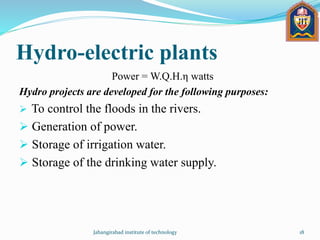
Power = W.Q.H.η watts
Hydro projects are developed for the following purposes:
 To control the floods in the rivers.
 Generation of power.
 Storage of irrigation water.
 Storage of the drinking water supply.
Jahangirabad institute of technology 18
Non Conventional Power Plants
Solar power plant:In the solar power plant, solar energy is
used to generate electricity. Sunrays are focused using
concave reflectors on to copper tubes filled with water and
painted black outside.
There are three main types:
Parabolic-trough systems
A dish/engine system
A power tower system
Jahangirabad institute of technology 19
Wind power plant
 the wind has velocity it has kinetic energy.
 This is the energy of the wind.
 We shall see how the kinetic energy of the wind can be used to
produce electricity.
Recent developments: The present windmill technology is
inadequate for the low wind speed regions in the plains.
 Artificial Winds.
 Aeroelectric Plant.
Jahangirabad institute of technology 20

nuclear power plant

  • 1.
  • 2.
    Nuclear power plant Jahangirabadinstitute of technology 2
  • 3.
    NUCLEAR FUEL Nuclear fuelis any material that can be consumed to derive nuclear energy. The most common type of nuclear fuel is fissile elements that can be made to undergo nuclear fission chain reactions in a nuclear reactor The most common nuclear fuels are 235U and 239Pu. Not all nuclear fuels are used in fission chain reactions Jahangirabad institute of technology 3
  • 4.
    Nuclear fission When aneutron strikes an atom of uranium, the uranium splits into two lighter atoms and releases heat simultaneously. Fission of heavy elements is an exothermic reaction which can release large amounts of energy both as electromagnetic radiation and as kinetic energy of the fragments Jahangirabad institute of technology 4
  • 5.
    Nuclear chain reactions Achain reaction refers to a process in which neutrons released in fission produce an additional fission in at least one further nucleus. This nucleus in turn produces neutrons, and the process repeats. If the process is controlled it is used for nuclear power or if uncontrolled it is used for nuclear weapons Jahangirabad institute of technology 5
  • 6.
    Jahangirabad institute oftechnology 6 U235 + n → fission + 2 or 3 n + 200 MeV
  • 7.
    Continue… If each neutronreleases two more neutrons, then the number of fissions doubles each generation. In that case, in 10 generations there are 1,024 fissions and in 80 generations about 6 x 10 23 (a mole) fissions. Jahangirabad institute of technology 7
  • 8.
    Fig - Schematicdiagram of nuclear power plant.Jahangirabad institute of technology 8
  • 9.
    Nuclear reactor A nuclearreactor is a device in which nuclear chain reactions are initiated, controlled, and sustained at a steady rate, as opposed to a nuclear bomb, in which the chain reaction occurs in a fraction of a second and is uncontrolled causing an explosion. Jahangirabad institute of technology 9
  • 10.
    CONTROL RODS  Controlrods made of a material that absorbs neutrtons are inserted into the bundle using a mechanism that can rise or lower the control rods  The control rods essentially contain neutron absorbers like, boron, cadmium or indium. Jahangirabad institute of technology 10
  • 11.
    STEAM GENERATORS  Steamgenerators are heat exchangers used to convert water into steam from heat produced in a nuclear reactor core.  Either ordinary water or heavy water is used as the coolant. Jahangirabad institute of technology 11
  • 12.
    Steam turbine A steamturbine is a mechanical device that extracts thermal energy from pressurized steam, and converts it into useful mechanical  Various high-performance alloys and super alloys have been used for steam generator tubing. Jahangirabad institute of technology 12
  • 13.
    Coolant pump  Thecoolant pump pressurizes the coolant to pressures of the order of 155bar.  The pressure of the coolant loop is maintained almost constant with the help of the pump and a pressurized unit. Jahangirabad institute of technology 13
  • 14.
    Feed pump Steam comingout of the turbine, flows through the condenser for condensation and re-circulated for the next cycle of operation. The feed pump circulates the condensed water in the working fluid loop. Jahangirabad institute of technology 14
  • 15.
    Cooling tower Cooling towersare heat removal devices used to transfer process waste heat to the atmosphere. Water circulating through the condenser is taken to the cooling tower for cooling and reuse Jahangirabad institute of technology 15
  • 16.
    Advantages  Nuclear powergeneration does emit relatively low amounts of carbon dioxide (CO2). The emissions of green house gases and therefore the contribution of nuclear power plants to global warming is therefore relatively little.  This technology is readily available, it does not have to be developed first.  It is possible to generate a high amount of electrical energy in one single plant Jahangirabad institute of technology 16
  • 17.
    Site selection ofnuclear power plant The various factors to be considered while selecting the site for nuclear plant are as follows :  Availability of water.  Distance from load center.  Distance from populated area.  Accessibility to site.  Waste disposal. Jahangirabad institute of technology 17
  • 18.
    Hydro-electric plants Power =W.Q.H.η watts Hydro projects are developed for the following purposes:  To control the floods in the rivers.  Generation of power.  Storage of irrigation water.  Storage of the drinking water supply. Jahangirabad institute of technology 18
  • 19.
    Non Conventional PowerPlants Solar power plant:In the solar power plant, solar energy is used to generate electricity. Sunrays are focused using concave reflectors on to copper tubes filled with water and painted black outside. There are three main types: Parabolic-trough systems A dish/engine system A power tower system Jahangirabad institute of technology 19
  • 20.
    Wind power plant the wind has velocity it has kinetic energy.  This is the energy of the wind.  We shall see how the kinetic energy of the wind can be used to produce electricity. Recent developments: The present windmill technology is inadequate for the low wind speed regions in the plains.  Artificial Winds.  Aeroelectric Plant. Jahangirabad institute of technology 20