POWER GENERATION AND UTILIZATION NUCLEAR POWER PLANT
Prepared by: Engr. Mansoor Hayat Page 1
UNIVERSITY OF SARGODHA
University College of Engineering and Technology
Instructor name: Engr.Mansoor Hayat Course code: ET124
Course Title: Power Generation and Utilization Credit Hours: 3+0
Classes: BSETF 14 A+B
NUCLEAR POWER PLANT
POWER GENERATION AND UTILIZATION NUCLEAR POWER PLANT
Prepared by: Engr. Mansoor Hayat Page 2
Introduction:
one large nuclear power plant saves more than 50,000 barrels of oil per day, such a power plant would
pay for its capital cost in a few short years. For those countries that now rely on but do not have oil, or
must reduce the importation of foreign oil.
For those countries that are oil exporters, nuclear power represents an insurance against the day when
oil is depleted.
The unit costs per kilowatt-hour for nuclear energy are now comparable to or lower than the unit costs
for coal in most parts of the world.
Natural gas is a good, relatively clean-burning fuel, but it has some availability problems in many
countries and should, in any case, be conserved for small-scale industrial and domestic uses.
Atom:
An atom consists of a relatively heavy, positively charged nucleus and a number of much lighter
negatively charged electrons that exist in various orbits around the nucleus.
Nucleons:
Nucleons at primarily of two kinds: the neutrons, which are electrically neutral, and the proton: which
are positively charged.
Einstine equation:
E=MC2
C speed of light
isotopes:
Atoms with nuclei that have the same number of protons have similar chemical and physical
characteristics and differ mainly in their masses. They are called isotopes.
Deuterium:
Deuterium has one proton and one neutron in its nucleus and one orbital electron. It exists as one part
in about 6660 in naturally occurring hydrogen. Alos called heavy hydrogen.
NUCLEAR FUEL
 Nuclear fuel is any material that can be consumed to derive nuclear energy. The most common
type of nuclear fuel is fissile elements that can be made to undergo nuclear fission chain
reactions in a nuclear reactor
 The most common nuclear fuels are 235U and 239Pu. Not all nuclear fuels are used in fission
chain reactions
POWER GENERATION AND UTILIZATION NUCLEAR POWER PLANT
Prepared by: Engr. Mansoor Hayat Page 3
NUCLEAR FISSION
 When a neutron strikes an atom of uranium, the uranium splits ingto two lighter atoms and
releases heat simultaneously.
Fission of heavy elements is an exothermic reaction which can release large amounts of energy
U235 + n → fission + 2 or 3 n + 200 MeV
 If each neutron releases two more neutrons, then the number of fissions doubles each
generation. In that case, in 10 generations there are 1,024 fissions and in 80 generations about 6
x 10 23 (a mole) fissions.
NUCLEAR POWER PLANT LAYOUT:
POWER GENERATION AND UTILIZATION NUCLEAR POWER PLANT
Prepared by: Engr. Mansoor Hayat Page 4
Control Building:
From this location, the operator controls the reactor.
Containment Building:
This is the the location of the core and primary components including the steam generators if it
is a PWR.
POWER GENERATION AND UTILIZATION NUCLEAR POWER PLANT
Prepared by: Engr. Mansoor Hayat Page 5
Turbine Building:
This is where the steam is converted to electricity. In a PWR it is “clean” whereas in a BWR, the
steam is contaminated since it is produced from water which has been in contact with the core.
Thus the turbine floor in a BWR has elevated radiation levels.
Fuel Building
This is where the spent fuel is stored onsite in a pool.
POWER GENERATION AND UTILIZATION NUCLEAR POWER PLANT
Prepared by: Engr. Mansoor Hayat Page 6
Diesel Generator and Auxiliary Buildings:
This is the location of the generators which supply emergency power and the other components
which support the water/steam system.
Protective Barriers:
The fuel pellets are protected by the fuel rod which is in turn protected by the reactor vessel
which is in turn protected by the reactor containment. This affords 3 levels of “containment”
for the radioactive material.
Steam Generator:
POWER GENERATION AND UTILIZATION NUCLEAR POWER PLANT
Prepared by: Engr. Mansoor Hayat Page 7
For a PWR, heat from the steam in the primary loop is transferred to the secondary system via a
heat exchange system. The primary steam (which may contain radioactive contamination)
travels through “U” tubes similar to the ones pictured here (these are actually from a heat
exchanger rather than a PWR steam generator). The tubes are immersed in clean water from
the secondary loop which is then turned to steam. Since this device generates steam in the
secondary loop it’s called a “Steam Generator”
Principal parts of a nuclear reactor:
NUCLEAR REACTOR
 A nuclear reactor is a device in which nuclear chain reactions are initiated, controlled, and
sustained at a steady rate, as opposed to a nuclear bomb, in which the chain reaction occurs in a
fraction of a second and is uncontrolled causing an explotion.
Core : Here the nuclear fission process takes place.
Moderator : This reduces the speed of fast moving neutrons. Most moderators
are graphite, water or heavy water. Heavy water is a much better moderator but is very
expensive to make
Control rods :
 Control rods made of a material that absorbs neutrtons are inserted into the bundle using a
mechanism that can rise or lower the control rods.
 . The control rods essentially contain neutron absorbers like, boron, cadmium or indium.
STEAM GENERATORS
 Steam generators are heat exchangers used to convert water into steam from heat produced in
a nuclear reactor core.
 Either ordinary water or heavy water is used as the coolant.
STEAM TURBINE
 A steam turbine is a mechanical device that extracts thermal energy from pressurized steam,
and converts it into useful mechanical
Various high-performance alloys and superalloys have been used for steam generator tubing.
COOLANT PUMP
 The coolant pump pressurizes the coolant to pressures of the orderof 155bar.
 The pressue of the coolant loop is maintained almost constant with the help of the pump and a
pressurizer unit.
FEED PUMP
 Steam coming out of the turbine, flows through the condenser for condensation and
recirculated for the next cycle of operation.
 The feed pump circulates the condensed water in the working fluid loop.
POWER GENERATION AND UTILIZATION NUCLEAR POWER PLANT
Prepared by: Engr. Mansoor Hayat Page 8
CONDENSER
 Condenser is a device or unit which is used to condense vapor into liquid.
 The objective of the condenser are to reduce the turbine exhaust pressure to increase the
efficiency and to recover high qyuality feed water in the form of condensate & feed back it to
the steam generator without any further treatment.
COOLING TOWER
 Cooling towers are heat removal devices used to transfer process waste heat to the
atmosphere.
 Water cirulating throughthe codeser is taken to the cooling tower for cooling and reuse
Fuel : The fuel used for nuclear fission is U235 isotope.
Radiation shield : To protect the people working from radiation and
(thermal shielding) radiation fragments.
Types of reactors:
Boiling Water (BWR) Nuclear Reactors
Pressurized Water (PWR) Nuclear Reactors
CANDU Reactors
Boiling Water (BWR) Nuclear Reactors:
In a BWR the water is boiled by the core, turned to steam and that steam is used to drive the turbines
which generates the electricity. The spent steam is cooled back to liquid and recycled through the core.
POWER GENERATION AND UTILIZATION NUCLEAR POWER PLANT
Prepared by: Engr. Mansoor Hayat Page 9
POWER GENERATION AND UTILIZATION NUCLEAR POWER PLANT
Prepared by: Engr. Mansoor Hayat Page 10
POWER GENERATION AND UTILIZATION NUCLEAR POWER PLANT
Prepared by: Engr. Mansoor Hayat Page 11
Pressurized Water (PWR) Nuclear Reactors:
In a PWR, water is heated in the core and converted to superheated steam. This is a closed system and
is called the primary loop. This contaminated water/steam does not exit the containment. The heat
from the steam in the primary loop is transferred to a separate water supply (the secondary loop)
causing it to boil and turn to steam. This is done by using “steam generators” which have many small
tubes inside. The steam from the primary loop travels through the tubes giving up heat to the water
surrounding the tubes. The steam in this secondary loop is used to run the turbines to generate the
electricity. In this way, the contaminated water supply is always maintained inside the containment
unless of course the steam generator tubes leak causing cross contamination in the secondary loop.
After passing through the turbines, the spent steam in the secondary loop is cooled back to water and
run through the steam generators again.
CANDU Reactors
 CANDU stands for "Canada Deuterium Uranium“
 It is a pressurized-heavy-water, natural-uranium power reactor designed first in the late 1950s
by a consortium of Canadian government and private industry
 All power reactors in Canada are CANDU type
The CANDU designer is AECL (Atomic Energy of Canada Limited), a federal crown corporation
POWER GENERATION AND UTILIZATION NUCLEAR POWER PLANT
Prepared by: Engr. Mansoor Hayat Page 12
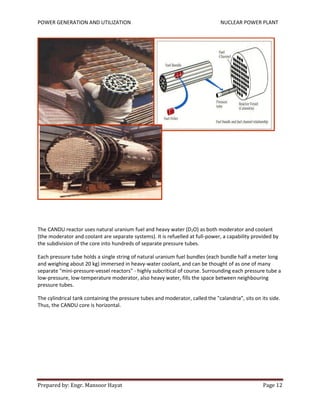
The CANDU reactor uses natural uranium fuel and heavy water (D2O) as both moderator and coolant
(the moderator and coolant are separate systems). It is refuelled at full-power, a capability provided by
the subdivision of the core into hundreds of separate pressure tubes.
Each pressure tube holds a single string of natural uranium fuel bundles (each bundle half a meter long
and weighing about 20 kg) immersed in heavy-water coolant, and can be thought of as one of many
separate "mini-pressure-vessel reactors" - highly subcritical of course. Surrounding each pressure tube a
low-pressure, low-temperature moderator, also heavy water, fills the space between neighbouring
pressure tubes.
The cylindrical tank containing the pressure tubes and moderator, called the "calandria", sits on its side.
Thus, the CANDU core is horizontal.
POWER GENERATION AND UTILIZATION NUCLEAR POWER PLANT
Prepared by: Engr. Mansoor Hayat Page 13
In the CANDU design, as with the PWR design, the heat of fission is transferred, via a primary water
coolant, to a secondary water system. The two water systems "meet" in a bank of steam generators,
where the heat from the first system causes the second system (at lower pressure) to boil. This steam is
then dried (liquid droplets removed, since they can damage turbine blades) and passed to a series of
high-pressure and low-pressure steam turbines. The turbines are connected in series to an electrical
generator. The primary water system, which becomes radioactive over time, does not leave the
reactor's containment building.
It is a highly complex system from start to finish, involving a series of energy transformations with
associated efficiencies. The potential energy of nuclear structure is converted first to heat via the fission
process, then steam pressure, kinetic energy (of the turbine and generator), and ultimately to electrical
energy
Fueling is accomplished by a fuelling machine which visits each end of the core, one fuelling and the
other de-fuelling, allowing operators to insert fresh fuel at alternate ends for neighbouring fuel
channels. From six to ten bundles are "shuffled" each day.
Flux-shaping is provided by fuel management. Long-term reactivity control is also achieved through fuel
management. Short-term reactivity control is provided by controllable light-water compartments, as
well as absorber rods.
Thermalhydraulically, the core of most CANDU reactors is divided into two halves, with the divider line
running vertically down the centre of the reactor face. Each half represents a separate coolant circuit.
Heavy water coolant is supplied to the pressure tubes in each circuit via large headers at each end of the
calandria, one pair of headers (inlet/outlet) for each half of the core. The subdivision of the core into
two circuits, plus the fine subdivision into hundreds of interconnected pressure tubes, greatly reduces
the effect of a potential LOCA (Loss-of-Coolant Accident).
POWER GENERATION AND UTILIZATION NUCLEAR POWER PLANT
Prepared by: Engr. Mansoor Hayat Page 14
PWR vs. BWR:
Safety and health hazards:
Although the construction and operation of these facilities are closely monitored and regulated by the
Nuclear Regulatory Commission (NRC), accidents are possible. An accident could result in dangerous
levels of radiation that could affect the health and safety of the public living near the nuclear power
plant.
Local and state governments, federal agencies, and the electric utilities have emergency response plans
in the event of a nuclear power plant incident. The plans define two “emergency planning zones.” One
zone covers an area within a 10-mile radius of the plant, where it is possible that people could be
harmed by direct radiation exposure. The second zone covers a broader area, usually up to a 50-mile
radius from the plant, where radioactive materials could contaminate water supplies, food crops and
livestock.
The potential danger from an accident at a nuclear power plant is exposure to radiation. This exposure
could come from the release of radioactive material from the plant into the environment, usually
characterized by a plume (cloud-like formation) of radioactive gases and particles. The major hazards to
people in the vicinity of the plume are radiation exposure to the body from the cloud and particles
deposited on the ground, inhalation of radioactive materials and ingestion of radioactive materials.
Radioactive materials are composed of atoms that are unstable. An unstable atom gives off its excess
energy until it becomes stable. The energy emitted is radiation. Each of us is exposed to radiation daily
from natural sources, including the Sun and the Earth. Small traces of radiation are present in food and
water. Radiation also is released from man-made sources such as X-ray machines, television sets and
microwave ovens. Radiation has a cumulative effect. The longer a person is exposed to radiation, the
greater the effect. A high exposure to radiation can cause serious illness or death.,
POWER GENERATION AND UTILIZATION NUCLEAR POWER PLANT
Prepared by: Engr. Mansoor Hayat Page 15
ADVANTAGES
 Nuclear power generation does emit relatively low amounts of carbon dioxide (CO2). The
emissions of green house gases and therefore the contribution of nuclear power plants to global
warming is therefore relatively little.
 This technology is readily available, it does not have to be developed first.
 It is possible to generate a high amount of electrical energy in one single plant
DISADVANTAGES
 The problem of radioactive waste is still an unsolved one.
 High risks: It is technically impossible to build a plant with 100% security.
 The energy source for nuclear energy is Uranium. Uranium is a scarce resource, its supply is
estimated to last only for the next 30 to 60 years depending on the actual demand.
 Nuclear power plants as well as nuclear waste could be preferred targets for terrorist attacks..
 During the operation of nuclear power plants, radioactive waste is produced, which in turn can
be used for the production of nuclear weapons.

Nuclear lecture

  • 1.
    POWER GENERATION ANDUTILIZATION NUCLEAR POWER PLANT Prepared by: Engr. Mansoor Hayat Page 1 UNIVERSITY OF SARGODHA University College of Engineering and Technology Instructor name: Engr.Mansoor Hayat Course code: ET124 Course Title: Power Generation and Utilization Credit Hours: 3+0 Classes: BSETF 14 A+B NUCLEAR POWER PLANT
  • 2.
    POWER GENERATION ANDUTILIZATION NUCLEAR POWER PLANT Prepared by: Engr. Mansoor Hayat Page 2 Introduction: one large nuclear power plant saves more than 50,000 barrels of oil per day, such a power plant would pay for its capital cost in a few short years. For those countries that now rely on but do not have oil, or must reduce the importation of foreign oil. For those countries that are oil exporters, nuclear power represents an insurance against the day when oil is depleted. The unit costs per kilowatt-hour for nuclear energy are now comparable to or lower than the unit costs for coal in most parts of the world. Natural gas is a good, relatively clean-burning fuel, but it has some availability problems in many countries and should, in any case, be conserved for small-scale industrial and domestic uses. Atom: An atom consists of a relatively heavy, positively charged nucleus and a number of much lighter negatively charged electrons that exist in various orbits around the nucleus. Nucleons: Nucleons at primarily of two kinds: the neutrons, which are electrically neutral, and the proton: which are positively charged. Einstine equation: E=MC2 C speed of light isotopes: Atoms with nuclei that have the same number of protons have similar chemical and physical characteristics and differ mainly in their masses. They are called isotopes. Deuterium: Deuterium has one proton and one neutron in its nucleus and one orbital electron. It exists as one part in about 6660 in naturally occurring hydrogen. Alos called heavy hydrogen. NUCLEAR FUEL  Nuclear fuel is any material that can be consumed to derive nuclear energy. The most common type of nuclear fuel is fissile elements that can be made to undergo nuclear fission chain reactions in a nuclear reactor  The most common nuclear fuels are 235U and 239Pu. Not all nuclear fuels are used in fission chain reactions
  • 3.
    POWER GENERATION ANDUTILIZATION NUCLEAR POWER PLANT Prepared by: Engr. Mansoor Hayat Page 3 NUCLEAR FISSION  When a neutron strikes an atom of uranium, the uranium splits ingto two lighter atoms and releases heat simultaneously. Fission of heavy elements is an exothermic reaction which can release large amounts of energy U235 + n → fission + 2 or 3 n + 200 MeV  If each neutron releases two more neutrons, then the number of fissions doubles each generation. In that case, in 10 generations there are 1,024 fissions and in 80 generations about 6 x 10 23 (a mole) fissions. NUCLEAR POWER PLANT LAYOUT:
  • 4.
    POWER GENERATION ANDUTILIZATION NUCLEAR POWER PLANT Prepared by: Engr. Mansoor Hayat Page 4 Control Building: From this location, the operator controls the reactor. Containment Building: This is the the location of the core and primary components including the steam generators if it is a PWR.
  • 5.
    POWER GENERATION ANDUTILIZATION NUCLEAR POWER PLANT Prepared by: Engr. Mansoor Hayat Page 5 Turbine Building: This is where the steam is converted to electricity. In a PWR it is “clean” whereas in a BWR, the steam is contaminated since it is produced from water which has been in contact with the core. Thus the turbine floor in a BWR has elevated radiation levels. Fuel Building This is where the spent fuel is stored onsite in a pool.
  • 6.
    POWER GENERATION ANDUTILIZATION NUCLEAR POWER PLANT Prepared by: Engr. Mansoor Hayat Page 6 Diesel Generator and Auxiliary Buildings: This is the location of the generators which supply emergency power and the other components which support the water/steam system. Protective Barriers: The fuel pellets are protected by the fuel rod which is in turn protected by the reactor vessel which is in turn protected by the reactor containment. This affords 3 levels of “containment” for the radioactive material. Steam Generator:
  • 7.
    POWER GENERATION ANDUTILIZATION NUCLEAR POWER PLANT Prepared by: Engr. Mansoor Hayat Page 7 For a PWR, heat from the steam in the primary loop is transferred to the secondary system via a heat exchange system. The primary steam (which may contain radioactive contamination) travels through “U” tubes similar to the ones pictured here (these are actually from a heat exchanger rather than a PWR steam generator). The tubes are immersed in clean water from the secondary loop which is then turned to steam. Since this device generates steam in the secondary loop it’s called a “Steam Generator” Principal parts of a nuclear reactor: NUCLEAR REACTOR  A nuclear reactor is a device in which nuclear chain reactions are initiated, controlled, and sustained at a steady rate, as opposed to a nuclear bomb, in which the chain reaction occurs in a fraction of a second and is uncontrolled causing an explotion. Core : Here the nuclear fission process takes place. Moderator : This reduces the speed of fast moving neutrons. Most moderators are graphite, water or heavy water. Heavy water is a much better moderator but is very expensive to make Control rods :  Control rods made of a material that absorbs neutrtons are inserted into the bundle using a mechanism that can rise or lower the control rods.  . The control rods essentially contain neutron absorbers like, boron, cadmium or indium. STEAM GENERATORS  Steam generators are heat exchangers used to convert water into steam from heat produced in a nuclear reactor core.  Either ordinary water or heavy water is used as the coolant. STEAM TURBINE  A steam turbine is a mechanical device that extracts thermal energy from pressurized steam, and converts it into useful mechanical Various high-performance alloys and superalloys have been used for steam generator tubing. COOLANT PUMP  The coolant pump pressurizes the coolant to pressures of the orderof 155bar.  The pressue of the coolant loop is maintained almost constant with the help of the pump and a pressurizer unit. FEED PUMP  Steam coming out of the turbine, flows through the condenser for condensation and recirculated for the next cycle of operation.  The feed pump circulates the condensed water in the working fluid loop.
  • 8.
    POWER GENERATION ANDUTILIZATION NUCLEAR POWER PLANT Prepared by: Engr. Mansoor Hayat Page 8 CONDENSER  Condenser is a device or unit which is used to condense vapor into liquid.  The objective of the condenser are to reduce the turbine exhaust pressure to increase the efficiency and to recover high qyuality feed water in the form of condensate & feed back it to the steam generator without any further treatment. COOLING TOWER  Cooling towers are heat removal devices used to transfer process waste heat to the atmosphere.  Water cirulating throughthe codeser is taken to the cooling tower for cooling and reuse Fuel : The fuel used for nuclear fission is U235 isotope. Radiation shield : To protect the people working from radiation and (thermal shielding) radiation fragments. Types of reactors: Boiling Water (BWR) Nuclear Reactors Pressurized Water (PWR) Nuclear Reactors CANDU Reactors Boiling Water (BWR) Nuclear Reactors: In a BWR the water is boiled by the core, turned to steam and that steam is used to drive the turbines which generates the electricity. The spent steam is cooled back to liquid and recycled through the core.
  • 9.
    POWER GENERATION ANDUTILIZATION NUCLEAR POWER PLANT Prepared by: Engr. Mansoor Hayat Page 9
  • 10.
    POWER GENERATION ANDUTILIZATION NUCLEAR POWER PLANT Prepared by: Engr. Mansoor Hayat Page 10
  • 11.
    POWER GENERATION ANDUTILIZATION NUCLEAR POWER PLANT Prepared by: Engr. Mansoor Hayat Page 11 Pressurized Water (PWR) Nuclear Reactors: In a PWR, water is heated in the core and converted to superheated steam. This is a closed system and is called the primary loop. This contaminated water/steam does not exit the containment. The heat from the steam in the primary loop is transferred to a separate water supply (the secondary loop) causing it to boil and turn to steam. This is done by using “steam generators” which have many small tubes inside. The steam from the primary loop travels through the tubes giving up heat to the water surrounding the tubes. The steam in this secondary loop is used to run the turbines to generate the electricity. In this way, the contaminated water supply is always maintained inside the containment unless of course the steam generator tubes leak causing cross contamination in the secondary loop. After passing through the turbines, the spent steam in the secondary loop is cooled back to water and run through the steam generators again. CANDU Reactors  CANDU stands for "Canada Deuterium Uranium“  It is a pressurized-heavy-water, natural-uranium power reactor designed first in the late 1950s by a consortium of Canadian government and private industry  All power reactors in Canada are CANDU type The CANDU designer is AECL (Atomic Energy of Canada Limited), a federal crown corporation
  • 12.
    POWER GENERATION ANDUTILIZATION NUCLEAR POWER PLANT Prepared by: Engr. Mansoor Hayat Page 12 The CANDU reactor uses natural uranium fuel and heavy water (D2O) as both moderator and coolant (the moderator and coolant are separate systems). It is refuelled at full-power, a capability provided by the subdivision of the core into hundreds of separate pressure tubes. Each pressure tube holds a single string of natural uranium fuel bundles (each bundle half a meter long and weighing about 20 kg) immersed in heavy-water coolant, and can be thought of as one of many separate "mini-pressure-vessel reactors" - highly subcritical of course. Surrounding each pressure tube a low-pressure, low-temperature moderator, also heavy water, fills the space between neighbouring pressure tubes. The cylindrical tank containing the pressure tubes and moderator, called the "calandria", sits on its side. Thus, the CANDU core is horizontal.
  • 13.
    POWER GENERATION ANDUTILIZATION NUCLEAR POWER PLANT Prepared by: Engr. Mansoor Hayat Page 13 In the CANDU design, as with the PWR design, the heat of fission is transferred, via a primary water coolant, to a secondary water system. The two water systems "meet" in a bank of steam generators, where the heat from the first system causes the second system (at lower pressure) to boil. This steam is then dried (liquid droplets removed, since they can damage turbine blades) and passed to a series of high-pressure and low-pressure steam turbines. The turbines are connected in series to an electrical generator. The primary water system, which becomes radioactive over time, does not leave the reactor's containment building. It is a highly complex system from start to finish, involving a series of energy transformations with associated efficiencies. The potential energy of nuclear structure is converted first to heat via the fission process, then steam pressure, kinetic energy (of the turbine and generator), and ultimately to electrical energy Fueling is accomplished by a fuelling machine which visits each end of the core, one fuelling and the other de-fuelling, allowing operators to insert fresh fuel at alternate ends for neighbouring fuel channels. From six to ten bundles are "shuffled" each day. Flux-shaping is provided by fuel management. Long-term reactivity control is also achieved through fuel management. Short-term reactivity control is provided by controllable light-water compartments, as well as absorber rods. Thermalhydraulically, the core of most CANDU reactors is divided into two halves, with the divider line running vertically down the centre of the reactor face. Each half represents a separate coolant circuit. Heavy water coolant is supplied to the pressure tubes in each circuit via large headers at each end of the calandria, one pair of headers (inlet/outlet) for each half of the core. The subdivision of the core into two circuits, plus the fine subdivision into hundreds of interconnected pressure tubes, greatly reduces the effect of a potential LOCA (Loss-of-Coolant Accident).
  • 14.
    POWER GENERATION ANDUTILIZATION NUCLEAR POWER PLANT Prepared by: Engr. Mansoor Hayat Page 14 PWR vs. BWR: Safety and health hazards: Although the construction and operation of these facilities are closely monitored and regulated by the Nuclear Regulatory Commission (NRC), accidents are possible. An accident could result in dangerous levels of radiation that could affect the health and safety of the public living near the nuclear power plant. Local and state governments, federal agencies, and the electric utilities have emergency response plans in the event of a nuclear power plant incident. The plans define two “emergency planning zones.” One zone covers an area within a 10-mile radius of the plant, where it is possible that people could be harmed by direct radiation exposure. The second zone covers a broader area, usually up to a 50-mile radius from the plant, where radioactive materials could contaminate water supplies, food crops and livestock. The potential danger from an accident at a nuclear power plant is exposure to radiation. This exposure could come from the release of radioactive material from the plant into the environment, usually characterized by a plume (cloud-like formation) of radioactive gases and particles. The major hazards to people in the vicinity of the plume are radiation exposure to the body from the cloud and particles deposited on the ground, inhalation of radioactive materials and ingestion of radioactive materials. Radioactive materials are composed of atoms that are unstable. An unstable atom gives off its excess energy until it becomes stable. The energy emitted is radiation. Each of us is exposed to radiation daily from natural sources, including the Sun and the Earth. Small traces of radiation are present in food and water. Radiation also is released from man-made sources such as X-ray machines, television sets and microwave ovens. Radiation has a cumulative effect. The longer a person is exposed to radiation, the greater the effect. A high exposure to radiation can cause serious illness or death.,
  • 15.
    POWER GENERATION ANDUTILIZATION NUCLEAR POWER PLANT Prepared by: Engr. Mansoor Hayat Page 15 ADVANTAGES  Nuclear power generation does emit relatively low amounts of carbon dioxide (CO2). The emissions of green house gases and therefore the contribution of nuclear power plants to global warming is therefore relatively little.  This technology is readily available, it does not have to be developed first.  It is possible to generate a high amount of electrical energy in one single plant DISADVANTAGES  The problem of radioactive waste is still an unsolved one.  High risks: It is technically impossible to build a plant with 100% security.  The energy source for nuclear energy is Uranium. Uranium is a scarce resource, its supply is estimated to last only for the next 30 to 60 years depending on the actual demand.  Nuclear power plants as well as nuclear waste could be preferred targets for terrorist attacks..  During the operation of nuclear power plants, radioactive waste is produced, which in turn can be used for the production of nuclear weapons.