WHAT IS ENERGY? 
• ENERGY IS THE ABILITY OR THE CAPACITY TO DO 
• WORK.THERE ARE DIFFERENT FORMS OF ENERGY. 
• EACH FORM OF ENERGY CAN BE CONVERTED INTO 
• ANOTHER FORM. 
• IN OTHER WORDS WE CAN SAY THAT ENERGY IS 
CONSERVABLE. 
• SOME EXAMPLES OF FORMS OF ENERGY ARE-POTENTIAL, 
THERMAL,ELECTRICAL,NUCLEAR,ETC.
WHAT IS A POWER PLANT? 
A power plant is a source to harness energy. 
A power plant (also referred to as a generating 
station, power station, or powerhouse) is an industrial 
facility for the generation of electrical energy. 
At the centre of nearly all power plants is a generator, 
a rotating machine that converts mechanical energy 
into electrical energy by creating relative motion 
between a magnetic field and a conductor. 
 The energy source harnessed to turn the generator 
varies widely. It depends chiefly on which fuels are 
easily available and on the types of technology that the 
power company has access to.
HOW DOES A POWER PLANT WORK? 
The heart of a power station is a large generator that 
extracts energy from a fuel. Some power stations burn 
fossil fuels such as coal, oil, or gas. Nuclear power 
stations produce energy by splitting apart atoms of 
heavy materials such as uranium and plutonium. The 
heat produced is used to turn water into steam at high 
pressure. This steam turns a windmill-like device called 
a turbine connected to an electricity generator. 
Extracting heat from a fuel takes place over a number 
of stages and some energy is wasted at each stage.
TYPES OF POWER PLANT ON THE BASIS 
OF WORKING 
BY FUEL 
Fossil fuelled power plants ,Nuclear power 
plants ,Geothermal power plants ,Biomass 
fuelled power plants ,Integrated steel mills 
,Waste heat from industrial processes ,solar 
thermal electric plants. 
BY PRIME MOVER 
Steam turbine plants ,Gas turbine plants 
,Combined cycle plants ,Water treatment 
plant ,Waste gas from oil production.
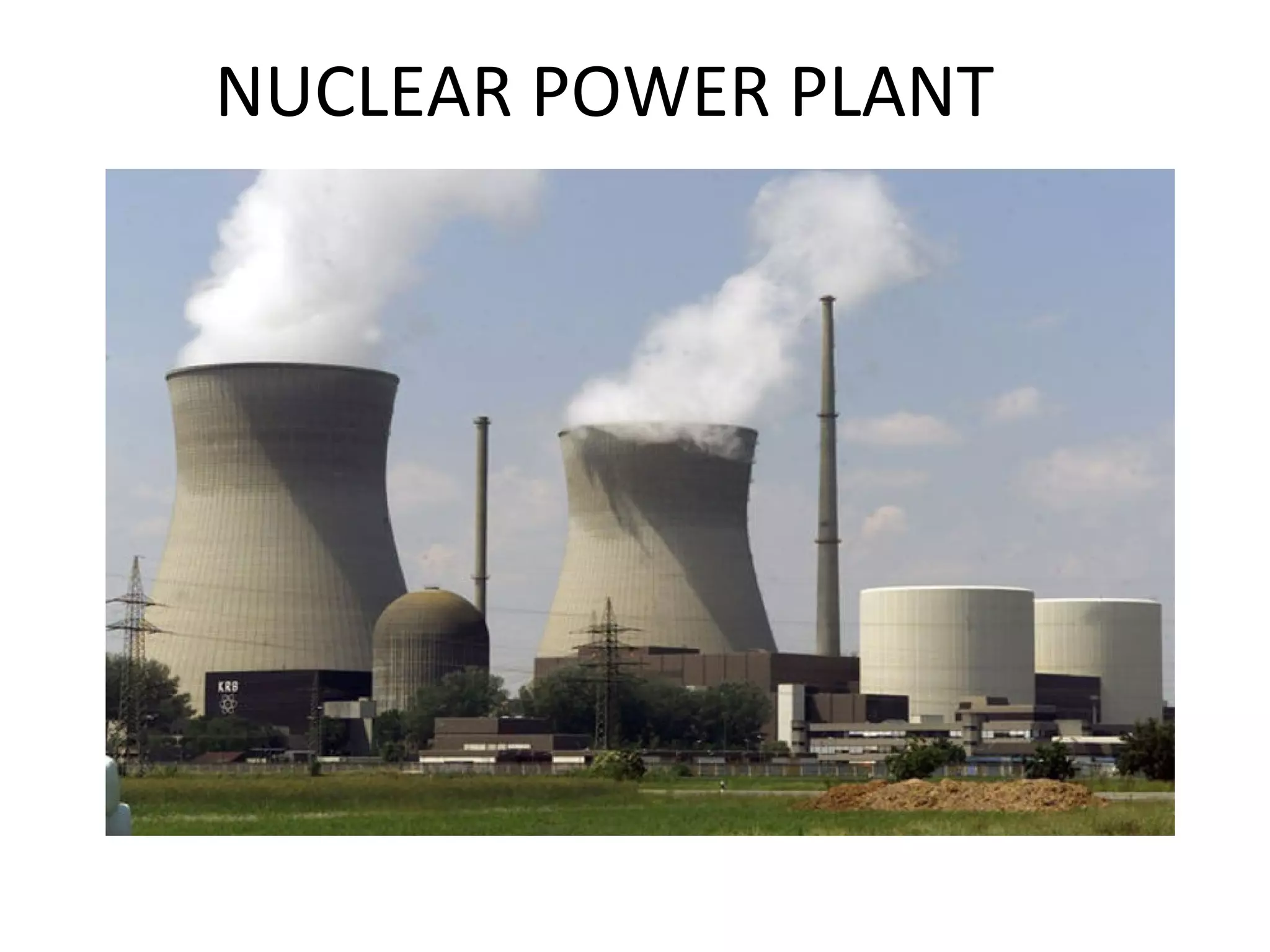
NUCLEAR POWER PLANT
NUCLEAR POWER PLANT 
A nuclear power plant (NPP) is a thermal power 
station in which the heat source is one or more nuclear 
reactors. 
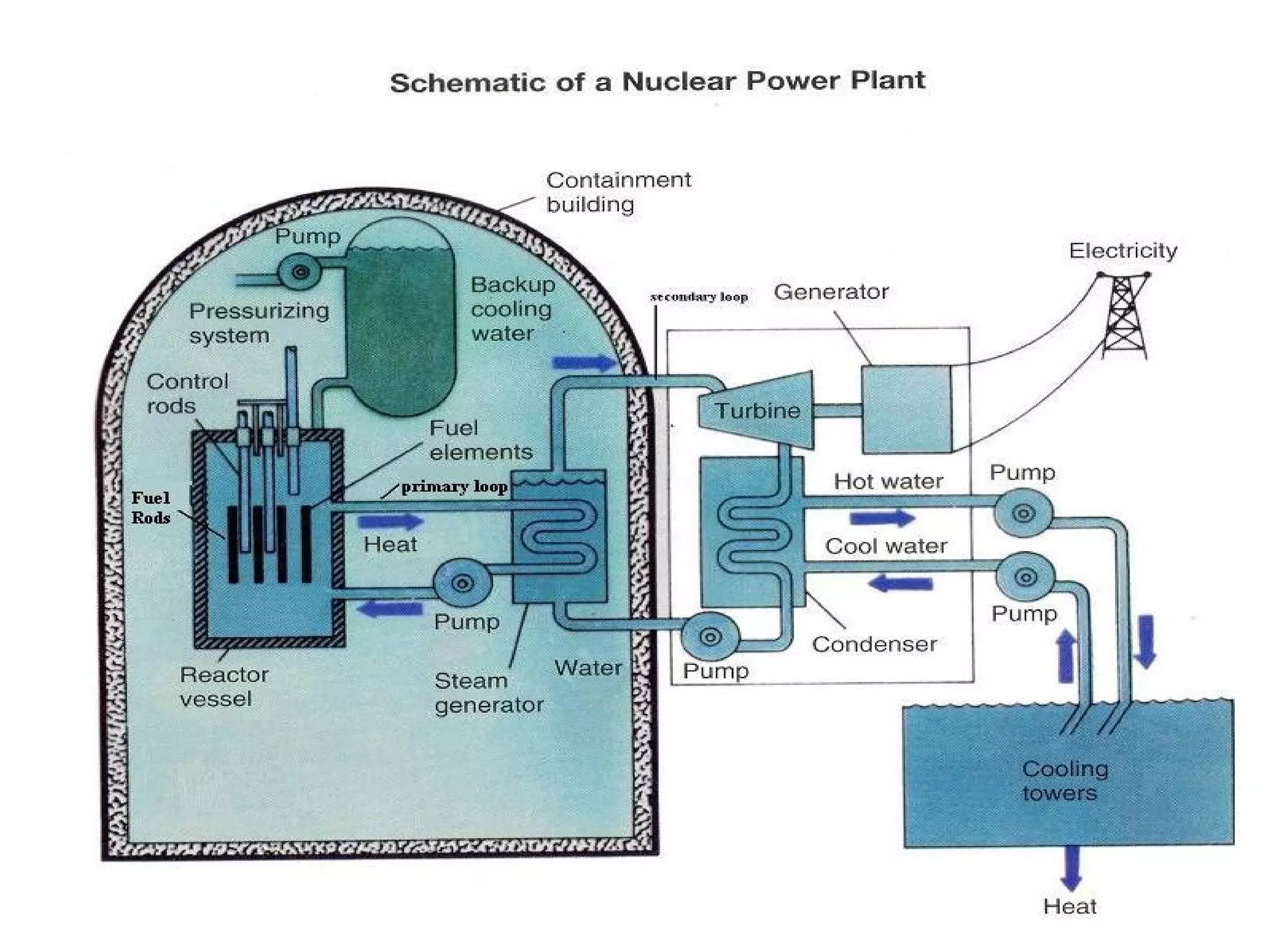
A nuclear reactor produces and controls the release of 
energy from splitting the atoms of certain elements. In 
a nuclear power reactor, the energy released is used as 
heat to make steam to generate electricity 
. The energy released from continuous fission of the 
atoms of the fuel is harnessed as heat in either a gas or 
water, and is used to produce steam. The steam is used 
to drive the turbines which produce electricity
How is energy released from the atom? 
Atoms of uranium are among the largest and also the heaviest 
known to occur on earth. Being heavy they are also unstable. The 
nucleus of a uranium atom can easily break up into two smaller 
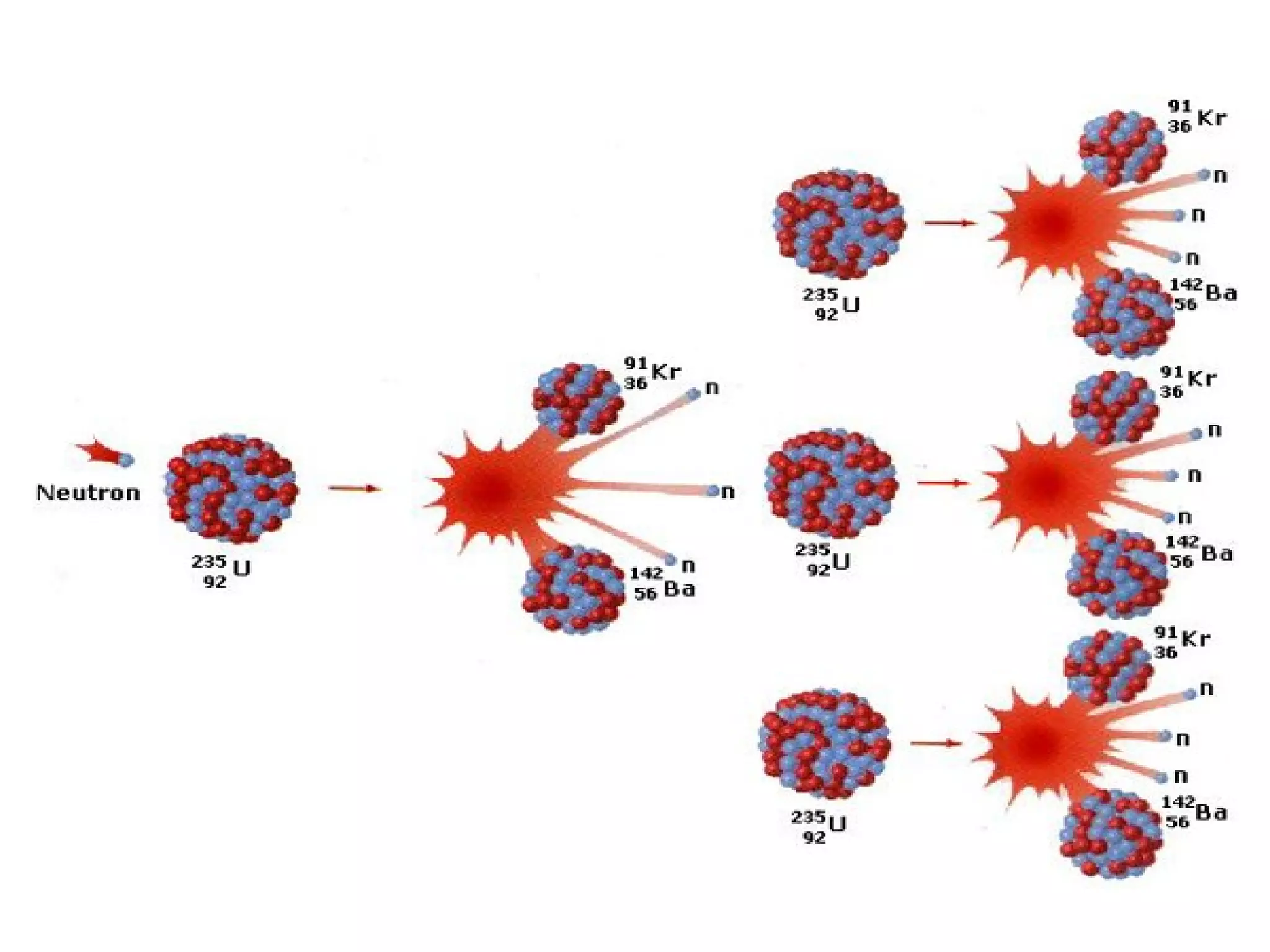
pieces. This process is called fission. The two fragments so produced 
fly apart with tremendous speed. As they collide with other atoms in 
a lump of uranium they come to a stop. In the process they heat up 
the uranium lump. This is how energy is released from the atom 
and converted to heat. The energy produced in fission is described 
as atomic energy by some and nuclear energy by others. Besides 
uranium, the atoms of plutonium are also fissionable. But plutonium 
does not occur in nature. 
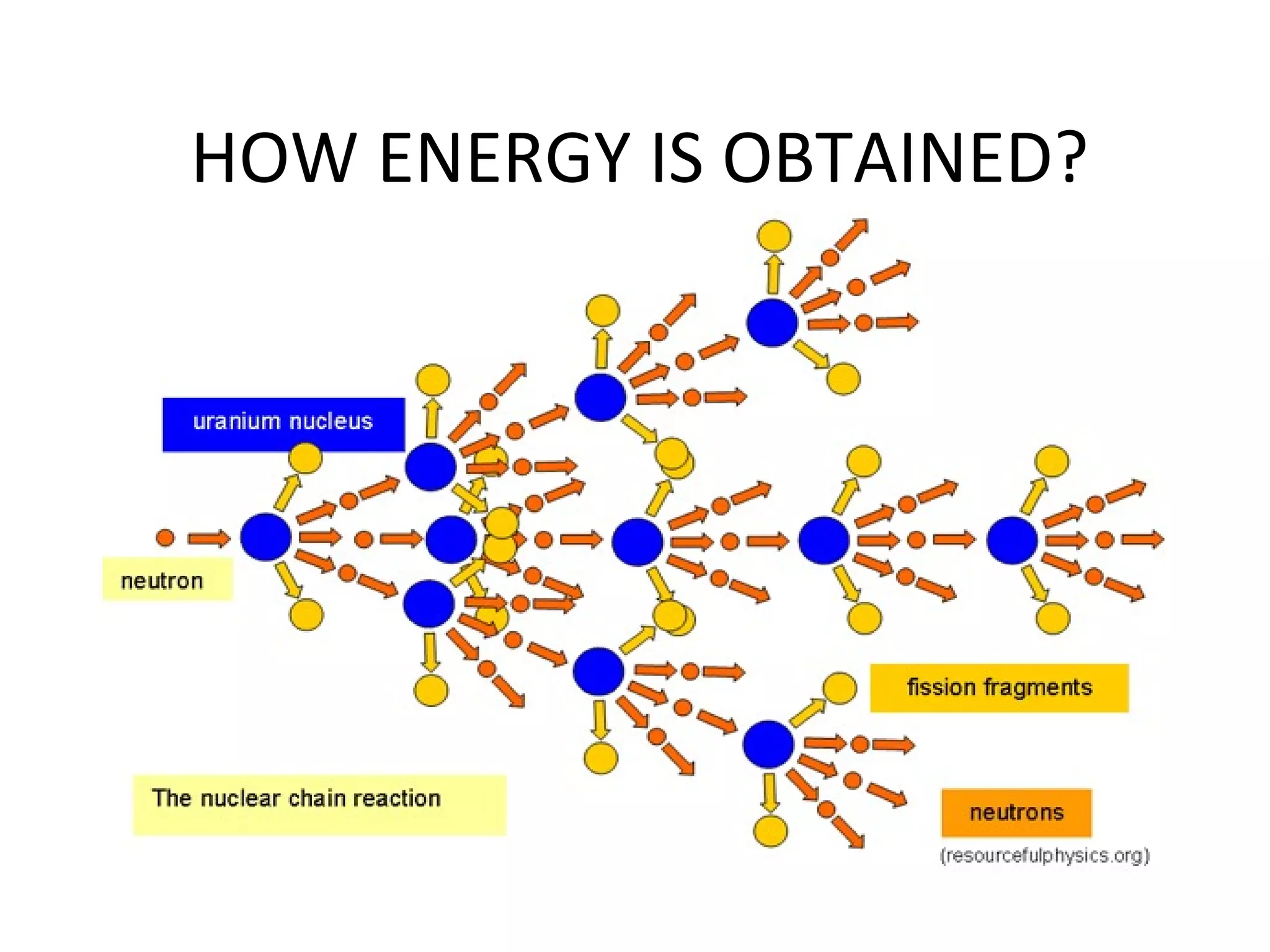
It has been found that 2 or 3 free neutrons are also released as a 
uranium atom breaks up during fission. When one of these neutrons 
collides with another uranium nucleus that nucleus also breaks up. 
In this manner using one neutron from every fission, we can cause 
another fission. This is known as chain reaction and produces heat 
at a steady rate.
HOW ENERGY IS OBTAINED?
COMPENENTS OF A NUCLEAR REACTOR 
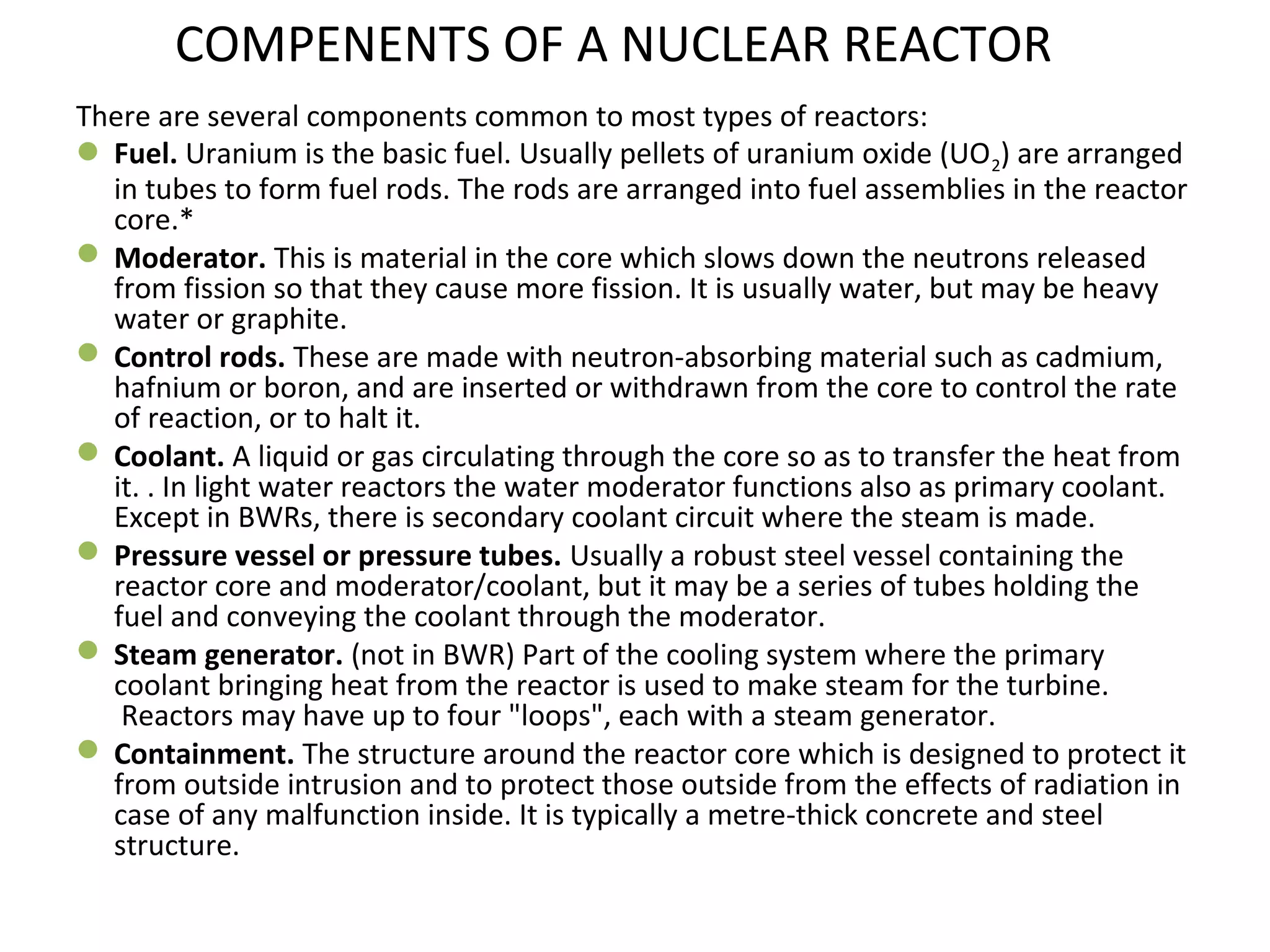
There are several components common to most types of reactors: 
Fuel. Uranium is the basic fuel. Usually pellets of uranium oxide (UO2) are arranged 
in tubes to form fuel rods. The rods are arranged into fuel assemblies in the reactor 
core.* 
Moderator. This is material in the core which slows down the neutrons released 
from fission so that they cause more fission. It is usually water, but may be heavy 
water or graphite. 
Control rods. These are made with neutron-absorbing material such as cadmium, 
hafnium or boron, and are inserted or withdrawn from the core to control the rate 
of reaction, or to halt it. 
Coolant. A liquid or gas circulating through the core so as to transfer the heat from 
it. . In light water reactors the water moderator functions also as primary coolant. 
Except in BWRs, there is secondary coolant circuit where the steam is made. 
Pressure vessel or pressure tubes. Usually a robust steel vessel containing the 
reactor core and moderator/coolant, but it may be a series of tubes holding the 
fuel and conveying the coolant through the moderator. 
Steam generator. (not in BWR) Part of the cooling system where the primary 
coolant bringing heat from the reactor is used to make steam for the turbine. 
Reactors may have up to four "loops", each with a steam generator. 
Containment. The structure around the reactor core which is designed to protect it 
from outside intrusion and to protect those outside from the effects of radiation in 
case of any malfunction inside. It is typically a metre-thick concrete and steel 
structure.
THERE ARE SEVERAL TYPES OF 
REACTORS 
Pressurised Water Reactor (PWR).Fuel-enriched 
UO2 
Boiling Water Reactor (BWR).Fuel-enriched 
UO2 
Pressurised Heavy Water Reactor 'CANDU' 
(PHWR).Fuel-natural UO2 
Gas-cooled Reactor (AGR & Magnox).Fuel-natural 
U (metal),enriched UO2
CHEMICAL CONVERSION TO UF6 
ENRICHMENT 
PELLETIZING 
ROD LOADING 
BUNDLE ASSEMBLY 
BUNDLE FINAL INSPECTION 
PACKAGING & SHIPPING 
SITE INSPECTION & CHANNELING
Uranium Ore (0.7%) 
Fuel Pellet (3.5%) 
ENRICHMENT 
(% U-235)
APPLICATIONS OF NUCLEAR POWER PLANT 
ITS BASIC APPLICATION IS IN GENERATING LARGE AMONT OF HEAT AND 
OBTAINING ELECTRICAL ENERGY. 
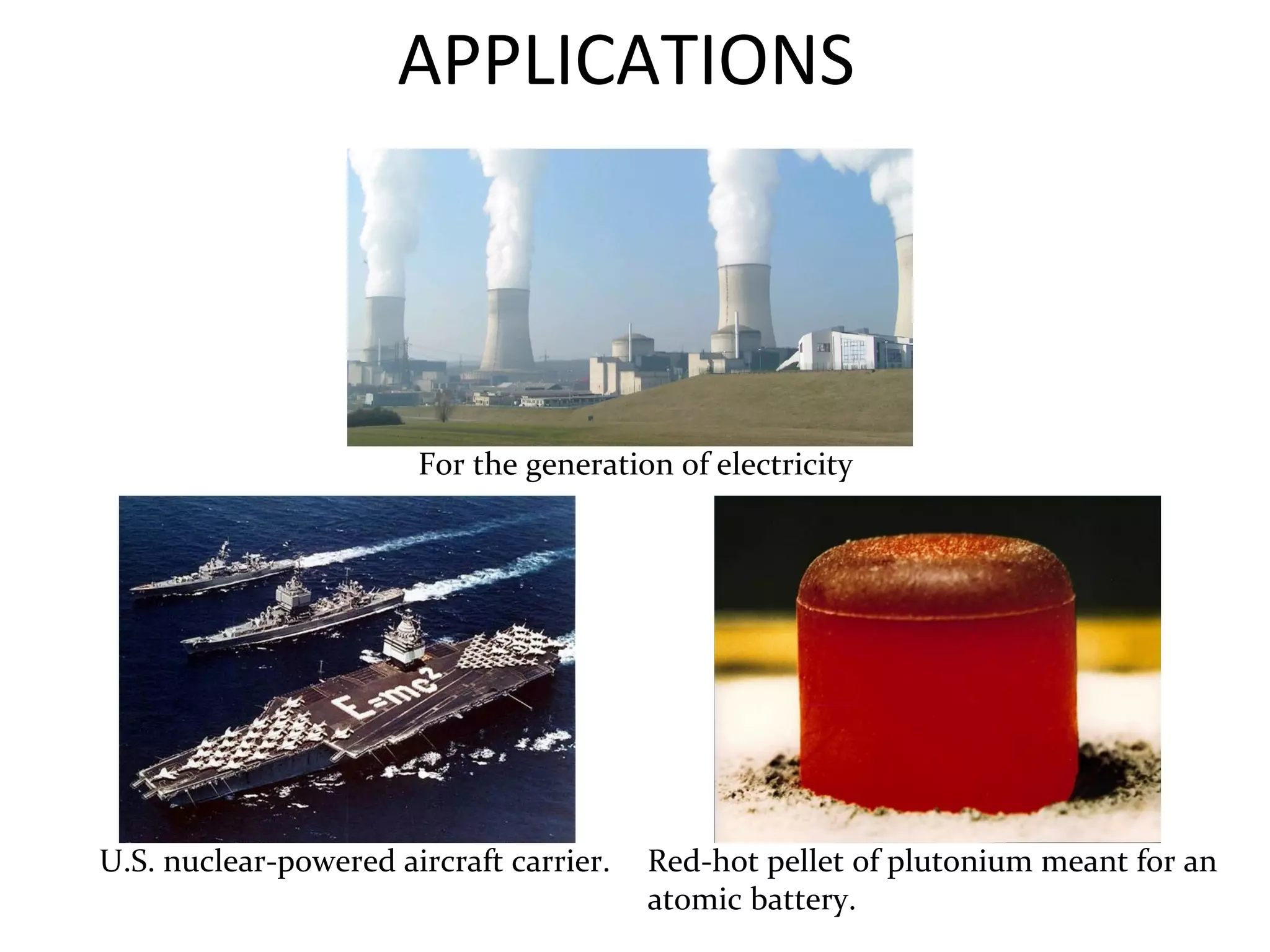
The most common use for a nuclear power plant is to generate electricity 
for civilian consumption. 
Nuclear reactors are also used on sea-going vessels, where they provide 
both electricity and mechanical power for propulsion. 
The process of creating fuel for and running nuclear power plants produces 
a number of useful by products, or can be tailored to do so. Enriching 
uranium for fission reactors, for example, creates an isotope commonly 
known as depleted uranium, which the American military uses in the 
manufacture of both armour and ammunition due to its extremely high 
density. Then there are breeder reactors, which produce new fissile material 
(usually plutonium) at a rate greater than that at which the reactor 
consumes them, thereby creating a second generation of fuel. This reactor 
design is useful for its high fuel economy.
APPLICATIONS 
For the generation of electricity 
U.S. nuclear-powered aircraft carrier. Red-hot pellet of plutonium meant for an 
atomic battery.
LOCATIONS IN WORLD AND INDIA 
In India we have nuclear power plant at 
Kaiga(880 MW) ,Kalpakkam(410 MW) 
,Kakrapar(44o MW) ,Rawatbhata(1180 MW) 
,Tarapur(1400 MW) ,Narora(440 MW).Some 
nuclear power plants which are under 
construction are Kundankulam(2000 MW) 
,Kaiga(220 MW) ,Kalpakkam(500 MW) 
,Rawatbhata(1400 MW).Some of the nuclear 
power plants have been planned for future.
ADVANTAGES OF NUCLEAR POWER PLANTS 
1. The amount of electricity produced in a nuclear power station is 
equivalent to that produced by a fossil fuelled power station. 
2. Nuclear power stations do not burn fossil fuels to produce 
electricity and consequently they do not produce damaging, polluting 
gases. 
3. Many developed countries such as the USA and the UK no longer 
want to rely on oil and gas imported from the Middle East, a 
politically unstable part of the world. 
4. Countries such as France produce approximately 90 percent of 
their electricity from nuclear power and lead the world in nuclear 
power generating technology - proving that nuclear power is an 
economic alternative to fossil fuel power stations. 
5. Nuclear reactors can be manufactured small enough to power ships 
and submarines. If this was extended beyond military vessels, the 
number of oil burning vessels would be reduced and consequently 
pollution
DISADVANTAGES OF NUCLEAR POWER PLANT 
1. Nuclear power is a controversial method of producing electricity. 
2. There have been serious accidents with a small number of nuclear 
power stations. The accident at Chernobyl (Ukraine) in 1986, led to 30 
people being killed and over 100,000 people being evacuated. In the 
preceding years another 200,00 people were resettled away from the 
radioactive area. Radiation was even detected over a thousand miles away 
in the UK as a result of the Chernobyl accident. It has been suggested that 
over time 2500 people died as a result of the accident. 
3. There are serious questions to be answered regarding the storage of 
radioactive waste produced through the use of nuclear power. Some of 
the waste remains radioactive (dangerous) for thousands of years and is 
currently stored in places such as deep caves and mines. 
4. Storing and monitoring the radioactive waste material for thousands of 
years has a high cost. 
5. Nuclear powered ships and submarines pose a danger to marine life and 
the environment. Old vessels can leak radiation if they are not maintained 
properly or if they are dismantled carelessly at the end of their working 
lives.
HYDRO ELECTRIC POWER PLANT
WHAT IS HYDRO POWER? 
The objective of a hydropower scheme is to convert the 
potential energy of a mass of water, flowing in a stream with a 
certain fall to the turbine (termed the "head"), into electric 
energy at the lower end of the scheme, where the powerhouse 
is located. The power output from the scheme is proportional 
to the flow and to the head.
TYPES OOFF HHYYDDRROO PPOOWWEERR PPLLAANNTT 
11)) WWaatteerr wwhheeeellss 
22)) HHyyddrroo ppoowweerr ppllaannttss 
33)) WWaavvee eenneerrggyy ffrroomm oocceeaannss 
44)) TTiiddaall eenneerrggyy 
BBaasseedd oonn tthhee HHeeaadd ooff WWaatteerr AAvvaaiillaabbllee 
11)) LLooww hheeaadd hhyyddrrooeelleeccttrriicc ppoowweerr ppllaannttss 
22))MMeeddiiuumm hheeaadd hhyyddrrooeelleeccttrriicc ppoowweerr ppllaannttss 
33)) HHiigghh hheeaadd hhyyddrrooeelleeccttrriicc ppoowweerr ppllaannttss
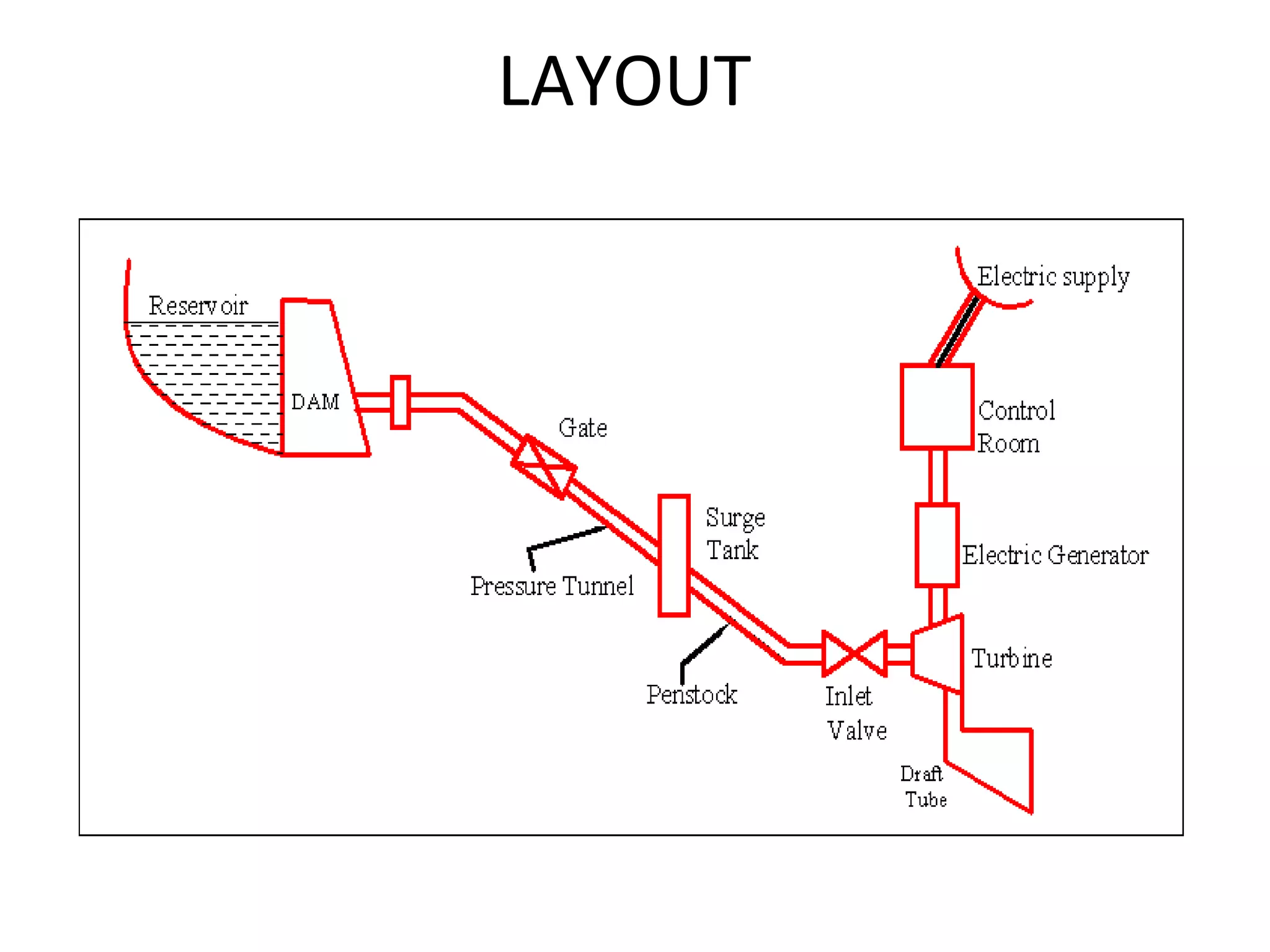
LAYOUT
ELEMENTS OF 
HYDRO POWER
DAMS
The movement of water can be used to make electricity. Energy from 
water is created by the force of water moving from a higher elevation 
to a lower elevation through a large pipe (penstock). When the water 
reaches the end of the pipe, it hits and spins a water wheel or turbine. 
The turbine rotates the connected shaft, which then turns the 
generator, making electricity.
WWhhaatt aarree SSppiillll wwaayyss?? 
A dam failure can have sever effects downstream of the dam. 
During the lifetime of a dam different flow conditions will be experienced 
and a dam must be able to safely accommodate high floods that 
can exceed normal flow conditions in the river. For this reason, 
carefully passages are corporate in the dams as part of structure. 
These passages are known as spillways.
INTAKE
IINNTTAAKKEE::-- 
A water intake must be able to divert the required amount of 
water in to a power canal or into a penstock without producing 
a negative impact on the local environment.
PPEENNSSTTOOCCKK
PENSTOCK 
“conveying water from the intake to the power house”. 
The water in the reservoir is considered stored energy 
When the gate opens the water flowing through the 
penstock becomes kinetic energy because it is in motion.
SURGE TANK 
• Surge tank is introduced in between the 
power house and dam to avoid sudden rise 
in the penstock. 
• As the load is reduced then there will be a 
backflow of water inside the penstock. 
• The back flow of water is known as water 
hammer.
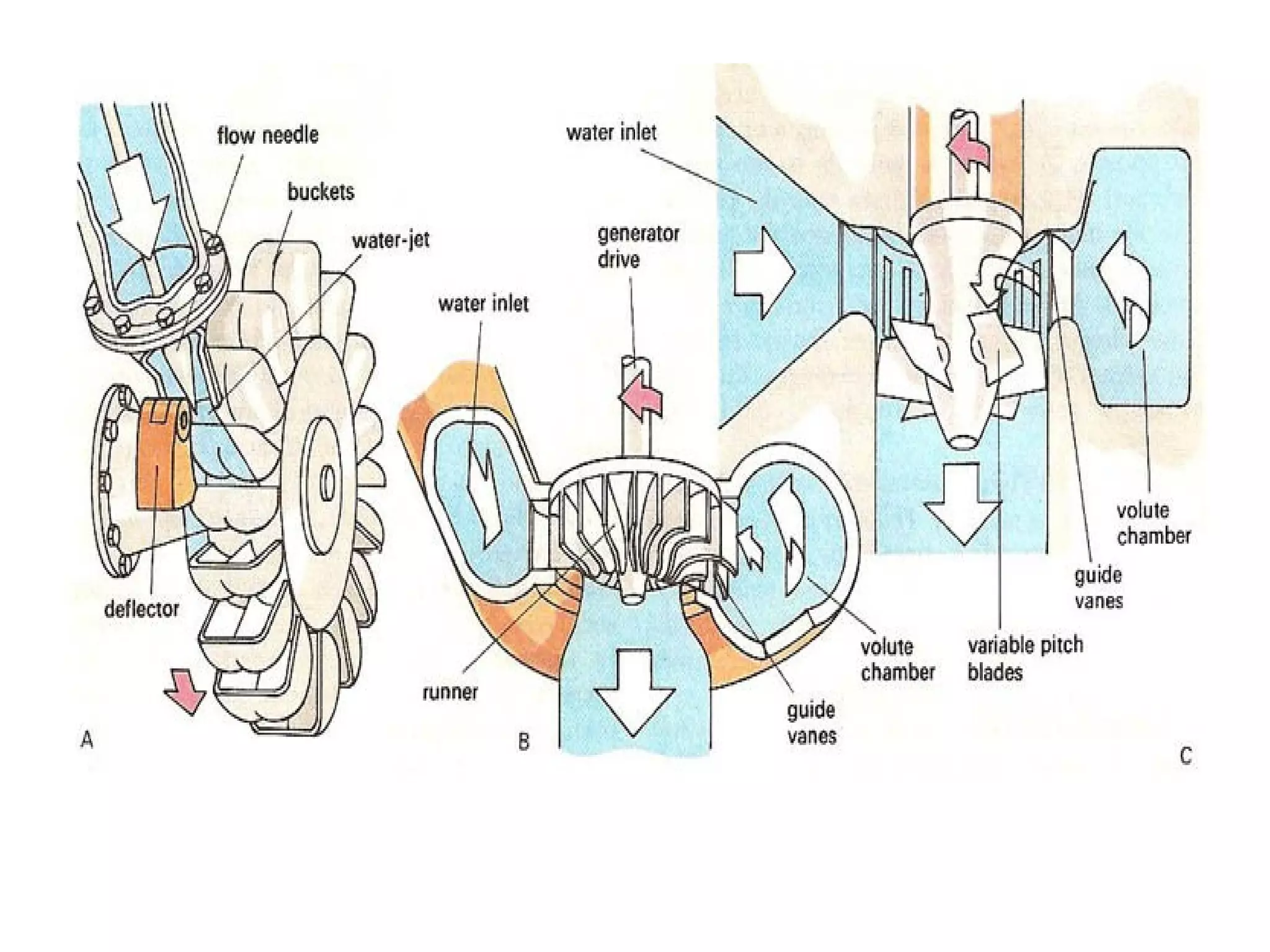
TURBINES
• Kaplan 
• Francis 
• Pelton 
2 < H < 40 
10 < H < 350 
50 < H < 1300 
(H = head in m)
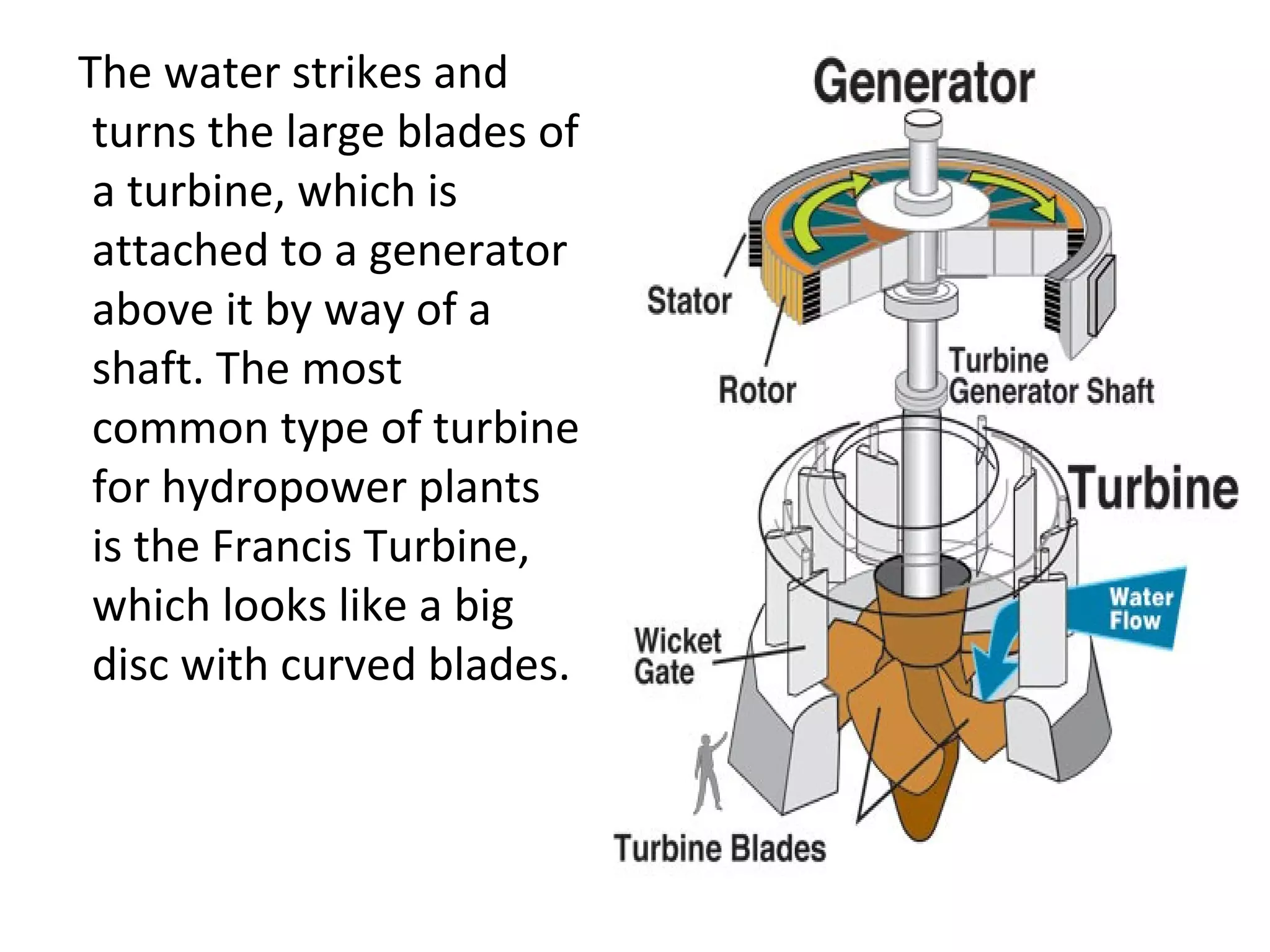
The water strikes and 
turns the large blades of 
a turbine, which is 
attached to a generator 
above it by way of a 
shaft. The most 
common type of turbine 
for hydropower plants 
is the Francis Turbine, 
which looks like a big 
disc with curved blades.
TTaaiillrraacceess::-- 
After passing through the turbine the water returns to the 
river trough a short canal called a tailrace.
GGEENNEERRAATTOORR
As the turbine turns, the exciter sends an electrical current 
to the rotor. The rotor is a series of large electromagnets 
that spins inside a tightly-wound coil of copper wire, called 
the stator. The magnetic field between the coil and the 
magnets creates an electric current.
TRANSFORMERS
A transformer is a device that transfers electrical energy 
from one circuit to another through a shared magnetic 
field. A changing current IP in the first circuit (the primary) 
creates a changing magnetic field; in turn, this magnetic 
field induces a voltage VS in the second circuit (the 
secondary). The secondary circuit mimics the primary 
circuit, but it need not carry the same current and voltage 
as the primary circuit. Instead, an ideal transformer keeps 
the product of the current and the voltage the same in the 
primary and secondary circuits.
OUTFLOW:- 
Used water is carried through pipelines, called tailraces, and re-enters 
the river downstream.
PPOOWWEERR HHOOUUSSEE::--
ADVANTAGES & DISADVANTAGES OF 
HYDRO POWER PLANT 
AAddvvaannttaaggeess 
1) No fuel required 
2) Cost of electricity is constant 
3) No air-pollution is created 
4) Long life 
5) Cost of generation of electricity 
6) Can easily work during high peak daily loads 
7) Irrigation of farms 
8) Water sports and gardens 
9) Prevents floods
DISADVANTAGES 
1) Disrupts the aquatic ecosystems 
2) Disruption in the surrounding areas 
3) Requires large areas 
4) Large scale human displacement 
5) Very high capital cost or investment 
6) High quality construction 
7) Site specific 
8) Effects on environment 
9) Safety of the dams
power1

power1

  • 1.
    WHAT IS ENERGY? • ENERGY IS THE ABILITY OR THE CAPACITY TO DO • WORK.THERE ARE DIFFERENT FORMS OF ENERGY. • EACH FORM OF ENERGY CAN BE CONVERTED INTO • ANOTHER FORM. • IN OTHER WORDS WE CAN SAY THAT ENERGY IS CONSERVABLE. • SOME EXAMPLES OF FORMS OF ENERGY ARE-POTENTIAL, THERMAL,ELECTRICAL,NUCLEAR,ETC.
  • 2.
    WHAT IS APOWER PLANT? A power plant is a source to harness energy. A power plant (also referred to as a generating station, power station, or powerhouse) is an industrial facility for the generation of electrical energy. At the centre of nearly all power plants is a generator, a rotating machine that converts mechanical energy into electrical energy by creating relative motion between a magnetic field and a conductor.  The energy source harnessed to turn the generator varies widely. It depends chiefly on which fuels are easily available and on the types of technology that the power company has access to.
  • 3.
    HOW DOES APOWER PLANT WORK? The heart of a power station is a large generator that extracts energy from a fuel. Some power stations burn fossil fuels such as coal, oil, or gas. Nuclear power stations produce energy by splitting apart atoms of heavy materials such as uranium and plutonium. The heat produced is used to turn water into steam at high pressure. This steam turns a windmill-like device called a turbine connected to an electricity generator. Extracting heat from a fuel takes place over a number of stages and some energy is wasted at each stage.
  • 4.
    TYPES OF POWERPLANT ON THE BASIS OF WORKING BY FUEL Fossil fuelled power plants ,Nuclear power plants ,Geothermal power plants ,Biomass fuelled power plants ,Integrated steel mills ,Waste heat from industrial processes ,solar thermal electric plants. BY PRIME MOVER Steam turbine plants ,Gas turbine plants ,Combined cycle plants ,Water treatment plant ,Waste gas from oil production.
  • 5.
  • 7.
    NUCLEAR POWER PLANT A nuclear power plant (NPP) is a thermal power station in which the heat source is one or more nuclear reactors. A nuclear reactor produces and controls the release of energy from splitting the atoms of certain elements. In a nuclear power reactor, the energy released is used as heat to make steam to generate electricity . The energy released from continuous fission of the atoms of the fuel is harnessed as heat in either a gas or water, and is used to produce steam. The steam is used to drive the turbines which produce electricity
  • 8.
    How is energyreleased from the atom? Atoms of uranium are among the largest and also the heaviest known to occur on earth. Being heavy they are also unstable. The nucleus of a uranium atom can easily break up into two smaller pieces. This process is called fission. The two fragments so produced fly apart with tremendous speed. As they collide with other atoms in a lump of uranium they come to a stop. In the process they heat up the uranium lump. This is how energy is released from the atom and converted to heat. The energy produced in fission is described as atomic energy by some and nuclear energy by others. Besides uranium, the atoms of plutonium are also fissionable. But plutonium does not occur in nature. It has been found that 2 or 3 free neutrons are also released as a uranium atom breaks up during fission. When one of these neutrons collides with another uranium nucleus that nucleus also breaks up. In this manner using one neutron from every fission, we can cause another fission. This is known as chain reaction and produces heat at a steady rate.
  • 9.
    HOW ENERGY ISOBTAINED?
  • 11.
    COMPENENTS OF ANUCLEAR REACTOR There are several components common to most types of reactors: Fuel. Uranium is the basic fuel. Usually pellets of uranium oxide (UO2) are arranged in tubes to form fuel rods. The rods are arranged into fuel assemblies in the reactor core.* Moderator. This is material in the core which slows down the neutrons released from fission so that they cause more fission. It is usually water, but may be heavy water or graphite. Control rods. These are made with neutron-absorbing material such as cadmium, hafnium or boron, and are inserted or withdrawn from the core to control the rate of reaction, or to halt it. Coolant. A liquid or gas circulating through the core so as to transfer the heat from it. . In light water reactors the water moderator functions also as primary coolant. Except in BWRs, there is secondary coolant circuit where the steam is made. Pressure vessel or pressure tubes. Usually a robust steel vessel containing the reactor core and moderator/coolant, but it may be a series of tubes holding the fuel and conveying the coolant through the moderator. Steam generator. (not in BWR) Part of the cooling system where the primary coolant bringing heat from the reactor is used to make steam for the turbine. Reactors may have up to four "loops", each with a steam generator. Containment. The structure around the reactor core which is designed to protect it from outside intrusion and to protect those outside from the effects of radiation in case of any malfunction inside. It is typically a metre-thick concrete and steel structure.
  • 12.
    THERE ARE SEVERALTYPES OF REACTORS Pressurised Water Reactor (PWR).Fuel-enriched UO2 Boiling Water Reactor (BWR).Fuel-enriched UO2 Pressurised Heavy Water Reactor 'CANDU' (PHWR).Fuel-natural UO2 Gas-cooled Reactor (AGR & Magnox).Fuel-natural U (metal),enriched UO2
  • 15.
    CHEMICAL CONVERSION TOUF6 ENRICHMENT PELLETIZING ROD LOADING BUNDLE ASSEMBLY BUNDLE FINAL INSPECTION PACKAGING & SHIPPING SITE INSPECTION & CHANNELING
  • 16.
    Uranium Ore (0.7%) Fuel Pellet (3.5%) ENRICHMENT (% U-235)
  • 17.
    APPLICATIONS OF NUCLEARPOWER PLANT ITS BASIC APPLICATION IS IN GENERATING LARGE AMONT OF HEAT AND OBTAINING ELECTRICAL ENERGY. The most common use for a nuclear power plant is to generate electricity for civilian consumption. Nuclear reactors are also used on sea-going vessels, where they provide both electricity and mechanical power for propulsion. The process of creating fuel for and running nuclear power plants produces a number of useful by products, or can be tailored to do so. Enriching uranium for fission reactors, for example, creates an isotope commonly known as depleted uranium, which the American military uses in the manufacture of both armour and ammunition due to its extremely high density. Then there are breeder reactors, which produce new fissile material (usually plutonium) at a rate greater than that at which the reactor consumes them, thereby creating a second generation of fuel. This reactor design is useful for its high fuel economy.
  • 18.
    APPLICATIONS For thegeneration of electricity U.S. nuclear-powered aircraft carrier. Red-hot pellet of plutonium meant for an atomic battery.
  • 19.
    LOCATIONS IN WORLDAND INDIA In India we have nuclear power plant at Kaiga(880 MW) ,Kalpakkam(410 MW) ,Kakrapar(44o MW) ,Rawatbhata(1180 MW) ,Tarapur(1400 MW) ,Narora(440 MW).Some nuclear power plants which are under construction are Kundankulam(2000 MW) ,Kaiga(220 MW) ,Kalpakkam(500 MW) ,Rawatbhata(1400 MW).Some of the nuclear power plants have been planned for future.
  • 20.
    ADVANTAGES OF NUCLEARPOWER PLANTS 1. The amount of electricity produced in a nuclear power station is equivalent to that produced by a fossil fuelled power station. 2. Nuclear power stations do not burn fossil fuels to produce electricity and consequently they do not produce damaging, polluting gases. 3. Many developed countries such as the USA and the UK no longer want to rely on oil and gas imported from the Middle East, a politically unstable part of the world. 4. Countries such as France produce approximately 90 percent of their electricity from nuclear power and lead the world in nuclear power generating technology - proving that nuclear power is an economic alternative to fossil fuel power stations. 5. Nuclear reactors can be manufactured small enough to power ships and submarines. If this was extended beyond military vessels, the number of oil burning vessels would be reduced and consequently pollution
  • 21.
    DISADVANTAGES OF NUCLEARPOWER PLANT 1. Nuclear power is a controversial method of producing electricity. 2. There have been serious accidents with a small number of nuclear power stations. The accident at Chernobyl (Ukraine) in 1986, led to 30 people being killed and over 100,000 people being evacuated. In the preceding years another 200,00 people were resettled away from the radioactive area. Radiation was even detected over a thousand miles away in the UK as a result of the Chernobyl accident. It has been suggested that over time 2500 people died as a result of the accident. 3. There are serious questions to be answered regarding the storage of radioactive waste produced through the use of nuclear power. Some of the waste remains radioactive (dangerous) for thousands of years and is currently stored in places such as deep caves and mines. 4. Storing and monitoring the radioactive waste material for thousands of years has a high cost. 5. Nuclear powered ships and submarines pose a danger to marine life and the environment. Old vessels can leak radiation if they are not maintained properly or if they are dismantled carelessly at the end of their working lives.
  • 22.
  • 23.
    WHAT IS HYDROPOWER? The objective of a hydropower scheme is to convert the potential energy of a mass of water, flowing in a stream with a certain fall to the turbine (termed the "head"), into electric energy at the lower end of the scheme, where the powerhouse is located. The power output from the scheme is proportional to the flow and to the head.
  • 24.
    TYPES OOFF HHYYDDRROOPPOOWWEERR PPLLAANNTT 11)) WWaatteerr wwhheeeellss 22)) HHyyddrroo ppoowweerr ppllaannttss 33)) WWaavvee eenneerrggyy ffrroomm oocceeaannss 44)) TTiiddaall eenneerrggyy BBaasseedd oonn tthhee HHeeaadd ooff WWaatteerr AAvvaaiillaabbllee 11)) LLooww hheeaadd hhyyddrrooeelleeccttrriicc ppoowweerr ppllaannttss 22))MMeeddiiuumm hheeaadd hhyyddrrooeelleeccttrriicc ppoowweerr ppllaannttss 33)) HHiigghh hheeaadd hhyyddrrooeelleeccttrriicc ppoowweerr ppllaannttss
  • 25.
  • 26.
  • 27.
  • 28.
    The movement ofwater can be used to make electricity. Energy from water is created by the force of water moving from a higher elevation to a lower elevation through a large pipe (penstock). When the water reaches the end of the pipe, it hits and spins a water wheel or turbine. The turbine rotates the connected shaft, which then turns the generator, making electricity.
  • 30.
    WWhhaatt aarree SSppiillllwwaayyss?? A dam failure can have sever effects downstream of the dam. During the lifetime of a dam different flow conditions will be experienced and a dam must be able to safely accommodate high floods that can exceed normal flow conditions in the river. For this reason, carefully passages are corporate in the dams as part of structure. These passages are known as spillways.
  • 31.
  • 32.
    IINNTTAAKKEE::-- A waterintake must be able to divert the required amount of water in to a power canal or into a penstock without producing a negative impact on the local environment.
  • 33.
  • 34.
    PENSTOCK “conveying waterfrom the intake to the power house”. The water in the reservoir is considered stored energy When the gate opens the water flowing through the penstock becomes kinetic energy because it is in motion.
  • 35.
    SURGE TANK •Surge tank is introduced in between the power house and dam to avoid sudden rise in the penstock. • As the load is reduced then there will be a backflow of water inside the penstock. • The back flow of water is known as water hammer.
  • 37.
  • 39.
    • Kaplan •Francis • Pelton 2 < H < 40 10 < H < 350 50 < H < 1300 (H = head in m)
  • 40.
    The water strikesand turns the large blades of a turbine, which is attached to a generator above it by way of a shaft. The most common type of turbine for hydropower plants is the Francis Turbine, which looks like a big disc with curved blades.
  • 41.
    TTaaiillrraacceess::-- After passingthrough the turbine the water returns to the river trough a short canal called a tailrace.
  • 42.
  • 43.
    As the turbineturns, the exciter sends an electrical current to the rotor. The rotor is a series of large electromagnets that spins inside a tightly-wound coil of copper wire, called the stator. The magnetic field between the coil and the magnets creates an electric current.
  • 44.
  • 45.
    A transformer isa device that transfers electrical energy from one circuit to another through a shared magnetic field. A changing current IP in the first circuit (the primary) creates a changing magnetic field; in turn, this magnetic field induces a voltage VS in the second circuit (the secondary). The secondary circuit mimics the primary circuit, but it need not carry the same current and voltage as the primary circuit. Instead, an ideal transformer keeps the product of the current and the voltage the same in the primary and secondary circuits.
  • 46.
    OUTFLOW:- Used wateris carried through pipelines, called tailraces, and re-enters the river downstream.
  • 47.
  • 48.
    ADVANTAGES & DISADVANTAGESOF HYDRO POWER PLANT AAddvvaannttaaggeess 1) No fuel required 2) Cost of electricity is constant 3) No air-pollution is created 4) Long life 5) Cost of generation of electricity 6) Can easily work during high peak daily loads 7) Irrigation of farms 8) Water sports and gardens 9) Prevents floods
  • 49.
    DISADVANTAGES 1) Disruptsthe aquatic ecosystems 2) Disruption in the surrounding areas 3) Requires large areas 4) Large scale human displacement 5) Very high capital cost or investment 6) High quality construction 7) Site specific 8) Effects on environment 9) Safety of the dams