   Electricity was generated for the first time ever
    by a nuclear reactor on December 20, 1951 at
    the EBR-I experimental station near Arco,
    Idaho in the United States.

   On June 27, 1954, the world's first nuclear
    power plant to generate electricity for a power
    grid started operations at Obninsk, USSR.

   The world's first commercial scale power
    station, Calder Hall in England opened
    in October 17, 1956.
   Tarapur Atomic Power Station (T.A.P.S.) was the
    first nuclear power plant in India. The
    construction of the plant was started in 1962 and
    the plant went operational in 1969.

   The 320 MW Tarapur nuclear power station
    housed two 160 MW boiling water reactors
    (BWRs), the first in Asia.

   The Tarapur Plant was originally constructed
    by the American companies Bechtel and GE,
    under a 1963 123 Agreement between India,
    the United States, and the IAEA. The
    Tarapur Atomic Power Station is under the
    control of Nuclear Power Corporation of India
    Limited.
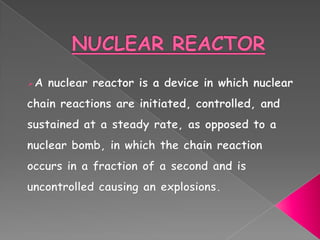
   A chain reaction refers to a process in which
    neutrons released in fission produce an
    additional fission in at least one further
    nucleus. This nucleus in turn produces
    neutrons, and the process repeats. If the
    process is controlled it is used for nuclear
    power or if uncontrolled it is used for nuclear
    weapons
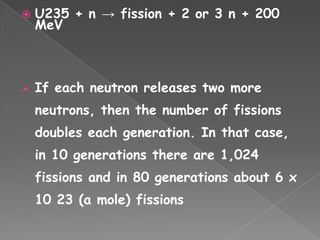
   U235 + n → fission + 2 or 3 n + 200
    MeV


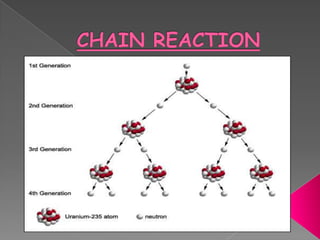
   If each neutron releases two more
    neutrons, then the number of fissions
    doubles each generation. In that case,
    in 10 generations there are 1,024
    fissions and in 80 generations about 6 x
    10 23 (a mole) fissions
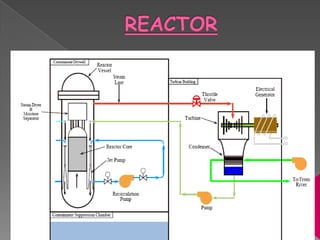
   A steam turbine is a mechanical device that
    extracts thermal energy from pressurized
    steam, and converts it into useful mechanical


   Various high-performance alloys and super
    alloys have been used for steam generator
    tubing.
   Steam coming out of the turbine, flows
    through the condenser for condensation
    and recirculated for the next cycle of
    operation.

   The feed pump circulates the condensed
    water in the working fluid loop.
   Condenser is a device or unit which is used
    to condense vapor into liquid.
   The objective of the condenser are to reduce
    the turbine exhaust pressure to increase the
    efficiency and to recover high quality feed
    water in the form of condensate & feed back
    it to the steam generator without any further
    treatment.
   Cooling towers are heat removal devices
    used to transfer process waste heat to the
    atmosphere.

   Water circulating through the condenser is
    taken to the cooling tower for cooling and
    reuse
   Nuclear power generation does emit relatively low
    amounts of carbon dioxide (CO₂). The emissions of
    green house gases and therefore the contribution
    of nuclear power plants to global warming is
    therefore relatively little.

   This technology is readily available, it does not
    have to be developed first.

   It is possible to generate a high amount of
   The problem of radioactive waste is still an unsolved
    one.
   High risks: It is technically impossible to build a
    plant with 100% security.
   The energy source for nuclear energy is Uranium.
    Uranium is a scarce resource, its supply is
    estimated to last only for the next 30 to 60 years
    depending on the actual demand.
   Nuclear power plants as well as nuclear waste
    could be preferred targets for terrorist
    attacks.


   During the operation of nuclear power plants,
    radioactive waste is produced, which in turn
    can be used for the production of nuclear
    weapons
   Nuclear power is the fourth-largest source
    of electricity in India after thermal, hydroele
    ctric and renewable sources of electricity.

   As of 2010, India has 20 nuclear reactors in
    operation in six nuclear power plants,
    generating 4,780 MW while five other plants
    are under construction and are expected to
    generate an additional 2,720 MW.
   India's nuclear power industry is
    undergoing rapid expansion with plans to
    increase nuclear power output to
    64,000 MW by 2032. The country is
    involved in the development of nuclear
    fusion reactors through its participation
    in the ITER project and is a global
    leader in the development of thorium-
    based fast breeder reactors.

Nuclear power plant

Nuclear power plant

  • 2.
    Electricity was generated for the first time ever by a nuclear reactor on December 20, 1951 at the EBR-I experimental station near Arco, Idaho in the United States.  On June 27, 1954, the world's first nuclear power plant to generate electricity for a power grid started operations at Obninsk, USSR.  The world's first commercial scale power station, Calder Hall in England opened in October 17, 1956.
  • 3.
    Tarapur Atomic Power Station (T.A.P.S.) was the first nuclear power plant in India. The construction of the plant was started in 1962 and the plant went operational in 1969.  The 320 MW Tarapur nuclear power station housed two 160 MW boiling water reactors (BWRs), the first in Asia.  The Tarapur Plant was originally constructed by the American companies Bechtel and GE, under a 1963 123 Agreement between India, the United States, and the IAEA. The Tarapur Atomic Power Station is under the control of Nuclear Power Corporation of India Limited.
  • 6.
    A chain reaction refers to a process in which neutrons released in fission produce an additional fission in at least one further nucleus. This nucleus in turn produces neutrons, and the process repeats. If the process is controlled it is used for nuclear power or if uncontrolled it is used for nuclear weapons
  • 8.
    U235 + n → fission + 2 or 3 n + 200 MeV  If each neutron releases two more neutrons, then the number of fissions doubles each generation. In that case, in 10 generations there are 1,024 fissions and in 80 generations about 6 x 10 23 (a mole) fissions
  • 13.
    A steam turbine is a mechanical device that extracts thermal energy from pressurized steam, and converts it into useful mechanical  Various high-performance alloys and super alloys have been used for steam generator tubing.
  • 15.
    Steam coming out of the turbine, flows through the condenser for condensation and recirculated for the next cycle of operation.  The feed pump circulates the condensed water in the working fluid loop.
  • 16.
    Condenser is a device or unit which is used to condense vapor into liquid.  The objective of the condenser are to reduce the turbine exhaust pressure to increase the efficiency and to recover high quality feed water in the form of condensate & feed back it to the steam generator without any further treatment.
  • 17.
    Cooling towers are heat removal devices used to transfer process waste heat to the atmosphere.  Water circulating through the condenser is taken to the cooling tower for cooling and reuse
  • 18.
    Nuclear power generation does emit relatively low amounts of carbon dioxide (CO₂). The emissions of green house gases and therefore the contribution of nuclear power plants to global warming is therefore relatively little.  This technology is readily available, it does not have to be developed first.  It is possible to generate a high amount of
  • 19.
    The problem of radioactive waste is still an unsolved one.  High risks: It is technically impossible to build a plant with 100% security.  The energy source for nuclear energy is Uranium. Uranium is a scarce resource, its supply is estimated to last only for the next 30 to 60 years depending on the actual demand.
  • 20.
    Nuclear power plants as well as nuclear waste could be preferred targets for terrorist attacks.  During the operation of nuclear power plants, radioactive waste is produced, which in turn can be used for the production of nuclear weapons
  • 21.
    Nuclear power is the fourth-largest source of electricity in India after thermal, hydroele ctric and renewable sources of electricity.  As of 2010, India has 20 nuclear reactors in operation in six nuclear power plants, generating 4,780 MW while five other plants are under construction and are expected to generate an additional 2,720 MW.
  • 22.
    India's nuclear power industry is undergoing rapid expansion with plans to increase nuclear power output to 64,000 MW by 2032. The country is involved in the development of nuclear fusion reactors through its participation in the ITER project and is a global leader in the development of thorium- based fast breeder reactors. 