9/6/2015
1
 What is ATOMIC ENERGY?
 Nuclear fission
 Nuclear fusion
 How this reactions are carried out ?
 Types of reactors:
 Common components of nuclear reactor
 Advantages and disadvantages of nuclear power
 References
9/6/2015 2
Outline History of Nuclear Energy
 The science of atomic radiation, atomic change and
nuclear fission was developed from 1895 to 1945,
much of it in the last six of those years.
 Over 1939-45, most development was focused on the
atomic bomb.
 From 1945 attention was given to harnessing this
energy in a controlled fashion for naval propulsion and
for making electricity.
 Since 1956 the prime focus has been on the
technological evolution of reliable nuclear power
plants.
 Uranium was discovered in 1789 by Martin Klaproth, a
German chemist.
9/6/2015 3
 Ernest Rutherford ,James Chadwick , Fermi, done many
experiments on radioactive metals.
 At the end of 1938 Otto Hahn and Fritz Strassmann in
Berlin showed that the new lighter elements were barium
and others which were about half the mass of uranium,
thereby demonstrating that atomic fission had occurred.
 Hahn and Strassmann showed that fission not only
released a lot of energy but that it also released additional
neutrons which could cause fission in other uranium nuclei
and possibly a self-sustaining chain reaction leading to an
enormous release of energy. This suggestion was soon
confirmed experimentally by Joliot and his co-workers in
Paris.
9/6/2015 4
 The energy that is released through a nuclear reaction
or radioactive decay process. Of particular interest is the
process known as fission, which occurs in a nuclear
reactor and produces energy usually in the form of heat.
 In a nuclear power plant, this heat is used to boil water in
order to produce STEAM that can be used to drive
large turbines. This, in turn, activates generators to
produce electrical power.
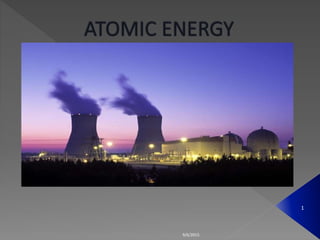
 Atomic energy is more correctly called nuclear energy.
9/6/2015 5
Nuclear Energy can be produced by two processes,
1. Nuclear fission
2. Nuclear fusion
9/6/2015 6
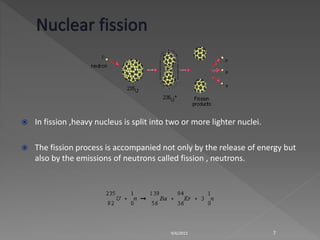
 In fission ,heavy nucleus is split into two or more lighter nuclei.
 The fission process is accompanied not only by the release of energy but
also by the emissions of neutrons called fission , neutrons.
9/6/2015 7
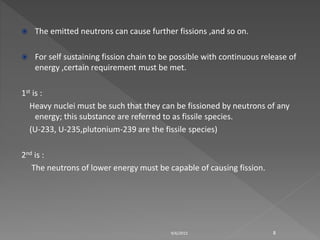
 The emitted neutrons can cause further fissions ,and so on.
 For self sustaining fission chain to be possible with continuous release of
energy ,certain requirement must be met.
1st is :
Heavy nuclei must be such that they can be fissioned by neutrons of any
energy; this substance are referred to as fissile species.
(U-233, U-235,plutonium-239 are the fissile species)
2nd is :
The neutrons of lower energy must be capable of causing fission.
9/6/2015 8
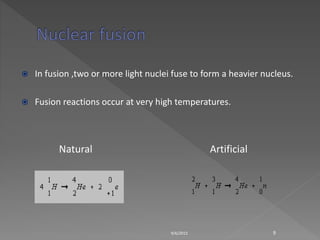
 In fusion ,two or more light nuclei fuse to form a heavier nucleus.
 Fusion reactions occur at very high temperatures.
Natural Artificial
9/6/2015 9
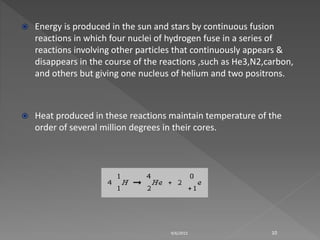
 Energy is produced in the sun and stars by continuous fusion
reactions in which four nuclei of hydrogen fuse in a series of
reactions involving other particles that continuously appears &
disappears in the course of the reactions ,such as He3,N2,carbon,
and others but giving one nucleus of helium and two positrons.
 Heat produced in these reactions maintain temperature of the
order of several million degrees in their cores.
9/6/2015 10
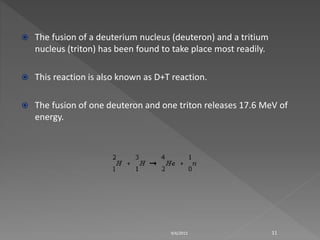
 The fusion of a deuterium nucleus (deuteron) and a tritium
nucleus (triton) has been found to take place most readily.
 This reaction is also known as D+T reaction.
 The fusion of one deuteron and one triton releases 17.6 MeV of
energy.
9/6/2015 11
 Nuclear chain reactions are carried out in closed structure called
nuclear reactor in which fissile material is made to undergo a
controlled self sustaining nuclear reaction with the consequent
release of energy.
 A nuclear reactor is a system that contains and controls sustained
nuclear chain reactions.
 Reactors are used for generating electricity, moving submarines
and air-craft carriers, producing medical isotopes for imaging and
cancer treatment, and for conducting research.
9/6/2015 12
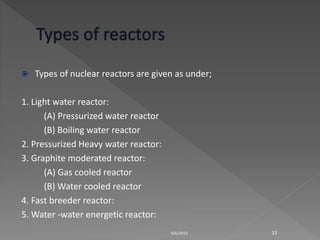
 Types of nuclear reactors are given as under;
1. Light water reactor:
(A) Pressurized water reactor
(B) Boiling water reactor
2. Pressurized Heavy water reactor:
3. Graphite moderated reactor:
(A) Gas cooled reactor
(B) Water cooled reactor
4. Fast breeder reactor:
5. Water -water energetic reactor:
9/6/2015 13
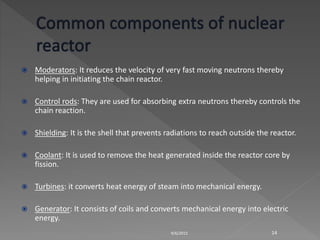
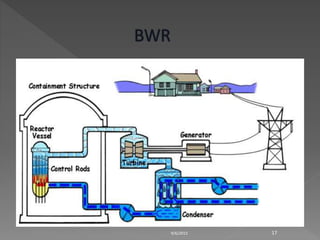
 Moderators: It reduces the velocity of very fast moving neutrons thereby
helping in initiating the chain reactor.
 Control rods: They are used for absorbing extra neutrons thereby controls the
chain reaction.
 Shielding: It is the shell that prevents radiations to reach outside the reactor.
 Coolant: It is used to remove the heat generated inside the reactor core by
fission.
 Turbines: it converts heat energy of steam into mechanical energy.
 Generator: It consists of coils and converts mechanical energy into electric
energy.
9/6/2015 14
9/6/2015 15
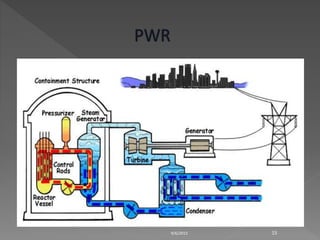
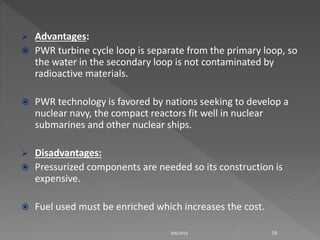
 Advantages:
 PWR turbine cycle loop is separate from the primary loop, so
the water in the secondary loop is not contaminated by
radioactive materials.
 PWR technology is favored by nations seeking to develop a
nuclear navy, the compact reactors fit well in nuclear
submarines and other nuclear ships.
 Disadvantages:
 Pressurized components are needed so its construction is
expensive.
 Fuel used must be enriched which increases the cost.
9/6/2015 16
9/6/2015 17
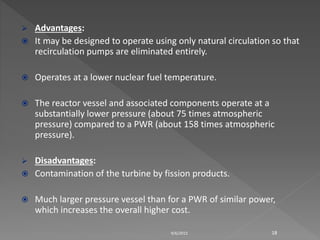
 Advantages:
 It may be designed to operate using only natural circulation so that
recirculation pumps are eliminated entirely.
 Operates at a lower nuclear fuel temperature.
 The reactor vessel and associated components operate at a
substantially lower pressure (about 75 times atmospheric
pressure) compared to a PWR (about 158 times atmospheric
pressure).
 Disadvantages:
 Contamination of the turbine by fission products.
 Much larger pressure vessel than for a PWR of similar power,
which increases the overall higher cost.
9/6/2015 18
9/6/2015 19
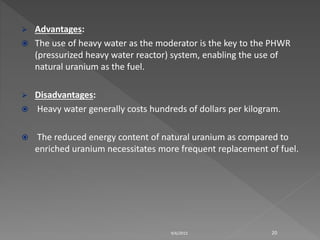
 Advantages:
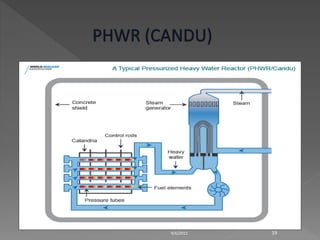
 The use of heavy water as the moderator is the key to the PHWR
(pressurized heavy water reactor) system, enabling the use of
natural uranium as the fuel.
 Disadvantages:
 Heavy water generally costs hundreds of dollars per kilogram.
 The reduced energy content of natural uranium as compared to
enriched uranium necessitates more frequent replacement of fuel.
9/6/2015 20
9/6/2015 21
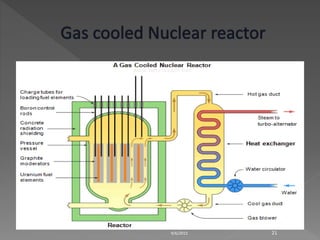
 Advantages:
The advantage of the design is that the coolant can be heated to higher
temperatures than water. As a result, higher plant efficiency (40% or
more) could be obtained compared to the water cooled design (33
34%).
The gases are less prone to react chemically with the structural material
of the reactor unlike water which has higher affinity for chemical
reactions with these elements.
 Disadvantages:
 Higher pumping power compared to liquid coolants.
 Need to maintain high pressure in the system, typically around 7 MPa
for helium systems, to approximately 25 MPa for supercritical CO2.
9/6/2015 22
9/6/2015 23
9/6/2015 24
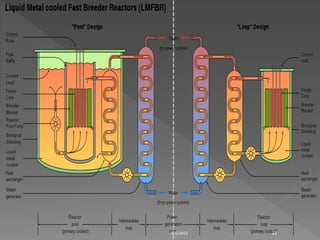
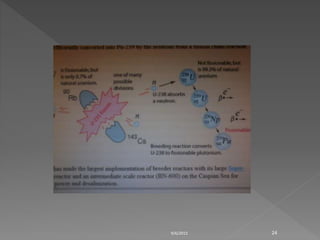
 Advantages:
Need not to be pressurized.
A breeder reactor creates 30% more fuel than it consumes.
Working temperature of liquid metals are higher.(Sodium is a solid at room
temperature but liquifies at 98°C. It has a wide working temperature since it
does not boil until 892°C)
Liquid metal cooled reactors were first adapted for nuclear submarine
Because the metal coolants have much higher density than the water & they
remove heat more rapidly and allow much higher power density.
9/6/2015 25
Disadvantages:
It requires liquified sodium or potassium metal as a coolant, as water would
slow down the neutrons. These metals can cause a mishap, as they react
violently when exposed to water or air.
The construction and operation is very costly. Between $4 to $8 billion is
required in the construction alone.
The by-products formed during the fission of plutonium have to be removed
by reprocessing, as they slow down the neutrons and reduce efficiency.
However, this step of reprocessing produces a very pure strain of plutonium,
which is ideal for use in nuclear weapons.
They also work at a very high temperature
Till date, not a single breeder reactor has been economically feasible. Every
year, billions of dollars worldwide are spent for the safe storage of the
plutonium produced, which is then useless, as few reactors use it as fuel.9/6/2015 26
 Water-Water Power Reactor is a “series of pressurised water
reactor” designs originally developed in the Russia, by OKB
Gidropress.
 Power output ranges from 300 to 1700 Mwe (Megawatt
electric) with the latest Russian development of the design.
 Fuel assemblies for these are characterized by their hexagonal
arrangement, but are otherwise of similar length and structure to
other PWR fuel assemblies.
9/6/2015 27
 Nuclear power generation does not emit carbon dioxide (CO2) and smoke
particles. The emissions of green house gases and therefore the
contribution of nuclear power plants to global warming is therefore
relatively little.
 This technology is readily available.
 It is possible to generate a high amount of electrical energy in one single
plant.
 Nuclear power is reliable. It does not depend on the weather.
9/6/2015 28
 The problem of radioactive waste. Disposal of nuclear waste is very
expensive.
 National risks so, Despite a generally high security standard, in
transportation etc.
 Nuclear power plants as well as nuclear waste could be preferred targets
for terrorist attacks.
 Heavy structure is required.
 Nuclear energy is not a renewable energy.
 Impact on Aquatic Life and Impact on human Life
9/6/2015 29
(Updated 8 August 2015)
 India has a flourishing and largely indigenous nuclear power program and
expects to have 14,600 MWe nuclear capacity on line by 2020 & aims to
supply 25% of electricity from nuclear power by 2050.
 Because India is outside the Nuclear Non-Proliferation Treaty due to its
weapons program, it was for 34 years largely excluded from trade in nuclear
plant or materials, which has hampered its development of civil nuclear
energy until 2009.
 Due to earlier trade bans and lack of indigenous uranium, India has uniquely
been developing a nuclear fuel cycle to exploit its reserves of thorium.
 A fundamental incompatibility between India’s civil liability law and
international conventions limits foreign technology provision.
 India has a vision of becoming a world leader in nuclear technology due to its
expertise in fast reactors and thorium fuel cycle.
CLICK HERE
9/6/2015 30
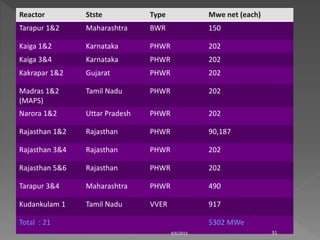
Reactor Stste Type Mwe net (each)
Tarapur 1&2 Maharashtra BWR 150
Kaiga 1&2 Karnataka PHWR 202
Kaiga 3&4 Karnataka PHWR 202
Kakrapar 1&2 Gujarat PHWR 202
Madras 1&2
(MAPS)
Tamil Nadu PHWR 202
Narora 1&2 Uttar Pradesh PHWR 202
Rajasthan 1&2 Rajasthan PHWR 90,187
Rajasthan 3&4 Rajasthan PHWR 202
Rajasthan 5&6 Rajasthan PHWR 202
Tarapur 3&4 Maharashtra PHWR 490
Kudankulam 1 Tamil Nadu VVER 917
Total : 21 5302 MWe
9/6/2015 31
 http://www.world-nuclear.org/
 Nuclear Power Corporation of India Limited
www.npcil.nic.in/
 UNITED STATES NUCLEAR REGULARITY
COMMISSION (U.s. nrc)
9/6/2015 32
9/6/2015 33

Atomic energy

  • 1.
  • 2.
     What isATOMIC ENERGY?  Nuclear fission  Nuclear fusion  How this reactions are carried out ?  Types of reactors:  Common components of nuclear reactor  Advantages and disadvantages of nuclear power  References 9/6/2015 2
  • 3.
    Outline History ofNuclear Energy  The science of atomic radiation, atomic change and nuclear fission was developed from 1895 to 1945, much of it in the last six of those years.  Over 1939-45, most development was focused on the atomic bomb.  From 1945 attention was given to harnessing this energy in a controlled fashion for naval propulsion and for making electricity.  Since 1956 the prime focus has been on the technological evolution of reliable nuclear power plants.  Uranium was discovered in 1789 by Martin Klaproth, a German chemist. 9/6/2015 3
  • 4.
     Ernest Rutherford,James Chadwick , Fermi, done many experiments on radioactive metals.  At the end of 1938 Otto Hahn and Fritz Strassmann in Berlin showed that the new lighter elements were barium and others which were about half the mass of uranium, thereby demonstrating that atomic fission had occurred.  Hahn and Strassmann showed that fission not only released a lot of energy but that it also released additional neutrons which could cause fission in other uranium nuclei and possibly a self-sustaining chain reaction leading to an enormous release of energy. This suggestion was soon confirmed experimentally by Joliot and his co-workers in Paris. 9/6/2015 4
  • 5.
     The energythat is released through a nuclear reaction or radioactive decay process. Of particular interest is the process known as fission, which occurs in a nuclear reactor and produces energy usually in the form of heat.  In a nuclear power plant, this heat is used to boil water in order to produce STEAM that can be used to drive large turbines. This, in turn, activates generators to produce electrical power.  Atomic energy is more correctly called nuclear energy. 9/6/2015 5
  • 6.
    Nuclear Energy canbe produced by two processes, 1. Nuclear fission 2. Nuclear fusion 9/6/2015 6
  • 7.
     In fission,heavy nucleus is split into two or more lighter nuclei.  The fission process is accompanied not only by the release of energy but also by the emissions of neutrons called fission , neutrons. 9/6/2015 7
  • 8.
     The emittedneutrons can cause further fissions ,and so on.  For self sustaining fission chain to be possible with continuous release of energy ,certain requirement must be met. 1st is : Heavy nuclei must be such that they can be fissioned by neutrons of any energy; this substance are referred to as fissile species. (U-233, U-235,plutonium-239 are the fissile species) 2nd is : The neutrons of lower energy must be capable of causing fission. 9/6/2015 8
  • 9.
     In fusion,two or more light nuclei fuse to form a heavier nucleus.  Fusion reactions occur at very high temperatures. Natural Artificial 9/6/2015 9
  • 10.
     Energy isproduced in the sun and stars by continuous fusion reactions in which four nuclei of hydrogen fuse in a series of reactions involving other particles that continuously appears & disappears in the course of the reactions ,such as He3,N2,carbon, and others but giving one nucleus of helium and two positrons.  Heat produced in these reactions maintain temperature of the order of several million degrees in their cores. 9/6/2015 10
  • 11.
     The fusionof a deuterium nucleus (deuteron) and a tritium nucleus (triton) has been found to take place most readily.  This reaction is also known as D+T reaction.  The fusion of one deuteron and one triton releases 17.6 MeV of energy. 9/6/2015 11
  • 12.
     Nuclear chainreactions are carried out in closed structure called nuclear reactor in which fissile material is made to undergo a controlled self sustaining nuclear reaction with the consequent release of energy.  A nuclear reactor is a system that contains and controls sustained nuclear chain reactions.  Reactors are used for generating electricity, moving submarines and air-craft carriers, producing medical isotopes for imaging and cancer treatment, and for conducting research. 9/6/2015 12
  • 13.
     Types ofnuclear reactors are given as under; 1. Light water reactor: (A) Pressurized water reactor (B) Boiling water reactor 2. Pressurized Heavy water reactor: 3. Graphite moderated reactor: (A) Gas cooled reactor (B) Water cooled reactor 4. Fast breeder reactor: 5. Water -water energetic reactor: 9/6/2015 13
  • 14.
     Moderators: Itreduces the velocity of very fast moving neutrons thereby helping in initiating the chain reactor.  Control rods: They are used for absorbing extra neutrons thereby controls the chain reaction.  Shielding: It is the shell that prevents radiations to reach outside the reactor.  Coolant: It is used to remove the heat generated inside the reactor core by fission.  Turbines: it converts heat energy of steam into mechanical energy.  Generator: It consists of coils and converts mechanical energy into electric energy. 9/6/2015 14
  • 15.
  • 16.
     Advantages:  PWRturbine cycle loop is separate from the primary loop, so the water in the secondary loop is not contaminated by radioactive materials.  PWR technology is favored by nations seeking to develop a nuclear navy, the compact reactors fit well in nuclear submarines and other nuclear ships.  Disadvantages:  Pressurized components are needed so its construction is expensive.  Fuel used must be enriched which increases the cost. 9/6/2015 16
  • 17.
  • 18.
     Advantages:  Itmay be designed to operate using only natural circulation so that recirculation pumps are eliminated entirely.  Operates at a lower nuclear fuel temperature.  The reactor vessel and associated components operate at a substantially lower pressure (about 75 times atmospheric pressure) compared to a PWR (about 158 times atmospheric pressure).  Disadvantages:  Contamination of the turbine by fission products.  Much larger pressure vessel than for a PWR of similar power, which increases the overall higher cost. 9/6/2015 18
  • 19.
  • 20.
     Advantages:  Theuse of heavy water as the moderator is the key to the PHWR (pressurized heavy water reactor) system, enabling the use of natural uranium as the fuel.  Disadvantages:  Heavy water generally costs hundreds of dollars per kilogram.  The reduced energy content of natural uranium as compared to enriched uranium necessitates more frequent replacement of fuel. 9/6/2015 20
  • 21.
  • 22.
     Advantages: The advantageof the design is that the coolant can be heated to higher temperatures than water. As a result, higher plant efficiency (40% or more) could be obtained compared to the water cooled design (33 34%). The gases are less prone to react chemically with the structural material of the reactor unlike water which has higher affinity for chemical reactions with these elements.  Disadvantages:  Higher pumping power compared to liquid coolants.  Need to maintain high pressure in the system, typically around 7 MPa for helium systems, to approximately 25 MPa for supercritical CO2. 9/6/2015 22
  • 23.
  • 24.
  • 25.
     Advantages: Need notto be pressurized. A breeder reactor creates 30% more fuel than it consumes. Working temperature of liquid metals are higher.(Sodium is a solid at room temperature but liquifies at 98°C. It has a wide working temperature since it does not boil until 892°C) Liquid metal cooled reactors were first adapted for nuclear submarine Because the metal coolants have much higher density than the water & they remove heat more rapidly and allow much higher power density. 9/6/2015 25
  • 26.
    Disadvantages: It requires liquifiedsodium or potassium metal as a coolant, as water would slow down the neutrons. These metals can cause a mishap, as they react violently when exposed to water or air. The construction and operation is very costly. Between $4 to $8 billion is required in the construction alone. The by-products formed during the fission of plutonium have to be removed by reprocessing, as they slow down the neutrons and reduce efficiency. However, this step of reprocessing produces a very pure strain of plutonium, which is ideal for use in nuclear weapons. They also work at a very high temperature Till date, not a single breeder reactor has been economically feasible. Every year, billions of dollars worldwide are spent for the safe storage of the plutonium produced, which is then useless, as few reactors use it as fuel.9/6/2015 26
  • 27.
     Water-Water PowerReactor is a “series of pressurised water reactor” designs originally developed in the Russia, by OKB Gidropress.  Power output ranges from 300 to 1700 Mwe (Megawatt electric) with the latest Russian development of the design.  Fuel assemblies for these are characterized by their hexagonal arrangement, but are otherwise of similar length and structure to other PWR fuel assemblies. 9/6/2015 27
  • 28.
     Nuclear powergeneration does not emit carbon dioxide (CO2) and smoke particles. The emissions of green house gases and therefore the contribution of nuclear power plants to global warming is therefore relatively little.  This technology is readily available.  It is possible to generate a high amount of electrical energy in one single plant.  Nuclear power is reliable. It does not depend on the weather. 9/6/2015 28
  • 29.
     The problemof radioactive waste. Disposal of nuclear waste is very expensive.  National risks so, Despite a generally high security standard, in transportation etc.  Nuclear power plants as well as nuclear waste could be preferred targets for terrorist attacks.  Heavy structure is required.  Nuclear energy is not a renewable energy.  Impact on Aquatic Life and Impact on human Life 9/6/2015 29
  • 30.
    (Updated 8 August2015)  India has a flourishing and largely indigenous nuclear power program and expects to have 14,600 MWe nuclear capacity on line by 2020 & aims to supply 25% of electricity from nuclear power by 2050.  Because India is outside the Nuclear Non-Proliferation Treaty due to its weapons program, it was for 34 years largely excluded from trade in nuclear plant or materials, which has hampered its development of civil nuclear energy until 2009.  Due to earlier trade bans and lack of indigenous uranium, India has uniquely been developing a nuclear fuel cycle to exploit its reserves of thorium.  A fundamental incompatibility between India’s civil liability law and international conventions limits foreign technology provision.  India has a vision of becoming a world leader in nuclear technology due to its expertise in fast reactors and thorium fuel cycle. CLICK HERE 9/6/2015 30
  • 31.
    Reactor Stste TypeMwe net (each) Tarapur 1&2 Maharashtra BWR 150 Kaiga 1&2 Karnataka PHWR 202 Kaiga 3&4 Karnataka PHWR 202 Kakrapar 1&2 Gujarat PHWR 202 Madras 1&2 (MAPS) Tamil Nadu PHWR 202 Narora 1&2 Uttar Pradesh PHWR 202 Rajasthan 1&2 Rajasthan PHWR 90,187 Rajasthan 3&4 Rajasthan PHWR 202 Rajasthan 5&6 Rajasthan PHWR 202 Tarapur 3&4 Maharashtra PHWR 490 Kudankulam 1 Tamil Nadu VVER 917 Total : 21 5302 MWe 9/6/2015 31
  • 32.
     http://www.world-nuclear.org/  NuclearPower Corporation of India Limited www.npcil.nic.in/  UNITED STATES NUCLEAR REGULARITY COMMISSION (U.s. nrc) 9/6/2015 32
  • 33.