FISSION
Fission is the splitting of a
nucleus into two or more
separate nuclei of comparable
mass
One neutron interacts with one
“fissionable” nucleus
(Uranium for example)
A slow moving neutron induces
fission in Uranium 235
RESULT OF NUCLEAR FISSION
Fission Products – Two heavy nuclides
One heavier than the other (Average ratio
of ~ 2 : 3 )
Neutrons – 2.43 on average emitted /
fission
Important that more neutrons are
produced than are used to cause one
fission
Gamma rays, beta particles
Energy !! E = mc2
CHAIN REACTION
 A chain reaction refer to a process
in which neutron released in fission
produced in additional fission in . At
least one further nucleus. This
nucleus in turn produces neutrons
and the process repeats. If the
process is controlled it is used for
nuclear power or if uncontrolled it is
used for nuclear weapon….
In nuclear fission, 3 neutrons are
produced along with large amount
of energy these neutrons further
cause fission producing three
more neutrons. This process
continues for longer time and it is
known as uncontrolled chain
reaction.
FISSION OF URANIUM
WHAT IS NUCLEAR POWER
PLANT???
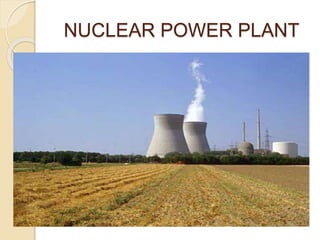
• A nuclear power plant is thermal
power station in which the heat source
is a nuclear reactor. As a typical in all
conventional thermal power stations,
the heat is used to generate steam
which drives a steam turbine
connected to an electric generator
which produces electricity.Nuclear
power was developed in 20th century...
NUCLEAR REACTOR
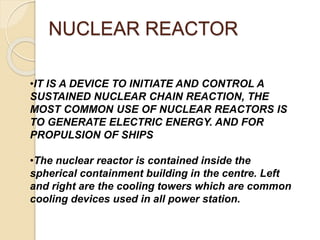
•IT IS A DEVICE TO INITIATE AND CONTROL A
SUSTAINED NUCLEAR CHAIN REACTION, THE
MOST COMMON USE OF NUCLEAR REACTORS IS
TO GENERATE ELECTRIC ENERGY. AND FOR
PROPULSION OF SHIPS
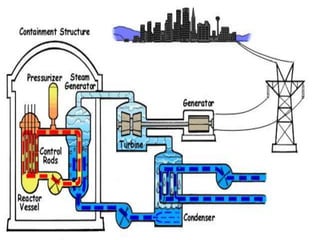
•The nuclear reactor is contained inside the
spherical containment building in the centre. Left
and right are the cooling towers which are common
cooling devices used in all power station.
NUCLEAR POWER PLANT
PARTS OF NUCLEAR
REACTOR
 Fissionable materials
Moderator
Control material
Coolant
Protective shield
FISSIONABLE MATERIAL
It is called a fuel of nuclear reactor.
For examples
1.Uranium
2.Thorium.
3.Plutonium.
These isotopes are most commonly used fuel.
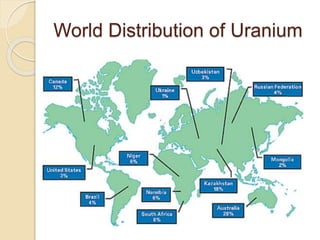
World Distribution of Uranium
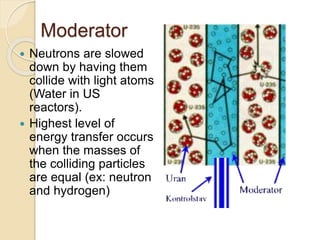
Moderator
 Neutrons are slowed
down by having them
collide with light atoms
(Water in US
reactors).
 Highest level of
energy transfer occurs
when the masses of
the colliding particles
are equal (ex: neutron
and hydrogen)
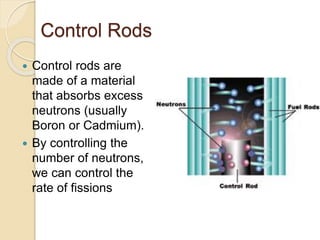
Control Rods
 Control rods are
made of a material
that absorbs excess
neutrons (usually
Boron or Cadmium).
 By controlling the
number of neutrons,
we can control the
rate of fissions
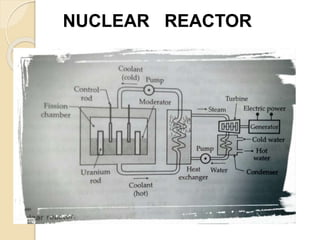
Coolent
It is the material used to cool the fuel rods and
the moderator and is capable of carrying away
large amount of heat produced in the fission
process. the coolent transfers heat to the
working liquid like water and produces steam the
steam drives turbine which, in turn, runs a
generator to generate electric power. The
coolent must have boiling point and specific
heat.
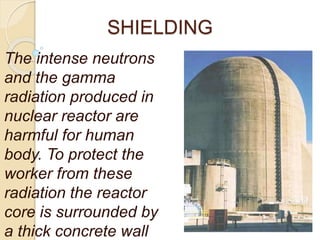
SHIELDING
The intense neutrons
and the gamma
radiation produced in
nuclear reactor are
harmful for human
body. To protect the
worker from these
radiation the reactor
core is surrounded by
a thick concrete wall
NUCLEAR REACTOR
ADVANTAGES
 Nuclear power generation does emit relatively low
amounts of carbon dioxide Co2 .
 The emissions of green house gases and
therefore the contribution of nuclear power plants
to global warming is therefore relatively little.
 This technology is readily available, it does not
have to be developed first.
 It is possible to generate a high amount of
electrical energy in one single plant .
23
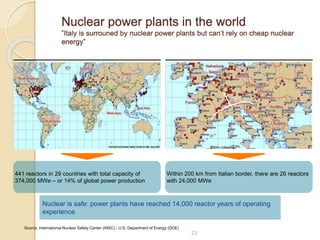
Nuclear power plants in the world
”Italy is surrouned by nuclear power plants but can’t rely on cheap nuclear
energy”
441 reactors in 29 countries with total capacity of
374,000 MWe – or 14% of global power production
Within 200 km from Italian border, there are 26 reactors
with 24,000 MWe
200 km
Source: International Nuclear Safety Center (INSC) - U.S. Department of Energy (DOE)
Nuclear is safe: power plants have reached 14,000 reactor years of operating
experience
DISADVANTAGEs
 The problem of radioactive waste is still an
unsolved one.
 High risks: It is technically impossible to build a
plant with 100% security.
 The energy source for nuclear energy is
Uranium. Uranium is a scarce resource, its
supply is estimated to last only for the next 30 to
60 years depending on the actual demand.
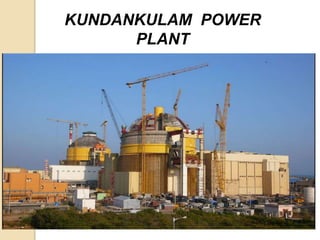
KUNDANKULAM POWER
PLANT

Nuclear Power Plant Presentation

  • 3.
    FISSION Fission is thesplitting of a nucleus into two or more separate nuclei of comparable mass One neutron interacts with one “fissionable” nucleus (Uranium for example)
  • 5.
    A slow movingneutron induces fission in Uranium 235
  • 6.
    RESULT OF NUCLEARFISSION Fission Products – Two heavy nuclides One heavier than the other (Average ratio of ~ 2 : 3 ) Neutrons – 2.43 on average emitted / fission Important that more neutrons are produced than are used to cause one fission Gamma rays, beta particles Energy !! E = mc2
  • 7.
    CHAIN REACTION  Achain reaction refer to a process in which neutron released in fission produced in additional fission in . At least one further nucleus. This nucleus in turn produces neutrons and the process repeats. If the process is controlled it is used for nuclear power or if uncontrolled it is used for nuclear weapon….
  • 8.
    In nuclear fission,3 neutrons are produced along with large amount of energy these neutrons further cause fission producing three more neutrons. This process continues for longer time and it is known as uncontrolled chain reaction.
  • 9.
  • 10.
    WHAT IS NUCLEARPOWER PLANT??? • A nuclear power plant is thermal power station in which the heat source is a nuclear reactor. As a typical in all conventional thermal power stations, the heat is used to generate steam which drives a steam turbine connected to an electric generator which produces electricity.Nuclear power was developed in 20th century...
  • 11.
    NUCLEAR REACTOR •IT ISA DEVICE TO INITIATE AND CONTROL A SUSTAINED NUCLEAR CHAIN REACTION, THE MOST COMMON USE OF NUCLEAR REACTORS IS TO GENERATE ELECTRIC ENERGY. AND FOR PROPULSION OF SHIPS •The nuclear reactor is contained inside the spherical containment building in the centre. Left and right are the cooling towers which are common cooling devices used in all power station.
  • 12.
  • 13.
    PARTS OF NUCLEAR REACTOR Fissionable materials Moderator Control material Coolant Protective shield
  • 14.
    FISSIONABLE MATERIAL It iscalled a fuel of nuclear reactor. For examples 1.Uranium 2.Thorium. 3.Plutonium. These isotopes are most commonly used fuel.
  • 15.
  • 16.
    Moderator  Neutrons areslowed down by having them collide with light atoms (Water in US reactors).  Highest level of energy transfer occurs when the masses of the colliding particles are equal (ex: neutron and hydrogen)
  • 17.
    Control Rods  Controlrods are made of a material that absorbs excess neutrons (usually Boron or Cadmium).  By controlling the number of neutrons, we can control the rate of fissions
  • 18.
    Coolent It is thematerial used to cool the fuel rods and the moderator and is capable of carrying away large amount of heat produced in the fission process. the coolent transfers heat to the working liquid like water and produces steam the steam drives turbine which, in turn, runs a generator to generate electric power. The coolent must have boiling point and specific heat.
  • 19.
    SHIELDING The intense neutrons andthe gamma radiation produced in nuclear reactor are harmful for human body. To protect the worker from these radiation the reactor core is surrounded by a thick concrete wall
  • 20.
  • 22.
    ADVANTAGES  Nuclear powergeneration does emit relatively low amounts of carbon dioxide Co2 .  The emissions of green house gases and therefore the contribution of nuclear power plants to global warming is therefore relatively little.  This technology is readily available, it does not have to be developed first.  It is possible to generate a high amount of electrical energy in one single plant .
  • 23.
    23 Nuclear power plantsin the world ”Italy is surrouned by nuclear power plants but can’t rely on cheap nuclear energy” 441 reactors in 29 countries with total capacity of 374,000 MWe – or 14% of global power production Within 200 km from Italian border, there are 26 reactors with 24,000 MWe 200 km Source: International Nuclear Safety Center (INSC) - U.S. Department of Energy (DOE) Nuclear is safe: power plants have reached 14,000 reactor years of operating experience
  • 24.
    DISADVANTAGEs  The problemof radioactive waste is still an unsolved one.  High risks: It is technically impossible to build a plant with 100% security.  The energy source for nuclear energy is Uranium. Uranium is a scarce resource, its supply is estimated to last only for the next 30 to 60 years depending on the actual demand.
  • 26.