


PREPARED
BY
UMAR YAURI
UMAR SHIDIGAWA
NES
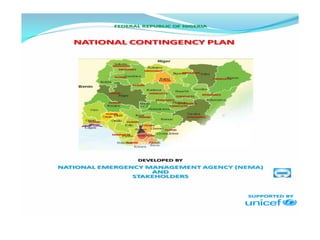
FEDERAL REPUBLIC OF NIGERIA
FLOOD
DROUGHT
DROUGHT
CONFLICTS
NATIONAL CONTINGENCY PLAN
DROUGHT
DROUGHT
FLOOD
FLOOD
FLOOD
FLOOD
FLOOD
FLOOD
FLOOD
FLOOD
FLOOD
FLOOD
CONFLICTS
CONFLICTS
EPIDEMICS
CONFLICTS
CONFLICTS
EPIDEMICS
EPIDEMICS
EPIDEMICS
DEVELOPED BY
NATIONAL EMERGENCY MANAGEMENT AGENCY (NEMA)
AND
STAKEHOLDERS
SUPPORTED BY
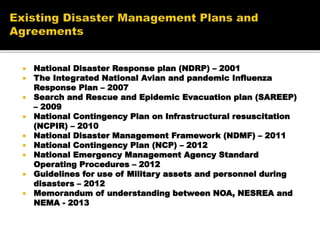
 National Disaster Response plan (NDRP) – 2001
 The Integrated National Avian and pandemic Influenza
Response Plan – 2007
 Search and Rescue and Epidemic Evacuation plan (SAREEP)
– 2009
 National Contingency Plan on Infrastructural resuscitation
(NCPIR) – 2010
 National Disaster Management Framework (NDMF) – 2011
 National Contingency Plan (NCP) – 2012
 National Emergency Management Agency Standard
Operating Procedures – 2012
 Guidelines for use of Military assets and personnel during
disasters – 2012
 Memorandum of understanding between NOA, NESREA and
NEMA - 2013
Overview of the NationalContingency plan
 Coordination in the implementation of the
state contingency plan
 Design of state contingency plan
Overview of standard operating procedures
of some specific Disasters in the state.
Coordination for Disaster Management
System in Nigeria
1.0 OVERVIEW OF THE NATIONAL CONTINGENCY PLAN
This Contingency Plan has been developed to provide a basis for
coordination of humanitarian minimum response in the event of a
major/catastrophic disaster for an initial 10 (ten) days by the
Federal Government of Nigeria through the National Emergency
Management Agency (NEMA) for 2011-2012
The document adopts the multi-risk approach and identified
flood, crisis, epidemic, drought and collapse of artificial and
natural impoundments, as probable disasters that can cause high
level impact and displacement of persons. A population of 10,000
was used as the benchmark for planning assumptions. The
geographical area covered the whole country based on identified
hazards. Meteorological predictions, monitoring of dams, as well
as, socio and ethno-religious activities by relevant agencies were
used as the basis for Early Warnings and triggers for the
probability of occurrence of the identified disasters.
Cont’d
The document adopted the coordination mechanism contained
in the National Disaster Management Framework (NDMF).The
information and communication mechanism of the Incident
Command System (ICS) was also adopted to ensure that the
implementation of the document is in line with best practices.The
funding of the Plan will be based on the source of Disaster
Management funding in Nigeria and other arrangement as
contained in the Establishment Act of NEMA.
The Sectoral Response section took into cognizance
Preparedness, Minimum Response and Comprehensive response
within the following Clusters:Water and Sanitation (WASH); Food
and Non Food Items (NFIs); Emergency Shelter;
Telecommunication and Logistics; Basic Education; Security and
Protection; Camp Management; Health, Reproductive Health and
HIV AIDS.
cont’d
The Contingency Supply requirements (i.e. personnel,
supplies and equipments) and budget was also developed to
ensure proper resource mobilization and functioning of the
various sectors during the agreed period of minimum
response. The document also made adequate arrangement for
trainings, simulations and review dates.
apacity at the lower levels.
 Inter-Agency rivalry.
 Lack of specialized equipment and maintenance of the
existing ones
 Low level of awareness on disaster risk at the grass root
levels
 Disregard for town planning regulation are responsible
for increase in urban risk
 Lack of sustained synergy between the tiers of
government and amongst stakeholders is affecting
continuity in disaster management activities
 Ethno-religious diversity has overtaking considerations
for merit and competence.
 Sensational reporting on the part of media
practitioners.
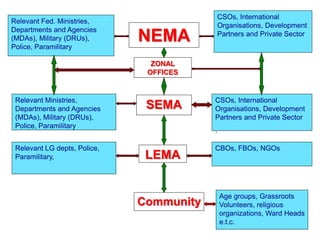
NEMA
Relevant Fed. Ministries,
Departments and Agencies
(MDAs), Military (DRUs),
Police, Paramilitary
Relevant Ministries,
Departments and Agencies
(MDAs), Military (DRUs),
Police, Paramilitary
Relevant LG depts, Police,
Paramilitary,
SEMA
LEMA
Community
CSOs, International
Organisations, Development
Partners and Private Sector
CSOs, International
Organisations, Development
Partners and Private Sector
.
CBOs, FBOs, NGOs
Age groups, Grassroots
Volunteers, religious
organizations, Ward Heads
e.t.c.
ZONAL
OFFICES
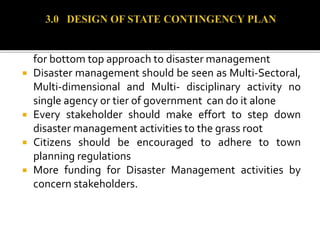
es and LGAs should establish and fund SEMAs and LEMCs
for bottom top approach to disaster management
 Disaster management should be seen as Multi-Sectoral,
Multi-dimensional and Multi- disciplinary activity no
single agency or tier of government can do it alone
 Every stakeholder should make effort to step down
disaster management activities to the grass root
 Citizens should be encouraged to adhere to town
planning regulations
 More funding for Disaster Management activities by
concern stakeholders.
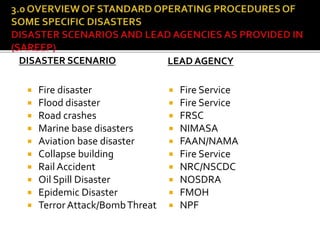
DISASTER SCENARIO
 Fire disaster
 Flood disaster
 Road crashes
 Marine base disasters
 Aviation base disaster
 Collapse building
 Rail Accident
 Oil Spill Disaster
 Epidemic Disaster
 Terror Attack/BombThreat
LEAD AGENCY
 Fire Service
 Fire Service
 FRSC
 NIMASA
 FAAN/NAMA
 Fire Service
 NRC/NSCDC
 NOSDRA
 FMOH
 NPF
Cont’d
The National Contingency Plan will build on collaboration with
governments, relevant MDAs, military and paramilitary, Police
Force, CSOs, International Organizations and the UN system.
NEMA will collaborate with relevant agencies to monitor early
warning, potential threats and emergency situations to ensure
adequate response. In responding to emergencies, additional
programmes may be developed to support humanitarian action
such as post-incident rehabilitation and recovery efforts within the
respective sector.
National Emergency Management Agency (NEMA) is an
Agency of the Federal Government directly under the
supervision of the Presidency saddled with the responsibility
of Managing disasters in Nigeria. The Agency was
established through Act 12 (as amended) by Act 50 of1999
• Formulate policy on all activities relating to
disaster management in Nigeria and co-
ordinate the plans and programmes for
efficient and effective response to disasters at
national level;
• Co-ordinate and promote research activities
relating to disaster management at the
national level;
• Monitor the state of preparedness of all
organizations or agencies which may
contribute to disaster management in Nigeria;
• collate data from relevant agencies so as to
enhance forecasting, planning and field
operation of disaster management;
• educate and inform the public on disaster
prevention and control measures;
• co-ordinates and facilitate the provision of
necessary resources for search and rescue
and other types of disaster curtailment
activities in response to distress call;
 Co-ordinate the activities of all voluntary
organizations engaged in emergency relief
operations in any part of the Federation;
 Receive financial and technical aid from
international organizations and non-
governmental agencies for the purpose of
disaster management in Nigeria;
 Collect emergency relief supply from local,
foreign sources, including international and non-
governmental agencies;
• Distribute emergency relief materials to victims
of natural or other disasters and to assist in the
rehabilitation of the victims where necessary;
• Liaise with State Emergency Management
committees established under section 8 of this
Act to assess and monitor where necessary, the
distribution of relief materials to disaster victims;
• Process relief assistance to such countries as may
be determined from time to time;
• Liaise with the United Nations Disaster
Reduction Organization or such other
international bodies for the reduction of
natural and other disasters;
• Prepare the annual budget for disaster
management in Nigeria; and;
• Perform such other functions which in the
opinion of the Agency are required for the
purpose of achieving its objectives under this
Act.
Looking at the fifteen – point mandate of NEMA
listed above, you will discover words such as co-
ordinate, collate, liaise, monitor, collect and receive
are used. This means that NEMA is essentially a
coordinating Agency. It is placed at the centre of a
network of disaster management organizations,
liaising and coordinating their efforts. Thus the
success or failure of disaster management in Nigeria
depends largely on how well these organizations are
working and how effectively NEMA is able to co-
ordinate their efforts.
 In line with disaster management circle and the Agency’s
mandate stated above, the Agency established four
technical line department to carry out functions in all phases
of disaster management. These departments are Disaster
Risk Reduction Department responsible for disaster
prevention and mitigation activities. Planning Research and
Forecasting Department is responsible for preparedness plan
and early warning systems.
Search and Rescue Department is responsible for
coordination of rescue operations and mobilization of critical
resources for search and rescue in all hazards.
Relief and Rehabilitation is responsible for provision of relief
materials to victims of disasters and coordinate
rehabilitation and reconstruction efforts.
Cont’d
 Therefore, measures put in place by the
Agency at the pre-disaster phase include but
not limited to the following:
 ADVOCACY
 This involves influencing and persuading
communities and government to bring about
positive change to situations that is
potentially harmful.Advocacy work involves
a number of activities such as research,
sensitization, education and awareness
creation.
 MITIGATION
Process of reducing the frequency, scale, intensity
and impact of hazards.
Mitigation measures: include construction of
(Engineering) infrastructures like
 Earth bunds,
 Storm drains,
 A forestation,
 Levees (raised river banks).
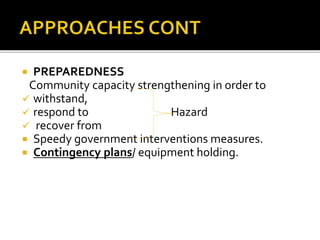
 PREPAREDNESS
Community capacity strengthening in order to
 withstand,
 respond to Hazard
 recover from
 Speedy government interventions measures.
 Contingency plans/ equipment holding.
www.nema.gov.ng
CONTACT NUMBERS:
0800CALLNEMA (toll free),
09290577 and 08032003555
THANK YOU
FOR
LISTENING

PRESENTATION CONTINGENCY PLAN

  • 1.
  • 2.
    FEDERAL REPUBLIC OFNIGERIA FLOOD DROUGHT DROUGHT CONFLICTS NATIONAL CONTINGENCY PLAN DROUGHT DROUGHT FLOOD FLOOD FLOOD FLOOD FLOOD FLOOD FLOOD FLOOD FLOOD FLOOD CONFLICTS CONFLICTS EPIDEMICS CONFLICTS CONFLICTS EPIDEMICS EPIDEMICS EPIDEMICS DEVELOPED BY NATIONAL EMERGENCY MANAGEMENT AGENCY (NEMA) AND STAKEHOLDERS SUPPORTED BY
  • 3.
     National DisasterResponse plan (NDRP) – 2001  The Integrated National Avian and pandemic Influenza Response Plan – 2007  Search and Rescue and Epidemic Evacuation plan (SAREEP) – 2009  National Contingency Plan on Infrastructural resuscitation (NCPIR) – 2010  National Disaster Management Framework (NDMF) – 2011  National Contingency Plan (NCP) – 2012  National Emergency Management Agency Standard Operating Procedures – 2012  Guidelines for use of Military assets and personnel during disasters – 2012  Memorandum of understanding between NOA, NESREA and NEMA - 2013
  • 4.
    Overview of theNationalContingency plan  Coordination in the implementation of the state contingency plan  Design of state contingency plan Overview of standard operating procedures of some specific Disasters in the state. Coordination for Disaster Management System in Nigeria
  • 5.
    1.0 OVERVIEW OFTHE NATIONAL CONTINGENCY PLAN This Contingency Plan has been developed to provide a basis for coordination of humanitarian minimum response in the event of a major/catastrophic disaster for an initial 10 (ten) days by the Federal Government of Nigeria through the National Emergency Management Agency (NEMA) for 2011-2012 The document adopts the multi-risk approach and identified flood, crisis, epidemic, drought and collapse of artificial and natural impoundments, as probable disasters that can cause high level impact and displacement of persons. A population of 10,000 was used as the benchmark for planning assumptions. The geographical area covered the whole country based on identified hazards. Meteorological predictions, monitoring of dams, as well as, socio and ethno-religious activities by relevant agencies were used as the basis for Early Warnings and triggers for the probability of occurrence of the identified disasters.
  • 6.
    Cont’d The document adoptedthe coordination mechanism contained in the National Disaster Management Framework (NDMF).The information and communication mechanism of the Incident Command System (ICS) was also adopted to ensure that the implementation of the document is in line with best practices.The funding of the Plan will be based on the source of Disaster Management funding in Nigeria and other arrangement as contained in the Establishment Act of NEMA. The Sectoral Response section took into cognizance Preparedness, Minimum Response and Comprehensive response within the following Clusters:Water and Sanitation (WASH); Food and Non Food Items (NFIs); Emergency Shelter; Telecommunication and Logistics; Basic Education; Security and Protection; Camp Management; Health, Reproductive Health and HIV AIDS.
  • 7.
    cont’d The Contingency Supplyrequirements (i.e. personnel, supplies and equipments) and budget was also developed to ensure proper resource mobilization and functioning of the various sectors during the agreed period of minimum response. The document also made adequate arrangement for trainings, simulations and review dates.
  • 8.
    apacity at thelower levels.  Inter-Agency rivalry.  Lack of specialized equipment and maintenance of the existing ones  Low level of awareness on disaster risk at the grass root levels  Disregard for town planning regulation are responsible for increase in urban risk  Lack of sustained synergy between the tiers of government and amongst stakeholders is affecting continuity in disaster management activities  Ethno-religious diversity has overtaking considerations for merit and competence.  Sensational reporting on the part of media practitioners.
  • 9.
    NEMA Relevant Fed. Ministries, Departmentsand Agencies (MDAs), Military (DRUs), Police, Paramilitary Relevant Ministries, Departments and Agencies (MDAs), Military (DRUs), Police, Paramilitary Relevant LG depts, Police, Paramilitary, SEMA LEMA Community CSOs, International Organisations, Development Partners and Private Sector CSOs, International Organisations, Development Partners and Private Sector . CBOs, FBOs, NGOs Age groups, Grassroots Volunteers, religious organizations, Ward Heads e.t.c. ZONAL OFFICES
  • 10.
    es and LGAsshould establish and fund SEMAs and LEMCs for bottom top approach to disaster management  Disaster management should be seen as Multi-Sectoral, Multi-dimensional and Multi- disciplinary activity no single agency or tier of government can do it alone  Every stakeholder should make effort to step down disaster management activities to the grass root  Citizens should be encouraged to adhere to town planning regulations  More funding for Disaster Management activities by concern stakeholders.
  • 11.
    DISASTER SCENARIO  Firedisaster  Flood disaster  Road crashes  Marine base disasters  Aviation base disaster  Collapse building  Rail Accident  Oil Spill Disaster  Epidemic Disaster  Terror Attack/BombThreat LEAD AGENCY  Fire Service  Fire Service  FRSC  NIMASA  FAAN/NAMA  Fire Service  NRC/NSCDC  NOSDRA  FMOH  NPF
  • 12.
    Cont’d The National ContingencyPlan will build on collaboration with governments, relevant MDAs, military and paramilitary, Police Force, CSOs, International Organizations and the UN system. NEMA will collaborate with relevant agencies to monitor early warning, potential threats and emergency situations to ensure adequate response. In responding to emergencies, additional programmes may be developed to support humanitarian action such as post-incident rehabilitation and recovery efforts within the respective sector.
  • 13.
    National Emergency ManagementAgency (NEMA) is an Agency of the Federal Government directly under the supervision of the Presidency saddled with the responsibility of Managing disasters in Nigeria. The Agency was established through Act 12 (as amended) by Act 50 of1999
  • 14.
    • Formulate policyon all activities relating to disaster management in Nigeria and co- ordinate the plans and programmes for efficient and effective response to disasters at national level; • Co-ordinate and promote research activities relating to disaster management at the national level; • Monitor the state of preparedness of all organizations or agencies which may contribute to disaster management in Nigeria;
  • 15.
    • collate datafrom relevant agencies so as to enhance forecasting, planning and field operation of disaster management; • educate and inform the public on disaster prevention and control measures; • co-ordinates and facilitate the provision of necessary resources for search and rescue and other types of disaster curtailment activities in response to distress call;
  • 16.
     Co-ordinate theactivities of all voluntary organizations engaged in emergency relief operations in any part of the Federation;  Receive financial and technical aid from international organizations and non- governmental agencies for the purpose of disaster management in Nigeria;  Collect emergency relief supply from local, foreign sources, including international and non- governmental agencies;
  • 17.
    • Distribute emergencyrelief materials to victims of natural or other disasters and to assist in the rehabilitation of the victims where necessary; • Liaise with State Emergency Management committees established under section 8 of this Act to assess and monitor where necessary, the distribution of relief materials to disaster victims; • Process relief assistance to such countries as may be determined from time to time;
  • 19.
    • Liaise withthe United Nations Disaster Reduction Organization or such other international bodies for the reduction of natural and other disasters; • Prepare the annual budget for disaster management in Nigeria; and; • Perform such other functions which in the opinion of the Agency are required for the purpose of achieving its objectives under this Act.
  • 20.
    Looking at thefifteen – point mandate of NEMA listed above, you will discover words such as co- ordinate, collate, liaise, monitor, collect and receive are used. This means that NEMA is essentially a coordinating Agency. It is placed at the centre of a network of disaster management organizations, liaising and coordinating their efforts. Thus the success or failure of disaster management in Nigeria depends largely on how well these organizations are working and how effectively NEMA is able to co- ordinate their efforts.
  • 21.
     In linewith disaster management circle and the Agency’s mandate stated above, the Agency established four technical line department to carry out functions in all phases of disaster management. These departments are Disaster Risk Reduction Department responsible for disaster prevention and mitigation activities. Planning Research and Forecasting Department is responsible for preparedness plan and early warning systems. Search and Rescue Department is responsible for coordination of rescue operations and mobilization of critical resources for search and rescue in all hazards. Relief and Rehabilitation is responsible for provision of relief materials to victims of disasters and coordinate rehabilitation and reconstruction efforts.
  • 22.
    Cont’d  Therefore, measuresput in place by the Agency at the pre-disaster phase include but not limited to the following:
  • 23.
     ADVOCACY  Thisinvolves influencing and persuading communities and government to bring about positive change to situations that is potentially harmful.Advocacy work involves a number of activities such as research, sensitization, education and awareness creation.
  • 24.
     MITIGATION Process ofreducing the frequency, scale, intensity and impact of hazards. Mitigation measures: include construction of (Engineering) infrastructures like  Earth bunds,  Storm drains,  A forestation,  Levees (raised river banks).
  • 25.
     PREPAREDNESS Community capacitystrengthening in order to  withstand,  respond to Hazard  recover from  Speedy government interventions measures.  Contingency plans/ equipment holding.
  • 26.
  • 29.