
DISASTER MANAGEMENT INDISASTER MANAGEMENT IN
EDUCATIONEDUCATION -NATIONAL PERSPECTIVE-NATIONAL PERSPECTIVE
Disasters both manmade and natural have affected mankind since time in memorialDisasters both manmade and natural have affected mankind since time in memorial
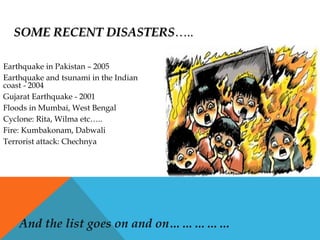
SOME RECENT DISASTERSSOME RECENT DISASTERS…..…..
Earthquake in Pakistan – 2005
Earthquake and tsunami in the Indian
coast - 2004
Gujarat Earthquake - 2001
Floods in Mumbai, West Bengal
Cyclone: Rita, Wilma etc…..
Fire: Kumbakonam, Dabwali
Terrorist attack: Chechnya
And the list goes on and on……………
DISASTERS OCCUR IN VARIED FORMS:DISASTERS OCCUR IN VARIED FORMS:
SOME ARE PREDICTABLE IN ADVANCE
SOME ARE ANNUAL OR SEASONAL
SOME ARE SUDDEN AND UNPREDICTABLE
FLOODS DAYS AND WEEKS
EARTHQUAKES SECONDS/MINUTES
CYCLONES DAYS
DROUGHTS MONTHS
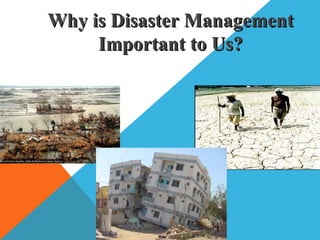
Why is Disaster ManagementWhy is Disaster Management
Important to Us?Important to Us?
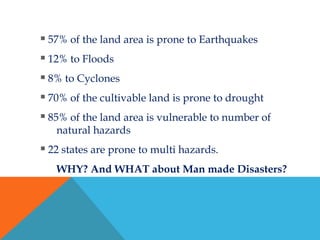
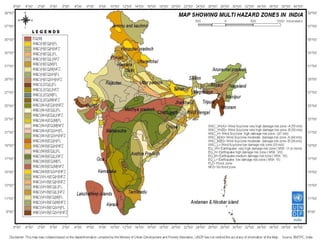
 57% of the land area is prone to Earthquakes
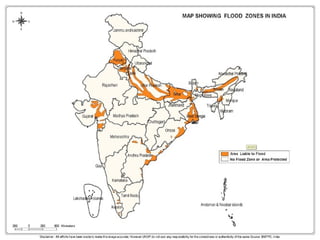
 12% to Floods
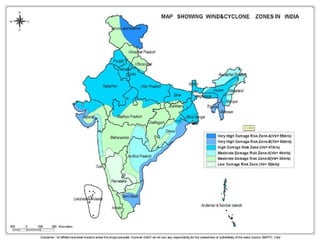
 8% to Cyclones
 70% of the cultivable land is prone to drought
 85% of the land area is vulnerable to number of
natural hazards
 22 states are prone to multi hazards.
WHY? And WHAT about Man made Disasters?
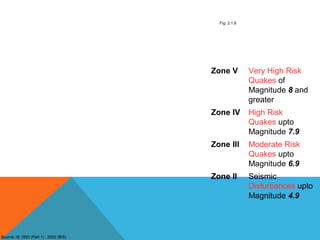
Seismic
Disturbances upto
Magnitude 4.9
Zone II
Moderate Risk
Quakes upto
Magnitude 6.9
Zone III
High Risk
Quakes upto
Magnitude 7.9
Zone IV
Very High Risk
Quakes of
Magnitude 8 and
greater
Zone V
MagnitudeZone
Source: IS 1893 (Part 1) : 2002 (BIS)
Fig: 2.1.6
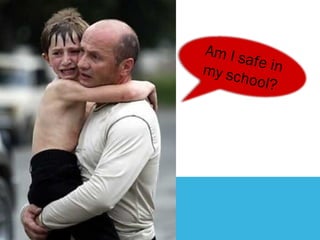
Am I safe inmy school?
TENTH FIVE YEAR PLAN EMPHASIZES ON:TENTH FIVE YEAR PLAN EMPHASIZES ON:
Planning for safer national development
Disaster prevention, mitigation and preparedness measures
Capacity building
Training and education at all levels
WHAT IS A SAFE SCHOOL?WHAT IS A SAFE SCHOOL?
A safe school is either a
school which is located in a
hazard free area, or one that
has been constructed to
withstand the hazard to
which it is exposed.
A safe school will not
collapse or get affected if a
disaster happens.
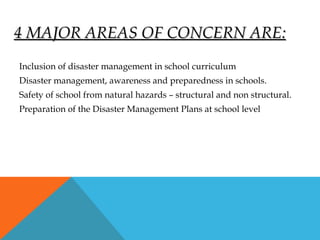
4 MAJOR AREAS OF CONCERN ARE:4 MAJOR AREAS OF CONCERN ARE:
Inclusion of disaster management in school curriculum
Disaster management, awareness and preparedness in schools.
Safety of school from natural hazards – structural and non structural.
Preparation of the Disaster Management Plans at school level
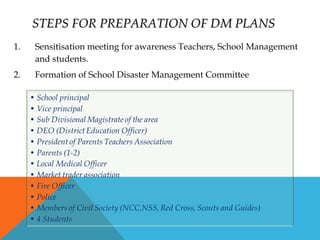
STEPS FOR PREPARATION OF DM PLANSSTEPS FOR PREPARATION OF DM PLANS
1. Sensitisation meeting for awareness Teachers, School Management
and students.
2. Formation of School Disaster Management Committee
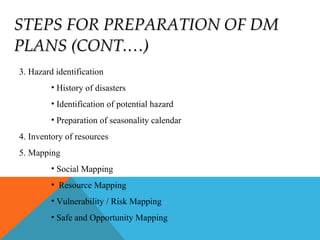
STEPS FOR PREPARATION OF DMSTEPS FOR PREPARATION OF DM
PLANS (CONT.…)PLANS (CONT.…)
3. Hazard identification
• History of disasters
• Identification of potential hazard
• Preparation of seasonality calendar
4. Inventory of resources
5. Mapping
• Social Mapping
• Resource Mapping
• Vulnerability / Risk Mapping
• Safe and Opportunity Mapping
SOCIAL MAPPING - SCHOOLSSOCIAL MAPPING - SCHOOLS
Class rooms in the school building
Laboratories
Play Ground
School Canteen
Library
RESOURCE MAP -RESOURCE MAP - SCHOOLSSCHOOLS
Human resources
School Buses
Generators
Fire extinguishers
Stretchers
Drinking water sources
Health Centre in the school
VULNERABILITY/ RISK MAP - SCHOOLVULNERABILITY/ RISK MAP - SCHOOL
Children in pre- school and primary section
Physically challenged
Identification of potentially vulnerable areas in the school
SAFE AND ALTERNATE ROUTE MAPPINGSAFE AND ALTERNATE ROUTE MAPPING
Identification of safe places in the school
Alternative staircases/ routes to be identified
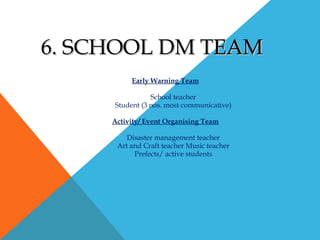
6. SCHOOL DM TEAM6. SCHOOL DM TEAM
Early Warning Team
School teacher
Student (3 nos. most communicative)
Activity/ Event Organising Team
Disaster management teacher
Art and Craft teacher Music teacher
Prefects/ active students
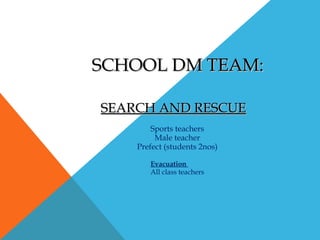
SCHOOL DM TEAM:SCHOOL DM TEAM:
SEARCH AND RESCUESEARCH AND RESCUE
Sports teachers
Male teacher
Prefect (students 2nos)
Evacuation
All class teachers
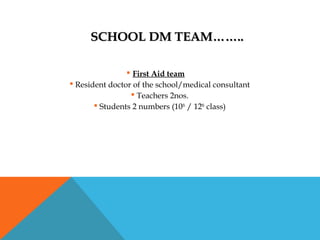
SCHOOL DM TEAM……..SCHOOL DM TEAM……..
 First Aid team
 Resident doctor of the school/medical consultant
 Teachers 2nos.
 Students 2 numbers (10th
/ 12th
class)
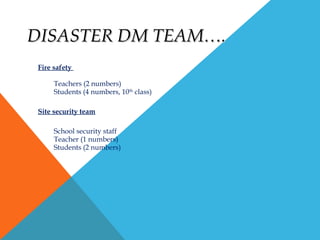
DISASTER DM TEAM….DISASTER DM TEAM….
Fire safety
Teachers (2 numbers)
Students (4 numbers, 10th
class)
Site security team
School security staff
Teacher (1 numbers)
Students (2 numbers)
7. TRAINING OF SCHOOL7. TRAINING OF SCHOOL
DISASTER MANAGEMENT TEAMSDISASTER MANAGEMENT TEAMS
 SEARCH AND RESCUE
FIRST AID
TRAUMA COUNSELING
FIRE FIGHTING
8. PLANNING TO BE DISSEMINATED8. PLANNING TO BE DISSEMINATED
TO EVERYONE IN THE SCHOOL.TO EVERYONE IN THE SCHOOL.
10. PLAN UPDATING10. PLAN UPDATING
 PLANS TO BE UPDATED EVERY SIX MONTHS
 PLAN TO BE APPROVED BY THE DISASTER MANAGEMENT
COMMITTEE
9. MOCK DRILL9. MOCK DRILL
 Drills to be carried out twice a year
 Drills should be hazard specific
SAFETY OF SCHOOL BUILDINGSSAFETY OF SCHOOL BUILDINGS
Focus on structural and non-structural safety.
NCERT INITIATIVESNCERT INITIATIVES
Development of training modules for the teachers and teacher educators.
 Safety in Schools
 Midday meals
 Health, well being and safety of students
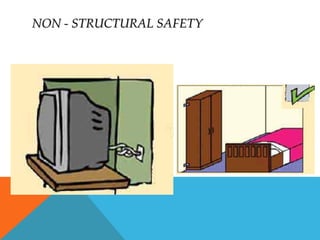
NON - STRUCTURAL SAFETYNON - STRUCTURAL SAFETY
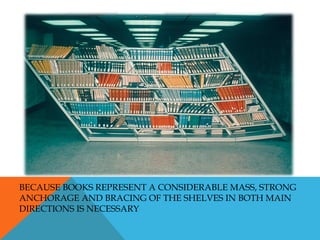
BECAUSE BOOKS REPRESENT A CONSIDERABLE MASS, STRONG
ANCHORAGE AND BRACING OF THE SHELVES IN BOTH MAIN
DIRECTIONS IS NECESSARY
Thank YouThank You
Kush Suman

Disaster management-in schools- Kush suman

  • 1.
    DISASTER MANAGEMENT INDISASTERMANAGEMENT IN EDUCATIONEDUCATION -NATIONAL PERSPECTIVE-NATIONAL PERSPECTIVE
  • 2.
    Disasters both manmadeand natural have affected mankind since time in memorialDisasters both manmade and natural have affected mankind since time in memorial
  • 3.
    SOME RECENT DISASTERSSOMERECENT DISASTERS…..….. Earthquake in Pakistan – 2005 Earthquake and tsunami in the Indian coast - 2004 Gujarat Earthquake - 2001 Floods in Mumbai, West Bengal Cyclone: Rita, Wilma etc….. Fire: Kumbakonam, Dabwali Terrorist attack: Chechnya And the list goes on and on……………
  • 4.
    DISASTERS OCCUR INVARIED FORMS:DISASTERS OCCUR IN VARIED FORMS: SOME ARE PREDICTABLE IN ADVANCE SOME ARE ANNUAL OR SEASONAL SOME ARE SUDDEN AND UNPREDICTABLE FLOODS DAYS AND WEEKS EARTHQUAKES SECONDS/MINUTES CYCLONES DAYS DROUGHTS MONTHS
  • 5.
    Why is DisasterManagementWhy is Disaster Management Important to Us?Important to Us?
  • 6.
     57% ofthe land area is prone to Earthquakes  12% to Floods  8% to Cyclones  70% of the cultivable land is prone to drought  85% of the land area is vulnerable to number of natural hazards  22 states are prone to multi hazards. WHY? And WHAT about Man made Disasters?
  • 8.
    Seismic Disturbances upto Magnitude 4.9 ZoneII Moderate Risk Quakes upto Magnitude 6.9 Zone III High Risk Quakes upto Magnitude 7.9 Zone IV Very High Risk Quakes of Magnitude 8 and greater Zone V MagnitudeZone Source: IS 1893 (Part 1) : 2002 (BIS) Fig: 2.1.6
  • 10.
    Am I safeinmy school?
  • 11.
    TENTH FIVE YEARPLAN EMPHASIZES ON:TENTH FIVE YEAR PLAN EMPHASIZES ON: Planning for safer national development Disaster prevention, mitigation and preparedness measures Capacity building Training and education at all levels
  • 12.
    WHAT IS ASAFE SCHOOL?WHAT IS A SAFE SCHOOL? A safe school is either a school which is located in a hazard free area, or one that has been constructed to withstand the hazard to which it is exposed. A safe school will not collapse or get affected if a disaster happens.
  • 14.
    4 MAJOR AREASOF CONCERN ARE:4 MAJOR AREAS OF CONCERN ARE: Inclusion of disaster management in school curriculum Disaster management, awareness and preparedness in schools. Safety of school from natural hazards – structural and non structural. Preparation of the Disaster Management Plans at school level
  • 15.
    STEPS FOR PREPARATIONOF DM PLANSSTEPS FOR PREPARATION OF DM PLANS 1. Sensitisation meeting for awareness Teachers, School Management and students. 2. Formation of School Disaster Management Committee
  • 16.
    STEPS FOR PREPARATIONOF DMSTEPS FOR PREPARATION OF DM PLANS (CONT.…)PLANS (CONT.…) 3. Hazard identification • History of disasters • Identification of potential hazard • Preparation of seasonality calendar 4. Inventory of resources 5. Mapping • Social Mapping • Resource Mapping • Vulnerability / Risk Mapping • Safe and Opportunity Mapping
  • 17.
    SOCIAL MAPPING -SCHOOLSSOCIAL MAPPING - SCHOOLS Class rooms in the school building Laboratories Play Ground School Canteen Library
  • 18.
    RESOURCE MAP -RESOURCEMAP - SCHOOLSSCHOOLS Human resources School Buses Generators Fire extinguishers Stretchers Drinking water sources Health Centre in the school
  • 19.
    VULNERABILITY/ RISK MAP- SCHOOLVULNERABILITY/ RISK MAP - SCHOOL Children in pre- school and primary section Physically challenged Identification of potentially vulnerable areas in the school
  • 20.
    SAFE AND ALTERNATEROUTE MAPPINGSAFE AND ALTERNATE ROUTE MAPPING Identification of safe places in the school Alternative staircases/ routes to be identified
  • 21.
    6. SCHOOL DMTEAM6. SCHOOL DM TEAM Early Warning Team School teacher Student (3 nos. most communicative) Activity/ Event Organising Team Disaster management teacher Art and Craft teacher Music teacher Prefects/ active students
  • 22.
    SCHOOL DM TEAM:SCHOOLDM TEAM: SEARCH AND RESCUESEARCH AND RESCUE Sports teachers Male teacher Prefect (students 2nos) Evacuation All class teachers
  • 23.
    SCHOOL DM TEAM……..SCHOOLDM TEAM……..  First Aid team  Resident doctor of the school/medical consultant  Teachers 2nos.  Students 2 numbers (10th / 12th class)
  • 24.
    DISASTER DM TEAM….DISASTERDM TEAM…. Fire safety Teachers (2 numbers) Students (4 numbers, 10th class) Site security team School security staff Teacher (1 numbers) Students (2 numbers)
  • 25.
    7. TRAINING OFSCHOOL7. TRAINING OF SCHOOL DISASTER MANAGEMENT TEAMSDISASTER MANAGEMENT TEAMS  SEARCH AND RESCUE FIRST AID TRAUMA COUNSELING FIRE FIGHTING
  • 26.
    8. PLANNING TOBE DISSEMINATED8. PLANNING TO BE DISSEMINATED TO EVERYONE IN THE SCHOOL.TO EVERYONE IN THE SCHOOL.
  • 27.
    10. PLAN UPDATING10.PLAN UPDATING  PLANS TO BE UPDATED EVERY SIX MONTHS  PLAN TO BE APPROVED BY THE DISASTER MANAGEMENT COMMITTEE
  • 28.
    9. MOCK DRILL9.MOCK DRILL  Drills to be carried out twice a year  Drills should be hazard specific
  • 29.
    SAFETY OF SCHOOLBUILDINGSSAFETY OF SCHOOL BUILDINGS Focus on structural and non-structural safety.
  • 30.
    NCERT INITIATIVESNCERT INITIATIVES Developmentof training modules for the teachers and teacher educators.  Safety in Schools  Midday meals  Health, well being and safety of students
  • 31.
    NON - STRUCTURALSAFETYNON - STRUCTURAL SAFETY
  • 32.
    BECAUSE BOOKS REPRESENTA CONSIDERABLE MASS, STRONG ANCHORAGE AND BRACING OF THE SHELVES IN BOTH MAIN DIRECTIONS IS NECESSARY
  • 33.