z
Relationships
Interdependence
- all species are dependent on other
species
z1) Predator - Prey
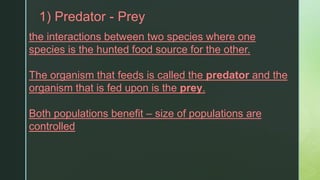
the interactions between two species where one
species is the hunted food source for the other.
The organism that feeds is called the predator and the
organism that is fed upon is the prey.
Both populations benefit – size of populations are
controlled
z1) Predator - Prey
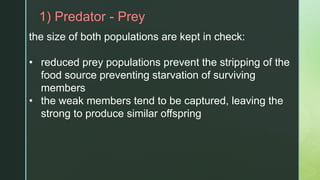
the size of both populations are kept in check:
• reduced prey populations prevent the stripping of the
food source preventing starvation of surviving
members
• the weak members tend to be captured, leaving the
strong to produce similar offspring
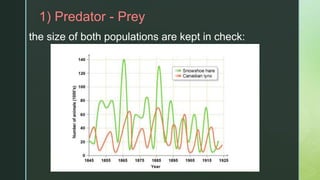
z1) Predator - Prey
the size of both populations are kept in check:
z
Relationships
Symbiosis: Whenever different living things
live closely together where the relationship
may benefit one or both living things
z2) Symbiotic Relationships
Mutualism: Both species benefit ex: flowers & bees
Commensalism: Only one species benefits and neither
are harmed ex: barnacle & whale
Parasitism: Only one species benefits and the other is
harmed ex: ticks & deer
zSable Island
The species of wild horses on Sable island are genetically unique in
the world. They also have a unique relationship with the seals of the
island:
Seals get food from the ocean, and fertilize the grasses of Sable
island.
The horses eat the grass.
Horse population is closely tied to the seal population: more seals ->
more fertilizer -> more nutritious grass -> more horses.
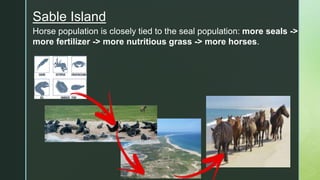
zSable Island
Horse population is closely tied to the seal population: more seals ->
more fertilizer -> more nutritious grass -> more horses.
z3) Interspecies Competition
When two different species are competing for the same
resource.
The competitive exclusion principle states that if two
species with identical niches compete, then one will
inevitably drive the other to extinction.
z3) Interspecies Competition
When two different species are competing for the same
resource.
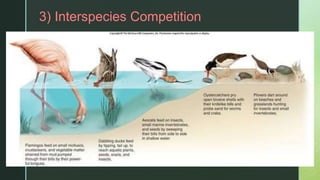
When two species differentiate their niches, they tend
to compete less strongly, and are thus more likely to
coexist.
Species can differentiate their niches in many ways,
such as by consuming different foods, or using different
parts of the environment.
z3) Interspecies Competition
Niche: How an organism satisfies its needs; how it "fits"
into the ecosystem.
An organism's niche can be described by any or all of the
following:
• habitat
• energy source
• water source
Species occupying the same niche are in competition.
z3) Interspecies Competition
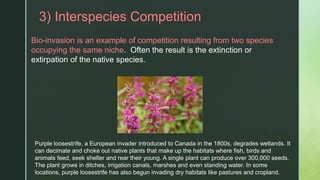
Bio-invasion is an example of competition resulting from two species
occupying the same niche. Often the result is the extinction or
extirpation of the native species.
Purple loosestrife, a European invader introduced to Canada in the 1800s, degrades wetlands. It
can decimate and choke out native plants that make up the habitats where fish, birds and
animals feed, seek shelter and rear their young. A single plant can produce over 300,000 seeds.
The plant grows in ditches, irrigation canals, marshes and even standing water. In some
locations, purple loosestrife has also begun invading dry habitats like pastures and cropland.
z3) Interspecies Competition
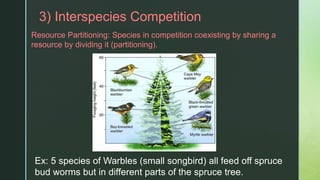
Resource Partitioning: Species in competition coexisting by sharing a
resource by dividing it (partitioning).
Ex: 5 species of Warbles (small songbird) all feed off spruce
bud worms but in different parts of the spruce ​tree.

Unit a biologicaldiversitynotes(relationships)

  • 1.
    z Relationships Interdependence - all speciesare dependent on other species
  • 2.
    z1) Predator -Prey the interactions between two species where one species is the hunted food source for the other. The organism that feeds is called the predator and the organism that is fed upon is the prey. Both populations benefit – size of populations are controlled
  • 3.
    z1) Predator -Prey the size of both populations are kept in check: • reduced prey populations prevent the stripping of the food source preventing starvation of surviving members • the weak members tend to be captured, leaving the strong to produce similar offspring
  • 4.
    z1) Predator -Prey the size of both populations are kept in check:
  • 5.
    z Relationships Symbiosis: Whenever differentliving things live closely together where the relationship may benefit one or both living things
  • 6.
    z2) Symbiotic Relationships Mutualism:Both species benefit ex: flowers & bees Commensalism: Only one species benefits and neither are harmed ex: barnacle & whale Parasitism: Only one species benefits and the other is harmed ex: ticks & deer
  • 7.
    zSable Island The speciesof wild horses on Sable island are genetically unique in the world. They also have a unique relationship with the seals of the island: Seals get food from the ocean, and fertilize the grasses of Sable island. The horses eat the grass. Horse population is closely tied to the seal population: more seals -> more fertilizer -> more nutritious grass -> more horses.
  • 8.
    zSable Island Horse populationis closely tied to the seal population: more seals -> more fertilizer -> more nutritious grass -> more horses.
  • 9.
    z3) Interspecies Competition Whentwo different species are competing for the same resource. The competitive exclusion principle states that if two species with identical niches compete, then one will inevitably drive the other to extinction.
  • 10.
    z3) Interspecies Competition Whentwo different species are competing for the same resource. When two species differentiate their niches, they tend to compete less strongly, and are thus more likely to coexist. Species can differentiate their niches in many ways, such as by consuming different foods, or using different parts of the environment.
  • 11.
    z3) Interspecies Competition Niche:How an organism satisfies its needs; how it "fits" into the ecosystem. An organism's niche can be described by any or all of the following: • habitat • energy source • water source Species occupying the same niche are in competition.
  • 12.
  • 13.
    z3) Interspecies Competition Bio-invasionis an example of competition resulting from two species occupying the same niche. Often the result is the extinction or extirpation of the native species. Purple loosestrife, a European invader introduced to Canada in the 1800s, degrades wetlands. It can decimate and choke out native plants that make up the habitats where fish, birds and animals feed, seek shelter and rear their young. A single plant can produce over 300,000 seeds. The plant grows in ditches, irrigation canals, marshes and even standing water. In some locations, purple loosestrife has also begun invading dry habitats like pastures and cropland.
  • 14.
    z3) Interspecies Competition ResourcePartitioning: Species in competition coexisting by sharing a resource by dividing it (partitioning). Ex: 5 species of Warbles (small songbird) all feed off spruce bud worms but in different parts of the spruce ​tree.