BY
SURABHI TANWAR
Masters Student in the
Environmental Sciences
Institute of Science, Mumbai
COMMUNITY ECOLOGY
What is a Community?
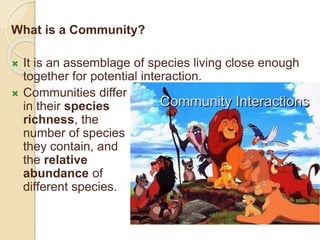
 It is an assemblage of species living close enough
together for potential interaction.
 Communities differ
in their species
richness, the
number of species
they contain, and
the relative
abundance of
different species.
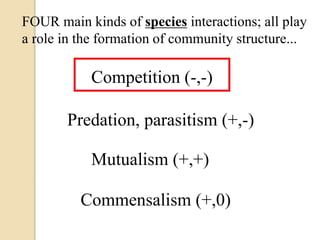
FOUR main kinds of species interactions; all play
a role in the formation of community structure...
Competition (-,-)
Predation, parasitism (+,-)
Mutualism (+,+)
Commensalism (+,0)
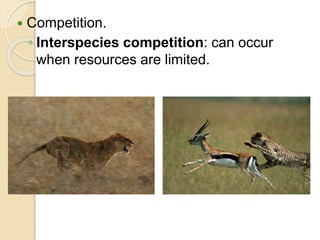
 Competition.
◦ Interspecies competition: can occur
when resources are limited.
 Competition.
◦ Interspecies competition for
resources can occur when
resources are in short supply.
 There is potential for
competition between any
two species that need the
same limited resource.
◦ The competitive exclusion
principle: two species with
similar needs for same limiting
resources cannot coexist in the
same place.
G. F. Gause (1934) tested competitive
exclusion principle
Ecological Niches
 The total of a species’ use of biotic and abiotic
resources is called the species’ ecological
niche
 Ecologically similar species can coexist in a
community if there are one or more significant
differences in their niches
 As a result of competition, a species’
fundamental niche may differ from its realized
niche
Fundamental Niche vs Realized Niche
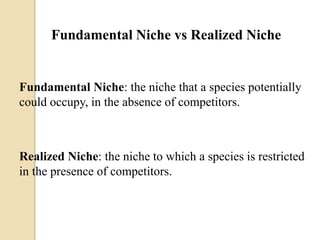
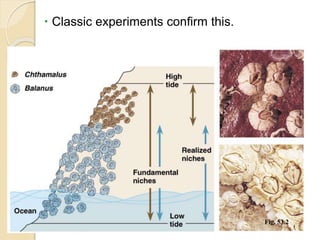
Fundamental Niche: the niche that a species potentially
could occupy, in the absence of competitors.
Realized Niche: the niche to which a species is restricted
in the presence of competitors.
 Classic experiments confirm this.
Fig. 53.2
Resource Partitioning
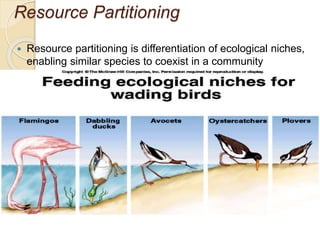
 Resource partitioning is differentiation of ecological niches,
enabling similar species to coexist in a community
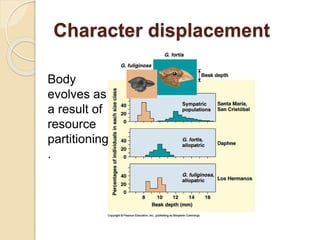
Character displacement
Body
evolves as
a result of
resource
partitioning
.
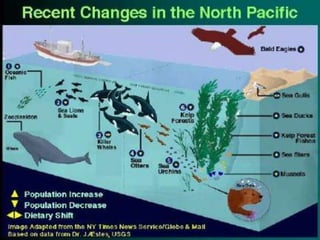
 Predation.
◦ A predator eats prey.
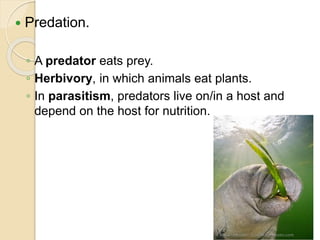
◦ Herbivory, in which animals eat plants.
◦ In parasitism, predators live on/in a host and
depend on the host for nutrition.
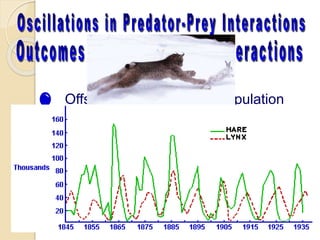
 Offset oscillations in the population
sizes of the predator and prey
 Coevolution of predator and prey
◦ Plant defenses against herbivores include
chemical compounds that are toxic.
◦ Animal defenses against predators.
 Behavioral defenses include fleeing, hiding, self-
defense, noises, and mobbing.
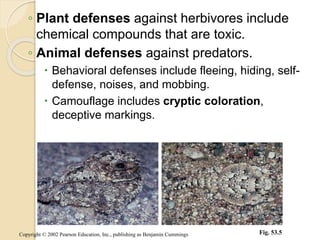
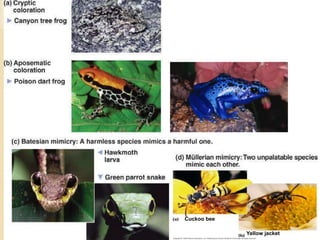
 Camouflage includes cryptic coloration,
deceptive markings.
Fig. 53.5Copyright © 2002 Pearson Education, Inc., publishing as Benjamin Cummings
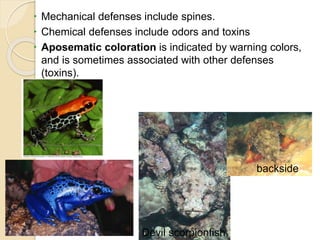
 Mechanical defenses include spines.
 Chemical defenses include odors and toxins
 Aposematic coloration is indicated by warning colors,
and is sometimes associated with other defenses
(toxins).
Devil scorpionfish
backside
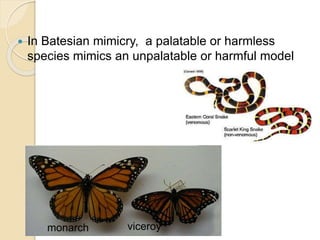
 In Batesian mimicry, a palatable or harmless
species mimics an unpalatable or harmful model
monarch viceroy
Cuckoo bee
Yellow jacket
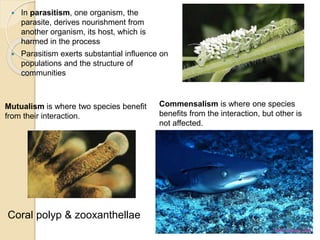
 In parasitism, one organism, the
parasite, derives nourishment from
another organism, its host, which is
harmed in the process
 Parasitism exerts substantial influence on
populations and the structure of
communities
Mutualism is where two species benefit
from their interaction.
Coral polyp & zooxanthellae
Commensalism is where one species
benefits from the interaction, but other is
not affected.
REFRENCES
http://www.bio.miami.edu/ecosummer/lectures/lec_coevolution.html
https://en.wikipedia.org/wiki/Ecological_niche
http://faculty.virginia.edu/bio202/lectures/LectureK7.pdf
http://ani_mardiastuti.staff.ipb.ac.id/files/2011/11/Biopop09_Resource-
Partition.pdf

Community ecology

  • 1.
    BY SURABHI TANWAR Masters Studentin the Environmental Sciences Institute of Science, Mumbai COMMUNITY ECOLOGY
  • 2.
    What is aCommunity?  It is an assemblage of species living close enough together for potential interaction.  Communities differ in their species richness, the number of species they contain, and the relative abundance of different species.
  • 3.
    FOUR main kindsof species interactions; all play a role in the formation of community structure... Competition (-,-) Predation, parasitism (+,-) Mutualism (+,+) Commensalism (+,0)
  • 4.
     Competition. ◦ Interspeciescompetition: can occur when resources are limited.
  • 5.
     Competition. ◦ Interspeciescompetition for resources can occur when resources are in short supply.  There is potential for competition between any two species that need the same limited resource. ◦ The competitive exclusion principle: two species with similar needs for same limiting resources cannot coexist in the same place. G. F. Gause (1934) tested competitive exclusion principle
  • 6.
    Ecological Niches  Thetotal of a species’ use of biotic and abiotic resources is called the species’ ecological niche  Ecologically similar species can coexist in a community if there are one or more significant differences in their niches  As a result of competition, a species’ fundamental niche may differ from its realized niche
  • 7.
    Fundamental Niche vsRealized Niche Fundamental Niche: the niche that a species potentially could occupy, in the absence of competitors. Realized Niche: the niche to which a species is restricted in the presence of competitors.
  • 8.
     Classic experimentsconfirm this. Fig. 53.2
  • 9.
    Resource Partitioning  Resourcepartitioning is differentiation of ecological niches, enabling similar species to coexist in a community
  • 10.
    Character displacement Body evolves as aresult of resource partitioning .
  • 11.
     Predation. ◦ Apredator eats prey. ◦ Herbivory, in which animals eat plants. ◦ In parasitism, predators live on/in a host and depend on the host for nutrition.
  • 12.
     Offset oscillationsin the population sizes of the predator and prey  Coevolution of predator and prey
  • 13.
    ◦ Plant defensesagainst herbivores include chemical compounds that are toxic. ◦ Animal defenses against predators.  Behavioral defenses include fleeing, hiding, self- defense, noises, and mobbing.  Camouflage includes cryptic coloration, deceptive markings. Fig. 53.5Copyright © 2002 Pearson Education, Inc., publishing as Benjamin Cummings
  • 14.
     Mechanical defensesinclude spines.  Chemical defenses include odors and toxins  Aposematic coloration is indicated by warning colors, and is sometimes associated with other defenses (toxins). Devil scorpionfish backside
  • 15.
     In Batesianmimicry, a palatable or harmless species mimics an unpalatable or harmful model monarch viceroy
  • 16.
  • 17.
     In parasitism,one organism, the parasite, derives nourishment from another organism, its host, which is harmed in the process  Parasitism exerts substantial influence on populations and the structure of communities Mutualism is where two species benefit from their interaction. Coral polyp & zooxanthellae Commensalism is where one species benefits from the interaction, but other is not affected.
  • 19.