
Implementing the 
Reliability Strategy 
Prof. Charlton S. Inao 
1 
Unit IX
The importance of reliability 
Electrical, electronic and Mechanical equipment is used in a 
number of fields — in industry for the control of processes, in 
computers, in medical electronics, atomic energy, in weapon 
systems, defence equipments, communications, navigation at sea 
and in the air, and in many other fields. 
It is essential that this equipment should operate reliably under all 
the conditions in which it is used. In the air navigation, military and 
atomic energy fields, for instance, failure could result in a dangerous 
situation. 
Very complicated systems, involving large numbers of separate 
units, such as avionic and aerospace electronic systems are coming 
into use more and more. These systems are extremely complex and 
use a large number of component parts. As each individual part is 
liable to failure, the overall reliability will decrease unless the 
reliability of each component part can be improved. 
2
Mechanical reliability 
The well-reported failures, such as the Space Shuttle Challenger, Chernobyl 
nuclear accidents, and the Bhopal gas escape, emphasize vividly the necessity for 
mechanical reliability. 
Buildings, bridges, transit systems. railways, automotive systems, robots, offshore 
structures, oil pipe lines and tanks, steam turbine plates, roller bearings, etc., all 
have their particular modes of failure affecting their reliability. 
There are a number of common modes of mechanical failures, which are worth 
listing, e.g. with structures: 
(1)Corrosion failures 
(2) Fatigue failures 
(3) Wear failures 
(4) Fretting failures 
(5) Creep failures 
(6) Impact failures 
These may be considered the main failure modes, but there are of course many 
others, such as ductile rupture, thermal shock, galling, brinelling, spalling, 
radiation damage, etc. 
A ‘failure’ is any inability of a part or equipment to carry out its 
3 
specified function.
Reliability Engineering 
• Reliability engineering is an engineering field that deals 
with the study, evaluation, and life-cycle 
management of reliability: the ability of a system or 
component to perform its required functions under 
stated conditions for a specified period of time 
• Reliability engineering is a sub-discipline within systems 
engineering. Reliability is often measured 
as probability of failure, frequency of failures, or in terms 
of availability, a probability derived from reliability and 
maintainability. Maintainability and maintenance are 
often important parts of reliability engineering.
Well-publicized system failures such as those listed below may have 
also contributed to more serious consideration of reliability in product 
design 
• Space Shuttle Challenger Disaster: 
This debacle occurred in 1986, in which all crew 
members lost their lives. The main reason for this 
disaster was design defects. 
• Chernobyl Nuclear Reactor Explosion: 
This disaster also occurred in 1986, in the former 
Soviet Union, in which 31 lives were lost. This 
debacle was also the result of design defects. 
• Point Pleasant Bridge Disaster: 
This bridge located on the West Virginia/ Ohio border 
collapsed in 1967. The disaster resulted in the loss 
of 46 lives and its basic cause was the metal fatigue 
of a critical eye bar.
RELIABILITY SPECIALIZED AND 
APPLICATION AREAS 
• Mechanical reliability 
This is concerned with the reliability of mechanical 
items. Many textbooks and other publications have 
appeared on this topic. 
Example: 
 Critical mechanical component assessment 
 Shaft strength 
 Selection of flexible couplings and transmission brakes 
 Gear life assessment; screening of belt drives 
 Assessment of bearing life, load ratings of slider bearings and shaft 
sealing devices 
 Bolt loading and lubrication systems
• Software reliability. 
This is an important emerging area of reliability as 
the use of computers is increasing at an alarming 
rate. 
• Human reliability. 
In the past, many times systems have failed not due 
to technical faults but due to human error. The 
first book on the topic appeared in 1986 
• Reliability optimization. 
This is concerned with the reliability optimization of 
engineering systems 
• Reliability growth. 
This is basically concerned with monitoring 
reliability growth of engineering systems during 
their design and development
• Structural reliability. 
This is concerned with the reliability of 
engineering structures, in particular civil 
engineering 
• Power system reliability. 
This is a well-developed area and is basically 
concerned with the application of 
reliability principles to conventional power 
system related problems. Many books on 
the subject have appeared over the years 
including a vast number of other 
publications
• Robot reliability and safety. 
This is an emerging new area of the application 
of basic reliability and safety principles to robot 
associated problems. 
• Life cycle costing. 
This is an important subject that is directly 
related to reliability. In particular, when 
estimating the ownership cost of the product, 
the knowledge regarding its failure rate is 
essential. 
• Maintainability. 
This is closely coupled to reliability and is 
concerned with the maintaining aspect of the 
product.
TERMS AND DEFINITIONS 
• Reliability: This is the probability that an item will 
carry out its assigned mission satisfactorily for the 
stated time period when used under the specified 
conditions. 
• Failure: This is the inability of an item to function 
within the initially defined guidelines. 
• Downtime: This is the time period during which the 
item is not in a condition to carry out its stated 
mission. 
• Maintainability: This is the probability that a failed 
item will be repaired to its satisfactory working state. 
• Redundancy :This is the existence of more than one 
means for accomplishing a defined function. 
10
Active redundancy: This is a type of redundancy when all redundant 
items are operating simultaneously. 
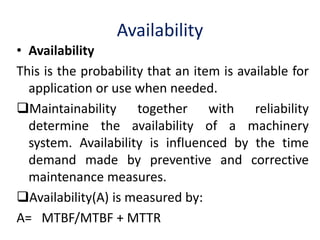
Availability: This is the probability that an item is available for 
application or use when needed. 
Useful life: This is the length of time an item operates within an 
acceptable level of failure rate. 
Mission time: This is the time during which the item is performing its 
specified operating condition. 
Human error: This is the failure to perform a given task (or the 
performance of a forbidden action) that could lead to disruption of 
scheduled operations or result in damage to property/equipment. 
Human reliability: This is the probability of completing a job/task 
successfully by humans at any required stage in the system operation 
within a defined minimum time limit (if the time requirement is 
specified). 
11
MEAN TIME BETWEEN FAILURES (MTBF): The mean exposure 
time between consecutive failures of a component. This applies to 
repairable items, and means that if an item fails, say 5 times over 
a period of use totaling 1000hours, the MTBF would be 1000/5 or 
200hours. 
MEAN TIME BETWEEN MAINTENANCE (MTBM): The average 
time between all maintenance events that cause downtime, both 
preventative and corrective maintenance, and also includes any 
associated logistics delay time. 
MEAN TIME TO FAILURE (MTTF): Mean Time To Failure (MTTF): It 
is the average time that elapses until a failure occurs. MTTF is 
commonly found for non repairable items such as fuses or bulbs, 
etc. 
12
GENERAL RELIABILITY ANALYSIS RELATED 
FORMULAS 
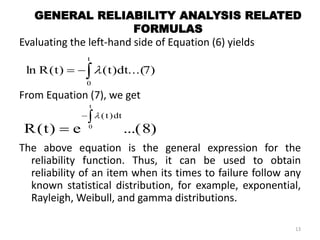
Evaluating the left-hand side of Equation (6) yields 
t 
   
From Equation (7), we get 
t 
 ( t )dt 
The above equation is the general expression for the 
reliability function. Thus, it can be used to obtain 
reliability of an item when its times to failure follow any 
known statistical distribution, for example, exponential, 
Rayleigh,Weibull, and gamma distributions. 
13 
ln R(t) (t)dt...(7) 
0  
R(t)  
e 0 
...(8) 
 
GENERAL RELIABILITY ANALYSIS RELATED FORMULAS 
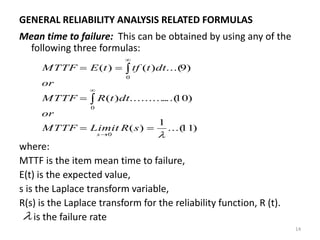
Mean time to failure: This can be obtained by using any of the 
following three formulas: 
MTTF  E t  
tf t dt 
( ) ( ) ...(9) 
or 
MTTF R t dt 
( ) .............(10) 
 
or 
where: 
MTTF is the item mean time to failure, 
E(t) is the expected value, 
s is the Laplace transform variable, 
R(s) is the Laplace transform for the reliability function, R (t). 
is the failure rate 
14 
...(11) 
1 
( ) 
0 
0 
0 
 
  
 
 
 
 
 
MTTF LimitR s 
s 

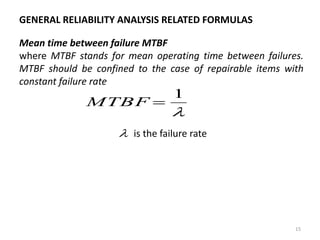
Mean time between failure MTBF 
where MTBF stands for mean operating time between failures. 
MTBF should be confined to the case of repairable items with 
constant failure rate 
15 
GENERAL RELIABILITY ANALYSIS RELATED FORMULAS 
1 
 
MTBF 
is the failure rate 
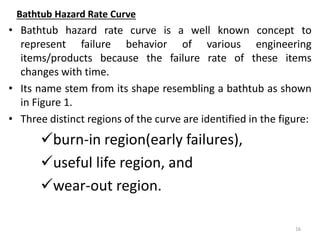
Bathtub Hazard Rate Curve 
• Bathtub hazard rate curve is a well known concept to 
represent failure behavior of various engineering 
items/products because the failure rate of these items 
changes with time. 
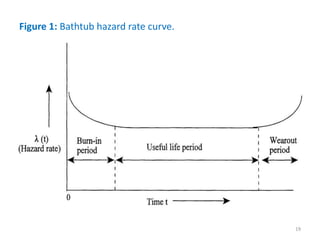
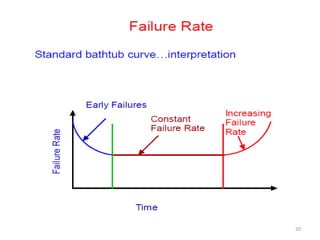
• Its name stem from its shape resembling a bathtub as shown 
in Figure 1. 
• Three distinct regions of the curve are identified in the figure: 
burn-in region(early failures), 
useful life region, and 
wear-out region. 
16
• These regions denote three phases that a newly 
manufactured product passes through during its 
life span. 
• During the burn-in region/period, the product 
hazard rate (i.e., time dependent failure rate) 
decreases and some of the reasons for the 
occurrence of failures during this period are poor 
workmanship, substandard parts and materials, 
poor quality control, poor manufacturing 
methods, ……. 
17
incorrect installation and start-up human error, inadequate 
debugging, incorrect packaging, inadequate processes, and 
poor handling methods. Other names used for the “burn-in 
region” are “debugging region,” “infant mortality region,” and 
“break-in region.” 
• During the useful life region, the product hazard rate remains 
constant and the failures occur randomly or unpredictably. 
Some of the reasons for their occurrence are undetectable 
defects, abuse, low safety factors, higher random stress than 
expected, unavoidable conditions, and human errors. 
• During the wear-out region, the product hazard rate increases 
and some of the reasons for the occurrence of “wear-out 
region” failures are as follows: Poor maintenance, Wear due to 
friction, Wear due to aging, Corrosion and creep, Wrong 
overhaul practices, and Short designed-in life of the product. 
18
Figure 1: Bathtub hazard rate curve. 
19
20
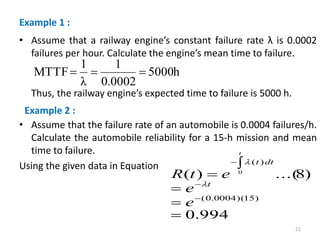
Example 1 : 
• Assume that a railway engine’s constant failure rate λ is 0.0002 
failures per hour. Calculate the engine’s mean time to failure. 
1 
1 
MTTF   
Thus, the railway engine’s expected time to failure is 5000 h. 
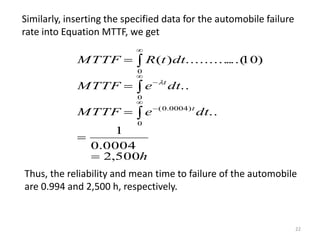
• Assume that the failure rate of an automobile is 0.0004 failures/h. 
Calculate the automobile reliability for a 15-h mission and mean 
time to failure. 
Using the given data in Equation 
R t e 
( ) ...(8) 
21 
5000h 
0.0002 
λ 
(0.0004)(15) 
 
e 
0.994 
( ) 
0 
 
 
 
 
 
 
 
e 
t 
t dt 
t 
 
 
Example 2 :
22 
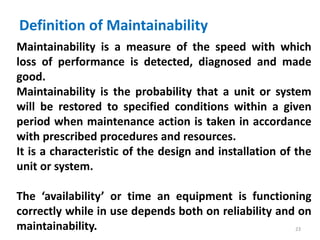
Similarly, inserting the specified data for the automobile failure 
rate into Equation MTTF, we get 
MTTF R t dt 
( ) .............(10) 
 
0 
 
MTTF  
e dt 
 
 
MTTF e dt 
h 
t 
t 
1 
0.0004 
2,500 
.. 
.. 
0 
(0.0004) 
0 
 
 
 
 
 
 
 
 
 
Thus, the reliability and mean time to failure of the automobile 
are 0.994 and 2,500 h, respectively.
Definition of Maintainability 
Maintainability is a measure of the speed with which 
loss of performance is detected, diagnosed and made 
good. 
Maintainability is the probability that a unit or system 
will be restored to specified conditions within a given 
period when maintenance action is taken in accordance 
with prescribed procedures and resources. 
It is a characteristic of the design and installation of the 
unit or system. 
The ‘availability’ or time an equipment is functioning 
correctly while in use depends both on reliability and on 
maintainability. 
23
Definition of Availability 
Availability. Availability is defined as the percentage of 
time that a system is available to perform its required 
function(s). 
It is measured in a variety of ways, but it is principally 
a function of downtime. 
Availability can be used to describe a component or 
system but it is most useful when describing the nature 
of a system of components working together. Because it 
is a fraction of time spent in the “available” state, the 
value can never exceed the bounds of 0 < A < 1. Thus, 
availability will most often be written as a decimal, as 
in 0.99999, as a percentage, as in 99.999%, 
24
Availability 
• Availability 
This is the probability that an item is available for 
application or use when needed. 
Maintainability together with reliability 
determine the availability of a machinery 
system. Availability is influenced by the time 
demand made by preventive and corrective 
maintenance measures. 
Availability(A) is measured by: 
A= MTBF/MTBF + MTTR
26 
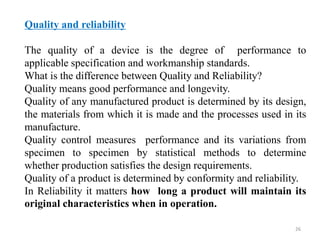
Quality and reliability 
The quality of a device is the degree of performance to 
applicable specification and workmanship standards. 
What is the difference between Quality and Reliability? 
Quality means good performance and longevity. 
Quality of any manufactured product is determined by its design, 
the materials from which it is made and the processes used in its 
manufacture. 
Quality control measures performance and its variations from 
specimen to specimen by statistical methods to determine 
whether production satisfies the design requirements. 
Quality of a product is determined by conformity and reliability. 
In Reliability it matters how long a product will maintain its 
original characteristics when in operation.
27 
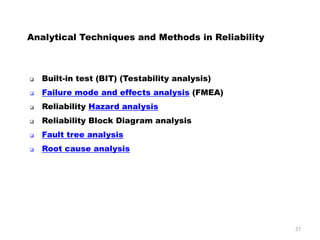
Analytical Techniques and Methods in Reliability 
 Built-in test (BIT) (Testability analysis) 
 Failure mode and effects analysis (FMEA) 
 Reliability Hazard analysis 
 Reliability Block Diagram analysis 
 Fault tree analysis 
 Root cause analysis
28 
 
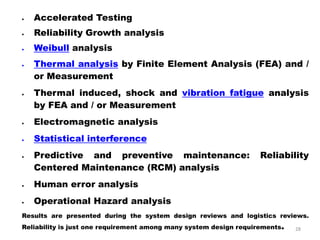
Accelerated Testing 
 
Reliability Growth analysis 
 
Weibull analysis 
 
Thermal analysis by Finite Element Analysis (FEA) and / 
or Measurement 
 
Thermal induced, shock and vibration fatigue analysis 
by FEA and / or Measurement 
 
Electromagnetic analysis 
 
Statistical interference 
 
Predictive and preventive maintenance: Reliability 
Centered Maintenance (RCM) analysis 
 
Human error analysis 
 
Operational Hazard analysis 
Results are presented during the system design reviews and logistics reviews. 
Reliability is just one requirement among many system design requirements.
KEY POINTS 
• Reliability is a measure of uncertainty and therefore 
estimating reliability means using statistics and 
probability theory 
• Reliability is quality over time 
• Reliability must be designed into a product or service 
• Most important aspect of reliability is to identify cause 
of failure and eliminate in design if possible otherwise 
identify ways of accommodation 
• Reliability is defined as the ability of an item to 
perform a required function without failure under stated 
conditions for a stated period of time 
• The costs of unreliability can be damaging to a 
company 
29
Steps in Implementation 
1. Arrange for schedules to be in corporated in 
relevant work plans 
2. Identify the training needs in discussion with 
relevant personnel 
3. Assist personnel to develop required skills for 
inspections and servicing within scope and 
authority. 
4. Collect data/information with performance 
indicators 
5. Recommend improvements to reliability 
strategy in accordance with procedures. 
30
The End 
31

Unit 9 implementing the reliability strategy

  • 1.
    Implementing the ReliabilityStrategy Prof. Charlton S. Inao 1 Unit IX
  • 2.
    The importance ofreliability Electrical, electronic and Mechanical equipment is used in a number of fields — in industry for the control of processes, in computers, in medical electronics, atomic energy, in weapon systems, defence equipments, communications, navigation at sea and in the air, and in many other fields. It is essential that this equipment should operate reliably under all the conditions in which it is used. In the air navigation, military and atomic energy fields, for instance, failure could result in a dangerous situation. Very complicated systems, involving large numbers of separate units, such as avionic and aerospace electronic systems are coming into use more and more. These systems are extremely complex and use a large number of component parts. As each individual part is liable to failure, the overall reliability will decrease unless the reliability of each component part can be improved. 2
  • 3.
    Mechanical reliability Thewell-reported failures, such as the Space Shuttle Challenger, Chernobyl nuclear accidents, and the Bhopal gas escape, emphasize vividly the necessity for mechanical reliability. Buildings, bridges, transit systems. railways, automotive systems, robots, offshore structures, oil pipe lines and tanks, steam turbine plates, roller bearings, etc., all have their particular modes of failure affecting their reliability. There are a number of common modes of mechanical failures, which are worth listing, e.g. with structures: (1)Corrosion failures (2) Fatigue failures (3) Wear failures (4) Fretting failures (5) Creep failures (6) Impact failures These may be considered the main failure modes, but there are of course many others, such as ductile rupture, thermal shock, galling, brinelling, spalling, radiation damage, etc. A ‘failure’ is any inability of a part or equipment to carry out its 3 specified function.
  • 4.
    Reliability Engineering •Reliability engineering is an engineering field that deals with the study, evaluation, and life-cycle management of reliability: the ability of a system or component to perform its required functions under stated conditions for a specified period of time • Reliability engineering is a sub-discipline within systems engineering. Reliability is often measured as probability of failure, frequency of failures, or in terms of availability, a probability derived from reliability and maintainability. Maintainability and maintenance are often important parts of reliability engineering.
  • 5.
    Well-publicized system failuressuch as those listed below may have also contributed to more serious consideration of reliability in product design • Space Shuttle Challenger Disaster: This debacle occurred in 1986, in which all crew members lost their lives. The main reason for this disaster was design defects. • Chernobyl Nuclear Reactor Explosion: This disaster also occurred in 1986, in the former Soviet Union, in which 31 lives were lost. This debacle was also the result of design defects. • Point Pleasant Bridge Disaster: This bridge located on the West Virginia/ Ohio border collapsed in 1967. The disaster resulted in the loss of 46 lives and its basic cause was the metal fatigue of a critical eye bar.
  • 6.
    RELIABILITY SPECIALIZED AND APPLICATION AREAS • Mechanical reliability This is concerned with the reliability of mechanical items. Many textbooks and other publications have appeared on this topic. Example:  Critical mechanical component assessment  Shaft strength  Selection of flexible couplings and transmission brakes  Gear life assessment; screening of belt drives  Assessment of bearing life, load ratings of slider bearings and shaft sealing devices  Bolt loading and lubrication systems
  • 7.
    • Software reliability. This is an important emerging area of reliability as the use of computers is increasing at an alarming rate. • Human reliability. In the past, many times systems have failed not due to technical faults but due to human error. The first book on the topic appeared in 1986 • Reliability optimization. This is concerned with the reliability optimization of engineering systems • Reliability growth. This is basically concerned with monitoring reliability growth of engineering systems during their design and development
  • 8.
    • Structural reliability. This is concerned with the reliability of engineering structures, in particular civil engineering • Power system reliability. This is a well-developed area and is basically concerned with the application of reliability principles to conventional power system related problems. Many books on the subject have appeared over the years including a vast number of other publications
  • 9.
    • Robot reliabilityand safety. This is an emerging new area of the application of basic reliability and safety principles to robot associated problems. • Life cycle costing. This is an important subject that is directly related to reliability. In particular, when estimating the ownership cost of the product, the knowledge regarding its failure rate is essential. • Maintainability. This is closely coupled to reliability and is concerned with the maintaining aspect of the product.
  • 10.
    TERMS AND DEFINITIONS • Reliability: This is the probability that an item will carry out its assigned mission satisfactorily for the stated time period when used under the specified conditions. • Failure: This is the inability of an item to function within the initially defined guidelines. • Downtime: This is the time period during which the item is not in a condition to carry out its stated mission. • Maintainability: This is the probability that a failed item will be repaired to its satisfactory working state. • Redundancy :This is the existence of more than one means for accomplishing a defined function. 10
  • 11.
    Active redundancy: Thisis a type of redundancy when all redundant items are operating simultaneously. Availability: This is the probability that an item is available for application or use when needed. Useful life: This is the length of time an item operates within an acceptable level of failure rate. Mission time: This is the time during which the item is performing its specified operating condition. Human error: This is the failure to perform a given task (or the performance of a forbidden action) that could lead to disruption of scheduled operations or result in damage to property/equipment. Human reliability: This is the probability of completing a job/task successfully by humans at any required stage in the system operation within a defined minimum time limit (if the time requirement is specified). 11
  • 12.
    MEAN TIME BETWEENFAILURES (MTBF): The mean exposure time between consecutive failures of a component. This applies to repairable items, and means that if an item fails, say 5 times over a period of use totaling 1000hours, the MTBF would be 1000/5 or 200hours. MEAN TIME BETWEEN MAINTENANCE (MTBM): The average time between all maintenance events that cause downtime, both preventative and corrective maintenance, and also includes any associated logistics delay time. MEAN TIME TO FAILURE (MTTF): Mean Time To Failure (MTTF): It is the average time that elapses until a failure occurs. MTTF is commonly found for non repairable items such as fuses or bulbs, etc. 12
  • 13.
    GENERAL RELIABILITY ANALYSISRELATED FORMULAS Evaluating the left-hand side of Equation (6) yields t    From Equation (7), we get t  ( t )dt The above equation is the general expression for the reliability function. Thus, it can be used to obtain reliability of an item when its times to failure follow any known statistical distribution, for example, exponential, Rayleigh,Weibull, and gamma distributions. 13 ln R(t) (t)dt...(7) 0  R(t)  e 0 ...(8)  
  • 14.
    GENERAL RELIABILITY ANALYSISRELATED FORMULAS Mean time to failure: This can be obtained by using any of the following three formulas: MTTF  E t  tf t dt ( ) ( ) ...(9) or MTTF R t dt ( ) .............(10)  or where: MTTF is the item mean time to failure, E(t) is the expected value, s is the Laplace transform variable, R(s) is the Laplace transform for the reliability function, R (t). is the failure rate 14 ...(11) 1 ( ) 0 0 0         MTTF LimitR s s 
  • 15.
    Mean time betweenfailure MTBF where MTBF stands for mean operating time between failures. MTBF should be confined to the case of repairable items with constant failure rate 15 GENERAL RELIABILITY ANALYSIS RELATED FORMULAS 1  MTBF is the failure rate 
  • 16.
    Bathtub Hazard RateCurve • Bathtub hazard rate curve is a well known concept to represent failure behavior of various engineering items/products because the failure rate of these items changes with time. • Its name stem from its shape resembling a bathtub as shown in Figure 1. • Three distinct regions of the curve are identified in the figure: burn-in region(early failures), useful life region, and wear-out region. 16
  • 17.
    • These regionsdenote three phases that a newly manufactured product passes through during its life span. • During the burn-in region/period, the product hazard rate (i.e., time dependent failure rate) decreases and some of the reasons for the occurrence of failures during this period are poor workmanship, substandard parts and materials, poor quality control, poor manufacturing methods, ……. 17
  • 18.
    incorrect installation andstart-up human error, inadequate debugging, incorrect packaging, inadequate processes, and poor handling methods. Other names used for the “burn-in region” are “debugging region,” “infant mortality region,” and “break-in region.” • During the useful life region, the product hazard rate remains constant and the failures occur randomly or unpredictably. Some of the reasons for their occurrence are undetectable defects, abuse, low safety factors, higher random stress than expected, unavoidable conditions, and human errors. • During the wear-out region, the product hazard rate increases and some of the reasons for the occurrence of “wear-out region” failures are as follows: Poor maintenance, Wear due to friction, Wear due to aging, Corrosion and creep, Wrong overhaul practices, and Short designed-in life of the product. 18
  • 19.
    Figure 1: Bathtubhazard rate curve. 19
  • 20.
  • 21.
    Example 1 : • Assume that a railway engine’s constant failure rate λ is 0.0002 failures per hour. Calculate the engine’s mean time to failure. 1 1 MTTF   Thus, the railway engine’s expected time to failure is 5000 h. • Assume that the failure rate of an automobile is 0.0004 failures/h. Calculate the automobile reliability for a 15-h mission and mean time to failure. Using the given data in Equation R t e ( ) ...(8) 21 5000h 0.0002 λ (0.0004)(15)  e 0.994 ( ) 0        e t t dt t   Example 2 :
  • 22.
    22 Similarly, insertingthe specified data for the automobile failure rate into Equation MTTF, we get MTTF R t dt ( ) .............(10)  0  MTTF  e dt   MTTF e dt h t t 1 0.0004 2,500 .. .. 0 (0.0004) 0          Thus, the reliability and mean time to failure of the automobile are 0.994 and 2,500 h, respectively.
  • 23.
    Definition of Maintainability Maintainability is a measure of the speed with which loss of performance is detected, diagnosed and made good. Maintainability is the probability that a unit or system will be restored to specified conditions within a given period when maintenance action is taken in accordance with prescribed procedures and resources. It is a characteristic of the design and installation of the unit or system. The ‘availability’ or time an equipment is functioning correctly while in use depends both on reliability and on maintainability. 23
  • 24.
    Definition of Availability Availability. Availability is defined as the percentage of time that a system is available to perform its required function(s). It is measured in a variety of ways, but it is principally a function of downtime. Availability can be used to describe a component or system but it is most useful when describing the nature of a system of components working together. Because it is a fraction of time spent in the “available” state, the value can never exceed the bounds of 0 < A < 1. Thus, availability will most often be written as a decimal, as in 0.99999, as a percentage, as in 99.999%, 24
  • 25.
    Availability • Availability This is the probability that an item is available for application or use when needed. Maintainability together with reliability determine the availability of a machinery system. Availability is influenced by the time demand made by preventive and corrective maintenance measures. Availability(A) is measured by: A= MTBF/MTBF + MTTR
  • 26.
    26 Quality andreliability The quality of a device is the degree of performance to applicable specification and workmanship standards. What is the difference between Quality and Reliability? Quality means good performance and longevity. Quality of any manufactured product is determined by its design, the materials from which it is made and the processes used in its manufacture. Quality control measures performance and its variations from specimen to specimen by statistical methods to determine whether production satisfies the design requirements. Quality of a product is determined by conformity and reliability. In Reliability it matters how long a product will maintain its original characteristics when in operation.
  • 27.
    27 Analytical Techniquesand Methods in Reliability  Built-in test (BIT) (Testability analysis)  Failure mode and effects analysis (FMEA)  Reliability Hazard analysis  Reliability Block Diagram analysis  Fault tree analysis  Root cause analysis
  • 28.
    28  AcceleratedTesting  Reliability Growth analysis  Weibull analysis  Thermal analysis by Finite Element Analysis (FEA) and / or Measurement  Thermal induced, shock and vibration fatigue analysis by FEA and / or Measurement  Electromagnetic analysis  Statistical interference  Predictive and preventive maintenance: Reliability Centered Maintenance (RCM) analysis  Human error analysis  Operational Hazard analysis Results are presented during the system design reviews and logistics reviews. Reliability is just one requirement among many system design requirements.
  • 29.
    KEY POINTS •Reliability is a measure of uncertainty and therefore estimating reliability means using statistics and probability theory • Reliability is quality over time • Reliability must be designed into a product or service • Most important aspect of reliability is to identify cause of failure and eliminate in design if possible otherwise identify ways of accommodation • Reliability is defined as the ability of an item to perform a required function without failure under stated conditions for a stated period of time • The costs of unreliability can be damaging to a company 29
  • 30.
    Steps in Implementation 1. Arrange for schedules to be in corporated in relevant work plans 2. Identify the training needs in discussion with relevant personnel 3. Assist personnel to develop required skills for inspections and servicing within scope and authority. 4. Collect data/information with performance indicators 5. Recommend improvements to reliability strategy in accordance with procedures. 30
  • 31.