RELIABILITY
AND
ITS PRINCIPLES
Dr. Himanshu Hora
SRMS College of Engineering & Technology
Bareilly (INDIA)
What is Reliability ?
• Software reliability is defined as the
probability of failure free software operation
for a specified period of time in a specified
environment.
• It is one of the attribute of software quality.
Reliability
There are four factors associated with Reliability:
1) Numerical Value:
The numerical value is the probability that the product will
function satisfactorily during a particular time.
2) Intended Function:
Product are designed for particular applications and are
expected to be able to perform those applications.
Reliability
3) Life.

How long the product is expected to last. Product life
is specified as a function of usage, time, or both.
4) Environmental Conditions
 Indoors
 Outdoors

 Storage
 Transportation
Aspects of reliability
• Design
• Production
• Transportation
Design
 The most important aspect of reliability is the
design.
 It should be as simple as possible.
 The fewer the number of components, the
greater the reliability.
 Another way of achieving reliability is to have
a backup or redundant component (parallel
component).
Cont…
 Reliability can be achieved by overdesign.

 The use of large factors of safety can increase
the reliability of a product.
 When an unreliable product can lead to a
fatality or substantial financial loss, a fail-safe
type of device should be used.

 The maintenance of the system is an
important factor in reliability.
Production
 The second most important aspect of
reliability is the production process.
 Emphasis should be placed on
components which are least reliable.

 Production personnel

those
Transportation
 The third most important aspect of reliability
is the transportation.
 Packaging
 Shipment

 Performance of the product by the customer
is the final evaluation.
 Good packaging techniques and shipment
evaluation are essential.
Reliability Management
 Select components, designs, and vendors that
meet reliability and cost criteria.
 Determine reliability requirements
machines and equipments.

 Analyze field reliability for improvement.

for
Availability and Maintainability
For long-lasting products and services such as
refrigerators, electric power lines, and frontline services, the time-related factors of
availability, reliability, and maintainability are
interrelated.
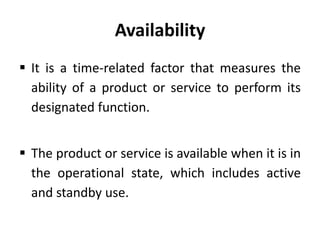
Availability
 It is a time-related factor that measures the
ability of a product or service to perform its
designated function.
 The product or service is available when it is in
the operational state, which includes active
and standby use.
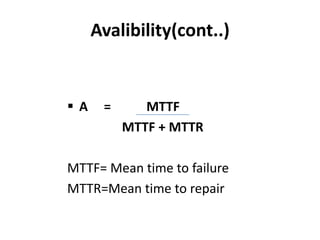
Avalibility(cont..)

A

=

MTTF
MTTF + MTTR

MTTF= Mean time to failure
MTTR=Mean time to repair
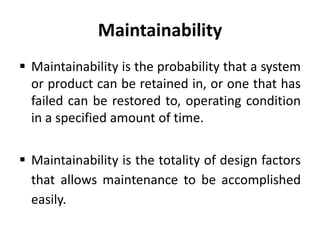
Maintainability
 Maintainability is the probability that a system
or product can be retained in, or one that has
failed can be restored to, operating condition
in a specified amount of time.
 Maintainability is the totality of design factors
that allows maintenance to be accomplished
easily.
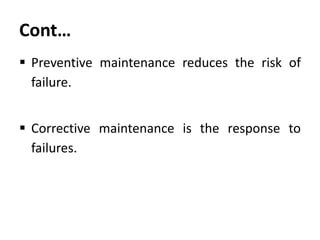
Cont…
 Preventive maintenance reduces the risk of
failure.
 Corrective maintenance is the response to
failures.
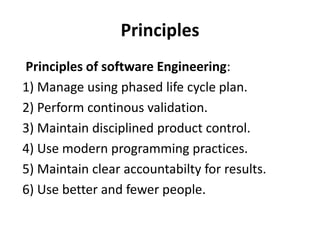
Principles
Principles of software Engineering:
1) Manage using phased life cycle plan.
2) Perform continous validation.
3) Maintain disciplined product control.
4) Use modern programming practices.
5) Maintain clear accountabilty for results.
6) Use better and fewer people.
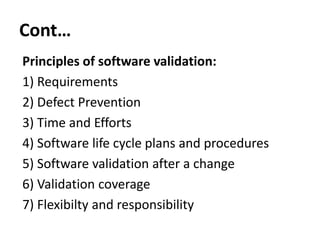
Cont…
Principles of software validation:
1) Requirements
2) Defect Prevention
3) Time and Efforts
4) Software life cycle plans and procedures
5) Software validation after a change
6) Validation coverage
7) Flexibilty and responsibility
Thank You
Dr. Himanshu Hora
SRMS College of Engineering & Technology
Bareilly (INDIA)

Reliability and its principals

  • 1.
    RELIABILITY AND ITS PRINCIPLES Dr. HimanshuHora SRMS College of Engineering & Technology Bareilly (INDIA)
  • 2.
    What is Reliability? • Software reliability is defined as the probability of failure free software operation for a specified period of time in a specified environment. • It is one of the attribute of software quality.
  • 3.
    Reliability There are fourfactors associated with Reliability: 1) Numerical Value: The numerical value is the probability that the product will function satisfactorily during a particular time. 2) Intended Function: Product are designed for particular applications and are expected to be able to perform those applications.
  • 4.
    Reliability 3) Life. How longthe product is expected to last. Product life is specified as a function of usage, time, or both. 4) Environmental Conditions  Indoors  Outdoors  Storage  Transportation
  • 5.
    Aspects of reliability •Design • Production • Transportation
  • 6.
    Design  The mostimportant aspect of reliability is the design.  It should be as simple as possible.  The fewer the number of components, the greater the reliability.  Another way of achieving reliability is to have a backup or redundant component (parallel component).
  • 7.
    Cont…  Reliability canbe achieved by overdesign.  The use of large factors of safety can increase the reliability of a product.  When an unreliable product can lead to a fatality or substantial financial loss, a fail-safe type of device should be used.  The maintenance of the system is an important factor in reliability.
  • 8.
    Production  The secondmost important aspect of reliability is the production process.  Emphasis should be placed on components which are least reliable.  Production personnel those
  • 9.
    Transportation  The thirdmost important aspect of reliability is the transportation.  Packaging  Shipment  Performance of the product by the customer is the final evaluation.  Good packaging techniques and shipment evaluation are essential.
  • 10.
    Reliability Management  Selectcomponents, designs, and vendors that meet reliability and cost criteria.  Determine reliability requirements machines and equipments.  Analyze field reliability for improvement. for
  • 11.
    Availability and Maintainability Forlong-lasting products and services such as refrigerators, electric power lines, and frontline services, the time-related factors of availability, reliability, and maintainability are interrelated.
  • 12.
    Availability  It isa time-related factor that measures the ability of a product or service to perform its designated function.  The product or service is available when it is in the operational state, which includes active and standby use.
  • 13.
    Avalibility(cont..) A = MTTF MTTF + MTTR MTTF=Mean time to failure MTTR=Mean time to repair
  • 14.
    Maintainability  Maintainability isthe probability that a system or product can be retained in, or one that has failed can be restored to, operating condition in a specified amount of time.  Maintainability is the totality of design factors that allows maintenance to be accomplished easily.
  • 15.
    Cont…  Preventive maintenancereduces the risk of failure.  Corrective maintenance is the response to failures.
  • 16.
    Principles Principles of softwareEngineering: 1) Manage using phased life cycle plan. 2) Perform continous validation. 3) Maintain disciplined product control. 4) Use modern programming practices. 5) Maintain clear accountabilty for results. 6) Use better and fewer people.
  • 17.
    Cont… Principles of softwarevalidation: 1) Requirements 2) Defect Prevention 3) Time and Efforts 4) Software life cycle plans and procedures 5) Software validation after a change 6) Validation coverage 7) Flexibilty and responsibility
  • 18.
    Thank You Dr. HimanshuHora SRMS College of Engineering & Technology Bareilly (INDIA)