2/10/20161
Presented by:
Vikash K Giri
PGDM (Marketing)
Batch: 2014-16
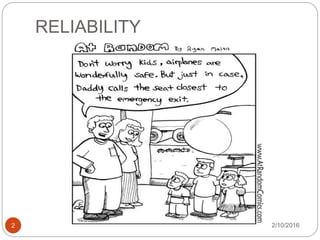
RELIABILITY
2/10/20162
Definition
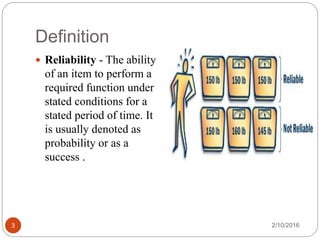
 Reliability - The ability
of an item to perform a
required function under
stated conditions for a
stated period of time. It
is usually denoted as
probability or as a
success .
2/10/20163
Type of reliability
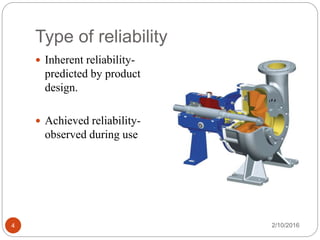
 Inherent reliability-
predicted by product
design.
 Achieved reliability-
observed during use
2/10/20164
 Reliability is related to the
safety of a system.
 Deals with the estimation
and management of high
levels of lifetime
engineering uncertainty
and risks of failure.
 Failure – The termination
of ability of an item to
perform a required
function.
2/10/20165
Type of failure
 Functional failure-
failure that occurs that at
the start of a product life
due to manufacturing
material defect.
 Reliability failure-
failure after some period
of time.
2/10/20166
Reliability measurement
 Failure rate – number of failure per unit time.
 Alternative measures
1. Mean time to failure
2. Mean time between failure
2/10/20167
 Observed Failure Rate – For a stated period in life of
an item, the ratio of the total number of failures in a
sample to the cumulative of the time on that sample.
The observed failure rate is associated with particular
and stated time intervals(or summation of intervals) in
the life of the item and under stated conditions. For
example, an automobile's failure rate in its fifth year of
service may be many times greater than its failure rate
during its first year of service.
2/10/20168
Bath tub curve
2/10/20169
 In the given graph, the 'bathtub curve' hazard function
(blue, upper solid line) is a combination of a decreasing
hazard of early failure (red dotted line) and an increasing
hazard of wear-out failure (yellow dotted line), plus some
constant hazard of random failure (green, lower solid line).
 It comprises of 3 parts:
1. The first part is a decreasing failure rate, known as
early failures.
2. The second part is a constant failure rate, known
as random failures.
3. The third part is an increasing failure rate, known as wear-
out failures.
2/10/201610
Advantages of reliability
 Focuses on costs of failure caused by system downtime,
cost of spares, repair equipment, personnel and cost of
warranty claims.
 For defense product and system, reliability is the
differentiating factor determining mission success or loss of
life.
 For industrial system and plants, reliability directly
influences inherent availability and return on investment.
 For commercial product, high reliability provide a supplier
with competitive advantage, resulting increase in market
share and higher profit.
2/10/201611
Advantages of reliability
 The capacity of a designed, produced or maintained
item to perform as required over time
 The capacity of a population of designed, produced or
maintained items to perform as required over specified
time
 The resistance to failure of an item over time
 The probability of an item to perform a required
function under stated conditions for a specified period
of time
 The durability of an object.
2/10/201612
Maintainability
 The probability that a system
or a product can be retained in,
or one that has failed can be
restored .
2/10/201613
Advantages of maintainability
 Correct defects or their cause
 Prevent unexpected breakdowns
 Maximize a product's useful life
 Maximize efficiency, reliability and safety
 Make future maintenance easier
2/10/201614
Design for Maintainability
 Repairable
 Interchangeability.
 Accessibility.
2/10/201615
Availability
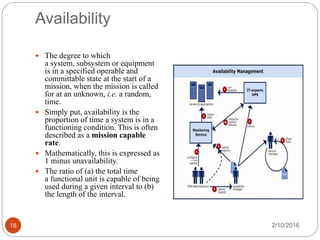
 The degree to which
a system, subsystem or equipment
is in a specified operable and
committable state at the start of a
mission, when the mission is called
for at an unknown, i.e. a random,
time.
 Simply put, availability is the
proportion of time a system is in a
functioning condition. This is often
described as a mission capable
rate.
 Mathematically, this is expressed as
1 minus unavailability.
 The ratio of (a) the total time
a functional unit is capable of being
used during a given interval to (b)
the length of the interval.
2/10/201616
Name Definition
Guarantee An assurance given by the manufacturer to the vendor that the product will work without
failure for a stated period of time
Warranty A written guarantee given to the purchaser of a new appliance, automobile, or other item by
the manufacturer or dealer, usually specifying that the manufacturer will make any repairs
or replace defective parts free of charge for a stated period of time.
Maintainability The measure of the ability of an item to be retained in or retained in or restored to a specified
condition when maintenance is performed by personnel having specified skill levels, using
prescribed procedures and resources
Applies to a major tasks where many repetitions are expected and where considerable time
is required
Availability A tool for measuring the percent of time an item or system is in a state of readiness where it is
operable and can be committed to use when called upon. Availability ceases because of a downing
event that causes the item/to system become unavailable to initiate a mission when called upon
Availability=MTBF/(MTBF+MTTR)
Reliability The ability of an item to perform a required function under stated conditions for a
stated period of time. It is usually denoted as probability or as a success .
2/10/201617
What is reliability engineering
 Manufacturers often suffer high costs
of failure under warranty
 Reliability is usually concerned with
failures in the time domain. This
distinction marks the difference
between traditional quality control and
reliability engineering
 Whether failures occur or not and their
times to occurrence can seldom be
forecast accurately .reliability is
therefore an aspect of engineering
uncertainty
 Whether an item will work for a
particular period is a question which
can be answered as a probability.
 Ultimately reliability engineering is
effective management of engineering
2/10/201618
Reliability centered maintenance
 A process to ensure that systems continue to do
what their users require in their present operating
context.
 It is used to achieve improvements in fields such
as the establishment of safe minimum levels of
maintenance, changes to operating procedures
and strategies and the establishment of capital
maintenance regimes and plans.
 It regards maintenance as the means to maintain
the functions a user may require of machinery in
a defined operating context.
2/10/201619
 RCM offers five principal options among the risk
management strategies:
 Predictive maintenance tasks
 Preventive Restoration or Preventive Replacement
maintenance tasks
 Detective maintenance tasks
 Run-to-Failure
 One-time changes to the "system" (changes to
hardware design, to operations, or to other things)
2/10/201620
Why engineering items failed?
 The design might be
inherently incapable, the
more complex the design
,more the difficult to
overcome the problem
 The item might be
overstressed in some way
 Failures can be caused by
wear out. Sufficiently strong
at the start of the life and
become weaker with age
 Failures can be caused by
other time dependent
mechanism such as battery
run down, creep in turbine
caused simultaneously by
high temperature and tensile
stress
2/10/201621
MISSION RELIABILITY
Mission reliability is defined as the ability of an item
to perform its required functions for the duration
of a specified “mission profile.”
 Mission reliability thus defines the probability of
non-failure of the system for the period of time
required to complete a mission. The probability is
a point on the reliability function corresponding to
a time equal to the mission length.
2/10/201622
BAUXITE
SL
H/C U/F
AIR
CLUTCH
MOTOR
GEAR
BOX
TROMMEL
SCREEN
MSP
Ball mill in NALCO
2/10/201623
CONCLUSION
 Reliability is like a preventive measures to avoid
failures.
 Reliable product will give consistent output for a
longer period of time.
 Failure occurs if a product is not reliable. So,
maintenance is required.
 Maintainability is restoring the failed parts to
working condition.
 Availability is when a product is in committable
state and available in specific time or random
time.
2/10/201624
2/10/201625
2/10/201626

Reliability

  • 1.
    2/10/20161 Presented by: Vikash KGiri PGDM (Marketing) Batch: 2014-16
  • 2.
  • 3.
    Definition  Reliability -The ability of an item to perform a required function under stated conditions for a stated period of time. It is usually denoted as probability or as a success . 2/10/20163
  • 4.
    Type of reliability Inherent reliability- predicted by product design.  Achieved reliability- observed during use 2/10/20164
  • 5.
     Reliability isrelated to the safety of a system.  Deals with the estimation and management of high levels of lifetime engineering uncertainty and risks of failure.  Failure – The termination of ability of an item to perform a required function. 2/10/20165
  • 6.
    Type of failure Functional failure- failure that occurs that at the start of a product life due to manufacturing material defect.  Reliability failure- failure after some period of time. 2/10/20166
  • 7.
    Reliability measurement  Failurerate – number of failure per unit time.  Alternative measures 1. Mean time to failure 2. Mean time between failure 2/10/20167
  • 8.
     Observed FailureRate – For a stated period in life of an item, the ratio of the total number of failures in a sample to the cumulative of the time on that sample. The observed failure rate is associated with particular and stated time intervals(or summation of intervals) in the life of the item and under stated conditions. For example, an automobile's failure rate in its fifth year of service may be many times greater than its failure rate during its first year of service. 2/10/20168
  • 9.
  • 10.
     In thegiven graph, the 'bathtub curve' hazard function (blue, upper solid line) is a combination of a decreasing hazard of early failure (red dotted line) and an increasing hazard of wear-out failure (yellow dotted line), plus some constant hazard of random failure (green, lower solid line).  It comprises of 3 parts: 1. The first part is a decreasing failure rate, known as early failures. 2. The second part is a constant failure rate, known as random failures. 3. The third part is an increasing failure rate, known as wear- out failures. 2/10/201610
  • 11.
    Advantages of reliability Focuses on costs of failure caused by system downtime, cost of spares, repair equipment, personnel and cost of warranty claims.  For defense product and system, reliability is the differentiating factor determining mission success or loss of life.  For industrial system and plants, reliability directly influences inherent availability and return on investment.  For commercial product, high reliability provide a supplier with competitive advantage, resulting increase in market share and higher profit. 2/10/201611
  • 12.
    Advantages of reliability The capacity of a designed, produced or maintained item to perform as required over time  The capacity of a population of designed, produced or maintained items to perform as required over specified time  The resistance to failure of an item over time  The probability of an item to perform a required function under stated conditions for a specified period of time  The durability of an object. 2/10/201612
  • 13.
    Maintainability  The probabilitythat a system or a product can be retained in, or one that has failed can be restored . 2/10/201613
  • 14.
    Advantages of maintainability Correct defects or their cause  Prevent unexpected breakdowns  Maximize a product's useful life  Maximize efficiency, reliability and safety  Make future maintenance easier 2/10/201614
  • 15.
    Design for Maintainability Repairable  Interchangeability.  Accessibility. 2/10/201615
  • 16.
    Availability  The degreeto which a system, subsystem or equipment is in a specified operable and committable state at the start of a mission, when the mission is called for at an unknown, i.e. a random, time.  Simply put, availability is the proportion of time a system is in a functioning condition. This is often described as a mission capable rate.  Mathematically, this is expressed as 1 minus unavailability.  The ratio of (a) the total time a functional unit is capable of being used during a given interval to (b) the length of the interval. 2/10/201616
  • 17.
    Name Definition Guarantee Anassurance given by the manufacturer to the vendor that the product will work without failure for a stated period of time Warranty A written guarantee given to the purchaser of a new appliance, automobile, or other item by the manufacturer or dealer, usually specifying that the manufacturer will make any repairs or replace defective parts free of charge for a stated period of time. Maintainability The measure of the ability of an item to be retained in or retained in or restored to a specified condition when maintenance is performed by personnel having specified skill levels, using prescribed procedures and resources Applies to a major tasks where many repetitions are expected and where considerable time is required Availability A tool for measuring the percent of time an item or system is in a state of readiness where it is operable and can be committed to use when called upon. Availability ceases because of a downing event that causes the item/to system become unavailable to initiate a mission when called upon Availability=MTBF/(MTBF+MTTR) Reliability The ability of an item to perform a required function under stated conditions for a stated period of time. It is usually denoted as probability or as a success . 2/10/201617
  • 18.
    What is reliabilityengineering  Manufacturers often suffer high costs of failure under warranty  Reliability is usually concerned with failures in the time domain. This distinction marks the difference between traditional quality control and reliability engineering  Whether failures occur or not and their times to occurrence can seldom be forecast accurately .reliability is therefore an aspect of engineering uncertainty  Whether an item will work for a particular period is a question which can be answered as a probability.  Ultimately reliability engineering is effective management of engineering 2/10/201618
  • 19.
    Reliability centered maintenance A process to ensure that systems continue to do what their users require in their present operating context.  It is used to achieve improvements in fields such as the establishment of safe minimum levels of maintenance, changes to operating procedures and strategies and the establishment of capital maintenance regimes and plans.  It regards maintenance as the means to maintain the functions a user may require of machinery in a defined operating context. 2/10/201619
  • 20.
     RCM offersfive principal options among the risk management strategies:  Predictive maintenance tasks  Preventive Restoration or Preventive Replacement maintenance tasks  Detective maintenance tasks  Run-to-Failure  One-time changes to the "system" (changes to hardware design, to operations, or to other things) 2/10/201620
  • 21.
    Why engineering itemsfailed?  The design might be inherently incapable, the more complex the design ,more the difficult to overcome the problem  The item might be overstressed in some way  Failures can be caused by wear out. Sufficiently strong at the start of the life and become weaker with age  Failures can be caused by other time dependent mechanism such as battery run down, creep in turbine caused simultaneously by high temperature and tensile stress 2/10/201621
  • 22.
    MISSION RELIABILITY Mission reliabilityis defined as the ability of an item to perform its required functions for the duration of a specified “mission profile.”  Mission reliability thus defines the probability of non-failure of the system for the period of time required to complete a mission. The probability is a point on the reliability function corresponding to a time equal to the mission length. 2/10/201622
  • 23.
  • 24.
    CONCLUSION  Reliability islike a preventive measures to avoid failures.  Reliable product will give consistent output for a longer period of time.  Failure occurs if a product is not reliable. So, maintenance is required.  Maintainability is restoring the failed parts to working condition.  Availability is when a product is in committable state and available in specific time or random time. 2/10/201624
  • 25.
  • 26.

Editor's Notes

  • #23 mission reliability is the ability of an item to perform its required functions for the duration of a specified mission. This definition applies directly to items of continuous use, such as engines, communication devices, and sensors.