UNCONVENTIONAL MACHINING
PROCESS – UNIT 5
Thermal Energy Based process
Thermal Energy based Processes
• Heat energy is concentrated on a small area of
work piece to melt and vaporize the tiny bits
of work material
• Required shape is obtained by the continued
repetition of the process
• Example
1. Electron Beam Machining (EBM)
2. Laser Beam Machining (LBM)
3. Plasma Arc Machining (PAM)
Electron Beam Machining (EBM)
• A beam of high velocity electrons travelling at
half the velocity of light (1.6 X 10^8 m/S) are
focused on the work piece to remove the metal
• Principle
– When high velocity beam of electrons strike the work
piece its kinetic energy is converted into heat
– This concentrated heat raises the temperature of work
piece material and vaporizes a small amount of it,
resulting in removal of material from work piece
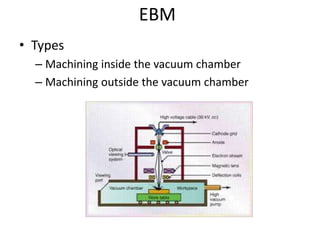
EBM
• Types
– Machining inside the vacuum chamber
– Machining outside the vacuum chamber
EBM
EBM
• Process parameters
– Control of current
– Control of spot diameter
– Control of focal distance of magnetic lens
• Applications
– Used for micromachining operations
– Used to drill holes in pressure differential devices
– Used to remove small broken taps from holes
– Used to machine low thermal conductivity and
high melting point materials
EBM
Accelerating voltage 50 to 200 KV
Beam current 100 to 1000µA
Electron velocity 1.6X10^8 m/S
Medium Vacuum
Work piece materials All materials
Depth of cut Up to 6.5mm
MRR Up to 4.Cu.mm/S
Specific power consumption 0.5 to 50 KW
Power density 6500 billion W/mm^2
EBM
• Advantages
– Excellent process for micromachining
– Very small holes and holes of different sized can be
machined
– No mechanical contact between tool and work piece
– Quick process
– Easily automated
– Close tolerances are obtained
– Brittle and fragile materials can be machined
– Physical and metallurgical damage to work piece are
less
EBM
• Disadvantages
– MRR is very low
– Cost of equipment is high
– Not suitable for large work pieces
– Little taper is produced on holes
– Vacuum requirements limits the size of work piece
– Not suitable to produce perfectly cylindrical
profiles
– Applicable for thin materials
– Energy consumption is high
Laser beam Machining (LBM)
• LASER – Light Amplification by Stimulated
Emission of Radiation
• Like EBM; LBM is also used to drill micro holes
up to 25µ
• Principle
– Laser beam is focused on the work piece by
means of lens to give extremely high energy
density to melt and vaporize the work material
LBM
LBM
LBM
• Accuracy
– To get best possible results, the material should be
placed within a tolerance of ±0.2mm focal point
• Lasing materials
– Solid laser
• Ruby laser, neodymium doped Yttrium – Aluminum –Garnet
(Nd-YAG) laser and neodymium doped glass laser
– Gas Laser
• Can be operated continuously
• Produces exceptionally high monochromaticity and high
stability of frequency
• Example
– Carbon dioxide Laser
– Helium-Neon Laser
LBM
• Processing with LASER
S. No Special characteristics of a LASER
beam
Cutting process characteristics
1 Can be focused to a maximum or
minimum intensity as needed
MRR is maximum to minimum
2 Can be moved rapidly on work piece Cutting of complex shapes
3 Projected on the work piece at a
particular distance from the lens
Remote cutting over long stand-off
distances
4 Dedicated to on-line processes Re-routing is not necessary
5 Power is shared on a job Two or more cuts simultaneously
LBM
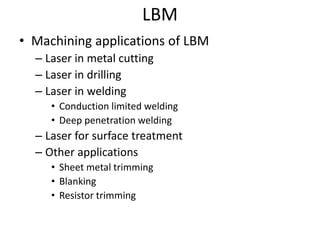
• Machining applications of LBM
– Laser in metal cutting
– Laser in drilling
– Laser in welding
• Conduction limited welding
• Deep penetration welding
– Laser for surface treatment
– Other applications
• Sheet metal trimming
• Blanking
• Resistor trimming
LBM
• Characteristics
Metal removal technique Heating, melting & vaporization of material by
using high intensity of laser beam
Work material All materials expect those having high thermal
conductivity
Tool Laser beam of wavelength range 0.3 to 0.6µ
Power density 10^7 W/sq.mm
Output energy laser 20 J
MRR 6 Cu.mm/min
Pulse duration 1 millisecond
Dimensional accuracy ±0.025mm
Medium Atmosphere
Efficiency 10 to 15 %
Specific power
consumption
1000 W/Cu.mm/min
LBM
• Advantages
– Micro sized holes are produced
– Soft materials like rubber can be machined
– No tool wear
– No direct contact between tool and work piece
– Dissimilar materials can be easily welded
– Easily automated
– Hardness of material does not affect the process
– Heat affected zone is very small
– Deep holes of short diameter can be easily drilled
LBM
• Disadvantages
– Initial investment is high
– Operating cost is also quite high
– Highly skilled operators are needed
– Rate of production is low
– Safety procedures to be followed strictly
– Overall efficiency is extremely low
– Life of flash lamp is short
– Machined hole is not round and straight
Plasma Arc Machining (PAM)
or
Plasma Jet machining (PJM)
• Principle
– Material is removed by directing a high velocity jet
of high temperature [11000 to 28000 deg. celcius]
ionized gas on the work piece, which in turn melts
the material from work piece
PAM
PAM
PAM
• Gases used in PAM
– Gas used should not affect the electrode or work
piece to be machined
S.No Gas or Gas Mixture Material to be machined
1 Nitrogen-hydrogen,
Argon-hydrogen
Stainless steel, non ferrous
material
2 Nitrogen-hydrogen,
Compressed air
Carbon & alloy steel, cast iron
3 Nitrogen,
nitrogen-hydrogen
Argon-hydrogen
Aluminum, Magnesium
PAM
• Types
– Direct arc plasma torch
– Indirect arc plasma torch
• Accuracy of PAM
– Accuracy of 1.4mm is obtained
– Accuracy on width of slots and diameter of holes
is ordinarily from ±4mm to 150 mm thick plates
PAM
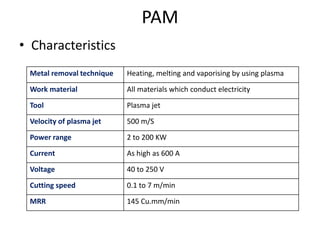
• Characteristics
Metal removal technique Heating, melting and vaporising by using plasma
Work material All materials which conduct electricity
Tool Plasma jet
Velocity of plasma jet 500 m/S
Power range 2 to 200 KW
Current As high as 600 A
Voltage 40 to 250 V
Cutting speed 0.1 to 7 m/min
MRR 145 Cu.mm/min
PAM
• Process parameters
– Stand off distance
– Thermo physical and metallurgical properties of
plasma
– Cutting speed or velocity of plasma jet
• Applications
– Used for profile cutting
– Used for turning and milling of hard to machine
materials
– Can be used for stack cutting, shape cutting
– Uniform thin film spraying of refractory materials
– Used to cut alloy steels, SS, copper, nickel, titanium,
Aluminum and alloy of copper and nickel
PAM
• Advantages
– Used to cut any material
– Cutting rate is high
– Can cut plain carbon steel four times faster than
ordinary flame cutting process
– Used for rough turning of very difficult materials
• Disadvantages
– Produces tapered surface
– Noise protection is necessary
– Equipment cost is high
– Protection of eyes is necessary for the operator
– Work surface may undergo metallurgical changes

Unit 5 thermal based energy process

  • 1.
    UNCONVENTIONAL MACHINING PROCESS –UNIT 5 Thermal Energy Based process
  • 2.
    Thermal Energy basedProcesses • Heat energy is concentrated on a small area of work piece to melt and vaporize the tiny bits of work material • Required shape is obtained by the continued repetition of the process • Example 1. Electron Beam Machining (EBM) 2. Laser Beam Machining (LBM) 3. Plasma Arc Machining (PAM)
  • 3.
    Electron Beam Machining(EBM) • A beam of high velocity electrons travelling at half the velocity of light (1.6 X 10^8 m/S) are focused on the work piece to remove the metal • Principle – When high velocity beam of electrons strike the work piece its kinetic energy is converted into heat – This concentrated heat raises the temperature of work piece material and vaporizes a small amount of it, resulting in removal of material from work piece
  • 4.
    EBM • Types – Machininginside the vacuum chamber – Machining outside the vacuum chamber
  • 5.
  • 6.
    EBM • Process parameters –Control of current – Control of spot diameter – Control of focal distance of magnetic lens • Applications – Used for micromachining operations – Used to drill holes in pressure differential devices – Used to remove small broken taps from holes – Used to machine low thermal conductivity and high melting point materials
  • 7.
    EBM Accelerating voltage 50to 200 KV Beam current 100 to 1000µA Electron velocity 1.6X10^8 m/S Medium Vacuum Work piece materials All materials Depth of cut Up to 6.5mm MRR Up to 4.Cu.mm/S Specific power consumption 0.5 to 50 KW Power density 6500 billion W/mm^2
  • 8.
    EBM • Advantages – Excellentprocess for micromachining – Very small holes and holes of different sized can be machined – No mechanical contact between tool and work piece – Quick process – Easily automated – Close tolerances are obtained – Brittle and fragile materials can be machined – Physical and metallurgical damage to work piece are less
  • 9.
    EBM • Disadvantages – MRRis very low – Cost of equipment is high – Not suitable for large work pieces – Little taper is produced on holes – Vacuum requirements limits the size of work piece – Not suitable to produce perfectly cylindrical profiles – Applicable for thin materials – Energy consumption is high
  • 10.
    Laser beam Machining(LBM) • LASER – Light Amplification by Stimulated Emission of Radiation • Like EBM; LBM is also used to drill micro holes up to 25µ • Principle – Laser beam is focused on the work piece by means of lens to give extremely high energy density to melt and vaporize the work material
  • 11.
  • 12.
  • 13.
    LBM • Accuracy – Toget best possible results, the material should be placed within a tolerance of ±0.2mm focal point • Lasing materials – Solid laser • Ruby laser, neodymium doped Yttrium – Aluminum –Garnet (Nd-YAG) laser and neodymium doped glass laser – Gas Laser • Can be operated continuously • Produces exceptionally high monochromaticity and high stability of frequency • Example – Carbon dioxide Laser – Helium-Neon Laser
  • 14.
    LBM • Processing withLASER S. No Special characteristics of a LASER beam Cutting process characteristics 1 Can be focused to a maximum or minimum intensity as needed MRR is maximum to minimum 2 Can be moved rapidly on work piece Cutting of complex shapes 3 Projected on the work piece at a particular distance from the lens Remote cutting over long stand-off distances 4 Dedicated to on-line processes Re-routing is not necessary 5 Power is shared on a job Two or more cuts simultaneously
  • 15.
    LBM • Machining applicationsof LBM – Laser in metal cutting – Laser in drilling – Laser in welding • Conduction limited welding • Deep penetration welding – Laser for surface treatment – Other applications • Sheet metal trimming • Blanking • Resistor trimming
  • 16.
    LBM • Characteristics Metal removaltechnique Heating, melting & vaporization of material by using high intensity of laser beam Work material All materials expect those having high thermal conductivity Tool Laser beam of wavelength range 0.3 to 0.6µ Power density 10^7 W/sq.mm Output energy laser 20 J MRR 6 Cu.mm/min Pulse duration 1 millisecond Dimensional accuracy ±0.025mm Medium Atmosphere Efficiency 10 to 15 % Specific power consumption 1000 W/Cu.mm/min
  • 17.
    LBM • Advantages – Microsized holes are produced – Soft materials like rubber can be machined – No tool wear – No direct contact between tool and work piece – Dissimilar materials can be easily welded – Easily automated – Hardness of material does not affect the process – Heat affected zone is very small – Deep holes of short diameter can be easily drilled
  • 18.
    LBM • Disadvantages – Initialinvestment is high – Operating cost is also quite high – Highly skilled operators are needed – Rate of production is low – Safety procedures to be followed strictly – Overall efficiency is extremely low – Life of flash lamp is short – Machined hole is not round and straight
  • 19.
    Plasma Arc Machining(PAM) or Plasma Jet machining (PJM) • Principle – Material is removed by directing a high velocity jet of high temperature [11000 to 28000 deg. celcius] ionized gas on the work piece, which in turn melts the material from work piece
  • 20.
  • 21.
  • 22.
    PAM • Gases usedin PAM – Gas used should not affect the electrode or work piece to be machined S.No Gas or Gas Mixture Material to be machined 1 Nitrogen-hydrogen, Argon-hydrogen Stainless steel, non ferrous material 2 Nitrogen-hydrogen, Compressed air Carbon & alloy steel, cast iron 3 Nitrogen, nitrogen-hydrogen Argon-hydrogen Aluminum, Magnesium
  • 23.
    PAM • Types – Directarc plasma torch – Indirect arc plasma torch • Accuracy of PAM – Accuracy of 1.4mm is obtained – Accuracy on width of slots and diameter of holes is ordinarily from ±4mm to 150 mm thick plates
  • 24.
    PAM • Characteristics Metal removaltechnique Heating, melting and vaporising by using plasma Work material All materials which conduct electricity Tool Plasma jet Velocity of plasma jet 500 m/S Power range 2 to 200 KW Current As high as 600 A Voltage 40 to 250 V Cutting speed 0.1 to 7 m/min MRR 145 Cu.mm/min
  • 25.
    PAM • Process parameters –Stand off distance – Thermo physical and metallurgical properties of plasma – Cutting speed or velocity of plasma jet • Applications – Used for profile cutting – Used for turning and milling of hard to machine materials – Can be used for stack cutting, shape cutting – Uniform thin film spraying of refractory materials – Used to cut alloy steels, SS, copper, nickel, titanium, Aluminum and alloy of copper and nickel
  • 26.
    PAM • Advantages – Usedto cut any material – Cutting rate is high – Can cut plain carbon steel four times faster than ordinary flame cutting process – Used for rough turning of very difficult materials • Disadvantages – Produces tapered surface – Noise protection is necessary – Equipment cost is high – Protection of eyes is necessary for the operator – Work surface may undergo metallurgical changes