laser beam MACHINING
PROCESs- lbm
S.G.R. Education Foundation
G H RAISONI COLLEGE OF ENGINEERING AND MANAGEMENT
AHMEDNAGAR
NAAC ACCREDITED
(APPROVED BY AICTE, NEW DELHI, RECOGNIZED BY GOVT. OF MAHARASHTRA & AFFILIATED TO SAVITRIBAI PHULE PUNE UNIVERSITY)
- Prof. Aniket V. Joshi
Asst. Professor
Mechanical Engineering Department
GHRCEM, A’Nagar.
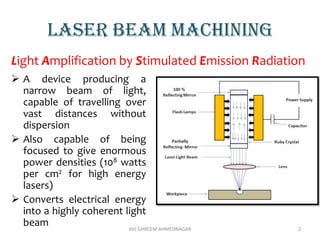
Laser beam machining
 A device producing a
narrow beam of light,
capable of travelling over
vast distances without
dispersion
 Also capable of being
focused to give enormous
power densities (108 watts
per cm2 for high energy
lasers)
 Converts electrical energy
into a highly coherent light
beam AVJ GHRCEM AHMEDNAGAR 2
Light Amplification by Stimulated Emission Radiation
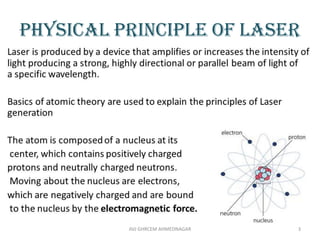
Physical principle of laser
AVJ GHRCEM AHMEDNAGAR 3
AVJ GHRCEM AHMEDNAGAR 4
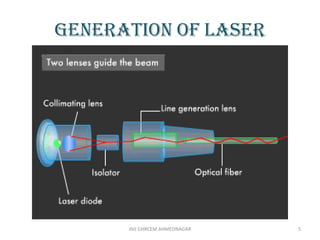
Generation of LASER
AVJ GHRCEM AHMEDNAGAR 5
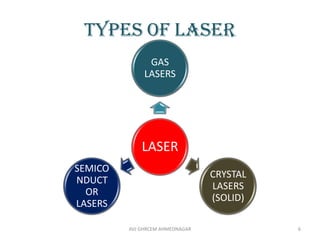
TYPES OF LASER
LASER
GAS
LASERS
CRYSTAL
LASERS
(SOLID)
SEMICO
NDUCT
OR
LASERS
AVJ GHRCEM AHMEDNAGAR 6
TYPES OF LASER
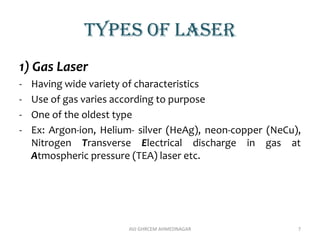
1) Gas Laser
- Having wide variety of characteristics
- Use of gas varies according to purpose
- One of the oldest type
- Ex: Argon-ion, Helium- silver (HeAg), neon-copper (NeCu),
Nitrogen Transverse Electrical discharge in gas at
Atmospheric pressure (TEA) laser etc.
AVJ GHRCEM AHMEDNAGAR 7
TYPES OF LASER
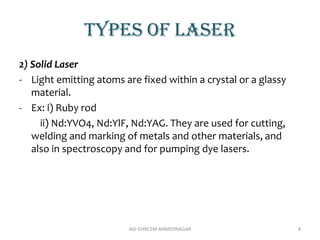
2) Solid Laser
- Light emitting atoms are fixed within a crystal or a glassy
material.
- Ex: i) Ruby rod
ii) Nd:YVO4, Nd:YlF, Nd:YAG. They are used for cutting,
welding and marking of metals and other materials, and
also in spectroscopy and for pumping dye lasers.
AVJ GHRCEM AHMEDNAGAR 8
TYPES OF LASER
3) Semiconductor laser
- Small dimensions, neutral integration capabilities with
micro electronic circuitry
- Ex: i) silicon laser in the field of optical computing.
ii) Vertical cavity surface emitting lasers
iii) Quantum cascade lasers
AVJ GHRCEM AHMEDNAGAR 9
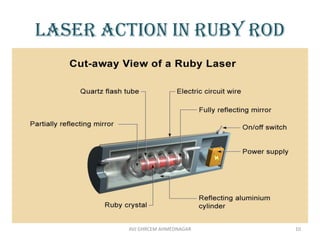
Laser action in Ruby rod
AVJ GHRCEM AHMEDNAGAR 10
Laser action in Ruby rod
- Material is in the form of aluminum oxide crystals that contains
@0.05% chromium.
- Ruby rod is in the form of cylindrical crystals of 10 mm diameter and
100 mm length.
- Ends of ruby rod are made reflective by mirrors
- One of these mirror is fully reflective while other is partially reflective
to allow the light pass through it.
- When light is thrown by flash lamp on ruby rod, chromium atoms
inside it gets excited to higher energy level.
- Excited atoms emit photons before it returns to its normal state. The
photons come out from the transparent mirror in the form of laser
beam.
- When it is focused through the lens, this laser beam falls on the work
piece. As a result the laser beam melts the workpiece, vaporizes it
and penetrates into it. AVJ GHRCEM AHMEDNAGAR 11
Set-up for lbm
AVJ GHRCEM AHMEDNAGAR 12
Set-up for lbm
1) Ruby rod with reflecting mirror
- Crystalline aluminum oxide
- 10 mm dia. and 100 mm length
- Ends are made reflective by two parallel mirrors
- One of mirror is fully reflective, while other is partially
reflective to allow the beam to pass through it.
2) Flash lamp
- Filled with gas like Xenon, Argon, krypton etc.
- Surrounds the ruby rod
- When flash lamp id charged, it stats emitting high intense
flashes of light.
- Ruby rod and flash lamp both are kept in a highly
reflecting cylinder.
AVJ GHRCEM AHMEDNAGAR 13
Set-up for lbm
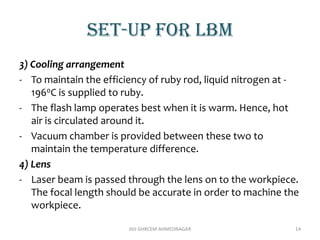
3) Cooling arrangement
- To maintain the efficiency of ruby rod, liquid nitrogen at -
1960C is supplied to ruby.
- The flash lamp operates best when it is warm. Hence, hot
air is circulated around it.
- Vacuum chamber is provided between these two to
maintain the temperature difference.
4) Lens
- Laser beam is passed through the lens on to the workpiece.
The focal length should be accurate in order to machine the
workpiece.
AVJ GHRCEM AHMEDNAGAR 14
Set-up for lbm
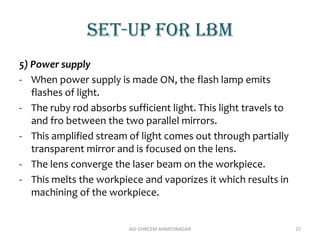
5) Power supply
- When power supply is made ON, the flash lamp emits
flashes of light.
- The ruby rod absorbs sufficient light. This light travels to
and fro between the two parallel mirrors.
- This amplified stream of light comes out through partially
transparent mirror and is focused on the lens.
- The lens converge the laser beam on the workpiece.
- This melts the workpiece and vaporizes it which results in
machining of the workpiece.
AVJ GHRCEM AHMEDNAGAR 15
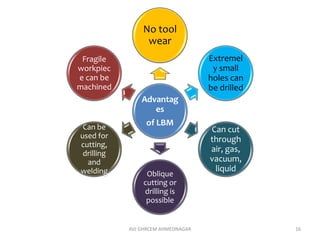
Advantag
es
of LBM
No tool
wear
Extremel
y small
holes can
be drilled
Can cut
through
air, gas,
vacuum,
liquid
Oblique
cutting or
drilling is
possible
Can be
used for
cutting,
drilling
and
welding
Fragile
workpiec
e can be
machined
AVJ GHRCEM AHMEDNAGAR 16
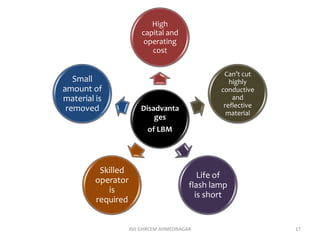
Disadvanta
ges
of LBM
High
capital and
operating
cost
Can’t cut
highly
conductive
and
reflective
material
Life of
flash lamp
is short
Skilled
operator
is
required
Small
amount of
material is
removed
AVJ GHRCEM AHMEDNAGAR 17
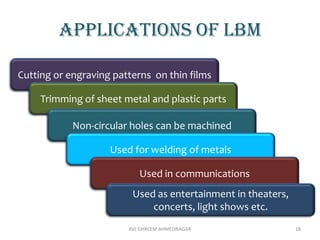
Applications of LBM
AVJ GHRCEM AHMEDNAGAR 18
Cutting or engraving patterns on thin films
Trimming of sheet metal and plastic parts
Non-circular holes can be machined
Used for welding of metals
Used in communications
Used as entertainment in theaters,
concerts, light shows etc.
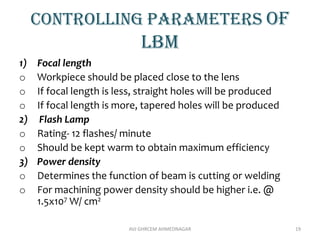
Controlling parameters of
lbm
1) Focal length
o Workpiece should be placed close to the lens
o If focal length is less, straight holes will be produced
o If focal length is more, tapered holes will be produced
2) Flash Lamp
o Rating- 12 flashes/ minute
o Should be kept warm to obtain maximum efficiency
3) Power density
o Determines the function of beam is cutting or welding
o For machining power density should be higher i.e. @
1.5x10⁷ W/ cm2
AVJ GHRCEM AHMEDNAGAR 19
20
AVJ GHRCEM AHMEDNAGAR

Laser Beam Machining Process

  • 1.
    laser beam MACHINING PROCESs-lbm S.G.R. Education Foundation G H RAISONI COLLEGE OF ENGINEERING AND MANAGEMENT AHMEDNAGAR NAAC ACCREDITED (APPROVED BY AICTE, NEW DELHI, RECOGNIZED BY GOVT. OF MAHARASHTRA & AFFILIATED TO SAVITRIBAI PHULE PUNE UNIVERSITY) - Prof. Aniket V. Joshi Asst. Professor Mechanical Engineering Department GHRCEM, A’Nagar.
  • 2.
    Laser beam machining A device producing a narrow beam of light, capable of travelling over vast distances without dispersion  Also capable of being focused to give enormous power densities (108 watts per cm2 for high energy lasers)  Converts electrical energy into a highly coherent light beam AVJ GHRCEM AHMEDNAGAR 2 Light Amplification by Stimulated Emission Radiation
  • 3.
    Physical principle oflaser AVJ GHRCEM AHMEDNAGAR 3
  • 4.
  • 5.
    Generation of LASER AVJGHRCEM AHMEDNAGAR 5
  • 6.
  • 7.
    TYPES OF LASER 1)Gas Laser - Having wide variety of characteristics - Use of gas varies according to purpose - One of the oldest type - Ex: Argon-ion, Helium- silver (HeAg), neon-copper (NeCu), Nitrogen Transverse Electrical discharge in gas at Atmospheric pressure (TEA) laser etc. AVJ GHRCEM AHMEDNAGAR 7
  • 8.
    TYPES OF LASER 2)Solid Laser - Light emitting atoms are fixed within a crystal or a glassy material. - Ex: i) Ruby rod ii) Nd:YVO4, Nd:YlF, Nd:YAG. They are used for cutting, welding and marking of metals and other materials, and also in spectroscopy and for pumping dye lasers. AVJ GHRCEM AHMEDNAGAR 8
  • 9.
    TYPES OF LASER 3)Semiconductor laser - Small dimensions, neutral integration capabilities with micro electronic circuitry - Ex: i) silicon laser in the field of optical computing. ii) Vertical cavity surface emitting lasers iii) Quantum cascade lasers AVJ GHRCEM AHMEDNAGAR 9
  • 10.
    Laser action inRuby rod AVJ GHRCEM AHMEDNAGAR 10
  • 11.
    Laser action inRuby rod - Material is in the form of aluminum oxide crystals that contains @0.05% chromium. - Ruby rod is in the form of cylindrical crystals of 10 mm diameter and 100 mm length. - Ends of ruby rod are made reflective by mirrors - One of these mirror is fully reflective while other is partially reflective to allow the light pass through it. - When light is thrown by flash lamp on ruby rod, chromium atoms inside it gets excited to higher energy level. - Excited atoms emit photons before it returns to its normal state. The photons come out from the transparent mirror in the form of laser beam. - When it is focused through the lens, this laser beam falls on the work piece. As a result the laser beam melts the workpiece, vaporizes it and penetrates into it. AVJ GHRCEM AHMEDNAGAR 11
  • 12.
    Set-up for lbm AVJGHRCEM AHMEDNAGAR 12
  • 13.
    Set-up for lbm 1)Ruby rod with reflecting mirror - Crystalline aluminum oxide - 10 mm dia. and 100 mm length - Ends are made reflective by two parallel mirrors - One of mirror is fully reflective, while other is partially reflective to allow the beam to pass through it. 2) Flash lamp - Filled with gas like Xenon, Argon, krypton etc. - Surrounds the ruby rod - When flash lamp id charged, it stats emitting high intense flashes of light. - Ruby rod and flash lamp both are kept in a highly reflecting cylinder. AVJ GHRCEM AHMEDNAGAR 13
  • 14.
    Set-up for lbm 3)Cooling arrangement - To maintain the efficiency of ruby rod, liquid nitrogen at - 1960C is supplied to ruby. - The flash lamp operates best when it is warm. Hence, hot air is circulated around it. - Vacuum chamber is provided between these two to maintain the temperature difference. 4) Lens - Laser beam is passed through the lens on to the workpiece. The focal length should be accurate in order to machine the workpiece. AVJ GHRCEM AHMEDNAGAR 14
  • 15.
    Set-up for lbm 5)Power supply - When power supply is made ON, the flash lamp emits flashes of light. - The ruby rod absorbs sufficient light. This light travels to and fro between the two parallel mirrors. - This amplified stream of light comes out through partially transparent mirror and is focused on the lens. - The lens converge the laser beam on the workpiece. - This melts the workpiece and vaporizes it which results in machining of the workpiece. AVJ GHRCEM AHMEDNAGAR 15
  • 16.
    Advantag es of LBM No tool wear Extremel ysmall holes can be drilled Can cut through air, gas, vacuum, liquid Oblique cutting or drilling is possible Can be used for cutting, drilling and welding Fragile workpiec e can be machined AVJ GHRCEM AHMEDNAGAR 16
  • 17.
    Disadvanta ges of LBM High capital and operating cost Can’tcut highly conductive and reflective material Life of flash lamp is short Skilled operator is required Small amount of material is removed AVJ GHRCEM AHMEDNAGAR 17
  • 18.
    Applications of LBM AVJGHRCEM AHMEDNAGAR 18 Cutting or engraving patterns on thin films Trimming of sheet metal and plastic parts Non-circular holes can be machined Used for welding of metals Used in communications Used as entertainment in theaters, concerts, light shows etc.
  • 19.
    Controlling parameters of lbm 1)Focal length o Workpiece should be placed close to the lens o If focal length is less, straight holes will be produced o If focal length is more, tapered holes will be produced 2) Flash Lamp o Rating- 12 flashes/ minute o Should be kept warm to obtain maximum efficiency 3) Power density o Determines the function of beam is cutting or welding o For machining power density should be higher i.e. @ 1.5x10⁷ W/ cm2 AVJ GHRCEM AHMEDNAGAR 19
  • 20.