UNCONVENTIONAL MACHINING
PROCESS – UNIT 2
Mechanical Energy Based process
• Material is removed by mechanical erosion of
work piece material
– Abrasive Jet Machining (AJM)
– Water Jet Machining (WJM)
– Ultrasonic Machining (USM)
ABRASIVE JET MACHINING (AJM)
• Principle
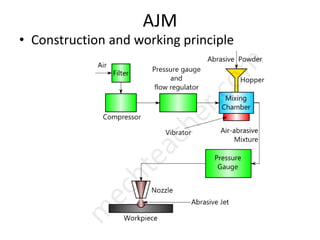
– A high speed stream of abrasive particles mixed
with high pressure air or gas are injected through
a nozzle on the workpiece to be machined
AJM
• Construction and working principle
AJM
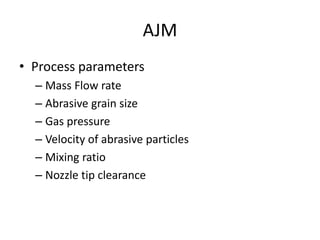
• Process parameters
– Mass Flow rate
– Abrasive grain size
– Gas pressure
– Velocity of abrasive particles
– Mixing ratio
– Nozzle tip clearance
AJM
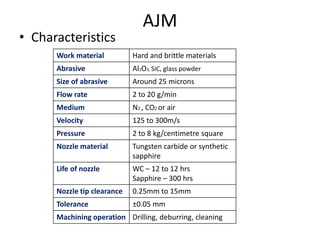
• Characteristics
Work material Hard and brittle materials
Abrasive Al2O3, SiC, glass powder
Size of abrasive Around 25 microns
Flow rate 2 to 20 g/min
Medium N2 , CO2 or air
Velocity 125 to 300m/s
Pressure 2 to 8 kg/centimetre square
Nozzle material Tungsten carbide or synthetic
sapphire
Life of nozzle WC – 12 to 12 hrs
Sapphire – 300 hrs
Nozzle tip clearance 0.25mm to 15mm
Tolerance ±0.05 mm
Machining operation Drilling, deburring, cleaning
AJM
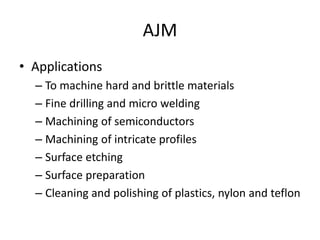
• Applications
– To machine hard and brittle materials
– Fine drilling and micro welding
– Machining of semiconductors
– Machining of intricate profiles
– Surface etching
– Surface preparation
– Cleaning and polishing of plastics, nylon and teflon
AJM
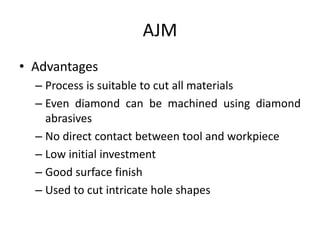
• Advantages
– Process is suitable to cut all materials
– Even diamond can be machined using diamond
abrasives
– No direct contact between tool and workpiece
– Low initial investment
– Good surface finish
– Used to cut intricate hole shapes
AJM
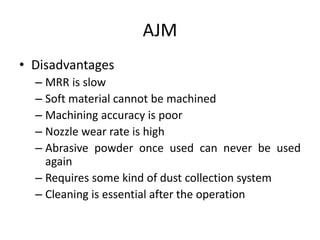
• Disadvantages
– MRR is slow
– Soft material cannot be machined
– Machining accuracy is poor
– Nozzle wear rate is high
– Abrasive powder once used can never be used
again
– Requires some kind of dust collection system
– Cleaning is essential after the operation
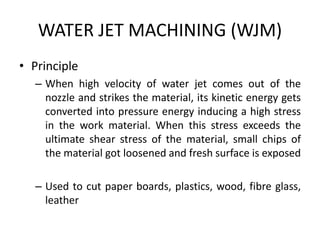
WATER JET MACHINING (WJM)
• Principle
– When high velocity of water jet comes out of the
nozzle and strikes the material, its kinetic energy gets
converted into pressure energy inducing a high stress
in the work material. When this stress exceeds the
ultimate shear stress of the material, small chips of
the material got loosened and fresh surface is exposed
– Used to cut paper boards, plastics, wood, fibre glass,
leather
WJM
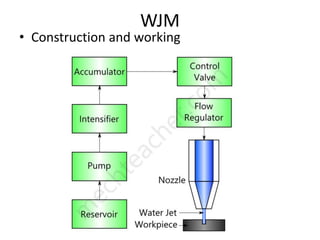
• Construction and working
WJM
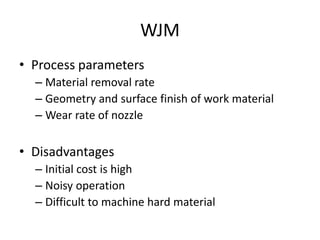
• Process parameters
– Material removal rate
– Geometry and surface finish of work material
– Wear rate of nozzle
• Disadvantages
– Initial cost is high
– Noisy operation
– Difficult to machine hard material
WJM
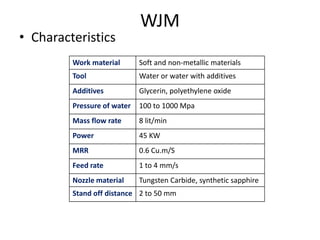
• Characteristics
Work material Soft and non-metallic materials
Tool Water or water with additives
Additives Glycerin, polyethylene oxide
Pressure of water 100 to 1000 Mpa
Mass flow rate 8 lit/min
Power 45 KW
MRR 0.6 Cu.m/S
Feed rate 1 to 4 mm/s
Nozzle material Tungsten Carbide, synthetic sapphire
Stand off distance 2 to 50 mm
WJM
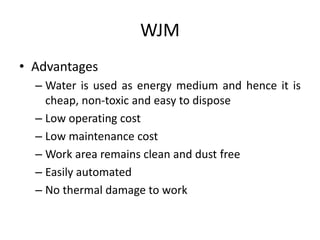
• Advantages
– Water is used as energy medium and hence it is
cheap, non-toxic and easy to dispose
– Low operating cost
– Low maintenance cost
– Work area remains clean and dust free
– Easily automated
– No thermal damage to work
ULTRASONIC MACHINING (USM)
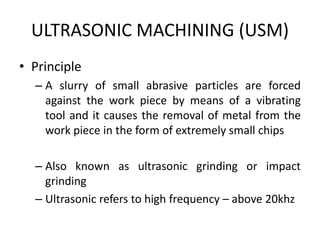
• Principle
– A slurry of small abrasive particles are forced
against the work piece by means of a vibrating
tool and it causes the removal of metal from the
work piece in the form of extremely small chips
– Also known as ultrasonic grinding or impact
grinding
– Ultrasonic refers to high frequency – above 20khz
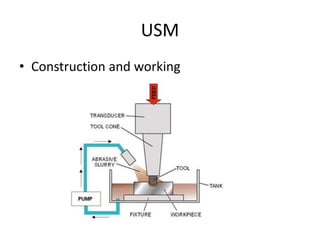
USM
• Construction and working
USM
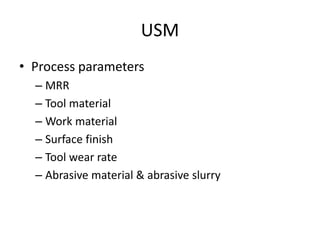
• Process parameters
– MRR
– Tool material
– Work material
– Surface finish
– Tool wear rate
– Abrasive material & abrasive slurry
USM
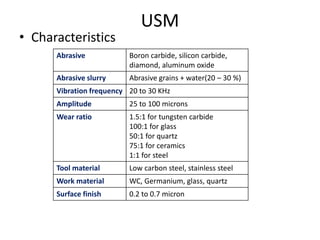
• Characteristics
Abrasive Boron carbide, silicon carbide,
diamond, aluminum oxide
Abrasive slurry Abrasive grains + water(20 – 30 %)
Vibration frequency 20 to 30 KHz
Amplitude 25 to 100 microns
Wear ratio 1.5:1 for tungsten carbide
100:1 for glass
50:1 for quartz
75:1 for ceramics
1:1 for steel
Tool material Low carbon steel, stainless steel
Work material WC, Germanium, glass, quartz
Surface finish 0.2 to 0.7 micron
USM
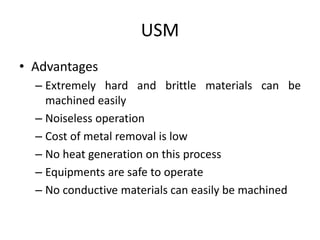
• Advantages
– Extremely hard and brittle materials can be
machined easily
– Noiseless operation
– Cost of metal removal is low
– No heat generation on this process
– Equipments are safe to operate
– No conductive materials can easily be machined
USM
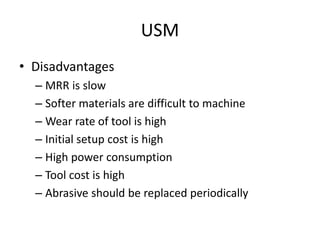
• Disadvantages
– MRR is slow
– Softer materials are difficult to machine
– Wear rate of tool is high
– Initial setup cost is high
– High power consumption
– Tool cost is high
– Abrasive should be replaced periodically
USM
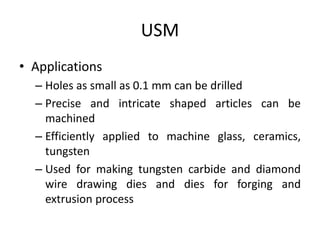
• Applications
– Holes as small as 0.1 mm can be drilled
– Precise and intricate shaped articles can be
machined
– Efficiently applied to machine glass, ceramics,
tungsten
– Used for making tungsten carbide and diamond
wire drawing dies and dies for forging and
extrusion process
USM
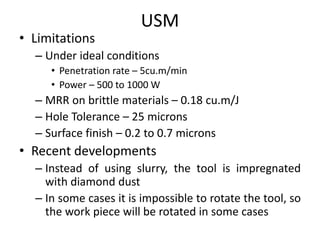
• Limitations
– Under ideal conditions
• Penetration rate – 5cu.m/min
• Power – 500 to 1000 W
– MRR on brittle materials – 0.18 cu.m/J
– Hole Tolerance – 25 microns
– Surface finish – 0.2 to 0.7 microns
• Recent developments
– Instead of using slurry, the tool is impregnated
with diamond dust
– In some cases it is impossible to rotate the tool, so
the work piece will be rotated in some cases

Unit 2 mechanical energy based process

  • 1.
    UNCONVENTIONAL MACHINING PROCESS –UNIT 2 Mechanical Energy Based process
  • 2.
    Mechanical Energy Basedprocess • Material is removed by mechanical erosion of work piece material – Abrasive Jet Machining (AJM) – Water Jet Machining (WJM) – Ultrasonic Machining (USM)
  • 3.
    ABRASIVE JET MACHINING(AJM) • Principle – A high speed stream of abrasive particles mixed with high pressure air or gas are injected through a nozzle on the workpiece to be machined
  • 4.
    AJM • Construction andworking principle
  • 5.
    AJM • Process parameters –Mass Flow rate – Abrasive grain size – Gas pressure – Velocity of abrasive particles – Mixing ratio – Nozzle tip clearance
  • 6.
    AJM • Characteristics Work materialHard and brittle materials Abrasive Al2O3, SiC, glass powder Size of abrasive Around 25 microns Flow rate 2 to 20 g/min Medium N2 , CO2 or air Velocity 125 to 300m/s Pressure 2 to 8 kg/centimetre square Nozzle material Tungsten carbide or synthetic sapphire Life of nozzle WC – 12 to 12 hrs Sapphire – 300 hrs Nozzle tip clearance 0.25mm to 15mm Tolerance ±0.05 mm Machining operation Drilling, deburring, cleaning
  • 7.
    AJM • Applications – Tomachine hard and brittle materials – Fine drilling and micro welding – Machining of semiconductors – Machining of intricate profiles – Surface etching – Surface preparation – Cleaning and polishing of plastics, nylon and teflon
  • 8.
    AJM • Advantages – Processis suitable to cut all materials – Even diamond can be machined using diamond abrasives – No direct contact between tool and workpiece – Low initial investment – Good surface finish – Used to cut intricate hole shapes
  • 9.
    AJM • Disadvantages – MRRis slow – Soft material cannot be machined – Machining accuracy is poor – Nozzle wear rate is high – Abrasive powder once used can never be used again – Requires some kind of dust collection system – Cleaning is essential after the operation
  • 10.
    WATER JET MACHINING(WJM) • Principle – When high velocity of water jet comes out of the nozzle and strikes the material, its kinetic energy gets converted into pressure energy inducing a high stress in the work material. When this stress exceeds the ultimate shear stress of the material, small chips of the material got loosened and fresh surface is exposed – Used to cut paper boards, plastics, wood, fibre glass, leather
  • 11.
  • 12.
    WJM • Process parameters –Material removal rate – Geometry and surface finish of work material – Wear rate of nozzle • Disadvantages – Initial cost is high – Noisy operation – Difficult to machine hard material
  • 13.
    WJM • Characteristics Work materialSoft and non-metallic materials Tool Water or water with additives Additives Glycerin, polyethylene oxide Pressure of water 100 to 1000 Mpa Mass flow rate 8 lit/min Power 45 KW MRR 0.6 Cu.m/S Feed rate 1 to 4 mm/s Nozzle material Tungsten Carbide, synthetic sapphire Stand off distance 2 to 50 mm
  • 14.
    WJM • Advantages – Wateris used as energy medium and hence it is cheap, non-toxic and easy to dispose – Low operating cost – Low maintenance cost – Work area remains clean and dust free – Easily automated – No thermal damage to work
  • 15.
    ULTRASONIC MACHINING (USM) •Principle – A slurry of small abrasive particles are forced against the work piece by means of a vibrating tool and it causes the removal of metal from the work piece in the form of extremely small chips – Also known as ultrasonic grinding or impact grinding – Ultrasonic refers to high frequency – above 20khz
  • 16.
  • 17.
    USM • Process parameters –MRR – Tool material – Work material – Surface finish – Tool wear rate – Abrasive material & abrasive slurry
  • 18.
    USM • Characteristics Abrasive Boroncarbide, silicon carbide, diamond, aluminum oxide Abrasive slurry Abrasive grains + water(20 – 30 %) Vibration frequency 20 to 30 KHz Amplitude 25 to 100 microns Wear ratio 1.5:1 for tungsten carbide 100:1 for glass 50:1 for quartz 75:1 for ceramics 1:1 for steel Tool material Low carbon steel, stainless steel Work material WC, Germanium, glass, quartz Surface finish 0.2 to 0.7 micron
  • 19.
    USM • Advantages – Extremelyhard and brittle materials can be machined easily – Noiseless operation – Cost of metal removal is low – No heat generation on this process – Equipments are safe to operate – No conductive materials can easily be machined
  • 20.
    USM • Disadvantages – MRRis slow – Softer materials are difficult to machine – Wear rate of tool is high – Initial setup cost is high – High power consumption – Tool cost is high – Abrasive should be replaced periodically
  • 21.
    USM • Applications – Holesas small as 0.1 mm can be drilled – Precise and intricate shaped articles can be machined – Efficiently applied to machine glass, ceramics, tungsten – Used for making tungsten carbide and diamond wire drawing dies and dies for forging and extrusion process
  • 22.
    USM • Limitations – Underideal conditions • Penetration rate – 5cu.m/min • Power – 500 to 1000 W – MRR on brittle materials – 0.18 cu.m/J – Hole Tolerance – 25 microns – Surface finish – 0.2 to 0.7 microns • Recent developments – Instead of using slurry, the tool is impregnated with diamond dust – In some cases it is impossible to rotate the tool, so the work piece will be rotated in some cases