UNIT I
NON CONVENTIONAL MACHINING PROCESSES-
WEDM
S.G.R. Education Foundation
G H RAISONI COLLEGE OF ENGINEERING AND MANAGEMENT
AHMEDNAGAR
NAAC ACCREDITED
(APPROVED BY AICTE, NEW DELHI, RECOGNIZED BY GOVT. OF MAHARASHTRA & AFFILIATED TO SAVITRIBAI PHULE PUNE UNIVERSITY)
- Prof. Aniket V. Joshi
Asst. Professor
Mechanical Engineering Department
GHRCEM, A’Nagar.
WIRE CUT ELECTRIC DICSCHARGE
MACHINING (WEDM)
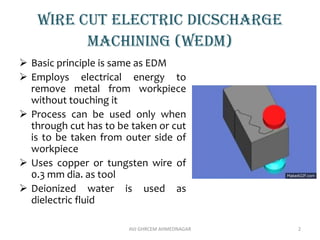
 Basic principle is same as EDM
 Employs electrical energy to
remove metal from workpiece
without touching it
 Process can be used only when
through cut has to be taken or cut
is to be taken from outer side of
workpiece
 Uses copper or tungsten wire of
0.3 mm dia. as tool
 Deionized water is used as
dielectric fluid
AVJ GHRCEM AHMEDNAGAR 2
Working principle of wedm
• Heat energy generated by a spark is used to remove
unwanted material from the workpiece
• Wire of dia. 0.3 mm used as electrode or tool
• Gap between wire and workpiece is 0.5 mm
• Wire is continuously moving at constant speed
• Dielectric fluid is constantly flushed in the area of machining
• When switch ON the supply, spark get generated and
dielectric fluid gets ionized allowing current to flow
between tool and workpiece.
• Due to heat, melting of metal takes place and melted
particles driven away by the dielectric fluid.
• Desired shape is achieved by table motions through control
system AVJ GHRCEM AHMEDNAGAR 3
Set-up for wedm
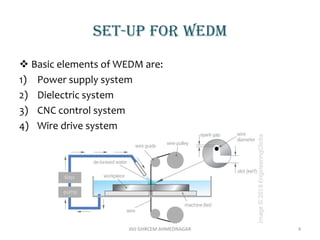
 Basic elements of WEDM are:
1) Power supply system
2) Dielectric system
3) CNC control system
4) Wire drive system
AVJ GHRCEM AHMEDNAGAR 4
Set-up for wedm
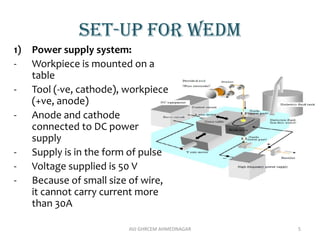
1) Power supply system:
- Workpiece is mounted on a
table
- Tool (-ve, cathode), workpiece
(+ve, anode)
- Anode and cathode
connected to DC power
supply
- Supply is in the form of pulse
- Voltage supplied is 50 V
- Because of small size of wire,
it cannot carry current more
than 30A
AVJ GHRCEM AHMEDNAGAR 5
Set-up for wedm
2) Dielectric fluid system:
- Deionized water is used as
dielectric fluid
- It gives high metal removal
rate and better surface
finish
- Nozzle is employed in
machining area
- Both workpiece and wire
are constantly flushed
- As serves as coolant.
AVJ GHRCEM AHMEDNAGAR 6
3) CNC control System:
- Used for the movement of
work table
- Table has movement in two
axis (direction)
- For taking contouring cuts,
table can be moved in both
directions simultaneously
Set-up for wedm
4) Wire drive system:
- this system performs three functions
a) To feed fresh wire for machining
b) To take-up the used wire
c) To maintain the tension in the wire
- Wire is used only once, because due to spark, wire surface
does not remain round
AVJ GHRCEM AHMEDNAGAR 7
Controlling parameters
for wedm
1) Discharge current:
- Material removal rate increases with current
- Increasing current increases crater depth to a certain
value, beyond that yield a smoother surface
- Current limit is 30A
2) Pulse duration:
- Directly proportional to MRR
- Inversely proportional to surface roughness
AVJ GHRCEM AHMEDNAGAR 8
Controlling parameters for
wedm
3) Pulse frequency:
- Directly proportional to MRR
- Pulse frequency is about 1 MHz
- Results in reduced crater size or better surface finish
4) Cutting Rate:
- Wire speed is between 205 to 150 mm/sec.
- Depends upon thickness of workpiece
- Maximum possible depth of cut is 90 mm
- Average machining rate is 10-15 mm2/min
AVJ GHRCEM AHMEDNAGAR 9
Controlling parameters for
wedm
5) Wire tension:
- Required to keep the wire straight
- A series of tension rollers is provided to keep the required
tension
- 50-60% of wire tensile strength
6) Dielectric flow:
- Nozzle is employed
- Continue and enough supply required to allow sparking
- Fluid can be reused only after filtration
AVJ GHRCEM AHMEDNAGAR 10
Advantages of wedm
 Straight holes can be produces to close tolerances
 Can be operated unattended for longer period of time
 High accuracy
 Good surface finish
 Very sharp angles can be cut
 Eliminates the need of post-machining
heat treating and possible part distortion
 Parts produced are burr-free
AVJ GHRCEM AHMEDNAGAR 11
disadvantages of wedm
o Wire can not be reused
o Proper tension needs to be
maintained
o Only electrically conductive material
can be machined
o Residual stresses are induced in the
workpiece
o limit for maximum depth of
workpiece is 90 mm
o A hole is necessary in the workpiece
AVJ GHRCEM AHMEDNAGAR 12
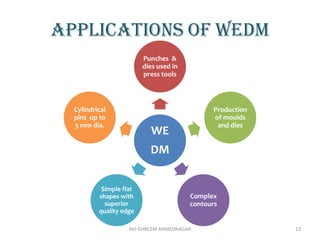
Applications of wedm
WE
DM
Punches &
dies used in
press tools
Production
of moulds
and dies
Complex
contours
Simple flat
shapes with
superior
quality edge
Cylindrical
pins up to
5 mm dia.
AVJ GHRCEM AHMEDNAGAR 13
14
AVJ GHRCEM AHMEDNAGAR

Wire Electric Discharge Machining Process

  • 1.
    UNIT I NON CONVENTIONALMACHINING PROCESSES- WEDM S.G.R. Education Foundation G H RAISONI COLLEGE OF ENGINEERING AND MANAGEMENT AHMEDNAGAR NAAC ACCREDITED (APPROVED BY AICTE, NEW DELHI, RECOGNIZED BY GOVT. OF MAHARASHTRA & AFFILIATED TO SAVITRIBAI PHULE PUNE UNIVERSITY) - Prof. Aniket V. Joshi Asst. Professor Mechanical Engineering Department GHRCEM, A’Nagar.
  • 2.
    WIRE CUT ELECTRICDICSCHARGE MACHINING (WEDM)  Basic principle is same as EDM  Employs electrical energy to remove metal from workpiece without touching it  Process can be used only when through cut has to be taken or cut is to be taken from outer side of workpiece  Uses copper or tungsten wire of 0.3 mm dia. as tool  Deionized water is used as dielectric fluid AVJ GHRCEM AHMEDNAGAR 2
  • 3.
    Working principle ofwedm • Heat energy generated by a spark is used to remove unwanted material from the workpiece • Wire of dia. 0.3 mm used as electrode or tool • Gap between wire and workpiece is 0.5 mm • Wire is continuously moving at constant speed • Dielectric fluid is constantly flushed in the area of machining • When switch ON the supply, spark get generated and dielectric fluid gets ionized allowing current to flow between tool and workpiece. • Due to heat, melting of metal takes place and melted particles driven away by the dielectric fluid. • Desired shape is achieved by table motions through control system AVJ GHRCEM AHMEDNAGAR 3
  • 4.
    Set-up for wedm Basic elements of WEDM are: 1) Power supply system 2) Dielectric system 3) CNC control system 4) Wire drive system AVJ GHRCEM AHMEDNAGAR 4
  • 5.
    Set-up for wedm 1)Power supply system: - Workpiece is mounted on a table - Tool (-ve, cathode), workpiece (+ve, anode) - Anode and cathode connected to DC power supply - Supply is in the form of pulse - Voltage supplied is 50 V - Because of small size of wire, it cannot carry current more than 30A AVJ GHRCEM AHMEDNAGAR 5
  • 6.
    Set-up for wedm 2)Dielectric fluid system: - Deionized water is used as dielectric fluid - It gives high metal removal rate and better surface finish - Nozzle is employed in machining area - Both workpiece and wire are constantly flushed - As serves as coolant. AVJ GHRCEM AHMEDNAGAR 6 3) CNC control System: - Used for the movement of work table - Table has movement in two axis (direction) - For taking contouring cuts, table can be moved in both directions simultaneously
  • 7.
    Set-up for wedm 4)Wire drive system: - this system performs three functions a) To feed fresh wire for machining b) To take-up the used wire c) To maintain the tension in the wire - Wire is used only once, because due to spark, wire surface does not remain round AVJ GHRCEM AHMEDNAGAR 7
  • 8.
    Controlling parameters for wedm 1)Discharge current: - Material removal rate increases with current - Increasing current increases crater depth to a certain value, beyond that yield a smoother surface - Current limit is 30A 2) Pulse duration: - Directly proportional to MRR - Inversely proportional to surface roughness AVJ GHRCEM AHMEDNAGAR 8
  • 9.
    Controlling parameters for wedm 3)Pulse frequency: - Directly proportional to MRR - Pulse frequency is about 1 MHz - Results in reduced crater size or better surface finish 4) Cutting Rate: - Wire speed is between 205 to 150 mm/sec. - Depends upon thickness of workpiece - Maximum possible depth of cut is 90 mm - Average machining rate is 10-15 mm2/min AVJ GHRCEM AHMEDNAGAR 9
  • 10.
    Controlling parameters for wedm 5)Wire tension: - Required to keep the wire straight - A series of tension rollers is provided to keep the required tension - 50-60% of wire tensile strength 6) Dielectric flow: - Nozzle is employed - Continue and enough supply required to allow sparking - Fluid can be reused only after filtration AVJ GHRCEM AHMEDNAGAR 10
  • 11.
    Advantages of wedm Straight holes can be produces to close tolerances  Can be operated unattended for longer period of time  High accuracy  Good surface finish  Very sharp angles can be cut  Eliminates the need of post-machining heat treating and possible part distortion  Parts produced are burr-free AVJ GHRCEM AHMEDNAGAR 11
  • 12.
    disadvantages of wedm oWire can not be reused o Proper tension needs to be maintained o Only electrically conductive material can be machined o Residual stresses are induced in the workpiece o limit for maximum depth of workpiece is 90 mm o A hole is necessary in the workpiece AVJ GHRCEM AHMEDNAGAR 12
  • 13.
    Applications of wedm WE DM Punches& dies used in press tools Production of moulds and dies Complex contours Simple flat shapes with superior quality edge Cylindrical pins up to 5 mm dia. AVJ GHRCEM AHMEDNAGAR 13
  • 14.