A presentation on
Abrasive Jet Machining
Prepared by: Arjun Patial
14MEMTC001
Under Guidance of: Mr. Bhaskar Goel
Abrasive Jet Machining
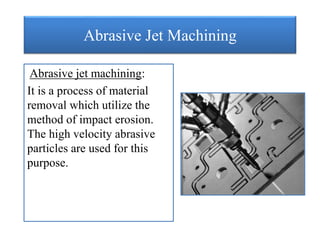
Abrasive jet machining:
It is a process of material
removal which utilize the
method of impact erosion.
The high velocity abrasive
particles are used for this
purpose.
Abrasive Jet Machining
Process:
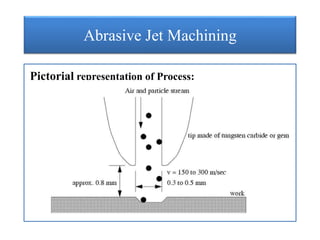
•A focused stream of abrasive particles, carried by
high pressure air or gas is made to impinge on the
work surface through a control nozzle.
•The high velocity stream of abrasives is generated by
converting pressure energy of carrier gas or air to its
Kinetic energy and hence high velocity jet.
•The high velocity abrasive particles remove the
material by micro-cutting action as well as brittle
fracture of the work material.
Abrasive Jet Machining
Pictorial representation of Process:
Abrasive Jet Machining
Physics of the Process:
•This is a process of removal of material by impact
erosion.
• Fine particles (0.025mm) are accelerated in a gas
stream.
• The particle are directed towards the focus of
machining.
• As the particles impact the surface, it causes a micro
fracture, and gas carries fractured particles away.
• Brittle and fragile work better.
Abrasive Jet Machining
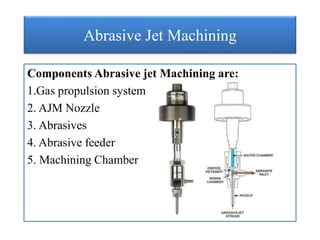
Components Abrasive jet Machining are:
1.Gas propulsion system
2. AJM Nozzle
3. Abrasives
4. Abrasive feeder
5. Machining Chamber
Abrasive Jet Machining
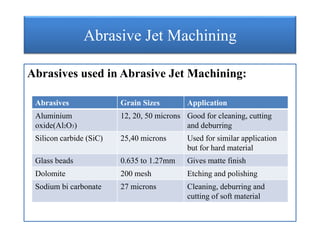
Abrasives used in Abrasive Jet Machining:
Abrasives Grain Sizes Application
Aluminium
oxide(Al2O3)
12, 20, 50 microns Good for cleaning, cutting
and deburring
Silicon carbide (SiC) 25,40 microns Used for similar application
but for hard material
Glass beads 0.635 to 1.27mm Gives matte finish
Dolomite 200 mesh Etching and polishing
Sodium bi carbonate 27 microns Cleaning, deburring and
cutting of soft material
Abrasive Jet Machining
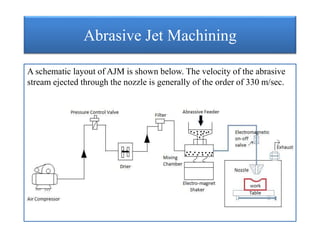
A schematic layout of AJM is shown below. The velocity of the abrasive
stream ejected through the nozzle is generally of the order of 330 m/sec.
Abrasive Jet Machining
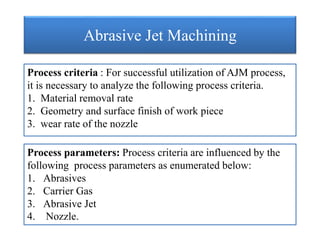
Process criteria : For successful utilization of AJM process,
it is necessary to analyze the following process criteria.
1. Material removal rate
2. Geometry and surface finish of work piece
3. wear rate of the nozzle
Process parameters: Process criteria are influenced by the
following process parameters as enumerated below:
1. Abrasives
2. Carrier Gas
3. Abrasive Jet
4. Nozzle.
Abrasive Jet Machining
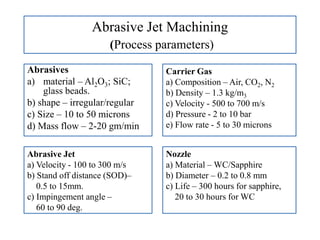
(Process parameters)
Abrasives
a) material – Al2O3; SiC;
glass beads.
b) shape – irregular/regular
c) Size – 10 to 50 microns
d) Mass flow – 2-20 gm/min
Carrier Gas
a) Composition – Air, CO2, N2
b) Density – 1.3 kg/m3
c) Velocity - 500 to 700 m/s
d) Pressure - 2 to 10 bar
e) Flow rate - 5 to 30 microns
Abrasive Jet
a) Velocity - 100 to 300 m/s
b) Stand off distance (SOD)–
0.5 to 15mm.
c) Impingement angle –
60 to 90 deg.
Nozzle
a) Material – WC/Sapphire
b) Diameter – 0.2 to 0.8 mm
c) Life – 300 hours for sapphire,
20 to 30 hours for WC
Abrasive Jet Machining
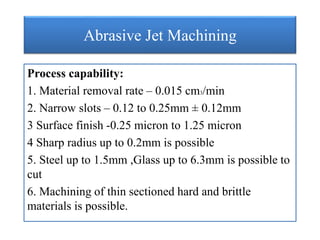
Process capability:
1. Material removal rate – 0.015 cm3/min
2. Narrow slots – 0.12 to 0.25mm ± 0.12mm
3 Surface finish -0.25 micron to 1.25 micron
4 Sharp radius up to 0.2mm is possible
5. Steel up to 1.5mm ,Glass up to 6.3mm is possible to
cut
6. Machining of thin sectioned hard and brittle
materials is possible.
Abrasive Jet Machining
Applications:
•Used in manufacturing of electronic devices , drilling of
glass wafers, deburring of plastics, making of nylon and
Teflon parts permanent marking on rubber stencils, cutting
titanium foils.
•Engraving registration numbers on toughened glass used for
car windows
•Used for drilling , cutting , deburring etching and polishing
of hard and brittle materials. Most suitable for machining
brittle and heat sensitive materials like glass, quartz, sapphire,
mica, ceramics germanium , silicon and gallium.
Abrasive Jet Machining
Advantages:
1. High surface finish can be obtained depending upon the
grain sizes.
2.Depth of damage is low ( around 2.5 microns)
3. It provides cool cutting action, so it can machine delicate
and heat sensitive material.
4.Process is free from chatter and vibration as there is no
contact between the tool and work piece
5.Capital cost is low and it is easy to operate and maintain
AJM.
6.It has the capability of cutting holes of intricate shape in
hard materials.
Abrasive Jet Machining
Disadvantages /Limitations:
1. Abrasives may get embedded in the work surface,
especially while machining soft material like elastomers or
soft plastics.
2. The accuracy of cutting is hampered by tapering of hole
due to unavoidable flaring of abrasive jet.
3. Stray cutting is difficult to avoid.
4. Nozzle life is limited (300 hours).
5. Abrasive powders cannot be reused as the sharp edges are
worn and smaller particles can clog the nozzle.
Abrasive Jet Machining
Effect of abrasive flow rate and grain size on material
removal rate:
•MRR increase with increase of abrasive flow rate and is
influenced by size of abrasive particles. But after reaching
optimum value, MRR decreases with further increase of
abrasive flow rate.
•This is owing to the fact that Mass flow rate of gas decreases
with increase of abrasive flow rate and hence mixing ratio
increases causing a decrease in material removal rate because
of decreasing energy available for erosion.
Abrasive Jet Machining
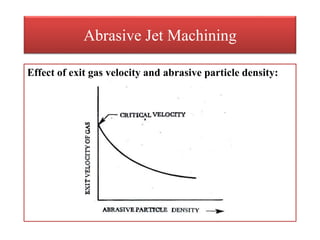
Effect of exit gas velocity and abrasive particle density:
Abrasive Jet Machining
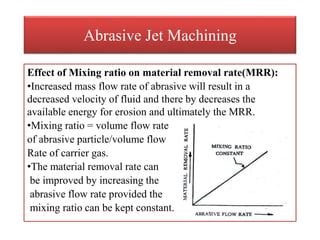
Effect of Mixing ratio on material removal rate(MRR):
•Increased mass flow rate of abrasive will result in a
decreased velocity of fluid and there by decreases the
available energy for erosion and ultimately the MRR.
•Mixing ratio = volume flow rate
of abrasive particle/volume flow
Rate of carrier gas.
•The material removal rate can
be improved by increasing the
abrasive flow rate provided the
mixing ratio can be kept constant.
Abrasive Jet Machining
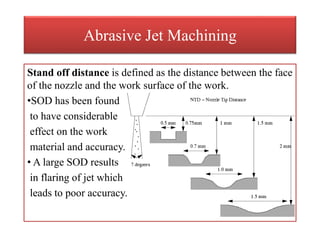
Stand off distance is defined as the distance between the face
of the nozzle and the work surface of the work.
•SOD has been found
to have considerable
effect on the work
material and accuracy.
• A large SOD results
in flaring of jet which
leads to poor accuracy.
Abrasive Jet Machining
Thank you

Abrasive jet machining

  • 1.
    A presentation on AbrasiveJet Machining Prepared by: Arjun Patial 14MEMTC001 Under Guidance of: Mr. Bhaskar Goel
  • 2.
  • 3.
    Abrasive Jet Machining Abrasivejet machining: It is a process of material removal which utilize the method of impact erosion. The high velocity abrasive particles are used for this purpose.
  • 4.
    Abrasive Jet Machining Process: •Afocused stream of abrasive particles, carried by high pressure air or gas is made to impinge on the work surface through a control nozzle. •The high velocity stream of abrasives is generated by converting pressure energy of carrier gas or air to its Kinetic energy and hence high velocity jet. •The high velocity abrasive particles remove the material by micro-cutting action as well as brittle fracture of the work material.
  • 5.
    Abrasive Jet Machining Pictorialrepresentation of Process:
  • 6.
    Abrasive Jet Machining Physicsof the Process: •This is a process of removal of material by impact erosion. • Fine particles (0.025mm) are accelerated in a gas stream. • The particle are directed towards the focus of machining. • As the particles impact the surface, it causes a micro fracture, and gas carries fractured particles away. • Brittle and fragile work better.
  • 7.
    Abrasive Jet Machining ComponentsAbrasive jet Machining are: 1.Gas propulsion system 2. AJM Nozzle 3. Abrasives 4. Abrasive feeder 5. Machining Chamber
  • 8.
    Abrasive Jet Machining Abrasivesused in Abrasive Jet Machining: Abrasives Grain Sizes Application Aluminium oxide(Al2O3) 12, 20, 50 microns Good for cleaning, cutting and deburring Silicon carbide (SiC) 25,40 microns Used for similar application but for hard material Glass beads 0.635 to 1.27mm Gives matte finish Dolomite 200 mesh Etching and polishing Sodium bi carbonate 27 microns Cleaning, deburring and cutting of soft material
  • 9.
    Abrasive Jet Machining Aschematic layout of AJM is shown below. The velocity of the abrasive stream ejected through the nozzle is generally of the order of 330 m/sec.
  • 10.
    Abrasive Jet Machining Processcriteria : For successful utilization of AJM process, it is necessary to analyze the following process criteria. 1. Material removal rate 2. Geometry and surface finish of work piece 3. wear rate of the nozzle Process parameters: Process criteria are influenced by the following process parameters as enumerated below: 1. Abrasives 2. Carrier Gas 3. Abrasive Jet 4. Nozzle.
  • 11.
    Abrasive Jet Machining (Processparameters) Abrasives a) material – Al2O3; SiC; glass beads. b) shape – irregular/regular c) Size – 10 to 50 microns d) Mass flow – 2-20 gm/min Carrier Gas a) Composition – Air, CO2, N2 b) Density – 1.3 kg/m3 c) Velocity - 500 to 700 m/s d) Pressure - 2 to 10 bar e) Flow rate - 5 to 30 microns Abrasive Jet a) Velocity - 100 to 300 m/s b) Stand off distance (SOD)– 0.5 to 15mm. c) Impingement angle – 60 to 90 deg. Nozzle a) Material – WC/Sapphire b) Diameter – 0.2 to 0.8 mm c) Life – 300 hours for sapphire, 20 to 30 hours for WC
  • 12.
    Abrasive Jet Machining Processcapability: 1. Material removal rate – 0.015 cm3/min 2. Narrow slots – 0.12 to 0.25mm ± 0.12mm 3 Surface finish -0.25 micron to 1.25 micron 4 Sharp radius up to 0.2mm is possible 5. Steel up to 1.5mm ,Glass up to 6.3mm is possible to cut 6. Machining of thin sectioned hard and brittle materials is possible.
  • 13.
    Abrasive Jet Machining Applications: •Usedin manufacturing of electronic devices , drilling of glass wafers, deburring of plastics, making of nylon and Teflon parts permanent marking on rubber stencils, cutting titanium foils. •Engraving registration numbers on toughened glass used for car windows •Used for drilling , cutting , deburring etching and polishing of hard and brittle materials. Most suitable for machining brittle and heat sensitive materials like glass, quartz, sapphire, mica, ceramics germanium , silicon and gallium.
  • 14.
    Abrasive Jet Machining Advantages: 1.High surface finish can be obtained depending upon the grain sizes. 2.Depth of damage is low ( around 2.5 microns) 3. It provides cool cutting action, so it can machine delicate and heat sensitive material. 4.Process is free from chatter and vibration as there is no contact between the tool and work piece 5.Capital cost is low and it is easy to operate and maintain AJM. 6.It has the capability of cutting holes of intricate shape in hard materials.
  • 15.
    Abrasive Jet Machining Disadvantages/Limitations: 1. Abrasives may get embedded in the work surface, especially while machining soft material like elastomers or soft plastics. 2. The accuracy of cutting is hampered by tapering of hole due to unavoidable flaring of abrasive jet. 3. Stray cutting is difficult to avoid. 4. Nozzle life is limited (300 hours). 5. Abrasive powders cannot be reused as the sharp edges are worn and smaller particles can clog the nozzle.
  • 16.
    Abrasive Jet Machining Effectof abrasive flow rate and grain size on material removal rate: •MRR increase with increase of abrasive flow rate and is influenced by size of abrasive particles. But after reaching optimum value, MRR decreases with further increase of abrasive flow rate. •This is owing to the fact that Mass flow rate of gas decreases with increase of abrasive flow rate and hence mixing ratio increases causing a decrease in material removal rate because of decreasing energy available for erosion.
  • 17.
    Abrasive Jet Machining Effectof exit gas velocity and abrasive particle density:
  • 18.
    Abrasive Jet Machining Effectof Mixing ratio on material removal rate(MRR): •Increased mass flow rate of abrasive will result in a decreased velocity of fluid and there by decreases the available energy for erosion and ultimately the MRR. •Mixing ratio = volume flow rate of abrasive particle/volume flow Rate of carrier gas. •The material removal rate can be improved by increasing the abrasive flow rate provided the mixing ratio can be kept constant.
  • 19.
    Abrasive Jet Machining Standoff distance is defined as the distance between the face of the nozzle and the work surface of the work. •SOD has been found to have considerable effect on the work material and accuracy. • A large SOD results in flaring of jet which leads to poor accuracy.
  • 20.
  • 21.