THERMAL ENERGY BASED
PROCESSES
PRINCIPLE
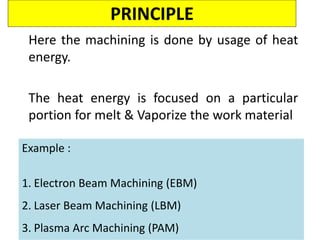
Here the machining is done by usage of heat
energy.
The heat energy is focused on a particular
portion for melt & Vaporize the work material
Example :
1. Electron Beam Machining (EBM)
2. Laser Beam Machining (LBM)
3. Plasma Arc Machining (PAM)
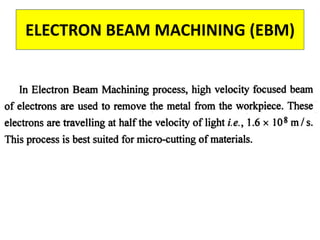
ELECTRON BEAM MACHINING (EBM)
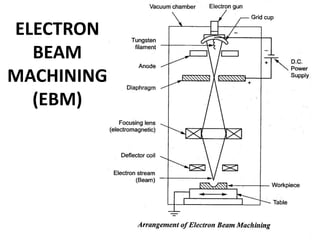
ELECTRON
BEAM
MACHINING
(EBM)
PRINCIPLE - EBM
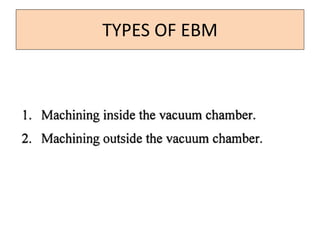
TYPES OF EBM
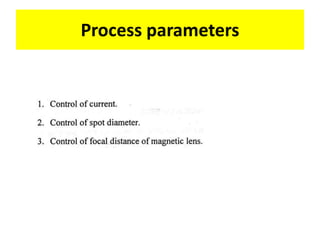
Process parameters
Process parameters
1.Control of current
Process parameters
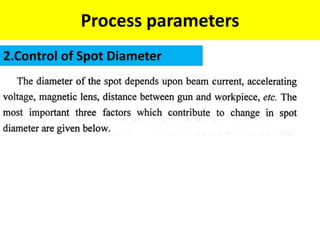
2.Control of Spot Diameter
Process parameters
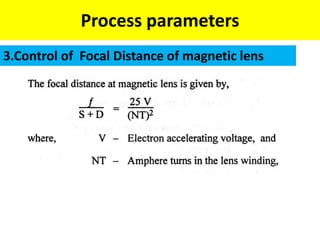
3.Control of Focal Distance of magnetic lens
LASER BEAM MACHINING
Photon Emission
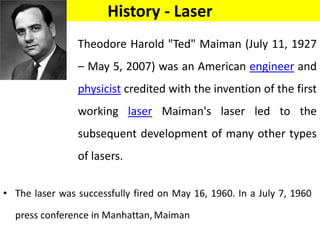
History - Laser
• The laser was successfully fired on May 16, 1960. In a July 7, 1960
press conference in Manhattan,Maiman
Theodore Harold "Ted" Maiman (July 11, 1927
– May 5, 2007) was an American engineer and
physicist credited with the invention of the first
working laser Maiman's laser led to the
subsequent development of many other types
of lasers.
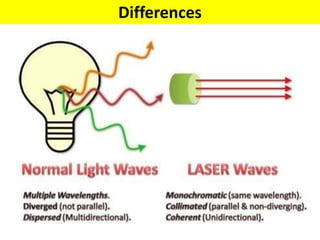
Differences
.
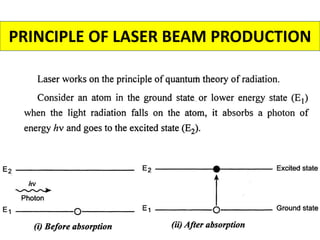
PRINCIPLE OF LASER BEAM PRODUCTION
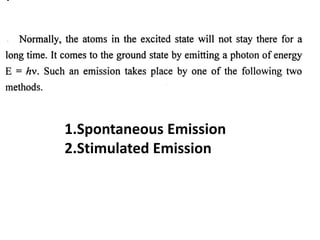
1.Spontaneous Emission
2.Stimulated Emission
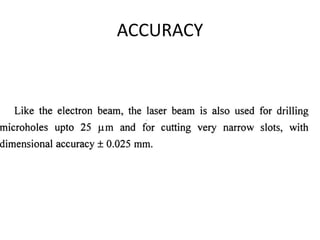
ACCURACY
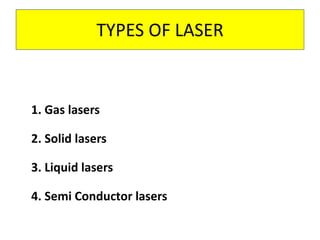
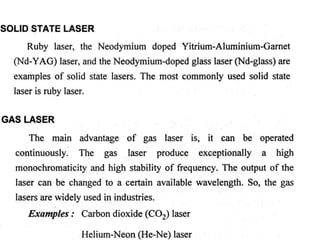
TYPES OF LASER
1. Gas lasers
2. Solid lasers
3. Liquid lasers
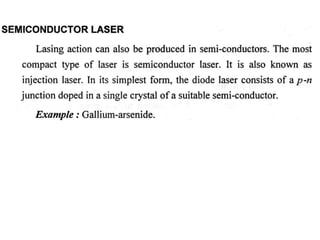
4. Semi Conductor lasers
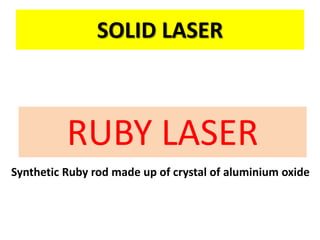
SOLID LASER
RUBY LASER
Synthetic Ruby rod made up of crystal of aluminium oxide
LASER BEAM MACHINING
.
LASER BEAM MACHINING
Flash tube filled
with Xenon, argon
or krypton Gases
250 – 1000
watts power
Few
Chromium
Atoms are
placed in Ruby
rod for
absorbing
Green light
. Cooling of ruby rod is necessary – Because they
are less efficient in high temperature
.
.
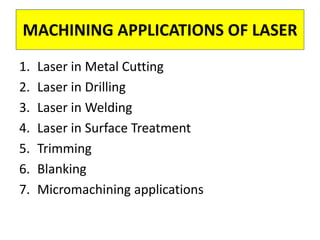
MACHINING APPLICATIONS OF LASER
1. Laser in Metal Cutting
2. Laser in Drilling
3. Laser in Welding
4. Laser in Surface Treatment
5. Trimming
6. Blanking
7. Micromachining applications
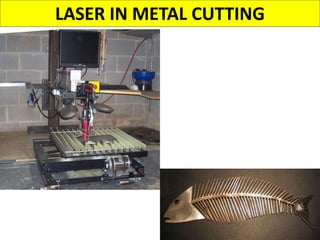
LASER IN METAL CUTTING
• .
LASER IN DRILLING
.
Laser in Surface Treatment
A thin layer of cobalt alloy coating is applied on
Turbine blade for heat and Wear Resistance.
A thin Ceramic coating is applied on metal
Surface for heat and Wear Resistance.
Its also used to seal the micro cracks which are
usually present in hard – Chromium
electroplates
Advantages of LBM
1. All Kind of metals are machined
2. Micro holes are possible
3. Soft materials like rubber can be machined
4. No tool wear and contact with w/p
5. Automated process
6. Controlling of beam is easy
1. High initial Cost
2. Operating cost is high
3. Required skilled labours
4. Rate of production is low
5. Need safety equipments
6. Life of flash lamp is low
7. The machined holes are not straight and round
Disadvantages of LBM
PLASMA ARC MACHINING
OR
PLASMA JET MACHINING
IONIZED GAS
High velocity jet of high temp. ionized Gas
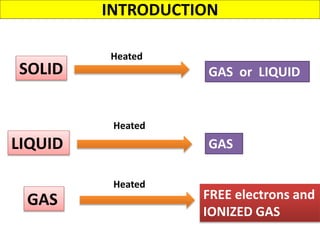
INTRODUCTION
SOLID GAS or LIQUID
Heated
LIQUID
Heated
GAS
GAS
Heated
FREE electrons and
IONIZED GAS
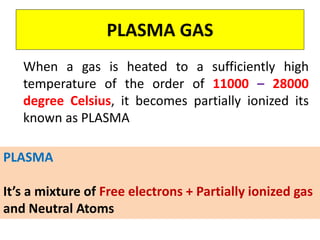
PLASMA GAS
When a gas is heated to a sufficiently high
temperature of the order of 11000 – 28000
degree Celsius, it becomes partially ionized its
known as PLASMA
PLASMA
It’s a mixture of Free electrons + Partially ionized gas
and Neutral Atoms
WORKING PRINCIPLE
Plasma arc
machining
ACCURACY
GASES USED IN PAM
TYPES OF PLASMA ARC TORCHES
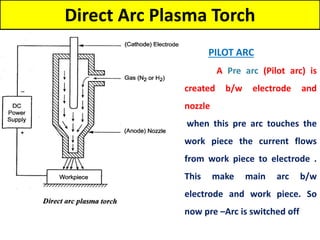
Direct Arc Plasma Torch
PILOT ARC
A Pre arc (Pilot arc) is
created b/w electrode and
nozzle
when this pre arc touches the
work piece the current flows
from work piece to electrode .
This make main arc b/w
electrode and work piece. So
now pre –Arc is switched off
Transferred arc process
Direct Arc Plasma Torch
• The arc is formed between the electrode(-) and the work piece(+).
• In other words, arc is transferred from the electrode to the work
piece.
• A transferred arc possesses high energy density and plasma jet
velocity. For this reason it is employed to cut and melt metals.
Besides carbon steels this process can cut stainless steel and
nonferrous metals also where oxyacetylene torch does not
succeed. Transferred arc can also be used for welding at high arc
travel speeds. A pilot arc is established between the electrode and
the nozzle. As the pilot arc touches the job main current starts
flowing between electrode and job, thus igniting the transferred
arc. The pilot arc initiating unit gets disconnected and pilot arc
extinguishes as soon as the arc between the electrode and the job
is started. The temperature of a constricted plasma arc may be of
the order of 8000 - 250000C.
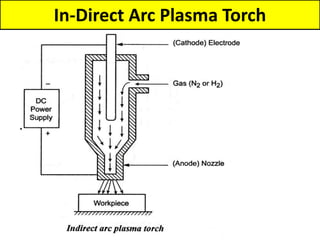
In-Direct Arc Plasma Torch
.
Non-transferred arc process
In-Direct Arc Plasma Torch
• The arc is formed between the electrode(-) and the water cooled
nozzle(+).
• Arc plasma comes out of the nozzle as a flame.
• The arc is independent of the work piece and the work piece does
not form a part of the electrical circuit. Just like an arc flame (as in
atomic hydrogen welding), it can be moved from one place to
another and can be better controlled. The non transferred plasma
arc possesses comparatively less energy density as compared to a
transferred arc plasma and it is employed for welding and in
applications involving ceramics or metal plating (spraying). High
density metal coatings can be produced by this process. A non-
transferred arc is initiated by using a high frequency unit in the
circuit.
Advantages of PAM
Dis-Advantages of PAM
Applications of PAM

EBM

  • 1.
  • 2.
    PRINCIPLE Here the machiningis done by usage of heat energy. The heat energy is focused on a particular portion for melt & Vaporize the work material Example : 1. Electron Beam Machining (EBM) 2. Laser Beam Machining (LBM) 3. Plasma Arc Machining (PAM)
  • 3.
  • 4.
  • 5.
  • 6.
  • 11.
  • 12.
  • 13.
  • 17.
    Process parameters 3.Control ofFocal Distance of magnetic lens
  • 18.
  • 19.
    History - Laser •The laser was successfully fired on May 16, 1960. In a July 7, 1960 press conference in Manhattan,Maiman Theodore Harold "Ted" Maiman (July 11, 1927 – May 5, 2007) was an American engineer and physicist credited with the invention of the first working laser Maiman's laser led to the subsequent development of many other types of lasers.
  • 20.
  • 21.
    PRINCIPLE OF LASERBEAM PRODUCTION
  • 22.
  • 23.
  • 24.
    TYPES OF LASER 1.Gas lasers 2. Solid lasers 3. Liquid lasers 4. Semi Conductor lasers
  • 25.
    SOLID LASER RUBY LASER SyntheticRuby rod made up of crystal of aluminium oxide
  • 26.
  • 27.
    LASER BEAM MACHINING Flashtube filled with Xenon, argon or krypton Gases 250 – 1000 watts power Few Chromium Atoms are placed in Ruby rod for absorbing Green light
  • 28.
    . Cooling ofruby rod is necessary – Because they are less efficient in high temperature
  • 29.
  • 30.
  • 31.
    MACHINING APPLICATIONS OFLASER 1. Laser in Metal Cutting 2. Laser in Drilling 3. Laser in Welding 4. Laser in Surface Treatment 5. Trimming 6. Blanking 7. Micromachining applications
  • 32.
    LASER IN METALCUTTING • .
  • 33.
  • 34.
    Laser in SurfaceTreatment A thin layer of cobalt alloy coating is applied on Turbine blade for heat and Wear Resistance. A thin Ceramic coating is applied on metal Surface for heat and Wear Resistance. Its also used to seal the micro cracks which are usually present in hard – Chromium electroplates
  • 35.
    Advantages of LBM 1.All Kind of metals are machined 2. Micro holes are possible 3. Soft materials like rubber can be machined 4. No tool wear and contact with w/p 5. Automated process 6. Controlling of beam is easy
  • 36.
    1. High initialCost 2. Operating cost is high 3. Required skilled labours 4. Rate of production is low 5. Need safety equipments 6. Life of flash lamp is low 7. The machined holes are not straight and round Disadvantages of LBM
  • 37.
    PLASMA ARC MACHINING OR PLASMAJET MACHINING IONIZED GAS High velocity jet of high temp. ionized Gas
  • 38.
    INTRODUCTION SOLID GAS orLIQUID Heated LIQUID Heated GAS GAS Heated FREE electrons and IONIZED GAS
  • 39.
    PLASMA GAS When agas is heated to a sufficiently high temperature of the order of 11000 – 28000 degree Celsius, it becomes partially ionized its known as PLASMA PLASMA It’s a mixture of Free electrons + Partially ionized gas and Neutral Atoms
  • 40.
  • 41.
  • 42.
  • 43.
  • 44.
    TYPES OF PLASMAARC TORCHES
  • 45.
    Direct Arc PlasmaTorch PILOT ARC A Pre arc (Pilot arc) is created b/w electrode and nozzle when this pre arc touches the work piece the current flows from work piece to electrode . This make main arc b/w electrode and work piece. So now pre –Arc is switched off
  • 46.
    Transferred arc process DirectArc Plasma Torch • The arc is formed between the electrode(-) and the work piece(+). • In other words, arc is transferred from the electrode to the work piece. • A transferred arc possesses high energy density and plasma jet velocity. For this reason it is employed to cut and melt metals. Besides carbon steels this process can cut stainless steel and nonferrous metals also where oxyacetylene torch does not succeed. Transferred arc can also be used for welding at high arc travel speeds. A pilot arc is established between the electrode and the nozzle. As the pilot arc touches the job main current starts flowing between electrode and job, thus igniting the transferred arc. The pilot arc initiating unit gets disconnected and pilot arc extinguishes as soon as the arc between the electrode and the job is started. The temperature of a constricted plasma arc may be of the order of 8000 - 250000C.
  • 47.
  • 48.
    Non-transferred arc process In-DirectArc Plasma Torch • The arc is formed between the electrode(-) and the water cooled nozzle(+). • Arc plasma comes out of the nozzle as a flame. • The arc is independent of the work piece and the work piece does not form a part of the electrical circuit. Just like an arc flame (as in atomic hydrogen welding), it can be moved from one place to another and can be better controlled. The non transferred plasma arc possesses comparatively less energy density as compared to a transferred arc plasma and it is employed for welding and in applications involving ceramics or metal plating (spraying). High density metal coatings can be produced by this process. A non- transferred arc is initiated by using a high frequency unit in the circuit.
  • 49.
  • 50.
  • 51.