08/02/2023 12:05 carra Dusabimana Jean D Amour
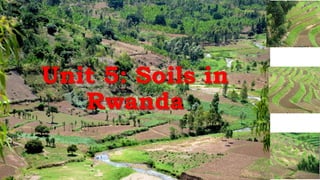
Unit 5: Soils in
Rwanda
Soils in Rwanda
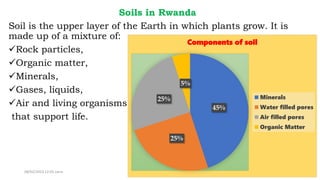
Soil is the upper layer of the Earth in which plants grow. It is
made up of a mixture of:
Rock particles,
Organic matter,
Minerals,
Gases, liquids,
Air and living organisms
that support life.
08/02/2023 12:05 carra Dusabimana Jean D Amour
45%
25%
25%
5%
Components of soil
Minerals
Water filled pores
Air filled pores
Organic Matter
08/02/2023 12:05 carra Dusabimana Jean D Amour
Silt
Clay
Loam
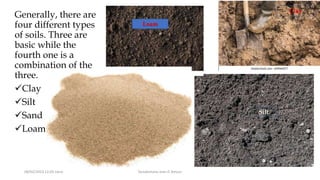
Generally, there are
four different types
of soils. Three are
basic while the
fourth one is a
combination of the
three.
Clay
Silt
Sand
Loam
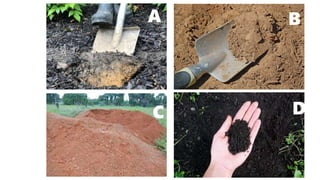
A
C
B
D
Loam soils
08/02/2023 12:05 carra Dusabimana Jean D Amour
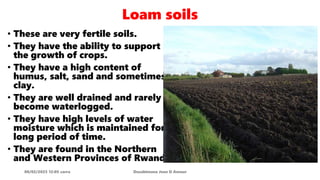
• These are very fertile soils.
• They have the ability to support
the growth of crops.
• They have a high content of
humus, salt, sand and sometimes
clay.
• They are well drained and rarely
become waterlogged.
• They have high levels of water
moisture which is maintained for a
long period of time.
• They are found in the Northern
and Western Provinces of Rwanda.
Clay soils
08/02/2023 12:05 carra Dusabimana Jean D Amour
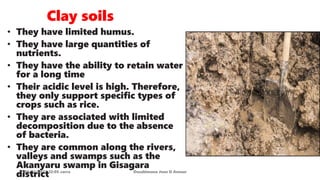
• They have limited humus.
• They have large quantities of
nutrients.
• They have the ability to retain water
for a long time
• Their acidic level is high. Therefore,
they only support specific types of
crops such as rice.
• They are associated with limited
decomposition due to the absence
of bacteria.
• They are common along the rivers,
valleys and swamps such as the
Akanyaru swamp in Gisagara
district
Sandy soils
08/02/2023 12:05 carra Dusabimana Jean D Amour
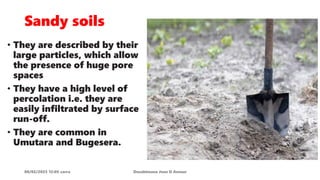
• They are described by their
large particles, which allow
the presence of huge pore
spaces
• They have a high level of
percolation i.e. they are
easily infiltrated by surface
run-off.
• They are common in
Umutara and Bugesera.
Lateritic soils
08/02/2023 12:05 carra Dusabimana Jean D Amour
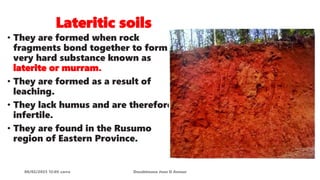
• They are formed when rock
fragments bond together to form a
very hard substance known as
laterite or murram.
• They are formed as a result of
leaching.
• They lack humus and are therefore
infertile.
• They are found in the Rusumo
region of Eastern Province.
Types of soil in Rwanda
There are 5 main types of soils depending on the mode of
formation and their location:
1. Valley soils
• Histosols
• Vertisols
2. Altitudinal soils or inceptisols.
3. Kaolisols
4. Xerokaolisols
5. Antisols
08/02/2023 12:05 carra Dusabimana Jean D Amour
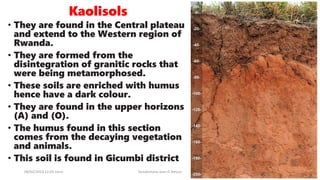
Kaolisols
08/02/2023 12:05 carra Dusabimana Jean D Amour
• They are found in the Central plateau
and extend to the Western region of
Rwanda.
• They are formed from the
disintegration of granitic rocks that
were being metamorphosed.
• These soils are enriched with humus
hence have a dark colour.
• They are found in the upper horizons
(A) and (O).
• The humus found in this section
comes from the decaying vegetation
and animals.
• This soil is found in Gicumbi district
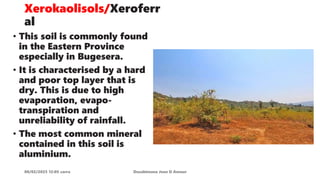
Xerokaolisols/Xeroferr
al
08/02/2023 12:05 carra Dusabimana Jean D Amour
• This soil is commonly found
in the Eastern Province
especially in Bugesera.
• It is characterised by a hard
and poor top layer that is
dry. This is due to high
evaporation, evapo-
transpiration and
unreliability of rainfall.
• The most common mineral
contained in this soil is
aluminium.
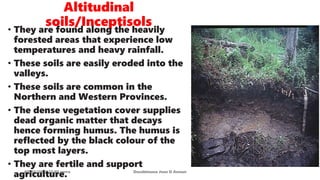
Altitudinal
soils/Inceptisols
08/02/2023 12:05 carra Dusabimana Jean D Amour
• They are found along the heavily
forested areas that experience low
temperatures and heavy rainfall.
• These soils are easily eroded into the
valleys.
• These soils are common in the
Northern and Western Provinces.
• The dense vegetation cover supplies
dead organic matter that decays
hence forming humus. The humus is
reflected by the black colour of the
top most layers.
• They are fertile and support
agriculture.
Volcanic soils/Antisols
08/02/2023 12:05 carra Dusabimana Jean D Amour
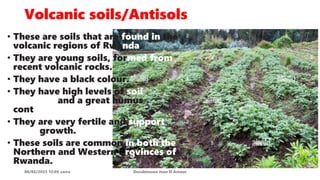
• These are soils that are found in the
volcanic regions of Rwanda.
• They are young soils, formed from
recent volcanic rocks.
• They have a black colour.
• They have high levels of soil
nutrients and a great humus
content.
• They are very fertile and support
plant growth.
• These soils are common in both the
Northern and Western Provinces of
Rwanda.
Valley soils
08/02/2023 12:05 carra Dusabimana Jean D Amour
• These soils are formed through deposition of sediments into the valleys hence the
name valley soils.
• They are found in valley floors of hilly and mountainous areas such as in river
valleys. These soils are further subdivided into:
Vertisoils
• These are valley soils which have a black colour and a high mineral content.
• They lose their fertility during seasons of unreliable rainfall. When the wet season
sets in, they become muddy.
Histosoils
• These are soils that are associated with the decomposition of vegetation that
occupy the valleys.
• The poor drainage characterised by waterlogging within the valley floors slows
down the decomposition of organic matter. This makes the soils to stay muddy for
longer periods.
• In areas where such soils are found, they support plant growth.
• They are found in Bugesera swamp.
Factors influencing soil formation of
Rwanda
• The nature of the parent rock: The soils of Rwanda have got an
influence from volcanic, metamorphic and sedimentary rocks.
• Climate: Lateritic soils dominate in Rwanda because of influence of
equatorial climate. Soils of northern and western provinces of Rwanda
where rainfall is high are deep and well evolved. Soils of the eastern
province are thin and less evolved due to low rainfall and high
temperature.
• Relief or topography: On the steep slopes of highlands, soils are very
thin, easily eroded and become less fertile. In lowlands (valleys and
depressions), soils are deeper and fertile due to the deposition of soils
especially when in valleys there is little water.
• Influence of living organisms: Living organisms such as plants and
animals (bacteria, moles, snakes, etc.) contribute to decay organic
matter and rocks to evolve the soil. Man brings fertilizers in the soils
and protects them against erosion
• Time: It is the duration of the operation of soil formation. Most of
soils in Rwanda are mature because they have had a sufficient time to
form. Entisoils are young thin soils, having short time of formation.
08/02/2023 12:05 carra Dusabimana Jean D Amour
Importance of soils
• Development of agriculture
• They support settlement and the growth of vegetation
• Tourism attraction sites
• Scientific research
• Used in tile and brick making
• Raw materials in craft industry especially for pottery
• They favor mining
• They may be used in building (mud, white clay…)
• Source of revenue for the government through taxation
08/02/2023 12:05 carra Dusabimana Jean D Amour
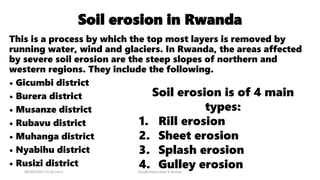
Soil erosion in Rwanda
This is a process by which the top most layers is removed by
running water, wind and glaciers. In Rwanda, the areas affected
by severe soil erosion are the steep slopes of northern and
western regions. They include the following.
• Gicumbi district
• Burera district
• Musanze district
• Rubavu district
• Muhanga district
• Nyabihu district
• Rusizi district
08/02/2023 12:05 carra Dusabimana Jean D Amour
Soil erosion is of 4 main
types:
1. Rill erosion
2. Sheet erosion
3. Splash erosion
4. Gulley erosion
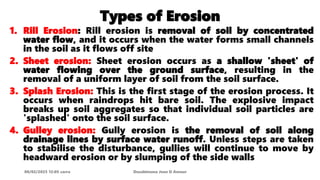
Types of Erosion
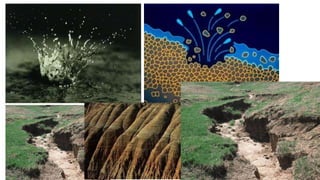
1. Rill Erosion: Rill erosion is removal of soil by concentrated
water flow, and it occurs when the water forms small channels
in the soil as it flows off site
2. Sheet erosion: Sheet erosion occurs as a shallow 'sheet' of
water flowing over the ground surface, resulting in the
removal of a uniform layer of soil from the soil surface.
3. Splash Erosion: This is the first stage of the erosion process. It
occurs when raindrops hit bare soil. The explosive impact
breaks up soil aggregates so that individual soil particles are
'splashed' onto the soil surface.
4. Gulley erosion: Gully erosion is the removal of soil along
drainage lines by surface water runoff. Unless steps are taken
to stabilise the disturbance, gullies will continue to move by
headward erosion or by slumping of the side walls
08/02/2023 12:05 carra Dusabimana Jean D Amour
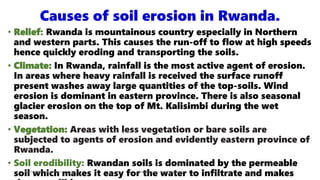
Causes of soil erosion in Rwanda.
• Relief: Rwanda is mountainous country especially in Northern
and western parts. This causes the run-off to flow at high speeds
hence quickly eroding and transporting the soils.
• Climate: In Rwanda, rainfall is the most active agent of erosion.
In areas where heavy rainfall is received the surface runoff
present washes away large quantities of the top-soils. Wind
erosion is dominant in eastern province. There is also seasonal
glacier erosion on the top of Mt. Kalisimbi during the wet
season.
• Vegetation: Areas with less vegetation or bare soils are
subjected to agents of erosion and evidently eastern province of
Rwanda.
• Soil erodibility: Rwandan soils is dominated by the permeable
soil which makes it easy for the water to infiltrate and makes
08/02/2023 12:05 carra Dusabimana Jean D Amour
• Poor methods of farming: Farming methods such as
monoculture and ploughing of land along slopes of Rwanda
speed up erosion. They subject the soils to erosion especially by
water
• Mining and quarrying: methods like open cast mining expose the
soils to erosion. They make the soil particles unstable and when
agents of erosion come by, much of the soils are carried away.
• Overgrazing: In some parts of Rwanda where animals are still
communally grazed, much of the soils remain bare due to the
clearance of the vegetation by animals. This exposes the land to
agents of erosion.
• Bush burning: The pastoral communities of eastern and north
western part of Rwanda have a tendency of burning grass or
pasture lands during the dry season in preparation for the rainy
season. The burning of vegetation leaves a given area bare and
totally exposed to agents of erosion
08/02/2023 12:05 carra Dusabimana Jean D Amour
Cause of soil erosion in Rwanda
(Summary)
1. A great increase in population which has led to overuse and
misuse of the existing land
2. The steep slopes which are easily eroded by running water
especially after heavy rainfall.
3. Poor methods of farming especially on steep and gentle slopes
4. Cutting of trees on slopes.
5. Uncontrolled grazing (overstocking) in almost dry areas such
as Mutara
6. Unstable soils coupled with unfavorable climate especially
on steep slopes.
7. Bush fires
08/02/2023 12:05 carra Dusabimana Jean D Amour
Effects of soil erosion in Rwanda
• Low soil productivity: Soils subjected to erosion lose all nutrients and
lowers their economic value because they can hardly support crop
production due to their infertility.
• Low soil moisture: Areas affected by erosion experience loss of
moisture. This further reduces the permeability, porosity, and
biological activity of soils hence rendering them unproductive.
• Destruction of crops: Wind erosion destroys young seedlings which
costs the farmers more costs via replanting. Sometimes, the
sediments being transported are deposited in farms where they end
up burying germinating seeds to deeper depths preventing them
from reaching the surface.
• Affects underground water: Soil erosion sometimes involves run-off
which percolates and dissolves soluble minerals. Some of the minerals
pollute the underground water.
08/02/2023 12:05 carra Dusabimana Jean D Amour
• Affects transport systems: Many roads in Rwanda especially up
country and feeder roads are affected by gullies created by
continuous surface run-off. This hinders the movement of goods
and services and increases the government’s expenditure due to
frequent rehabilitations
• Flooding: Through soil erosion, sediments are deposited into
lakes, rivers and streams. When there is too much deposition in a
river or lake, its carrying capacity reduces and becomes shallow.
As a result, water starts overflowing hence flooding the
surrounding areas.
• Silting: Closely related to the flooding, the silting problem comes
along with increased expenses of dredging, resettling people and
total disruption of the eco-system.
08/02/2023 12:05 carra Dusabimana Jean D Amour
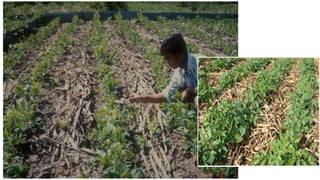
Soil conservation methods in Rwanda
• Proper soil management and application of fertilizers on poor
soils
• Better farming methods such as contour ploughing, strip
cropping, terracing, etc.
• Afforestation and re-afforestation in grazing and mountainous
areas.
• Reducing the number of animals grazing in an area
according to the carrying capacity of land.
• Planting of cover crops in areas.
• Practicing Agro-forestry especially in eastern parts of the
country.
• Mulching of the cultivated farmlands.
08/02/2023 12:05 carra Dusabimana Jean D Amour
Effects of soil erosion in Rwanda
• Loss of soil fertility
• There is decline in crop yields (productivity)
• Famine is always rampant among the local people
where there has been severe erosion.
• Over flooding of the river valley may occur as a result of
eroded materials blocking the flow of a river.
• Destruction of natural vegetation covers (environmental
degradation).
08/02/2023 12:05 carra Dusabimana Jean D Amour

Unit 5 Soils in Rwanda.pptx

  • 1.
    08/02/2023 12:05 carraDusabimana Jean D Amour Unit 5: Soils in Rwanda
  • 2.
    Soils in Rwanda Soilis the upper layer of the Earth in which plants grow. It is made up of a mixture of: Rock particles, Organic matter, Minerals, Gases, liquids, Air and living organisms that support life. 08/02/2023 12:05 carra Dusabimana Jean D Amour 45% 25% 25% 5% Components of soil Minerals Water filled pores Air filled pores Organic Matter
  • 3.
    08/02/2023 12:05 carraDusabimana Jean D Amour Silt Clay Loam Generally, there are four different types of soils. Three are basic while the fourth one is a combination of the three. Clay Silt Sand Loam
  • 4.
  • 5.
    Loam soils 08/02/2023 12:05carra Dusabimana Jean D Amour • These are very fertile soils. • They have the ability to support the growth of crops. • They have a high content of humus, salt, sand and sometimes clay. • They are well drained and rarely become waterlogged. • They have high levels of water moisture which is maintained for a long period of time. • They are found in the Northern and Western Provinces of Rwanda.
  • 6.
    Clay soils 08/02/2023 12:05carra Dusabimana Jean D Amour • They have limited humus. • They have large quantities of nutrients. • They have the ability to retain water for a long time • Their acidic level is high. Therefore, they only support specific types of crops such as rice. • They are associated with limited decomposition due to the absence of bacteria. • They are common along the rivers, valleys and swamps such as the Akanyaru swamp in Gisagara district
  • 7.
    Sandy soils 08/02/2023 12:05carra Dusabimana Jean D Amour • They are described by their large particles, which allow the presence of huge pore spaces • They have a high level of percolation i.e. they are easily infiltrated by surface run-off. • They are common in Umutara and Bugesera.
  • 8.
    Lateritic soils 08/02/2023 12:05carra Dusabimana Jean D Amour • They are formed when rock fragments bond together to form a very hard substance known as laterite or murram. • They are formed as a result of leaching. • They lack humus and are therefore infertile. • They are found in the Rusumo region of Eastern Province.
  • 9.
    Types of soilin Rwanda There are 5 main types of soils depending on the mode of formation and their location: 1. Valley soils • Histosols • Vertisols 2. Altitudinal soils or inceptisols. 3. Kaolisols 4. Xerokaolisols 5. Antisols 08/02/2023 12:05 carra Dusabimana Jean D Amour
  • 10.
    Kaolisols 08/02/2023 12:05 carraDusabimana Jean D Amour • They are found in the Central plateau and extend to the Western region of Rwanda. • They are formed from the disintegration of granitic rocks that were being metamorphosed. • These soils are enriched with humus hence have a dark colour. • They are found in the upper horizons (A) and (O). • The humus found in this section comes from the decaying vegetation and animals. • This soil is found in Gicumbi district
  • 11.
    Xerokaolisols/Xeroferr al 08/02/2023 12:05 carraDusabimana Jean D Amour • This soil is commonly found in the Eastern Province especially in Bugesera. • It is characterised by a hard and poor top layer that is dry. This is due to high evaporation, evapo- transpiration and unreliability of rainfall. • The most common mineral contained in this soil is aluminium.
  • 12.
    Altitudinal soils/Inceptisols 08/02/2023 12:05 carraDusabimana Jean D Amour • They are found along the heavily forested areas that experience low temperatures and heavy rainfall. • These soils are easily eroded into the valleys. • These soils are common in the Northern and Western Provinces. • The dense vegetation cover supplies dead organic matter that decays hence forming humus. The humus is reflected by the black colour of the top most layers. • They are fertile and support agriculture.
  • 13.
    Volcanic soils/Antisols 08/02/2023 12:05carra Dusabimana Jean D Amour • These are soils that are found in the volcanic regions of Rwanda. • They are young soils, formed from recent volcanic rocks. • They have a black colour. • They have high levels of soil nutrients and a great humus content. • They are very fertile and support plant growth. • These soils are common in both the Northern and Western Provinces of Rwanda.
  • 14.
    Valley soils 08/02/2023 12:05carra Dusabimana Jean D Amour • These soils are formed through deposition of sediments into the valleys hence the name valley soils. • They are found in valley floors of hilly and mountainous areas such as in river valleys. These soils are further subdivided into: Vertisoils • These are valley soils which have a black colour and a high mineral content. • They lose their fertility during seasons of unreliable rainfall. When the wet season sets in, they become muddy. Histosoils • These are soils that are associated with the decomposition of vegetation that occupy the valleys. • The poor drainage characterised by waterlogging within the valley floors slows down the decomposition of organic matter. This makes the soils to stay muddy for longer periods. • In areas where such soils are found, they support plant growth. • They are found in Bugesera swamp.
  • 15.
    Factors influencing soilformation of Rwanda • The nature of the parent rock: The soils of Rwanda have got an influence from volcanic, metamorphic and sedimentary rocks. • Climate: Lateritic soils dominate in Rwanda because of influence of equatorial climate. Soils of northern and western provinces of Rwanda where rainfall is high are deep and well evolved. Soils of the eastern province are thin and less evolved due to low rainfall and high temperature. • Relief or topography: On the steep slopes of highlands, soils are very thin, easily eroded and become less fertile. In lowlands (valleys and depressions), soils are deeper and fertile due to the deposition of soils especially when in valleys there is little water. • Influence of living organisms: Living organisms such as plants and animals (bacteria, moles, snakes, etc.) contribute to decay organic matter and rocks to evolve the soil. Man brings fertilizers in the soils and protects them against erosion • Time: It is the duration of the operation of soil formation. Most of soils in Rwanda are mature because they have had a sufficient time to form. Entisoils are young thin soils, having short time of formation. 08/02/2023 12:05 carra Dusabimana Jean D Amour
  • 16.
    Importance of soils •Development of agriculture • They support settlement and the growth of vegetation • Tourism attraction sites • Scientific research • Used in tile and brick making • Raw materials in craft industry especially for pottery • They favor mining • They may be used in building (mud, white clay…) • Source of revenue for the government through taxation 08/02/2023 12:05 carra Dusabimana Jean D Amour
  • 17.
    Soil erosion inRwanda This is a process by which the top most layers is removed by running water, wind and glaciers. In Rwanda, the areas affected by severe soil erosion are the steep slopes of northern and western regions. They include the following. • Gicumbi district • Burera district • Musanze district • Rubavu district • Muhanga district • Nyabihu district • Rusizi district 08/02/2023 12:05 carra Dusabimana Jean D Amour Soil erosion is of 4 main types: 1. Rill erosion 2. Sheet erosion 3. Splash erosion 4. Gulley erosion
  • 18.
    Types of Erosion 1.Rill Erosion: Rill erosion is removal of soil by concentrated water flow, and it occurs when the water forms small channels in the soil as it flows off site 2. Sheet erosion: Sheet erosion occurs as a shallow 'sheet' of water flowing over the ground surface, resulting in the removal of a uniform layer of soil from the soil surface. 3. Splash Erosion: This is the first stage of the erosion process. It occurs when raindrops hit bare soil. The explosive impact breaks up soil aggregates so that individual soil particles are 'splashed' onto the soil surface. 4. Gulley erosion: Gully erosion is the removal of soil along drainage lines by surface water runoff. Unless steps are taken to stabilise the disturbance, gullies will continue to move by headward erosion or by slumping of the side walls 08/02/2023 12:05 carra Dusabimana Jean D Amour
  • 19.
    08/02/2023 12:05 carraDusabimana Jean D Amour
  • 20.
    Causes of soilerosion in Rwanda. • Relief: Rwanda is mountainous country especially in Northern and western parts. This causes the run-off to flow at high speeds hence quickly eroding and transporting the soils. • Climate: In Rwanda, rainfall is the most active agent of erosion. In areas where heavy rainfall is received the surface runoff present washes away large quantities of the top-soils. Wind erosion is dominant in eastern province. There is also seasonal glacier erosion on the top of Mt. Kalisimbi during the wet season. • Vegetation: Areas with less vegetation or bare soils are subjected to agents of erosion and evidently eastern province of Rwanda. • Soil erodibility: Rwandan soils is dominated by the permeable soil which makes it easy for the water to infiltrate and makes 08/02/2023 12:05 carra Dusabimana Jean D Amour
  • 21.
    • Poor methodsof farming: Farming methods such as monoculture and ploughing of land along slopes of Rwanda speed up erosion. They subject the soils to erosion especially by water • Mining and quarrying: methods like open cast mining expose the soils to erosion. They make the soil particles unstable and when agents of erosion come by, much of the soils are carried away. • Overgrazing: In some parts of Rwanda where animals are still communally grazed, much of the soils remain bare due to the clearance of the vegetation by animals. This exposes the land to agents of erosion. • Bush burning: The pastoral communities of eastern and north western part of Rwanda have a tendency of burning grass or pasture lands during the dry season in preparation for the rainy season. The burning of vegetation leaves a given area bare and totally exposed to agents of erosion 08/02/2023 12:05 carra Dusabimana Jean D Amour
  • 22.
    Cause of soilerosion in Rwanda (Summary) 1. A great increase in population which has led to overuse and misuse of the existing land 2. The steep slopes which are easily eroded by running water especially after heavy rainfall. 3. Poor methods of farming especially on steep and gentle slopes 4. Cutting of trees on slopes. 5. Uncontrolled grazing (overstocking) in almost dry areas such as Mutara 6. Unstable soils coupled with unfavorable climate especially on steep slopes. 7. Bush fires 08/02/2023 12:05 carra Dusabimana Jean D Amour
  • 23.
    Effects of soilerosion in Rwanda • Low soil productivity: Soils subjected to erosion lose all nutrients and lowers their economic value because they can hardly support crop production due to their infertility. • Low soil moisture: Areas affected by erosion experience loss of moisture. This further reduces the permeability, porosity, and biological activity of soils hence rendering them unproductive. • Destruction of crops: Wind erosion destroys young seedlings which costs the farmers more costs via replanting. Sometimes, the sediments being transported are deposited in farms where they end up burying germinating seeds to deeper depths preventing them from reaching the surface. • Affects underground water: Soil erosion sometimes involves run-off which percolates and dissolves soluble minerals. Some of the minerals pollute the underground water. 08/02/2023 12:05 carra Dusabimana Jean D Amour
  • 24.
    • Affects transportsystems: Many roads in Rwanda especially up country and feeder roads are affected by gullies created by continuous surface run-off. This hinders the movement of goods and services and increases the government’s expenditure due to frequent rehabilitations • Flooding: Through soil erosion, sediments are deposited into lakes, rivers and streams. When there is too much deposition in a river or lake, its carrying capacity reduces and becomes shallow. As a result, water starts overflowing hence flooding the surrounding areas. • Silting: Closely related to the flooding, the silting problem comes along with increased expenses of dredging, resettling people and total disruption of the eco-system. 08/02/2023 12:05 carra Dusabimana Jean D Amour
  • 25.
    08/02/2023 12:05 carraDusabimana Jean D Amour Soil conservation methods in Rwanda
  • 26.
    Soil conservation methodsin Rwanda • Proper soil management and application of fertilizers on poor soils • Better farming methods such as contour ploughing, strip cropping, terracing, etc. • Afforestation and re-afforestation in grazing and mountainous areas. • Reducing the number of animals grazing in an area according to the carrying capacity of land. • Planting of cover crops in areas. • Practicing Agro-forestry especially in eastern parts of the country. • Mulching of the cultivated farmlands. 08/02/2023 12:05 carra Dusabimana Jean D Amour
  • 27.
    Effects of soilerosion in Rwanda • Loss of soil fertility • There is decline in crop yields (productivity) • Famine is always rampant among the local people where there has been severe erosion. • Over flooding of the river valley may occur as a result of eroded materials blocking the flow of a river. • Destruction of natural vegetation covers (environmental degradation). 08/02/2023 12:05 carra Dusabimana Jean D Amour
  • 28.
    08/02/2023 12:05 carraDusabimana Jean D Amour

Editor's Notes

  • #2 By the end of this unit, a learner should be able to: 1. State the different types of soil in Rwanda. 2. Identify the causes and effects of soil erosion in Rwanda. 3. Identify the importance of soils in Rwanda.