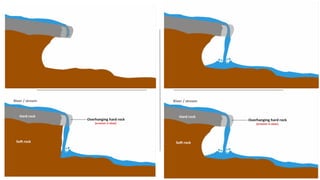
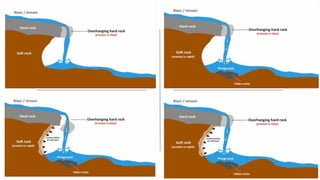
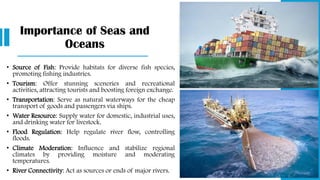
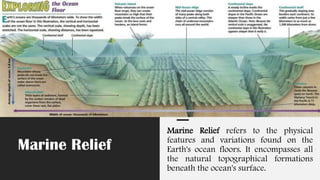
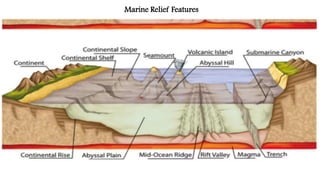
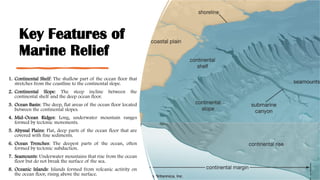
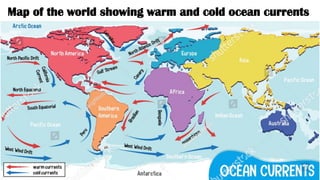
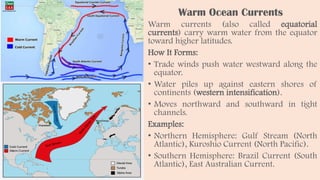
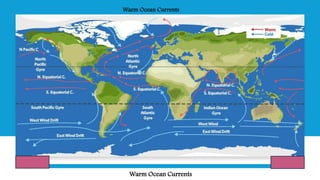
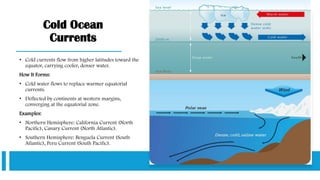
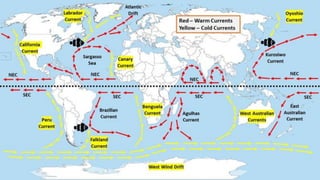
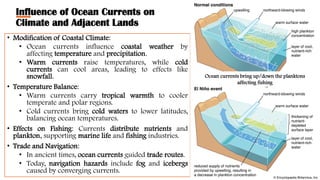
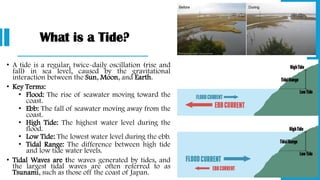
Unit 9: GLOBAL
DRAINAGE SYSTEMS
Key unit
competence
• By the end of this unit, I
should be able to
investigate the economic
importance of global
drainage systems and the
reasons for their
conservation
Unit objectives
Identify and describe the different drainage patterns of the world.
Outline the characteristics of a river profile and examine its features.
Identify and describe the landforms resulting from the work of a river.
Explain the processes of river capture and river rejuvenation and differentiate between
them.
Appreciate the distribution and importance of global drainage patterns and water bodies.
1
2
3
4
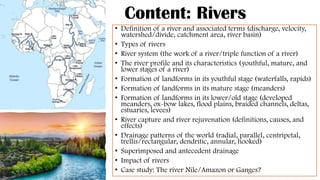
Content: Rivers
• Definition of a river and associated terms (discharge, velocity,
watershed/divide, catchment area, river basin)
• Types of rivers
• River system (the work of a river/triple function of a river)
• The river profile and its characteristics (youthful, mature, and
lower stages of a river)
• Formation of landforms in its youthful stage (waterfalls, rapids)
• Formation of landforms in its mature stage (meanders)
• Formation of landforms in its lower/old stage (developed
meanders, ox-bow lakes, flood plains, braided channels, deltas,
estuaries, levees)
• River capture and river rejuvenation (definitions, causes, and
effects)
• Drainage patterns of the world (radial, parallel, centripetal,
trellis/rectangular, dendritic, annular, hooked)
• Superimposed and antecedent drainage
• Impact of rivers
• Case study: The river Nile/Amazon or Ganges?
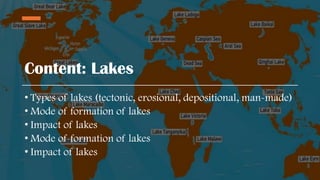
Content: Lakes
• Types of lakes (tectonic, erosional, depositional, man-made)
• Mode of formation of lakes
• Impact of lakes
• Mode of formation of lakes
• Impact of lakes
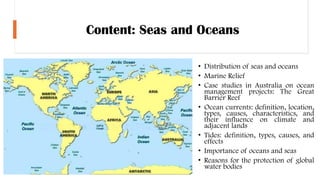
Content: Seas and Oceans
• Distribution of seas and oceans
• Marine Relief
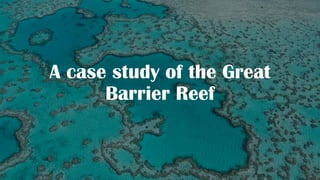
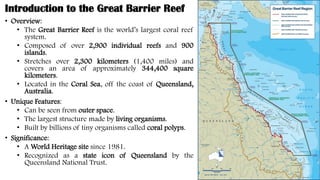
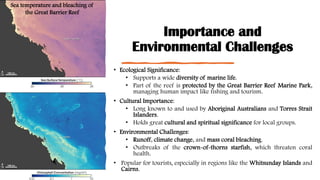
• Case studies in Australia on ocean
management projects: The Great
Barrier Reef
• Ocean currents: definition, location,
types, causes, characteristics, and
their influence on climate and
adjacent lands
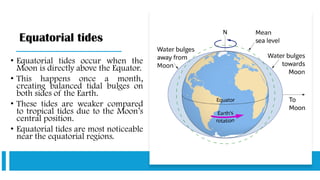
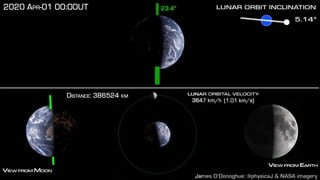
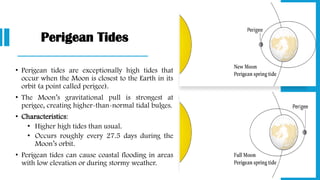
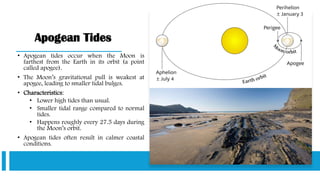
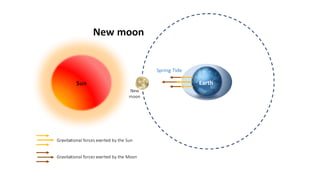
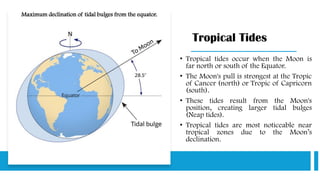
• Tides: definition, types, causes, and
effects
• Importance of oceans and seas
• Reasons for the protection of global
water bodies
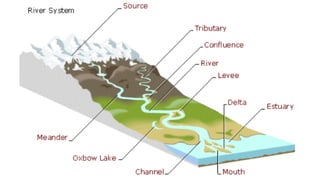
1. River system
A river system refers to a network of interconnected streams and
rivers that work together to drain a specific area of land. It
includes the main river and all its tributaries, distributaries, and
the surrounding watershed or drainage basin.
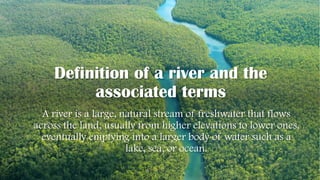
Definition of a river and the
associated terms
A river is a large, natural stream of freshwater that flows
across the land, usually from higher elevations to lower ones,
eventually emptying into a larger body of water such as a
lake, sea, or ocean.
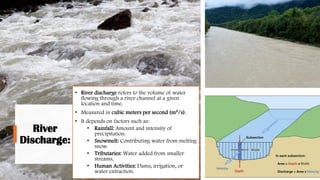
River
Discharge:
• River discharge refers to the volume of water
flowing through a river channel at a given
location and time.
• Measured in cubic meters per second (m³/s).
• It depends on factors such as:
• Rainfall: Amount and intensity of
precipitation.
• Snowmelt: Contributing water from melting
snow.
• Tributaries: Water added from smaller
streams.
• Human Activities: Dams, irrigation, or
water extraction.
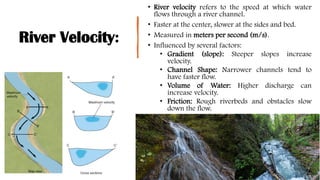
River Velocity:
• River velocity refers to the speed at which water
flows through a river channel.
• Faster at the center, slower at the sides and bed.
• Measured in meters per second (m/s).
• Influenced by several factors:
• Gradient (slope): Steeper slopes increase
velocity.
• Channel Shape: Narrower channels tend to
have faster flow.
• Volume of Water: Higher discharge can
increase velocity.
• Friction: Rough riverbeds and obstacles slow
down the flow.
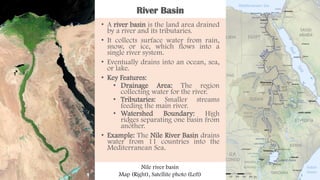
River Basin
• A river basin is the land area drained
by a river and its tributaries.
• It collects surface water from rain,
snow, or ice, which flows into a
single river system.
• Eventually drains into an ocean, sea,
or lake.
• Key Features:
• Drainage Area: The region
collecting water for the river.
• Tributaries: Smaller streams
feeding the main river.
• Watershed Boundary: High
ridges separating one basin from
another.
• Example: The Nile River Basin drains
water from 11 countries into the
Mediterranean Sea.
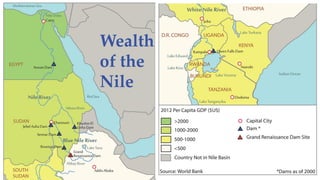
Nile river basin
Map (Right), Satellite photo (Left)
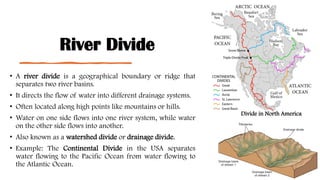
River Divide
• A river divide is a geographical boundary or ridge that
separates two river basins.
• It directs the flow of water into different drainage systems.
• Often located along high points like mountains or hills.
• Water on one side flows into one river system, while water
on the other side flows into another.
• Also known as a watershed divide or drainage divide.
• Example: The Continental Divide in the USA separates
water flowing to the Pacific Ocean from water flowing to
the Atlantic Ocean.
Divide in North America
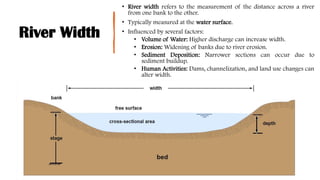
River Width
• River width refers to the measurement of the distance across a river
from one bank to the other.
• Typically measured at the water surface.
• Influenced by several factors:
• Volume of Water: Higher discharge can increase width.
• Erosion: Widening of banks due to river erosion.
• Sediment Deposition: Narrower sections can occur due to
sediment buildup.
• Human Activities: Dams, channelization, and land use changes can
alter width.
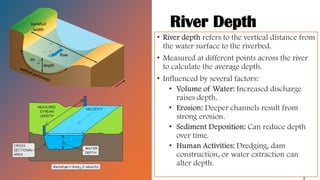
River Depth
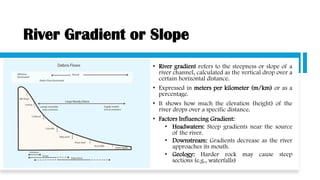
River Gradient or Slope
• River gradient refers to the steepness or slope of a
river channel, calculated as the vertical drop over a
certain horizontal distance.
• Expressed in meters per kilometer (m/km) or as a
percentage.
• It shows how much the elevation (height) of the
river drops over a specific distance.
• Factors Influencing Gradient:
• Headwaters: Steep gradients near the source
of the river.
• Downstream: Gradients decrease as the river
approaches its mouth.
• Geology: Harder rock may cause steep
sections (e.g., waterfalls)
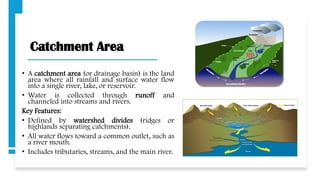
Catchment Area
• A catchment area (or drainage basin) is the land
area where all rainfall and surface water flow
into a single river, lake, or reservoir.
• Water is collected through runoff and
channeled into streams and rivers.
Key Features:
• Defined by watershed divides (ridges or
highlands separating catchments).
• All water flows toward a common outlet, such as
a river mouth.
• Includes tributaries, streams, and the main river.
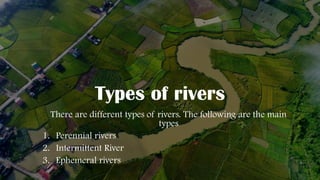
Types of rivers
There are different types of rivers. The following are the main
types
1. Perennial rivers
2. Intermittent River
3. Ephemeral rivers
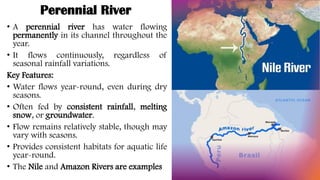
Perennial River
• A perennial river has water flowing
permanently in its channel throughout the
year.
• It flows continuously, regardless of
seasonal rainfall variations.
Key Features:
• Water flows year-round, even during dry
seasons.
• Often fed by consistent rainfall, melting
snow, or groundwater.
• Flow remains relatively stable, though may
vary with seasons.
• Provides consistent habitats for aquatic life
year-round.
• The Nile and Amazon Rivers are examples
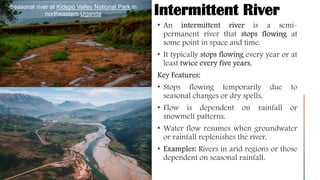
Intermittent River
Seasonal river at Kidepo Valley National Park in
northeastern Uganda
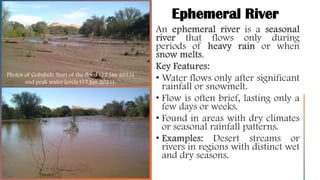
Ephemeral River
Photos of Gobabeb: Start of the flood (12 Jan 2021)
and peak water levels (17 Jan 2021).
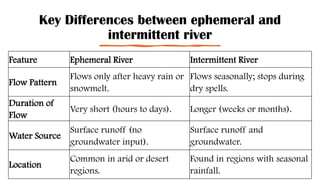
Key Differences between ephemeral and
intermittent river
Feature Ephemeral River Intermittent River
Flow Pattern
Flows only after heavy rain or
snowmelt.
Flows seasonally; stops during
dry spells.
Duration of
Flow
Very short (hours to days). Longer (weeks or months).
Water Source
Surface runoff (no
groundwater input).
Surface runoff and
groundwater.
Location
Common in arid or desert
regions.
Found in regions with seasonal
rainfall.
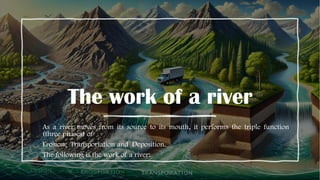
The work of a river
As a river moves from its source to its mouth, it performs the triple function
(three phases) of
Erosion, Transportation and Deposition.
The following is the work of a river:
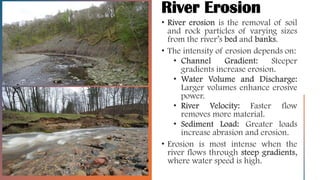
River Erosion
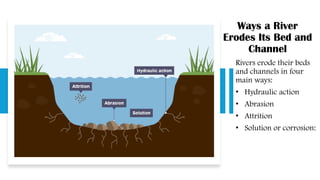
Ways a River
Erodes Its Bed and
Channel
Rivers erode their beds
and channels in four
main ways:
• Hydraulic action
• Abrasion
• Attrition
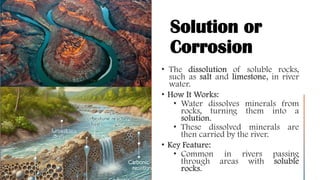
• Solution or corrosion:
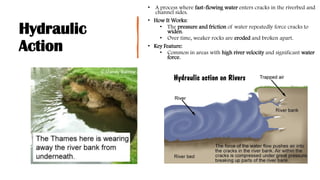
Hydraulic
Action
• A process where fast-flowing water enters cracks in the riverbed and
channel sides.
• How It Works:
• The pressure and friction of water repeatedly force cracks to
widen.
• Over time, weaker rocks are eroded and broken apart.
• Key Feature:
• Common in areas with high river velocity and significant water
force.
Solution or
Corrosion
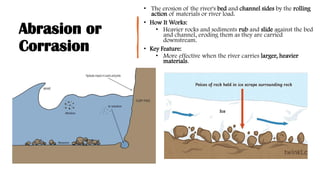
Abrasion or
Corrasion
• The erosion of the river's bed and channel sides by the rolling
action of materials or river load.
• How It Works:
• Heavier rocks and sediments rub and slide against the bed
and channel, eroding them as they are carried
downstream.
• Key Feature:
• More effective when the river carries larger, heavier
materials.
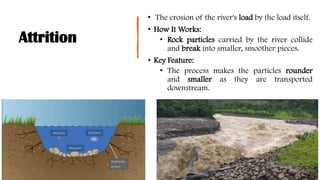
Attrition
• The erosion of the river's load by the load itself.
• How It Works:
• Rock particles carried by the river collide
and break into smaller, smoother pieces.
• Key Feature:
• The process makes the particles rounder
and smaller as they are transported
downstream.
2. River
transportation
River transport refers to the carrying away of
eroded material downstream.
Factors Affecting River Transportation
1.Water Velocity: Faster flow can carry larger
and heavier materials.
2.Discharge: More water increases the river's
capacity to transport sediment.
3.Gradient: Steeper slopes cause faster flow,
improving transportation of materials.
4.Channel Shape and Size: A wider and deeper
channel allows more water and sediment to
flow.
5.Sediment Size: Larger particles require more
energy to be transported.
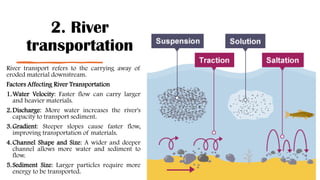
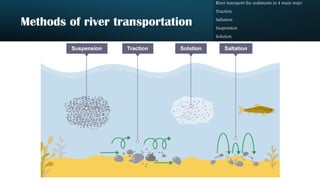
Methods of river transportation
River transport the sediments in 4 main ways
Traction
Saltation
Suspension
Solution
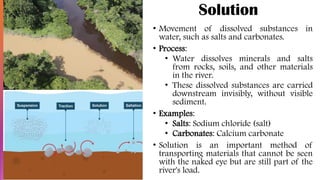
Solution
• Movement of dissolved substances in
water, such as salts and carbonates.
• Process:
• Water dissolves minerals and salts
from rocks, soils, and other materials
in the river.
• These dissolved substances are carried
downstream invisibly, without visible
sediment.
• Examples:
• Salts: Sodium chloride (salt)
• Carbonates: Calcium carbonate
• Solution is an important method of
transporting materials that cannot be seen
with the naked eye but are still part of the
river's load.
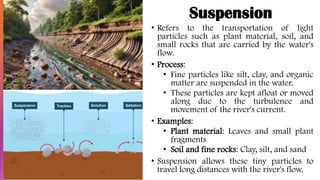
Suspension
• Refers to the transportation of light
particles such as plant material, soil, and
small rocks that are carried by the water's
flow.
• Process:
• Fine particles like silt, clay, and organic
matter are suspended in the water.
• These particles are kept afloat or moved
along due to the turbulence and
movement of the river's current.
• Examples:
• Plant material: Leaves and small plant
fragments
• Soil and fine rocks: Clay, silt, and sand
• Suspension allows these tiny particles to
travel long distances with the river's flow.
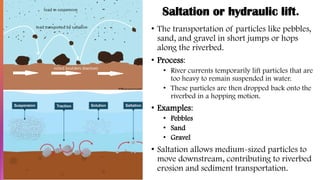
Saltation or hydraulic lift.
• The transportation of particles like pebbles,
sand, and gravel in short jumps or hops
along the riverbed.
• Process:
• River currents temporarily lift particles that are
too heavy to remain suspended in water.
• These particles are then dropped back onto the
riverbed in a hopping motion.
• Examples:
• Pebbles
• Sand
• Gravel
• Saltation allows medium-sized particles to
move downstream, contributing to riverbed
erosion and sediment transportation.
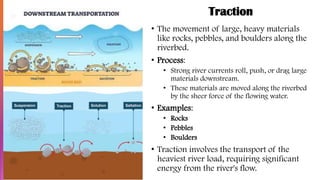
Traction
• The movement of large, heavy materials
like rocks, pebbles, and boulders along the
riverbed.
• Process:
• Strong river currents roll, push, or drag large
materials downstream.
• These materials are moved along the riverbed
by the sheer force of the flowing water.
• Examples:
• Rocks
• Pebbles
• Boulders
• Traction involves the transport of the
heaviest river load, requiring significant
energy from the river's flow.
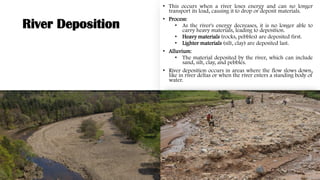
River Deposition
• This occurs when a river loses energy and can no longer
transport its load, causing it to drop or deposit materials.
• Process:
• As the river's energy decreases, it is no longer able to
carry heavy materials, leading to deposition.
• Heavy materials (rocks, pebbles) are deposited first.
• Lighter materials (silt, clay) are deposited last.
• Alluvium:
• The material deposited by the river, which can include
sand, silt, clay, and pebbles.
• River deposition occurs in areas where the flow slows down,
like in river deltas or when the river enters a standing body of
water.
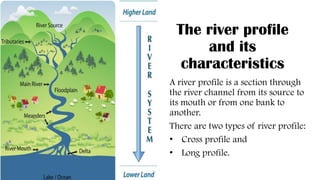
The river profile
and its
characteristics
A river profile is a section through
the river channel from its source to
its mouth or from one bank to
another.
There are two types of river profile:
• Cross profile and
• Long profile.
Cross Profile
section
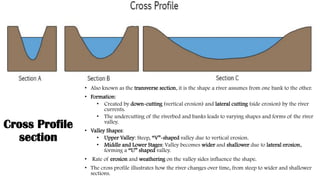
• Also known as the transverse section, it is the shape a river assumes from one bank to the other.
• Formation:
• Created by down-cutting (vertical erosion) and lateral cutting (side erosion) by the river
currents.
• The undercutting of the riverbed and banks leads to varying shapes and forms of the river
valley.
• Valley Shapes:
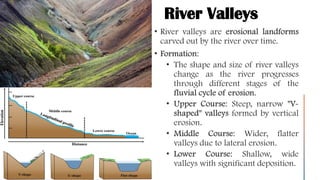
• Upper Valley: Steep, “V”-shaped valley due to vertical erosion.
• Middle and Lower Stages: Valley becomes wider and shallower due to lateral erosion,
forming a “U” shaped valley.
• Rate of erosion and weathering on the valley sides influence the shape.
• The cross profile illustrates how the river changes over time, from steep to wider and shallower
sections.
Long Profile
of a River
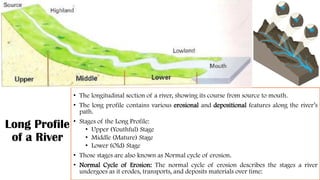
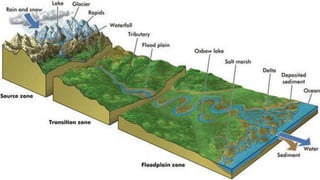
• The longitudinal section of a river, showing its course from source to mouth.
• The long profile contains various erosional and depositional features along the river’s
path.
• Stages of the Long Profile:
• Upper (Youthful) Stage
• Middle (Mature) Stage
• Lower (Old) Stage
• Those stages are also known as Normal cycle of erosion.
• Normal Cycle of Erosion: The normal cycle of erosion describes the stages a river
undergoes as it erodes, transports, and deposits materials over time:
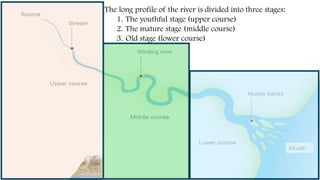
The long profile of the river is divided into three stages:
1. The youthful stage (upper course)
2. The mature stage (middle course)
3. Old stage (lower course)
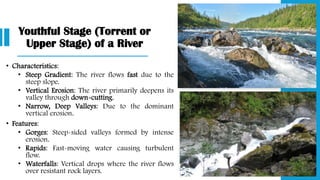
Youthful Stage (Torrent or
Upper Stage) of a River
• Characteristics:
• Steep Gradient: The river flows fast due to the
steep slope.
• Vertical Erosion: The river primarily deepens its
valley through down-cutting.
• Narrow, Deep Valleys: Due to the dominant
vertical erosion.
• Features:
• Gorges: Steep-sided valleys formed by intense
erosion.
• Rapids: Fast-moving water causing turbulent
flow.
• Waterfalls: Vertical drops where the river flows
over resistant rock layers.
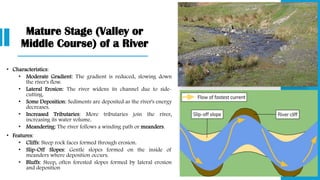
Mature Stage (Valley or
Middle Course) of a River
• Characteristics:
• Moderate Gradient: The gradient is reduced, slowing down
the river's flow.
• Lateral Erosion: The river widens its channel due to side-
cutting.
• Some Deposition: Sediments are deposited as the river's energy
decreases.
• Increased Tributaries: More tributaries join the river,
increasing its water volume.
• Meandering: The river follows a winding path or meanders.
• Features:
• Cliffs: Steep rock faces formed through erosion.
• Slip-Off Slopes: Gentle slopes formed on the inside of
meanders where deposition occurs.
• Bluffs: Steep, often forested slopes formed by lateral erosion
and deposition
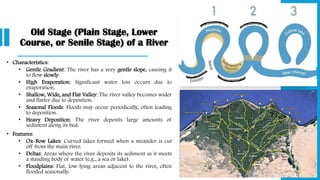
Old Stage (Plain Stage, Lower
Course, or Senile Stage) of a River
• Characteristics:
• Gentle Gradient: The river has a very gentle slope, causing it
to flow slowly.
• High Evaporation: Significant water loss occurs due to
evaporation.
• Shallow, Wide, and Flat Valley: The river valley becomes wider
and flatter due to deposition.
• Seasonal Floods: Floods may occur periodically, often leading
to deposition.
• Heavy Deposition: The river deposits large amounts of
sediment along its bed.
• Features:
• Ox-Bow Lakes: Curved lakes formed when a meander is cut
off from the main river.
• Deltas: Areas where the river deposits its sediment as it meets
a standing body of water (e.g., a sea or lake).
• Floodplains: Flat, low-lying areas adjacent to the river, often
flooded seasonally.
Formation of the major landforms
associated with a river profile
This part will cover the formation of features located in
• Young stage
• Mature stage
• Old stage
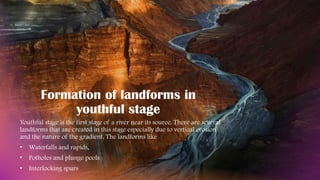
Formation of landforms in
youthful stage
Youthful stage is the first stage of a river near its source. There are several
landforms that are created in this stage especially due to vertical erosion
and the nature of the gradient. The landforms like
• Waterfalls and rapids,
• Potholes and plunge pools
• Interlocking spurs
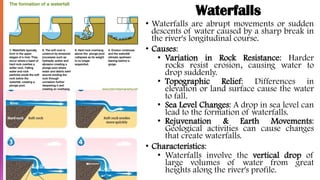
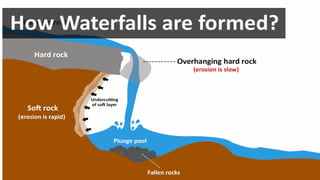
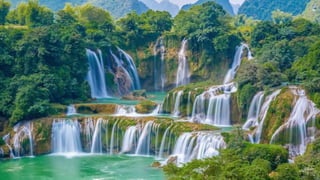
Waterfalls
• Waterfalls are abrupt movements or sudden
descents of water caused by a sharp break in
the river's longitudinal course.
• Causes:
• Variation in Rock Resistance: Harder
rocks resist erosion, causing water to
drop suddenly.
• Topographic Relief: Differences in
elevation or land surface cause the water
to fall.
• Sea Level Changes: A drop in sea level can
lead to the formation of waterfalls.
• Rejuvenation & Earth Movements:
Geological activities can cause changes
that create waterfalls.
• Characteristics:
• Waterfalls involve the vertical drop of
large volumes of water from great
heights along the river's profile.
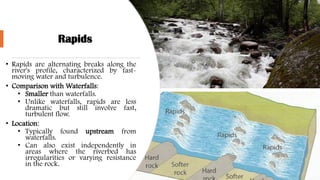
Rapids
• Rapids are alternating breaks along the
river's profile, characterized by fast-
moving water and turbulence.
• Comparison with Waterfalls:
• Smaller than waterfalls.
• Unlike waterfalls, rapids are less
dramatic but still involve fast,
turbulent flow.
• Location:
• Typically found upstream from
waterfalls.
• Can also exist independently in
areas where the riverbed has
irregularities or varying resistance
in the rock.
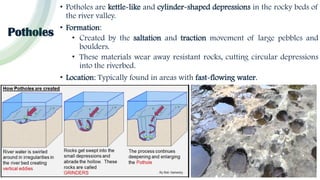
Potholes
• Potholes are kettle-like and cylinder-shaped depressions in the rocky beds of
the river valley.
• Formation:
• Created by the saltation and traction movement of large pebbles and
boulders.
• These materials wear away resistant rocks, cutting circular depressions
into the riverbed.
• Location: Typically found in areas with fast-flowing water.
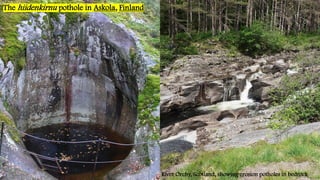
The hiidenkirnu pothole in Askola, Finland
River Orchy, Scotland, showing erosion potholes in bedrock
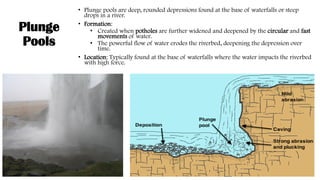
Plunge
Pools
• Plunge pools are deep, rounded depressions found at the base of waterfalls or steep
drops in a river.
• Formation:
• Created when potholes are further widened and deepened by the circular and fast
movements of water.
• The powerful flow of water erodes the riverbed, deepening the depression over
time.
• Location: Typically found at the base of waterfalls where the water impacts the riverbed
with high force.
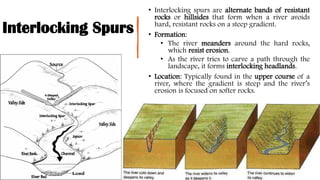
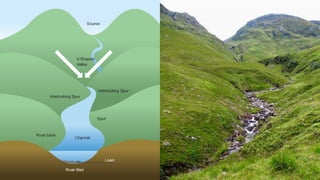
Interlocking Spurs
• Interlocking spurs are alternate bands of resistant
rocks or hillsides that form when a river avoids
hard, resistant rocks on a steep gradient.
• Formation:
• The river meanders around the hard rocks,
which resist erosion.
• As the river tries to carve a path through the
landscape, it forms interlocking headlands.
• Location: Typically found in the upper course of a
river, where the gradient is steep and the river’s
erosion is focused on softer rocks.
Formation of
landforms in
mature stage
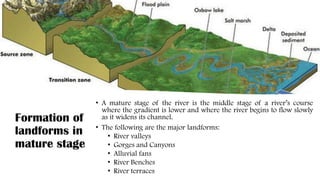
• A mature stage of the river is the middle stage of a river’s course
where the gradient is lower and where the river begins to flow slowly
as it widens its channel.
• The following are the major landforms:
• River valleys
• Gorges and Canyons
• Alluvial fans
• River Benches
• River terraces
River Valleys
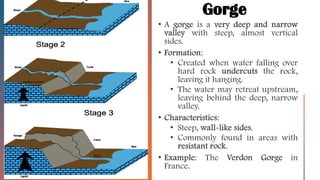
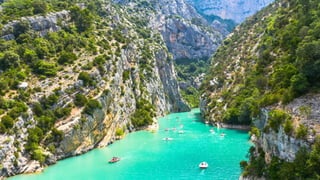
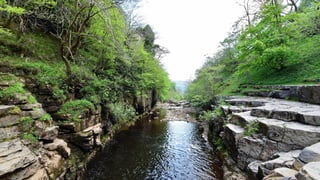
Gorge
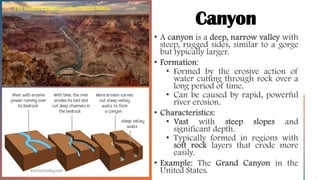
Canyon
The Grand Canyon in the United States.
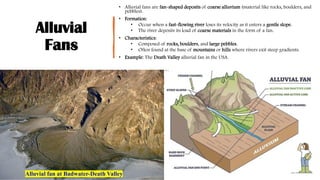
Alluvial
Fans
• Alluvial fans are fan-shaped deposits of coarse alluvium (material like rocks, boulders, and
pebbles).
• Formation:
• Occur when a fast-flowing river loses its velocity as it enters a gentle slope.
• The river deposits its load of coarse materials in the form of a fan.
• Characteristics:
• Composed of rocks, boulders, and large pebbles.
• Often found at the base of mountains or hills where rivers exit steep gradients.
• Example: The Death Valley alluvial fan in the USA.
Alluvial fan at Badwater-Death Valley
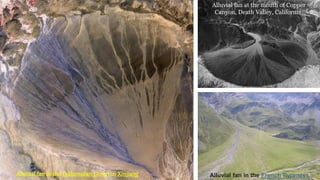
Alluvial fan in the Taklamakan Desert in Xinjiang Alluvial fan in the French Pyrenees
Alluvial fan at the mouth of Copper
Canyon, Death Valley, California.
River
Benches
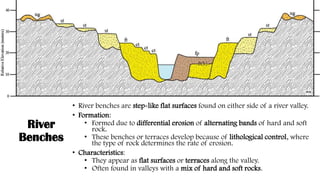
• River benches are step-like flat surfaces found on either side of a river valley.
• Formation:
• Formed due to differential erosion of alternating bands of hard and soft
rock.
• These benches or terraces develop because of lithological control, where
the type of rock determines the rate of erosion.
• Characteristics:
• They appear as flat surfaces or terraces along the valley.
• Often found in valleys with a mix of hard and soft rocks.
River Terraces
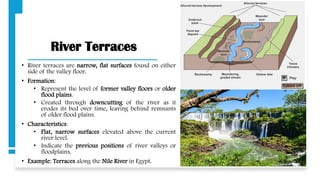
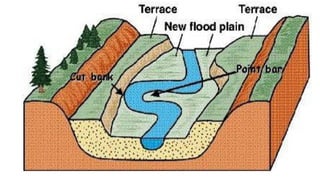
• River terraces are narrow, flat surfaces found on either
side of the valley floor.
• Formation:
• Represent the level of former valley floors or older
flood plains.
• Created through downcutting of the river as it
erodes its bed over time, leaving behind remnants
of older flood plains.
• Characteristics:
• Flat, narrow surfaces elevated above the current
river level.
• Indicate the previous positions of river valleys or
floodplains.
• Example: Terraces along the Nile River in Egypt.
Formation of
landforms in old
stage
• The lower or old stage of river is the last stage where a river
nears its destination. This stage is characterized by large
deposits along the river’s bed and channel.
• River deposition results into the formation of the following
features:
• River meanders
• An Ox-bow lake
• A Flood plain
• Levees
• Deferred tributaries
• Braided channel
• Delta
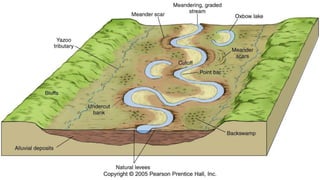
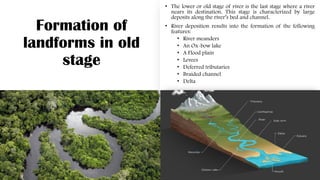
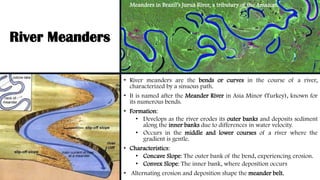
River Meanders
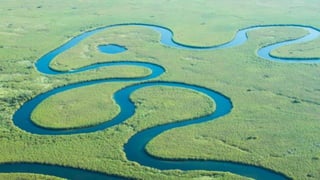
• River meanders are the bends or curves in the course of a river,
characterized by a sinuous path.
• It is named after the Meander River in Asia Minor (Turkey), known for
its numerous bends.
• Formation:
• Develops as the river erodes its outer banks and deposits sediment
along the inner banks due to differences in water velocity.
• Occurs in the middle and lower courses of a river where the
gradient is gentle.
• Characteristics:
• Concave Slope: The outer bank of the bend, experiencing erosion.
• Convex Slope: The inner bank, where deposition occurs
• Alternating erosion and deposition shape the meander belt.
Meanders in Brazil’s Juruá River, a tributary of the Amazon.
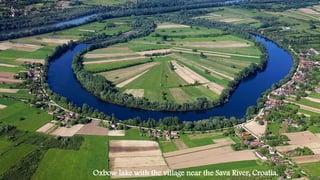
Ox-Bow Lake
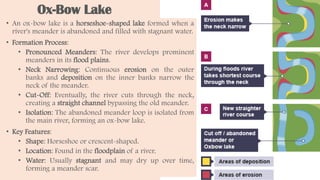
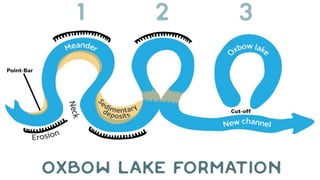
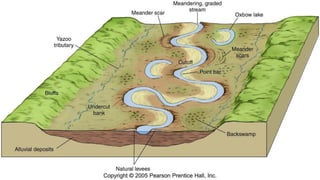
• An ox-bow lake is a horseshoe-shaped lake formed when a
river's meander is abandoned and filled with stagnant water.
• Formation Process:
• Pronounced Meanders: The river develops prominent
meanders in its flood plains.
• Neck Narrowing: Continuous erosion on the outer
banks and deposition on the inner banks narrow the
neck of the meander.
• Cut-Off: Eventually, the river cuts through the neck,
creating a straight channel bypassing the old meander.
• Isolation: The abandoned meander loop is isolated from
the main river, forming an ox-bow lake.
• Key Features:
• Shape: Horseshoe or crescent-shaped.
• Location: Found in the floodplain of a river.
• Water: Usually stagnant and may dry up over time,
forming a meander scar.
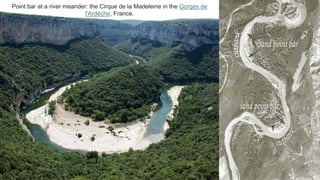
Point bar at a river meander: the Cirque de la Madeleine in the Gorges de
l'Ardèche, France.
Oxbow lake with the village near the Sava River, Croatia.
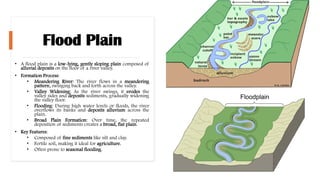
Flood Plain
• A flood plain is a low-lying, gently sloping plain composed of
alluvial deposits on the floor of a river valley.
• Formation Process:
• Meandering River: The river flows in a meandering
pattern, swinging back and forth across the valley.
• Valley Widening: As the river swings, it erodes the
valley sides and deposits sediments, gradually widening
the valley floor.
• Flooding: During high water levels or floods, the river
overflows its banks and deposits alluvium across the
plain.
• Broad Plain Formation: Over time, the repeated
deposition of sediments creates a broad, flat plain.
• Key Features:
• Composed of fine sediments like silt and clay.
• Fertile soil, making it ideal for agriculture.
• Often prone to seasonal flooding.
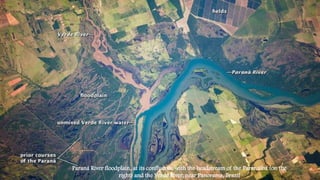
Paraná River floodplain, at its confluence with the headstream of the Paranaíba (on the
right) and the Verde River, near Panorama, Brazil
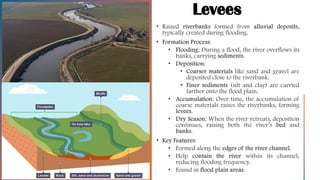
Levees
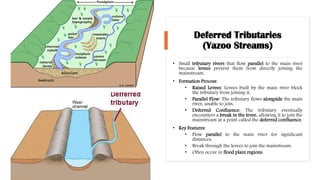
Deferred Tributaries
(Yazoo Streams)
• Small tributary rivers that flow parallel to the main river
because levees prevent them from directly joining the
mainstream.
• Formation Process:
• Raised Levees: Levees built by the main river block
the tributary from joining it.
• Parallel Flow: The tributary flows alongside the main
river, unable to join.
• Deferred Confluence: The tributary eventually
encounters a break in the levee, allowing it to join the
mainstream at a point called the deferred confluence.
• Key Features:
• Flow parallel to the main river for significant
distances.
• Break through the levees to join the mainstream.
• Often occur in flood plain regions.
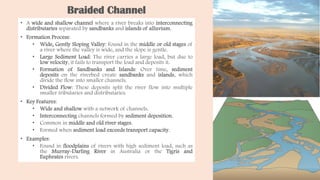
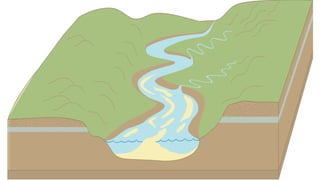
Braided Channel
• A wide and shallow channel where a river breaks into interconnecting
distributaries separated by sandbanks and islands of alluvium.
• Formation Process:
• Wide, Gently Sloping Valley: Found in the middle or old stages of
a river where the valley is wide, and the slope is gentle.
• Large Sediment Load: The river carries a large load, but due to
low velocity, it fails to transport the load and deposits it.
• Formation of Sandbanks and Islands: Over time, sediment
deposits on the riverbed create sandbanks and islands, which
divide the flow into smaller channels.
• Divided Flow: These deposits split the river flow into multiple
smaller tributaries and distributaries.
• Key Features:
• Wide and shallow with a network of channels.
• Interconnecting channels formed by sediment deposition.
• Common in middle and old river stages.
• Formed when sediment load exceeds transport capacity.
• Examples:
• Found in floodplains of rivers with high sediment load, such as
the Murray-Darling River in Australia or the Tigris and
Euphrates rivers.
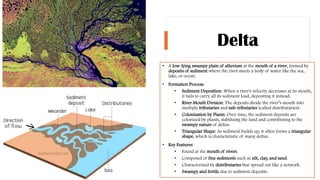
Delta
• A low-lying swampy plain of alluvium at the mouth of a river, formed by
deposits of sediment where the river meets a body of water like the sea,
lake, or ocean.
• Formation Process:
• Sediment Deposition: When a river's velocity decreases at its mouth,
it fails to carry all its sediment load, depositing it instead.
• River Mouth Division: The deposits divide the river’s mouth into
multiple tributaries and sub-tributaries (called distributaries).
• Colonization by Plants: Over time, the sediment deposits are
colonized by plants, stabilizing the land and contributing to the
swampy nature of deltas.
• Triangular Shape: As sediment builds up, it often forms a triangular
shape, which is characteristic of many deltas.
• Key Features:
• Found at the mouth of rivers.
• Composed of fine sediments such as silt, clay, and sand.
• Characterized by distributaries that spread out like a network.
• Swampy and fertile due to sediment deposits.
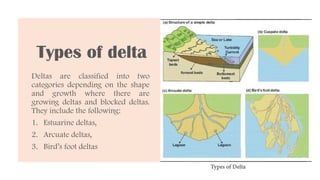
Types of delta
Deltas are classified into two
categories depending on the shape
and growth where there are
growing deltas and blocked deltas.
They include the following:
1. Estuarine deltas,
2. Arcuate deltas,
3. Bird’s foot deltas
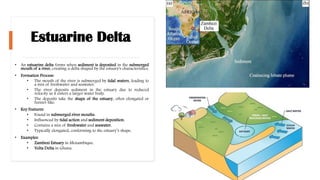
Estuarine Delta
• An estuarine delta forms when sediment is deposited in the submerged
mouth of a river, creating a delta shaped by the estuary's characteristics.
• Formation Process:
• The mouth of the river is submerged by tidal waters, leading to
a mix of freshwater and seawater.
• The river deposits sediment in the estuary due to reduced
velocity as it enters a larger water body.
• The deposits take the shape of the estuary, often elongated or
funnel-like.
• Key Features:
• Found in submerged river mouths.
• Influenced by tidal action and sediment deposition.
• Contains a mix of freshwater and seawater.
• Typically elongated, conforming to the estuary’s shape.
• Examples:
• Zambezi Estuary in Mozambique.
• Volta Delta in Ghana.
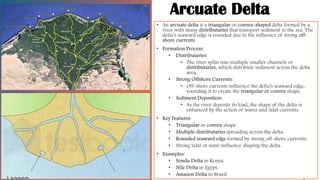
Arcuate Delta
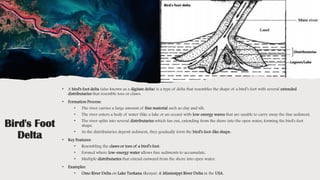
Bird's Foot
Delta
• A bird's foot delta (also known as a digitate delta) is a type of delta that resembles the shape of a bird’s foot with several extended
distributaries that resemble toes or claws.
• Formation Process:
• The river carries a large amount of fine material such as clay and silt.
• The river enters a body of water (like a lake or an ocean) with low-energy waves that are unable to carry away the fine sediment.
• The river splits into several distributaries which fan out, extending from the shore into the open water, forming the bird's foot
shape.
• As the distributaries deposit sediment, they gradually form the bird’s foot-like shape.
• Key Features:
• Resembling the claws or toes of a bird’s foot.
• Formed where low-energy water allows fine sediments to accumulate.
• Multiple distributaries that extend outward from the shore into open water.
• Examples:
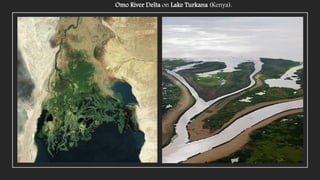
• Omo River Delta on Lake Turkana (Kenya). & Mississippi River Delta in the USA.
Omo River Delta on Lake Turkana (Kenya).
River capture and river
rejuvenation
River capture and river rejuvenation are both geomorphic processes
that involve changes in the flow and dynamics of rivers.
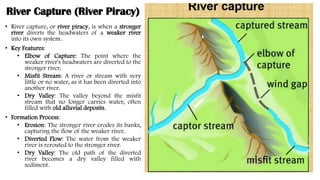
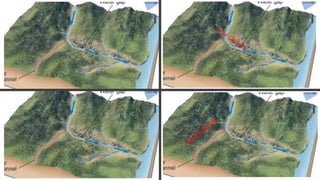
River Capture (River Piracy)
• River capture, or river piracy, is when a stronger
river diverts the headwaters of a weaker river
into its own system.
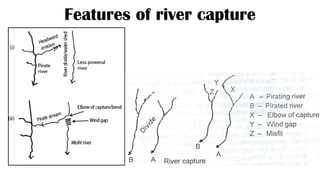
• Key Features:
• Elbow of Capture: The point where the
weaker river's headwaters are diverted to the
stronger river.
• Misfit Stream: A river or stream with very
little or no water, as it has been diverted into
another river.
• Dry Valley: The valley beyond the misfit
stream that no longer carries water, often
filled with old alluvial deposits.
• Formation Process:
• Erosion: The stronger river erodes its banks,
capturing the flow of the weaker river.
• Diverted Flow: The water from the weaker
river is rerouted to the stronger river.
• Dry Valley: The old path of the diverted
river becomes a dry valley filled with
sediment.
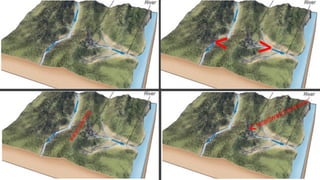
Features of river capture
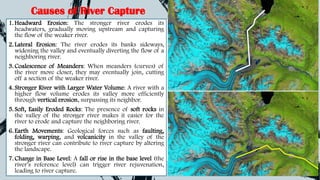
Causes of River Capture
1. Headward Erosion: The stronger river erodes its
headwaters, gradually moving upstream and capturing
the flow of the weaker river.
2. Lateral Erosion: The river erodes its banks sideways,
widening the valley and eventually diverting the flow of a
neighboring river.
3. Coalescence of Meanders: When meanders (curves) of
the river move closer, they may eventually join, cutting
off a section of the weaker river.
4. Stronger River with Larger Water Volume: A river with a
higher flow volume erodes its valley more efficiently
through vertical erosion, surpassing its neighbor.
5. Soft, Easily Eroded Rocks: The presence of soft rocks in
the valley of the stronger river makes it easier for the
river to erode and capture the neighboring river.
6. Earth Movements: Geological forces such as faulting,
folding, warping, and volcanicity in the valley of the
stronger river can contribute to river capture by altering
the landscape.
7. Change in Base Level: A fall or rise in the base level (the
river’s reference level) can trigger river rejuvenation,
leading to river capture.
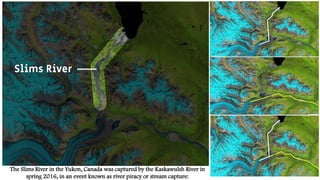
The Slims River in the Yukon, Canada was captured by the Kaskawulsh River in
spring 2016, in an event known as river piracy or stream capture:
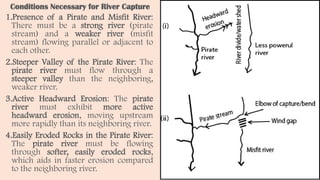
Conditions Necessary for River Capture
1.Presence of a Pirate and Misfit River:
There must be a strong river (pirate
stream) and a weaker river (misfit
stream) flowing parallel or adjacent to
each other.
2.Steeper Valley of the Pirate River: The
pirate river must flow through a
steeper valley than the neighboring,
weaker river.
3.Active Headward Erosion: The pirate
river must exhibit more active
headward erosion, moving upstream
more rapidly than its neighboring river.
4.Easily Eroded Rocks in the Pirate River:
The pirate river must be flowing
through softer, easily eroded rocks,
which aids in faster erosion compared
to the neighboring river.
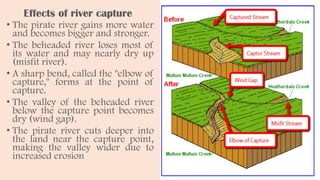
Effects of river capture
• The pirate river gains more water
and becomes bigger and stronger.
• The beheaded river loses most of
its water and may nearly dry up
(misfit river).
• A sharp bend, called the "elbow of
capture," forms at the point of
capture.
• The valley of the beheaded river
below the capture point becomes
dry (wind gap).
• The pirate river cuts deeper into
the land near the capture point,
making the valley wider due to
increased erosion
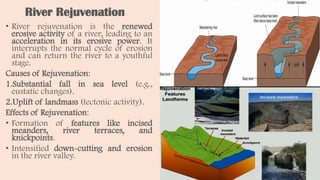
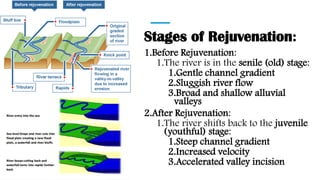
River Rejuvenation
• River rejuvenation is the renewed
erosive activity of a river, leading to an
acceleration in its erosive power. It
interrupts the normal cycle of erosion
and can return the river to a youthful
stage.
Causes of Rejuvenation:
1.Substantial fall in sea level (e.g.,
eustatic changes).
2.Uplift of landmass (tectonic activity).
Effects of Rejuvenation:
• Formation of features like incised
meanders, river terraces, and
knickpoints.
• Intensified down-cutting and erosion
in the river valley.
Stages of Rejuvenation:
1.Before Rejuvenation:
1.The river is in the senile (old) stage:
1.Gentle channel gradient
2.Sluggish river flow
3.Broad and shallow alluvial
valleys
2.After Rejuvenation:
1.The river shifts back to the juvenile
(youthful) stage:
1.Steep channel gradient
2.Increased velocity
3.Accelerated valley incision
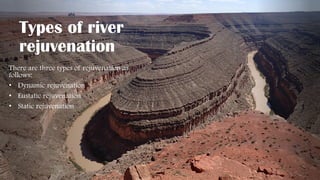
Types of river
rejuvenation
There are three types of rejuvenation as
follows:
• Dynamic rejuvenation
• Eustatic rejuvenation
• Static rejuvenation
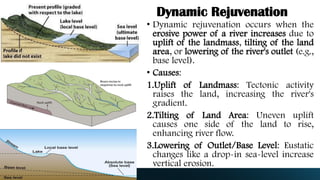
Dynamic Rejuvenation
• Dynamic rejuvenation occurs when the
erosive power of a river increases due to
uplift of the landmass, tilting of the land
area, or lowering of the river's outlet (e.g.,
base level).
• Causes:
1.Uplift of Landmass: Tectonic activity
raises the land, increasing the river's
gradient.
2.Tilting of Land Area: Uneven uplift
causes one side of the land to rise,
enhancing river flow.
3.Lowering of Outlet/Base Level: Eustatic
changes like a drop-in sea-level increase
vertical erosion.
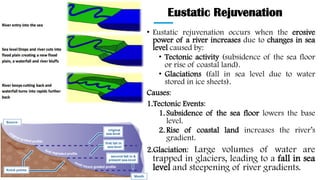
Eustatic Rejuvenation
• Eustatic rejuvenation occurs when the erosive
power of a river increases due to changes in sea
level caused by:
• Tectonic activity (subsidence of the sea floor
or rise of coastal land).
• Glaciations (fall in sea level due to water
stored in ice sheets).
Causes:
1.Tectonic Events:
1.Subsidence of the sea floor lowers the base
level.
2.Rise of coastal land increases the river’s
gradient.
2.Glaciation: Large volumes of water are
trapped in glaciers, leading to a fall in sea
level and steepening of river gradients.
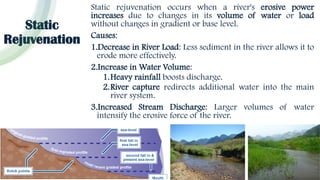
Static
Rejuvenation
Static rejuvenation occurs when a river's erosive power
increases due to changes in its volume of water or load
without changes in gradient or base level.
Causes:
1.Decrease in River Load: Less sediment in the river allows it to
erode more effectively.
2.Increase in Water Volume:
1.Heavy rainfall boosts discharge.
2.River capture redirects additional water into the main
river system.
3.Increased Stream Discharge: Larger volumes of water
intensify the erosive force of the river.
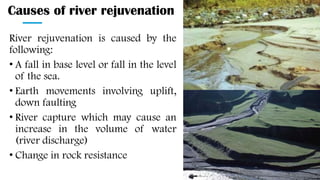
Causes of river rejuvenation
River rejuvenation is caused by the
following:
• A fall in base level or fall in the level
of the sea.
• Earth movements involving uplift,
down faulting
• River capture which may cause an
increase in the volume of water
(river discharge)
• Change in rock resistance
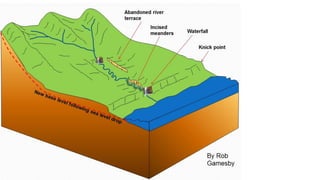
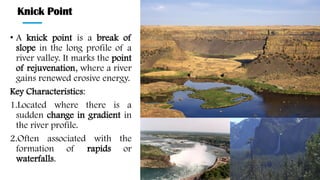
Knick Point
• A knick point is a break of
slope in the long profile of a
river valley. It marks the point
of rejuvenation, where a river
gains renewed erosive energy.
Key Characteristics:
1.Located where there is a
sudden change in gradient in
the river profile.
2.Often associated with the
formation of rapids or
waterfalls.
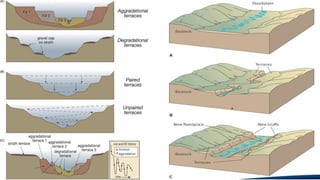
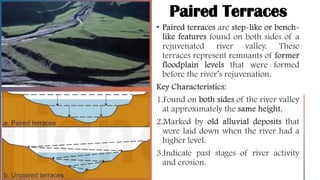
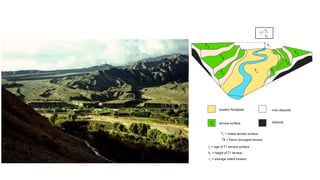
Paired Terraces
Incised Meanders
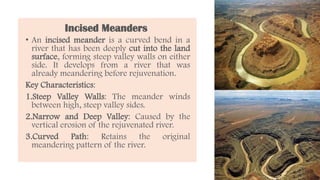
• An incised meander is a curved bend in a
river that has been deeply cut into the land
surface, forming steep valley walls on either
side. It develops from a river that was
already meandering before rejuvenation.
Key Characteristics:
1.Steep Valley Walls: The meander winds
between high, steep valley sides.
2.Narrow and Deep Valley: Caused by the
vertical erosion of the rejuvenated river.
3.Curved Path: Retains the original
meandering pattern of the river.
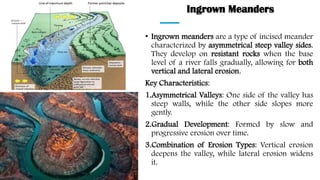
Ingrown Meanders
• Ingrown meanders are a type of incised meander
characterized by asymmetrical steep valley sides.
They develop on resistant rocks when the base
level of a river falls gradually, allowing for both
vertical and lateral erosion.
Key Characteristics:
1.Asymmetrical Valleys: One side of the valley has
steep walls, while the other side slopes more
gently.
2.Gradual Development: Formed by slow and
progressive erosion over time.
3.Combination of Erosion Types: Vertical erosion
deepens the valley, while lateral erosion widens
it.
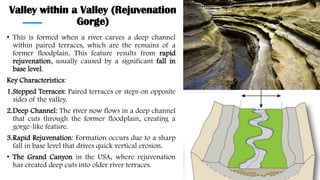
Valley within a Valley (Rejuvenation
Gorge)
• This is formed when a river carves a deep channel
within paired terraces, which are the remains of a
former floodplain. This feature results from rapid
rejuvenation, usually caused by a significant fall in
base level.
Key Characteristics:
1.Stepped Terraces: Paired terraces or steps on opposite
sides of the valley.
2.Deep Channel: The river now flows in a deep channel
that cuts through the former floodplain, creating a
gorge-like feature.
3.Rapid Rejuvenation: Formation occurs due to a sharp
fall in base level that drives quick vertical erosion.
• The Grand Canyon in the USA, where rejuvenation
has created deep cuts into older river terraces.
Drainage pattern in
the world
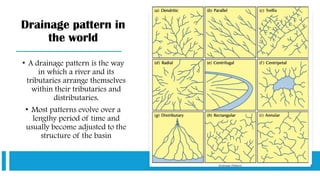
• A drainage pattern is the way
in which a river and its
tributaries arrange themselves
within their tributaries and
distributaries.
• Most patterns evolve over a
lengthy period of time and
usually become adjusted to the
structure of the basin
Factors
influencing
drainage
pattern
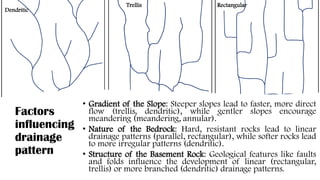
• Gradient of the Slope: Steeper slopes lead to faster, more direct
flow (trellis, dendritic), while gentler slopes encourage
meandering (meandering, annular).
• Nature of the Bedrock: Hard, resistant rocks lead to linear
drainage patterns (parallel, rectangular), while softer rocks lead
to more irregular patterns (dendritic).
• Structure of the Basement Rock: Geological features like faults
and folds influence the development of linear (rectangular,
trellis) or more branched (dendritic) drainage patterns.
Dendritic
Trellis Rectangular
Types
of
Drainage
Patterns
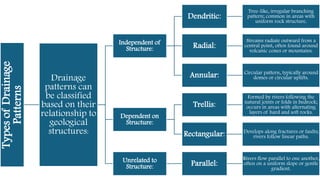
Drainage
patterns can
be classified
based on their
relationship to
geological
structures:
Independent of
Structure:
Dendritic:
Tree-like, irregular branching
pattern; common in areas with
uniform rock structure.
Radial:
Streams radiate outward from a
central point, often found around
volcanic cones or mountains.
Annular: Circular pattern, typically around
domes or circular uplifts.
Dependent on
Structure:
Trellis:
Formed by rivers following the
natural joints or folds in bedrock;
occurs in areas with alternating
layers of hard and soft rocks.
Rectangular: Develops along fractures or faults;
rivers follow linear paths.
Unrelated to
Structure: Parallel:
Rivers flow parallel to one another,
often on a uniform slope or gentle
gradient.
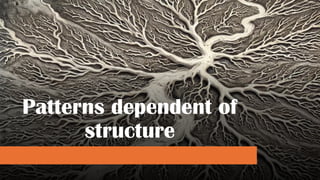
Patterns dependent of
structure
Trellised or
Rectangular
Drainage Pattern
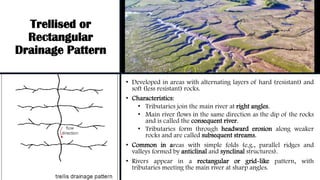
• Developed in areas with alternating layers of hard (resistant) and
soft (less resistant) rocks.
• Characteristics:
• Tributaries join the main river at right angles.
• Main river flows in the same direction as the dip of the rocks
and is called the consequent river.
• Tributaries form through headward erosion along weaker
rocks and are called subsequent streams.
• Common in areas with simple folds (e.g., parallel ridges and
valleys formed by anticlinal and synclinal structures).
• Rivers appear in a rectangular or grid-like pattern, with
tributaries meeting the main river at sharp angles.
Radial Drainage Pattern
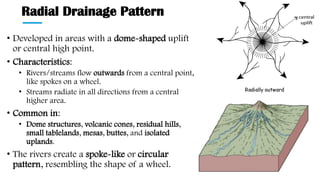
• Developed in areas with a dome-shaped uplift
or central high point.
• Characteristics:
• Rivers/streams flow outwards from a central point,
like spokes on a wheel.
• Streams radiate in all directions from a central
higher area.
• Common in:
• Dome structures, volcanic cones, residual hills,
small tablelands, mesas, buttes, and isolated
uplands.
• The rivers create a spoke-like or circular
pattern, resembling the shape of a wheel.
Centripetal Drainage Pattern
(Inland Drainage)
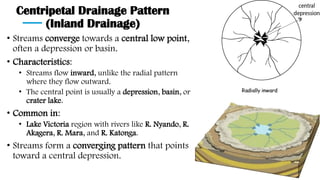
• Streams converge towards a central low point,
often a depression or basin.
• Characteristics:
• Streams flow inward, unlike the radial pattern
where they flow outward.
• The central point is usually a depression, basin, or
crater lake.
• Common in:
• Lake Victoria region with rivers like R. Nyando, R.
Akagera, R. Mara, and R. Katonga.
• Streams form a converging pattern that points
toward a central depression.
Annular Drainage Pattern
(Circular Pattern)
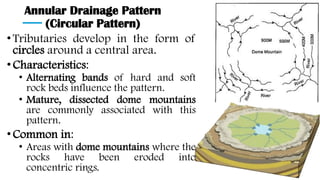
•Tributaries develop in the form of
circles around a central area.
•Characteristics:
• Alternating bands of hard and soft
rock beds influence the pattern.
• Mature, dissected dome mountains
are commonly associated with this
pattern.
•Common in:
• Areas with dome mountains where the
rocks have been eroded into
concentric rings.
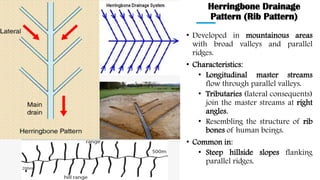
Herringbone Drainage
Pattern (Rib Pattern)
• Developed in mountainous areas
with broad valleys and parallel
ridges.
• Characteristics:
• Longitudinal master streams
flow through parallel valleys.
• Tributaries (lateral consequents)
join the master streams at right
angles.
• Resembling the structure of rib
bones of human beings.
• Common in:
• Steep hillside slopes flanking
parallel ridges.
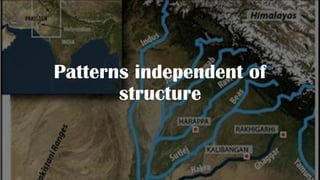
Patterns independent of
structure
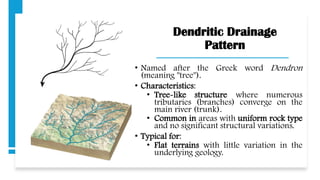
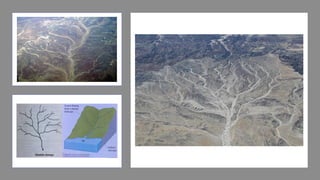
Dendritic Drainage
Pattern
• Named after the Greek word Dendron
(meaning "tree").
• Characteristics:
• Tree-like structure where numerous
tributaries (branches) converge on the
main river (trunk).
• Common in areas with uniform rock type
and no significant structural variations.
• Typical for:
• Flat terrains with little variation in the
underlying geology.
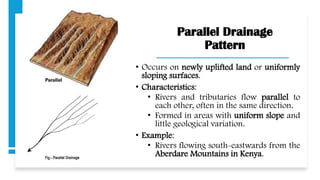
Parallel Drainage
Pattern
• Occurs on newly uplifted land or uniformly
sloping surfaces.
• Characteristics:
• Rivers and tributaries flow parallel to
each other, often in the same direction.
• Formed in areas with uniform slope and
little geological variation.
• Example:
• Rivers flowing south-eastwards from the
Aberdare Mountains in Kenya.
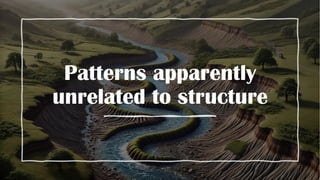
Patterns apparently
unrelated to structure
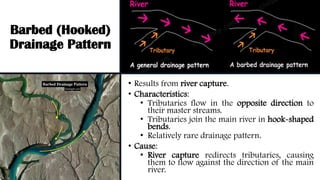
Barbed (Hooked)
Drainage Pattern
• Results from river capture.
• Characteristics:
• Tributaries flow in the opposite direction to
their master streams.
• Tributaries join the main river in hook-shaped
bends.
• Relatively rare drainage pattern.
• Cause:
• River capture redirects tributaries, causing
them to flow against the direction of the main
river.
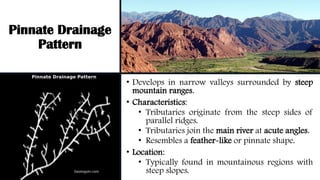
Pinnate Drainage
Pattern
• Develops in narrow valleys surrounded by steep
mountain ranges.
• Characteristics:
• Tributaries originate from the steep sides of
parallel ridges.
• Tributaries join the main river at acute angles.
• Resembles a feather-like or pinnate shape.
• Location:
• Typically found in mountainous regions with
steep slopes.
Superimposed and
antecedent drainage
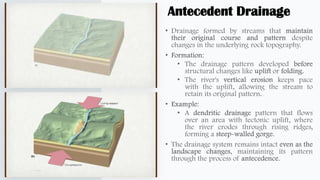
Antecedent Drainage
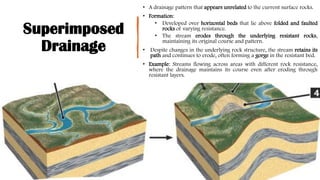
Superimposed
Drainage
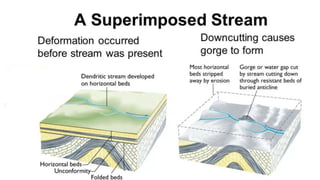
• A drainage pattern that appears unrelated to the current surface rocks.
• Formation:
• Developed over horizontal beds that lie above folded and faulted
rocks of varying resistance.
• The stream erodes through the underlying resistant rocks,
maintaining its original course and pattern.
• Despite changes in the underlying rock structure, the stream retains its
path and continues to erode, often forming a gorge in the resistant bed.
• Example: Streams flowing across areas with different rock resistance,
where the drainage maintains its course even after eroding through
resistant layers.
Impact of Rivers
Positive Impacts
• Water Supply: Rivers provide water for domestic, industrial,
and agricultural uses, as well as for drinking by animals.
• Transportation: Navigable rivers act as natural routes for
transportation.
• Irrigation: Rivers offer water for irrigation, especially in areas
with low rainfall, boosting agriculture and food production.
• Hydroelectric Power: Waterfalls, such as those on the Rusizi
River (Rwanda), River Tana (Kenya), and Nile River, are used
to generate hydroelectric power.
• Ports Development: River estuaries and deltas, like the Nile
Delta, provide sheltered areas that support the development of
ports (e.g., Alexandria).
• Building Materials: Rivers provide sand, gravel, and pebbles
for construction materials.
• Tourism: Rivers with features like waterfalls (e.g., Rusumo
Falls in Rwanda) and gorges attract tourists.
• Minerals: Some rivers deposit valuable minerals like alluvial
gold, as seen in Miyove (Rwanda).
• Fertile Soils: River valleys, such as those of the Nyabarongo
River and Nile River, are known for their fertile alluvial soils,
supporting agriculture.
• Livestock Development: Livestock activities thrive near rivers
where water and green vegetation are readily available.
Negative Effects of Rivers
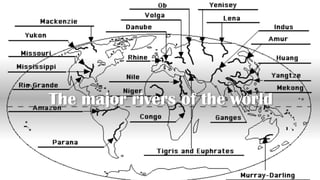
The major rivers of the world
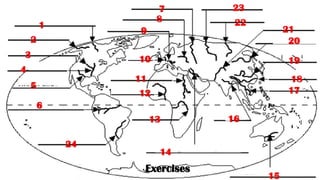
1
2
3
4
5
6
24
7
8
9
10
11
12
13
14
15
16
17
18
19
20
21
22
23
Exercises
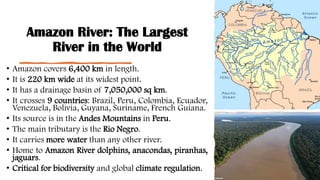
Amazon River: The Largest
River in the World
• Amazon covers 6,400 km in length.
• It is 220 km wide at its widest point.
• It has a drainage basin of 7,050,000 sq km.
• It crosses 9 countries: Brazil, Peru, Colombia, Ecuador,
Venezuela, Bolivia, Guyana, Suriname, French Guiana.
• Its source is in the Andes Mountains in Peru.
• The main tributary is the Rio Negro.
• It carries more water than any other river.
• Home to Amazon River dolphins, anacondas, piranhas,
jaguars.
• Critical for biodiversity and global climate regulation.
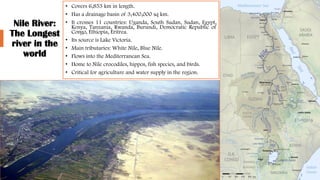
Nile River:
The Longest
river in the
world
• Covers 6,853 km in length.
• Has a drainage basin of 3,400,000 sq km.
• It crosses 11 countries: Uganda, South Sudan, Sudan, Egypt,
Kenya, Tanzania, Rwanda, Burundi, Democratic Republic of
Congo, Ethiopia, Eritrea.
• Its source is Lake Victoria.
• Main tributaries: White Nile, Blue Nile.
• Flows into the Mediterranean Sea.
• Home to Nile crocodiles, hippos, fish species, and birds.
• Critical for agriculture and water supply in the region.
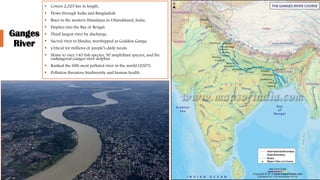
Ganges
River
• Covers 2,525 km in length.
• Flows through India and Bangladesh.
• Rises in the western Himalayas in Uttarakhand, India.
• Empties into the Bay of Bengal.
• Third largest river by discharge.
• Sacred river to Hindus, worshipped as Goddess Ganga.
• Critical for millions of people’s daily needs.
• Home to over 140 fish species, 90 amphibian species, and the
endangered Ganges river dolphin.
• Ranked the fifth most polluted river in the world (2007).
• Pollution threatens biodiversity and human health.
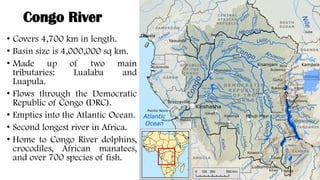
Congo River
• Covers 4,700 km in length.
• Basin size is 4,000,000 sq km.
• Made up of two main
tributaries: Lualaba and
Luapula.
• Flows through the Democratic
Republic of Congo (DRC).
• Empties into the Atlantic Ocean.
• Second longest river in Africa.
• Home to Congo River dolphins,
crocodiles, African manatees,
and over 700 species of fish.
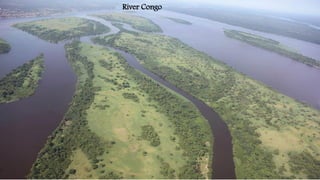
River Congo
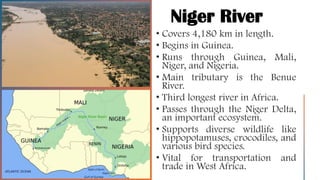
Niger River
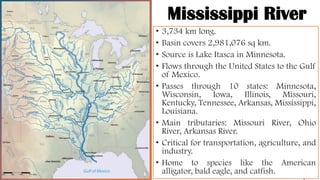
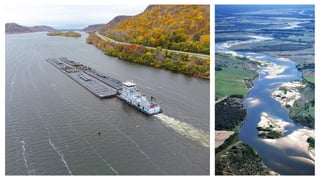
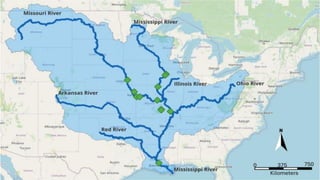
Mississippi River
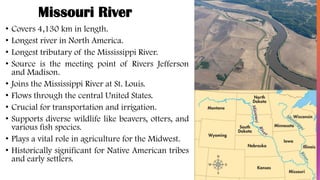
Missouri River
• Covers 4,130 km in length.
• Longest river in North America.
• Longest tributary of the Mississippi River.
• Source is the meeting point of Rivers Jefferson
and Madison.
• Joins the Mississippi River at St. Louis.
• Flows through the central United States.
• Crucial for transportation and irrigation.
• Supports diverse wildlife like beavers, otters, and
various fish species.
• Plays a vital role in agriculture for the Midwest.
• Historically significant for Native American tribes
and early settlers.
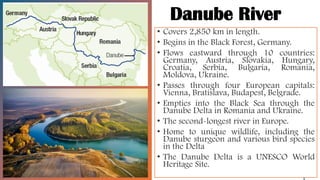
Danube River
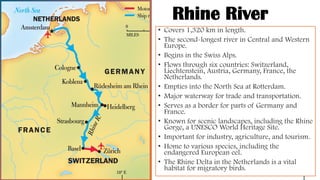
Rhine River
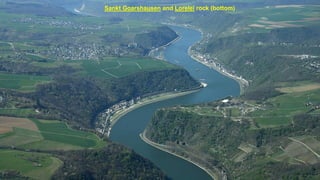
Sankt Goarshausen and Lorelei rock (bottom)
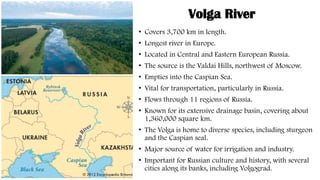
Volga River
• Covers 3,700 km in length.
• Longest river in Europe.
• Located in Central and Eastern European Russia.
• The source is the Valdai Hills, northwest of Moscow.
• Empties into the Caspian Sea.
• Vital for transportation, particularly in Russia.
• Flows through 11 regions of Russia.
• Known for its extensive drainage basin, covering about
1,360,000 square km.
• The Volga is home to diverse species, including sturgeon
and the Caspian seal.
• Major source of water for irrigation and industry.
• Important for Russian culture and history, with several
cities along its banks, including Volgograd.
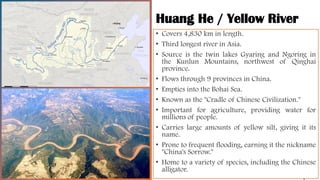
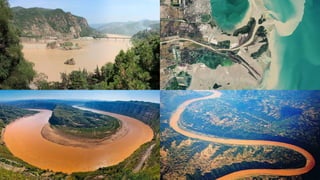
Huang He / Yellow River
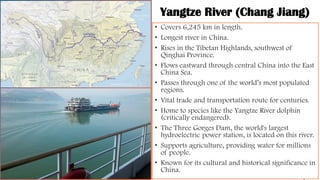
Yangtze River (Chang Jiang)
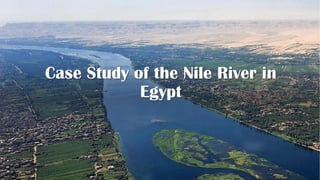
Case Study of the Nile River in
Egypt
History of
the Nile
River:
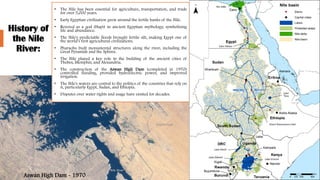
• The Nile has been essential for agriculture, transportation, and trade
for over 5,000 years.
• Early Egyptian civilization grew around the fertile banks of the Nile.
• Revered as a god (Hapi) in ancient Egyptian mythology, symbolizing
life and abundance.
• The Nile's predictable floods brought fertile silt, making Egypt one of
the world’s first agricultural civilizations.
• Pharaohs built monumental structures along the river, including the
Great Pyramids and the Sphinx.
• The Nile played a key role in the building of the ancient cities of
Thebes, Memphis, and Alexandria.
• The construction of the Aswan High Dam (completed in 1970)
controlled flooding, provided hydroelectric power, and improved
irrigation.
• The Nile's waters are central to the politics of the countries that rely on
it, particularly Egypt, Sudan, and Ethiopia.
• Disputes over water rights and usage have existed for decades.
Aswan High Dam - 1970
History of the Nile River in Egypt
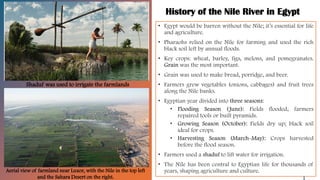
Shaduf was used to irrigate the farmlands
Aerial view of farmland near Luxor, with the Nile in the top left
and the Sahara Desert on the right.
Why the Nile River Flooded
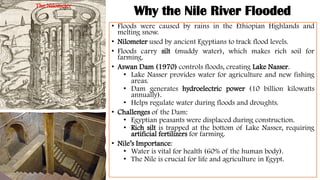
• Floods were caused by rains in the Ethiopian Highlands and
melting snow.
• Nilometer used by ancient Egyptians to track flood levels.
• Floods carry silt (muddy water), which makes rich soil for
farming.
• Aswan Dam (1970) controls floods, creating Lake Nasser.
• Lake Nasser provides water for agriculture and new fishing
areas.
• Dam generates hydroelectric power (10 billion kilowatts
annually).
• Helps regulate water during floods and droughts.
• Challenges of the Dam:
• Egyptian peasants were displaced during construction.
• Rich silt is trapped at the bottom of Lake Nasser, requiring
artificial fertilizers for farming.
• Nile’s Importance:
• Water is vital for health (60% of the human body).
• The Nile is crucial for life and agriculture in Egypt.
The Nilometer
Economic Projects Based on
the Nile River
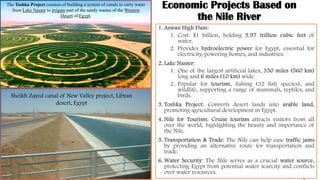
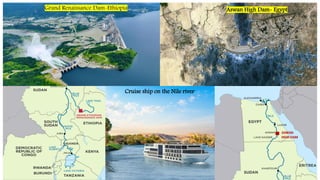
The Toshka Project consists of building a system of canals to carry water
from Lake Nasser to irrigate part of the sandy wastes of the Western
Desert of Egypt.
Sheikh Zayed canal of New Valley project, Libyan
desert, Egypt
Grand Renaissance Dam-Ethiopia Aswan High Dam- Egypt
Cruise ship on the Nile river
Lakes, Seas and Oceans
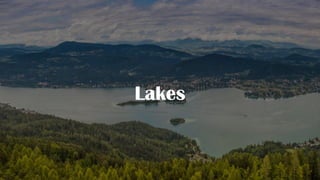
Lakes
Introduction to lakes
• A lake is a large body of water that fills a basin or depression on the
Earth’s surface.
• Sources of Water: Lakes get their water from:
• Streams: Flowing water from rivers and tributaries.
• Overland Flow: Surface runoff during rainfall.
• Groundwater: Water from beneath the Earth's surface.
• Lakes are part of larger drainage systems, collecting and distributing
water within an area.
• Types of Lakes:
• Permanent Lakes: Always contain water due to consistent
inflow.
• Seasonal Lakes: Water levels fluctuate depending on rainfall
and other factors.
• Water Loss in Lakes:
• Evaporation: Water is lost into the atmosphere due to heat.
• River Outlets: Water flows out through rivers connected to the
lake.
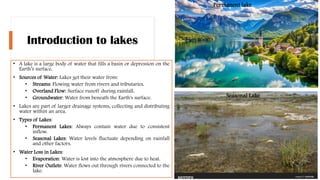
Permanent lake
Seasonal Lake
Categories of lakes
Lakes are classified based on how they were formed:
1. Tectonic Lakes: Formed through earth movements such as faulting, folding, or
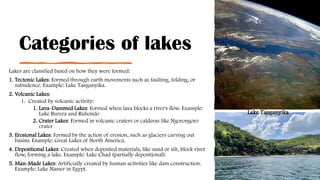
subsidence. Example: Lake Tanganyika.
2. Volcanic Lakes:
1. Created by volcanic activity:
1. Lava-Dammed Lakes: Formed when lava blocks a river's flow. Example:
Lake Burera and Ruhondo
2. Crater Lakes: Formed in volcanic craters or calderas like Ngorongoro
crater
3. Erosional Lakes: Formed by the action of erosion, such as glaciers carving out
basins. Example: Great Lakes of North America.
4. Depositional Lakes: Created when deposited materials, like sand or silt, block river
flow, forming a lake. Example: Lake Chad (partially depositional).
5. Man-Made Lakes: Artificially created by human activities like dam construction.
Example: Lake Nasser in Egypt.
Lake Tanganyika
Lakes formed by earth
movements
Lakes Formed by Crustal Warping
• Lakes formed when water fills basins
created by crustal warping (subsidence
lakes).
• Formation:
• Caused by the down-warping of the
Earth's crust, creating depressions.
• These depressions collect and hold
water.
• Examples:
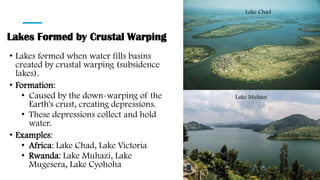
• Africa: Lake Chad, Lake Victoria
• Rwanda: Lake Muhazi, Lake
Mugesera, Lake Cyohoha
Lake Chad
Lake Muhazi
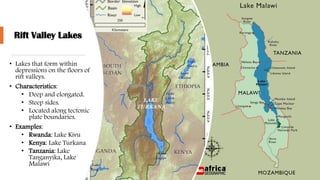
Rift Valley Lakes
• Lakes that form within
depressions on the floors of
rift valleys.
• Characteristics:
• Deep and elongated.
• Steep sides.
• Located along tectonic
plate boundaries.
• Examples:
• Rwanda: Lake Kivu
• Kenya: Lake Turkana
• Tanzania: Lake
Tanganyika, Lake
Malawi
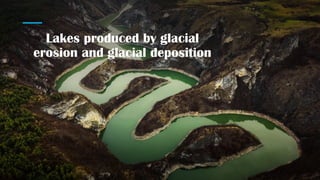
Lakes produced by glacial
erosion and glacial deposition
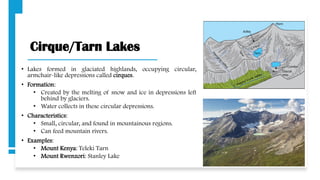
Cirque/Tarn Lakes
• Lakes formed in glaciated highlands, occupying circular,
armchair-like depressions called cirques.
• Formation:
• Created by the melting of snow and ice in depressions left
behind by glaciers.
• Water collects in these circular depressions.
• Characteristics:
• Small, circular, and found in mountainous regions.
• Can feed mountain rivers.
• Examples:
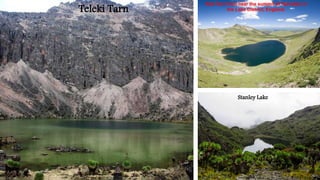
• Mount Kenya: Teleki Tarn
• Mount Rwenzori: Stanley Lake
Teleki Tarn
Stanley Lake
Red Tarn from near the summit of Helvellyn in
the Lake District, England.
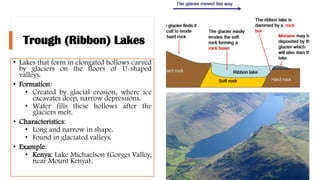
Trough (Ribbon) Lakes
• Lakes that form in elongated hollows carved
by glaciers on the floors of U-shaped
valleys.
• Formation:
• Created by glacial erosion, where ice
excavates deep, narrow depressions.
• Water fills these hollows after the
glaciers melt.
• Characteristics:
• Long and narrow in shape.
• Found in glaciated valleys.
• Example:
• Kenya: Lake Michaelson (Gorges Valley,
near Mount Kenya).
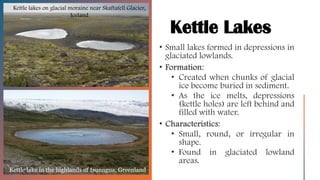
Kettle Lakes
Kettle lakes on glacial moraine near Skaftafell Glacier,
Iceland
Kettle lake in the highlands of Isunngua, Greenland
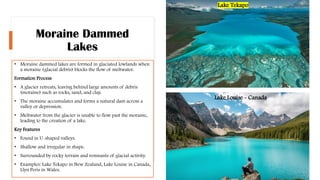
Moraine Dammed
Lakes
• Moraine dammed lakes are formed in glaciated lowlands when
a moraine (glacial debris) blocks the flow of meltwater.
Formation Process
• A glacier retreats, leaving behind large amounts of debris
(moraine) such as rocks, sand, and clay.
• The moraine accumulates and forms a natural dam across a
valley or depression.
• Meltwater from the glacier is unable to flow past the moraine,
leading to the creation of a lake.
Key Features
• Found in U-shaped valleys.
• Shallow and irregular in shape.
• Surrounded by rocky terrain and remnants of glacial activity.
• Examples: Lake Tekapo in New Zealand, Lake Louise in Canada,
Llyn Peris in Wales.
Lake Louise - Canada
Lake Tekapo
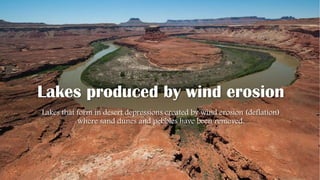
Lakes produced by wind erosion
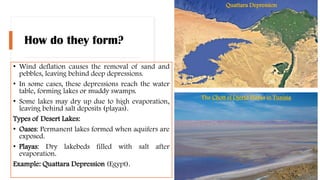
Lakes that form in desert depressions created by wind erosion (deflation)
where sand dunes and pebbles have been removed.
How do they form?
• Wind deflation causes the removal of sand and
pebbles, leaving behind deep depressions.
• In some cases, these depressions reach the water
table, forming lakes or muddy swamps.
• Some lakes may dry up due to high evaporation,
leaving behind salt deposits (playas).
Types of Desert Lakes:
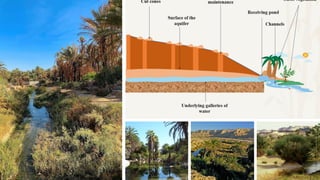
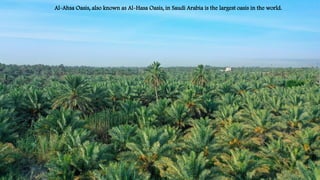
• Oases: Permanent lakes formed when aquifers are
exposed.
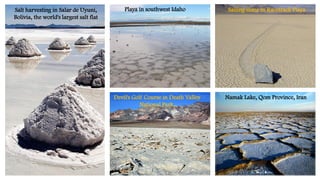
• Playas: Dry lakebeds filled with salt after
evaporation.
Example: Quattara Depression (Egypt).
The Chott el Djerid Playas in Tunisia
Quattara Depression
Sailing stone in Racetrack Playa
Playa in southwest Idaho
Devil's Golf Course in Death Valley
National Park,
Namak Lake, Qom Province, Iran
Salt harvesting in Salar de Uyuni,
Bolivia, the world's largest salt flat
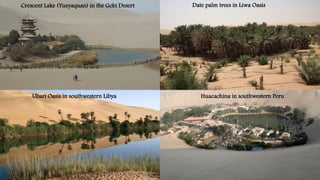
Al-Ahsa Oasis, also known as Al-Hasa Oasis, in Saudi Arabia is the largest oasis in the world.
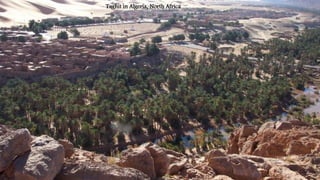
Taghit in Algeria, North Africa
Huacachina in southwestern Peru
Crescent Lake (Yueyaquan) in the Gobi Desert Date palm trees in Liwa Oasis
Ubari Oasis in southwestern Libya
Lakes produced by river
deposition
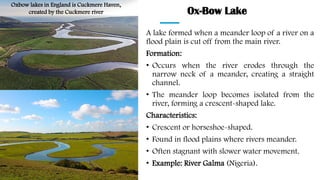
Ox-Bow Lake
A lake formed when a meander loop of a river on a
flood plain is cut off from the main river.
Formation:
• Occurs when the river erodes through the
narrow neck of a meander, creating a straight
channel.
• The meander loop becomes isolated from the
river, forming a crescent-shaped lake.
Characteristics:
• Crescent or horseshoe-shaped.
• Found in flood plains where rivers meander.
• Often stagnant with slower water movement.
• Example: River Galma (Nigeria).
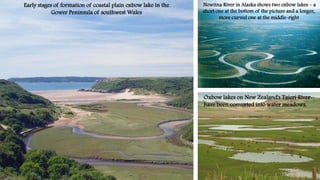
Oxbow lakes in England is Cuckmere Haven,
created by the Cuckmere river
Early stages of formation of coastal plain oxbow lake in the
Gower Peninsula of southwest Wales
Oxbow lakes on New Zealand's Taieri River
have been converted into water meadows.
Nowitna River in Alaska shows two oxbow lakes – a
short one at the bottom of the picture and a longer,
more curved one at the middle-right
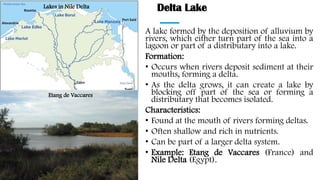
Delta Lake
A lake formed by the deposition of alluvium by
rivers, which either turn part of the sea into a
lagoon or part of a distributary into a lake.
Formation:
• Occurs when rivers deposit sediment at their
mouths, forming a delta.
• As the delta grows, it can create a lake by
blocking off part of the sea or forming a
distributary that becomes isolated.
Characteristics:
• Found at the mouth of rivers forming deltas.
• Often shallow and rich in nutrients.
• Can be part of a larger delta system.
• Example: Etang de Vaccares (France) and
Nile Delta (Egypt).
Etang de Vaccares
Lakes in Nile Delta
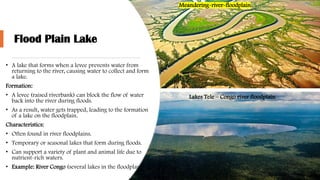
Flood Plain Lake
• A lake that forms when a levee prevents water from
returning to the river, causing water to collect and form
a lake.
Formation:
• A levee (raised riverbank) can block the flow of water
back into the river during floods.
• As a result, water gets trapped, leading to the formation
of a lake on the floodplain.
Characteristics:
• Often found in river floodplains.
• Temporary or seasonal lakes that form during floods.
• Can support a variety of plant and animal life due to
nutrient-rich waters.
• Example: River Congo (several lakes in the floodplain).
Lakes Tele – Congo river floodplain
Meandering-river-floodplain
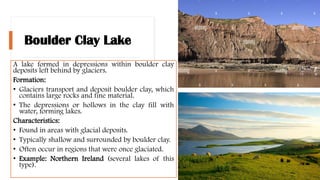
Boulder Clay Lake
A lake formed in depressions within boulder clay
deposits left behind by glaciers.
Formation:
• Glaciers transport and deposit boulder clay, which
contains large rocks and fine material.
• The depressions or hollows in the clay fill with
water, forming lakes.
Characteristics:
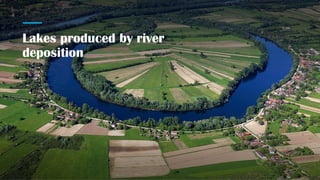
• Found in areas with glacial deposits.
• Typically shallow and surrounded by boulder clay.
• Often occur in regions that were once glaciated.
• Example: Northern Ireland (several lakes of this
type).
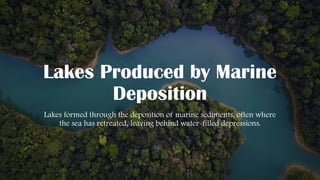
Lakes Produced by Marine
Deposition
Lakes formed through the deposition of marine sediments, often where
the sea has retreated, leaving behind water-filled depressions.
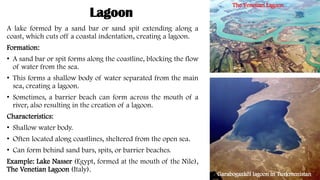
Lagoon
A lake formed by a sand bar or sand spit extending along a
coast, which cuts off a coastal indentation, creating a lagoon.
Formation:
• A sand bar or spit forms along the coastline, blocking the flow
of water from the sea.
• This forms a shallow body of water separated from the main
sea, creating a lagoon.
• Sometimes, a barrier beach can form across the mouth of a
river, also resulting in the creation of a lagoon.
Characteristics:
• Shallow water body.
• Often located along coastlines, sheltered from the open sea.
• Can form behind sand bars, spits, or barrier beaches.
Example: Lake Nasser (Egypt, formed at the mouth of the Nile),
The Venetian Lagoon (Italy).
The Venetian Lagoon
Garabogazköl lagoon in Turkmenistan
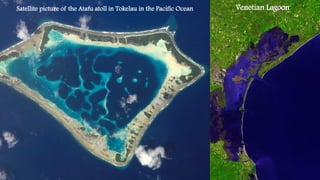
Satellite picture of the Atafu atoll in Tokelau in the Pacific Ocean Venetian Lagoon
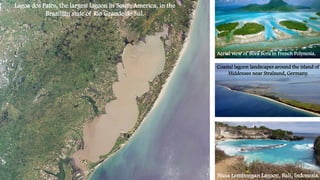
Nusa Lembongan Lagoon, Bali, Indonesia.
Aerial view of Bora Bora in French Polynesia.
Lagoa dos Patos, the largest lagoon in South America, in the
Brazilian state of Rio Grande do Sul.
Coastal lagoon landscapes around the island of
Hiddensee near Stralsund, Germany.
Lakes produced
by volcanicity
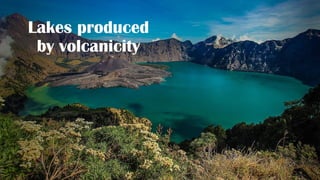
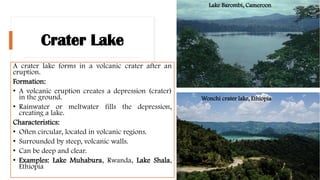
Crater Lake
A crater lake forms in a volcanic crater after an
eruption.
Formation:
• A volcanic eruption creates a depression (crater)
in the ground.
• Rainwater or meltwater fills the depression,
creating a lake.
Characteristics:
• Often circular, located in volcanic regions.
• Surrounded by steep, volcanic walls.
• Can be deep and clear.
• Examples: Lake Muhabura, Rwanda, Lake Shala,
Ethiopia
Wonchi crater lake, Ethiopia
Lake Barombi, Cameroon
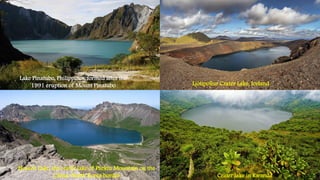
Lake Pinatubo, Philippines, formed after the
1991 eruption of Mount Pinatubo
Heaven Lake, the crater lake of Paektu Mountain on the
China–North Korea border Crater lake in Rwanda
Ljòtipollur Crater Lake, Iceland
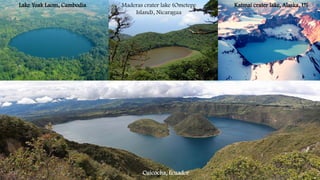
Katmai crater lake, Alaska, US
Maderas crater lake (Ometepe
Island), Nicaragua
Cuicocha, Ecuador
Lake Yeak Laom, Cambodia
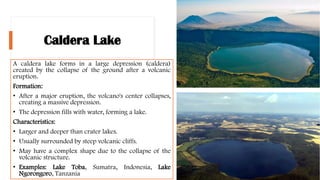
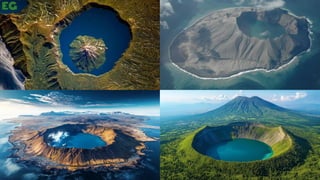
Caldera Lake
A caldera lake forms in a large depression (caldera)
created by the collapse of the ground after a volcanic
eruption.
Formation:
• After a major eruption, the volcano's center collapses,
creating a massive depression.
• The depression fills with water, forming a lake.
Characteristics:
• Larger and deeper than crater lakes.
• Usually surrounded by steep volcanic cliffs.
• May have a complex shape due to the collapse of the
volcanic structure.
• Examples: Lake Toba, Sumatra, Indonesia, Lake
Ngorongoro, Tanzania
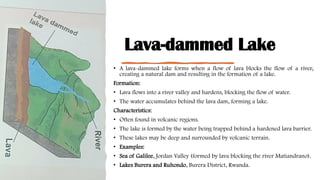
Lava-dammed Lake
• A lava-dammed lake forms when a flow of lava blocks the flow of a river,
creating a natural dam and resulting in the formation of a lake.
Formation:
• Lava flows into a river valley and hardens, blocking the flow of water.
• The water accumulates behind the lava dam, forming a lake.
Characteristics:
• Often found in volcanic regions.
• The lake is formed by the water being trapped behind a hardened lava barrier.
• These lakes may be deep and surrounded by volcanic terrain.
• Examples:
• Sea of Galilee, Jordan Valley (formed by lava blocking the river Matiandrano).
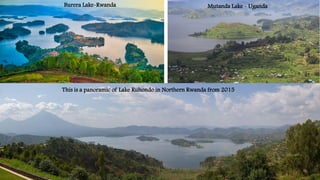
• Lakes Burera and Ruhondo, Burera District, Rwanda.
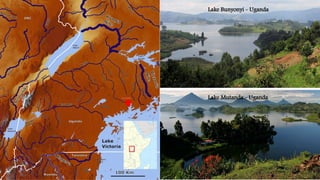
This is a panoramic of Lake Ruhondo in Northern Rwanda from 2015
Burera Lake-Rwanda Mutanda Lake - Uganda
Lake Bunyonyi - Uganda
Lake Mutanda - Uganda
Other types of lakes
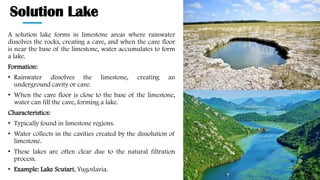
Solution Lake
A solution lake forms in limestone areas where rainwater
dissolves the rocks, creating a cave, and when the cave floor
is near the base of the limestone, water accumulates to form
a lake.
Formation:
• Rainwater dissolves the limestone, creating an
underground cavity or cave.
• When the cave floor is close to the base of the limestone,
water can fill the cave, forming a lake.
Characteristics:
• Typically found in limestone regions.
• Water collects in the cavities created by the dissolution of
limestone.
• These lakes are often clear due to the natural filtration
process.
• Example: Lake Scutari, Yugoslavia.
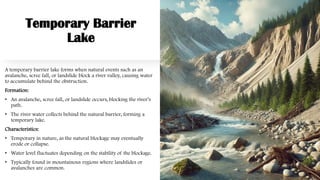
Temporary Barrier
Lake
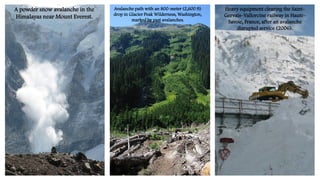
A temporary barrier lake forms when natural events such as an
avalanche, scree fall, or landslide block a river valley, causing water
to accumulate behind the obstruction.
Formation:
• An avalanche, scree fall, or landslide occurs, blocking the river’s
path.
• The river water collects behind the natural barrier, forming a
temporary lake.
Characteristics:
• Temporary in nature, as the natural blockage may eventually
erode or collapse.
• Water level fluctuates depending on the stability of the blockage.
• Typically found in mountainous regions where landslides or
avalanches are common.
Avalanche path with an 800-meter (2,600 ft)
drop in Glacier Peak Wilderness, Washington,
marked by past avalanches.
Heavy equipment clearing the Saint-
Gervais–Vallorcine railway in Haute-
Savoie, France, after an avalanche
disrupted service (2006).
A powder snow avalanche in the
Himalayas near Mount Everest.
Man-made Lake (Reservoir)
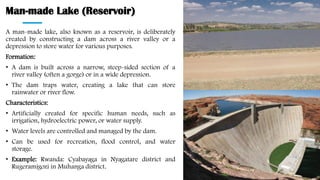
A man-made lake, also known as a reservoir, is deliberately
created by constructing a dam across a river valley or a
depression to store water for various purposes.
Formation:
• A dam is built across a narrow, steep-sided section of a
river valley (often a gorge) or in a wide depression.
• The dam traps water, creating a lake that can store
rainwater or river flow.
Characteristics:
• Artificially created for specific human needs, such as
irrigation, hydroelectric power, or water supply.
• Water levels are controlled and managed by the dam.
• Can be used for recreation, flood control, and water
storage.
• Example: Rwanda: Cyabayaga in Nyagatare district and
Rugeramigozi in Muhanga district.
Lakes Produced Due to Mass Movement
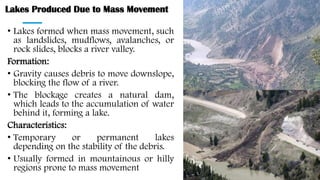
• Lakes formed when mass movement, such
as landslides, mudflows, avalanches, or
rock slides, blocks a river valley.
Formation:
• Gravity causes debris to move downslope,
blocking the flow of a river.
• The blockage creates a natural dam,
which leads to the accumulation of water
behind it, forming a lake.
Characteristics:
• Temporary or permanent lakes
depending on the stability of the debris.
• Usually formed in mountainous or hilly
regions prone to mass movement
Lakes Produced by Alluvial Deposits
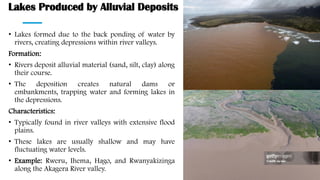
• Lakes formed due to the back ponding of water by
rivers, creating depressions within river valleys.
Formation:
• Rivers deposit alluvial material (sand, silt, clay) along
their course.
• The deposition creates natural dams or
embankments, trapping water and forming lakes in
the depressions.
Characteristics:
• Typically found in river valleys with extensive flood
plains.
• These lakes are usually shallow and may have
fluctuating water levels.
• Example: Rweru, Ihema, Hago, and Rwanyakizinga
along the Akagera River valley.
Impact of lakes
Usefulness of Lakes to
Human Society
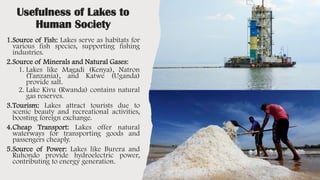
1.Source of Fish: Lakes serve as habitats for
various fish species, supporting fishing
industries.
2.Source of Minerals and Natural Gases:
1. Lakes like Magadi (Kenya), Natron
(Tanzania), and Katwe (Uganda)
provide salt.
2. Lake Kivu (Rwanda) contains natural
gas reserves.
3.Tourism: Lakes attract tourists due to
scenic beauty and recreational activities,
boosting foreign exchange.
4.Cheap Transport: Lakes offer natural
waterways for transporting goods and
passengers cheaply.
5.Source of Power: Lakes like Burera and
Ruhondo provide hydroelectric power,
contributing to energy generation.
Usefulness of Lakes to Human
Society
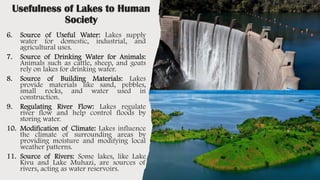
6. Source of Useful Water: Lakes supply
water for domestic, industrial, and
agricultural uses.
7. Source of Drinking Water for Animals:
Animals such as cattle, sheep, and goats
rely on lakes for drinking water.
8. Source of Building Materials: Lakes
provide materials like sand, pebbles,
small rocks, and water used in
construction.
9. Regulating River Flow: Lakes regulate
river flow and help control floods by
storing water.
10. Modification of Climate: Lakes influence
the climate of surrounding areas by
providing moisture and modifying local
weather patterns.
11. Source of Rivers: Some lakes, like Lake
Kivu and Lake Muhazi, are sources of
rivers, acting as water reservoirs.
Negative Impacts of Lakes on Human
Society
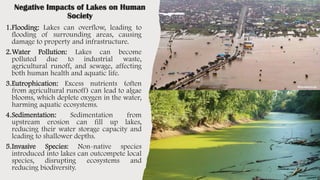
1.Flooding: Lakes can overflow, leading to
flooding of surrounding areas, causing
damage to property and infrastructure.
2.Water Pollution: Lakes can become
polluted due to industrial waste,
agricultural runoff, and sewage, affecting
both human health and aquatic life.
3.Eutrophication: Excess nutrients (often
from agricultural runoff) can lead to algae
blooms, which deplete oxygen in the water,
harming aquatic ecosystems.
4.Sedimentation: Sedimentation from
upstream erosion can fill up lakes,
reducing their water storage capacity and
leading to shallower depths.
5.Invasive Species: Non-native species
introduced into lakes can outcompete local
species, disrupting ecosystems and
reducing biodiversity.
Negative Impacts of Lakes
on Human Society
6. Evaporation: Lakes in arid or semi-arid regions may
suffer high rates of evaporation, leading to reduced
water levels and loss of water resources.
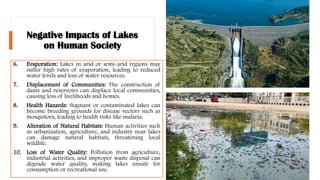
7. Displacement of Communities: The construction of
dams and reservoirs can displace local communities,
causing loss of livelihoods and homes.
8. Health Hazards: Stagnant or contaminated lakes can
become breeding grounds for disease vectors such as
mosquitoes, leading to health risks like malaria.
9. Alteration of Natural Habitats: Human activities such
as urbanization, agriculture, and industry near lakes
can damage natural habitats, threatening local
wildlife.
10. Loss of Water Quality: Pollution from agriculture,
industrial activities, and improper waste disposal can
degrade water quality, making lakes unsafe for
consumption or recreational use.
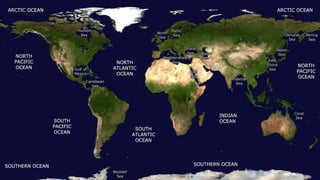
Distribution of seas and
Oceans
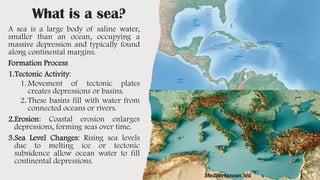
What is a sea?
A sea is a large body of saline water,
smaller than an ocean, occupying a
massive depression and typically found
along continental margins.
Formation Process
1.Tectonic Activity:
1.Movement of tectonic plates
creates depressions or basins.
2.These basins fill with water from
connected oceans or rivers.
2.Erosion: Coastal erosion enlarges
depressions, forming seas over time.
3.Sea Level Changes: Rising sea levels
due to melting ice or tectonic
subsidence allow ocean water to fill
continental depressions.
Mediterranean Sea
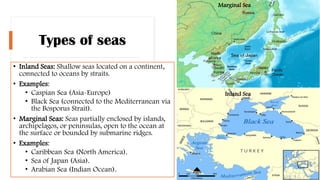
Types of seas
• Inland Seas: Shallow seas located on a continent,
connected to oceans by straits.
• Examples:
• Caspian Sea (Asia-Europe)
• Black Sea (connected to the Mediterranean via
the Bosporus Strait).
• Marginal Seas: Seas partially enclosed by islands,
archipelagos, or peninsulas, open to the ocean at
the surface or bounded by submarine ridges.
• Examples:
• Caribbean Sea (North America).
• Sea of Japan (Asia).
• Arabian Sea (Indian Ocean).
Marginal Sea
Inland Sea
Straights on Black Sea
A.The Dardanelles
B. The Marmara Sea,
C.The Bosporus.
A bay at Sibiryakov Island, 50 km (31 mi) south from
Vladivostok – Sea of Japan
The Sea of Japan seen from the south of Slavyanka. From a distance,
the two islands of Antipenko (left) and Sibiryakov (right).
Kapchik Cape in Crimea – Black Sea
Black Sea coast of western Georgia, with the
skyline of Batumi on the horizon
Tategami rock – Sea of Japan
Major Seas of the world
What is an
ocean?
An ocean is a vast body of saline water that covers about 71% of the Earth’s
surface and separates continents. Oceans are larger and deeper than seas and are
interconnected.
Formation
1. Earth’s Cooling: Oceans formed about 4 billion years ago as Earth cooled,
allowing water vapor from volcanic eruptions to condense into liquid.
2. Accumulation: Rainwater filled basins created by tectonic activity and
volcanic processes.
3. Tectonic Shifts: Movement of tectonic plates shaped ocean basins.
Major oceans of the world
Pacific Ocean
• Covers about 155 million square kilometers.
• Borders:
• East: North and South America.
• West: Asia and Australia.
• Largest and deepest ocean, with an average
depth of 4,280 meters and the Mariana
Trench as its deepest point (11,034 meters).
• Contains over 25,000 islands, more than any
other ocean.
• Plays a vital role in global weather patterns,
including the El Niño and La Niña phenomena.
Bora Bora Islands in the pacific
Atlantic Ocean
• Covers about 76 million square kilometers.
• Borders:
• East: Europe and Africa.
• West: North and South America.
• Known for its S-shaped layout and significant
role in trade and exploration.
• Includes important seas like the Caribbean
Sea, Mediterranean Sea, and Baltic Sea.
• Second largest ocean and contains the Mid-
Atlantic Ridge, an underwater mountain
range.
Indian Ocean
• Covers about 68.5 million square kilometers.
• Borders:
• North: Asia.
• West: Africa.
• East: Australia.
• South: Southern Ocean.
• Dominated by monsoon winds affecting the
climate of surrounding regions.
• Known for the Bay of Bengal and Arabian Sea.
• Rich in marine resources like fish, oil, and gas
reserves.
Arctic
Ocean
• Covers about 14 million square kilometers.
• Surrounds the Arctic Circle and touches North America,
Europe, and Asia.
• Smallest and shallowest ocean, with an average depth of
1,038 meters.
• Mostly covered by sea ice that changes with the seasons.
• Rich in unique ecosystems and under threat from climate
change.
Southern Ocean
• Covers about 20 million square kilometers.
• Surrounds Antarctica and connects the Pacific, Atlantic, and Indian
Oceans.
• Youngest ocean, officially recognized in 2000.
• Known for the Antarctic Circumpolar Current, which helps regulate
Earth's climate.
• Rich in marine life, including krill, a crucial part of the food web.
Importance of Seas and
Oceans
• Source of Fish: Provide habitats for diverse fish species,
promoting fishing industries.
• Tourism: Offer stunning sceneries and recreational
activities, attracting tourists and boosting foreign exchange.
• Transportation: Serve as natural waterways for the cheap
transport of goods and passengers via ships.
• Water Resource: Supply water for domestic, industrial uses,
and drinking water for livestock.
• Flood Regulation: Help regulate river flow, controlling
floods.
• Climate Moderation: Influence and stabilize regional
climates by providing moisture and moderating
temperatures.
• River Connectivity: Act as sources or ends of major rivers.
Marine Relief
Marine Relief refers to the physical
features and variations found on the
Earth's ocean floors. It encompasses all
the natural topographical formations
beneath the ocean's surface.
Marine Relief Features
Key Features of
Marine Relief
1. Continental Shelf: The shallow part of the ocean floor that
stretches from the coastline to the continental slope.
2. Continental Slope: The steep incline between the
continental shelf and the deep ocean floor.
3. Ocean Basin: The deep, flat areas of the ocean floor located
between the continental slopes.
4. Mid-Ocean Ridges: Long, underwater mountain ranges
formed by tectonic movements.
5. Abyssal Plains: Flat, deep parts of the ocean floor that are
covered with fine sediments.
6. Ocean Trenches: The deepest parts of the ocean, often
formed by tectonic subduction.
7. Seamounts: Underwater mountains that rise from the ocean
floor but do not break the surface of the sea.
8. Oceanic Islands: Islands formed from volcanic activity on
the ocean floor, rising above the surface.
Continental Shelf
(Platform)
• A submerged area of the continental margin, typically characterized by shallow
waters, gently sloping towards the sea or ocean.
• Key Features:
• Shallow Waters: Average water depth of about 200 meters.
• Gentle Slope: Gradually slopes down from the shore to the deep ocean.
• Varied Width: The width of the continental shelf varies greatly, depending on
the coastal land's relief (e.g., wide shelves in some places like the North Sea,
narrower shelves in others).
Continental
Slope
• A steep slope zone that lies between the steep continental shelf and the gently sloping part of the ocean
basin.
It marks the transition from the steep slope of the continental margin to the relatively flat abyssal plains of
the deep ocean.
• Key Features:
• The slope is steep, typically ranging from 4° to 6° but can be steeper in some areas.
• The depth increases significantly, often reaching thousands of meters below sea level.
Continental rise
• A gently sloping zone that lies between the steep continental slope and the deep-sea floor of the ocean basin.
• It marks the transition from the steep slope of the continental margin to the relatively flat abyssal plains of the deep ocean.
Key Features:
1. The slope is less steep compared to the continental slope, usually ranging from 0.5° to 1°.
2. Sediments transported from the continental shelf and slope accumulate here, forming thick layers of sediment like
submarine fans.
Deep Sea Plains
(Abyssal Plains)
• A vast, flat, and rolling submarine plain located in the ocean basin, typically found at depths of 3000m to 6000m below sea level.
• Abyssal plains are formed by the gradual accumulation of sediments such as clay, sand, and organic material that are deposited over
time by ocean currents.
• Key Features:
• Flat Terrain: These plains are remarkably flat, with very gentle slopes and minimal variations in depth.
• Sediment Deposition: The plains are covered by thick layers of fine sediments, creating a smooth surface.
• High Pressure: The area experiences immense pressure due to its depth in the ocean.
Oceanic Trenches (Deeps)
• Oceanic trenches are deep, narrow depressions on the
sea floor. They are the deepest parts of the ocean and
are characterized by steep side slopes.
• Deeps: Very deep, but less extensive depressions.
• Trenches: Long and narrow linear depressions
with steep side slopes.
• Trenches are formed by the subduction of one tectonic
plate beneath another, a process associated with plate
tectonics.
• Key Features:
• Depth: Oceanic trenches are the deepest parts of
the ocean floor, reaching depths greater than
6000 meters.
• Narrow and Long: Trenches are typically narrow,
with steep slopes on either side.
• Tectonic Activity: The formation of trenches is
often linked to seismic and volcanic activity.
• Examples:
• Mariana Trench: Located in the western Pacific
Ocean, it is the deepest trench in the world, with
a depth of about 10,994 meters.
• Puerto Rico Trench: Found in the Atlantic Ocean,
it is the deepest part of the Atlantic Ocean basin.
Ocean Ridges
• Ocean ridges are underwater mountain ranges formed by tectonic
plate movements. These ridges have steep side slopes and can
sometimes rise above the ocean surface to form islands.
• Ocean ridges are formed by the divergent boundary between tectonic
plates, where magma rises from the mantle to create new oceanic
crust. Over time, the plates move apart, pushing the crust upward and
creating ridges.
• Key Features:
• Submarine Mountain Ranges: Ocean ridges are long, continuous
underwater mountain chains that can stretch across vast
distances.
• Steep Sides: The ridges typically have steep side slopes, formed by
the movement of tectonic plates.
• Above Sea Level: Some parts of the ocean ridge rise above the sea
surface to form islands.
• Examples:
• Mid-Atlantic Ridge: A massive ocean ridge running down the
center of the Atlantic Ocean, stretching from the Arctic Ocean to
the Southern Ocean. Parts of the ridge rise above sea level,
forming islands like Iceland.
• East Pacific Rise: A significant ocean ridge in the Pacific Ocean,
where tectonic plates are moving apart, creating new ocean floor.
Mid-oceanic ridge distribution map. It shows the major ridges, such as the Mid-
Atlantic Ridge, East Pacific Rise, and Indian Ridge
Seamount
• A seamount is an underwater mountain formed
by volcanic activity that rises above the seafloor
but does not reach the ocean surface.
How They Form:
1. Magma rises through the Earth's crust at hotspots
or along tectonic plate boundaries.
2. The cooled and solidified lava builds up to form a
volcanic peak under the ocean.
3. The peak remains submerged beneath the water.
Example: Emperor Seamount Chain in the Pacific
Ocean.
Guyot
A guyot is a flat-topped seamount that was once an island but was eroded down by
waves, wind, and other processes.
How They Form:
1.A volcanic island forms above the ocean surface.
2.Over time, erosion flattens the top of the island.
3.As the oceanic plate moves, the island sinks below sea level due to subsidence,
becoming a submerged flat-topped seamount (guyot).
Example: Horizon Guyot in the Pacific Ocean.
Resolution Guyot (formerly known as Huevo) is a guyot
(tablemount) in the underwater Mid-Pacific Mountains
in the Pacific Ocean.
It is a circular flat mountain, rising 500 metres
(1,600 ft) above the seafloor to a depth of about
1,320 metres (4,330 ft), with a 35-kilometre-
wide (22-mile) summit platform
Island
An island is a landmass surrounded by water that rises above the ocean surface.
How They Form:
1. Volcanic islands: Formed by magma rising from hotspots (e.g., Hawaii).
2. Continental islands: Pieces of land separated from continents by water (e.g.,
Madagascar).
3. Coral islands: Built by coral reefs over time (e.g., Maldives).
Example: Hawaii (volcanic island). Madagascar (continental island). Maldives
(coral island).
Maldives Madagascar
Formation of Island, guyot and sea mount
A case study of the Great
Barrier Reef
Introduction to the Great Barrier Reef
• Overview:
• The Great Barrier Reef is the world’s largest coral reef
system.
• Composed of over 2,900 individual reefs and 900
islands.
• Stretches over 2,300 kilometers (1,400 miles) and
covers an area of approximately 344,400 square
kilometers.
• Located in the Coral Sea, off the coast of Queensland,
Australia.
• Unique Features:
• Can be seen from outer space.
• The largest structure made by living organisms.
• Built by billions of tiny organisms called coral polyps.
• Significance:
• A World Heritage site since 1981.
• Recognized as a state icon of Queensland by the
Queensland National Trust.
Importance and
Environmental Challenges
• Ecological Significance:
• Supports a wide diversity of marine life.
• Part of the reef is protected by the Great Barrier Reef Marine Park,
managing human impact like fishing and tourism.
• Cultural Importance:
• Long known to and used by Aboriginal Australians and Torres Strait
Islanders.
• Holds great cultural and spiritual significance for local groups.
• Environmental Challenges:
• Runoff, climate change, and mass coral bleaching.
• Outbreaks of the crown-of-thorns starfish, which threaten coral
health.
• Popular for tourists, especially in regions like the Whitsunday Islands and
Cairns.
Sea temperature and bleaching of
the Great Barrier Reef
Ocean currents
Ocean currents are slow and steady movements of a
mass of oceanic water in a definite direction.
What are Ocean Currents?
Ocean currents are large-scale
movements of seawater driven by
various forces, such as wind,
temperature, salinity, and the Earth's
rotation.
Key Types:
• Surface Currents: Flow in the upper
400 meters of the ocean and are
driven by wind. Ex. Gulf Stream,
Kuroshio Current
• Deep Currents: Flow beneath the
surface and are driven by
differences in temperature and
salinity (thermohaline circulation).
Ex. Upwelling and downwelling
zones.
Upwelling
Downwelling
Key types of ocean currents
How Ocean
Currents Form
1. Wind: Wind transfers energy to the ocean surface, pushing water to
create currents (e.g., the Gulf Stream).
2. Temperature and Salinity (Thermohaline Circulation): Cold, salty
water sinks due to its density, while warm, less salty water rises,
creating deep currents.
3. Coastlines and Seafloor: Ocean currents are redirected by the shape
of continents and underwater features.
4. Earth's Rotation (Coriolis Effect): Deflects currents:
• Clockwise in the Northern Hemisphere.
• Counterclockwise in the Southern Hemisphere.
Major surface currents of the world's oceans.
Surface Ocean
Currents
Surface currents move water horizontally,
parallel to the Earth's surface.
How It Forms:
• Powered by wind and friction between
wind and water.
• Driven in circular patterns by trade winds
and Coriolis effect.
Examples:
• Warm currents: Gulf Stream, Kuroshio
Current.
• Cold currents: California Current, Peru
Current.
Map of the world showing warm and cold ocean currents
Warm Ocean Currents
Warm currents (also called equatorial
currents) carry warm water from the equator
toward higher latitudes.
How It Forms:
• Trade winds push water westward along the
equator.
• Water piles up against eastern shores of
continents (western intensification).
• Moves northward and southward in tight
channels.
Examples:
• Northern Hemisphere: Gulf Stream (North
Atlantic), Kuroshio Current (North Pacific).
• Southern Hemisphere: Brazil Current (South
Atlantic), East Australian Current.
Warm Ocean Currents
Warm Ocean Currents
Cold Ocean
Currents
• Cold currents flow from higher latitudes toward the
equator, carrying cooler, denser water.
How It Forms:
• Cold water flows to replace warmer equatorial
currents.
• Deflected by continents at western margins,
converging at the equatorial zone.
Examples:
• Northern Hemisphere: California Current (North
Pacific), Canary Current (North Atlantic).
• Southern Hemisphere: Benguela Current (South
Atlantic), Peru Current (South Pacific).
Western
Intensification
This is a phenomenon where ocean water
piles up along the western margins of
ocean basins due to strong trade winds.
How It Forms:
• Trade winds push surface water
westward along the equator.
• Water accumulates on the eastern
shores of continents, intensifying
currents.
• Examples:
• Gulf Stream (North Atlantic).
• Kuroshio Current (North Pacific).
Locations of Major Cold Ocean Currents
1.California Current – Along the western
coast of North America (Pacific Ocean).
2.Humboldt Current – Along the western
coast of South America (Pacific Ocean).
3.Labrador Current – Along the eastern coast
of Canada and Greenland (Atlantic
Ocean).
4.Canaries Current – Along the northwest
coast of Africa (Atlantic Ocean).
5.Benguela Current – Along the southwest
coast of Africa (Atlantic Ocean).
6.Falkland Current – Along the southeast
coast of South America (Atlantic Ocean).
7.West Australian Current – Along the
western coast of Australia (Indian Ocean).
8.Okhotsk Current – Along the east coast of
Russia (Sea of Okhotsk, Pacific Ocean).
Warm Currents and Their
Locations:
1. North Pacific Drift – North Pacific Ocean.
2. North Equatorial Current – Pacific and Atlantic Oceans,
near the equator.
3. Equatorial Counter Current – Along the equator, flowing
opposite to equatorial currents.
4. South Equatorial Current – Pacific, Atlantic, and Indian
Oceans near the equator.
5. West Wind Drift – Around the Southern Ocean, driven by
westerly winds.
6. Gulf Stream – Along the eastern coast of North America
(Atlantic Ocean).
7. North Atlantic Drift – Continuation of the Gulf Stream in
the North Atlantic Ocean.
8. North Equatorial Current – Pacific and Atlantic Oceans
near the equator.
9. Equatorial Counter Current – Opposite flow to the North
Equatorial Current.
10.South Equatorial Current – Pacific, Atlantic, and Indian
Oceans near the equator.
Warm Currents and Their
Locations:
11. Brazil Current – Along the eastern coast of South America
(Atlantic Ocean).
12. West Wind Drift – Around the Southern Ocean, driven by
westerly winds.
13. Monsoon Current – Seasonal current in the Indian Ocean,
influenced by monsoons.
14. Equatorial Counter Current – Flows opposite to the
equatorial currents, near the equator.
15. South Equatorial Current – Pacific, Atlantic, and Indian
Oceans near the equator.
16. Mozambique Current – Along the southeastern coast of
Africa (Indian Ocean).
17. West Wind Drift – Southern Ocean current, encircling
Antarctica.
18. Japan Current (Kuroshio Current) – Along the eastern coast
of Japan (Pacific Ocean).
19. North Equatorial Current – Pacific and Atlantic Oceans
near the equator.
20. Equatorial Counter Current – Opposite to equatorial
currents, flowing west to east.
21. South Equatorial Current – Pacific, Atlantic, and Indian
Oceans near the equator.
22. East Australian Current – Along the eastern coast of
Australia (Pacific Ocean).
Cold and Warm surface ocean Currents
Vertical Ocean
Currents
• Vertical ocean currents are the
upward or downward movement
of seawater within the ocean.
• These currents move water
vertically instead of horizontally,
playing a crucial role in the
transfer of heat, nutrients, and
gases between ocean layers.
• It is divided into:
• Upwelling
• Downwelling
Upwelling
• Upwelling is a process where deep, cold water rises to the ocean's surface, replacing the
warm surface water pushed away by wind.
• How does it form?
• Wind blows offshore, moving surface water away from the land.
• This creates space for colder, nutrient-rich water from the depths to rise and fill the void.
• The cold water brought to the surface is rich in nutrients, making upwelling areas prime
fishing regions.
• Key Locations:
• Pacific coasts of North and South America.
• Subtropical and mid-latitude west coast of Africa.
Downwelling
Causes of ocean
currents
Earth’s Nature
and Rotation:
• Gravitational Force: The Earth’s gravity pulls
water, helping to create currents.
• Deflective Force (Coriolis Effect): Due to the
Earth’s rotation, ocean currents are deflected
to the right in the Northern Hemisphere and
to the left in the Southern Hemisphere. This
changes the direction of currents.
Gravity Pulls Cold, Dense Water Downward, While Warm Water
Rises to Replace It, Driving Global Circulation
Ocean Currents Deflect to the Right in the Northern
Hem. and to the Left in the Southern Hem.
Deflection of ocean currents caused by Coriolis force
Oceanic Factors:
• Pressure Gradients: Differences in
water pressure cause water to move
from areas of high pressure to low
pressure, creating currents.
• Temperature Variations: Warm
water tends to rise, while cold water
sinks, creating movement in the
ocean.
• Salinity Differences: Water with
higher salt content is denser and
sinks, while fresher water stays on
the surface, driving currents.
Ex-oceanic
Factors:
• Atmospheric Pressure: Changes in air pressure above the
ocean can push or pull on the water, influencing currents.
• Winds: Winds blowing across the surface push water in the
same direction, creating surface currents.
• Evaporation: When water evaporates, it increases salinity and
density, causing currents.
• Precipitation: Rainwater can reduce salinity and affect current
movement.
Current Modifying
Factors:
• Coastline Direction: The shape of
coastlines can redirect ocean currents,
making them change direction.
• Ocean Basin Relief: The underwater
features, like mountains and valleys, can
slow down or alter currents.
• Seasonal Variations: Changes in seasons
(like temperature shifts) can affect current
patterns.
Seamounts act as obstructions for deep-water currents,
diverting the water upwards
Characteristics of Ocean
Currents
Influence of Ocean Currents on
Climate and Adjacent Lands
• Modification of Coastal Climate:
• Ocean currents influence coastal weather by
affecting temperature and precipitation.
• Warm currents raise temperatures, while cold
currents can cool areas, leading to effects like
snowfall.
• Temperature Balance:
• Warm currents carry tropical warmth to cooler
temperate and polar regions.
• Cold currents bring cold waters to lower latitudes,
balancing ocean temperatures.
• Effects on Fishing: Currents distribute nutrients and
plankton, supporting marine life and fishing industries.
• Trade and Navigation:
• In ancient times, ocean currents guided trade routes.
• Today, navigation hazards include fog and icebergs
caused by converging currents.
Ocean currents bring up/down the planktons
affecting fishing
Ocean tides
An ocean tide refers to the regular rise and fall of sea levels caused by the
gravitational forces exerted by the moon and the sun, as well as the Earth’s
rotation.
What is a Tide?
• A tide is a regular, twice-daily oscillation (rise and
fall) in sea level, caused by the gravitational
interaction between the Sun, Moon, and Earth.
• Key Terms:
• Flood: The rise of seawater moving toward the
coast.
• Ebb: The fall of seawater moving away from the
coast.
• High Tide: The highest water level during the
flood.
• Low Tide: The lowest water level during the ebb.
• Tidal Range: The difference between high tide
and low tide water levels.
• Tidal Waves are the waves generated by tides, and
the largest tidal waves are often referred to as
Tsunami, such as those off the coast of Japan.
Syzygy
Types of Syzygy:
1.Conjunction (New Moon):
1. The Moon and Sun are on the same
side of the Earth.
2. This alignment produces spring tides,
with extreme tidal ranges.
2.Opposition (Full Moon):
1. The Earth is between the Moon and
Sun.
2. This also produces spring tides,
where the Sun and Moon’s combined
gravitational pull leads to larger tidal
movements.
Conjunction (New Moon)
Opposition (Full Moon)
Quadrature
• Quadrature occurs when the Sun, Earth, and
Moon form a right angle (90°), with the
Earth at the vertex of the angle.
• This alignment takes place during the first
quarter and last quarter phases of the Moon.
• During quadrature, the gravitational pull of
the Sun and Moon act perpendicularly to
each other.
• This reduces the overall effect of their
combined forces on Earth's oceans.
The major types of tides
Tides are divided into:
• Spring tides
• Neap tides
• Tropical tides
• Equatorial tides
• Perigean Tides
• Apogean tides
• Daily tides
• Semi-diurnal tides
Spring Tides
• Spring tides are the highest high tides and the lowest low tides that
occur when the Sun, Moon, and Earth align in a straight line. This
alignment leads to an increase in gravitational attraction, resulting
in the maximum tidal range.
• How Spring Tides Occur:
• When the Sun, Moon, and Earth are aligned, the
gravitational forces of the Sun and Moon combine, pulling
the ocean waters in the same direction.
• The combined gravitational pull causes the ocean's water
level to rise higher than usual during high tide and drop
lower than usual during low tide.
• The difference between high tide and low tide is the
greatest, making the tidal range much larger than normal.
• Characteristics:
• Spring tides occur twice each month: during a full moon
and during a new moon.
• These times are predictable and occur when the Sun, Moon,
and Earth are either in a straight line (during full moon or
new moon).
• Spring tides cause the water to move further inland (higher
high tides) and retreat further out (lower low tides),
affecting coastal areas more dramatically than regular tides.
• The height of spring tides is about 20% higher than normal
tides, making them especially notable for those living near
the coast.
Neap Tides
• Neap tides are midway between the high and
low extremes of the tidal range seen during
spring tides. They occur when the Sun, Earth,
and Moon form a right angle with the Earth
at the apex.
• How Neap Tides Occur:
• During neap tides, the Sun and Moon's gravitational
forces partially cancel each other out. Instead of
working together (like during spring tides), the
forces pull in opposite directions.
• The Sun and Moon create separate tidal bulges,
affecting the water nearest to each of them. The
Earth, in turn, experiences weaker gravitational
forces than during spring tides.
• Characteristics:
• Because the Sun and Moon's forces partially oppose
each other, the difference between high tide and low
tide is smaller than during spring tides.
• Neap tides occur twice a month: halfway between
the spring tides, during the first and third quarters
of the moon (when the Moon and Sun are at right
angles to each other).
• Neap tides cause smaller tidal fluctuations, meaning
less movement of water along the coast. Coastal
activities may experience milder changes in water
levels compared to spring tides.
Tropical Tides
• Tropical tides occur when the Moon is
far north or south of the Equator.
• The Moon's pull is strongest at the Tropic
of Cancer (north) or Tropic of Capricorn
(south).
• These tides result from the Moon's
position, creating larger tidal bulges
(Neap tides).
• Tropical tides are most noticeable near
tropical zones due to the Moon’s
declination.
Maximum declination of tidal bulges from the equator.
Comparison of low tide and high tide at Chausey archipelago
[Wiki] (Saint Malo, France); tidal range of over 14 meters.
Equatorial tides
• Equatorial tides occur when the
Moon is directly above the Equator.
• This happens once a month,
creating balanced tidal bulges on
both sides of the Earth.
• These tides are weaker compared
to tropical tides due to the Moon’s
central position.
• Equatorial tides are most noticeable
near the equatorial regions.
Perigean Tides
• Perigean tides are exceptionally high tides that
occur when the Moon is closest to the Earth in its
orbit (a point called perigee).
• The Moon’s gravitational pull is strongest at
perigee, creating higher-than-normal tidal bulges.
• Characteristics:
• Higher high tides than usual.
• Occurs roughly every 27.5 days during the
Moon’s orbit.
• Perigean tides can cause coastal flooding in areas
with low elevation or during stormy weather.
Apogean Tides
• Apogean tides occur when the Moon is
farthest from the Earth in its orbit (a point
called apogee).
• The Moon’s gravitational pull is weakest at
apogee, leading to smaller tidal bulges.
• Characteristics:
• Lower high tides than usual.
• Smaller tidal range compared to normal
tides.
• Happens roughly every 27.5 days during
the Moon’s orbit.
• Apogean tides often result in calmer coastal
conditions.
Daily tides
• Daily tides, also known as diurnal tides,
refer to the consistent rise and fall of sea
level that occurs once every 24 hours and
50 minutes.
• Why do tides occur daily?:
• The moon’s gravity and the Earth’s
rotation cause two tidal bulges to move
around the Earth every lunar day,
which lasts 24 hours and 50 minutes.
• As the Earth rotates through these
bulges, high and low tides occur.
Tidal range in the Bay of Fundy, Canada. Both
photographs were taken on the same day in July 2003
Semi-Diurnal tides
• These are tides that occur twice a day, at
intervals of 12 hours and 26 minutes.
• Characteristics:
• Two high tides and two low tides
every 24 hours and 52 minutes.
• The high and low tides are nearly
equal in size.
• The Earth's rotation and the Moon's
gravitational pull result in two tidal
bulges as the Earth rotates through
them.
Causes of Tides
• Gravitational Pull of the Moon: The primary cause
of tides is the Moon's gravity pulling on Earth's
oceans, creating tidal bulges on the side facing the
Moon and the opposite side.
• Gravitational Pull of the Sun: The Sun's gravity also
affects tides, though less than the Moon's. When the
Sun, Moon, and Earth align, its gravitational effect
intensifies the tides, causing spring tides.
• Earth's Rotation: As the Earth rotates, different parts
of the planet pass through the tidal bulges,
experiencing high and low tides. This causes the rise
and fall of water levels throughout the day.
• Local Factors: Coastal shape, water depth, and ocean
floor features can amplify or dampen tidal effects,
influencing the height and timing of tides in
different areas.
Effects of Tides
• Tidal Energy: The rising and falling of sea levels generate
tidal waves that can be harnessed for electricity production
(e.g., St. Malo, France).
• Erosion: Strong ebb and flood currents through narrow
inlets cause coastal erosion.
• Sediment Deposition: Tidal currents carry fine silt and
clay, which accumulate in bays and estuaries, potentially
silting up harbors and disrupting water transport.
• Coastal Flooding: High tidal waves can flood coastal areas,
leading to property damage and loss of life.
• Nutrient Distribution: Tides help in the movement of
nutrients in coastal waters, supporting marine life and
ecosystems.
• Fishing: Tides influence fishing patterns as many species of
fish rely on tidal movements for feeding and spawning.
• Navigation: Tides affect the depth of water in harbors and
along coastlines, impacting ships' ability to navigate safely.
• Tidal Bores: In some rivers, high tides create a tidal bore—
a powerful surge of water moving upstream against the
current, which can affect river ecosystems and human
activities.
Reasons for Protecting
Global Water Bodies (1/2)
1. Economic Uses:
• Water is essential for domestic purposes (drinking,
washing, cooking, sanitation).
• About 50 liters of water per person per day is required
for basic needs.
• Freshwater needs for 7 billion people: approximately 110
x 10^9m³ annually.
2. Agricultural Use:
• Agriculture needs large volumes of water for growing
food.
• On average, 600–1,800m³ of water is needed per person
for food production.
• Over 6,000 km³ of water is used annually, with 67% for
irrigation.
3. Recreational Uses:
• Freshwater bodies are used for sports, boating,
sightseeing, swimming, and fishing.
• They also serve as sites for commercial fishing and
tourism.
• Introducing non-native species can harm local
ecosystems.
Reasons for Protecting
Global Water Bodies (2/2)
4. Aesthetic Values:
• Water bodies have spiritual and inspirational importance.
• Difficult to quantify, yet have long been admired by artists,
writers, and religious communities.
5. Cultural Values:
• Lakes and rivers play a significant role in human history and
cultural heritage.
• They are important for religious and socio-cultural practices.
6. Educational Uses:
• Lakes, rivers, and other water bodies serve as educational tools
for understanding biology and ecology.
7. Scientific Values:
• Water bodies are crucial for scientific research in ecology,
biology, and environmental science.
• They provide insights into past, present, and future
environmental conditions.
8. Ecological Values:
• Freshwater bodies support global biodiversity and are essential
in the hydrological cycle.
• They provide ecosystem services worth about $6.6 trillion
annually.
The end
Thank you so much for your
unwavering attention

Rivers, Lakes, and Oceans: A Comprehensive Geographic Study

  • 1.
  • 2.
    Key unit competence • Bythe end of this unit, I should be able to investigate the economic importance of global drainage systems and the reasons for their conservation
  • 3.
    Unit objectives Identify anddescribe the different drainage patterns of the world. Outline the characteristics of a river profile and examine its features. Identify and describe the landforms resulting from the work of a river. Explain the processes of river capture and river rejuvenation and differentiate between them. Appreciate the distribution and importance of global drainage patterns and water bodies. 1 2 3 4
  • 4.
    Content: Rivers • Definitionof a river and associated terms (discharge, velocity, watershed/divide, catchment area, river basin) • Types of rivers • River system (the work of a river/triple function of a river) • The river profile and its characteristics (youthful, mature, and lower stages of a river) • Formation of landforms in its youthful stage (waterfalls, rapids) • Formation of landforms in its mature stage (meanders) • Formation of landforms in its lower/old stage (developed meanders, ox-bow lakes, flood plains, braided channels, deltas, estuaries, levees) • River capture and river rejuvenation (definitions, causes, and effects) • Drainage patterns of the world (radial, parallel, centripetal, trellis/rectangular, dendritic, annular, hooked) • Superimposed and antecedent drainage • Impact of rivers • Case study: The river Nile/Amazon or Ganges?
  • 5.
    Content: Lakes • Typesof lakes (tectonic, erosional, depositional, man-made) • Mode of formation of lakes • Impact of lakes • Mode of formation of lakes • Impact of lakes
  • 6.
    Content: Seas andOceans • Distribution of seas and oceans • Marine Relief • Case studies in Australia on ocean management projects: The Great Barrier Reef • Ocean currents: definition, location, types, causes, characteristics, and their influence on climate and adjacent lands • Tides: definition, types, causes, and effects • Importance of oceans and seas • Reasons for the protection of global water bodies
  • 8.
    1. River system Ariver system refers to a network of interconnected streams and rivers that work together to drain a specific area of land. It includes the main river and all its tributaries, distributaries, and the surrounding watershed or drainage basin.
  • 9.
    Definition of ariver and the associated terms A river is a large, natural stream of freshwater that flows across the land, usually from higher elevations to lower ones, eventually emptying into a larger body of water such as a lake, sea, or ocean.
  • 10.
    River Discharge: • River dischargerefers to the volume of water flowing through a river channel at a given location and time. • Measured in cubic meters per second (m³/s). • It depends on factors such as: • Rainfall: Amount and intensity of precipitation. • Snowmelt: Contributing water from melting snow. • Tributaries: Water added from smaller streams. • Human Activities: Dams, irrigation, or water extraction.
  • 11.
    River Velocity: • Rivervelocity refers to the speed at which water flows through a river channel. • Faster at the center, slower at the sides and bed. • Measured in meters per second (m/s). • Influenced by several factors: • Gradient (slope): Steeper slopes increase velocity. • Channel Shape: Narrower channels tend to have faster flow. • Volume of Water: Higher discharge can increase velocity. • Friction: Rough riverbeds and obstacles slow down the flow.
  • 12.
    River Basin • Ariver basin is the land area drained by a river and its tributaries. • It collects surface water from rain, snow, or ice, which flows into a single river system. • Eventually drains into an ocean, sea, or lake. • Key Features: • Drainage Area: The region collecting water for the river. • Tributaries: Smaller streams feeding the main river. • Watershed Boundary: High ridges separating one basin from another. • Example: The Nile River Basin drains water from 11 countries into the Mediterranean Sea. Nile river basin Map (Right), Satellite photo (Left)
  • 13.
    River Divide • Ariver divide is a geographical boundary or ridge that separates two river basins. • It directs the flow of water into different drainage systems. • Often located along high points like mountains or hills. • Water on one side flows into one river system, while water on the other side flows into another. • Also known as a watershed divide or drainage divide. • Example: The Continental Divide in the USA separates water flowing to the Pacific Ocean from water flowing to the Atlantic Ocean. Divide in North America
  • 14.
    River Width • Riverwidth refers to the measurement of the distance across a river from one bank to the other. • Typically measured at the water surface. • Influenced by several factors: • Volume of Water: Higher discharge can increase width. • Erosion: Widening of banks due to river erosion. • Sediment Deposition: Narrower sections can occur due to sediment buildup. • Human Activities: Dams, channelization, and land use changes can alter width.
  • 15.
  • 16.
    River Gradient orSlope • River gradient refers to the steepness or slope of a river channel, calculated as the vertical drop over a certain horizontal distance. • Expressed in meters per kilometer (m/km) or as a percentage. • It shows how much the elevation (height) of the river drops over a specific distance. • Factors Influencing Gradient: • Headwaters: Steep gradients near the source of the river. • Downstream: Gradients decrease as the river approaches its mouth. • Geology: Harder rock may cause steep sections (e.g., waterfalls)
  • 17.
    Catchment Area • Acatchment area (or drainage basin) is the land area where all rainfall and surface water flow into a single river, lake, or reservoir. • Water is collected through runoff and channeled into streams and rivers. Key Features: • Defined by watershed divides (ridges or highlands separating catchments). • All water flows toward a common outlet, such as a river mouth. • Includes tributaries, streams, and the main river.
  • 18.
    Types of rivers Thereare different types of rivers. The following are the main types 1. Perennial rivers 2. Intermittent River 3. Ephemeral rivers
  • 19.
    Perennial River • Aperennial river has water flowing permanently in its channel throughout the year. • It flows continuously, regardless of seasonal rainfall variations. Key Features: • Water flows year-round, even during dry seasons. • Often fed by consistent rainfall, melting snow, or groundwater. • Flow remains relatively stable, though may vary with seasons. • Provides consistent habitats for aquatic life year-round. • The Nile and Amazon Rivers are examples
  • 20.
    Intermittent River Seasonal riverat Kidepo Valley National Park in northeastern Uganda
  • 21.
    Ephemeral River Photos ofGobabeb: Start of the flood (12 Jan 2021) and peak water levels (17 Jan 2021).
  • 22.
    Key Differences betweenephemeral and intermittent river Feature Ephemeral River Intermittent River Flow Pattern Flows only after heavy rain or snowmelt. Flows seasonally; stops during dry spells. Duration of Flow Very short (hours to days). Longer (weeks or months). Water Source Surface runoff (no groundwater input). Surface runoff and groundwater. Location Common in arid or desert regions. Found in regions with seasonal rainfall.
  • 23.
    The work ofa river As a river moves from its source to its mouth, it performs the triple function (three phases) of Erosion, Transportation and Deposition. The following is the work of a river:
  • 24.
  • 25.
    Ways a River ErodesIts Bed and Channel Rivers erode their beds and channels in four main ways: • Hydraulic action • Abrasion • Attrition • Solution or corrosion:
  • 26.
    Hydraulic Action • A processwhere fast-flowing water enters cracks in the riverbed and channel sides. • How It Works: • The pressure and friction of water repeatedly force cracks to widen. • Over time, weaker rocks are eroded and broken apart. • Key Feature: • Common in areas with high river velocity and significant water force.
  • 27.
  • 28.
    Abrasion or Corrasion • Theerosion of the river's bed and channel sides by the rolling action of materials or river load. • How It Works: • Heavier rocks and sediments rub and slide against the bed and channel, eroding them as they are carried downstream. • Key Feature: • More effective when the river carries larger, heavier materials.
  • 29.
    Attrition • The erosionof the river's load by the load itself. • How It Works: • Rock particles carried by the river collide and break into smaller, smoother pieces. • Key Feature: • The process makes the particles rounder and smaller as they are transported downstream.
  • 30.
    2. River transportation River transportrefers to the carrying away of eroded material downstream. Factors Affecting River Transportation 1.Water Velocity: Faster flow can carry larger and heavier materials. 2.Discharge: More water increases the river's capacity to transport sediment. 3.Gradient: Steeper slopes cause faster flow, improving transportation of materials. 4.Channel Shape and Size: A wider and deeper channel allows more water and sediment to flow. 5.Sediment Size: Larger particles require more energy to be transported.
  • 31.
    Methods of rivertransportation River transport the sediments in 4 main ways Traction Saltation Suspension Solution
  • 32.
    Solution • Movement ofdissolved substances in water, such as salts and carbonates. • Process: • Water dissolves minerals and salts from rocks, soils, and other materials in the river. • These dissolved substances are carried downstream invisibly, without visible sediment. • Examples: • Salts: Sodium chloride (salt) • Carbonates: Calcium carbonate • Solution is an important method of transporting materials that cannot be seen with the naked eye but are still part of the river's load.
  • 33.
    Suspension • Refers tothe transportation of light particles such as plant material, soil, and small rocks that are carried by the water's flow. • Process: • Fine particles like silt, clay, and organic matter are suspended in the water. • These particles are kept afloat or moved along due to the turbulence and movement of the river's current. • Examples: • Plant material: Leaves and small plant fragments • Soil and fine rocks: Clay, silt, and sand • Suspension allows these tiny particles to travel long distances with the river's flow.
  • 34.
    Saltation or hydrauliclift. • The transportation of particles like pebbles, sand, and gravel in short jumps or hops along the riverbed. • Process: • River currents temporarily lift particles that are too heavy to remain suspended in water. • These particles are then dropped back onto the riverbed in a hopping motion. • Examples: • Pebbles • Sand • Gravel • Saltation allows medium-sized particles to move downstream, contributing to riverbed erosion and sediment transportation.
  • 35.
    Traction • The movementof large, heavy materials like rocks, pebbles, and boulders along the riverbed. • Process: • Strong river currents roll, push, or drag large materials downstream. • These materials are moved along the riverbed by the sheer force of the flowing water. • Examples: • Rocks • Pebbles • Boulders • Traction involves the transport of the heaviest river load, requiring significant energy from the river's flow.
  • 36.
    River Deposition • Thisoccurs when a river loses energy and can no longer transport its load, causing it to drop or deposit materials. • Process: • As the river's energy decreases, it is no longer able to carry heavy materials, leading to deposition. • Heavy materials (rocks, pebbles) are deposited first. • Lighter materials (silt, clay) are deposited last. • Alluvium: • The material deposited by the river, which can include sand, silt, clay, and pebbles. • River deposition occurs in areas where the flow slows down, like in river deltas or when the river enters a standing body of water.
  • 38.
    The river profile andits characteristics A river profile is a section through the river channel from its source to its mouth or from one bank to another. There are two types of river profile: • Cross profile and • Long profile.
  • 39.
    Cross Profile section • Alsoknown as the transverse section, it is the shape a river assumes from one bank to the other. • Formation: • Created by down-cutting (vertical erosion) and lateral cutting (side erosion) by the river currents. • The undercutting of the riverbed and banks leads to varying shapes and forms of the river valley. • Valley Shapes: • Upper Valley: Steep, “V”-shaped valley due to vertical erosion. • Middle and Lower Stages: Valley becomes wider and shallower due to lateral erosion, forming a “U” shaped valley. • Rate of erosion and weathering on the valley sides influence the shape. • The cross profile illustrates how the river changes over time, from steep to wider and shallower sections.
  • 40.
    Long Profile of aRiver • The longitudinal section of a river, showing its course from source to mouth. • The long profile contains various erosional and depositional features along the river’s path. • Stages of the Long Profile: • Upper (Youthful) Stage • Middle (Mature) Stage • Lower (Old) Stage • Those stages are also known as Normal cycle of erosion. • Normal Cycle of Erosion: The normal cycle of erosion describes the stages a river undergoes as it erodes, transports, and deposits materials over time:
  • 42.
    The long profileof the river is divided into three stages: 1. The youthful stage (upper course) 2. The mature stage (middle course) 3. Old stage (lower course)
  • 43.
    Youthful Stage (Torrentor Upper Stage) of a River • Characteristics: • Steep Gradient: The river flows fast due to the steep slope. • Vertical Erosion: The river primarily deepens its valley through down-cutting. • Narrow, Deep Valleys: Due to the dominant vertical erosion. • Features: • Gorges: Steep-sided valleys formed by intense erosion. • Rapids: Fast-moving water causing turbulent flow. • Waterfalls: Vertical drops where the river flows over resistant rock layers.
  • 44.
    Mature Stage (Valleyor Middle Course) of a River • Characteristics: • Moderate Gradient: The gradient is reduced, slowing down the river's flow. • Lateral Erosion: The river widens its channel due to side- cutting. • Some Deposition: Sediments are deposited as the river's energy decreases. • Increased Tributaries: More tributaries join the river, increasing its water volume. • Meandering: The river follows a winding path or meanders. • Features: • Cliffs: Steep rock faces formed through erosion. • Slip-Off Slopes: Gentle slopes formed on the inside of meanders where deposition occurs. • Bluffs: Steep, often forested slopes formed by lateral erosion and deposition
  • 45.
    Old Stage (PlainStage, Lower Course, or Senile Stage) of a River • Characteristics: • Gentle Gradient: The river has a very gentle slope, causing it to flow slowly. • High Evaporation: Significant water loss occurs due to evaporation. • Shallow, Wide, and Flat Valley: The river valley becomes wider and flatter due to deposition. • Seasonal Floods: Floods may occur periodically, often leading to deposition. • Heavy Deposition: The river deposits large amounts of sediment along its bed. • Features: • Ox-Bow Lakes: Curved lakes formed when a meander is cut off from the main river. • Deltas: Areas where the river deposits its sediment as it meets a standing body of water (e.g., a sea or lake). • Floodplains: Flat, low-lying areas adjacent to the river, often flooded seasonally.
  • 46.
    Formation of themajor landforms associated with a river profile This part will cover the formation of features located in • Young stage • Mature stage • Old stage
  • 47.
    Formation of landformsin youthful stage Youthful stage is the first stage of a river near its source. There are several landforms that are created in this stage especially due to vertical erosion and the nature of the gradient. The landforms like • Waterfalls and rapids, • Potholes and plunge pools • Interlocking spurs
  • 48.
    Waterfalls • Waterfalls areabrupt movements or sudden descents of water caused by a sharp break in the river's longitudinal course. • Causes: • Variation in Rock Resistance: Harder rocks resist erosion, causing water to drop suddenly. • Topographic Relief: Differences in elevation or land surface cause the water to fall. • Sea Level Changes: A drop in sea level can lead to the formation of waterfalls. • Rejuvenation & Earth Movements: Geological activities can cause changes that create waterfalls. • Characteristics: • Waterfalls involve the vertical drop of large volumes of water from great heights along the river's profile.
  • 51.
    Rapids • Rapids arealternating breaks along the river's profile, characterized by fast- moving water and turbulence. • Comparison with Waterfalls: • Smaller than waterfalls. • Unlike waterfalls, rapids are less dramatic but still involve fast, turbulent flow. • Location: • Typically found upstream from waterfalls. • Can also exist independently in areas where the riverbed has irregularities or varying resistance in the rock.
  • 52.
    Potholes • Potholes arekettle-like and cylinder-shaped depressions in the rocky beds of the river valley. • Formation: • Created by the saltation and traction movement of large pebbles and boulders. • These materials wear away resistant rocks, cutting circular depressions into the riverbed. • Location: Typically found in areas with fast-flowing water.
  • 53.
    The hiidenkirnu potholein Askola, Finland River Orchy, Scotland, showing erosion potholes in bedrock
  • 54.
    Plunge Pools • Plunge poolsare deep, rounded depressions found at the base of waterfalls or steep drops in a river. • Formation: • Created when potholes are further widened and deepened by the circular and fast movements of water. • The powerful flow of water erodes the riverbed, deepening the depression over time. • Location: Typically found at the base of waterfalls where the water impacts the riverbed with high force.
  • 57.
    Interlocking Spurs • Interlockingspurs are alternate bands of resistant rocks or hillsides that form when a river avoids hard, resistant rocks on a steep gradient. • Formation: • The river meanders around the hard rocks, which resist erosion. • As the river tries to carve a path through the landscape, it forms interlocking headlands. • Location: Typically found in the upper course of a river, where the gradient is steep and the river’s erosion is focused on softer rocks.
  • 59.
    Formation of landforms in maturestage • A mature stage of the river is the middle stage of a river’s course where the gradient is lower and where the river begins to flow slowly as it widens its channel. • The following are the major landforms: • River valleys • Gorges and Canyons • Alluvial fans • River Benches • River terraces
  • 60.
  • 61.
  • 64.
    Canyon The Grand Canyonin the United States.
  • 65.
    Alluvial Fans • Alluvial fansare fan-shaped deposits of coarse alluvium (material like rocks, boulders, and pebbles). • Formation: • Occur when a fast-flowing river loses its velocity as it enters a gentle slope. • The river deposits its load of coarse materials in the form of a fan. • Characteristics: • Composed of rocks, boulders, and large pebbles. • Often found at the base of mountains or hills where rivers exit steep gradients. • Example: The Death Valley alluvial fan in the USA. Alluvial fan at Badwater-Death Valley
  • 66.
    Alluvial fan inthe Taklamakan Desert in Xinjiang Alluvial fan in the French Pyrenees Alluvial fan at the mouth of Copper Canyon, Death Valley, California.
  • 67.
    River Benches • River benchesare step-like flat surfaces found on either side of a river valley. • Formation: • Formed due to differential erosion of alternating bands of hard and soft rock. • These benches or terraces develop because of lithological control, where the type of rock determines the rate of erosion. • Characteristics: • They appear as flat surfaces or terraces along the valley. • Often found in valleys with a mix of hard and soft rocks.
  • 69.
    River Terraces • Riverterraces are narrow, flat surfaces found on either side of the valley floor. • Formation: • Represent the level of former valley floors or older flood plains. • Created through downcutting of the river as it erodes its bed over time, leaving behind remnants of older flood plains. • Characteristics: • Flat, narrow surfaces elevated above the current river level. • Indicate the previous positions of river valleys or floodplains. • Example: Terraces along the Nile River in Egypt.
  • 71.
    Formation of landforms inold stage • The lower or old stage of river is the last stage where a river nears its destination. This stage is characterized by large deposits along the river’s bed and channel. • River deposition results into the formation of the following features: • River meanders • An Ox-bow lake • A Flood plain • Levees • Deferred tributaries • Braided channel • Delta
  • 73.
    River Meanders • Rivermeanders are the bends or curves in the course of a river, characterized by a sinuous path. • It is named after the Meander River in Asia Minor (Turkey), known for its numerous bends. • Formation: • Develops as the river erodes its outer banks and deposits sediment along the inner banks due to differences in water velocity. • Occurs in the middle and lower courses of a river where the gradient is gentle. • Characteristics: • Concave Slope: The outer bank of the bend, experiencing erosion. • Convex Slope: The inner bank, where deposition occurs • Alternating erosion and deposition shape the meander belt. Meanders in Brazil’s Juruá River, a tributary of the Amazon.
  • 75.
    Ox-Bow Lake • Anox-bow lake is a horseshoe-shaped lake formed when a river's meander is abandoned and filled with stagnant water. • Formation Process: • Pronounced Meanders: The river develops prominent meanders in its flood plains. • Neck Narrowing: Continuous erosion on the outer banks and deposition on the inner banks narrow the neck of the meander. • Cut-Off: Eventually, the river cuts through the neck, creating a straight channel bypassing the old meander. • Isolation: The abandoned meander loop is isolated from the main river, forming an ox-bow lake. • Key Features: • Shape: Horseshoe or crescent-shaped. • Location: Found in the floodplain of a river. • Water: Usually stagnant and may dry up over time, forming a meander scar.
  • 78.
    Point bar ata river meander: the Cirque de la Madeleine in the Gorges de l'Ardèche, France.
  • 79.
    Oxbow lake withthe village near the Sava River, Croatia.
  • 80.
    Flood Plain • Aflood plain is a low-lying, gently sloping plain composed of alluvial deposits on the floor of a river valley. • Formation Process: • Meandering River: The river flows in a meandering pattern, swinging back and forth across the valley. • Valley Widening: As the river swings, it erodes the valley sides and deposits sediments, gradually widening the valley floor. • Flooding: During high water levels or floods, the river overflows its banks and deposits alluvium across the plain. • Broad Plain Formation: Over time, the repeated deposition of sediments creates a broad, flat plain. • Key Features: • Composed of fine sediments like silt and clay. • Fertile soil, making it ideal for agriculture. • Often prone to seasonal flooding.
  • 81.
    Paraná River floodplain,at its confluence with the headstream of the Paranaíba (on the right) and the Verde River, near Panorama, Brazil
  • 82.
  • 83.
    Deferred Tributaries (Yazoo Streams) •Small tributary rivers that flow parallel to the main river because levees prevent them from directly joining the mainstream. • Formation Process: • Raised Levees: Levees built by the main river block the tributary from joining it. • Parallel Flow: The tributary flows alongside the main river, unable to join. • Deferred Confluence: The tributary eventually encounters a break in the levee, allowing it to join the mainstream at a point called the deferred confluence. • Key Features: • Flow parallel to the main river for significant distances. • Break through the levees to join the mainstream. • Often occur in flood plain regions.
  • 84.
    Braided Channel • Awide and shallow channel where a river breaks into interconnecting distributaries separated by sandbanks and islands of alluvium. • Formation Process: • Wide, Gently Sloping Valley: Found in the middle or old stages of a river where the valley is wide, and the slope is gentle. • Large Sediment Load: The river carries a large load, but due to low velocity, it fails to transport the load and deposits it. • Formation of Sandbanks and Islands: Over time, sediment deposits on the riverbed create sandbanks and islands, which divide the flow into smaller channels. • Divided Flow: These deposits split the river flow into multiple smaller tributaries and distributaries. • Key Features: • Wide and shallow with a network of channels. • Interconnecting channels formed by sediment deposition. • Common in middle and old river stages. • Formed when sediment load exceeds transport capacity. • Examples: • Found in floodplains of rivers with high sediment load, such as the Murray-Darling River in Australia or the Tigris and Euphrates rivers.
  • 86.
    Delta • A low-lyingswampy plain of alluvium at the mouth of a river, formed by deposits of sediment where the river meets a body of water like the sea, lake, or ocean. • Formation Process: • Sediment Deposition: When a river's velocity decreases at its mouth, it fails to carry all its sediment load, depositing it instead. • River Mouth Division: The deposits divide the river’s mouth into multiple tributaries and sub-tributaries (called distributaries). • Colonization by Plants: Over time, the sediment deposits are colonized by plants, stabilizing the land and contributing to the swampy nature of deltas. • Triangular Shape: As sediment builds up, it often forms a triangular shape, which is characteristic of many deltas. • Key Features: • Found at the mouth of rivers. • Composed of fine sediments such as silt, clay, and sand. • Characterized by distributaries that spread out like a network. • Swampy and fertile due to sediment deposits.
  • 87.
    Types of delta Deltasare classified into two categories depending on the shape and growth where there are growing deltas and blocked deltas. They include the following: 1. Estuarine deltas, 2. Arcuate deltas, 3. Bird’s foot deltas
  • 88.
    Estuarine Delta • Anestuarine delta forms when sediment is deposited in the submerged mouth of a river, creating a delta shaped by the estuary's characteristics. • Formation Process: • The mouth of the river is submerged by tidal waters, leading to a mix of freshwater and seawater. • The river deposits sediment in the estuary due to reduced velocity as it enters a larger water body. • The deposits take the shape of the estuary, often elongated or funnel-like. • Key Features: • Found in submerged river mouths. • Influenced by tidal action and sediment deposition. • Contains a mix of freshwater and seawater. • Typically elongated, conforming to the estuary’s shape. • Examples: • Zambezi Estuary in Mozambique. • Volta Delta in Ghana.
  • 89.
  • 90.
    Bird's Foot Delta • Abird's foot delta (also known as a digitate delta) is a type of delta that resembles the shape of a bird’s foot with several extended distributaries that resemble toes or claws. • Formation Process: • The river carries a large amount of fine material such as clay and silt. • The river enters a body of water (like a lake or an ocean) with low-energy waves that are unable to carry away the fine sediment. • The river splits into several distributaries which fan out, extending from the shore into the open water, forming the bird's foot shape. • As the distributaries deposit sediment, they gradually form the bird’s foot-like shape. • Key Features: • Resembling the claws or toes of a bird’s foot. • Formed where low-energy water allows fine sediments to accumulate. • Multiple distributaries that extend outward from the shore into open water. • Examples: • Omo River Delta on Lake Turkana (Kenya). & Mississippi River Delta in the USA.
  • 91.
    Omo River Deltaon Lake Turkana (Kenya).
  • 92.
    River capture andriver rejuvenation River capture and river rejuvenation are both geomorphic processes that involve changes in the flow and dynamics of rivers.
  • 93.
    River Capture (RiverPiracy) • River capture, or river piracy, is when a stronger river diverts the headwaters of a weaker river into its own system. • Key Features: • Elbow of Capture: The point where the weaker river's headwaters are diverted to the stronger river. • Misfit Stream: A river or stream with very little or no water, as it has been diverted into another river. • Dry Valley: The valley beyond the misfit stream that no longer carries water, often filled with old alluvial deposits. • Formation Process: • Erosion: The stronger river erodes its banks, capturing the flow of the weaker river. • Diverted Flow: The water from the weaker river is rerouted to the stronger river. • Dry Valley: The old path of the diverted river becomes a dry valley filled with sediment.
  • 96.
  • 97.
    Causes of RiverCapture 1. Headward Erosion: The stronger river erodes its headwaters, gradually moving upstream and capturing the flow of the weaker river. 2. Lateral Erosion: The river erodes its banks sideways, widening the valley and eventually diverting the flow of a neighboring river. 3. Coalescence of Meanders: When meanders (curves) of the river move closer, they may eventually join, cutting off a section of the weaker river. 4. Stronger River with Larger Water Volume: A river with a higher flow volume erodes its valley more efficiently through vertical erosion, surpassing its neighbor. 5. Soft, Easily Eroded Rocks: The presence of soft rocks in the valley of the stronger river makes it easier for the river to erode and capture the neighboring river. 6. Earth Movements: Geological forces such as faulting, folding, warping, and volcanicity in the valley of the stronger river can contribute to river capture by altering the landscape. 7. Change in Base Level: A fall or rise in the base level (the river’s reference level) can trigger river rejuvenation, leading to river capture.
  • 98.
    The Slims Riverin the Yukon, Canada was captured by the Kaskawulsh River in spring 2016, in an event known as river piracy or stream capture:
  • 99.
    Conditions Necessary forRiver Capture 1.Presence of a Pirate and Misfit River: There must be a strong river (pirate stream) and a weaker river (misfit stream) flowing parallel or adjacent to each other. 2.Steeper Valley of the Pirate River: The pirate river must flow through a steeper valley than the neighboring, weaker river. 3.Active Headward Erosion: The pirate river must exhibit more active headward erosion, moving upstream more rapidly than its neighboring river. 4.Easily Eroded Rocks in the Pirate River: The pirate river must be flowing through softer, easily eroded rocks, which aids in faster erosion compared to the neighboring river.
  • 100.
    Effects of rivercapture • The pirate river gains more water and becomes bigger and stronger. • The beheaded river loses most of its water and may nearly dry up (misfit river). • A sharp bend, called the "elbow of capture," forms at the point of capture. • The valley of the beheaded river below the capture point becomes dry (wind gap). • The pirate river cuts deeper into the land near the capture point, making the valley wider due to increased erosion
  • 101.
    River Rejuvenation • Riverrejuvenation is the renewed erosive activity of a river, leading to an acceleration in its erosive power. It interrupts the normal cycle of erosion and can return the river to a youthful stage. Causes of Rejuvenation: 1.Substantial fall in sea level (e.g., eustatic changes). 2.Uplift of landmass (tectonic activity). Effects of Rejuvenation: • Formation of features like incised meanders, river terraces, and knickpoints. • Intensified down-cutting and erosion in the river valley.
  • 103.
    Stages of Rejuvenation: 1.BeforeRejuvenation: 1.The river is in the senile (old) stage: 1.Gentle channel gradient 2.Sluggish river flow 3.Broad and shallow alluvial valleys 2.After Rejuvenation: 1.The river shifts back to the juvenile (youthful) stage: 1.Steep channel gradient 2.Increased velocity 3.Accelerated valley incision
  • 104.
    Types of river rejuvenation Thereare three types of rejuvenation as follows: • Dynamic rejuvenation • Eustatic rejuvenation • Static rejuvenation
  • 105.
    Dynamic Rejuvenation • Dynamicrejuvenation occurs when the erosive power of a river increases due to uplift of the landmass, tilting of the land area, or lowering of the river's outlet (e.g., base level). • Causes: 1.Uplift of Landmass: Tectonic activity raises the land, increasing the river's gradient. 2.Tilting of Land Area: Uneven uplift causes one side of the land to rise, enhancing river flow. 3.Lowering of Outlet/Base Level: Eustatic changes like a drop-in sea-level increase vertical erosion.
  • 106.
    Eustatic Rejuvenation • Eustaticrejuvenation occurs when the erosive power of a river increases due to changes in sea level caused by: • Tectonic activity (subsidence of the sea floor or rise of coastal land). • Glaciations (fall in sea level due to water stored in ice sheets). Causes: 1.Tectonic Events: 1.Subsidence of the sea floor lowers the base level. 2.Rise of coastal land increases the river’s gradient. 2.Glaciation: Large volumes of water are trapped in glaciers, leading to a fall in sea level and steepening of river gradients.
  • 107.
    Static Rejuvenation Static rejuvenation occurswhen a river's erosive power increases due to changes in its volume of water or load without changes in gradient or base level. Causes: 1.Decrease in River Load: Less sediment in the river allows it to erode more effectively. 2.Increase in Water Volume: 1.Heavy rainfall boosts discharge. 2.River capture redirects additional water into the main river system. 3.Increased Stream Discharge: Larger volumes of water intensify the erosive force of the river.
  • 108.
    Causes of riverrejuvenation River rejuvenation is caused by the following: • A fall in base level or fall in the level of the sea. • Earth movements involving uplift, down faulting • River capture which may cause an increase in the volume of water (river discharge) • Change in rock resistance
  • 109.
    Knick Point • Aknick point is a break of slope in the long profile of a river valley. It marks the point of rejuvenation, where a river gains renewed erosive energy. Key Characteristics: 1.Located where there is a sudden change in gradient in the river profile. 2.Often associated with the formation of rapids or waterfalls.
  • 110.
  • 112.
    Incised Meanders • Anincised meander is a curved bend in a river that has been deeply cut into the land surface, forming steep valley walls on either side. It develops from a river that was already meandering before rejuvenation. Key Characteristics: 1.Steep Valley Walls: The meander winds between high, steep valley sides. 2.Narrow and Deep Valley: Caused by the vertical erosion of the rejuvenated river. 3.Curved Path: Retains the original meandering pattern of the river.
  • 113.
    Ingrown Meanders • Ingrownmeanders are a type of incised meander characterized by asymmetrical steep valley sides. They develop on resistant rocks when the base level of a river falls gradually, allowing for both vertical and lateral erosion. Key Characteristics: 1.Asymmetrical Valleys: One side of the valley has steep walls, while the other side slopes more gently. 2.Gradual Development: Formed by slow and progressive erosion over time. 3.Combination of Erosion Types: Vertical erosion deepens the valley, while lateral erosion widens it.
  • 114.
    Valley within aValley (Rejuvenation Gorge) • This is formed when a river carves a deep channel within paired terraces, which are the remains of a former floodplain. This feature results from rapid rejuvenation, usually caused by a significant fall in base level. Key Characteristics: 1.Stepped Terraces: Paired terraces or steps on opposite sides of the valley. 2.Deep Channel: The river now flows in a deep channel that cuts through the former floodplain, creating a gorge-like feature. 3.Rapid Rejuvenation: Formation occurs due to a sharp fall in base level that drives quick vertical erosion. • The Grand Canyon in the USA, where rejuvenation has created deep cuts into older river terraces.
  • 115.
    Drainage pattern in theworld • A drainage pattern is the way in which a river and its tributaries arrange themselves within their tributaries and distributaries. • Most patterns evolve over a lengthy period of time and usually become adjusted to the structure of the basin
  • 116.
    Factors influencing drainage pattern • Gradient ofthe Slope: Steeper slopes lead to faster, more direct flow (trellis, dendritic), while gentler slopes encourage meandering (meandering, annular). • Nature of the Bedrock: Hard, resistant rocks lead to linear drainage patterns (parallel, rectangular), while softer rocks lead to more irregular patterns (dendritic). • Structure of the Basement Rock: Geological features like faults and folds influence the development of linear (rectangular, trellis) or more branched (dendritic) drainage patterns. Dendritic Trellis Rectangular
  • 117.
    Types of Drainage Patterns Drainage patterns can be classified basedon their relationship to geological structures: Independent of Structure: Dendritic: Tree-like, irregular branching pattern; common in areas with uniform rock structure. Radial: Streams radiate outward from a central point, often found around volcanic cones or mountains. Annular: Circular pattern, typically around domes or circular uplifts. Dependent on Structure: Trellis: Formed by rivers following the natural joints or folds in bedrock; occurs in areas with alternating layers of hard and soft rocks. Rectangular: Develops along fractures or faults; rivers follow linear paths. Unrelated to Structure: Parallel: Rivers flow parallel to one another, often on a uniform slope or gentle gradient.
  • 118.
  • 119.
    Trellised or Rectangular Drainage Pattern •Developed in areas with alternating layers of hard (resistant) and soft (less resistant) rocks. • Characteristics: • Tributaries join the main river at right angles. • Main river flows in the same direction as the dip of the rocks and is called the consequent river. • Tributaries form through headward erosion along weaker rocks and are called subsequent streams. • Common in areas with simple folds (e.g., parallel ridges and valleys formed by anticlinal and synclinal structures). • Rivers appear in a rectangular or grid-like pattern, with tributaries meeting the main river at sharp angles.
  • 120.
    Radial Drainage Pattern •Developed in areas with a dome-shaped uplift or central high point. • Characteristics: • Rivers/streams flow outwards from a central point, like spokes on a wheel. • Streams radiate in all directions from a central higher area. • Common in: • Dome structures, volcanic cones, residual hills, small tablelands, mesas, buttes, and isolated uplands. • The rivers create a spoke-like or circular pattern, resembling the shape of a wheel.
  • 121.
    Centripetal Drainage Pattern (InlandDrainage) • Streams converge towards a central low point, often a depression or basin. • Characteristics: • Streams flow inward, unlike the radial pattern where they flow outward. • The central point is usually a depression, basin, or crater lake. • Common in: • Lake Victoria region with rivers like R. Nyando, R. Akagera, R. Mara, and R. Katonga. • Streams form a converging pattern that points toward a central depression.
  • 122.
    Annular Drainage Pattern (CircularPattern) •Tributaries develop in the form of circles around a central area. •Characteristics: • Alternating bands of hard and soft rock beds influence the pattern. • Mature, dissected dome mountains are commonly associated with this pattern. •Common in: • Areas with dome mountains where the rocks have been eroded into concentric rings.
  • 123.
    Herringbone Drainage Pattern (RibPattern) • Developed in mountainous areas with broad valleys and parallel ridges. • Characteristics: • Longitudinal master streams flow through parallel valleys. • Tributaries (lateral consequents) join the master streams at right angles. • Resembling the structure of rib bones of human beings. • Common in: • Steep hillside slopes flanking parallel ridges.
  • 124.
  • 125.
    Dendritic Drainage Pattern • Namedafter the Greek word Dendron (meaning "tree"). • Characteristics: • Tree-like structure where numerous tributaries (branches) converge on the main river (trunk). • Common in areas with uniform rock type and no significant structural variations. • Typical for: • Flat terrains with little variation in the underlying geology.
  • 127.
    Parallel Drainage Pattern • Occurson newly uplifted land or uniformly sloping surfaces. • Characteristics: • Rivers and tributaries flow parallel to each other, often in the same direction. • Formed in areas with uniform slope and little geological variation. • Example: • Rivers flowing south-eastwards from the Aberdare Mountains in Kenya.
  • 128.
  • 129.
    Barbed (Hooked) Drainage Pattern •Results from river capture. • Characteristics: • Tributaries flow in the opposite direction to their master streams. • Tributaries join the main river in hook-shaped bends. • Relatively rare drainage pattern. • Cause: • River capture redirects tributaries, causing them to flow against the direction of the main river.
  • 130.
    Pinnate Drainage Pattern • Developsin narrow valleys surrounded by steep mountain ranges. • Characteristics: • Tributaries originate from the steep sides of parallel ridges. • Tributaries join the main river at acute angles. • Resembles a feather-like or pinnate shape. • Location: • Typically found in mountainous regions with steep slopes.
  • 131.
  • 132.
  • 133.
    Superimposed Drainage • A drainagepattern that appears unrelated to the current surface rocks. • Formation: • Developed over horizontal beds that lie above folded and faulted rocks of varying resistance. • The stream erodes through the underlying resistant rocks, maintaining its original course and pattern. • Despite changes in the underlying rock structure, the stream retains its path and continues to erode, often forming a gorge in the resistant bed. • Example: Streams flowing across areas with different rock resistance, where the drainage maintains its course even after eroding through resistant layers.
  • 136.
  • 137.
    Positive Impacts • WaterSupply: Rivers provide water for domestic, industrial, and agricultural uses, as well as for drinking by animals. • Transportation: Navigable rivers act as natural routes for transportation. • Irrigation: Rivers offer water for irrigation, especially in areas with low rainfall, boosting agriculture and food production. • Hydroelectric Power: Waterfalls, such as those on the Rusizi River (Rwanda), River Tana (Kenya), and Nile River, are used to generate hydroelectric power. • Ports Development: River estuaries and deltas, like the Nile Delta, provide sheltered areas that support the development of ports (e.g., Alexandria). • Building Materials: Rivers provide sand, gravel, and pebbles for construction materials. • Tourism: Rivers with features like waterfalls (e.g., Rusumo Falls in Rwanda) and gorges attract tourists. • Minerals: Some rivers deposit valuable minerals like alluvial gold, as seen in Miyove (Rwanda). • Fertile Soils: River valleys, such as those of the Nyabarongo River and Nile River, are known for their fertile alluvial soils, supporting agriculture. • Livestock Development: Livestock activities thrive near rivers where water and green vegetation are readily available.
  • 138.
  • 139.
    The major riversof the world
  • 140.
  • 141.
    Amazon River: TheLargest River in the World • Amazon covers 6,400 km in length. • It is 220 km wide at its widest point. • It has a drainage basin of 7,050,000 sq km. • It crosses 9 countries: Brazil, Peru, Colombia, Ecuador, Venezuela, Bolivia, Guyana, Suriname, French Guiana. • Its source is in the Andes Mountains in Peru. • The main tributary is the Rio Negro. • It carries more water than any other river. • Home to Amazon River dolphins, anacondas, piranhas, jaguars. • Critical for biodiversity and global climate regulation.
  • 142.
    Nile River: The Longest riverin the world • Covers 6,853 km in length. • Has a drainage basin of 3,400,000 sq km. • It crosses 11 countries: Uganda, South Sudan, Sudan, Egypt, Kenya, Tanzania, Rwanda, Burundi, Democratic Republic of Congo, Ethiopia, Eritrea. • Its source is Lake Victoria. • Main tributaries: White Nile, Blue Nile. • Flows into the Mediterranean Sea. • Home to Nile crocodiles, hippos, fish species, and birds. • Critical for agriculture and water supply in the region.
  • 143.
    Ganges River • Covers 2,525km in length. • Flows through India and Bangladesh. • Rises in the western Himalayas in Uttarakhand, India. • Empties into the Bay of Bengal. • Third largest river by discharge. • Sacred river to Hindus, worshipped as Goddess Ganga. • Critical for millions of people’s daily needs. • Home to over 140 fish species, 90 amphibian species, and the endangered Ganges river dolphin. • Ranked the fifth most polluted river in the world (2007). • Pollution threatens biodiversity and human health.
  • 144.
    Congo River • Covers4,700 km in length. • Basin size is 4,000,000 sq km. • Made up of two main tributaries: Lualaba and Luapula. • Flows through the Democratic Republic of Congo (DRC). • Empties into the Atlantic Ocean. • Second longest river in Africa. • Home to Congo River dolphins, crocodiles, African manatees, and over 700 species of fish.
  • 145.
  • 146.
  • 147.
  • 150.
    Missouri River • Covers4,130 km in length. • Longest river in North America. • Longest tributary of the Mississippi River. • Source is the meeting point of Rivers Jefferson and Madison. • Joins the Mississippi River at St. Louis. • Flows through the central United States. • Crucial for transportation and irrigation. • Supports diverse wildlife like beavers, otters, and various fish species. • Plays a vital role in agriculture for the Midwest. • Historically significant for Native American tribes and early settlers.
  • 151.
  • 152.
  • 153.
    Sankt Goarshausen andLorelei rock (bottom)
  • 154.
    Volga River • Covers3,700 km in length. • Longest river in Europe. • Located in Central and Eastern European Russia. • The source is the Valdai Hills, northwest of Moscow. • Empties into the Caspian Sea. • Vital for transportation, particularly in Russia. • Flows through 11 regions of Russia. • Known for its extensive drainage basin, covering about 1,360,000 square km. • The Volga is home to diverse species, including sturgeon and the Caspian seal. • Major source of water for irrigation and industry. • Important for Russian culture and history, with several cities along its banks, including Volgograd.
  • 155.
    Huang He /Yellow River
  • 157.
  • 158.
    Case Study ofthe Nile River in Egypt
  • 159.
    History of the Nile River: •The Nile has been essential for agriculture, transportation, and trade for over 5,000 years. • Early Egyptian civilization grew around the fertile banks of the Nile. • Revered as a god (Hapi) in ancient Egyptian mythology, symbolizing life and abundance. • The Nile's predictable floods brought fertile silt, making Egypt one of the world’s first agricultural civilizations. • Pharaohs built monumental structures along the river, including the Great Pyramids and the Sphinx. • The Nile played a key role in the building of the ancient cities of Thebes, Memphis, and Alexandria. • The construction of the Aswan High Dam (completed in 1970) controlled flooding, provided hydroelectric power, and improved irrigation. • The Nile's waters are central to the politics of the countries that rely on it, particularly Egypt, Sudan, and Ethiopia. • Disputes over water rights and usage have existed for decades. Aswan High Dam - 1970
  • 160.
    History of theNile River in Egypt Shaduf was used to irrigate the farmlands Aerial view of farmland near Luxor, with the Nile in the top left and the Sahara Desert on the right.
  • 161.
    Why the NileRiver Flooded • Floods were caused by rains in the Ethiopian Highlands and melting snow. • Nilometer used by ancient Egyptians to track flood levels. • Floods carry silt (muddy water), which makes rich soil for farming. • Aswan Dam (1970) controls floods, creating Lake Nasser. • Lake Nasser provides water for agriculture and new fishing areas. • Dam generates hydroelectric power (10 billion kilowatts annually). • Helps regulate water during floods and droughts. • Challenges of the Dam: • Egyptian peasants were displaced during construction. • Rich silt is trapped at the bottom of Lake Nasser, requiring artificial fertilizers for farming. • Nile’s Importance: • Water is vital for health (60% of the human body). • The Nile is crucial for life and agriculture in Egypt. The Nilometer
  • 162.
    Economic Projects Basedon the Nile River The Toshka Project consists of building a system of canals to carry water from Lake Nasser to irrigate part of the sandy wastes of the Western Desert of Egypt. Sheikh Zayed canal of New Valley project, Libyan desert, Egypt
  • 163.
    Grand Renaissance Dam-EthiopiaAswan High Dam- Egypt Cruise ship on the Nile river
  • 165.
  • 166.
  • 167.
    Introduction to lakes •A lake is a large body of water that fills a basin or depression on the Earth’s surface. • Sources of Water: Lakes get their water from: • Streams: Flowing water from rivers and tributaries. • Overland Flow: Surface runoff during rainfall. • Groundwater: Water from beneath the Earth's surface. • Lakes are part of larger drainage systems, collecting and distributing water within an area. • Types of Lakes: • Permanent Lakes: Always contain water due to consistent inflow. • Seasonal Lakes: Water levels fluctuate depending on rainfall and other factors. • Water Loss in Lakes: • Evaporation: Water is lost into the atmosphere due to heat. • River Outlets: Water flows out through rivers connected to the lake. Permanent lake Seasonal Lake
  • 168.
    Categories of lakes Lakesare classified based on how they were formed: 1. Tectonic Lakes: Formed through earth movements such as faulting, folding, or subsidence. Example: Lake Tanganyika. 2. Volcanic Lakes: 1. Created by volcanic activity: 1. Lava-Dammed Lakes: Formed when lava blocks a river's flow. Example: Lake Burera and Ruhondo 2. Crater Lakes: Formed in volcanic craters or calderas like Ngorongoro crater 3. Erosional Lakes: Formed by the action of erosion, such as glaciers carving out basins. Example: Great Lakes of North America. 4. Depositional Lakes: Created when deposited materials, like sand or silt, block river flow, forming a lake. Example: Lake Chad (partially depositional). 5. Man-Made Lakes: Artificially created by human activities like dam construction. Example: Lake Nasser in Egypt. Lake Tanganyika
  • 169.
    Lakes formed byearth movements
  • 170.
    Lakes Formed byCrustal Warping • Lakes formed when water fills basins created by crustal warping (subsidence lakes). • Formation: • Caused by the down-warping of the Earth's crust, creating depressions. • These depressions collect and hold water. • Examples: • Africa: Lake Chad, Lake Victoria • Rwanda: Lake Muhazi, Lake Mugesera, Lake Cyohoha Lake Chad Lake Muhazi
  • 171.
    Rift Valley Lakes •Lakes that form within depressions on the floors of rift valleys. • Characteristics: • Deep and elongated. • Steep sides. • Located along tectonic plate boundaries. • Examples: • Rwanda: Lake Kivu • Kenya: Lake Turkana • Tanzania: Lake Tanganyika, Lake Malawi
  • 172.
    Lakes produced byglacial erosion and glacial deposition
  • 173.
    Cirque/Tarn Lakes • Lakesformed in glaciated highlands, occupying circular, armchair-like depressions called cirques. • Formation: • Created by the melting of snow and ice in depressions left behind by glaciers. • Water collects in these circular depressions. • Characteristics: • Small, circular, and found in mountainous regions. • Can feed mountain rivers. • Examples: • Mount Kenya: Teleki Tarn • Mount Rwenzori: Stanley Lake
  • 174.
    Teleki Tarn Stanley Lake RedTarn from near the summit of Helvellyn in the Lake District, England.
  • 175.
    Trough (Ribbon) Lakes •Lakes that form in elongated hollows carved by glaciers on the floors of U-shaped valleys. • Formation: • Created by glacial erosion, where ice excavates deep, narrow depressions. • Water fills these hollows after the glaciers melt. • Characteristics: • Long and narrow in shape. • Found in glaciated valleys. • Example: • Kenya: Lake Michaelson (Gorges Valley, near Mount Kenya).
  • 176.
    Kettle Lakes Kettle lakeson glacial moraine near Skaftafell Glacier, Iceland Kettle lake in the highlands of Isunngua, Greenland
  • 177.
    Moraine Dammed Lakes • Morainedammed lakes are formed in glaciated lowlands when a moraine (glacial debris) blocks the flow of meltwater. Formation Process • A glacier retreats, leaving behind large amounts of debris (moraine) such as rocks, sand, and clay. • The moraine accumulates and forms a natural dam across a valley or depression. • Meltwater from the glacier is unable to flow past the moraine, leading to the creation of a lake. Key Features • Found in U-shaped valleys. • Shallow and irregular in shape. • Surrounded by rocky terrain and remnants of glacial activity. • Examples: Lake Tekapo in New Zealand, Lake Louise in Canada, Llyn Peris in Wales. Lake Louise - Canada Lake Tekapo
  • 178.
    Lakes produced bywind erosion Lakes that form in desert depressions created by wind erosion (deflation) where sand dunes and pebbles have been removed.
  • 179.
    How do theyform? • Wind deflation causes the removal of sand and pebbles, leaving behind deep depressions. • In some cases, these depressions reach the water table, forming lakes or muddy swamps. • Some lakes may dry up due to high evaporation, leaving behind salt deposits (playas). Types of Desert Lakes: • Oases: Permanent lakes formed when aquifers are exposed. • Playas: Dry lakebeds filled with salt after evaporation. Example: Quattara Depression (Egypt). The Chott el Djerid Playas in Tunisia Quattara Depression
  • 180.
    Sailing stone inRacetrack Playa Playa in southwest Idaho Devil's Golf Course in Death Valley National Park, Namak Lake, Qom Province, Iran Salt harvesting in Salar de Uyuni, Bolivia, the world's largest salt flat
  • 182.
    Al-Ahsa Oasis, alsoknown as Al-Hasa Oasis, in Saudi Arabia is the largest oasis in the world.
  • 183.
    Taghit in Algeria,North Africa
  • 184.
    Huacachina in southwesternPeru Crescent Lake (Yueyaquan) in the Gobi Desert Date palm trees in Liwa Oasis Ubari Oasis in southwestern Libya
  • 185.
    Lakes produced byriver deposition
  • 186.
    Ox-Bow Lake A lakeformed when a meander loop of a river on a flood plain is cut off from the main river. Formation: • Occurs when the river erodes through the narrow neck of a meander, creating a straight channel. • The meander loop becomes isolated from the river, forming a crescent-shaped lake. Characteristics: • Crescent or horseshoe-shaped. • Found in flood plains where rivers meander. • Often stagnant with slower water movement. • Example: River Galma (Nigeria). Oxbow lakes in England is Cuckmere Haven, created by the Cuckmere river
  • 187.
    Early stages offormation of coastal plain oxbow lake in the Gower Peninsula of southwest Wales Oxbow lakes on New Zealand's Taieri River have been converted into water meadows. Nowitna River in Alaska shows two oxbow lakes – a short one at the bottom of the picture and a longer, more curved one at the middle-right
  • 188.
    Delta Lake A lakeformed by the deposition of alluvium by rivers, which either turn part of the sea into a lagoon or part of a distributary into a lake. Formation: • Occurs when rivers deposit sediment at their mouths, forming a delta. • As the delta grows, it can create a lake by blocking off part of the sea or forming a distributary that becomes isolated. Characteristics: • Found at the mouth of rivers forming deltas. • Often shallow and rich in nutrients. • Can be part of a larger delta system. • Example: Etang de Vaccares (France) and Nile Delta (Egypt). Etang de Vaccares Lakes in Nile Delta
  • 189.
    Flood Plain Lake •A lake that forms when a levee prevents water from returning to the river, causing water to collect and form a lake. Formation: • A levee (raised riverbank) can block the flow of water back into the river during floods. • As a result, water gets trapped, leading to the formation of a lake on the floodplain. Characteristics: • Often found in river floodplains. • Temporary or seasonal lakes that form during floods. • Can support a variety of plant and animal life due to nutrient-rich waters. • Example: River Congo (several lakes in the floodplain). Lakes Tele – Congo river floodplain Meandering-river-floodplain
  • 190.
    Boulder Clay Lake Alake formed in depressions within boulder clay deposits left behind by glaciers. Formation: • Glaciers transport and deposit boulder clay, which contains large rocks and fine material. • The depressions or hollows in the clay fill with water, forming lakes. Characteristics: • Found in areas with glacial deposits. • Typically shallow and surrounded by boulder clay. • Often occur in regions that were once glaciated. • Example: Northern Ireland (several lakes of this type).
  • 191.
    Lakes Produced byMarine Deposition Lakes formed through the deposition of marine sediments, often where the sea has retreated, leaving behind water-filled depressions.
  • 192.
    Lagoon A lake formedby a sand bar or sand spit extending along a coast, which cuts off a coastal indentation, creating a lagoon. Formation: • A sand bar or spit forms along the coastline, blocking the flow of water from the sea. • This forms a shallow body of water separated from the main sea, creating a lagoon. • Sometimes, a barrier beach can form across the mouth of a river, also resulting in the creation of a lagoon. Characteristics: • Shallow water body. • Often located along coastlines, sheltered from the open sea. • Can form behind sand bars, spits, or barrier beaches. Example: Lake Nasser (Egypt, formed at the mouth of the Nile), The Venetian Lagoon (Italy). The Venetian Lagoon Garabogazköl lagoon in Turkmenistan
  • 193.
    Satellite picture ofthe Atafu atoll in Tokelau in the Pacific Ocean Venetian Lagoon
  • 194.
    Nusa Lembongan Lagoon,Bali, Indonesia. Aerial view of Bora Bora in French Polynesia. Lagoa dos Patos, the largest lagoon in South America, in the Brazilian state of Rio Grande do Sul. Coastal lagoon landscapes around the island of Hiddensee near Stralsund, Germany.
  • 195.
  • 196.
    Crater Lake A craterlake forms in a volcanic crater after an eruption. Formation: • A volcanic eruption creates a depression (crater) in the ground. • Rainwater or meltwater fills the depression, creating a lake. Characteristics: • Often circular, located in volcanic regions. • Surrounded by steep, volcanic walls. • Can be deep and clear. • Examples: Lake Muhabura, Rwanda, Lake Shala, Ethiopia Wonchi crater lake, Ethiopia Lake Barombi, Cameroon
  • 197.
    Lake Pinatubo, Philippines,formed after the 1991 eruption of Mount Pinatubo Heaven Lake, the crater lake of Paektu Mountain on the China–North Korea border Crater lake in Rwanda Ljòtipollur Crater Lake, Iceland
  • 198.
    Katmai crater lake,Alaska, US Maderas crater lake (Ometepe Island), Nicaragua Cuicocha, Ecuador Lake Yeak Laom, Cambodia
  • 199.
    Caldera Lake A calderalake forms in a large depression (caldera) created by the collapse of the ground after a volcanic eruption. Formation: • After a major eruption, the volcano's center collapses, creating a massive depression. • The depression fills with water, forming a lake. Characteristics: • Larger and deeper than crater lakes. • Usually surrounded by steep volcanic cliffs. • May have a complex shape due to the collapse of the volcanic structure. • Examples: Lake Toba, Sumatra, Indonesia, Lake Ngorongoro, Tanzania
  • 201.
    Lava-dammed Lake • Alava-dammed lake forms when a flow of lava blocks the flow of a river, creating a natural dam and resulting in the formation of a lake. Formation: • Lava flows into a river valley and hardens, blocking the flow of water. • The water accumulates behind the lava dam, forming a lake. Characteristics: • Often found in volcanic regions. • The lake is formed by the water being trapped behind a hardened lava barrier. • These lakes may be deep and surrounded by volcanic terrain. • Examples: • Sea of Galilee, Jordan Valley (formed by lava blocking the river Matiandrano). • Lakes Burera and Ruhondo, Burera District, Rwanda.
  • 202.
    This is apanoramic of Lake Ruhondo in Northern Rwanda from 2015 Burera Lake-Rwanda Mutanda Lake - Uganda
  • 203.
    Lake Bunyonyi -Uganda Lake Mutanda - Uganda
  • 204.
  • 205.
    Solution Lake A solutionlake forms in limestone areas where rainwater dissolves the rocks, creating a cave, and when the cave floor is near the base of the limestone, water accumulates to form a lake. Formation: • Rainwater dissolves the limestone, creating an underground cavity or cave. • When the cave floor is close to the base of the limestone, water can fill the cave, forming a lake. Characteristics: • Typically found in limestone regions. • Water collects in the cavities created by the dissolution of limestone. • These lakes are often clear due to the natural filtration process. • Example: Lake Scutari, Yugoslavia.
  • 206.
    Temporary Barrier Lake A temporarybarrier lake forms when natural events such as an avalanche, scree fall, or landslide block a river valley, causing water to accumulate behind the obstruction. Formation: • An avalanche, scree fall, or landslide occurs, blocking the river’s path. • The river water collects behind the natural barrier, forming a temporary lake. Characteristics: • Temporary in nature, as the natural blockage may eventually erode or collapse. • Water level fluctuates depending on the stability of the blockage. • Typically found in mountainous regions where landslides or avalanches are common.
  • 207.
    Avalanche path withan 800-meter (2,600 ft) drop in Glacier Peak Wilderness, Washington, marked by past avalanches. Heavy equipment clearing the Saint- Gervais–Vallorcine railway in Haute- Savoie, France, after an avalanche disrupted service (2006). A powder snow avalanche in the Himalayas near Mount Everest.
  • 208.
    Man-made Lake (Reservoir) Aman-made lake, also known as a reservoir, is deliberately created by constructing a dam across a river valley or a depression to store water for various purposes. Formation: • A dam is built across a narrow, steep-sided section of a river valley (often a gorge) or in a wide depression. • The dam traps water, creating a lake that can store rainwater or river flow. Characteristics: • Artificially created for specific human needs, such as irrigation, hydroelectric power, or water supply. • Water levels are controlled and managed by the dam. • Can be used for recreation, flood control, and water storage. • Example: Rwanda: Cyabayaga in Nyagatare district and Rugeramigozi in Muhanga district.
  • 209.
    Lakes Produced Dueto Mass Movement • Lakes formed when mass movement, such as landslides, mudflows, avalanches, or rock slides, blocks a river valley. Formation: • Gravity causes debris to move downslope, blocking the flow of a river. • The blockage creates a natural dam, which leads to the accumulation of water behind it, forming a lake. Characteristics: • Temporary or permanent lakes depending on the stability of the debris. • Usually formed in mountainous or hilly regions prone to mass movement
  • 210.
    Lakes Produced byAlluvial Deposits • Lakes formed due to the back ponding of water by rivers, creating depressions within river valleys. Formation: • Rivers deposit alluvial material (sand, silt, clay) along their course. • The deposition creates natural dams or embankments, trapping water and forming lakes in the depressions. Characteristics: • Typically found in river valleys with extensive flood plains. • These lakes are usually shallow and may have fluctuating water levels. • Example: Rweru, Ihema, Hago, and Rwanyakizinga along the Akagera River valley.
  • 211.
  • 212.
    Usefulness of Lakesto Human Society 1.Source of Fish: Lakes serve as habitats for various fish species, supporting fishing industries. 2.Source of Minerals and Natural Gases: 1. Lakes like Magadi (Kenya), Natron (Tanzania), and Katwe (Uganda) provide salt. 2. Lake Kivu (Rwanda) contains natural gas reserves. 3.Tourism: Lakes attract tourists due to scenic beauty and recreational activities, boosting foreign exchange. 4.Cheap Transport: Lakes offer natural waterways for transporting goods and passengers cheaply. 5.Source of Power: Lakes like Burera and Ruhondo provide hydroelectric power, contributing to energy generation.
  • 213.
    Usefulness of Lakesto Human Society 6. Source of Useful Water: Lakes supply water for domestic, industrial, and agricultural uses. 7. Source of Drinking Water for Animals: Animals such as cattle, sheep, and goats rely on lakes for drinking water. 8. Source of Building Materials: Lakes provide materials like sand, pebbles, small rocks, and water used in construction. 9. Regulating River Flow: Lakes regulate river flow and help control floods by storing water. 10. Modification of Climate: Lakes influence the climate of surrounding areas by providing moisture and modifying local weather patterns. 11. Source of Rivers: Some lakes, like Lake Kivu and Lake Muhazi, are sources of rivers, acting as water reservoirs.
  • 214.
    Negative Impacts ofLakes on Human Society 1.Flooding: Lakes can overflow, leading to flooding of surrounding areas, causing damage to property and infrastructure. 2.Water Pollution: Lakes can become polluted due to industrial waste, agricultural runoff, and sewage, affecting both human health and aquatic life. 3.Eutrophication: Excess nutrients (often from agricultural runoff) can lead to algae blooms, which deplete oxygen in the water, harming aquatic ecosystems. 4.Sedimentation: Sedimentation from upstream erosion can fill up lakes, reducing their water storage capacity and leading to shallower depths. 5.Invasive Species: Non-native species introduced into lakes can outcompete local species, disrupting ecosystems and reducing biodiversity.
  • 215.
    Negative Impacts ofLakes on Human Society 6. Evaporation: Lakes in arid or semi-arid regions may suffer high rates of evaporation, leading to reduced water levels and loss of water resources. 7. Displacement of Communities: The construction of dams and reservoirs can displace local communities, causing loss of livelihoods and homes. 8. Health Hazards: Stagnant or contaminated lakes can become breeding grounds for disease vectors such as mosquitoes, leading to health risks like malaria. 9. Alteration of Natural Habitats: Human activities such as urbanization, agriculture, and industry near lakes can damage natural habitats, threatening local wildlife. 10. Loss of Water Quality: Pollution from agriculture, industrial activities, and improper waste disposal can degrade water quality, making lakes unsafe for consumption or recreational use.
  • 216.
  • 217.
    What is asea? A sea is a large body of saline water, smaller than an ocean, occupying a massive depression and typically found along continental margins. Formation Process 1.Tectonic Activity: 1.Movement of tectonic plates creates depressions or basins. 2.These basins fill with water from connected oceans or rivers. 2.Erosion: Coastal erosion enlarges depressions, forming seas over time. 3.Sea Level Changes: Rising sea levels due to melting ice or tectonic subsidence allow ocean water to fill continental depressions. Mediterranean Sea
  • 218.
    Types of seas •Inland Seas: Shallow seas located on a continent, connected to oceans by straits. • Examples: • Caspian Sea (Asia-Europe) • Black Sea (connected to the Mediterranean via the Bosporus Strait). • Marginal Seas: Seas partially enclosed by islands, archipelagos, or peninsulas, open to the ocean at the surface or bounded by submarine ridges. • Examples: • Caribbean Sea (North America). • Sea of Japan (Asia). • Arabian Sea (Indian Ocean). Marginal Sea Inland Sea
  • 219.
    Straights on BlackSea A.The Dardanelles B. The Marmara Sea, C.The Bosporus.
  • 220.
    A bay atSibiryakov Island, 50 km (31 mi) south from Vladivostok – Sea of Japan The Sea of Japan seen from the south of Slavyanka. From a distance, the two islands of Antipenko (left) and Sibiryakov (right). Kapchik Cape in Crimea – Black Sea Black Sea coast of western Georgia, with the skyline of Batumi on the horizon
  • 221.
    Tategami rock –Sea of Japan
  • 222.
    Major Seas ofthe world
  • 223.
    What is an ocean? Anocean is a vast body of saline water that covers about 71% of the Earth’s surface and separates continents. Oceans are larger and deeper than seas and are interconnected. Formation 1. Earth’s Cooling: Oceans formed about 4 billion years ago as Earth cooled, allowing water vapor from volcanic eruptions to condense into liquid. 2. Accumulation: Rainwater filled basins created by tectonic activity and volcanic processes. 3. Tectonic Shifts: Movement of tectonic plates shaped ocean basins.
  • 224.
    Major oceans ofthe world
  • 225.
    Pacific Ocean • Coversabout 155 million square kilometers. • Borders: • East: North and South America. • West: Asia and Australia. • Largest and deepest ocean, with an average depth of 4,280 meters and the Mariana Trench as its deepest point (11,034 meters). • Contains over 25,000 islands, more than any other ocean. • Plays a vital role in global weather patterns, including the El Niño and La Niña phenomena. Bora Bora Islands in the pacific
  • 227.
    Atlantic Ocean • Coversabout 76 million square kilometers. • Borders: • East: Europe and Africa. • West: North and South America. • Known for its S-shaped layout and significant role in trade and exploration. • Includes important seas like the Caribbean Sea, Mediterranean Sea, and Baltic Sea. • Second largest ocean and contains the Mid- Atlantic Ridge, an underwater mountain range.
  • 228.
    Indian Ocean • Coversabout 68.5 million square kilometers. • Borders: • North: Asia. • West: Africa. • East: Australia. • South: Southern Ocean. • Dominated by monsoon winds affecting the climate of surrounding regions. • Known for the Bay of Bengal and Arabian Sea. • Rich in marine resources like fish, oil, and gas reserves.
  • 229.
    Arctic Ocean • Covers about14 million square kilometers. • Surrounds the Arctic Circle and touches North America, Europe, and Asia. • Smallest and shallowest ocean, with an average depth of 1,038 meters. • Mostly covered by sea ice that changes with the seasons. • Rich in unique ecosystems and under threat from climate change.
  • 230.
    Southern Ocean • Coversabout 20 million square kilometers. • Surrounds Antarctica and connects the Pacific, Atlantic, and Indian Oceans. • Youngest ocean, officially recognized in 2000. • Known for the Antarctic Circumpolar Current, which helps regulate Earth's climate. • Rich in marine life, including krill, a crucial part of the food web.
  • 231.
    Importance of Seasand Oceans • Source of Fish: Provide habitats for diverse fish species, promoting fishing industries. • Tourism: Offer stunning sceneries and recreational activities, attracting tourists and boosting foreign exchange. • Transportation: Serve as natural waterways for the cheap transport of goods and passengers via ships. • Water Resource: Supply water for domestic, industrial uses, and drinking water for livestock. • Flood Regulation: Help regulate river flow, controlling floods. • Climate Moderation: Influence and stabilize regional climates by providing moisture and moderating temperatures. • River Connectivity: Act as sources or ends of major rivers.
  • 232.
    Marine Relief Marine Reliefrefers to the physical features and variations found on the Earth's ocean floors. It encompasses all the natural topographical formations beneath the ocean's surface.
  • 233.
  • 234.
    Key Features of MarineRelief 1. Continental Shelf: The shallow part of the ocean floor that stretches from the coastline to the continental slope. 2. Continental Slope: The steep incline between the continental shelf and the deep ocean floor. 3. Ocean Basin: The deep, flat areas of the ocean floor located between the continental slopes. 4. Mid-Ocean Ridges: Long, underwater mountain ranges formed by tectonic movements. 5. Abyssal Plains: Flat, deep parts of the ocean floor that are covered with fine sediments. 6. Ocean Trenches: The deepest parts of the ocean, often formed by tectonic subduction. 7. Seamounts: Underwater mountains that rise from the ocean floor but do not break the surface of the sea. 8. Oceanic Islands: Islands formed from volcanic activity on the ocean floor, rising above the surface.
  • 235.
    Continental Shelf (Platform) • Asubmerged area of the continental margin, typically characterized by shallow waters, gently sloping towards the sea or ocean. • Key Features: • Shallow Waters: Average water depth of about 200 meters. • Gentle Slope: Gradually slopes down from the shore to the deep ocean. • Varied Width: The width of the continental shelf varies greatly, depending on the coastal land's relief (e.g., wide shelves in some places like the North Sea, narrower shelves in others).
  • 236.
    Continental Slope • A steepslope zone that lies between the steep continental shelf and the gently sloping part of the ocean basin. It marks the transition from the steep slope of the continental margin to the relatively flat abyssal plains of the deep ocean. • Key Features: • The slope is steep, typically ranging from 4° to 6° but can be steeper in some areas. • The depth increases significantly, often reaching thousands of meters below sea level.
  • 237.
    Continental rise • Agently sloping zone that lies between the steep continental slope and the deep-sea floor of the ocean basin. • It marks the transition from the steep slope of the continental margin to the relatively flat abyssal plains of the deep ocean. Key Features: 1. The slope is less steep compared to the continental slope, usually ranging from 0.5° to 1°. 2. Sediments transported from the continental shelf and slope accumulate here, forming thick layers of sediment like submarine fans.
  • 238.
    Deep Sea Plains (AbyssalPlains) • A vast, flat, and rolling submarine plain located in the ocean basin, typically found at depths of 3000m to 6000m below sea level. • Abyssal plains are formed by the gradual accumulation of sediments such as clay, sand, and organic material that are deposited over time by ocean currents. • Key Features: • Flat Terrain: These plains are remarkably flat, with very gentle slopes and minimal variations in depth. • Sediment Deposition: The plains are covered by thick layers of fine sediments, creating a smooth surface. • High Pressure: The area experiences immense pressure due to its depth in the ocean.
  • 239.
    Oceanic Trenches (Deeps) •Oceanic trenches are deep, narrow depressions on the sea floor. They are the deepest parts of the ocean and are characterized by steep side slopes. • Deeps: Very deep, but less extensive depressions. • Trenches: Long and narrow linear depressions with steep side slopes. • Trenches are formed by the subduction of one tectonic plate beneath another, a process associated with plate tectonics. • Key Features: • Depth: Oceanic trenches are the deepest parts of the ocean floor, reaching depths greater than 6000 meters. • Narrow and Long: Trenches are typically narrow, with steep slopes on either side. • Tectonic Activity: The formation of trenches is often linked to seismic and volcanic activity. • Examples: • Mariana Trench: Located in the western Pacific Ocean, it is the deepest trench in the world, with a depth of about 10,994 meters. • Puerto Rico Trench: Found in the Atlantic Ocean, it is the deepest part of the Atlantic Ocean basin.
  • 240.
    Ocean Ridges • Oceanridges are underwater mountain ranges formed by tectonic plate movements. These ridges have steep side slopes and can sometimes rise above the ocean surface to form islands. • Ocean ridges are formed by the divergent boundary between tectonic plates, where magma rises from the mantle to create new oceanic crust. Over time, the plates move apart, pushing the crust upward and creating ridges. • Key Features: • Submarine Mountain Ranges: Ocean ridges are long, continuous underwater mountain chains that can stretch across vast distances. • Steep Sides: The ridges typically have steep side slopes, formed by the movement of tectonic plates. • Above Sea Level: Some parts of the ocean ridge rise above the sea surface to form islands. • Examples: • Mid-Atlantic Ridge: A massive ocean ridge running down the center of the Atlantic Ocean, stretching from the Arctic Ocean to the Southern Ocean. Parts of the ridge rise above sea level, forming islands like Iceland. • East Pacific Rise: A significant ocean ridge in the Pacific Ocean, where tectonic plates are moving apart, creating new ocean floor.
  • 242.
    Mid-oceanic ridge distributionmap. It shows the major ridges, such as the Mid- Atlantic Ridge, East Pacific Rise, and Indian Ridge
  • 243.
    Seamount • A seamountis an underwater mountain formed by volcanic activity that rises above the seafloor but does not reach the ocean surface. How They Form: 1. Magma rises through the Earth's crust at hotspots or along tectonic plate boundaries. 2. The cooled and solidified lava builds up to form a volcanic peak under the ocean. 3. The peak remains submerged beneath the water. Example: Emperor Seamount Chain in the Pacific Ocean.
  • 245.
    Guyot A guyot isa flat-topped seamount that was once an island but was eroded down by waves, wind, and other processes. How They Form: 1.A volcanic island forms above the ocean surface. 2.Over time, erosion flattens the top of the island. 3.As the oceanic plate moves, the island sinks below sea level due to subsidence, becoming a submerged flat-topped seamount (guyot). Example: Horizon Guyot in the Pacific Ocean.
  • 246.
    Resolution Guyot (formerlyknown as Huevo) is a guyot (tablemount) in the underwater Mid-Pacific Mountains in the Pacific Ocean. It is a circular flat mountain, rising 500 metres (1,600 ft) above the seafloor to a depth of about 1,320 metres (4,330 ft), with a 35-kilometre- wide (22-mile) summit platform
  • 247.
    Island An island isa landmass surrounded by water that rises above the ocean surface. How They Form: 1. Volcanic islands: Formed by magma rising from hotspots (e.g., Hawaii). 2. Continental islands: Pieces of land separated from continents by water (e.g., Madagascar). 3. Coral islands: Built by coral reefs over time (e.g., Maldives). Example: Hawaii (volcanic island). Madagascar (continental island). Maldives (coral island).
  • 248.
  • 249.
    Formation of Island,guyot and sea mount
  • 250.
    A case studyof the Great Barrier Reef
  • 251.
    Introduction to theGreat Barrier Reef • Overview: • The Great Barrier Reef is the world’s largest coral reef system. • Composed of over 2,900 individual reefs and 900 islands. • Stretches over 2,300 kilometers (1,400 miles) and covers an area of approximately 344,400 square kilometers. • Located in the Coral Sea, off the coast of Queensland, Australia. • Unique Features: • Can be seen from outer space. • The largest structure made by living organisms. • Built by billions of tiny organisms called coral polyps. • Significance: • A World Heritage site since 1981. • Recognized as a state icon of Queensland by the Queensland National Trust.
  • 252.
    Importance and Environmental Challenges •Ecological Significance: • Supports a wide diversity of marine life. • Part of the reef is protected by the Great Barrier Reef Marine Park, managing human impact like fishing and tourism. • Cultural Importance: • Long known to and used by Aboriginal Australians and Torres Strait Islanders. • Holds great cultural and spiritual significance for local groups. • Environmental Challenges: • Runoff, climate change, and mass coral bleaching. • Outbreaks of the crown-of-thorns starfish, which threaten coral health. • Popular for tourists, especially in regions like the Whitsunday Islands and Cairns. Sea temperature and bleaching of the Great Barrier Reef
  • 253.
    Ocean currents Ocean currentsare slow and steady movements of a mass of oceanic water in a definite direction.
  • 254.
    What are OceanCurrents? Ocean currents are large-scale movements of seawater driven by various forces, such as wind, temperature, salinity, and the Earth's rotation. Key Types: • Surface Currents: Flow in the upper 400 meters of the ocean and are driven by wind. Ex. Gulf Stream, Kuroshio Current • Deep Currents: Flow beneath the surface and are driven by differences in temperature and salinity (thermohaline circulation). Ex. Upwelling and downwelling zones. Upwelling Downwelling Key types of ocean currents
  • 255.
    How Ocean Currents Form 1.Wind: Wind transfers energy to the ocean surface, pushing water to create currents (e.g., the Gulf Stream). 2. Temperature and Salinity (Thermohaline Circulation): Cold, salty water sinks due to its density, while warm, less salty water rises, creating deep currents. 3. Coastlines and Seafloor: Ocean currents are redirected by the shape of continents and underwater features. 4. Earth's Rotation (Coriolis Effect): Deflects currents: • Clockwise in the Northern Hemisphere. • Counterclockwise in the Southern Hemisphere.
  • 256.
    Major surface currentsof the world's oceans.
  • 257.
    Surface Ocean Currents Surface currentsmove water horizontally, parallel to the Earth's surface. How It Forms: • Powered by wind and friction between wind and water. • Driven in circular patterns by trade winds and Coriolis effect. Examples: • Warm currents: Gulf Stream, Kuroshio Current. • Cold currents: California Current, Peru Current.
  • 259.
    Map of theworld showing warm and cold ocean currents
  • 260.
    Warm Ocean Currents Warmcurrents (also called equatorial currents) carry warm water from the equator toward higher latitudes. How It Forms: • Trade winds push water westward along the equator. • Water piles up against eastern shores of continents (western intensification). • Moves northward and southward in tight channels. Examples: • Northern Hemisphere: Gulf Stream (North Atlantic), Kuroshio Current (North Pacific). • Southern Hemisphere: Brazil Current (South Atlantic), East Australian Current.
  • 261.
  • 262.
    Cold Ocean Currents • Coldcurrents flow from higher latitudes toward the equator, carrying cooler, denser water. How It Forms: • Cold water flows to replace warmer equatorial currents. • Deflected by continents at western margins, converging at the equatorial zone. Examples: • Northern Hemisphere: California Current (North Pacific), Canary Current (North Atlantic). • Southern Hemisphere: Benguela Current (South Atlantic), Peru Current (South Pacific).
  • 264.
    Western Intensification This is aphenomenon where ocean water piles up along the western margins of ocean basins due to strong trade winds. How It Forms: • Trade winds push surface water westward along the equator. • Water accumulates on the eastern shores of continents, intensifying currents. • Examples: • Gulf Stream (North Atlantic). • Kuroshio Current (North Pacific).
  • 265.
    Locations of MajorCold Ocean Currents 1.California Current – Along the western coast of North America (Pacific Ocean). 2.Humboldt Current – Along the western coast of South America (Pacific Ocean). 3.Labrador Current – Along the eastern coast of Canada and Greenland (Atlantic Ocean). 4.Canaries Current – Along the northwest coast of Africa (Atlantic Ocean). 5.Benguela Current – Along the southwest coast of Africa (Atlantic Ocean). 6.Falkland Current – Along the southeast coast of South America (Atlantic Ocean). 7.West Australian Current – Along the western coast of Australia (Indian Ocean). 8.Okhotsk Current – Along the east coast of Russia (Sea of Okhotsk, Pacific Ocean).
  • 266.
    Warm Currents andTheir Locations: 1. North Pacific Drift – North Pacific Ocean. 2. North Equatorial Current – Pacific and Atlantic Oceans, near the equator. 3. Equatorial Counter Current – Along the equator, flowing opposite to equatorial currents. 4. South Equatorial Current – Pacific, Atlantic, and Indian Oceans near the equator. 5. West Wind Drift – Around the Southern Ocean, driven by westerly winds. 6. Gulf Stream – Along the eastern coast of North America (Atlantic Ocean). 7. North Atlantic Drift – Continuation of the Gulf Stream in the North Atlantic Ocean. 8. North Equatorial Current – Pacific and Atlantic Oceans near the equator. 9. Equatorial Counter Current – Opposite flow to the North Equatorial Current. 10.South Equatorial Current – Pacific, Atlantic, and Indian Oceans near the equator.
  • 267.
    Warm Currents andTheir Locations: 11. Brazil Current – Along the eastern coast of South America (Atlantic Ocean). 12. West Wind Drift – Around the Southern Ocean, driven by westerly winds. 13. Monsoon Current – Seasonal current in the Indian Ocean, influenced by monsoons. 14. Equatorial Counter Current – Flows opposite to the equatorial currents, near the equator. 15. South Equatorial Current – Pacific, Atlantic, and Indian Oceans near the equator. 16. Mozambique Current – Along the southeastern coast of Africa (Indian Ocean). 17. West Wind Drift – Southern Ocean current, encircling Antarctica. 18. Japan Current (Kuroshio Current) – Along the eastern coast of Japan (Pacific Ocean). 19. North Equatorial Current – Pacific and Atlantic Oceans near the equator. 20. Equatorial Counter Current – Opposite to equatorial currents, flowing west to east. 21. South Equatorial Current – Pacific, Atlantic, and Indian Oceans near the equator. 22. East Australian Current – Along the eastern coast of Australia (Pacific Ocean).
  • 270.
    Cold and Warmsurface ocean Currents
  • 271.
    Vertical Ocean Currents • Verticalocean currents are the upward or downward movement of seawater within the ocean. • These currents move water vertically instead of horizontally, playing a crucial role in the transfer of heat, nutrients, and gases between ocean layers. • It is divided into: • Upwelling • Downwelling
  • 272.
    Upwelling • Upwelling isa process where deep, cold water rises to the ocean's surface, replacing the warm surface water pushed away by wind. • How does it form? • Wind blows offshore, moving surface water away from the land. • This creates space for colder, nutrient-rich water from the depths to rise and fill the void. • The cold water brought to the surface is rich in nutrients, making upwelling areas prime fishing regions. • Key Locations: • Pacific coasts of North and South America. • Subtropical and mid-latitude west coast of Africa.
  • 274.
  • 275.
  • 276.
    Earth’s Nature and Rotation: •Gravitational Force: The Earth’s gravity pulls water, helping to create currents. • Deflective Force (Coriolis Effect): Due to the Earth’s rotation, ocean currents are deflected to the right in the Northern Hemisphere and to the left in the Southern Hemisphere. This changes the direction of currents. Gravity Pulls Cold, Dense Water Downward, While Warm Water Rises to Replace It, Driving Global Circulation Ocean Currents Deflect to the Right in the Northern Hem. and to the Left in the Southern Hem.
  • 277.
    Deflection of oceancurrents caused by Coriolis force
  • 278.
    Oceanic Factors: • PressureGradients: Differences in water pressure cause water to move from areas of high pressure to low pressure, creating currents. • Temperature Variations: Warm water tends to rise, while cold water sinks, creating movement in the ocean. • Salinity Differences: Water with higher salt content is denser and sinks, while fresher water stays on the surface, driving currents.
  • 279.
    Ex-oceanic Factors: • Atmospheric Pressure:Changes in air pressure above the ocean can push or pull on the water, influencing currents. • Winds: Winds blowing across the surface push water in the same direction, creating surface currents. • Evaporation: When water evaporates, it increases salinity and density, causing currents. • Precipitation: Rainwater can reduce salinity and affect current movement.
  • 280.
    Current Modifying Factors: • CoastlineDirection: The shape of coastlines can redirect ocean currents, making them change direction. • Ocean Basin Relief: The underwater features, like mountains and valleys, can slow down or alter currents. • Seasonal Variations: Changes in seasons (like temperature shifts) can affect current patterns. Seamounts act as obstructions for deep-water currents, diverting the water upwards
  • 282.
  • 284.
    Influence of OceanCurrents on Climate and Adjacent Lands • Modification of Coastal Climate: • Ocean currents influence coastal weather by affecting temperature and precipitation. • Warm currents raise temperatures, while cold currents can cool areas, leading to effects like snowfall. • Temperature Balance: • Warm currents carry tropical warmth to cooler temperate and polar regions. • Cold currents bring cold waters to lower latitudes, balancing ocean temperatures. • Effects on Fishing: Currents distribute nutrients and plankton, supporting marine life and fishing industries. • Trade and Navigation: • In ancient times, ocean currents guided trade routes. • Today, navigation hazards include fog and icebergs caused by converging currents. Ocean currents bring up/down the planktons affecting fishing
  • 285.
    Ocean tides An oceantide refers to the regular rise and fall of sea levels caused by the gravitational forces exerted by the moon and the sun, as well as the Earth’s rotation.
  • 286.
    What is aTide? • A tide is a regular, twice-daily oscillation (rise and fall) in sea level, caused by the gravitational interaction between the Sun, Moon, and Earth. • Key Terms: • Flood: The rise of seawater moving toward the coast. • Ebb: The fall of seawater moving away from the coast. • High Tide: The highest water level during the flood. • Low Tide: The lowest water level during the ebb. • Tidal Range: The difference between high tide and low tide water levels. • Tidal Waves are the waves generated by tides, and the largest tidal waves are often referred to as Tsunami, such as those off the coast of Japan.
  • 289.
  • 290.
    Types of Syzygy: 1.Conjunction(New Moon): 1. The Moon and Sun are on the same side of the Earth. 2. This alignment produces spring tides, with extreme tidal ranges. 2.Opposition (Full Moon): 1. The Earth is between the Moon and Sun. 2. This also produces spring tides, where the Sun and Moon’s combined gravitational pull leads to larger tidal movements. Conjunction (New Moon) Opposition (Full Moon)
  • 291.
    Quadrature • Quadrature occurswhen the Sun, Earth, and Moon form a right angle (90°), with the Earth at the vertex of the angle. • This alignment takes place during the first quarter and last quarter phases of the Moon. • During quadrature, the gravitational pull of the Sun and Moon act perpendicularly to each other. • This reduces the overall effect of their combined forces on Earth's oceans.
  • 292.
    The major typesof tides Tides are divided into: • Spring tides • Neap tides • Tropical tides • Equatorial tides • Perigean Tides • Apogean tides • Daily tides • Semi-diurnal tides
  • 293.
    Spring Tides • Springtides are the highest high tides and the lowest low tides that occur when the Sun, Moon, and Earth align in a straight line. This alignment leads to an increase in gravitational attraction, resulting in the maximum tidal range. • How Spring Tides Occur: • When the Sun, Moon, and Earth are aligned, the gravitational forces of the Sun and Moon combine, pulling the ocean waters in the same direction. • The combined gravitational pull causes the ocean's water level to rise higher than usual during high tide and drop lower than usual during low tide. • The difference between high tide and low tide is the greatest, making the tidal range much larger than normal. • Characteristics: • Spring tides occur twice each month: during a full moon and during a new moon. • These times are predictable and occur when the Sun, Moon, and Earth are either in a straight line (during full moon or new moon). • Spring tides cause the water to move further inland (higher high tides) and retreat further out (lower low tides), affecting coastal areas more dramatically than regular tides. • The height of spring tides is about 20% higher than normal tides, making them especially notable for those living near the coast.
  • 294.
    Neap Tides • Neaptides are midway between the high and low extremes of the tidal range seen during spring tides. They occur when the Sun, Earth, and Moon form a right angle with the Earth at the apex. • How Neap Tides Occur: • During neap tides, the Sun and Moon's gravitational forces partially cancel each other out. Instead of working together (like during spring tides), the forces pull in opposite directions. • The Sun and Moon create separate tidal bulges, affecting the water nearest to each of them. The Earth, in turn, experiences weaker gravitational forces than during spring tides. • Characteristics: • Because the Sun and Moon's forces partially oppose each other, the difference between high tide and low tide is smaller than during spring tides. • Neap tides occur twice a month: halfway between the spring tides, during the first and third quarters of the moon (when the Moon and Sun are at right angles to each other). • Neap tides cause smaller tidal fluctuations, meaning less movement of water along the coast. Coastal activities may experience milder changes in water levels compared to spring tides.
  • 296.
    Tropical Tides • Tropicaltides occur when the Moon is far north or south of the Equator. • The Moon's pull is strongest at the Tropic of Cancer (north) or Tropic of Capricorn (south). • These tides result from the Moon's position, creating larger tidal bulges (Neap tides). • Tropical tides are most noticeable near tropical zones due to the Moon’s declination. Maximum declination of tidal bulges from the equator.
  • 297.
    Comparison of lowtide and high tide at Chausey archipelago [Wiki] (Saint Malo, France); tidal range of over 14 meters.
  • 298.
    Equatorial tides • Equatorialtides occur when the Moon is directly above the Equator. • This happens once a month, creating balanced tidal bulges on both sides of the Earth. • These tides are weaker compared to tropical tides due to the Moon’s central position. • Equatorial tides are most noticeable near the equatorial regions.
  • 300.
    Perigean Tides • Perigeantides are exceptionally high tides that occur when the Moon is closest to the Earth in its orbit (a point called perigee). • The Moon’s gravitational pull is strongest at perigee, creating higher-than-normal tidal bulges. • Characteristics: • Higher high tides than usual. • Occurs roughly every 27.5 days during the Moon’s orbit. • Perigean tides can cause coastal flooding in areas with low elevation or during stormy weather.
  • 301.
    Apogean Tides • Apogeantides occur when the Moon is farthest from the Earth in its orbit (a point called apogee). • The Moon’s gravitational pull is weakest at apogee, leading to smaller tidal bulges. • Characteristics: • Lower high tides than usual. • Smaller tidal range compared to normal tides. • Happens roughly every 27.5 days during the Moon’s orbit. • Apogean tides often result in calmer coastal conditions.
  • 302.
    Daily tides • Dailytides, also known as diurnal tides, refer to the consistent rise and fall of sea level that occurs once every 24 hours and 50 minutes. • Why do tides occur daily?: • The moon’s gravity and the Earth’s rotation cause two tidal bulges to move around the Earth every lunar day, which lasts 24 hours and 50 minutes. • As the Earth rotates through these bulges, high and low tides occur. Tidal range in the Bay of Fundy, Canada. Both photographs were taken on the same day in July 2003
  • 303.
    Semi-Diurnal tides • Theseare tides that occur twice a day, at intervals of 12 hours and 26 minutes. • Characteristics: • Two high tides and two low tides every 24 hours and 52 minutes. • The high and low tides are nearly equal in size. • The Earth's rotation and the Moon's gravitational pull result in two tidal bulges as the Earth rotates through them.
  • 304.
    Causes of Tides •Gravitational Pull of the Moon: The primary cause of tides is the Moon's gravity pulling on Earth's oceans, creating tidal bulges on the side facing the Moon and the opposite side. • Gravitational Pull of the Sun: The Sun's gravity also affects tides, though less than the Moon's. When the Sun, Moon, and Earth align, its gravitational effect intensifies the tides, causing spring tides. • Earth's Rotation: As the Earth rotates, different parts of the planet pass through the tidal bulges, experiencing high and low tides. This causes the rise and fall of water levels throughout the day. • Local Factors: Coastal shape, water depth, and ocean floor features can amplify or dampen tidal effects, influencing the height and timing of tides in different areas.
  • 305.
    Effects of Tides •Tidal Energy: The rising and falling of sea levels generate tidal waves that can be harnessed for electricity production (e.g., St. Malo, France). • Erosion: Strong ebb and flood currents through narrow inlets cause coastal erosion. • Sediment Deposition: Tidal currents carry fine silt and clay, which accumulate in bays and estuaries, potentially silting up harbors and disrupting water transport. • Coastal Flooding: High tidal waves can flood coastal areas, leading to property damage and loss of life. • Nutrient Distribution: Tides help in the movement of nutrients in coastal waters, supporting marine life and ecosystems. • Fishing: Tides influence fishing patterns as many species of fish rely on tidal movements for feeding and spawning. • Navigation: Tides affect the depth of water in harbors and along coastlines, impacting ships' ability to navigate safely. • Tidal Bores: In some rivers, high tides create a tidal bore— a powerful surge of water moving upstream against the current, which can affect river ecosystems and human activities.
  • 306.
    Reasons for Protecting GlobalWater Bodies (1/2) 1. Economic Uses: • Water is essential for domestic purposes (drinking, washing, cooking, sanitation). • About 50 liters of water per person per day is required for basic needs. • Freshwater needs for 7 billion people: approximately 110 x 10^9m³ annually. 2. Agricultural Use: • Agriculture needs large volumes of water for growing food. • On average, 600–1,800m³ of water is needed per person for food production. • Over 6,000 km³ of water is used annually, with 67% for irrigation. 3. Recreational Uses: • Freshwater bodies are used for sports, boating, sightseeing, swimming, and fishing. • They also serve as sites for commercial fishing and tourism. • Introducing non-native species can harm local ecosystems.
  • 307.
    Reasons for Protecting GlobalWater Bodies (2/2) 4. Aesthetic Values: • Water bodies have spiritual and inspirational importance. • Difficult to quantify, yet have long been admired by artists, writers, and religious communities. 5. Cultural Values: • Lakes and rivers play a significant role in human history and cultural heritage. • They are important for religious and socio-cultural practices. 6. Educational Uses: • Lakes, rivers, and other water bodies serve as educational tools for understanding biology and ecology. 7. Scientific Values: • Water bodies are crucial for scientific research in ecology, biology, and environmental science. • They provide insights into past, present, and future environmental conditions. 8. Ecological Values: • Freshwater bodies support global biodiversity and are essential in the hydrological cycle. • They provide ecosystem services worth about $6.6 trillion annually.
  • 308.
    The end Thank youso much for your unwavering attention