Darcy’s law
Groundwater Hydraulics
Daene C. McKinney
Outline
• Properties – Aquifer Storage
• Darcy’s Law
• Hydraulic Conductivity
• Heterogeneity and Anisotropy
• Refraction of Streamlines
• Generalized Darcy’s Law
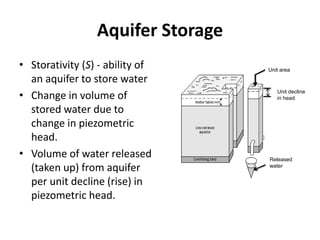
Aquifer Storage
• Storativity (S) - ability of
an aquifer to store water
• Change in volume of
stored water due to
change in piezometric
head.
• Volume of water released
(taken up) from aquifer
per unit decline (rise) in
piezometric head.
Unit area
Unit decline
in head
Released
water
Aquifer Storage
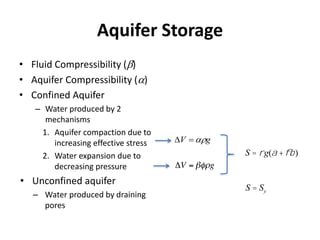
• Fluid Compressibility (b)
• Aquifer Compressibility (a)
• Confined Aquifer
– Water produced by 2
mechanisms
1. Aquifer compaction due to
increasing effective stress
2. Water expansion due to
decreasing pressure
• Unconfined aquifer
– Water produced by draining
pores
gV a
S = rg(a +fb)
S = Sy  
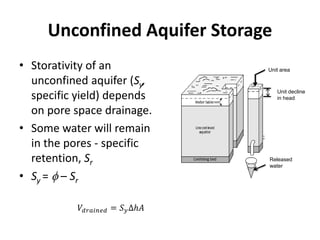
Unconfined Aquifer Storage
• Storativity of an
unconfined aquifer (Sy,
specific yield) depends
on pore space drainage.
• Some water will remain
in the pores - specific
retention, Sr
• Sy = f – Sr
Unit area
Unit decline
in head
Released
water
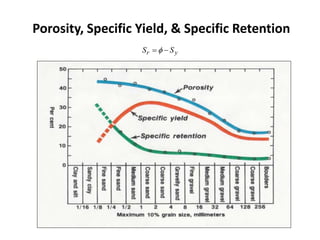
Porosity, Specific Yield, & Specific Retention
yr SS f
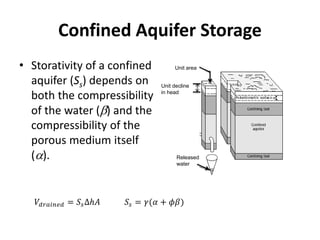
Confined Aquifer Storage
• Storativity of a confined
aquifer (Ss) depends on
both the compressibility
of the water (b) and the
compressibility of the
porous medium itself
(a).
Unit area
Unit decline
in head
Released
water
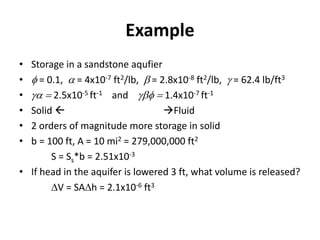
Example
• Storage in a sandstone aqufier
• f = 0.1, a = 4x10⁻⁷ ft2/lb, b = 2.8x10⁻⁸ ft2/lb, g = 62.4 lb/ft3
• ga  2.5x10⁻⁵ ft-1 and gbf  1.4x10⁻⁷ ft-1
• Solid  Fluid
• 2 orders of magnitude more storage in solid
• b = 100 ft, A = 10 mi2 = 279,000,000 ft2
S = Ss*b = 2.51x10⁻³
• If head in the aquifer is lowered 3 ft, what volume is released?
V = SAh = 2.1x10⁻⁶ ft3
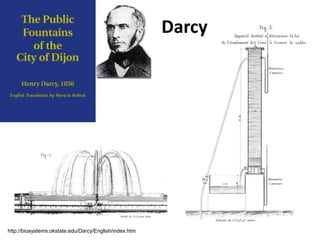
Darcy
http://biosystems.okstate.edu/Darcy/English/index.htm
hL
z1
z2
P1/g
P2/g
Q
Q
L
v
Sand
column
Datum
plane
Area,A
h1 h2
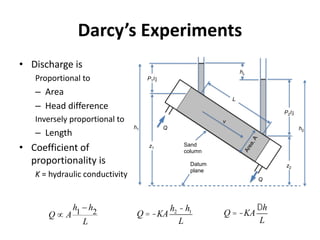
Darcy’s Experiments
• Discharge is
Proportional to
– Area
– Head difference
Inversely proportional to
– Length
• Coefficient of
proportionality is
K = hydraulic conductivity
L
hh
AQ 21 
 Q = -KA
h2 -h1
L
Q = -KA
Dh
L
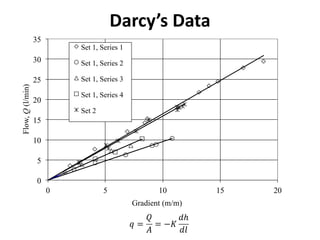
Darcy’s Data
0
5
10
15
20
25
30
35
0 5 10 15 20
Flow,Q(l/min)
Gradient (m/m)
Set 1, Series 1
Set 1, Series 2
Set 1, Series 3
Set 1, Series 4
Set 2
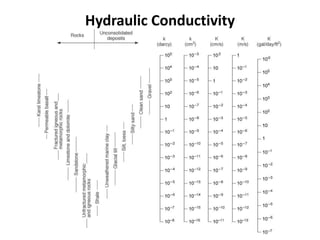
Hydraulic Conductivity
• Has dimensions of velocity [L/T]
• A combined property of the medium and the fluid
• Ease with which fluid moves through the medium
k = cd2 intrinsic permeability
ρ = density
µ = dynamic viscosity
g = specific weight
Porous medium property
Fluid properties
Hydraulic Conductivity
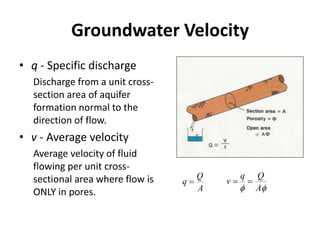
Groundwater Velocity
• q - Specific discharge
Discharge from a unit cross-
section area of aquifer
formation normal to the
direction of flow.
• v - Average velocity
Average velocity of fluid
flowing per unit cross-
sectional area where flow is
ONLY in pores. A
Q
q 
ff A
Qq
v 
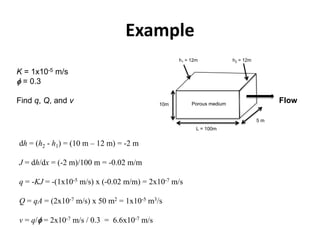
dh = (h2 - h1) = (10 m – 12 m) = -2 m
J = dh/dx = (-2 m)/100 m = -0.02 m/m
q = -KJ = -(1x10⁻⁵ m/s) x (-0.02 m/m) = 2x10⁻⁷ m/s
Q = qA = (2x10⁻⁷ m/s) x 50 m2 = 1x10⁻⁵ m3/s
v = q/f = 2x10⁻⁷ m/s / 0.3 = 6.6x10⁻⁷ m/s
/”
h1 = 12m h2 = 12m
L = 100m
10m
5 m
FlowPorous medium
Example
K = 1x10⁻⁵ m/s
f = 0.3
Find q, Q, and v
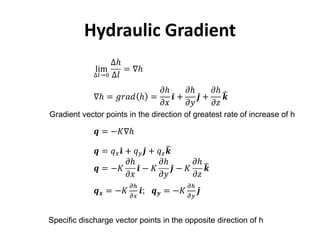
Hydraulic Gradient
Gradient vector points in the direction of greatest rate of increase of h
Specific discharge vector points in the opposite direction of h
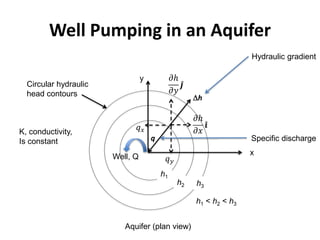
Well Pumping in an Aquifer
Aquifer (plan view)
y
h1 < h2 < h3
x
h1
h2 h3
Well, Q
q
h
Circular hydraulic
head contours
K, conductivity,
Is constant
Hydraulic gradient
Specific discharge
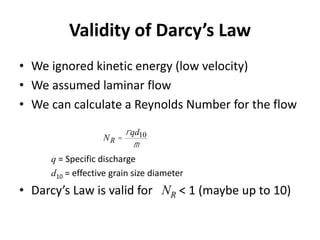
Validity of Darcy’s Law
• We ignored kinetic energy (low velocity)
• We assumed laminar flow
• We can calculate a Reynolds Number for the flow
q = Specific discharge
d10 = effective grain size diameter
• Darcy’s Law is valid for NR < 1 (maybe up to 10)
NR =
rqd10
m
Specific Discharge vs Head Gradient
q
Re = 10
Re = 1
Experiment
shows this
a
tan-1(a)= (1/K)
Darcy Law
predicts this
Estimating Conductivity
Kozeny – Carman Equation
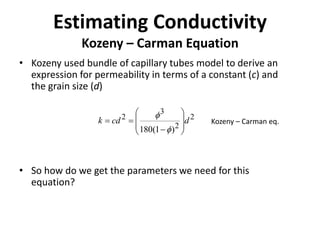
• Kozeny used bundle of capillary tubes model to derive an
expression for permeability in terms of a constant (c) and
the grain size (d)
• So how do we get the parameters we need for this
equation?
2
2
3
2
)1(180
dcdk










f
f
Kozeny – Carman eq.
Measuring Conductivity
Permeameter Lab Measurements
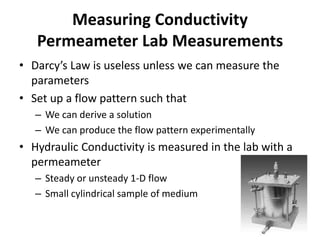
• Darcy’s Law is useless unless we can measure the
parameters
• Set up a flow pattern such that
– We can derive a solution
– We can produce the flow pattern experimentally
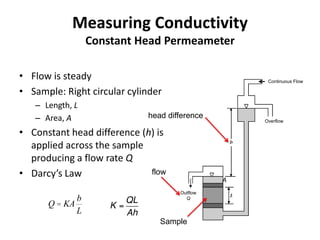
• Hydraulic Conductivity is measured in the lab with a
permeameter
– Steady or unsteady 1-D flow
– Small cylindrical sample of medium
Measuring Conductivity
Constant Head Permeameter
• Flow is steady
• Sample: Right circular cylinder
– Length, L
– Area, A
• Constant head difference (h) is
applied across the sample
producing a flow rate Q
• Darcy’s Law
Continuous Flow
Outflow
Q
Overflow
A
Q = KA
b
L
Sample
head difference
flow
Measuring Conductivity
Falling Head Permeameter
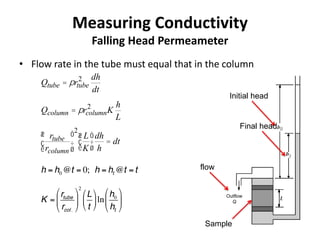
• Flow rate in the tube must equal that in the column
Outflow
Q
Qcolumn = prcolumn
2
K
h
L
Qtube = prtube
2 dh
dt
rtube
rcolumn
æ
è
ç
ö
ø
÷
2
L
K
æ
è
ç
ö
ø
÷
dh
h
= dt
Sample
flow
Initial head
Final head
Heterogeneity and Anisotropy
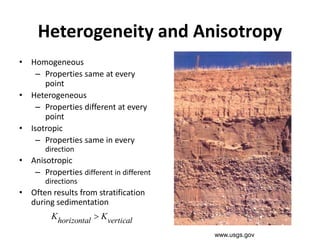
• Homogeneous
– Properties same at every
point
• Heterogeneous
– Properties different at every
point
• Isotropic
– Properties same in every
direction
• Anisotropic
– Properties different in different
directions
• Often results from stratification
during sedimentation
verticalhorizontal KK 
www.usgs.gov
Example
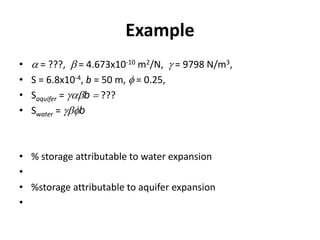
• a = ???, b = 4.673x10⁻¹⁰ m2/N, g = 9798 N/m3,
• S = 6.8x10⁻⁴, b = 50 m, f = 0.25,
• Saquifer = gabb  ???
• Swater = gbfb
• % storage attributable to water expansion
•
• %storage attributable to aquifer expansion
•
Layered Porous Media
(Flow Parallel to Layers)
3K
2K
1K
W
b
1b
2b
3b
1Q
2Q
3Q
h
h2
h1
Piezometric surface
Q
datum
Layered Porous Media
(Flow Perpendicular to Layers)
Q
3K2K1K
b
Q
L
L3L2L1
h1
Piezometric surface
h2
h3
h
Example
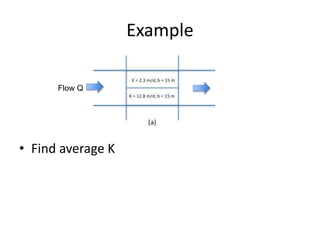
• Find average K
Flow Q
Example
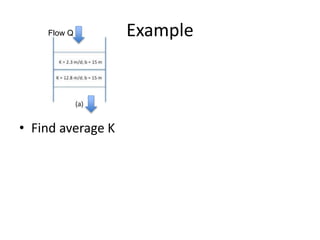
• Find average K
Flow Q
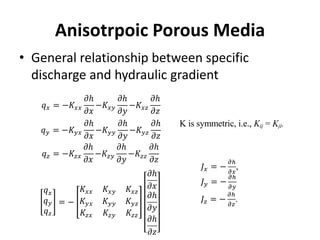
Anisotrpoic Porous Media
• General relationship between specific
discharge and hydraulic gradient
K is symmetric, i.e., Kij = Kji.
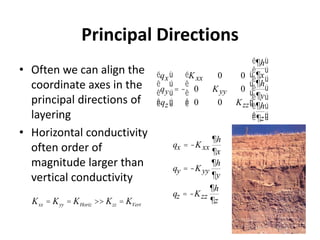
Principal Directions
• Often we can align the
coordinate axes in the
principal directions of
layering
• Horizontal conductivity
often order of
magnitude larger than
vertical conductivity
qx = -Kxx
¶h
¶x
qy = -Kyy
¶h
¶y
qz = -Kzz
¶h
¶z
qx
qy
qz
é
ë
ê
ê
ê
ù
û
ú
ú
ú
= -
Kxx 0 0
0 Kyy 0
0 0 Kzz
é
ë
ê
ê
ê
ù
û
ú
ú
ú
¶h
¶x
¶h
¶y
¶h
¶z
é
ë
ê
ê
ê
ê
ê
ê
ù
û
ú
ú
ú
ú
ú
ú
Kxx = Kyy = KHoriz >> Kzz = KVert
Groundwater Flow Direction
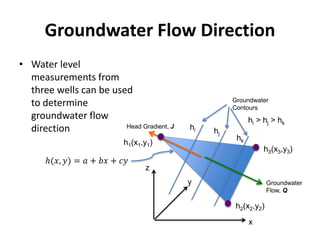
• Water level
measurements from
three wells can be used
to determine
groundwater flow
direction
Groundwater
Contours
Groundwater
Flow, Q
x
y
z
Head Gradient, J
hk
hj
hi
hi > hj > hk
h1(x1,y1)
h3(x3,y3)
h2(x2,y2)
Groundwater Flow Direction
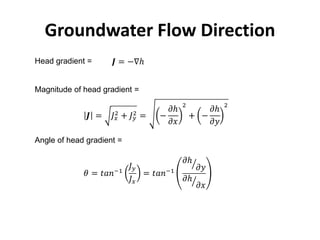
Magnitude of head gradient =
Angle of head gradient =
Head gradient =
Groundwater Flow Direction
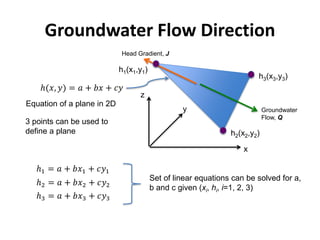
Set of linear equations can be solved for a,
b and c given (xi, hi, i=1, 2, 3)
3 points can be used to
define a plane
Equation of a plane in 2D
Groundwater
Flow, Q
x
y
z
Head Gradient, J
h1(x1,y1)
h3(x3,y3)
h2(x2,y2)
Groundwater Flow Direction
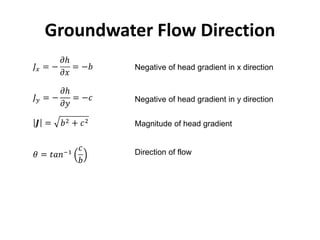
Negative of head gradient in x direction
Negative of head gradient in y direction
Magnitude of head gradient
Direction of flow
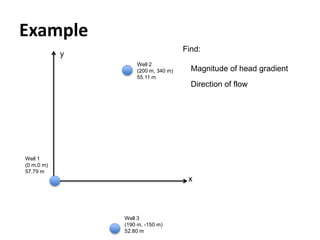
x
Well 2
(200 m, 340 m)
55.11 m
Well 1
(0 m,0 m)
57.79 m
Well 3
(190 m, -150 m)
52.80 m
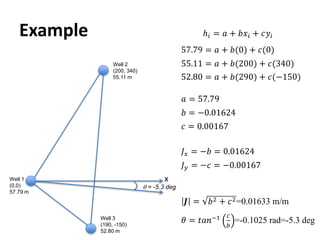
Example
Find:
Magnitude of head gradient
Direction of flow
y
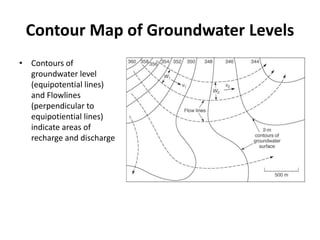
Contour Map of Groundwater Levels
• Contours of
groundwater level
(equipotential lines)
and Flowlines
(perpendicular to
equipotiential lines)
indicate areas of
recharge and discharge
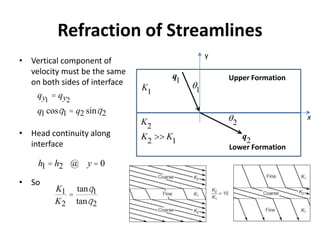
Refraction of Streamlines
• Vertical component of
velocity must be the same
on both sides of interface
• Head continuity along
interface
• So
2K
1K
Upper Formation
12 KK 
y
x
1
2
2q
1q
Lower Formation
qy1
= qy2
q1 cosq1 = q2 sinq2
h1 = h2 @ y = 0
K1
K2
=
tanq1
tanq2
Summary
• Properties – Aquifer Storage
• Darcy’s Law
– Darcy’s Experiment
– Specific Discharge
– Average Velocity
– Validity of Darcy’s Law
• Hydraulic Conductivity
– Permeability
– Kozeny-Carman Equation
– Constant Head Permeameter
– Falling Head Permeameter
• Heterogeneity and Anisotropy
– Layered Porous Media
• Refraction of Streamlines
• Generalized Darcy’s Law
Darcy’s Law
Examples
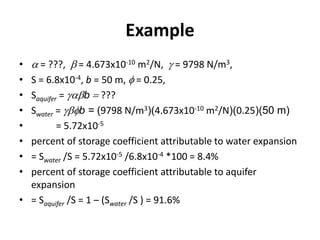
Example
• a = ???, b = 4.673x10⁻¹⁰ m2/N, g = 9798 N/m3,
• S = 6.8x10⁻⁴, b = 50 m, f = 0.25,
• Saquifer = gabb  ???
• Swater = gbfb = (9798 N/m3)(4.673x10-10 m2/N)(0.25)(50 m)
• = 5.72x10⁻⁵
• percent of storage coefficient attributable to water expansion
• = Swater /S = 5.72x10⁻⁵ /6.8x10-4 *100 = 8.4%
• percent of storage coefficient attributable to aquifer
expansion
• = Saquifer /S = 1 – (Swater /S ) = 91.6%
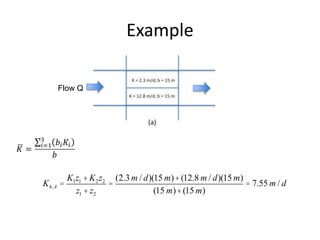
Example
Flow Q
Kh,A =
K1z1 + K2z2
z1 + z2
=
(2.3 m / d)(15 m)+(12.8 m / d)(15 m)
(15 m)+(15 m)
= 7.55 m / d
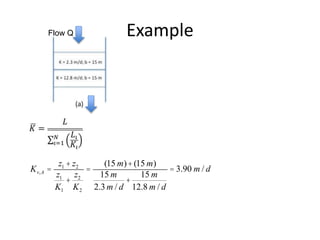
ExampleFlow Q
Kv,A =
z1 + z2
z1
K1
+
z2
K2
=
(15 m)+(15 m)
15 m
2.3 m / d
+
15 m
12.8 m / d
= 3.90 m / d
x
 = -5.3 deg
Well 2
(200, 340)
55.11 m
Well 1
(0,0)
57.79 m
Well 3
(190, -150)
52.80 m
Example

03 darcys law

  • 1.
  • 2.
    Outline • Properties –Aquifer Storage • Darcy’s Law • Hydraulic Conductivity • Heterogeneity and Anisotropy • Refraction of Streamlines • Generalized Darcy’s Law
  • 3.
    Aquifer Storage • Storativity(S) - ability of an aquifer to store water • Change in volume of stored water due to change in piezometric head. • Volume of water released (taken up) from aquifer per unit decline (rise) in piezometric head. Unit area Unit decline in head Released water
  • 4.
    Aquifer Storage • FluidCompressibility (b) • Aquifer Compressibility (a) • Confined Aquifer – Water produced by 2 mechanisms 1. Aquifer compaction due to increasing effective stress 2. Water expansion due to decreasing pressure • Unconfined aquifer – Water produced by draining pores gV a S = rg(a +fb) S = Sy  
  • 5.
    Unconfined Aquifer Storage •Storativity of an unconfined aquifer (Sy, specific yield) depends on pore space drainage. • Some water will remain in the pores - specific retention, Sr • Sy = f – Sr Unit area Unit decline in head Released water
  • 6.
    Porosity, Specific Yield,& Specific Retention yr SS f
  • 7.
    Confined Aquifer Storage •Storativity of a confined aquifer (Ss) depends on both the compressibility of the water (b) and the compressibility of the porous medium itself (a). Unit area Unit decline in head Released water
  • 8.
    Example • Storage ina sandstone aqufier • f = 0.1, a = 4x10⁻⁷ ft2/lb, b = 2.8x10⁻⁸ ft2/lb, g = 62.4 lb/ft3 • ga  2.5x10⁻⁵ ft-1 and gbf  1.4x10⁻⁷ ft-1 • Solid  Fluid • 2 orders of magnitude more storage in solid • b = 100 ft, A = 10 mi2 = 279,000,000 ft2 S = Ss*b = 2.51x10⁻³ • If head in the aquifer is lowered 3 ft, what volume is released? V = SAh = 2.1x10⁻⁶ ft3
  • 9.
  • 10.
    hL z1 z2 P1/g P2/g Q Q L v Sand column Datum plane Area,A h1 h2 Darcy’s Experiments •Discharge is Proportional to – Area – Head difference Inversely proportional to – Length • Coefficient of proportionality is K = hydraulic conductivity L hh AQ 21   Q = -KA h2 -h1 L Q = -KA Dh L
  • 11.
    Darcy’s Data 0 5 10 15 20 25 30 35 0 510 15 20 Flow,Q(l/min) Gradient (m/m) Set 1, Series 1 Set 1, Series 2 Set 1, Series 3 Set 1, Series 4 Set 2
  • 12.
    Hydraulic Conductivity • Hasdimensions of velocity [L/T] • A combined property of the medium and the fluid • Ease with which fluid moves through the medium k = cd2 intrinsic permeability ρ = density µ = dynamic viscosity g = specific weight Porous medium property Fluid properties
  • 13.
  • 14.
    Groundwater Velocity • q- Specific discharge Discharge from a unit cross- section area of aquifer formation normal to the direction of flow. • v - Average velocity Average velocity of fluid flowing per unit cross- sectional area where flow is ONLY in pores. A Q q  ff A Qq v 
  • 15.
    dh = (h2- h1) = (10 m – 12 m) = -2 m J = dh/dx = (-2 m)/100 m = -0.02 m/m q = -KJ = -(1x10⁻⁵ m/s) x (-0.02 m/m) = 2x10⁻⁷ m/s Q = qA = (2x10⁻⁷ m/s) x 50 m2 = 1x10⁻⁵ m3/s v = q/f = 2x10⁻⁷ m/s / 0.3 = 6.6x10⁻⁷ m/s /” h1 = 12m h2 = 12m L = 100m 10m 5 m FlowPorous medium Example K = 1x10⁻⁵ m/s f = 0.3 Find q, Q, and v
  • 16.
    Hydraulic Gradient Gradient vectorpoints in the direction of greatest rate of increase of h Specific discharge vector points in the opposite direction of h
  • 17.
    Well Pumping inan Aquifer Aquifer (plan view) y h1 < h2 < h3 x h1 h2 h3 Well, Q q h Circular hydraulic head contours K, conductivity, Is constant Hydraulic gradient Specific discharge
  • 18.
    Validity of Darcy’sLaw • We ignored kinetic energy (low velocity) • We assumed laminar flow • We can calculate a Reynolds Number for the flow q = Specific discharge d10 = effective grain size diameter • Darcy’s Law is valid for NR < 1 (maybe up to 10) NR = rqd10 m
  • 19.
    Specific Discharge vsHead Gradient q Re = 10 Re = 1 Experiment shows this a tan-1(a)= (1/K) Darcy Law predicts this
  • 20.
    Estimating Conductivity Kozeny –Carman Equation • Kozeny used bundle of capillary tubes model to derive an expression for permeability in terms of a constant (c) and the grain size (d) • So how do we get the parameters we need for this equation? 2 2 3 2 )1(180 dcdk           f f Kozeny – Carman eq.
  • 21.
    Measuring Conductivity Permeameter LabMeasurements • Darcy’s Law is useless unless we can measure the parameters • Set up a flow pattern such that – We can derive a solution – We can produce the flow pattern experimentally • Hydraulic Conductivity is measured in the lab with a permeameter – Steady or unsteady 1-D flow – Small cylindrical sample of medium
  • 22.
    Measuring Conductivity Constant HeadPermeameter • Flow is steady • Sample: Right circular cylinder – Length, L – Area, A • Constant head difference (h) is applied across the sample producing a flow rate Q • Darcy’s Law Continuous Flow Outflow Q Overflow A Q = KA b L Sample head difference flow
  • 23.
    Measuring Conductivity Falling HeadPermeameter • Flow rate in the tube must equal that in the column Outflow Q Qcolumn = prcolumn 2 K h L Qtube = prtube 2 dh dt rtube rcolumn æ è ç ö ø ÷ 2 L K æ è ç ö ø ÷ dh h = dt Sample flow Initial head Final head
  • 24.
    Heterogeneity and Anisotropy •Homogeneous – Properties same at every point • Heterogeneous – Properties different at every point • Isotropic – Properties same in every direction • Anisotropic – Properties different in different directions • Often results from stratification during sedimentation verticalhorizontal KK  www.usgs.gov
  • 25.
    Example • a =???, b = 4.673x10⁻¹⁰ m2/N, g = 9798 N/m3, • S = 6.8x10⁻⁴, b = 50 m, f = 0.25, • Saquifer = gabb  ??? • Swater = gbfb • % storage attributable to water expansion • • %storage attributable to aquifer expansion •
  • 26.
    Layered Porous Media (FlowParallel to Layers) 3K 2K 1K W b 1b 2b 3b 1Q 2Q 3Q h h2 h1 Piezometric surface Q datum
  • 27.
    Layered Porous Media (FlowPerpendicular to Layers) Q 3K2K1K b Q L L3L2L1 h1 Piezometric surface h2 h3 h
  • 28.
  • 29.
  • 30.
    Anisotrpoic Porous Media •General relationship between specific discharge and hydraulic gradient K is symmetric, i.e., Kij = Kji.
  • 31.
    Principal Directions • Oftenwe can align the coordinate axes in the principal directions of layering • Horizontal conductivity often order of magnitude larger than vertical conductivity qx = -Kxx ¶h ¶x qy = -Kyy ¶h ¶y qz = -Kzz ¶h ¶z qx qy qz é ë ê ê ê ù û ú ú ú = - Kxx 0 0 0 Kyy 0 0 0 Kzz é ë ê ê ê ù û ú ú ú ¶h ¶x ¶h ¶y ¶h ¶z é ë ê ê ê ê ê ê ù û ú ú ú ú ú ú Kxx = Kyy = KHoriz >> Kzz = KVert
  • 32.
    Groundwater Flow Direction •Water level measurements from three wells can be used to determine groundwater flow direction Groundwater Contours Groundwater Flow, Q x y z Head Gradient, J hk hj hi hi > hj > hk h1(x1,y1) h3(x3,y3) h2(x2,y2)
  • 33.
    Groundwater Flow Direction Magnitudeof head gradient = Angle of head gradient = Head gradient =
  • 34.
    Groundwater Flow Direction Setof linear equations can be solved for a, b and c given (xi, hi, i=1, 2, 3) 3 points can be used to define a plane Equation of a plane in 2D Groundwater Flow, Q x y z Head Gradient, J h1(x1,y1) h3(x3,y3) h2(x2,y2)
  • 35.
    Groundwater Flow Direction Negativeof head gradient in x direction Negative of head gradient in y direction Magnitude of head gradient Direction of flow
  • 36.
    x Well 2 (200 m,340 m) 55.11 m Well 1 (0 m,0 m) 57.79 m Well 3 (190 m, -150 m) 52.80 m Example Find: Magnitude of head gradient Direction of flow y
  • 37.
    Contour Map ofGroundwater Levels • Contours of groundwater level (equipotential lines) and Flowlines (perpendicular to equipotiential lines) indicate areas of recharge and discharge
  • 38.
    Refraction of Streamlines •Vertical component of velocity must be the same on both sides of interface • Head continuity along interface • So 2K 1K Upper Formation 12 KK  y x 1 2 2q 1q Lower Formation qy1 = qy2 q1 cosq1 = q2 sinq2 h1 = h2 @ y = 0 K1 K2 = tanq1 tanq2
  • 39.
    Summary • Properties –Aquifer Storage • Darcy’s Law – Darcy’s Experiment – Specific Discharge – Average Velocity – Validity of Darcy’s Law • Hydraulic Conductivity – Permeability – Kozeny-Carman Equation – Constant Head Permeameter – Falling Head Permeameter • Heterogeneity and Anisotropy – Layered Porous Media • Refraction of Streamlines • Generalized Darcy’s Law
  • 40.
  • 41.
    Example • a =???, b = 4.673x10⁻¹⁰ m2/N, g = 9798 N/m3, • S = 6.8x10⁻⁴, b = 50 m, f = 0.25, • Saquifer = gabb  ??? • Swater = gbfb = (9798 N/m3)(4.673x10-10 m2/N)(0.25)(50 m) • = 5.72x10⁻⁵ • percent of storage coefficient attributable to water expansion • = Swater /S = 5.72x10⁻⁵ /6.8x10-4 *100 = 8.4% • percent of storage coefficient attributable to aquifer expansion • = Saquifer /S = 1 – (Swater /S ) = 91.6%
  • 42.
    Example Flow Q Kh,A = K1z1+ K2z2 z1 + z2 = (2.3 m / d)(15 m)+(12.8 m / d)(15 m) (15 m)+(15 m) = 7.55 m / d
  • 43.
    ExampleFlow Q Kv,A = z1+ z2 z1 K1 + z2 K2 = (15 m)+(15 m) 15 m 2.3 m / d + 15 m 12.8 m / d = 3.90 m / d
  • 44.
    x  = -5.3deg Well 2 (200, 340) 55.11 m Well 1 (0,0) 57.79 m Well 3 (190, -150) 52.80 m Example