UNIT -IV
ADVANCED NANO FINISHING
PROCESSES
INTRODUCTION
• In order to substitute manual finishing process
and to meet the functional properties such as wear
resistance, power loss, due to friction on most of
the engineering components, we go for advanced
machining process.
• This finishing process is carried out at micro and
nano level. This process is called as advanced
nano finishing process.
NANO FINISHING PROCESSES
• Nano finishing is the only operation which
can make rough surfaces in nanometers range.
The ultimate precision through finishing will
be where processed where there is a change in
size of sub nanometer.
Nano finishing processes
1. Abrasive flow machining
2. Chemo mechanical polishing
3. Magnetic abrasive finishing
4. Magneto rheological finishing
5. Magneto rheological abrasive flow
finishing
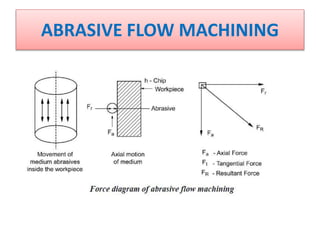
• In abrasive flow machining process, the
semisolid abrasive media acts as deformable
grading wheel; which helps to remove small
amount of materials.
• The abrasive media is given larger force or
velocity by hydraulic or mechanical means to
push the media into the areas in which
conventional finishing process cannot be
performed.
ABRASIVE FLOW MACHINING
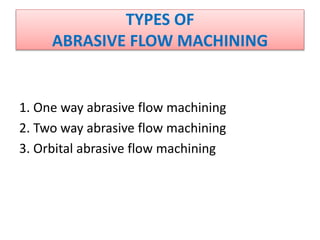
1. One way abrasive flow machining
2. Two way abrasive flow machining
3. Orbital abrasive flow machining
TYPES OF
ABRASIVE FLOW MACHINING
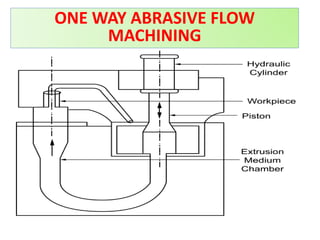
ONE WAY ABRASIVE FLOW
MACHINING
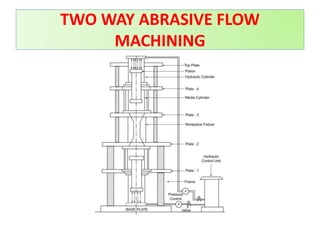
TWO WAY ABRASIVE FLOW
MACHINING
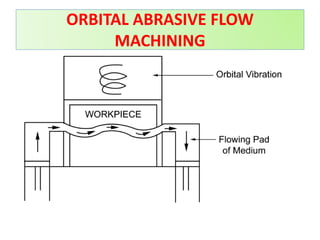
ORBITAL ABRASIVE FLOW
MACHINING
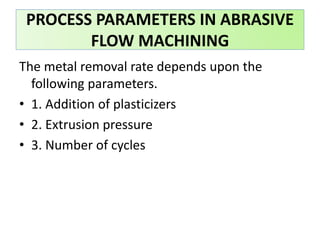
The metal removal rate depends upon the
following parameters.
• 1. Addition of plasticizers
• 2. Extrusion pressure
• 3. Number of cycles
PROCESS PARAMETERS IN ABRASIVE
FLOW MACHINING
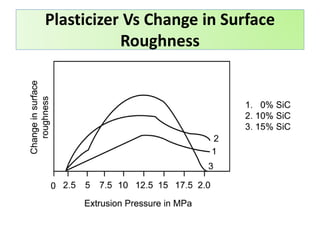
Plasticizer Vs Change in Surface
Roughness
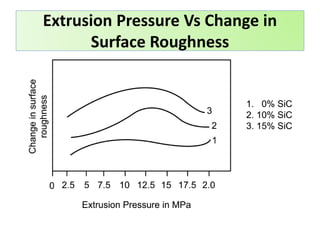
Extrusion Pressure Vs Change in
Surface Roughness
• As the finishing cycles are increased from 100
to 400, the surface roughness also increased
and good surface finish is obtained.
• The number of finishing cycles are controlled
by mechanical counter
Finishing Cycles Vs Change in Surface
Roughness
• Operations such as deburring polishing and
radiusing can be done.
• This process is more suitable for batch
production
• It is faster than manual finishing
• It can finish inaccessible areas in one single
movement
ADVANTAGES OF AFM
• It has low finishing rate compared to other
nano finishing process.
• The process involves high production time
and high production cost.
• There should be repeated replacements of
poly abrasive media that is used in AFM
process.
LIMITATIONS OF AFM
• AFM is used in finishing of
• Extrusion dies
• Nozzle of flame cutting touch
• Air foil surfaces of impellors
• Accessory parts like fuel spray, nozzle, fuel
control bodies.
APPLICATIONS OF AFM
• Chemo mechanical polishing is a process of
smoothing and planning surface with the combination
of chemical etching and free abrasive polishing.
• CMP of silicon wafers is a basic processing
technology for production of flat, defect free, highly
reflective surface.
• This planarization method is a choice for < 0.5
micron technologies
CHEMO MECHANICAL POLISHING
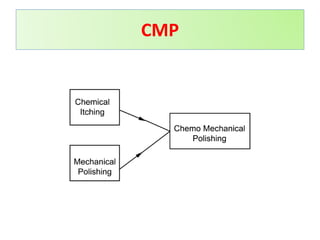
• In chemo mechanical polishing, a chemical
reaction is used to soften the material and then
mechanical polishing is done on the layer. The
polishing action is partly mechanical and
partly chemical
PRINCIPLE OF CMP
CMP
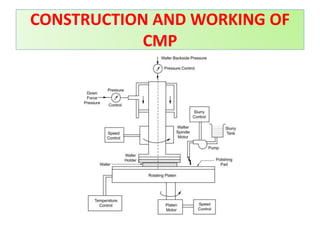
CONSTRUCTION AND WORKING OF
CMP
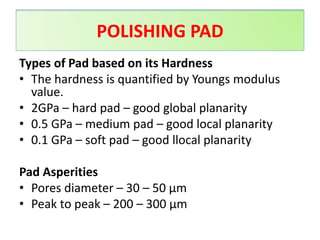
Types of Pad based on its Hardness
• The hardness is quantified by Youngs modulus
value.
• 2GPa – hard pad – good global planarity
• 0.5 GPa – medium pad – good local planarity
• 0.1 GPa – soft pad – good llocal planarity
Pad Asperities
• Pores diameter – 30 – 50 μm
• Peak to peak – 200 – 300 μm
POLISHING PAD
POLISHING PAD
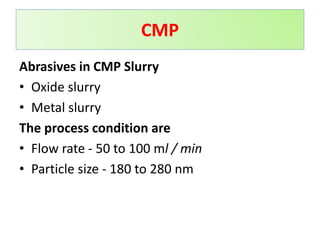
Abrasives in CMP Slurry
• Oxide slurry
• Metal slurry
The process condition are
• Flow rate - 50 to 100 ml / min
• Particle size - 180 to 280 nm
CMP
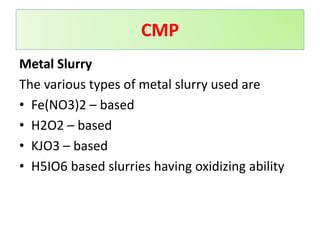
Metal Slurry
The various types of metal slurry used are
• Fe(NO3)2 – based
• H2O2 – based
• KJO3 – based
• H5IO6 based slurries having oxidizing ability
CMP
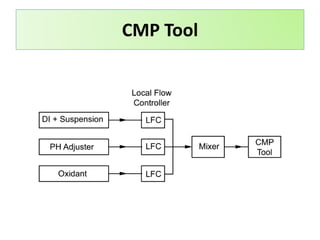
CMP Tool
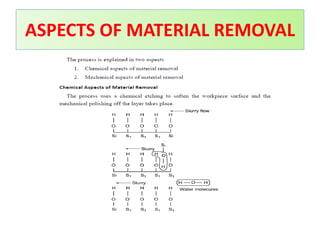
ASPECTS OF MATERIAL REMOVAL
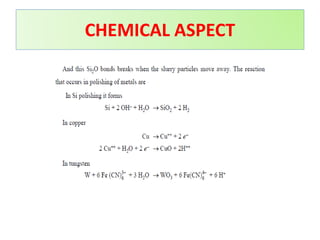
CHEMICAL ASPECT
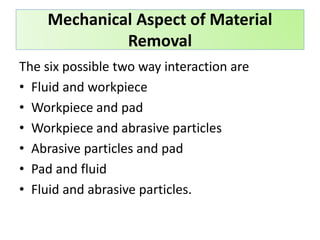
The six possible two way interaction are
• Fluid and workpiece
• Workpiece and pad
• Workpiece and abrasive particles
• Abrasive particles and pad
• Pad and fluid
• Fluid and abrasive particles.
Mechanical Aspect of Material
Removal
Also four possible three way interaction are
• Workpiece, fluid and abrasives
• Work[piece, abrasives and pad
• Fluid, pad and abrasives.
Mechanical Aspect of Material
Removal
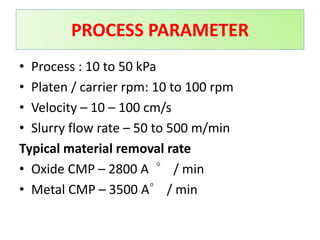
• Process : 10 to 50 kPa
• Platen / carrier rpm: 10 to 100 rpm
• Velocity – 10 – 100 cm/s
• Slurry flow rate – 50 to 500 m/min
Typical material removal rate
• Oxide CMP – 2800 A ∘ / min
• Metal CMP – 3500 A∘ / min
PROCESS PARAMETER
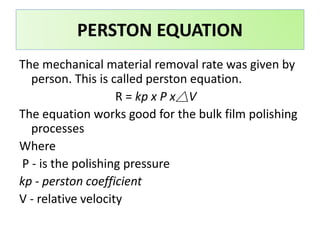
The mechanical material removal rate was given by
person. This is called perston equation.
R = kp x P x△V
The equation works good for the bulk film polishing
processes
Where
P - is the polishing pressure
kp - perston coefficient
V - relative velocity
PERSTON EQUATION
• Temperature in the polishing pad
• Conditioning of polishing pad.
FACTORS AFFECTING PROCESS
PARAMETERS
ADVANTAGES OF CMP
• It is used to polish metal like Aluminium, Copper, Silver titanium
etc.
• It can also polish insulators like SiO2, Si3N4.
• Ceramics like SiC, TiN, TaN can also be polished.
LIMITATIONS OF CMP
• Cleaning of platen surface in a difficult process.
• Embedded particles, residual slurry are to be removed very
carefully.
• Due to residues min scratches are also formed on the surface of the
platen and the pad.
• Surface defects such riping out and dishing are formed on the
surface.
ADVANTAGES AND DISADVANTAGES
• It is used in fabrication of semiconductor
devices
• Oxides are deposited on the wafer in from of
shape trenches
• Flat panel display
• Microelectronic mechanical system
• Magnetic recording head and CD writing
APPLICATIONS OF CMP
• Magnetic abrasive finishing process was
developed in US, USSR, Bulgaria and Japan.
This process is mainly used in finishing
radiusing and deburring of various flat surfaces
and cylindrical surfaces.
MAGNETIC ABRASIVE FINISHING
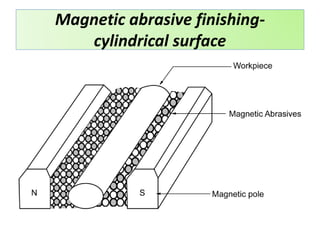
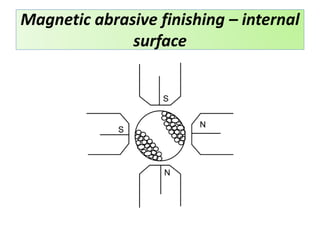
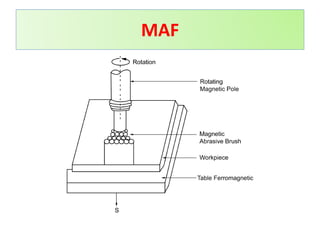
• In magnetic abrasive finishing process, the
magnetic particles are joined to each other
magnetically between magnetic poles along
the lines of magnetic force forming a flexible
abrasive brush.
• This magnetic abrasive brush is used to
perform surface and edge finishing operation.
PRINCIPLE OF MAF
MAF
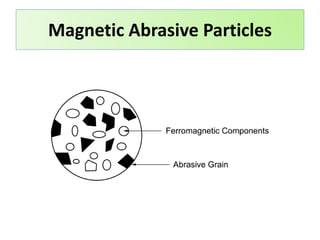
Magnetic Abrasive Particles
Magnetic abrasive finishing-
cylindrical surface
Magnetic abrasive finishing – internal
surface
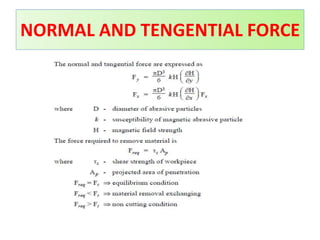
NORMAL AND TENGENTIAL FORCE
1.Pressure
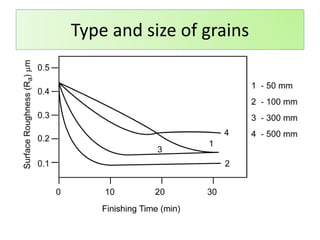
2. Type and size of grains
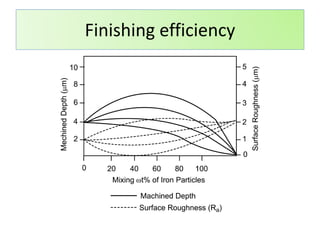
3. Finishing efficiency
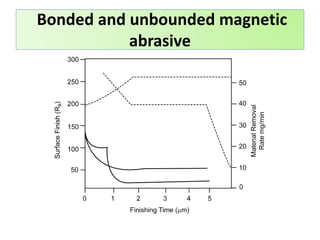
4. Bonded and unbounded magnetic abrasive
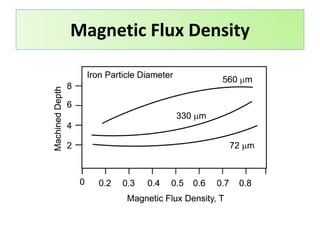
5. Magnetic flux density.
FACTORS AFFECTING PROCESS
PARAMETERS
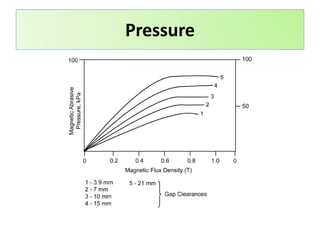
Pressure
Type and size of grains
Finishing efficiency
Bonded and unbounded magnetic
abrasive
Magnetic Flux Density
ADVANTAGES OF MAF
• MAF have self adaptability and easy controllability
• Surface finish is in order of nanometer.
• The device can be easily mounted on other machine without
the need of high capital investment.
DISADVANTAGES OF MAF
• It is difficult to implement MAF in mass production operation.
• It is a time consuming process.
• It is not applicable for some ordinary finishing task where
conventional finishing technique can be easily implemented.
ADVANTAGES AND DISADVANTAGES
OF MAF
• It is used in finishing processes such as
lapping, buffing, honing and burnishing
operation in surface of tubes, bearing and
automobile components.
• Precision deburring can be done on edges of
the workpiece.
• It is used in medical field in areas of capillary
tube, needles and biopsy needles etc.
APPLICATIONS OF MAF
• A magneto rheological fluid is a layer of smart
fluid in a carrier. It is a type of oil when subjected
to a magnetic field, the fluid increases it apparent
viscosity to the point that it becomes a
viscoelastic solid.
• Rheology is a science of flow and deformation
study of rheological properties of the medium.
The performance of the medium. The
performance of the medium is given by its
rheological properties.
MAGNETO RHEOLOGICAL FINISHING
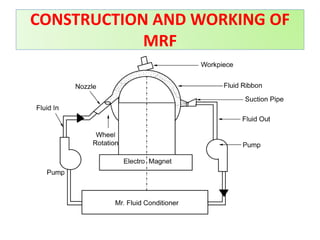
• In magneto rheological finishing process under
the influence of magnetic field the MR fluid
(Magneto rheological fluid) becomes a
viscoelastic solid.
• This act as the cutting tool to remove the
materials from the surface of the workpiece.
PRINCIPLE OF MRF
CONSTRUCTION AND WORKING OF
MRF
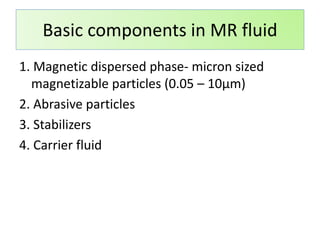
1. Magnetic dispersed phase- micron sized
magnetizable particles (0.05 – 10μm)
2. Abrasive particles
3. Stabilizers
4. Carrier fluid
Basic components in MR fluid
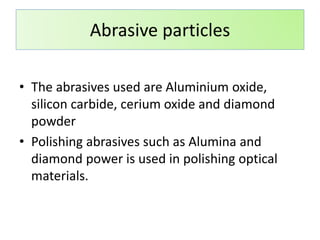
• The abrasives used are Aluminium oxide,
silicon carbide, cerium oxide and diamond
powder
• Polishing abrasives such as Alumina and
diamond power is used in polishing optical
materials.
Abrasive particles
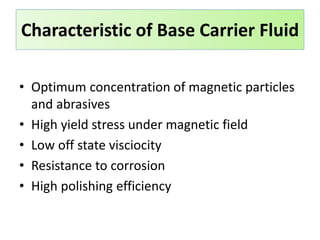
• Optimum concentration of magnetic particles
and abrasives
• High yield stress under magnetic field
• Low off state visciocity
• Resistance to corrosion
• High polishing efficiency
Characteristic of Base Carrier Fluid
• The main function of stabilizers is used to
disperse the magnetic particles and abrasives
uniformly in suspension
• The main function of stabilizers is that it
creates a coating on the particles so that MR
fluid can easily re-disperse
STABILIZERS
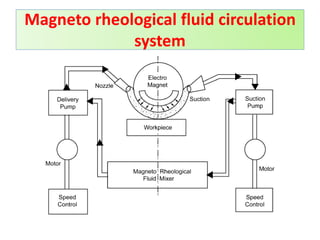
Magneto rheological fluid circulation
system
ADVANTAGES
• High accuracy
• Enhances product quality and repeatability
• Increases production rate, productivity yield and cost effectiveness.
• Manufacture of precision optics.
• Optical glasses with roughness of less than 10 angstrom can be machined.
• Surface finish upto nanometer level is achieved without sub surface
damage.
LIMITATIONS OF MRF
• High quality fluids are expensive.
• Fluids are subject to thickening after prolonged used and need replacement.
• Settling of ferromagnetic particles can be a problem for some application
• This process is not suitable for finishing of internal and external surface of
cylindrical components.
ADVANTAGES AND DISADVANTAGES
OF MRF
• Use in lens manufacturing
• Optical glasses, single crystals, calcium
fluorides silicon ceramic are machined.
• Square and rectangular aperture surface such
as prism, cylinder and photo blank substrates
are machined
APPLICATIONS OF MRF
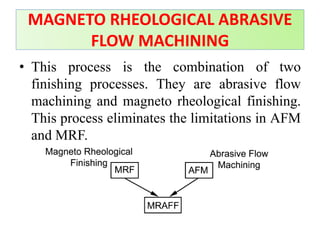
• This process is the combination of two
finishing processes. They are abrasive flow
machining and magneto rheological finishing.
This process eliminates the limitations in AFM
and MRF.
MAGNETO RHEOLOGICAL ABRASIVE
FLOW MACHINING
• Magneto rheological polishing fluid comprises
of carbonyl iron powder and silicon carbide,
abrasive dispersed in the viscoplastic base of
grease and mineral oil.
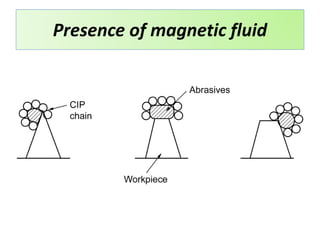
• When external magnetic field is applied these
fluid exhibit change in rheological behavior.
These fluids behaves smartly and does the
finishing operation precisely
PRINCIPLE OF MRAFM
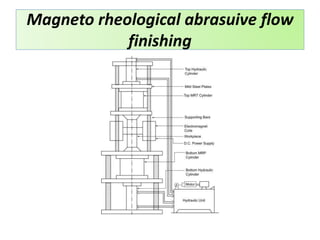
Magneto rheological abrasuive flow
finishing
• Electromagnets - 2000 turns of 17 SWG copper
wire.
• Continuous Phase -Organic fluids are used as
continuous phase for MR fluids. The other type of
fluids are silicone oils, kerosene, mineral oil and
glycol.
• Additives -MR fluid is mixture of 26.6 vol% of
electrolytes, 99.5% of Fe powder, 13.4 vol% of
silicon carbide abrasive with 4.8% paraffin oil
and 12% AP3 grease.
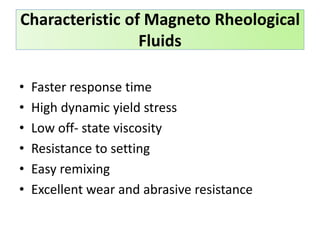
• Faster response time
• High dynamic yield stress
• Low off- state viscosity
• Resistance to setting
• Easy remixing
• Excellent wear and abrasive resistance
Characteristic of Magneto Rheological
Fluids
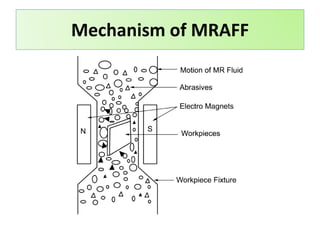
Mechanism of MRAFF
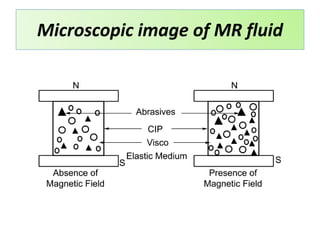
Microscopic image of MR fluid
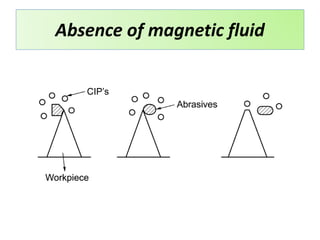
Absence of magnetic fluid
Presence of magnetic fluid
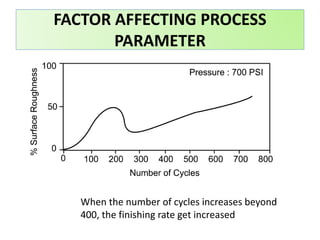
FACTOR AFFECTING PROCESS
PARAMETER
When the number of cycles increases beyond
400, the finishing rate get increased
• Complex structures can be easily machined.
• Localized finishing is possible
• Thermal distortion is negligible
• High machining versatility.
ADVANTAGES OF MRAFF
• Low finishing rate
• Non uniform magnetic field produces non
uniform surface finish
• Required a closed environment
LIMITATIONS OF MRAFF
• Used in investment cast milled parts, airfoil, cast
aluminum automobile turbo components
• Complex piping for values, fittings, tubes and
flow meter
• Finishing of automotive gears in a single pass,
heart values, exhaust manifold and high pressure
holes.
• Used in finishing of heart valves, exhaust
manifold and high pressure holes.
APPLICATIONS OF MRAFF
Unit 4 ucm
Unit 4 ucm
Unit 4 ucm
Unit 4 ucm
Unit 4 ucm
Unit 4 ucm
Unit 4 ucm
Unit 4 ucm

Unit 4 ucm

  • 1.
    UNIT -IV ADVANCED NANOFINISHING PROCESSES
  • 2.
    INTRODUCTION • In orderto substitute manual finishing process and to meet the functional properties such as wear resistance, power loss, due to friction on most of the engineering components, we go for advanced machining process. • This finishing process is carried out at micro and nano level. This process is called as advanced nano finishing process.
  • 3.
    NANO FINISHING PROCESSES •Nano finishing is the only operation which can make rough surfaces in nanometers range. The ultimate precision through finishing will be where processed where there is a change in size of sub nanometer.
  • 4.
    Nano finishing processes 1.Abrasive flow machining 2. Chemo mechanical polishing 3. Magnetic abrasive finishing 4. Magneto rheological finishing 5. Magneto rheological abrasive flow finishing
  • 5.
    • In abrasiveflow machining process, the semisolid abrasive media acts as deformable grading wheel; which helps to remove small amount of materials. • The abrasive media is given larger force or velocity by hydraulic or mechanical means to push the media into the areas in which conventional finishing process cannot be performed. ABRASIVE FLOW MACHINING
  • 6.
  • 7.
    1. One wayabrasive flow machining 2. Two way abrasive flow machining 3. Orbital abrasive flow machining TYPES OF ABRASIVE FLOW MACHINING
  • 8.
    ONE WAY ABRASIVEFLOW MACHINING
  • 9.
    TWO WAY ABRASIVEFLOW MACHINING
  • 10.
  • 11.
    The metal removalrate depends upon the following parameters. • 1. Addition of plasticizers • 2. Extrusion pressure • 3. Number of cycles PROCESS PARAMETERS IN ABRASIVE FLOW MACHINING
  • 12.
    Plasticizer Vs Changein Surface Roughness
  • 13.
    Extrusion Pressure VsChange in Surface Roughness
  • 14.
    • As thefinishing cycles are increased from 100 to 400, the surface roughness also increased and good surface finish is obtained. • The number of finishing cycles are controlled by mechanical counter Finishing Cycles Vs Change in Surface Roughness
  • 15.
    • Operations suchas deburring polishing and radiusing can be done. • This process is more suitable for batch production • It is faster than manual finishing • It can finish inaccessible areas in one single movement ADVANTAGES OF AFM
  • 16.
    • It haslow finishing rate compared to other nano finishing process. • The process involves high production time and high production cost. • There should be repeated replacements of poly abrasive media that is used in AFM process. LIMITATIONS OF AFM
  • 17.
    • AFM isused in finishing of • Extrusion dies • Nozzle of flame cutting touch • Air foil surfaces of impellors • Accessory parts like fuel spray, nozzle, fuel control bodies. APPLICATIONS OF AFM
  • 18.
    • Chemo mechanicalpolishing is a process of smoothing and planning surface with the combination of chemical etching and free abrasive polishing. • CMP of silicon wafers is a basic processing technology for production of flat, defect free, highly reflective surface. • This planarization method is a choice for < 0.5 micron technologies CHEMO MECHANICAL POLISHING
  • 19.
    • In chemomechanical polishing, a chemical reaction is used to soften the material and then mechanical polishing is done on the layer. The polishing action is partly mechanical and partly chemical PRINCIPLE OF CMP
  • 20.
  • 21.
  • 22.
    Types of Padbased on its Hardness • The hardness is quantified by Youngs modulus value. • 2GPa – hard pad – good global planarity • 0.5 GPa – medium pad – good local planarity • 0.1 GPa – soft pad – good llocal planarity Pad Asperities • Pores diameter – 30 – 50 μm • Peak to peak – 200 – 300 μm POLISHING PAD POLISHING PAD
  • 23.
    Abrasives in CMPSlurry • Oxide slurry • Metal slurry The process condition are • Flow rate - 50 to 100 ml / min • Particle size - 180 to 280 nm CMP
  • 24.
    Metal Slurry The varioustypes of metal slurry used are • Fe(NO3)2 – based • H2O2 – based • KJO3 – based • H5IO6 based slurries having oxidizing ability CMP
  • 25.
  • 26.
  • 27.
  • 28.
    The six possibletwo way interaction are • Fluid and workpiece • Workpiece and pad • Workpiece and abrasive particles • Abrasive particles and pad • Pad and fluid • Fluid and abrasive particles. Mechanical Aspect of Material Removal
  • 29.
    Also four possiblethree way interaction are • Workpiece, fluid and abrasives • Work[piece, abrasives and pad • Fluid, pad and abrasives. Mechanical Aspect of Material Removal
  • 30.
    • Process :10 to 50 kPa • Platen / carrier rpm: 10 to 100 rpm • Velocity – 10 – 100 cm/s • Slurry flow rate – 50 to 500 m/min Typical material removal rate • Oxide CMP – 2800 A ∘ / min • Metal CMP – 3500 A∘ / min PROCESS PARAMETER
  • 31.
    The mechanical materialremoval rate was given by person. This is called perston equation. R = kp x P x△V The equation works good for the bulk film polishing processes Where P - is the polishing pressure kp - perston coefficient V - relative velocity PERSTON EQUATION
  • 32.
    • Temperature inthe polishing pad • Conditioning of polishing pad. FACTORS AFFECTING PROCESS PARAMETERS
  • 33.
    ADVANTAGES OF CMP •It is used to polish metal like Aluminium, Copper, Silver titanium etc. • It can also polish insulators like SiO2, Si3N4. • Ceramics like SiC, TiN, TaN can also be polished. LIMITATIONS OF CMP • Cleaning of platen surface in a difficult process. • Embedded particles, residual slurry are to be removed very carefully. • Due to residues min scratches are also formed on the surface of the platen and the pad. • Surface defects such riping out and dishing are formed on the surface. ADVANTAGES AND DISADVANTAGES
  • 34.
    • It isused in fabrication of semiconductor devices • Oxides are deposited on the wafer in from of shape trenches • Flat panel display • Microelectronic mechanical system • Magnetic recording head and CD writing APPLICATIONS OF CMP
  • 35.
    • Magnetic abrasivefinishing process was developed in US, USSR, Bulgaria and Japan. This process is mainly used in finishing radiusing and deburring of various flat surfaces and cylindrical surfaces. MAGNETIC ABRASIVE FINISHING
  • 36.
    • In magneticabrasive finishing process, the magnetic particles are joined to each other magnetically between magnetic poles along the lines of magnetic force forming a flexible abrasive brush. • This magnetic abrasive brush is used to perform surface and edge finishing operation. PRINCIPLE OF MAF
  • 37.
  • 38.
  • 39.
  • 40.
    Magnetic abrasive finishing– internal surface
  • 41.
  • 42.
    1.Pressure 2. Type andsize of grains 3. Finishing efficiency 4. Bonded and unbounded magnetic abrasive 5. Magnetic flux density. FACTORS AFFECTING PROCESS PARAMETERS
  • 43.
  • 44.
    Type and sizeof grains
  • 45.
  • 46.
    Bonded and unboundedmagnetic abrasive
  • 47.
  • 48.
    ADVANTAGES OF MAF •MAF have self adaptability and easy controllability • Surface finish is in order of nanometer. • The device can be easily mounted on other machine without the need of high capital investment. DISADVANTAGES OF MAF • It is difficult to implement MAF in mass production operation. • It is a time consuming process. • It is not applicable for some ordinary finishing task where conventional finishing technique can be easily implemented. ADVANTAGES AND DISADVANTAGES OF MAF
  • 49.
    • It isused in finishing processes such as lapping, buffing, honing and burnishing operation in surface of tubes, bearing and automobile components. • Precision deburring can be done on edges of the workpiece. • It is used in medical field in areas of capillary tube, needles and biopsy needles etc. APPLICATIONS OF MAF
  • 50.
    • A magnetorheological fluid is a layer of smart fluid in a carrier. It is a type of oil when subjected to a magnetic field, the fluid increases it apparent viscosity to the point that it becomes a viscoelastic solid. • Rheology is a science of flow and deformation study of rheological properties of the medium. The performance of the medium. The performance of the medium is given by its rheological properties. MAGNETO RHEOLOGICAL FINISHING
  • 51.
    • In magnetorheological finishing process under the influence of magnetic field the MR fluid (Magneto rheological fluid) becomes a viscoelastic solid. • This act as the cutting tool to remove the materials from the surface of the workpiece. PRINCIPLE OF MRF
  • 52.
  • 53.
    1. Magnetic dispersedphase- micron sized magnetizable particles (0.05 – 10μm) 2. Abrasive particles 3. Stabilizers 4. Carrier fluid Basic components in MR fluid
  • 54.
    • The abrasivesused are Aluminium oxide, silicon carbide, cerium oxide and diamond powder • Polishing abrasives such as Alumina and diamond power is used in polishing optical materials. Abrasive particles
  • 55.
    • Optimum concentrationof magnetic particles and abrasives • High yield stress under magnetic field • Low off state visciocity • Resistance to corrosion • High polishing efficiency Characteristic of Base Carrier Fluid
  • 56.
    • The mainfunction of stabilizers is used to disperse the magnetic particles and abrasives uniformly in suspension • The main function of stabilizers is that it creates a coating on the particles so that MR fluid can easily re-disperse STABILIZERS
  • 57.
    Magneto rheological fluidcirculation system
  • 58.
    ADVANTAGES • High accuracy •Enhances product quality and repeatability • Increases production rate, productivity yield and cost effectiveness. • Manufacture of precision optics. • Optical glasses with roughness of less than 10 angstrom can be machined. • Surface finish upto nanometer level is achieved without sub surface damage. LIMITATIONS OF MRF • High quality fluids are expensive. • Fluids are subject to thickening after prolonged used and need replacement. • Settling of ferromagnetic particles can be a problem for some application • This process is not suitable for finishing of internal and external surface of cylindrical components. ADVANTAGES AND DISADVANTAGES OF MRF
  • 59.
    • Use inlens manufacturing • Optical glasses, single crystals, calcium fluorides silicon ceramic are machined. • Square and rectangular aperture surface such as prism, cylinder and photo blank substrates are machined APPLICATIONS OF MRF
  • 60.
    • This processis the combination of two finishing processes. They are abrasive flow machining and magneto rheological finishing. This process eliminates the limitations in AFM and MRF. MAGNETO RHEOLOGICAL ABRASIVE FLOW MACHINING
  • 61.
    • Magneto rheologicalpolishing fluid comprises of carbonyl iron powder and silicon carbide, abrasive dispersed in the viscoplastic base of grease and mineral oil. • When external magnetic field is applied these fluid exhibit change in rheological behavior. These fluids behaves smartly and does the finishing operation precisely PRINCIPLE OF MRAFM
  • 62.
  • 63.
    • Electromagnets -2000 turns of 17 SWG copper wire. • Continuous Phase -Organic fluids are used as continuous phase for MR fluids. The other type of fluids are silicone oils, kerosene, mineral oil and glycol. • Additives -MR fluid is mixture of 26.6 vol% of electrolytes, 99.5% of Fe powder, 13.4 vol% of silicon carbide abrasive with 4.8% paraffin oil and 12% AP3 grease.
  • 64.
    • Faster responsetime • High dynamic yield stress • Low off- state viscosity • Resistance to setting • Easy remixing • Excellent wear and abrasive resistance Characteristic of Magneto Rheological Fluids
  • 65.
  • 66.
  • 67.
  • 68.
  • 69.
    FACTOR AFFECTING PROCESS PARAMETER Whenthe number of cycles increases beyond 400, the finishing rate get increased
  • 70.
    • Complex structurescan be easily machined. • Localized finishing is possible • Thermal distortion is negligible • High machining versatility. ADVANTAGES OF MRAFF
  • 71.
    • Low finishingrate • Non uniform magnetic field produces non uniform surface finish • Required a closed environment LIMITATIONS OF MRAFF
  • 72.
    • Used ininvestment cast milled parts, airfoil, cast aluminum automobile turbo components • Complex piping for values, fittings, tubes and flow meter • Finishing of automotive gears in a single pass, heart values, exhaust manifold and high pressure holes. • Used in finishing of heart valves, exhaust manifold and high pressure holes. APPLICATIONS OF MRAFF