By
Gulamhushen Sipai ( 710807 )
Sandip K Gadhiya ( 710816 )
Prof. Dr. Komal G. Dave
Mechanical Engineering Dept.
L D College of Engineering, Ahmedabad.
Gujarat Technological University, Ahmedabad.
ADVANCED FINE
FINISHING PROCESS
 ABRASIVE FLOW MACHINING(AFM)
 MAGNETIC ABRASIVE FINISHING (MAF)
 MAGNETO RHEOLOGICAL ABRASIVE FINISHING
ABRASIVE FLOW
MACHINING (AFM)
Introduction to AFM
 Abrasive flow machining (AFM) was developed by Extrude Hone Corporation, USA in 1960.
AFM is used to deburr, radius and polish difficult to reach surfaces by extruding an abrasive
laden polymer medium with very special rheological properties.
It is widely used finishing process to finish complicated shapes and profiles.
The polymer abrasive medium which is used in this process, possesses easy flow ability, better
self deformability and fine abrading capability.
Layer thickness of the material removed is of the order of about 1 to 10 μm. Best surface finish
that has been achieved is 50 nm and tolerances are +/- 0.5 μm.
Process description and Principle
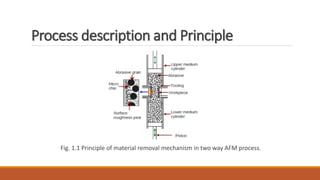
Fig. 1.1 Principle of material removal mechanism in two way AFM process.
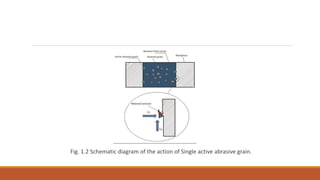
Fig. 1.2 Schematic diagram of the action of Single active abrasive grain.
Classification AFM machine
 There are three types of AFM machines that have been reported in the literature:
1) One way AFM,
2) Two way AFM and
3) Orbital AFM.
Commonly used AFM is Two-way AFM in which two vertically opposed cylinders extrude
medium back and forth through passages formed by the workpiece and tooling.
One way AFM process
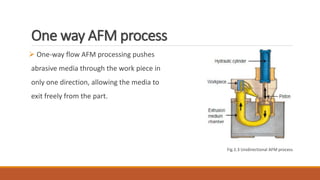
 One-way flow AFM processing pushes
abrasive media through the work piece in
only one direction, allowing the media to
exit freely from the part.
Fig.1.3 Unidirectional AFM process
The advantages of One Way AFM
 Faster cycle processing
 Easy clean-up
 Media temperature control generally not required
 Able to process larger parts
 Simpler tooling and part change-over
 Accurately replicates air or liquids natural flow
 Does not encapsulate workpart in media
Two way AFM process
 Two way AFM machine has two hydraulic cylinders and two medium cylinders. The medium is
extruded, hydraulically or mechanically, from the filled chamber to the empty chamber via the
restricted passageway through or past the workpiece surface to be abraded (Fig.1.1).
 Typically, the medium is extruded back and forth between the chambers for the desired fixed
number of cycles. Counter bores, recessed areas and even blind cavities can be finished by using
restrictors or mandrels to direct the medium flow along the surfaces to be finished.
Advantages of Two-Way AFM
 Excellent process control
 Can finish both ID and OD of component
 Good control of radius generation
 Fully automated system capabilities
 Faster setup & quick-change tooling
Faster change-over of media
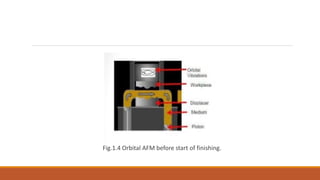
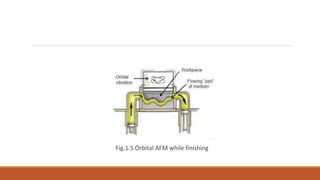
Orbital AFM process
 Surface and edge finishing are achieved rapid, low-amplitude, oscillations of the work piece
relative to a self-forming elastic plastic abrasive polishing tool.
The tool is a pad or layer of abrasive-laden elastic plastic medium (similar to that used in two
way abrasive flow finishing), but typically higher in viscosity and more in elastic.
Fig.1.4 Orbital AFM before start of finishing.
Fig.1.5 Orbital AFM while finishing
Mechanism of material removal
 Two modes of abrasive wear, micro-ploughing and micro-cutting, have been identified
as the mechanisms of removal in AFM.
 In micro-ploughing, surface peaks are smeared and plastically deformed, resulting in
‘‘leveling out’’ of surface asperities. No volume loss takes place in this mode of removal.
Ridges are also formed adjacent to the grooves created by abrasive particles’ sliding
path.
 On the other hand, in micro-cutting, abrasive particles act as single-point cutting
tools, indenting and removing material in the form of microchips.
 In both forms of abrasive wear, scratches are characterized by continuous scratches.
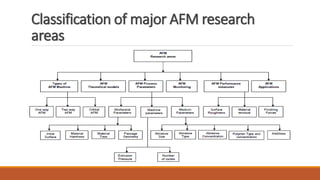
Classification of major AFM research
areas
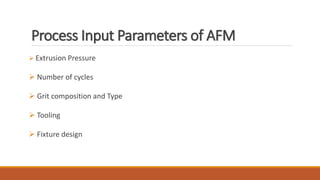
Process Input Parameters of AFM
 Extrusion Pressure
 Number of cycles
 Grit composition and Type
 Tooling
 Fixture design
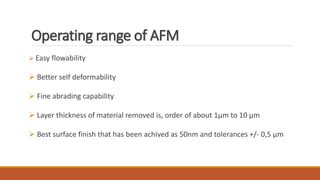
Operating range of AFM
 Easy flowability
 Better self deformability
 Fine abrading capability
 Layer thickness of material removed is, order of about 1μm to 10 μm
 Best surface finish that has been achived as 50nm and tolerances +/- 0,5 μm
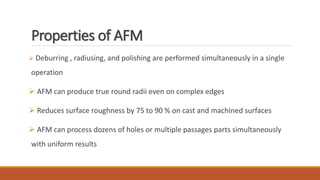
Properties of AFM
 Deburring , radiusing, and polishing are performed simultaneously in a single
operation
 AFM can produce true round radii even on complex edges
 Reduces surface roughness by 75 to 90 % on cast and machined surfaces
 AFM can process dozens of holes or multiple passages parts simultaneously
with uniform results
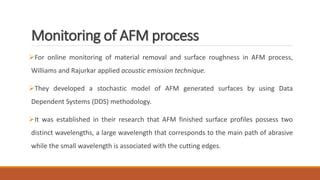
Monitoring of AFM process
For online monitoring of material removal and surface roughness in AFM process,
Williams and Rajurkar applied acoustic emission technique.
They developed a stochastic model of AFM generated surfaces by using Data
Dependent Systems (DDS) methodology.
It was established in their research that AFM finished surface profiles possess two
distinct wavelengths, a large wavelength that corresponds to the main path of abrasive
while the small wavelength is associated with the cutting edges.
CONT.
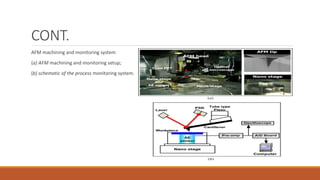
AFM machining and monitoring system
(a) AFM machining and monitoring setup;
(b) schematic of the process monitoring system.
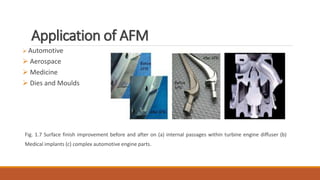
Application of AFM
 Automotive
 Aerospace
 Medicine
 Dies and Moulds
Fig. 1.7 Surface finish improvement before and after on (a) internal passages within turbine engine diffuser (b)
Medical implants (c) complex automotive engine parts.
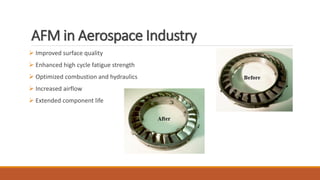
AFM in Aerospace Industry
 Improved surface quality
 Enhanced high cycle fatigue strength
 Optimized combustion and hydraulics
 Increased airflow
 Extended component life
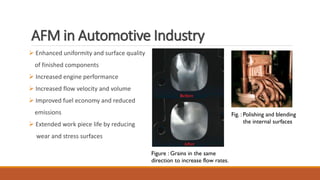
AFM in Automotive Industry
 Enhanced uniformity and surface quality
of finished components
 Increased engine performance
 Increased flow velocity and volume
 Improved fuel economy and reduced
emissions
 Extended work piece life by reducing
wear and stress surfaces
Fig. : Polishing and blending
the internal surfaces
Figure : Grains in the same
direction to increase flow rates.
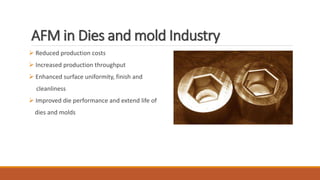
AFM in Dies and mold Industry
 Reduced production costs
 Increased production throughput
 Enhanced surface uniformity, finish and
cleanliness
 Improved die performance and extend life of
dies and molds
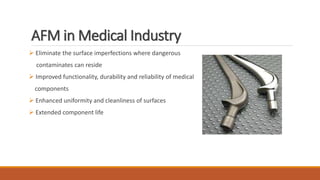
AFM in Medical Industry
 Eliminate the surface imperfections where dangerous
contaminates can reside
 Improved functionality, durability and reliability of medical
components
 Enhanced uniformity and cleanliness of surfaces
 Extended component life
Process limitations
 Geometries such as blind holes remain difficult to be finished effectively by AFM.
 AFM’s media are also governed by the fluid flow properties, leading to difficulty in exerting
uniform finishing forces on complex internal surfaces.
 Preferential flow over more restricted areas results in non-uniform finishes.
 Furthermore, abrasive particle embedment onto the workpiece surface had been reported by
various researchers, thereby raising contamination issues. This could be undesirable in parts
where high material purity of the component is required.
Summary of AFM
 Possible to control and select the intensity and location of abrasion
 Produces uniform, repeatable and predictable results on an impressive range of finishing operations.
 Maintain flexibility and jobs which require hours of highly skilled hand polishing can be processed in a
few minutes
 Process used in aerospace, medical and automobile industries
 Better surface roughness values and tight tolerances.
 Disadvantage of this process is low finishing rate
 Better performance is achieved if the process is monitored online.
 Improve surface quality
 Reduction in Friction
 Eliminate imperfection
Magnetic Abrasive
Finishing (MAF)
Introduction to Magnetic Abrasive
Finishing (MAF)
Various industrial applications require very high surface finish up
to the range of nanometers or even above.
Presently, it is required that the parts, used in manufacturing
semiconductors, atomic energy parts, medical instruments and
aerospace applications, have a very fine surface roughness.
 Amongst them, vacuum tubes, wave-guides and sanitary tubes
are difficult to be polished by conventional finishing methods such
as lapping, because of their shapes.
 The technology for super finishing needs ultra clean machining
of advanced engineering materials such as silicon nitride, silicon
carbide, and aluminum oxide which are used in high- technology
industries and are difficult to finish by conventional grinding and
polishing techniques with high accuracy, and minimal surface
defects, such as micro cracks.
Therefore, magnetic abrasive finishing (MAF) process has been recently developed for efficient
and precision finishing of internal and flat surfaces.
This process can produce surface finish of the order of few nanometers.
 In addition, MAF possesses many attractive advantages, such as self-sharpening, self-
adaptability, controllability, and the finishing tool requires neither compensation nor dressing.
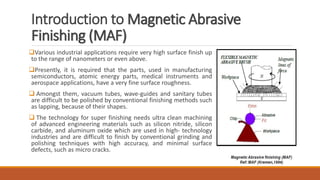
Magnetic abrasive finishing (MAF) is a high-precision nontraditional finishing process in
which the finishing forces are controlled by a magnetic field. Magnetic abrasive particles
supplied to a work piece are influenced by magnetic poles, thus forming a flexible magnetic
abrasive brush.
Process description and principle
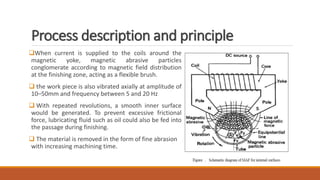
When current is supplied to the coils around the
magnetic yoke, magnetic abrasive particles
conglomerate according to magnetic field distribution
at the finishing zone, acting as a flexible brush.
 the work piece is also vibrated axially at amplitude of
10–50mm and frequency between 5 and 20 Hz
 With repeated revolutions, a smooth inner surface
would be generated. To prevent excessive frictional
force, lubricating fluid such as oil could also be fed into
the passage during finishing.
 The material is removed in the form of fine abrasion
with increasing machining time.
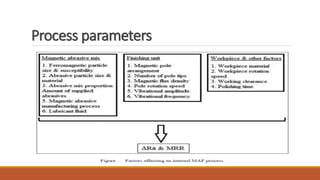
Process parameters
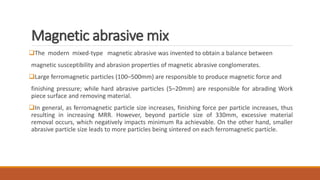
Magnetic abrasive mix
The modern mixed-type magnetic abrasive was invented to obtain a balance between
magnetic susceptibility and abrasion properties of magnetic abrasive conglomerates.
Large ferromagnetic particles (100–500mm) are responsible to produce magnetic force and
finishing pressure; while hard abrasive particles (5–20mm) are responsible for abrading Work
piece surface and removing material.
In general, as ferromagnetic particle size increases, finishing force per particle increases, thus
resulting in increasing MRR. However, beyond particle size of 330mm, excessive material
removal occurs, which negatively impacts minimum Ra achievable. On the other hand, smaller
abrasive particle size leads to more particles being sintered on each ferromagnetic particle.
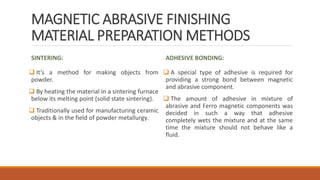
MAGNETIC ABRASIVE FINISHING
MATERIAL PREPARATION METHODS
SINTERING:
 It’s a method for making objects from
powder.
 By heating the material in a sintering furnace
below its melting point (solid state sintering).
 Traditionally used for manufacturing ceramic
objects & in the field of powder metallurgy.
ADHESIVE BONDING:
 A special type of adhesive is required for
providing a strong bond between magnetic
and abrasive component.
 The amount of adhesive in mixture of
abrasive and Ferro magnetic components was
decided in such a way that adhesive
completely wets the mixture and at the same
time the mixture should not behave like a
fluid.
Types of Magnetic Abrasive Finishing
 MAF with permanent magnet
 MAF with Direct Current
 MAF with Alternating Current
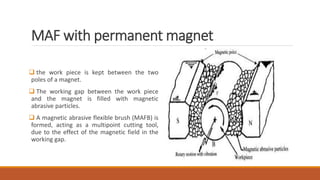
MAF with permanent magnet
 the work piece is kept between the two
poles of a magnet.
 The working gap between the work piece
and the magnet is filled with magnetic
abrasive particles.
 A magnetic abrasive flexible brush (MAFB) is
formed, acting as a multipoint cutting tool,
due to the effect of the magnetic field in the
working gap.
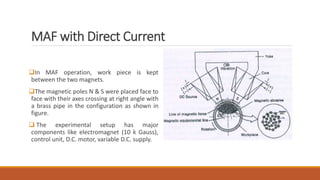
MAF with Direct Current
In MAF operation, work piece is kept
between the two magnets.
The magnetic poles N & S were placed face to
face with their axes crossing at right angle with
a brass pipe in the configuration as shown in
figure.
 The experimental setup has major
components like electromagnet (10 k Gauss),
control unit, D.C. motor, variable D.C. supply.
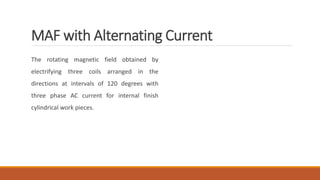
MAF with Alternating Current
The rotating magnetic field obtained by
electrifying three coils arranged in the
directions at intervals of 120 degrees with
three phase AC current for internal finish
cylindrical work pieces.
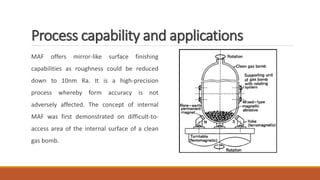
Process capability and applications
MAF offers mirror-like surface finishing
capabilities as roughness could be reduced
down to 10nm Ra. It is a high-precision
process whereby form accuracy is not
adversely affected. The concept of internal
MAF was first demonstrated on difficult-to-
access area of the internal surface of a clean
gas bomb.
Study on Magnetic Abrasive Finishing Process
using Low - Frequency Alternating Magnetic Field
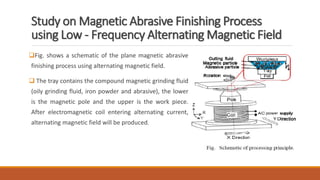
Fig. shows a schematic of the plane magnetic abrasive
finishing process using alternating magnetic field.
 The tray contains the compound magnetic grinding fluid
(oily grinding fluid, iron powder and abrasive), the lower
is the magnetic pole and the upper is the work piece.
After electromagnetic coil entering alternating current,
alternating magnetic field will be produced.
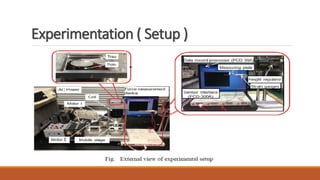
Experimentation ( Setup )
Experimentation ( Condition )
Experimental conditions
Work piece SUS304 stainless steel plate with the size of
80mm×90mm×1mm
Finishing time 60 min
Abrasive Al₂O₃, 0-1[μm] in mean dia: 0.3[g]
Cutting fluid Neat cutting oil (Honilo 988): 0.8[ml]
Feed speed of mobile stage 260 [mm/min]
Rotational speed of magnetic pole 350 [r/min]
Magnetic field Type 1:Direct magnetic field: 1.9[A].
Type 2:Alternating magnetic field: 1.9[A]
Current frequency :3[Hz]
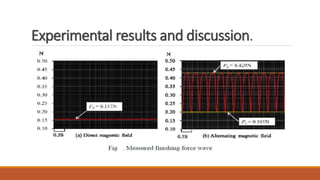
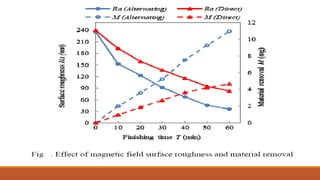
Experimental results and discussion.
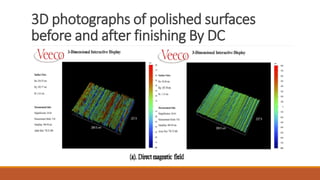
3D photographs of polished surfaces
before and after finishing By DC
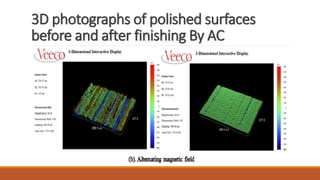
3D photographs of polished surfaces
before and after finishing By AC
Experimental Conclusion
I. In the case of using this experimental setup MAF process using low frequency alternating
magnetic field may obtain a smoother and more uniform finished surface than that of direct
magnetic field.
II. Based on analysis of the mechanism of increasing material removal on MAF process using
alternating magnetic field, we can calculate that material removal in alternating magnetic
field is approximately 2.05 times than that of direct magnetic field in this experimental
setup, and the results of prediction and calculation are verified by finishing experiments
Advantages & Applications of MAF
ADVANTAGES
I. Minimizes the micro-cracks and surface
damage of work piece.
II. MAF is able to produce surface roughness of
nanometer range with hardly any surface
defects .
III. The flexible magnetic abrasive brush (tool)
requires neither compensation nor dressing.
APPLICATIONS
I. Non -ferromagnetic materials like stainless
steel, brass and aluminum.
II. Ferromagnetic materials like steels.
III. Finishing of bearing.
IV. Aerospace components.
V. Electronics components with micro meter
or sub micrometer ranges.
Process limitations
Despite the promise of producing mirror-like surface, MAF’s biggest limitation lies in the
restriction on the materials that are suitable to be processed. Surface finishing is negligible on
ferromagnetic materials such as nickel and cobalt alloy. This is due to the work piece being
magnetized in the presence of magnetic field, thus attracting magnetic abrasive particles to it
strongly. So no any relative motion between magnetic abrasive particles and work piece surface.
Complicated internal features such as fins and protuberances would render MAF inefficient as
magnetic abrasive particles are unable to navigate around these features. However, these
limitations could be stretched by further research effort. More experimental studies are needed
to extend understanding and fully realize the potential of this finishing process.
Concluding remarks
MAF for internal surfaces is a process with vast potential. Finishing force can be controlled
locally by altering the external magnetic field distribution. This is not achievable on AFM and
FBM as local flow manipulation is not possible. With very fine surface finish produced and its
capability on very small channels, MAF could find applications in precision finishing of most
internal passages.
Magneto-Rheological
Abrasive Finishing
Introduction to Magneto-Rheological
Abrasive Finishing
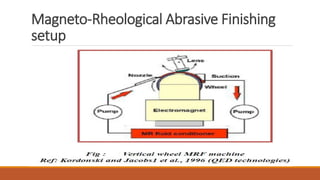
In magneto-rheological abrasive finishing abrasive mixed with magneto-rheological (MR) fluid is
used. Kordonski and Jacobs (1996) developed a setup in which magnetically stiffened magneto-
rheological fluid mixed with abrasives is made to flow over a moving flat rigid wall and the
polishing happens at a converging gap formed by the surface to be finished and a moving wall.
Now it finds an interesting industrial application in polishing of optical lenses.
Introducing the abrasive mixed MR fluid, the relative motions between the work piece and
abrasive medium are imparted in different ways; using reciprocation, rotation or combination of
both.
Magneto-Rheological Abrasive Finishing
setup
History of MR Fluid
Magnetorheological (MR) fluids, invented by Rabinow in late 1940s, belong to a class of smart
controllable materials whose rheological behavior can be manipulated externally by the application of
some energy fields . These applications include shock absorbers, damping devices, clutches, brakes,
actuators, and artificial joints.
MR fluid works as polishing tool.
MRF uses MR fluid which is invented by Rabinow in late 1940s consist of
 CIP (Magnetic)
 Abrasive Particle (Non-magnetic)
 carrier liquid (Oil or water)
 additives (glycerol,grease)
Application & Limitation
APPLICATION
 MRF has been used for finishing a large
variety of brittle material ranging from optical
glasses to hard crystals.
LIMITATION
 Internal and specially complex surfaces can’t
be finished.
Magnetorheological abrasive flow
finishing process (MRAFF)
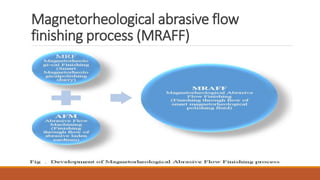
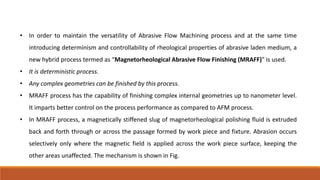
• In order to maintain the versatility of Abrasive Flow Machining process and at the same time
introducing determinism and controllability of rheological properties of abrasive laden medium, a
new hybrid process termed as “Magnetorheological Abrasive Flow Finishing (MRAFF)” is used.
• It is deterministic process.
• Any complex geometries can be finished by this process.
• MRAFF process has the capability of finishing complex internal geometries up to nanometer level.
It imparts better control on the process performance as compared to AFM process.
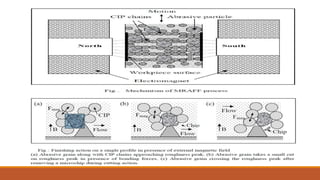
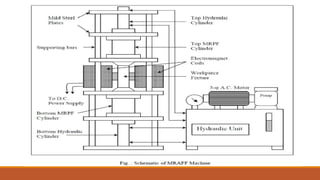
• In MRAFF process, a magnetically stiffened slug of magnetorheological polishing fluid is extruded
back and forth through or across the passage formed by work piece and fixture. Abrasion occurs
selectively only where the magnetic field is applied across the work piece surface, keeping the
other areas unaffected. The mechanism is shown in Fig.
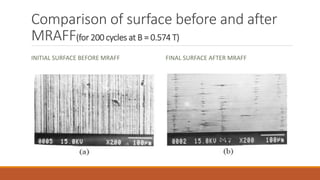
Comparison of surface before and after
MRAFF(for 200 cycles at B = 0.574 T)
INITIAL SURFACE BEFORE MRAFF FINAL SURFACE AFTER MRAFF
Reference
[1] Abrasive flow machining (AFM): An Overview by M. Ravi Sankar, V. K. Jain*, J. Ramkumar.
[2] Nontraditional finishing processes for internal surfaces and passages: A review by Kai Liang
Tan, Swee-Hock Yeo and Chin Hwee Ong.
[3] Magnetic abrasive finishing by Vishwanath Patil and Prof. Jaydeep Ashtekar.
[4] Magnetic field assisted abrasive based micro-/Nano-finishing by V.K. Jain.
[5] Magnetorheological Finishing: A Review by K.Saraswathamma.
[6] Nano-Finishing Techniques by Sunil Jha and V. K. Jain.
Reference
[7] T. Shinmura, K. Takazawa, E. Hatano, T. Aizawa: Bull. Jpn. Soc. Precis. Eng Vol.19(1) (1985), p.54-55.
[8] Y. Zou: J. Jpn. Soc. Abras. Technol Vol. 56 (2) (2012), p. 86-89 (in Japanese).
[9] Y. Zou, T. Shinmura: J. Jpn. Soc. Abras. Technol Vol. 53(2009), p.31-34 (in Japanese).
[10] J.Z. Wu, Y. Zou: Appl. Mech. Mater Vol. 395-396 (2013), p.985-989.
[11] J.Z. Wu, Y. Zou, H. Sugiyama: J. Magnet. Magnet. Mater Vol. 386 (2015), p.50-59.
[12] J.Z. Wu, Y. Zou, H. Sugiyama: Int. J. Adv. Manuf. Technol (2015), DOI 10.1007/s 00170-015-7962-9.
[13] M. Natsume, T. Shinmura: Trans. Jpn. Soc. Mech. Eng Vol 74 (737) (2008), p.212-
218 (in Japanese).
[14] H. Matsuo: Fourier transform for engineering, Morikita Publishing limited company
(2004), p.20-22.124
Thank you

Advanced fine finishing process

  • 1.
    By Gulamhushen Sipai (710807 ) Sandip K Gadhiya ( 710816 ) Prof. Dr. Komal G. Dave Mechanical Engineering Dept. L D College of Engineering, Ahmedabad. Gujarat Technological University, Ahmedabad.
  • 2.
    ADVANCED FINE FINISHING PROCESS ABRASIVE FLOW MACHINING(AFM)  MAGNETIC ABRASIVE FINISHING (MAF)  MAGNETO RHEOLOGICAL ABRASIVE FINISHING
  • 3.
  • 4.
    Introduction to AFM Abrasive flow machining (AFM) was developed by Extrude Hone Corporation, USA in 1960. AFM is used to deburr, radius and polish difficult to reach surfaces by extruding an abrasive laden polymer medium with very special rheological properties. It is widely used finishing process to finish complicated shapes and profiles. The polymer abrasive medium which is used in this process, possesses easy flow ability, better self deformability and fine abrading capability. Layer thickness of the material removed is of the order of about 1 to 10 μm. Best surface finish that has been achieved is 50 nm and tolerances are +/- 0.5 μm.
  • 5.
    Process description andPrinciple Fig. 1.1 Principle of material removal mechanism in two way AFM process.
  • 6.
    Fig. 1.2 Schematicdiagram of the action of Single active abrasive grain.
  • 7.
    Classification AFM machine There are three types of AFM machines that have been reported in the literature: 1) One way AFM, 2) Two way AFM and 3) Orbital AFM. Commonly used AFM is Two-way AFM in which two vertically opposed cylinders extrude medium back and forth through passages formed by the workpiece and tooling.
  • 8.
    One way AFMprocess  One-way flow AFM processing pushes abrasive media through the work piece in only one direction, allowing the media to exit freely from the part. Fig.1.3 Unidirectional AFM process
  • 9.
    The advantages ofOne Way AFM  Faster cycle processing  Easy clean-up  Media temperature control generally not required  Able to process larger parts  Simpler tooling and part change-over  Accurately replicates air or liquids natural flow  Does not encapsulate workpart in media
  • 10.
    Two way AFMprocess  Two way AFM machine has two hydraulic cylinders and two medium cylinders. The medium is extruded, hydraulically or mechanically, from the filled chamber to the empty chamber via the restricted passageway through or past the workpiece surface to be abraded (Fig.1.1).  Typically, the medium is extruded back and forth between the chambers for the desired fixed number of cycles. Counter bores, recessed areas and even blind cavities can be finished by using restrictors or mandrels to direct the medium flow along the surfaces to be finished.
  • 11.
    Advantages of Two-WayAFM  Excellent process control  Can finish both ID and OD of component  Good control of radius generation  Fully automated system capabilities  Faster setup & quick-change tooling Faster change-over of media
  • 12.
    Orbital AFM process Surface and edge finishing are achieved rapid, low-amplitude, oscillations of the work piece relative to a self-forming elastic plastic abrasive polishing tool. The tool is a pad or layer of abrasive-laden elastic plastic medium (similar to that used in two way abrasive flow finishing), but typically higher in viscosity and more in elastic.
  • 13.
    Fig.1.4 Orbital AFMbefore start of finishing.
  • 14.
    Fig.1.5 Orbital AFMwhile finishing
  • 15.
    Mechanism of materialremoval  Two modes of abrasive wear, micro-ploughing and micro-cutting, have been identified as the mechanisms of removal in AFM.  In micro-ploughing, surface peaks are smeared and plastically deformed, resulting in ‘‘leveling out’’ of surface asperities. No volume loss takes place in this mode of removal. Ridges are also formed adjacent to the grooves created by abrasive particles’ sliding path.  On the other hand, in micro-cutting, abrasive particles act as single-point cutting tools, indenting and removing material in the form of microchips.  In both forms of abrasive wear, scratches are characterized by continuous scratches.
  • 16.
    Classification of majorAFM research areas
  • 17.
    Process Input Parametersof AFM  Extrusion Pressure  Number of cycles  Grit composition and Type  Tooling  Fixture design
  • 18.
    Operating range ofAFM  Easy flowability  Better self deformability  Fine abrading capability  Layer thickness of material removed is, order of about 1μm to 10 μm  Best surface finish that has been achived as 50nm and tolerances +/- 0,5 μm
  • 19.
    Properties of AFM Deburring , radiusing, and polishing are performed simultaneously in a single operation  AFM can produce true round radii even on complex edges  Reduces surface roughness by 75 to 90 % on cast and machined surfaces  AFM can process dozens of holes or multiple passages parts simultaneously with uniform results
  • 20.
    Monitoring of AFMprocess For online monitoring of material removal and surface roughness in AFM process, Williams and Rajurkar applied acoustic emission technique. They developed a stochastic model of AFM generated surfaces by using Data Dependent Systems (DDS) methodology. It was established in their research that AFM finished surface profiles possess two distinct wavelengths, a large wavelength that corresponds to the main path of abrasive while the small wavelength is associated with the cutting edges.
  • 21.
    CONT. AFM machining andmonitoring system (a) AFM machining and monitoring setup; (b) schematic of the process monitoring system.
  • 22.
    Application of AFM Automotive  Aerospace  Medicine  Dies and Moulds Fig. 1.7 Surface finish improvement before and after on (a) internal passages within turbine engine diffuser (b) Medical implants (c) complex automotive engine parts.
  • 23.
    AFM in AerospaceIndustry  Improved surface quality  Enhanced high cycle fatigue strength  Optimized combustion and hydraulics  Increased airflow  Extended component life
  • 24.
    AFM in AutomotiveIndustry  Enhanced uniformity and surface quality of finished components  Increased engine performance  Increased flow velocity and volume  Improved fuel economy and reduced emissions  Extended work piece life by reducing wear and stress surfaces Fig. : Polishing and blending the internal surfaces Figure : Grains in the same direction to increase flow rates.
  • 25.
    AFM in Diesand mold Industry  Reduced production costs  Increased production throughput  Enhanced surface uniformity, finish and cleanliness  Improved die performance and extend life of dies and molds
  • 26.
    AFM in MedicalIndustry  Eliminate the surface imperfections where dangerous contaminates can reside  Improved functionality, durability and reliability of medical components  Enhanced uniformity and cleanliness of surfaces  Extended component life
  • 27.
    Process limitations  Geometriessuch as blind holes remain difficult to be finished effectively by AFM.  AFM’s media are also governed by the fluid flow properties, leading to difficulty in exerting uniform finishing forces on complex internal surfaces.  Preferential flow over more restricted areas results in non-uniform finishes.  Furthermore, abrasive particle embedment onto the workpiece surface had been reported by various researchers, thereby raising contamination issues. This could be undesirable in parts where high material purity of the component is required.
  • 28.
    Summary of AFM Possible to control and select the intensity and location of abrasion  Produces uniform, repeatable and predictable results on an impressive range of finishing operations.  Maintain flexibility and jobs which require hours of highly skilled hand polishing can be processed in a few minutes  Process used in aerospace, medical and automobile industries  Better surface roughness values and tight tolerances.  Disadvantage of this process is low finishing rate  Better performance is achieved if the process is monitored online.  Improve surface quality  Reduction in Friction  Eliminate imperfection
  • 29.
  • 30.
    Introduction to MagneticAbrasive Finishing (MAF) Various industrial applications require very high surface finish up to the range of nanometers or even above. Presently, it is required that the parts, used in manufacturing semiconductors, atomic energy parts, medical instruments and aerospace applications, have a very fine surface roughness.  Amongst them, vacuum tubes, wave-guides and sanitary tubes are difficult to be polished by conventional finishing methods such as lapping, because of their shapes.  The technology for super finishing needs ultra clean machining of advanced engineering materials such as silicon nitride, silicon carbide, and aluminum oxide which are used in high- technology industries and are difficult to finish by conventional grinding and polishing techniques with high accuracy, and minimal surface defects, such as micro cracks.
  • 31.
    Therefore, magnetic abrasivefinishing (MAF) process has been recently developed for efficient and precision finishing of internal and flat surfaces. This process can produce surface finish of the order of few nanometers.  In addition, MAF possesses many attractive advantages, such as self-sharpening, self- adaptability, controllability, and the finishing tool requires neither compensation nor dressing. Magnetic abrasive finishing (MAF) is a high-precision nontraditional finishing process in which the finishing forces are controlled by a magnetic field. Magnetic abrasive particles supplied to a work piece are influenced by magnetic poles, thus forming a flexible magnetic abrasive brush.
  • 32.
    Process description andprinciple When current is supplied to the coils around the magnetic yoke, magnetic abrasive particles conglomerate according to magnetic field distribution at the finishing zone, acting as a flexible brush.  the work piece is also vibrated axially at amplitude of 10–50mm and frequency between 5 and 20 Hz  With repeated revolutions, a smooth inner surface would be generated. To prevent excessive frictional force, lubricating fluid such as oil could also be fed into the passage during finishing.  The material is removed in the form of fine abrasion with increasing machining time.
  • 33.
  • 34.
    Magnetic abrasive mix Themodern mixed-type magnetic abrasive was invented to obtain a balance between magnetic susceptibility and abrasion properties of magnetic abrasive conglomerates. Large ferromagnetic particles (100–500mm) are responsible to produce magnetic force and finishing pressure; while hard abrasive particles (5–20mm) are responsible for abrading Work piece surface and removing material. In general, as ferromagnetic particle size increases, finishing force per particle increases, thus resulting in increasing MRR. However, beyond particle size of 330mm, excessive material removal occurs, which negatively impacts minimum Ra achievable. On the other hand, smaller abrasive particle size leads to more particles being sintered on each ferromagnetic particle.
  • 35.
    MAGNETIC ABRASIVE FINISHING MATERIALPREPARATION METHODS SINTERING:  It’s a method for making objects from powder.  By heating the material in a sintering furnace below its melting point (solid state sintering).  Traditionally used for manufacturing ceramic objects & in the field of powder metallurgy. ADHESIVE BONDING:  A special type of adhesive is required for providing a strong bond between magnetic and abrasive component.  The amount of adhesive in mixture of abrasive and Ferro magnetic components was decided in such a way that adhesive completely wets the mixture and at the same time the mixture should not behave like a fluid.
  • 36.
    Types of MagneticAbrasive Finishing  MAF with permanent magnet  MAF with Direct Current  MAF with Alternating Current
  • 37.
    MAF with permanentmagnet  the work piece is kept between the two poles of a magnet.  The working gap between the work piece and the magnet is filled with magnetic abrasive particles.  A magnetic abrasive flexible brush (MAFB) is formed, acting as a multipoint cutting tool, due to the effect of the magnetic field in the working gap.
  • 38.
    MAF with DirectCurrent In MAF operation, work piece is kept between the two magnets. The magnetic poles N & S were placed face to face with their axes crossing at right angle with a brass pipe in the configuration as shown in figure.  The experimental setup has major components like electromagnet (10 k Gauss), control unit, D.C. motor, variable D.C. supply.
  • 39.
    MAF with AlternatingCurrent The rotating magnetic field obtained by electrifying three coils arranged in the directions at intervals of 120 degrees with three phase AC current for internal finish cylindrical work pieces.
  • 40.
    Process capability andapplications MAF offers mirror-like surface finishing capabilities as roughness could be reduced down to 10nm Ra. It is a high-precision process whereby form accuracy is not adversely affected. The concept of internal MAF was first demonstrated on difficult-to- access area of the internal surface of a clean gas bomb.
  • 41.
    Study on MagneticAbrasive Finishing Process using Low - Frequency Alternating Magnetic Field Fig. shows a schematic of the plane magnetic abrasive finishing process using alternating magnetic field.  The tray contains the compound magnetic grinding fluid (oily grinding fluid, iron powder and abrasive), the lower is the magnetic pole and the upper is the work piece. After electromagnetic coil entering alternating current, alternating magnetic field will be produced.
  • 42.
  • 43.
    Experimentation ( Condition) Experimental conditions Work piece SUS304 stainless steel plate with the size of 80mm×90mm×1mm Finishing time 60 min Abrasive Al₂O₃, 0-1[μm] in mean dia: 0.3[g] Cutting fluid Neat cutting oil (Honilo 988): 0.8[ml] Feed speed of mobile stage 260 [mm/min] Rotational speed of magnetic pole 350 [r/min] Magnetic field Type 1:Direct magnetic field: 1.9[A]. Type 2:Alternating magnetic field: 1.9[A] Current frequency :3[Hz]
  • 44.
  • 46.
    3D photographs ofpolished surfaces before and after finishing By DC
  • 47.
    3D photographs ofpolished surfaces before and after finishing By AC
  • 48.
    Experimental Conclusion I. Inthe case of using this experimental setup MAF process using low frequency alternating magnetic field may obtain a smoother and more uniform finished surface than that of direct magnetic field. II. Based on analysis of the mechanism of increasing material removal on MAF process using alternating magnetic field, we can calculate that material removal in alternating magnetic field is approximately 2.05 times than that of direct magnetic field in this experimental setup, and the results of prediction and calculation are verified by finishing experiments
  • 49.
    Advantages & Applicationsof MAF ADVANTAGES I. Minimizes the micro-cracks and surface damage of work piece. II. MAF is able to produce surface roughness of nanometer range with hardly any surface defects . III. The flexible magnetic abrasive brush (tool) requires neither compensation nor dressing. APPLICATIONS I. Non -ferromagnetic materials like stainless steel, brass and aluminum. II. Ferromagnetic materials like steels. III. Finishing of bearing. IV. Aerospace components. V. Electronics components with micro meter or sub micrometer ranges.
  • 50.
    Process limitations Despite thepromise of producing mirror-like surface, MAF’s biggest limitation lies in the restriction on the materials that are suitable to be processed. Surface finishing is negligible on ferromagnetic materials such as nickel and cobalt alloy. This is due to the work piece being magnetized in the presence of magnetic field, thus attracting magnetic abrasive particles to it strongly. So no any relative motion between magnetic abrasive particles and work piece surface. Complicated internal features such as fins and protuberances would render MAF inefficient as magnetic abrasive particles are unable to navigate around these features. However, these limitations could be stretched by further research effort. More experimental studies are needed to extend understanding and fully realize the potential of this finishing process.
  • 51.
    Concluding remarks MAF forinternal surfaces is a process with vast potential. Finishing force can be controlled locally by altering the external magnetic field distribution. This is not achievable on AFM and FBM as local flow manipulation is not possible. With very fine surface finish produced and its capability on very small channels, MAF could find applications in precision finishing of most internal passages.
  • 52.
  • 53.
    Introduction to Magneto-Rheological AbrasiveFinishing In magneto-rheological abrasive finishing abrasive mixed with magneto-rheological (MR) fluid is used. Kordonski and Jacobs (1996) developed a setup in which magnetically stiffened magneto- rheological fluid mixed with abrasives is made to flow over a moving flat rigid wall and the polishing happens at a converging gap formed by the surface to be finished and a moving wall. Now it finds an interesting industrial application in polishing of optical lenses. Introducing the abrasive mixed MR fluid, the relative motions between the work piece and abrasive medium are imparted in different ways; using reciprocation, rotation or combination of both.
  • 54.
  • 55.
    History of MRFluid Magnetorheological (MR) fluids, invented by Rabinow in late 1940s, belong to a class of smart controllable materials whose rheological behavior can be manipulated externally by the application of some energy fields . These applications include shock absorbers, damping devices, clutches, brakes, actuators, and artificial joints. MR fluid works as polishing tool. MRF uses MR fluid which is invented by Rabinow in late 1940s consist of  CIP (Magnetic)  Abrasive Particle (Non-magnetic)  carrier liquid (Oil or water)  additives (glycerol,grease)
  • 56.
    Application & Limitation APPLICATION MRF has been used for finishing a large variety of brittle material ranging from optical glasses to hard crystals. LIMITATION  Internal and specially complex surfaces can’t be finished.
  • 57.
  • 58.
    • In orderto maintain the versatility of Abrasive Flow Machining process and at the same time introducing determinism and controllability of rheological properties of abrasive laden medium, a new hybrid process termed as “Magnetorheological Abrasive Flow Finishing (MRAFF)” is used. • It is deterministic process. • Any complex geometries can be finished by this process. • MRAFF process has the capability of finishing complex internal geometries up to nanometer level. It imparts better control on the process performance as compared to AFM process. • In MRAFF process, a magnetically stiffened slug of magnetorheological polishing fluid is extruded back and forth through or across the passage formed by work piece and fixture. Abrasion occurs selectively only where the magnetic field is applied across the work piece surface, keeping the other areas unaffected. The mechanism is shown in Fig.
  • 61.
    Comparison of surfacebefore and after MRAFF(for 200 cycles at B = 0.574 T) INITIAL SURFACE BEFORE MRAFF FINAL SURFACE AFTER MRAFF
  • 62.
    Reference [1] Abrasive flowmachining (AFM): An Overview by M. Ravi Sankar, V. K. Jain*, J. Ramkumar. [2] Nontraditional finishing processes for internal surfaces and passages: A review by Kai Liang Tan, Swee-Hock Yeo and Chin Hwee Ong. [3] Magnetic abrasive finishing by Vishwanath Patil and Prof. Jaydeep Ashtekar. [4] Magnetic field assisted abrasive based micro-/Nano-finishing by V.K. Jain. [5] Magnetorheological Finishing: A Review by K.Saraswathamma. [6] Nano-Finishing Techniques by Sunil Jha and V. K. Jain.
  • 63.
    Reference [7] T. Shinmura,K. Takazawa, E. Hatano, T. Aizawa: Bull. Jpn. Soc. Precis. Eng Vol.19(1) (1985), p.54-55. [8] Y. Zou: J. Jpn. Soc. Abras. Technol Vol. 56 (2) (2012), p. 86-89 (in Japanese). [9] Y. Zou, T. Shinmura: J. Jpn. Soc. Abras. Technol Vol. 53(2009), p.31-34 (in Japanese). [10] J.Z. Wu, Y. Zou: Appl. Mech. Mater Vol. 395-396 (2013), p.985-989. [11] J.Z. Wu, Y. Zou, H. Sugiyama: J. Magnet. Magnet. Mater Vol. 386 (2015), p.50-59. [12] J.Z. Wu, Y. Zou, H. Sugiyama: Int. J. Adv. Manuf. Technol (2015), DOI 10.1007/s 00170-015-7962-9. [13] M. Natsume, T. Shinmura: Trans. Jpn. Soc. Mech. Eng Vol 74 (737) (2008), p.212- 218 (in Japanese). [14] H. Matsuo: Fourier transform for engineering, Morikita Publishing limited company (2004), p.20-22.124
  • 64.