Abrasive Finishing Processes
(AFM, MAF)
Abrasive finishing processes
• The need for high accuracy and efficiency
machining of difficult- to- machine materials is
making the application of abrasive finishing
technology.
Advantages
• Because of extremely thin chips produced in
abrasive machining, it allows:
• Better surface finish
• Close tolerances
• Generation of more intricate surface
features. &
• Machining of harder and difficult to machine
materials.
Abrasive finishing processes
• The two important abrasive finishing
processes are:
1. Abrasive Flow Machining
2. Magnetic Abrasive finishing
1. Abrasive Flow Finishing
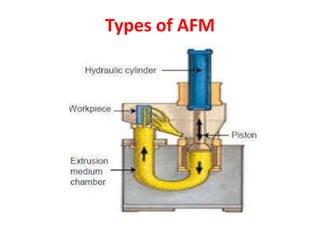
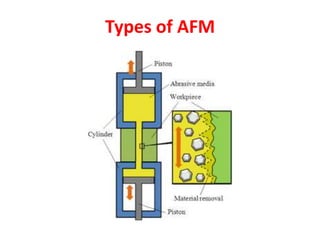
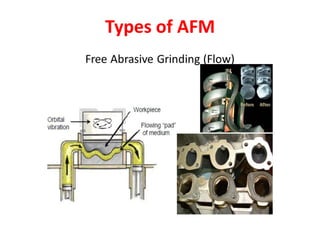
• AFM is a kind of finishing process in which a small
quantity of material is removed by flowing a
semisolid abrasive laden putty over the surface to be
finished.
• The media has high viscosity that it can be held
between fingers like a rubber ball which can be
deformed by applying little pressure.
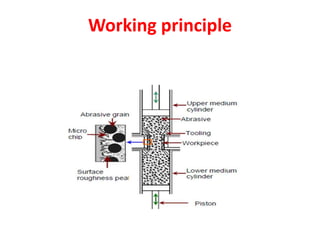
• Two vertically opposed cylinders extrude abrasive
media back & forth through passages formed by w/p
& tooling or by w/p alone.
Working principle
Advantages
• This process is good for operations like
deburring, radiusing, polishing & removing
recast layer etc.,
• The process can produce tens of parts at the
same time to enhance productivity.
• Same machine can be use to do a variety of
jobs by changing tooling, machining
parameters, media and abrasives.
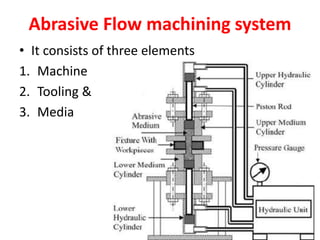
Abrasive Flow machining system
• It consists of three elements
1. Machine
2. Tooling &
3. Media
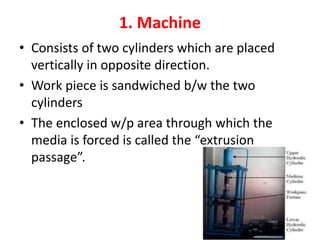
1. Machine
• Consists of two cylinders which are placed
vertically in opposite direction.
• Work piece is sandwiched b/w the two
cylinders
• The enclosed w/p area through which the
media is forced is called the “extrusion
passage”.
2. Tooling
• Which is used to confine and direct the flow of
media to the appropriate areas.
• Tooling for AFM machine is designed with two
aims:
1. To hold the parts in position &
2. To contain the media and direct its flow.
• Internal surfaces
• External surfaces.
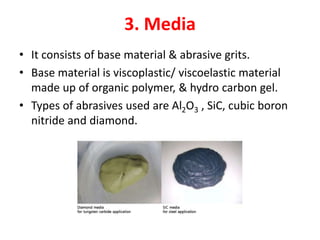
3. Media
• It consists of base material & abrasive grits.
• Base material is viscoplastic/ viscoelastic material
made up of organic polymer, & hydro carbon gel.
• Types of abrasives used are Al2O3 , SiC, cubic boron
nitride and diamond.
Types of AFM
Types of AFM
Types of AFM
Applications
Magnetic Abrasive Finishing Process
• Initially MAF process was developed by US.
• Japanese researches followed this work and
conducted research for fine polishing
applications.
• Finishing of rod and finishing of flat surfaces
can de done.
• Granular magnetic abrasives composed of
ferromagnetic material (iron particles) and
abrasive grains (Al2O3 , SiC or diamond).
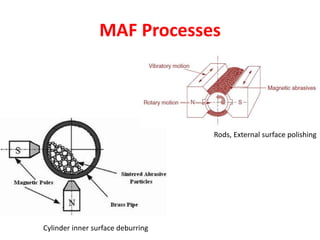
MAF Processes
Rods, External surface polishing
Cylinder inner surface deburring
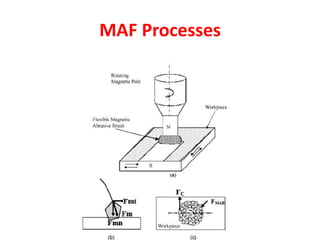
MAF Processes
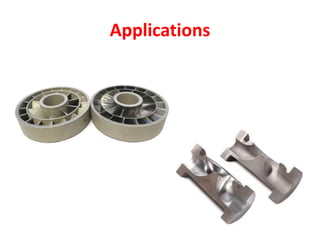
Applications
• Finishing air foil surfaces of impellers &
extrusion dies
• Nozzle of torch flame etc.

AFP.pptx

  • 1.
  • 2.
    Abrasive finishing processes •The need for high accuracy and efficiency machining of difficult- to- machine materials is making the application of abrasive finishing technology.
  • 3.
    Advantages • Because ofextremely thin chips produced in abrasive machining, it allows: • Better surface finish • Close tolerances • Generation of more intricate surface features. & • Machining of harder and difficult to machine materials.
  • 4.
    Abrasive finishing processes •The two important abrasive finishing processes are: 1. Abrasive Flow Machining 2. Magnetic Abrasive finishing
  • 5.
    1. Abrasive FlowFinishing • AFM is a kind of finishing process in which a small quantity of material is removed by flowing a semisolid abrasive laden putty over the surface to be finished. • The media has high viscosity that it can be held between fingers like a rubber ball which can be deformed by applying little pressure. • Two vertically opposed cylinders extrude abrasive media back & forth through passages formed by w/p & tooling or by w/p alone.
  • 6.
  • 7.
    Advantages • This processis good for operations like deburring, radiusing, polishing & removing recast layer etc., • The process can produce tens of parts at the same time to enhance productivity. • Same machine can be use to do a variety of jobs by changing tooling, machining parameters, media and abrasives.
  • 8.
    Abrasive Flow machiningsystem • It consists of three elements 1. Machine 2. Tooling & 3. Media
  • 9.
    1. Machine • Consistsof two cylinders which are placed vertically in opposite direction. • Work piece is sandwiched b/w the two cylinders • The enclosed w/p area through which the media is forced is called the “extrusion passage”.
  • 10.
    2. Tooling • Whichis used to confine and direct the flow of media to the appropriate areas. • Tooling for AFM machine is designed with two aims: 1. To hold the parts in position & 2. To contain the media and direct its flow. • Internal surfaces • External surfaces.
  • 11.
    3. Media • Itconsists of base material & abrasive grits. • Base material is viscoplastic/ viscoelastic material made up of organic polymer, & hydro carbon gel. • Types of abrasives used are Al2O3 , SiC, cubic boron nitride and diamond.
  • 12.
  • 13.
  • 14.
  • 15.
  • 16.
    Magnetic Abrasive FinishingProcess • Initially MAF process was developed by US. • Japanese researches followed this work and conducted research for fine polishing applications. • Finishing of rod and finishing of flat surfaces can de done. • Granular magnetic abrasives composed of ferromagnetic material (iron particles) and abrasive grains (Al2O3 , SiC or diamond).
  • 17.
    MAF Processes Rods, Externalsurface polishing Cylinder inner surface deburring
  • 18.
  • 19.
    Applications • Finishing airfoil surfaces of impellers & extrusion dies • Nozzle of torch flame etc.