MICROMACHINING
• MRF,MRAFF Processes,
Diamond turning,
• MRP Fluid
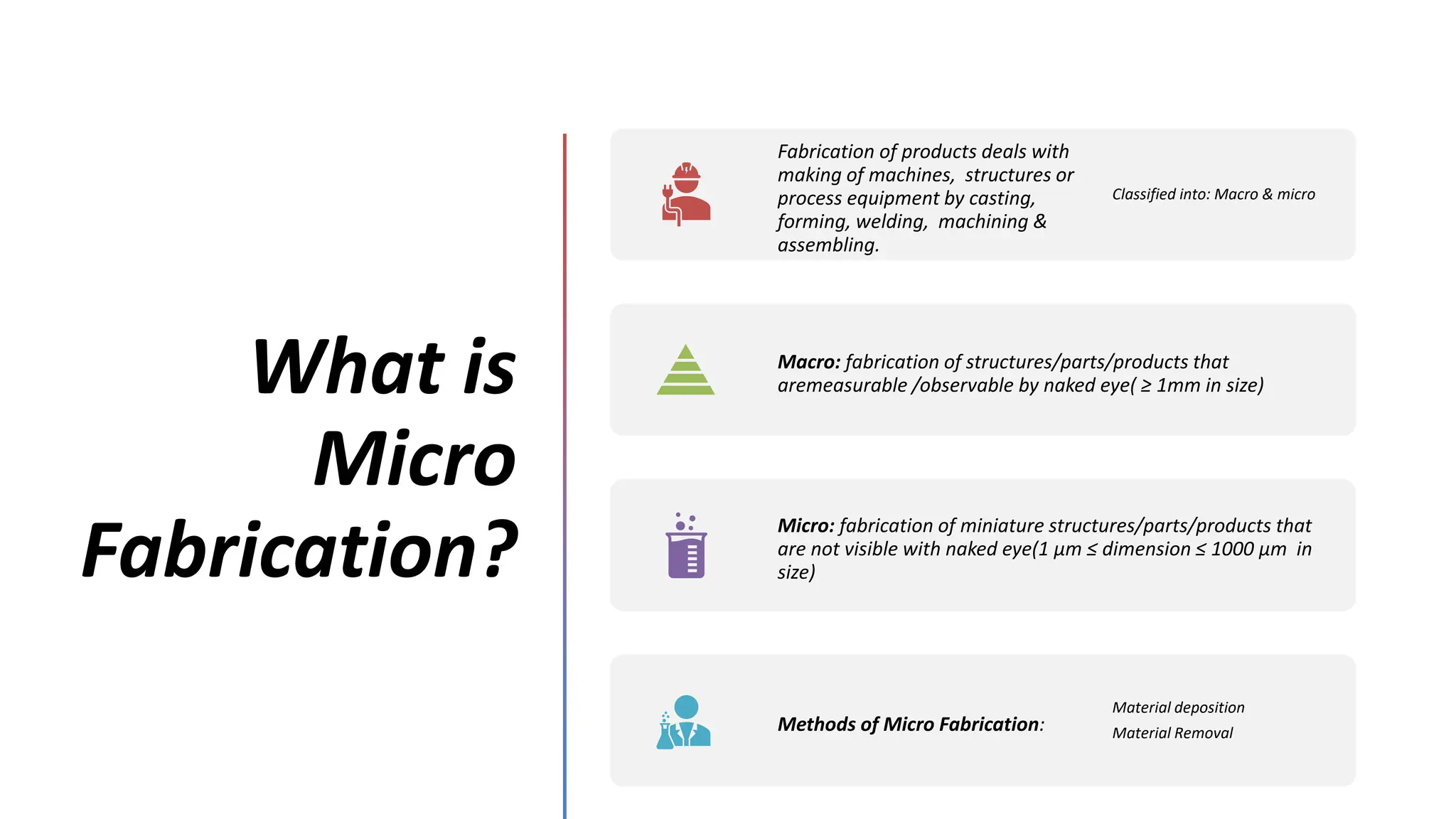
What is
Micro
Fabrication?
Fabrication of products deals with
making of machines, structures or
process equipment by casting,
forming, welding, machining &
assembling.
Classified into: Macro & micro
Macro: fabrication of structures/parts/products that
aremeasurable /observable by naked eye( ≥ 1mm in size)
Micro: fabrication of miniature structures/parts/products that
are not visible with naked eye(1 µm ≤ dimension ≤ 1000 µm in
size)
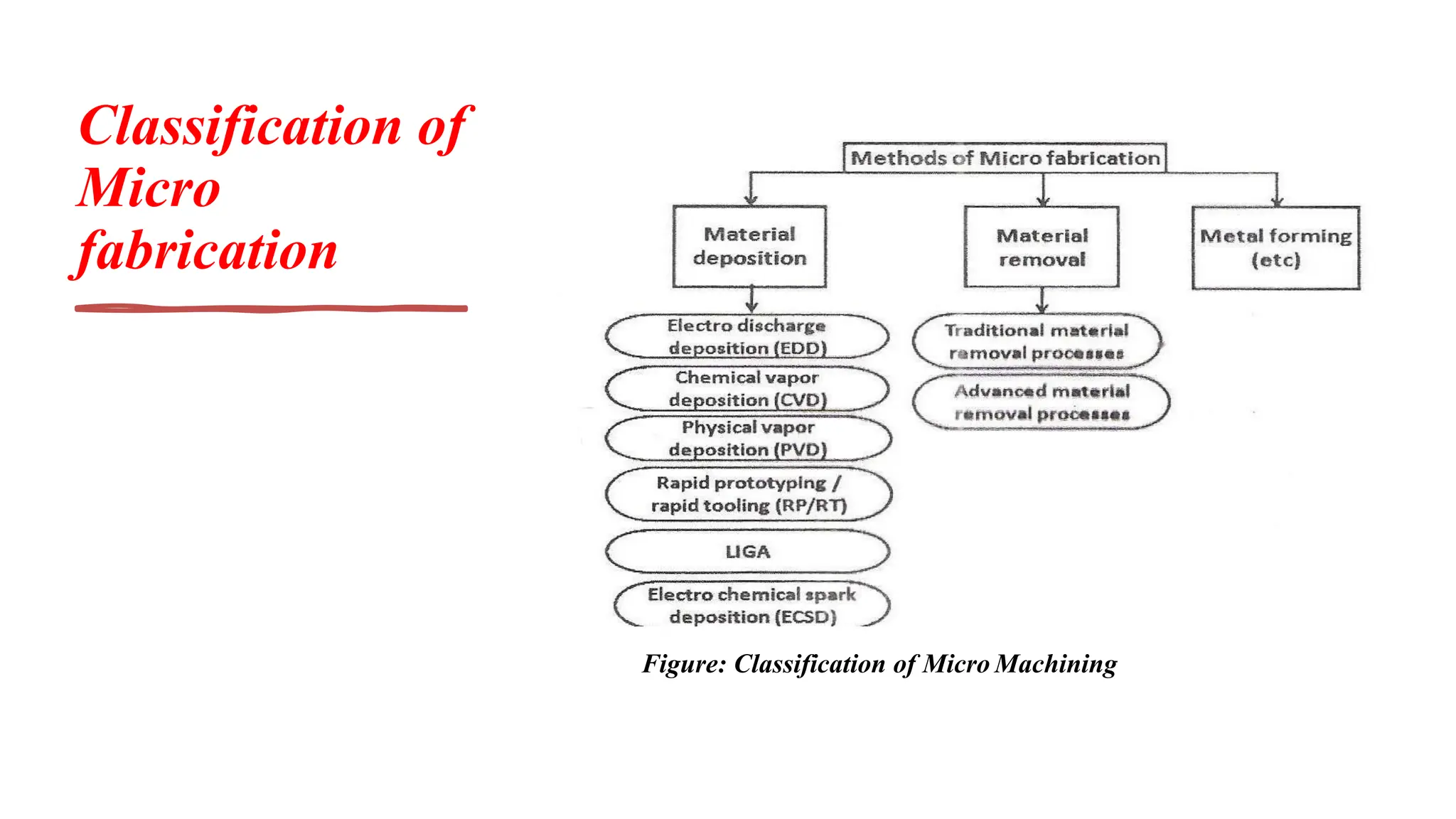
Methods of Micro Fabrication:
Material deposition
Material Removal
Classification of
Micro
fabrication
Figure: Classification of Micro Machining
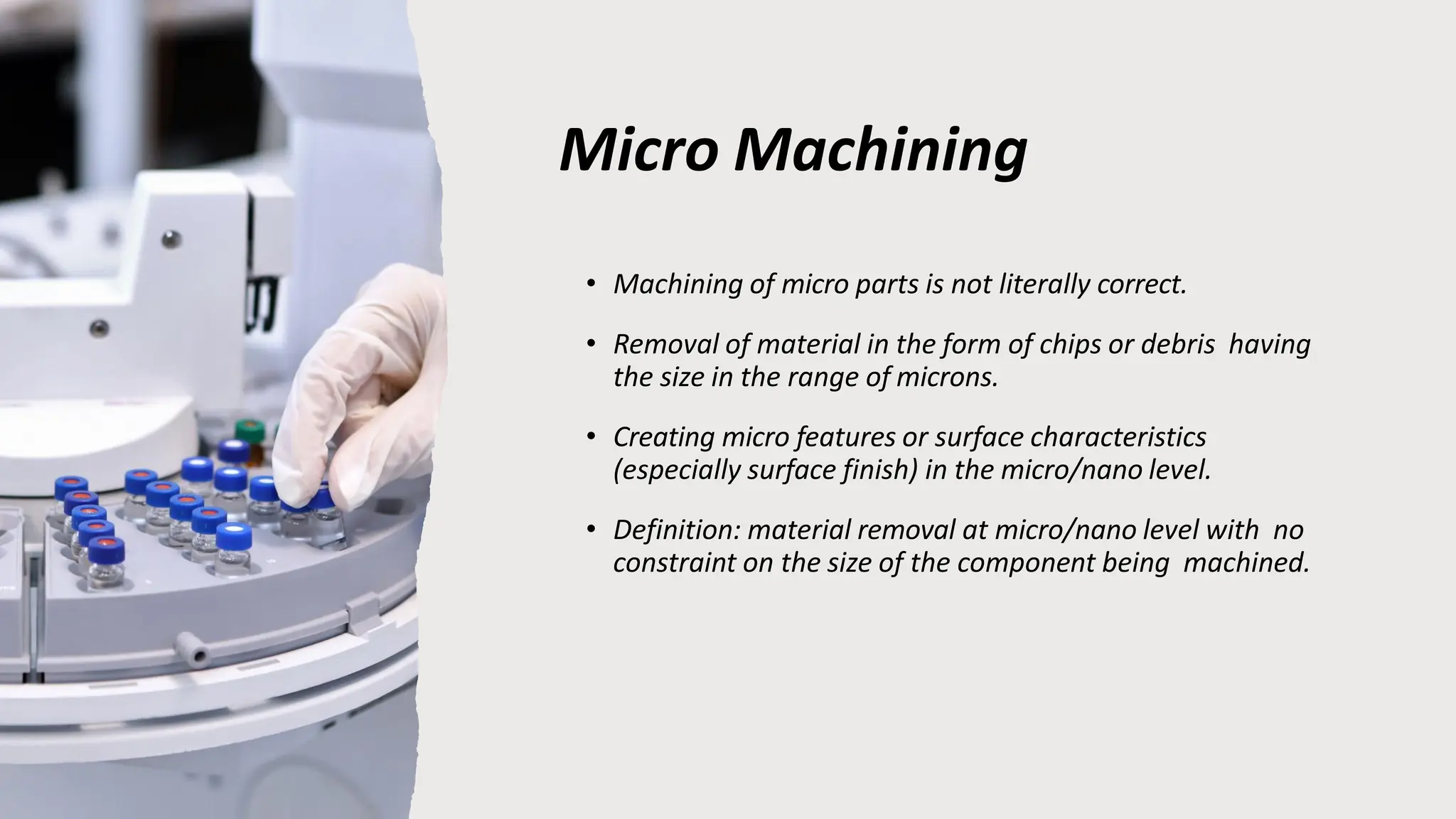
Micro Machining
• Machining of micro parts is not literally correct.
• Removal of material in the form of chips or debris having
the size in the range of microns.
• Creating micro features or surface characteristics
(especially surface finish) in the micro/nano level.
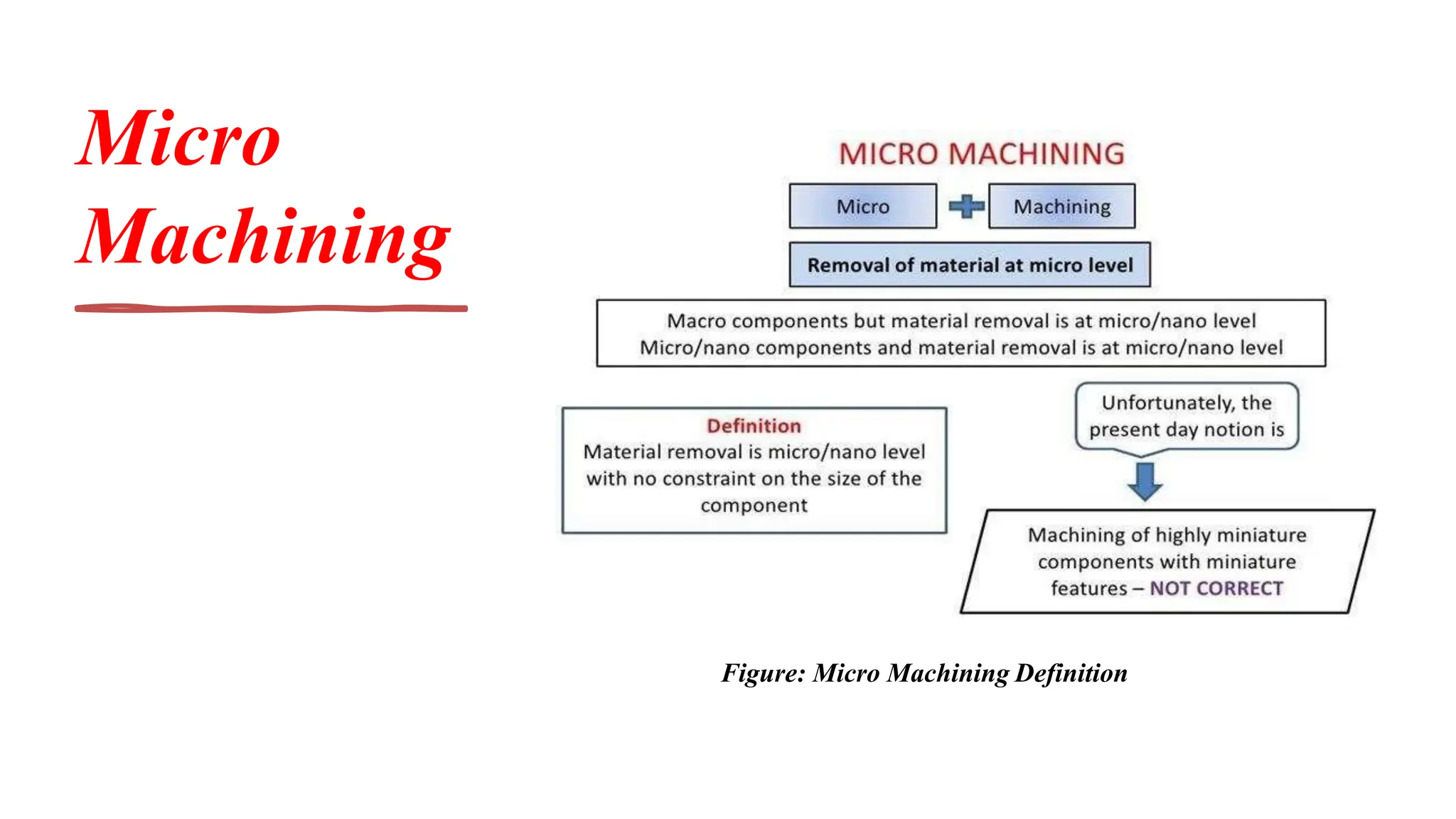
• Definition: material removal at micro/nano level with no
constraint on the size of the component being machined.
Micro
Machining
Figure: Micro Machining Definition
Why Micro
Machining?
• Final finishing operations in
manufacturing of precise parts are
always of concern owing to their most
critical, labour intensive and least
controllable nature.
• In the era of nanotechnology,
deterministic high precision finishing
methods are of utmost importance
and are the need of present
manufacturing scenario.
• The need for high precision in
manufacturing was felt by
manufacturers to improve
interchangeability of components,
improve quality control and longer
wear/fatigue life.
Why Micro
Machining?
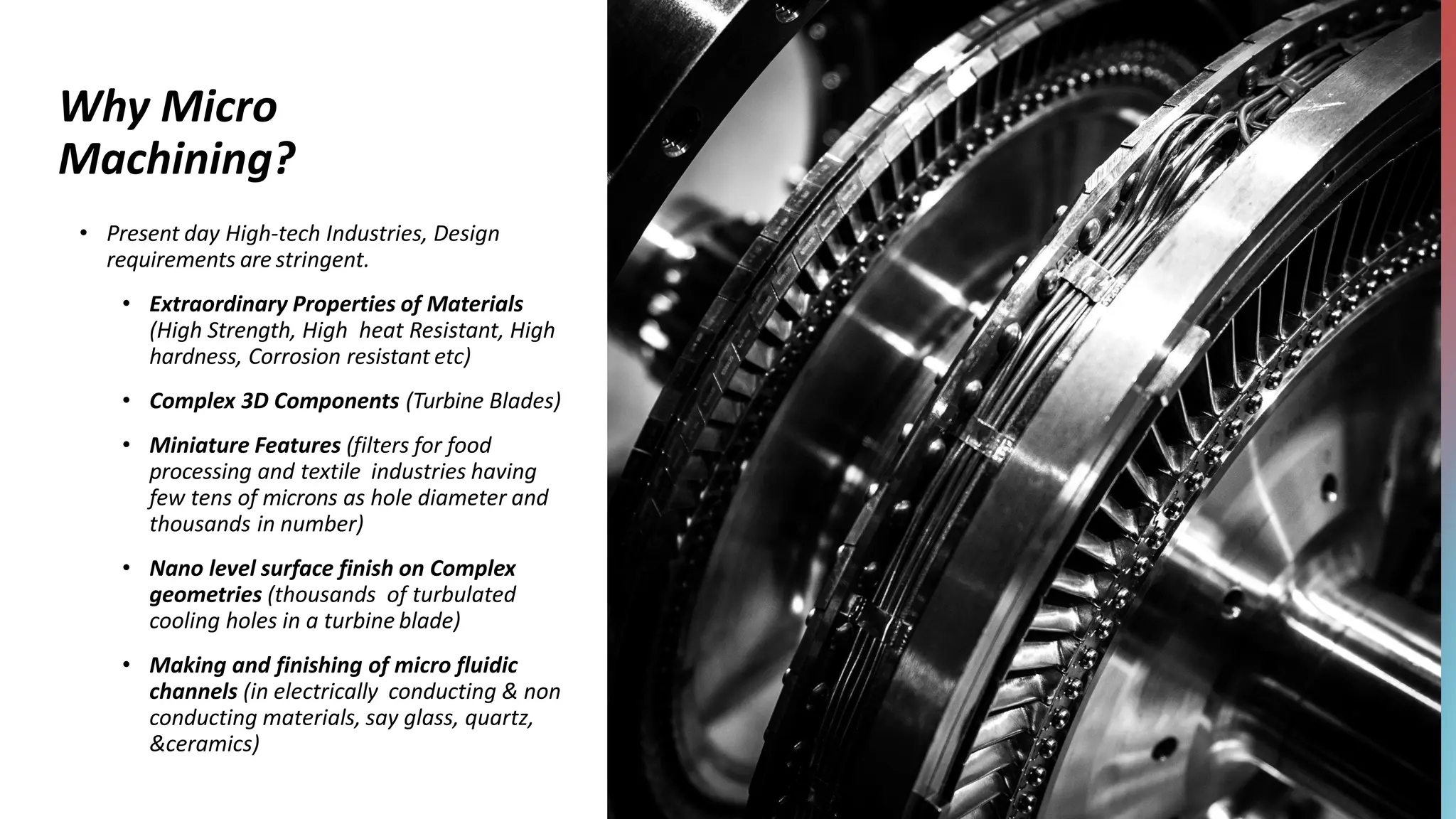
• Present day High-tech Industries, Design
requirements are stringent.
• Extraordinary Properties of Materials
(High Strength, High heat Resistant, High
hardness, Corrosion resistant etc)
• Complex 3D Components (Turbine Blades)
• Miniature Features (filters for food
processing and textile industries having
few tens of microns as hole diameter and
thousands in number)
• Nano level surface finish on Complex
geometries (thousands of turbulated
cooling holes in a turbine blade)
• Making and finishing of micro fluidic
channels (in electrically conducting & non
conducting materials, say glass, quartz,
&ceramics)
Micro Machining
Main purposes:
– Shaping and sizing a part (AMMPs)
– Surface finishing a part (ANFPs)
Main classification: Processes which use
Advanced Micro Machining Processes, (AMMPs)
– Mechanical AMMPs: Mechanical force (abrasion: abrasive
particles as tools, removing material in the form of micro/nano
chips)
– Thermal AMMPs: Direct energy of beam or plasma (ablation:
removal by melting /vaporization)
– Electro Chemical AMMPs: Electro Chemical or Chemical
Reaction (removal by chemical reaction)
Micro Machining
Advanced Nano Finishing Processes (ANFPs)
– ANFPs with no external control of forces
1) Abrasive Flow Finishing AFF,
2) Chemo Mechanical Polishing CMP &
3) Elastic Emission Machining EMM)
– ANFPs with external control of forces
1) Magnetic Abrasive Finishing MAF,
2) Magneto Rheological Finishing MRF,
3) Magneto Rheological Abrasive Flow
Finishing MRAFF &
4) Magnetic Float Polishing MFP)
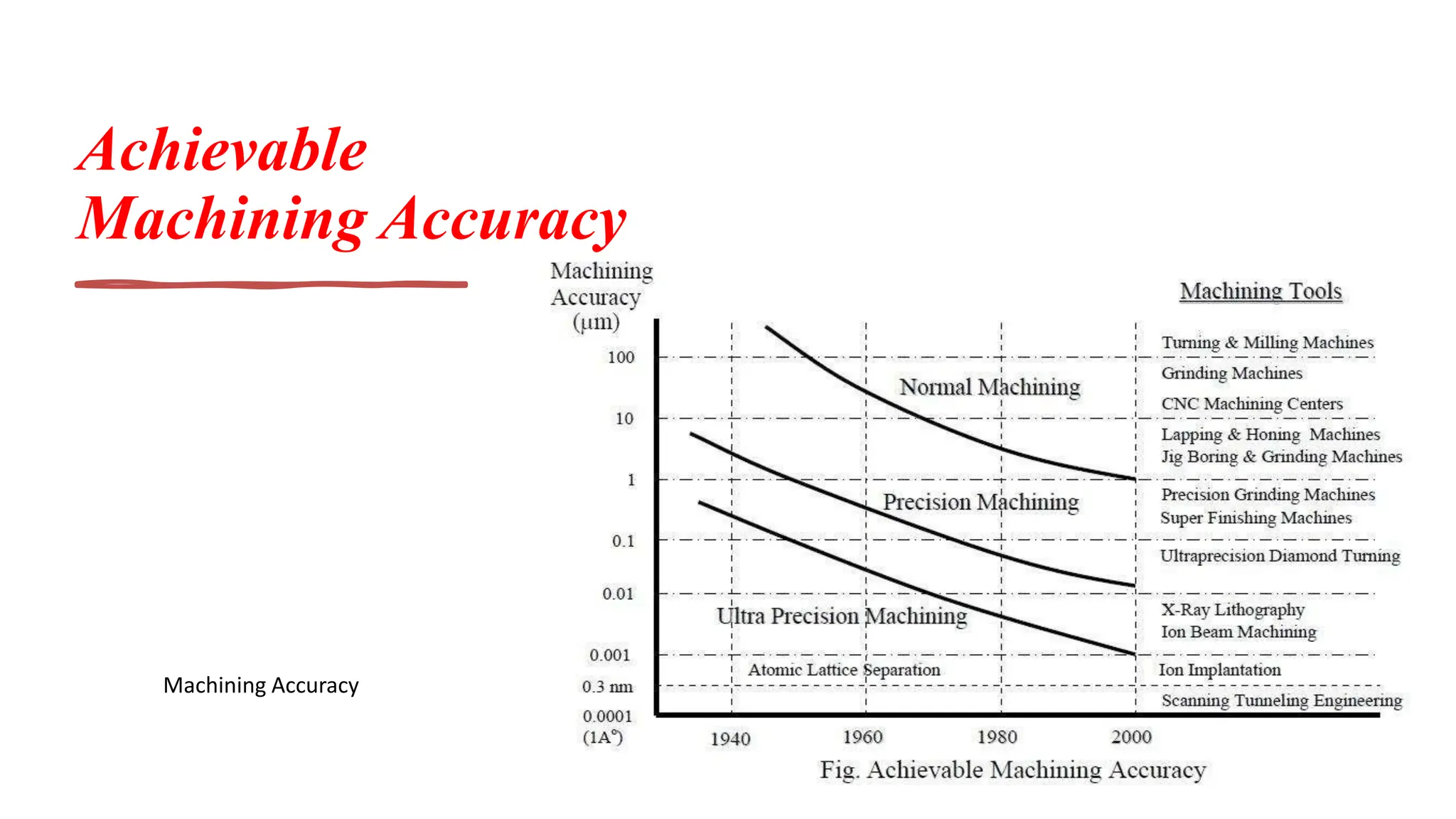
Machining Accuracy
▪ The machining processes are classified into three categories on the
basis of achievable accuracy: Conventional machining, precision
machining and ultra precision machining.
▪ Conventional machining processes is about 1 μm,
▪ Precision is 0.01μm (10 nm), and
▪ Ultra precision machining is 0.001μm (1 nm).
▪ As the demand moves from the microtechnology (1μm accuracy
capability) to the nanotechnology region (1 nm accuracy) the
systems engineering demands rapid increase in stringency and
complexity.
Achievable
Machining Accuracy
Machining Accuracy
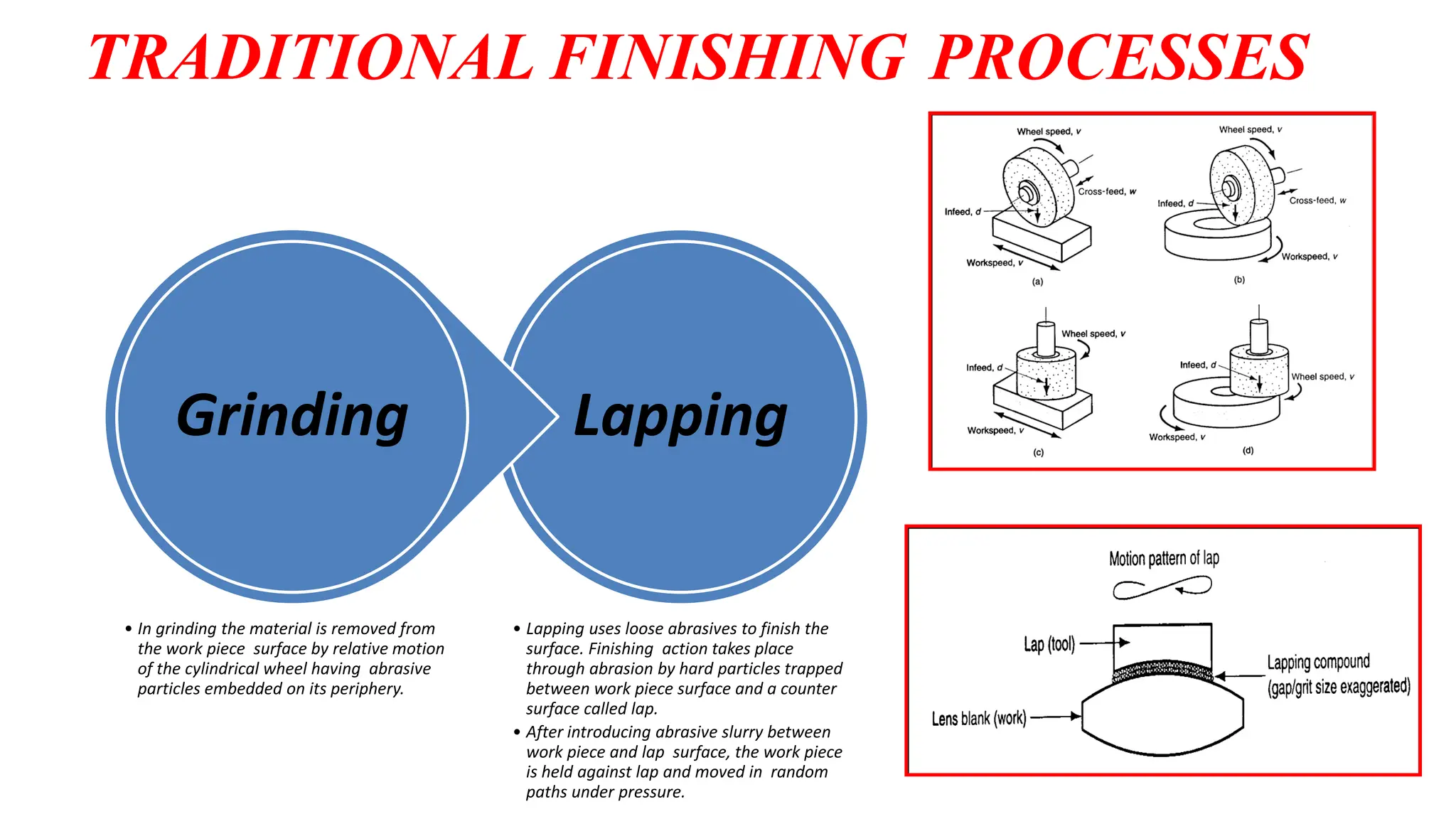
TRADITIONAL FINISHING PROCESSES
Lapping
• Lapping uses loose abrasives to finish the
surface. Finishing action takes place
through abrasion by hard particles trapped
between work piece surface and a counter
surface called lap.
• After introducing abrasive slurry between
work piece and lap surface, the work piece
is held against lap and moved in random
paths under pressure.
Grinding
• In grinding the material is removed from
the work piece surface by relative motion
of the cylindrical wheel having abrasive
particles embedded on its periphery.
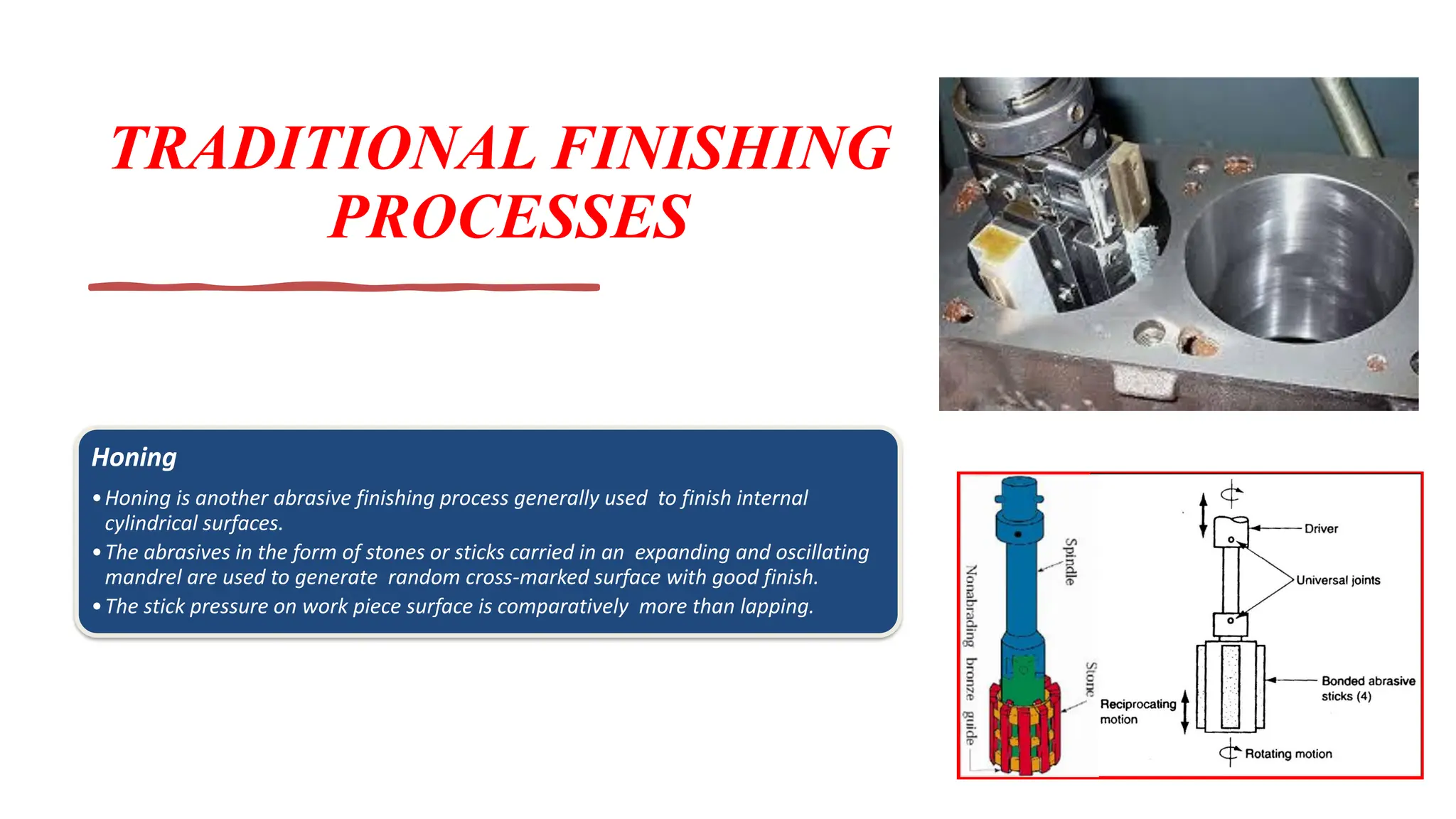
TRADITIONAL FINISHING
PROCESSES
Honing
•Honing is another abrasive finishing process generally used to finish internal
cylindrical surfaces.
•The abrasives in the form of stones or sticks carried in an expanding and oscillating
mandrel are used to generate random cross-marked surface with good finish.
•The stick pressure on work piece surface is comparatively more than lapping.
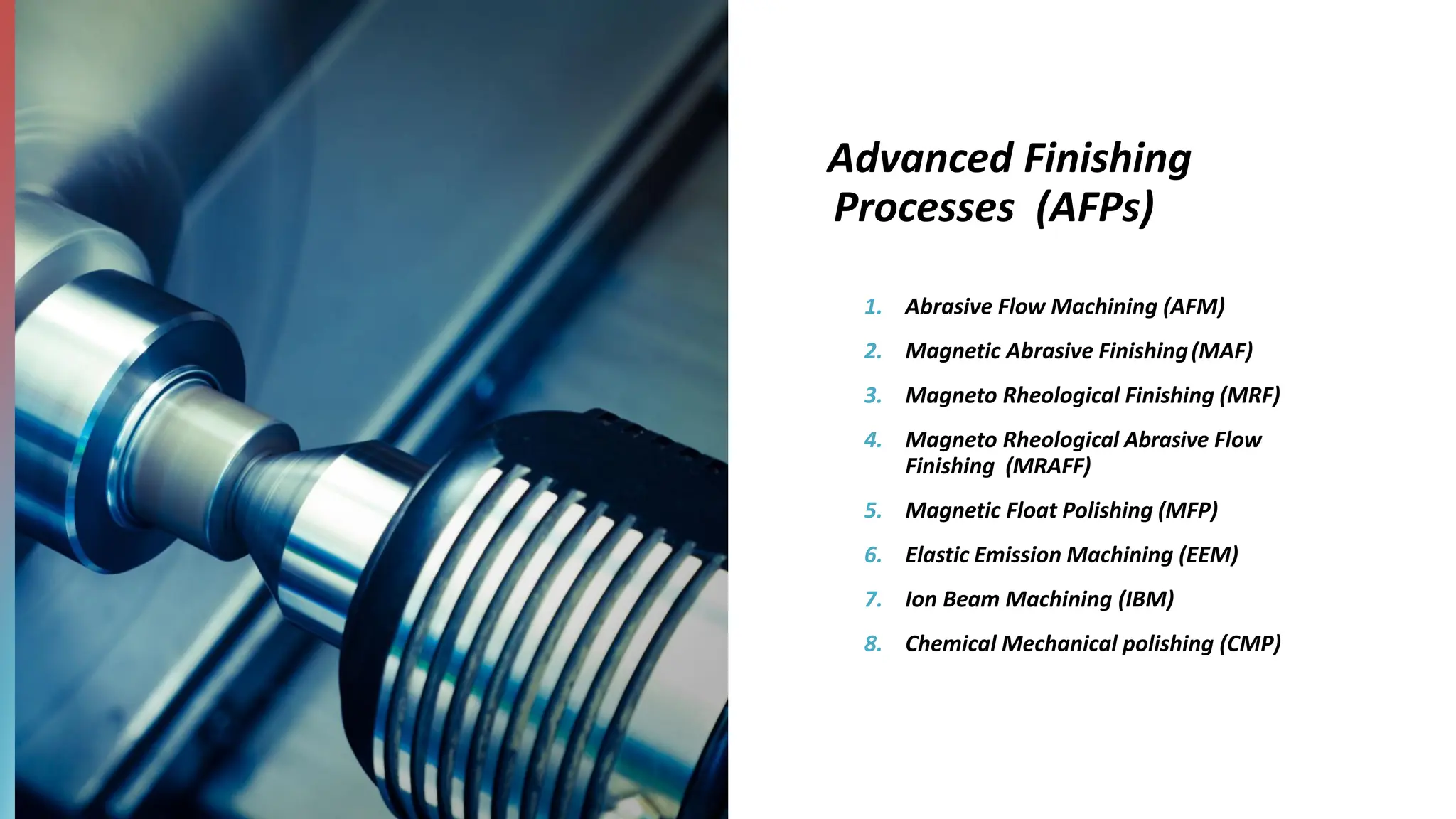
Advanced Finishing
Processes (AFPs)
1. Abrasive Flow Machining (AFM)
2. Magnetic Abrasive Finishing(MAF)
3. Magneto Rheological Finishing (MRF)
4. Magneto Rheological Abrasive Flow
Finishing (MRAFF)
5. Magnetic Float Polishing (MFP)
6. Elastic Emission Machining (EEM)
7. Ion Beam Machining (IBM)
8. Chemical Mechanical polishing (CMP)
Abrasive
Flow
Machining
(AFM)
https://www.youtube.com/watch?v=lHjJz7BQ49Y
https://www.youtube.com/watch?v=Wa4Z5tsX3E4
It is a non-traditional machining method that can be used to deburr,
polish, remove recast layer, produce compressive residual stress and
radius difficult to reach surfaces and edges by flowing an abrasive
laden visco- plastic polymer over them.
Because of its capability to machine interior and curved surfaces, it is
considered as a suitable surface finishing process to finish internal
complex geometry of work pieces.
The Effect of this AFM occurs at nanometer scale, obtaining surface
roughness under Ra = 100 nm
It is employed both for metals and non-metals
Low MRR.
Abrasive Flow
Machining
(AFM)
• Principle:
• a AFM is a kind of finishing process in which a small
quantity of material is removed by flowing a semi-solid
media (comprises of a carriers in the form of polymer
base containing abrasive powders) over the surface to be
machined
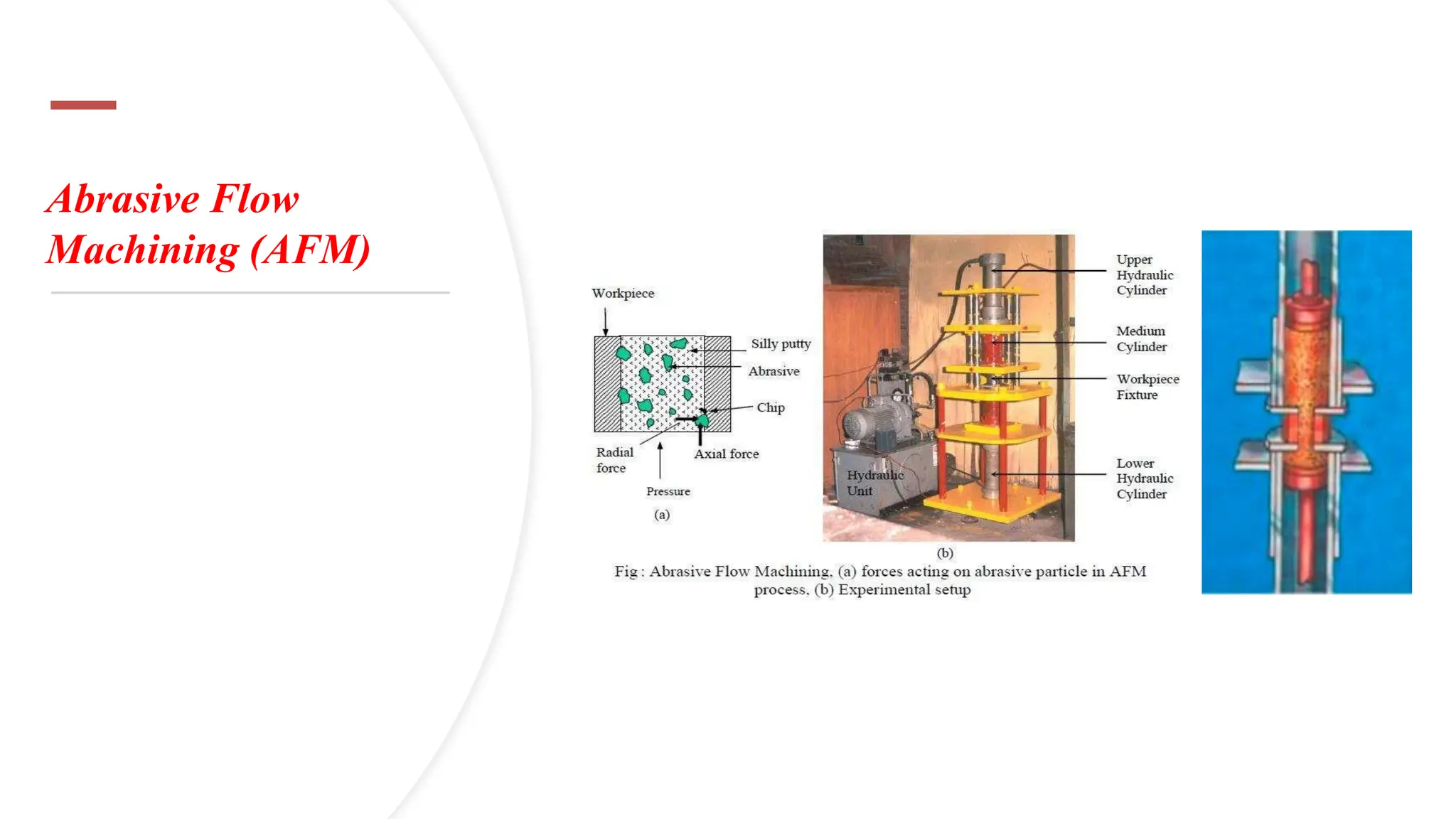
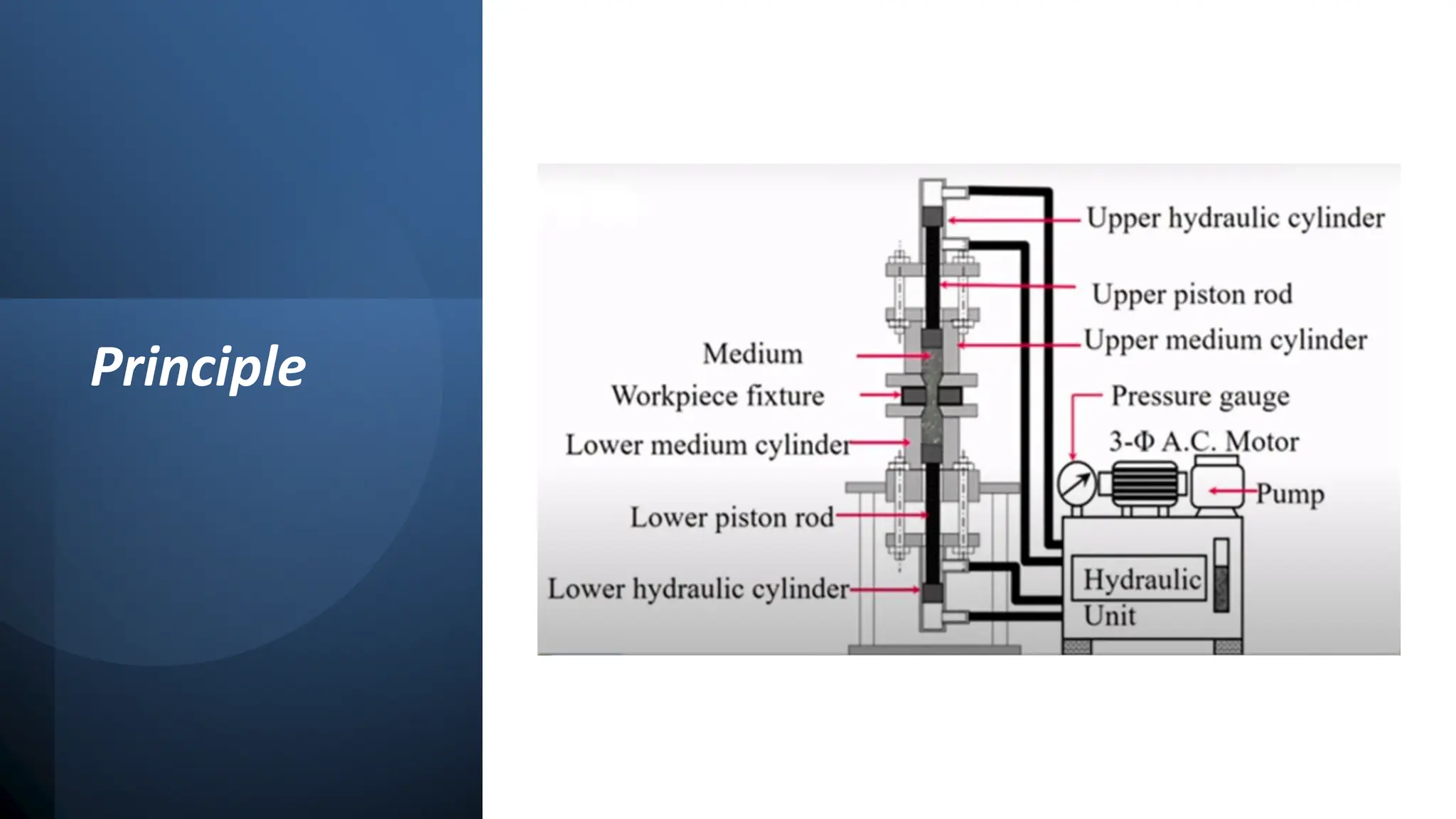
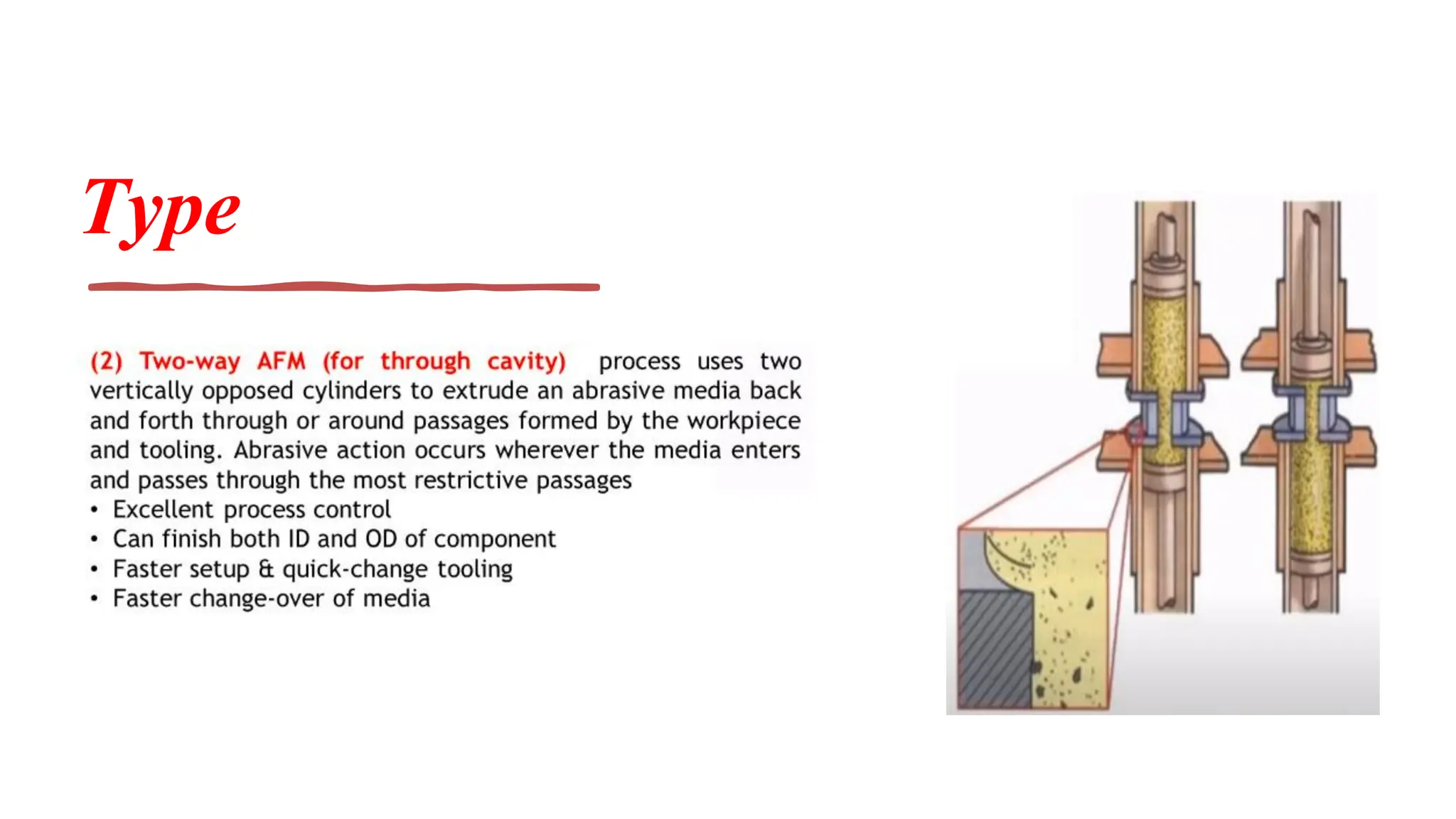
• It uses two vertically opposed cylinders, which extrude an
abrasive medium back and forth through passage formed
by the work piece and tooling.
• Extrusion pressure, number of cycles, grit composition
and type, and fixture design are the process parameters
that have the largest impact on AFM results.
• The viscosity of polymeric medium plays an important
role in finishing operation. This allows it to selectively
and controllably abrade surfaces that it flows across.
https://www.youtube.com/watch?v=lHjJz7BQ49Y
Abrasive Flow
Machining (AFM)
Principle
Abrasive Flow
Machining (AFM)
• Abrasive action accelerates by change in the
rheological properties of the medium when it enters
and passes through the restrictive passages.
• The work piece held by fixture is placed between two
medium cylinders which are clamped together to seal
so that medium does not leak during finishing
process.
• Abrasion occurs wherever the medium passes
through the restrictive passages. The key
components of AFM are the machine, the tooling,
types of abrasives, medium composition and process
settings.
Abrasive Flow
Machining (AFM)
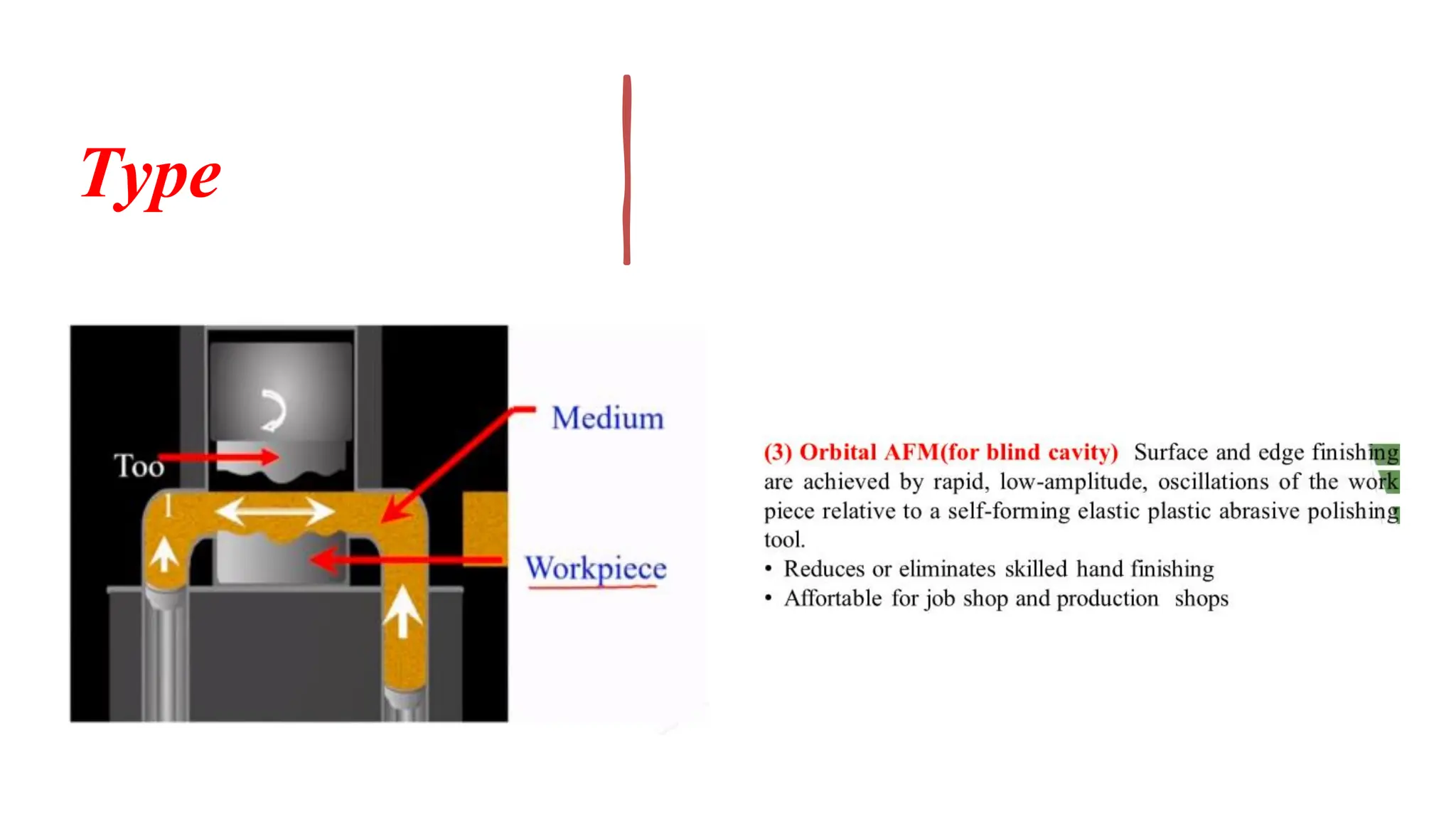
• The three major elements of the processare:
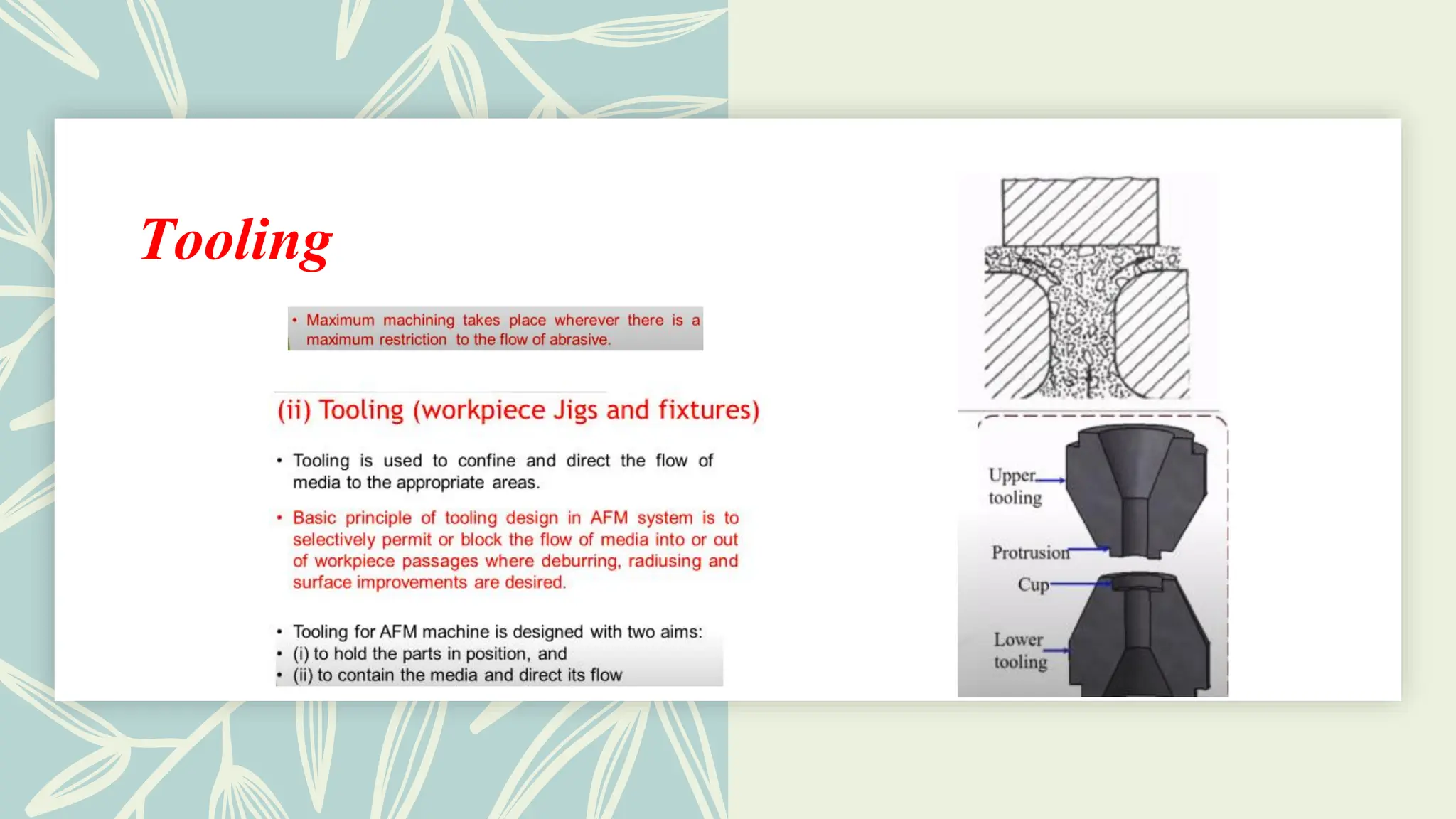
• The Tooling, which confines and directs the abrasive
medium flow to the areas where deburring,
radiusing and surface improvements are desired.
• The Machine to control the process variables like
extrusion pressure, medium flow volume, and flow
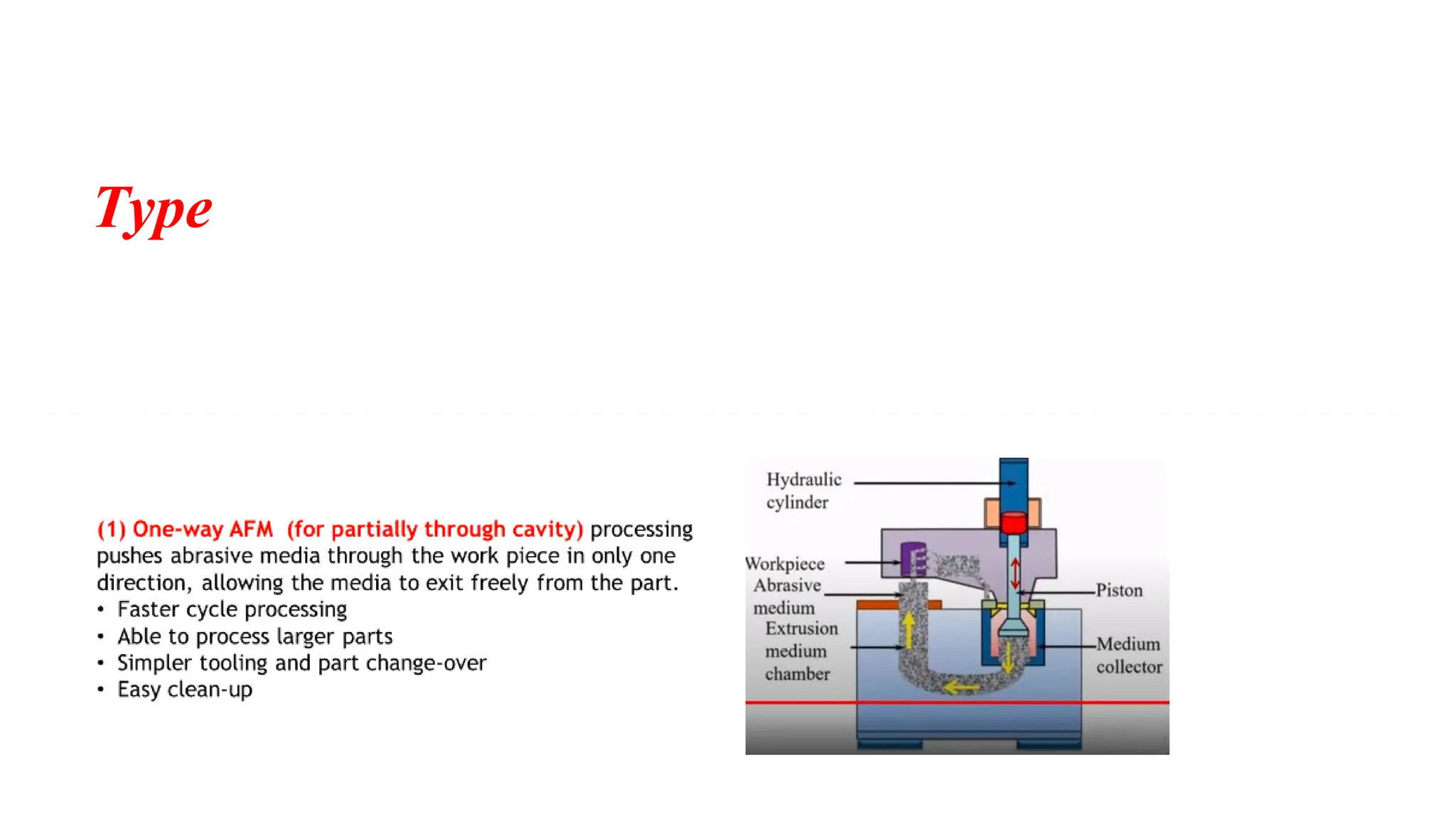
rate. Type: One-way AFM, Two-way AFM, orbital
AFM.
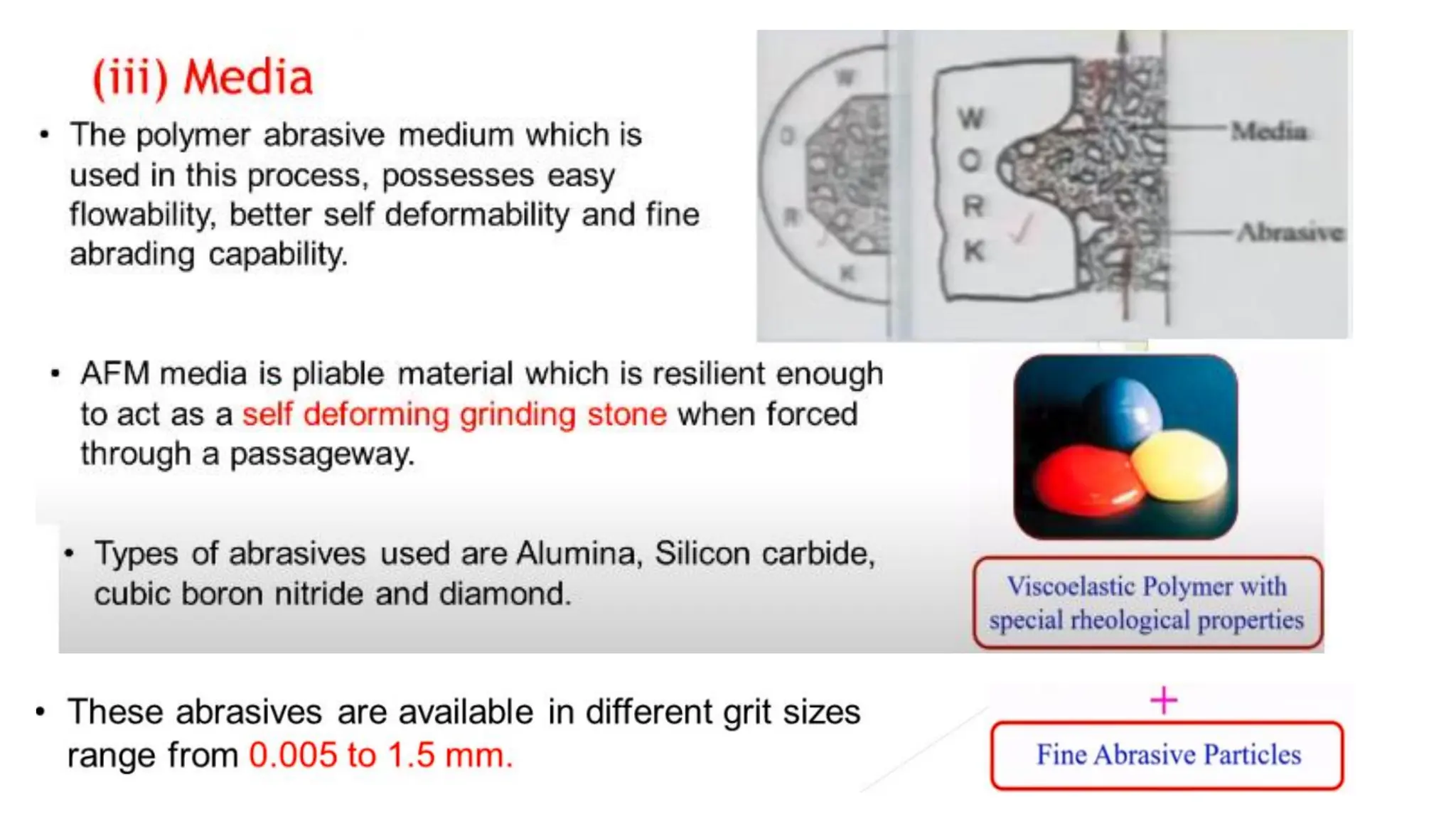
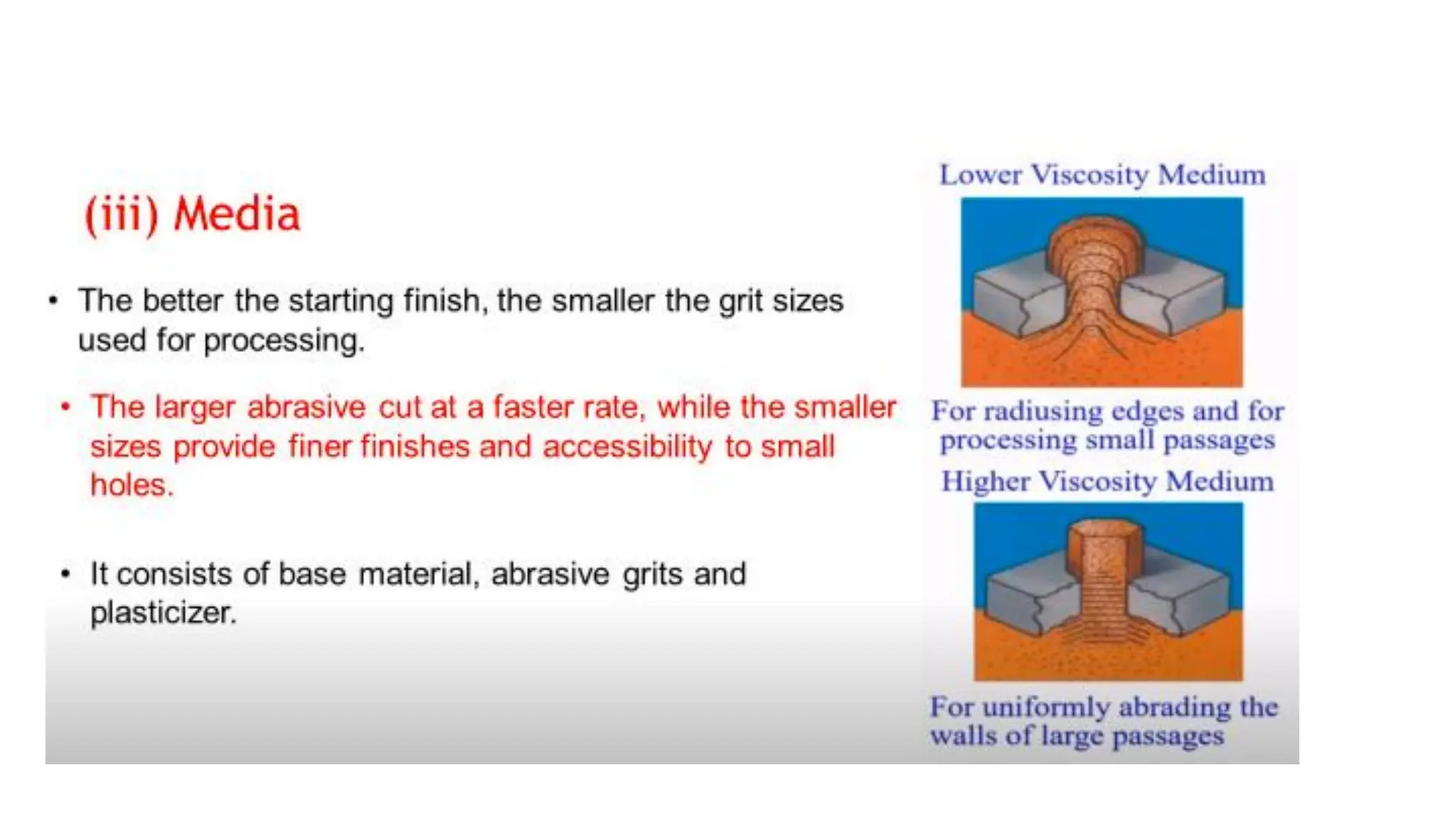
• The abrasive laden Polymeric Medium whose
rheological properties determine the pattern and
aggressiveness of the abrasive action. Consists of
base material, abrasive grits and plasticizers
• Toformulate the AFM medium, the abrasive particles are
blended into special visco-elastic polymer,which show
change in viscosity when forced to flow through
restrictive passages.
Type
Type
Type
Tooling
Magneto Rheological
Finishing (MRF)
• Traditional methods of finishing high precision
lenses, ceramics and semiconductor wafers are
very expensive and labor intensive.
• Lenses are usually made of brittle materials such
as glass, which tends to crack while it is
machined, and every device that uses either
lasers or fiber optics requires at least one high
precision lens, increasing its demand higher than
ever.
• The lens manufacturer generally uses its in-house
opticians for the finishing process, which makes
it an arduous, labor- intensive process.
https://www.youtube.com/watch?v=Lo2DRTFazYg
Magneto
Rheological
Finishing
Lens manufacturing can be classified into two
main processes: grinding and finishing.
Grindinggets the lens close to the desired
size, while finishing removes the cracks and
tiny surface imperfections that the grinding
process either overlooked or created.
• Perhaps the biggest disadvantage to manual grinding
and finishing is that it is nondeterministic.
• To overcome these difficulties, Center for Optics
Manufacturing (COM) in Rochester, N.Y. has developed
a technology to automate the lens finishing process
known as Magneto Rheological Finishing (MRF).
Magneto
Rheological
Finishing
(MRF)
The MRF process relies on a unique "smart fluid", known as
Magnetorheological (MR) fluid.
MR-Fluids are suspensions of micron sized magnetizable
particles such as carbonyl iron, dispersed in a non- magnetic
carrier medium like silicone oil, mineral oil or water.
In the absence of a magnetic field, an ideal MR-fluid exhibits
Newtonian behaviour.
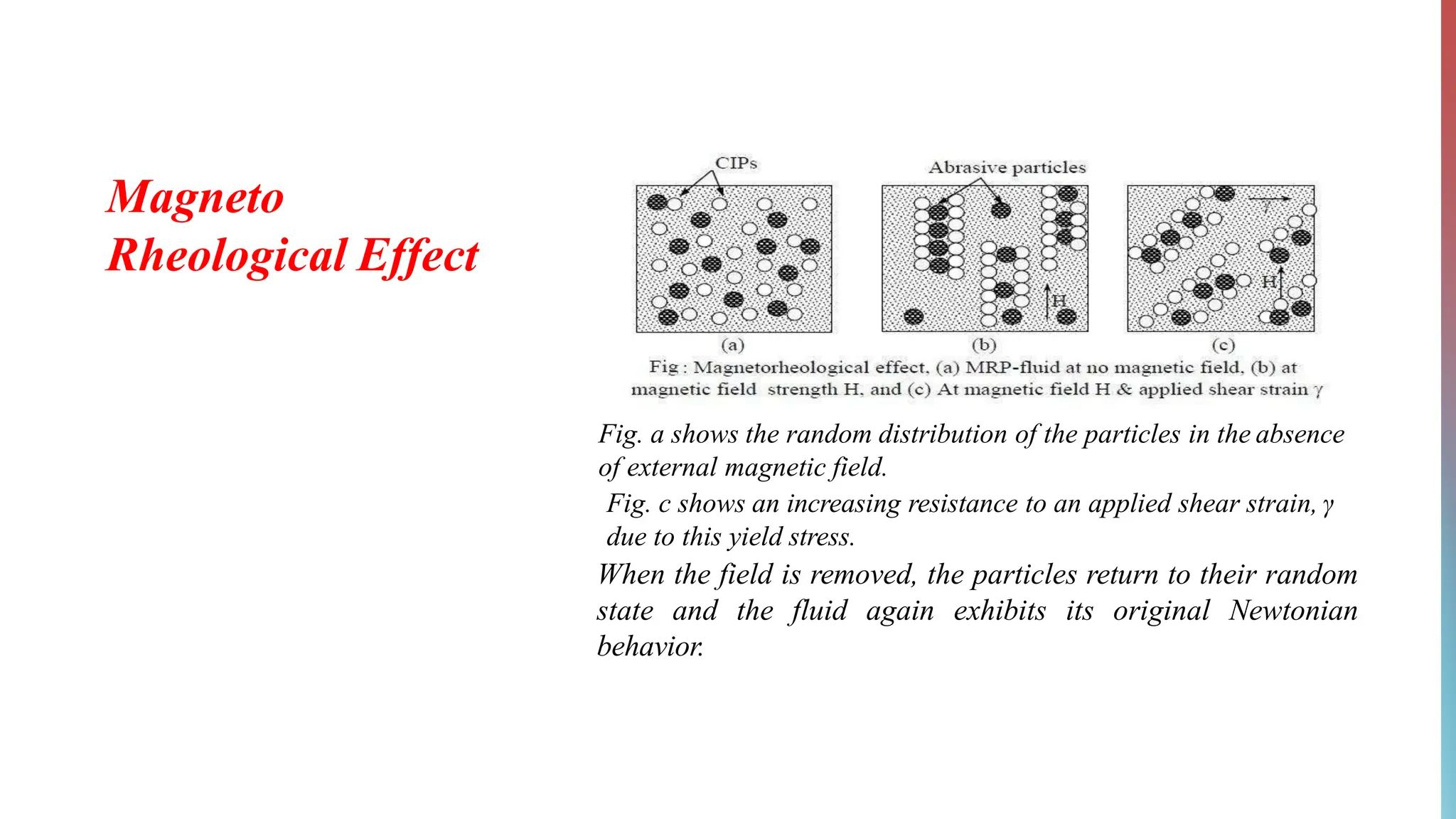
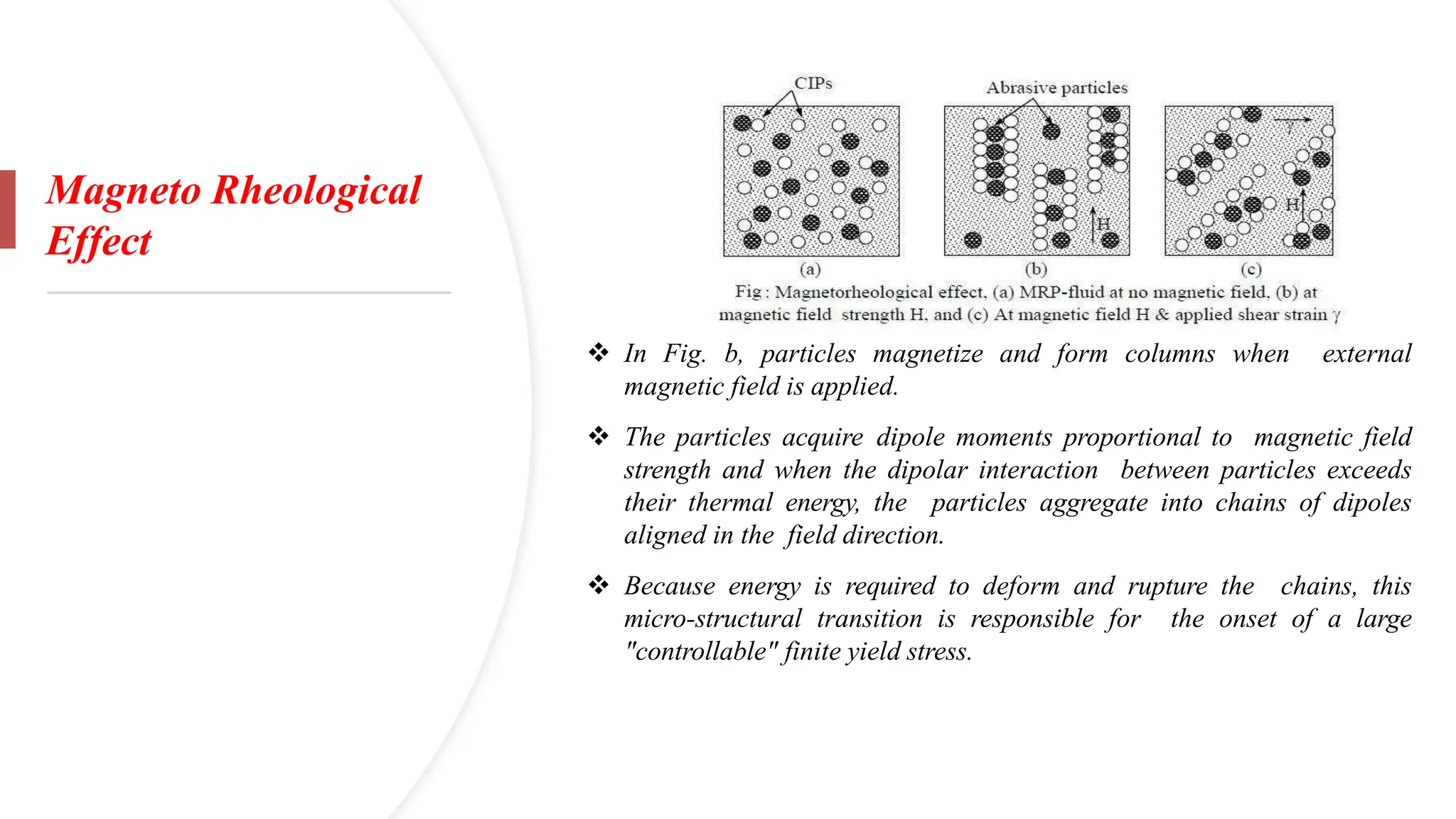
On the application of an external magnetic field to a MR-
suspension, a phenomenon known as Magneto Rheological
Effect, shown in Fig, is observed.
Magneto
Rheological Effect
Fig. a shows the random distribution of the particles in the absence
of external magnetic field.
Fig. c shows an increasing resistance to an applied shear strain, γ
due to this yield stress.
When the field is removed, the particles return to their random
state and the fluid again exhibits its original Newtonian
behavior.
Magneto Rheological
Effect
❖ In Fig. b, particles magnetize and form columns when external
magnetic field is applied.
❖ The particles acquire dipole moments proportional to magnetic field
strength and when the dipolar interaction between particles exceeds
their thermal energy, the particles aggregate into chains of dipoles
aligned in the field direction.
❖ Because energy is required to deform and rupture the chains, this
micro-structural transition is responsible for the onset of a large
"controllable" finite yield stress.
Magneto Rheological
Finishing
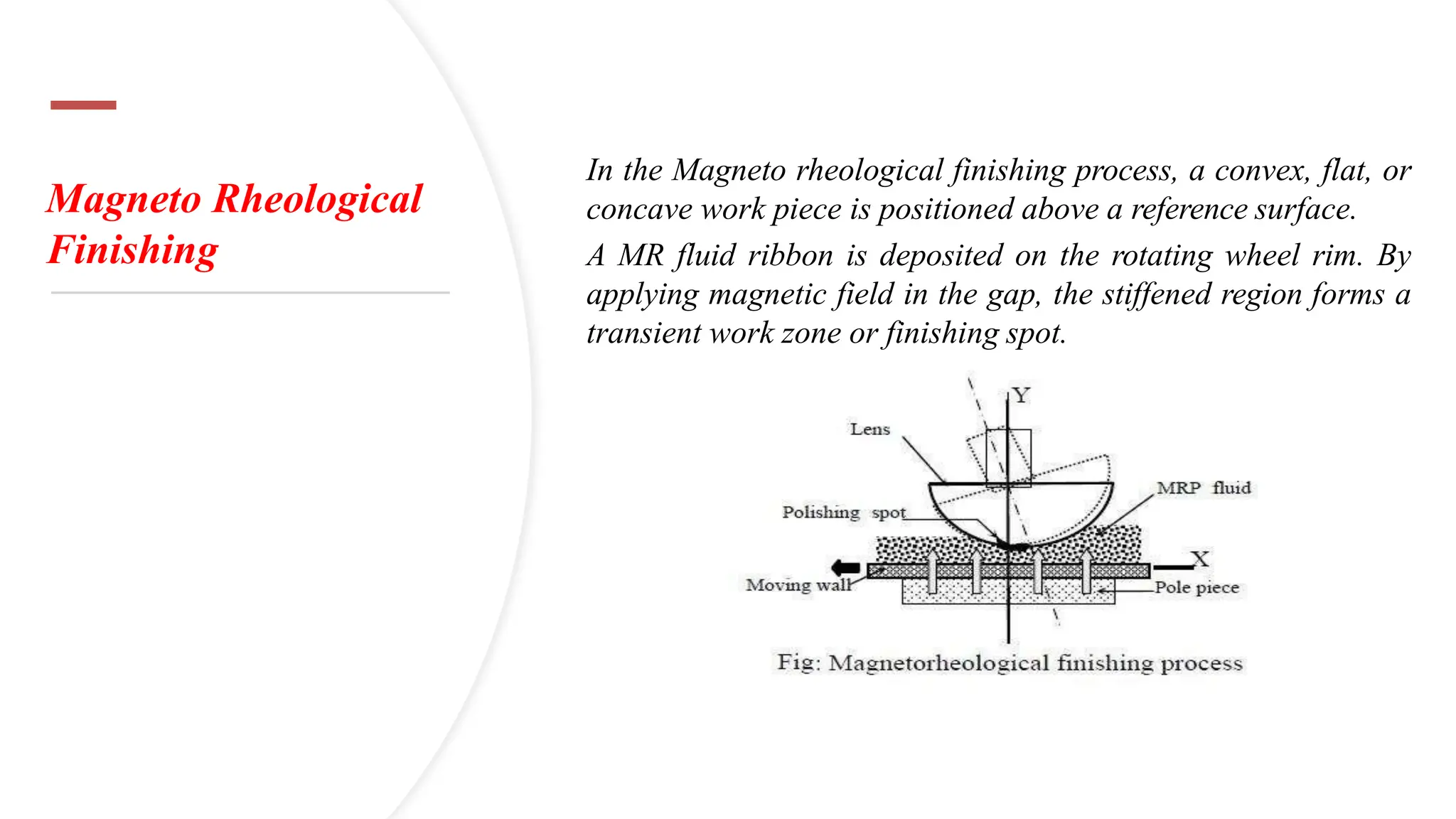
In the Magneto rheological finishing process, a convex, flat, or
concave work piece is positioned above a reference surface.
A MR fluid ribbon is deposited on the rotating wheel rim. By
applying magnetic field in the gap, the stiffened region forms a
transient work zone or finishing spot.
Magneto Rheological
Finishing
• Surface smoothing, removal of sub-surface damage, and
figure correction are accomplished by rotating the lens on a
spindle at a constant speed while sweeping the lens about
its radius of curvature through the stiffened finishing zone.
• Material removal takes place through the shear stress
created as the Magneto Rheological polishing ribbon is
dragged into the converging gap between the part and
carrier surface.
• Deterministic finishing of flats or spheres can be done by
mounting the part on rotating spindle and sweeping it
through the spot under computer control, such that dwell
time determines the amount of material removal.
Magneto Rheological
Finishing
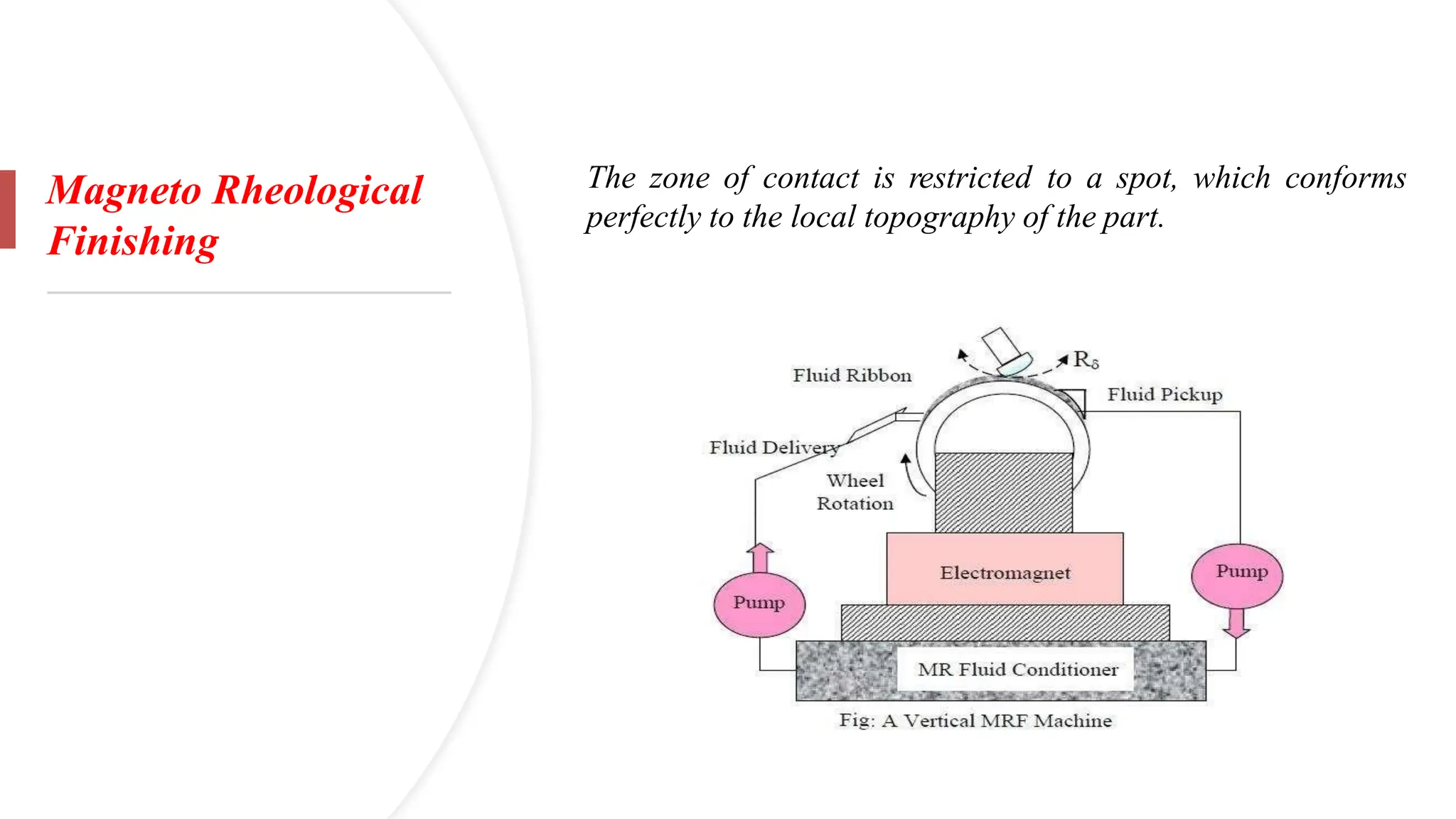
The zone of contact is restricted to a spot, which conforms
perfectly to the local topography of the part.
MRP Fluid
• Magnetorheological polishing fluid comprises of MR-fluid
with fine abrasive particles dispersed in it.
• On the application of magnetic field the carbonyl iron
particles (CIP) form a chain like columnar structure with
abrasives embedded in between.
• The magnetic force between iron particles encompassing
abrasive grain provides bonding strength to it and its
magnitude is a function of iron concentration, applied
magnetic field intensity, magnetic permeability of particles
and particle size.
MRP Fluid
• The MR-polishing fluid has following merits:-
• Its compliance is adjustable through the magnetic
field.
• It carries heat and debris away from the polishing
zone.
• It does not load up as in grinding wheel.
• It is flexible and adapts the shape of the part of
the work piece which is in its contact.
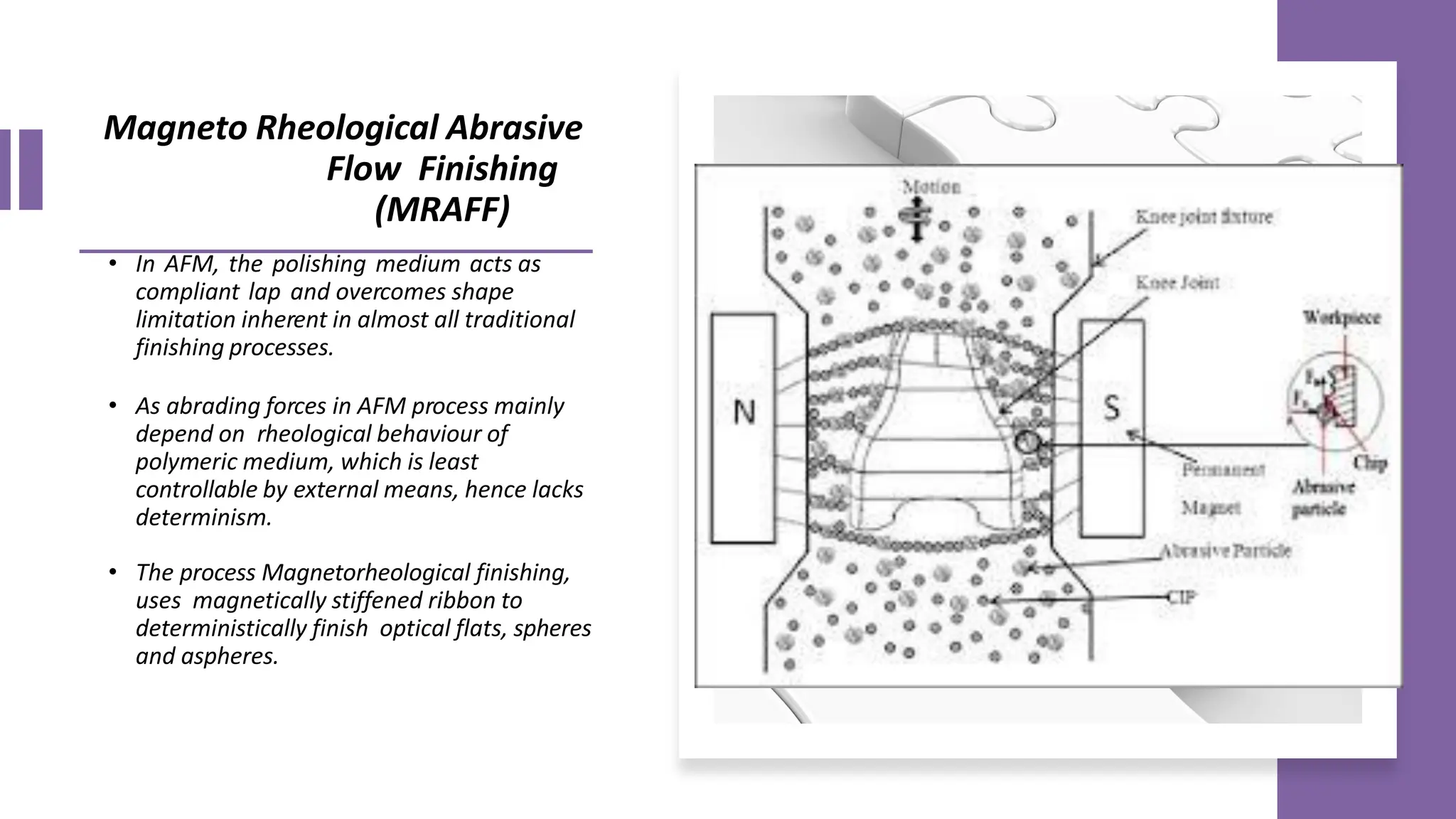
Magneto Rheological Abrasive
Flow Finishing
(MRAFF)
• In AFM, the polishing medium acts as
compliant lap and overcomes shape
limitation inherent in almost all traditional
finishing processes.
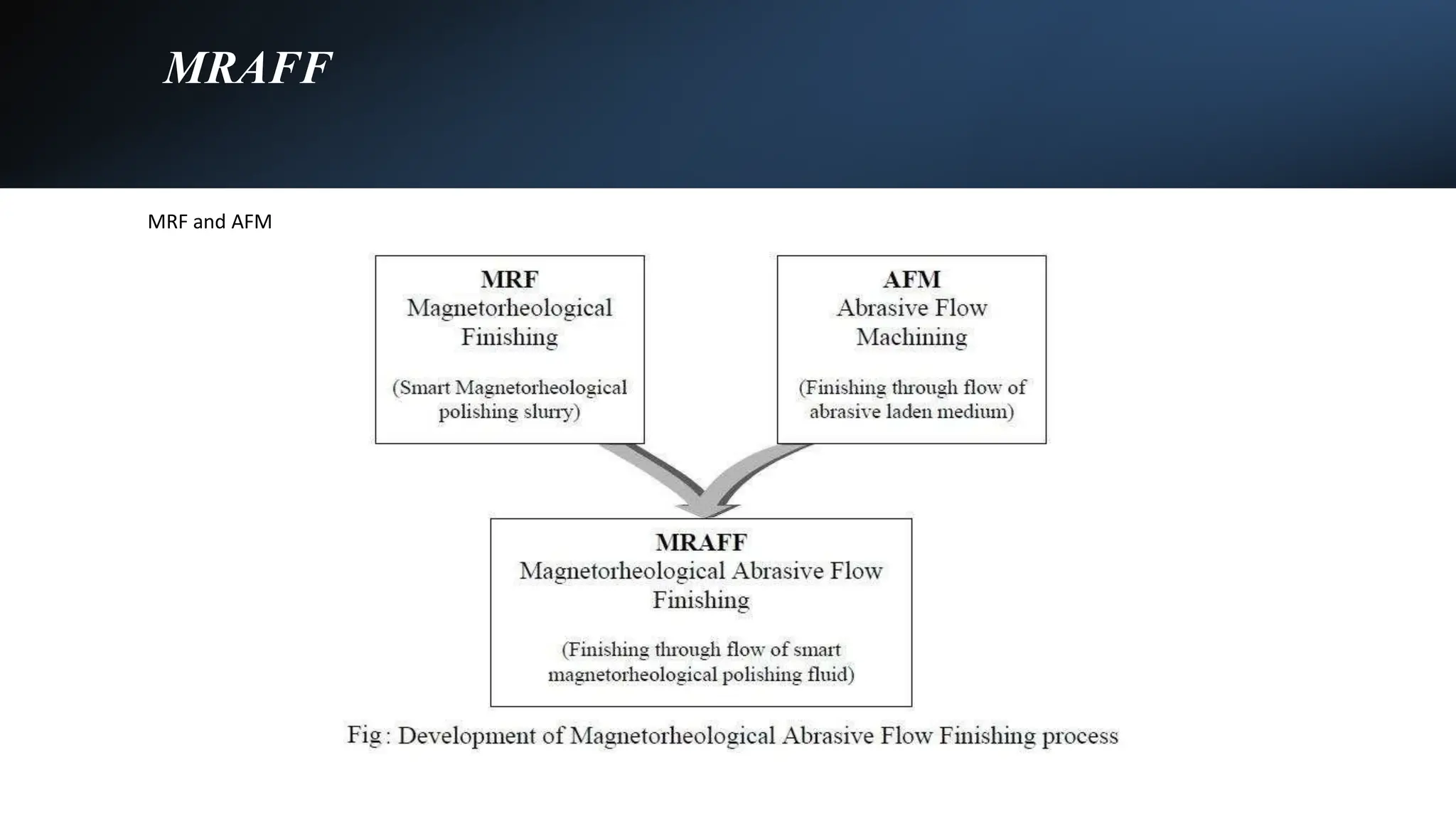
• As abrading forces in AFM process mainly
depend on rheological behaviour of
polymeric medium, which is least
controllable by external means, hence lacks
determinism.
• The process Magnetorheological finishing,
uses magnetically stiffened ribbon to
deterministically finish optical flats, spheres
and aspheres.
Magneto Rheological
Abrasive Flow Finishing
(MRAFF)
• In order to maintain the versatility of
Abrasive Flow Machining process
and at the same time introducing
determinism and controllability of
rheological properties of abrasive
laden medium, a new hybrid process
termed as Magnetorheological
Abrasive Flow Finishing (MRAFF) is
used.
• This process relies on smart
behaviour of magneto Rheological
fluids whose rheological properties
are controllable by means of external
magnetic field.
MRAFF
MRF and AFM
Mechanism of
MRAFF Process
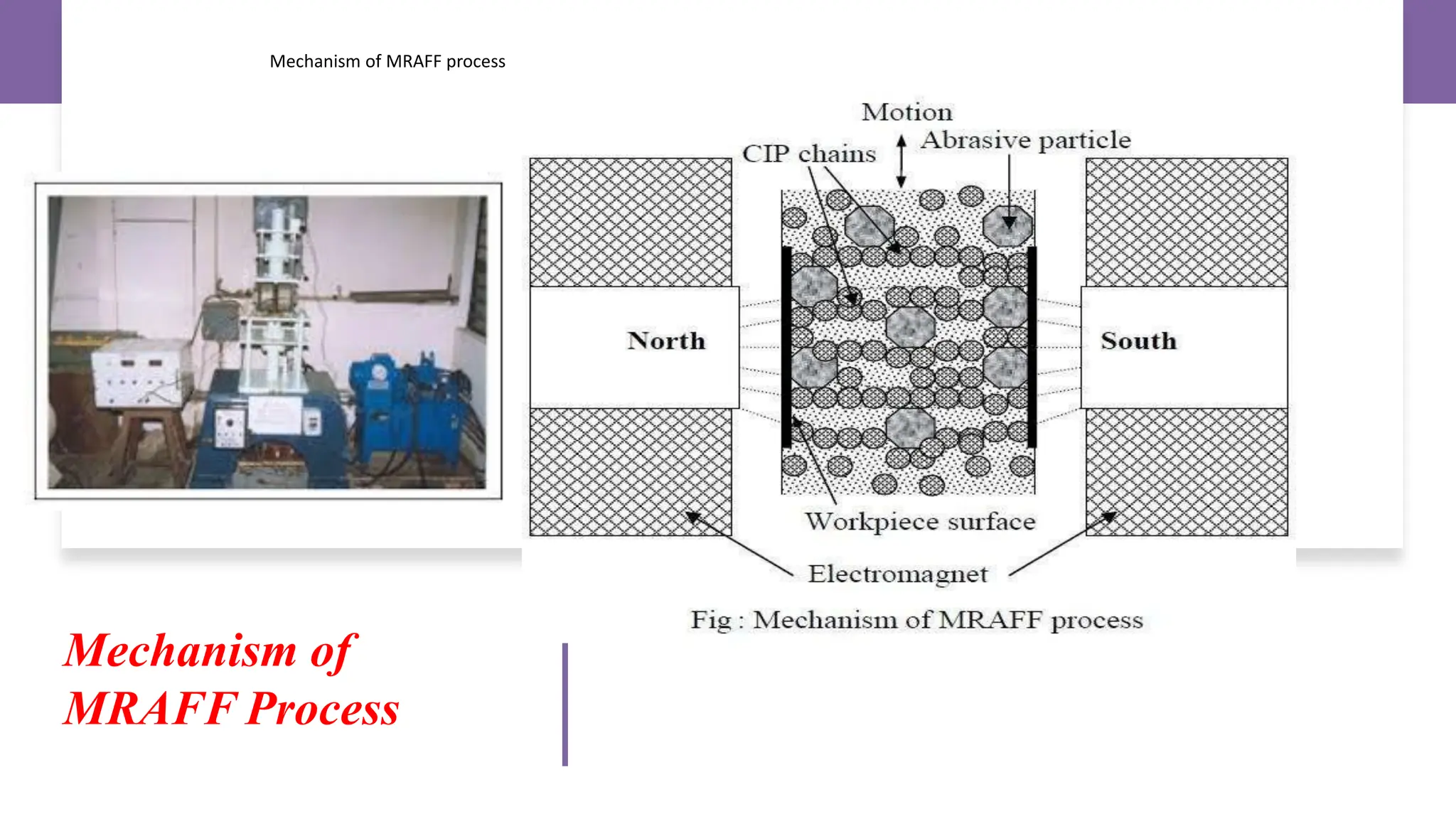
Mechanism of MRAFF process
Mechanism of MRAFF Process
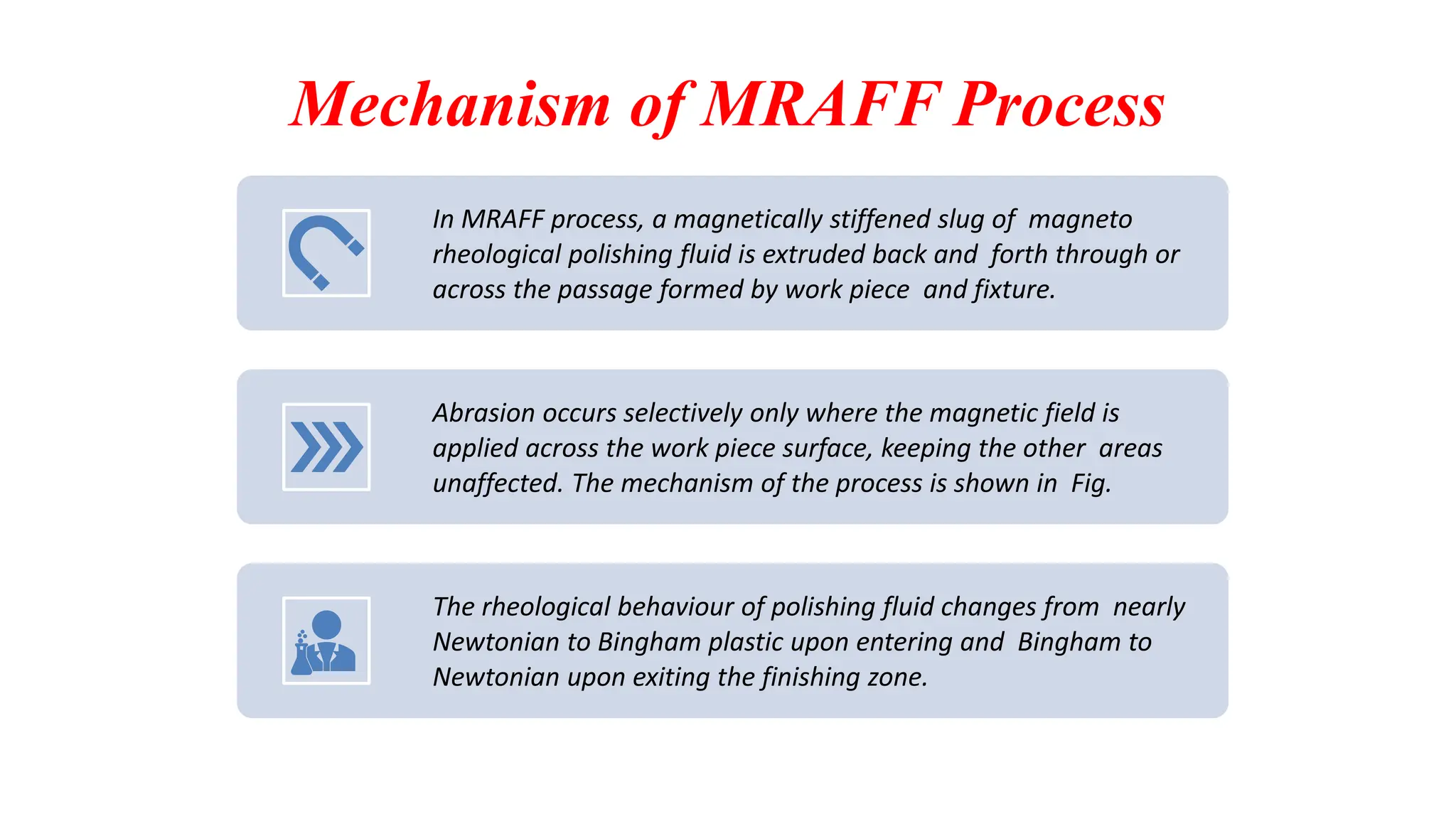
In MRAFF process, a magnetically stiffened slug of magneto
rheological polishing fluid is extruded back and forth through or
across the passage formed by work piece and fixture.
Abrasion occurs selectively only where the magnetic field is
applied across the work piece surface, keeping the other areas
unaffected. The mechanism of the process is shown in Fig.
The rheological behaviour of polishing fluid changes from nearly
Newtonian to Bingham plastic upon entering and Bingham to
Newtonian upon exiting the finishing zone.
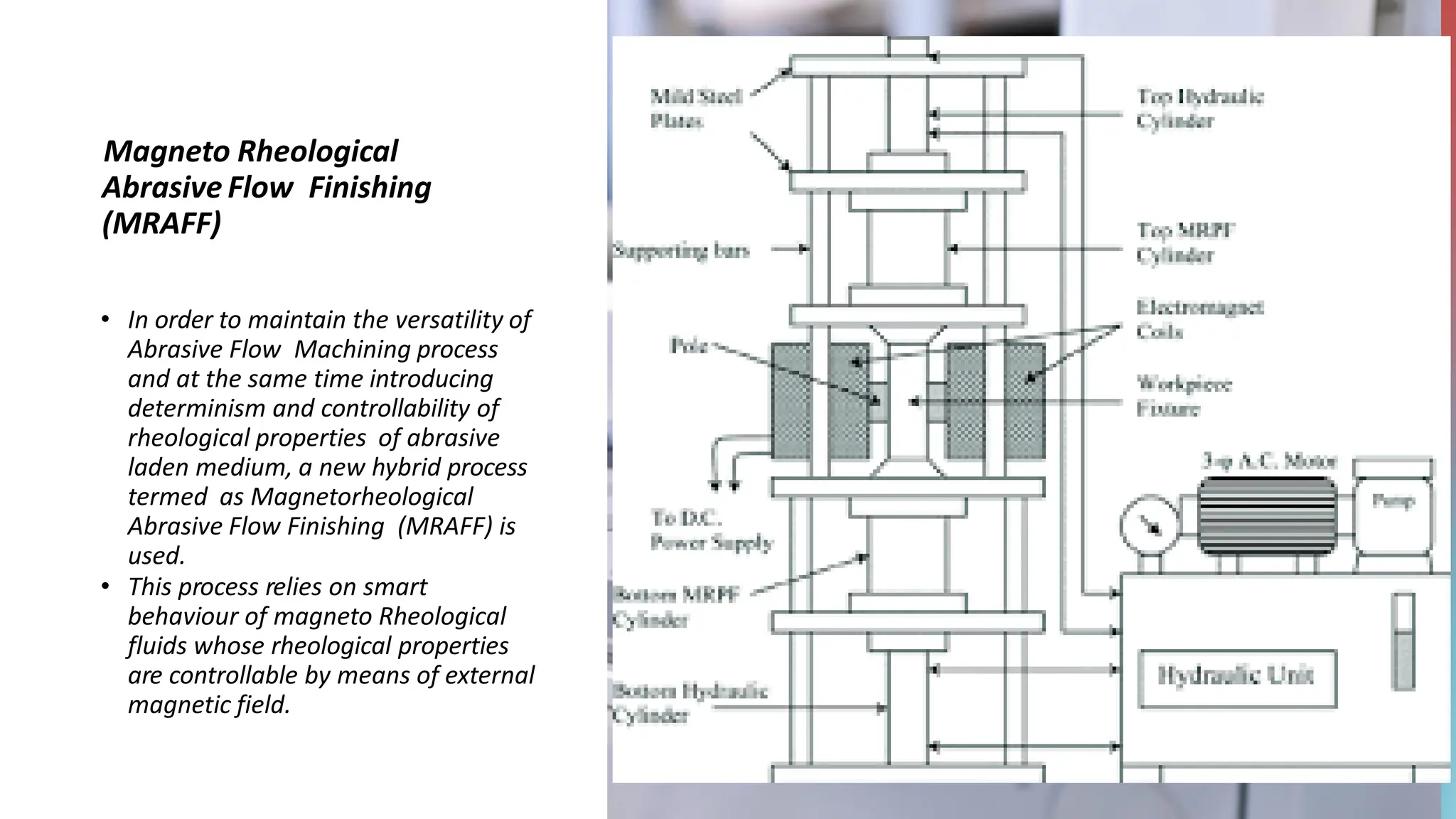
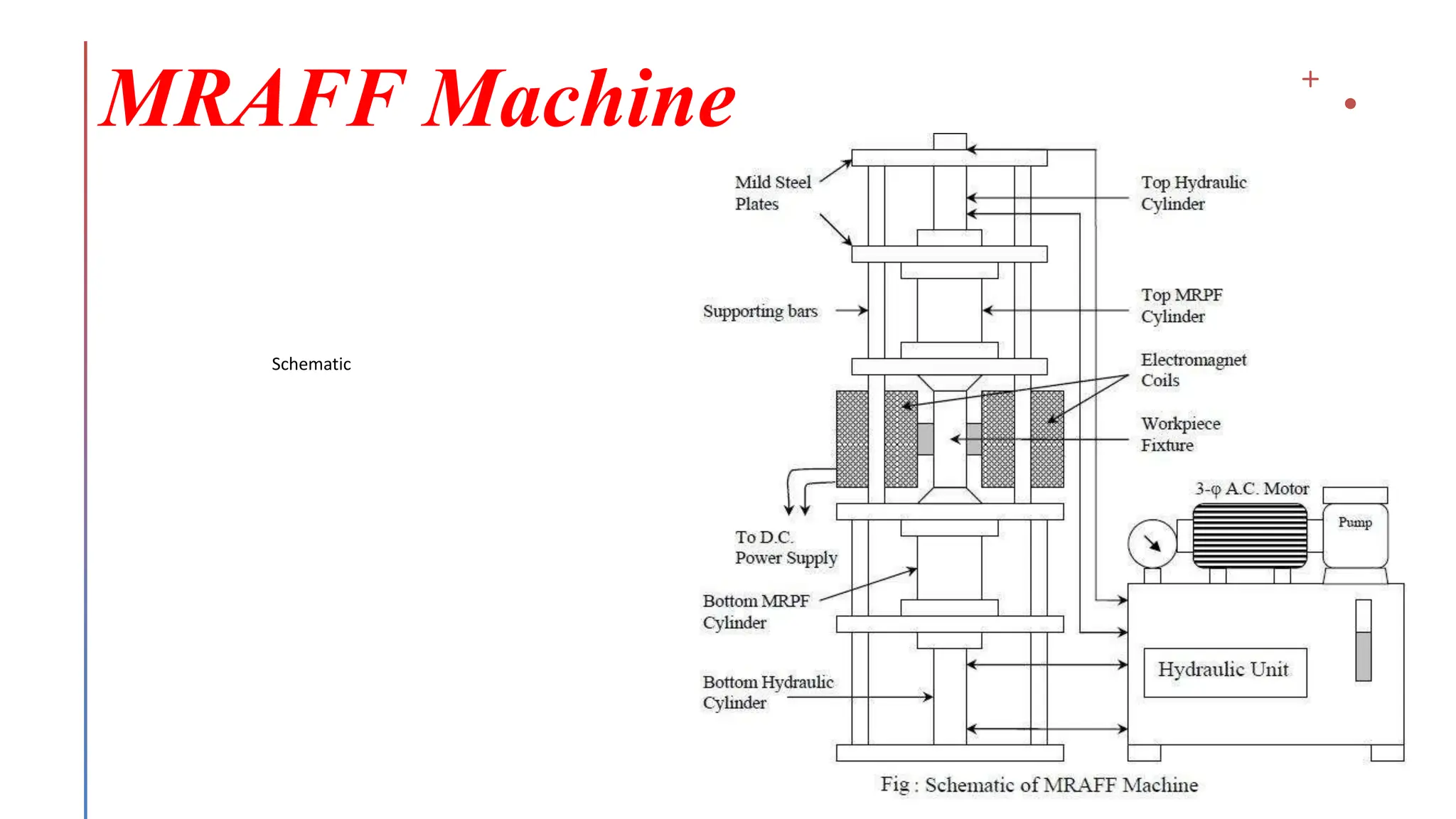
MRAFF Machine
• The viscosity of smart magnetorheological polishing fluid
(MRPF) is a function of applied magnetic field strength,
and it is varied according to the desired finishing
characteristics.
• The shearing of the Bingham plastic polishing fluid near the
workpiece surface contributes to the material removal and
hence finishing.
• Extrusion of the MRP-fluid through the passage formed in
the work piece fixture is accomplished by driving two
opposed pistons in MRPF cylinders using hydraulic
actuators operated in desired manner with the help of
designed hydraulic circuit, Fig. 14.
MRAFF Machine
Schematic
Diamond Turning
Diamond turning is a process of mechanical machining of precision elements
using lathes or derivative machine tools (e.g., turn-mills, rotary transfers)
equipped with natural or synthetic diamond-tipped tool bits.
The process of diamond turning is widely used to manufacture high-quality a
spheric optical elements from crystals, metals, acrylic, and other materials.
Optical elements produced by the means of diamond turning are used in optical
assemblies in telescopes, video projectors, missile guidance systems, lasers,
scientific research instruments and numerous other systems & devices.
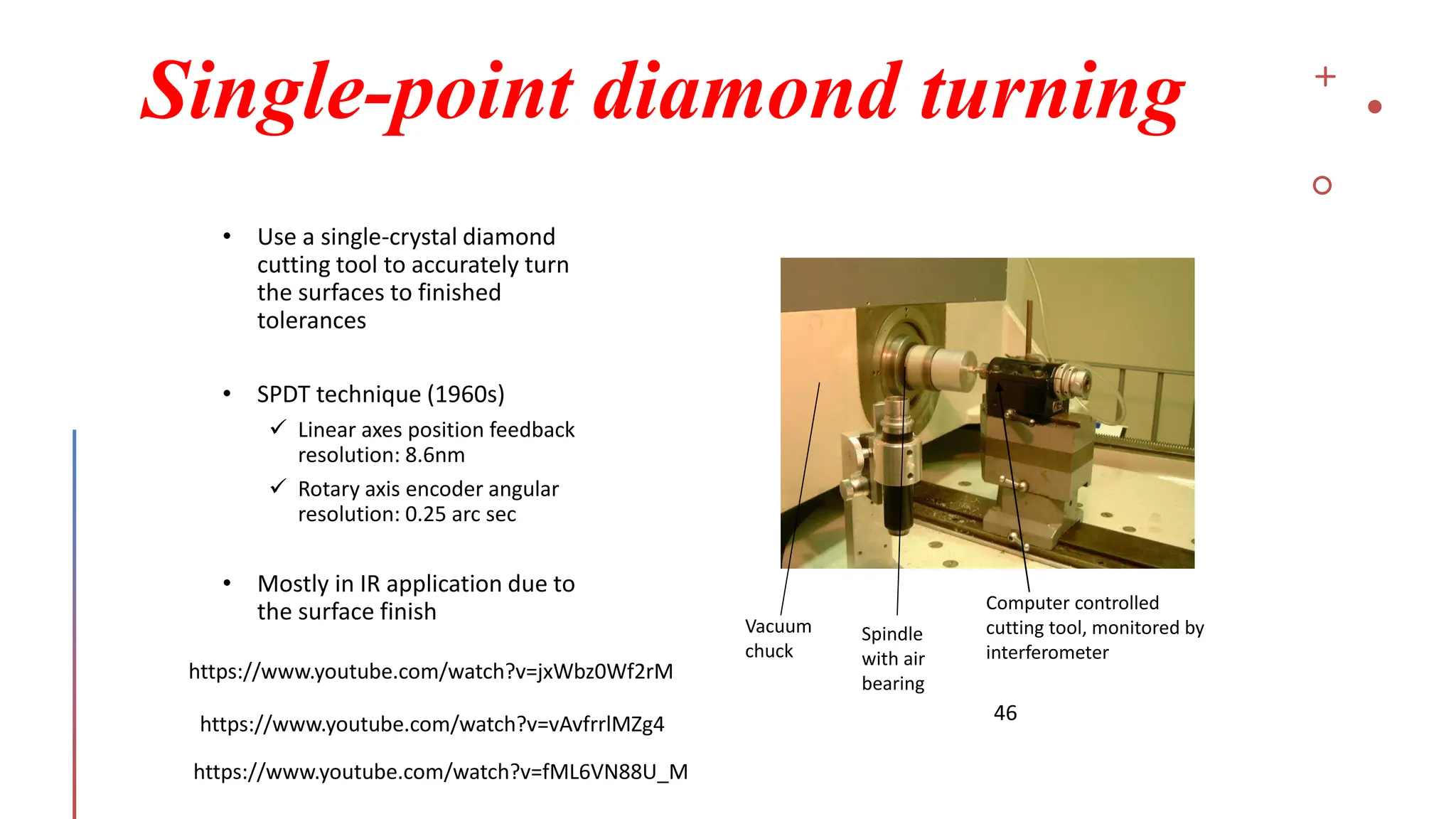
Single-point diamond turning
46
• Use a single-crystal diamond
cutting tool to accurately turn
the surfaces to finished
tolerances
• SPDT technique (1960s)
✓ Linear axes position feedback
resolution: 8.6nm
✓ Rotary axis encoder angular
resolution: 0.25 arc sec
• Mostly in IR application due to
the surface finish
Vacuum
chuck
Spindle
with air
bearing
Computer controlled
cutting tool, monitored by
interferometer
https://www.youtube.com/watch?v=jxWbz0Wf2rM
https://www.youtube.com/watch?v=vAvfrrlMZg4
https://www.youtube.com/watch?v=fML6VN88U_M
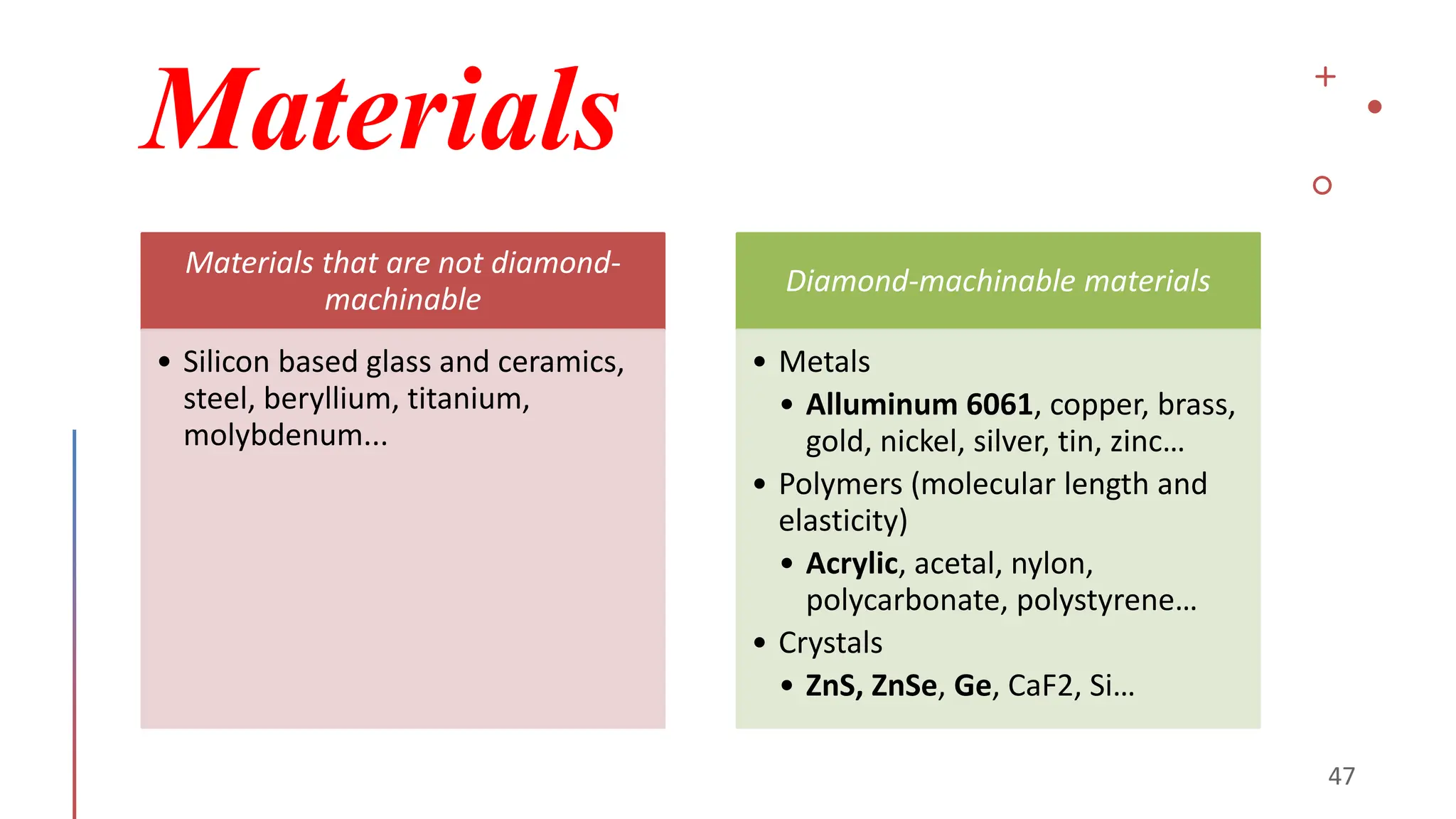
Materials
Materials that are not diamond-
machinable
• Silicon based glass and ceramics,
steel, beryllium, titanium,
molybdenum...
Diamond-machinable materials
• Metals
• Alluminum 6061, copper, brass,
gold, nickel, silver, tin, zinc…
• Polymers (molecular length and
elasticity)
• Acrylic, acetal, nylon,
polycarbonate, polystyrene…
• Crystals
• ZnS, ZnSe, Ge, CaF2, Si…
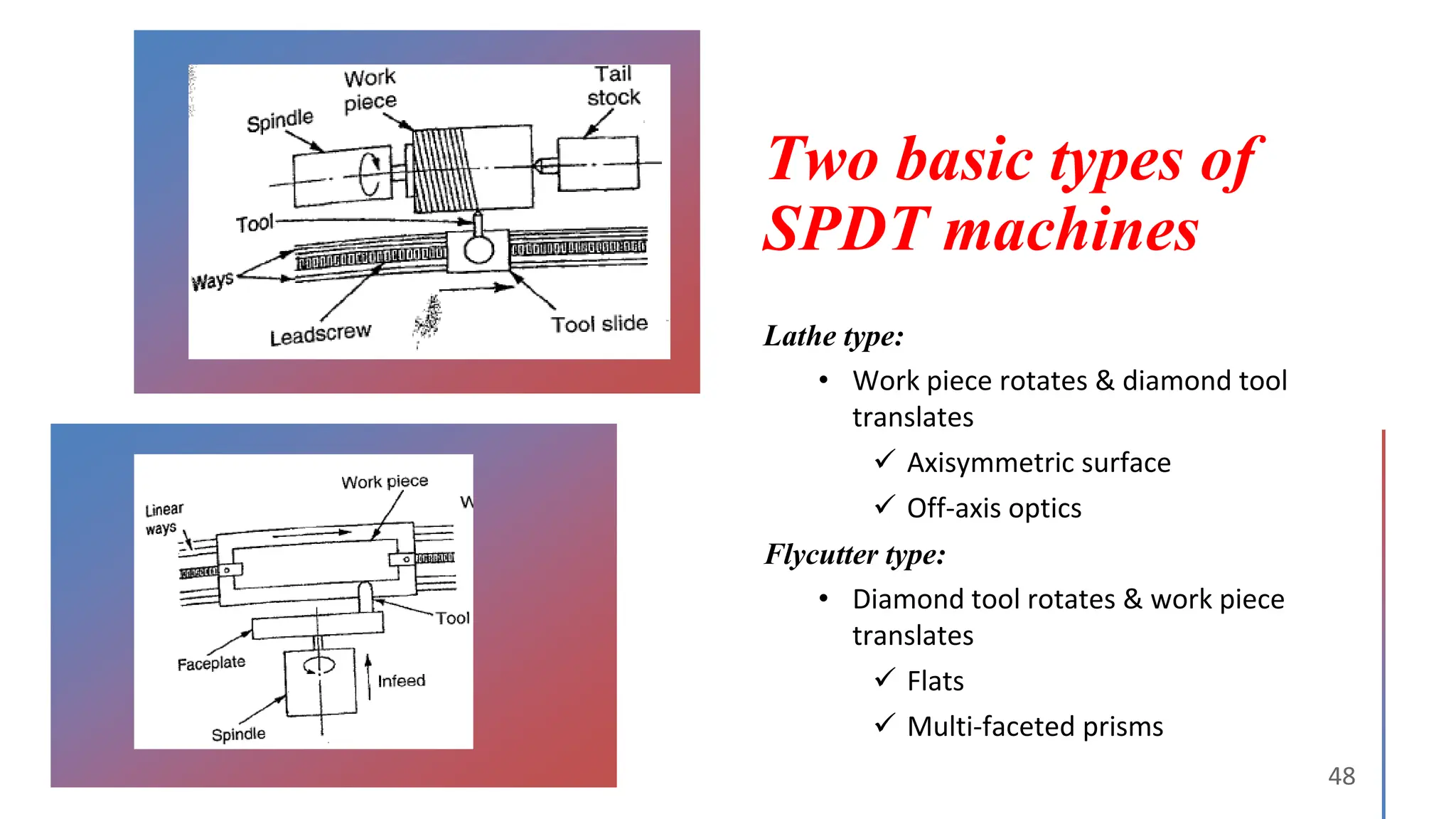
Two basic types of
SPDT machines
Lathe type:
• Work piece rotates & diamond tool
translates
✓ Axisymmetric surface
✓ Off-axis optics
Flycutter type:
• Diamond tool rotates & work piece
translates
✓ Flats
✓ Multi-faceted prisms
Surface figure—radius of
curvature & irregularity
• Radius of curvature
✓ Typical tolerance for radius of curvature: ±0.05%
➢ Relatively short radii: limits of spherometer accuracy:
about 0.005%
➢ Long radii (> 2 m) : lower accuracy, error in the order
of 0.1 – 1.0%
• Irregulairty
✓ The height departure from the ideal surface figure
✓ ¼ power specification (Rule of thumb)
49
Surface figure—aspheric figure
• Rotationally symmetric surface or off-axis section of the
surface that has rotational symmetry
✓ General asphere with spherical, even and odd polynomial
terms
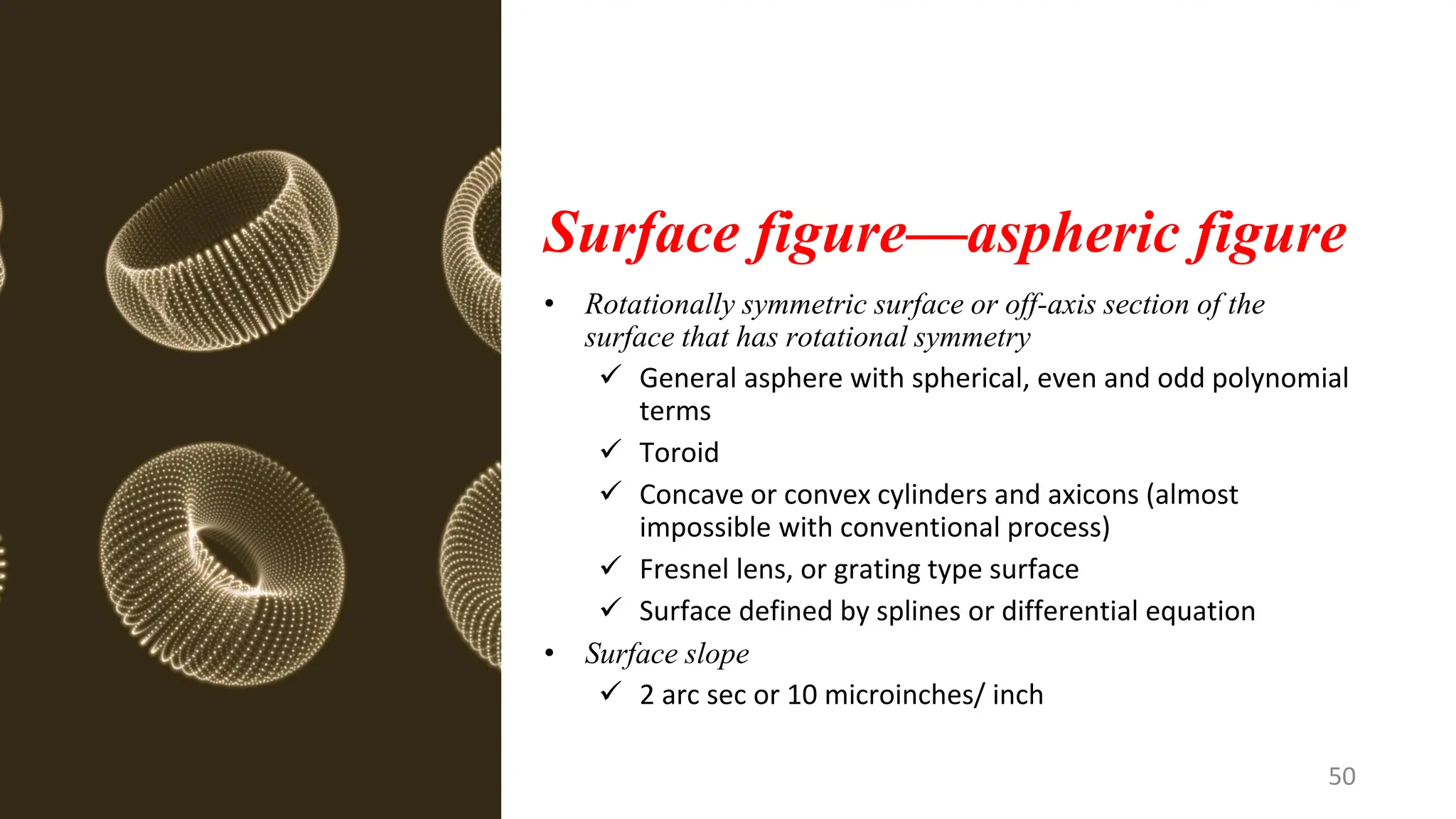
✓ Toroid
✓ Concave or convex cylinders and axicons (almost
impossible with conventional process)
✓ Fresnel lens, or grating type surface
✓ Surface defined by splines or differential equation
• Surface slope
✓ 2 arc sec or 10 microinches/ inch
50
Surface figure test
• Talysurf contacting profilometer
✓ Scan the part
✓ Measure the departure of the surface from theoretical
shape
• Interferometer
✓ Overall performance
✓ Null test
51
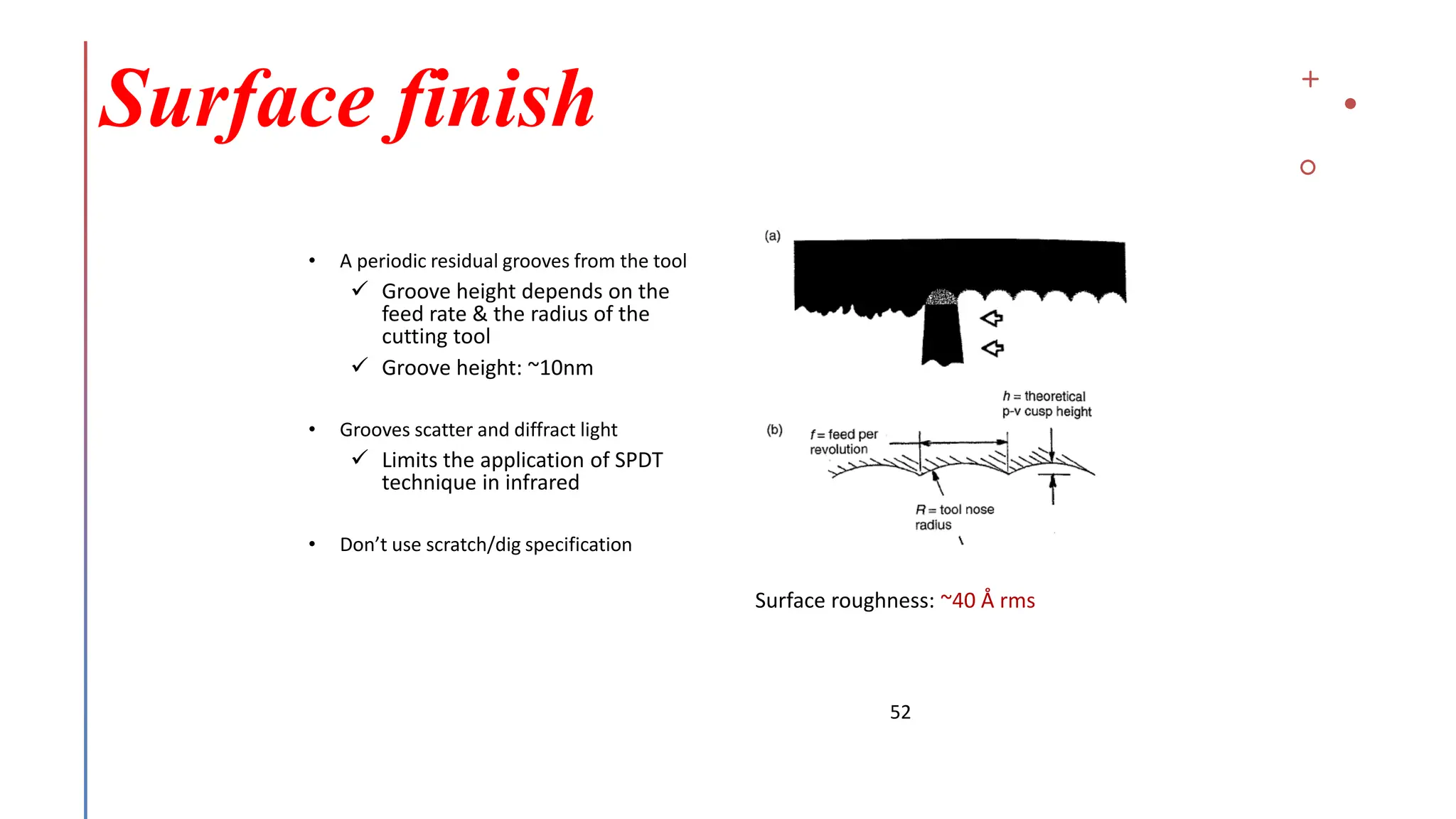
Surface finish
52
• A periodic residual grooves from the tool
✓ Groove height depends on the
feed rate & the radius of the
cutting tool
✓ Groove height: ~10nm
• Grooves scatter and diffract light
✓ Limits the application of SPDT
technique in infrared
• Don’t use scratch/dig specification
Surface roughness: ~40 Å rms
Post finish
• SPDT usually provide adequate surface figure accuracy
• Post finish can smooth out the residual grooves and minimize
the scatter for the application of shorter wavelength
• Avoid post finish: it may change the surface figure
53
Advantages of SPDT
7/22/2024 OPTI 521 54
EASY TO PROGRAM SETUP CAN BE
CHANGED QUICKLY FOR
SHORT RUNS OF OPTICS
HIGH DEGREE OF
PRECISIONS IN
MECHANICS
PERMITS VARIATIONS
ON SURFACE SHAPE,
ASPHERIC, TOROIDAL,
DIFFRACTIVE OPTICS…
FAST: DIRECTLY TURN
THE SURFACE TO ITS
FINISHED TOLERANCES
COST EFFECTIVE
Limitation of SPDT
55
https://www.youtube.com/watch?v=XwKCALyJ7r8
https://www.youtube.com/watch?v=TJyxltsFKUo
Produce only one optic at a
time
The size of the work piece
is limited by the size of the
SPDT machine
Mostly applied to infrared
optics
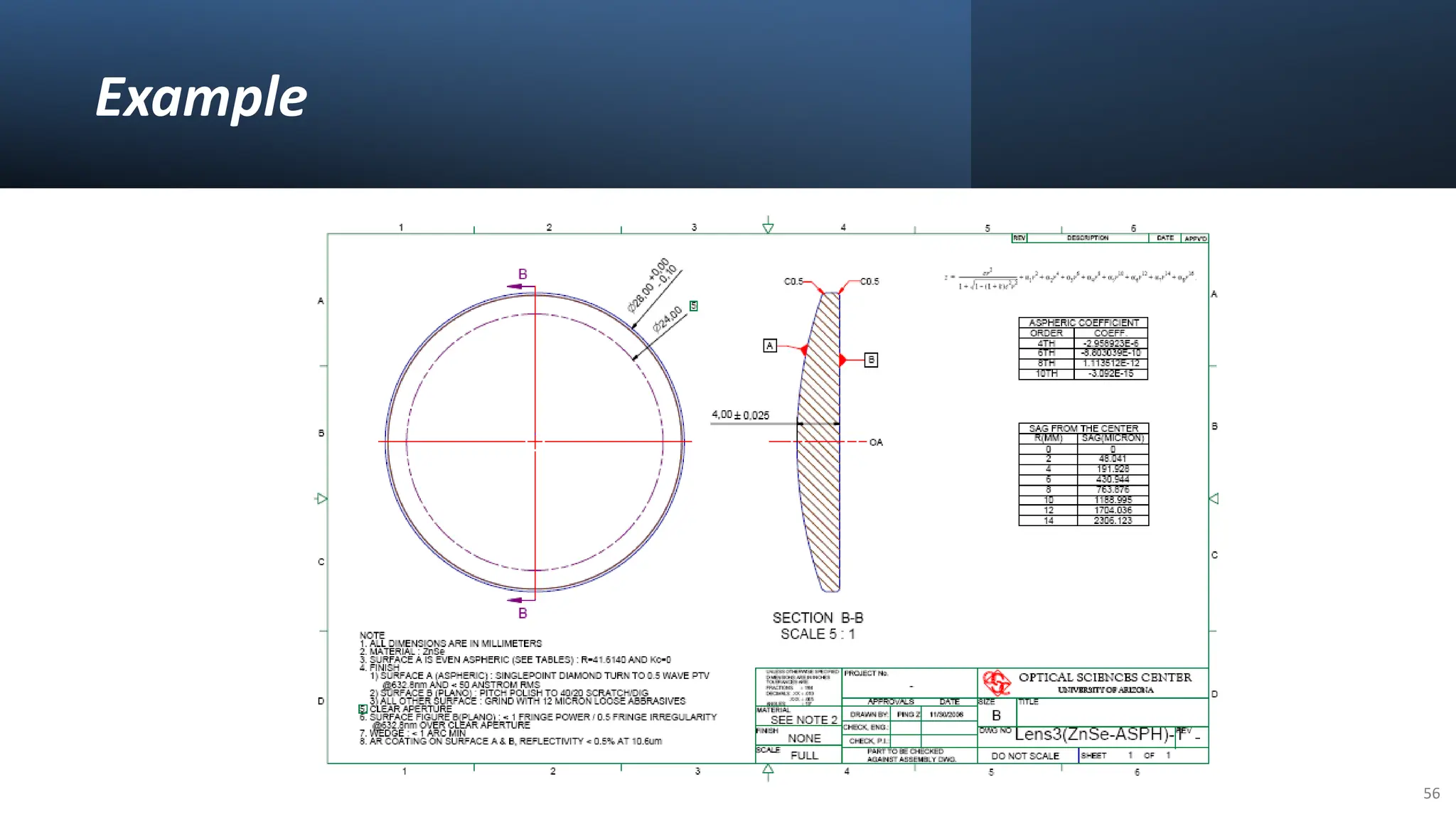
Example
56
Reference
1. The Handbook of Optical Engineering
2. Robert A. Clark, Design and Specification of Diamond Turned
Optics
3. Hillary G. Sillitto, Analysis, tolerancing and diagnosis of
diamond maching errors
4. Mark Craig Gerchman, Specifications and manufacturing
considerations of diamond machined optical components
5. E.R. Freniere and J. Zimmerman, Specifications for diamond-
turned surfaces
6. Paul R. Yoder, Opto-Mechanical System Design
57
micromachining-MRF, MRAFF Processes. pdf

  • 1.
  • 2.
    What is Micro Fabrication? Fabrication ofproducts deals with making of machines, structures or process equipment by casting, forming, welding, machining & assembling. Classified into: Macro & micro Macro: fabrication of structures/parts/products that aremeasurable /observable by naked eye( ≥ 1mm in size) Micro: fabrication of miniature structures/parts/products that are not visible with naked eye(1 µm ≤ dimension ≤ 1000 µm in size) Methods of Micro Fabrication: Material deposition Material Removal
  • 3.
  • 4.
    Micro Machining • Machiningof micro parts is not literally correct. • Removal of material in the form of chips or debris having the size in the range of microns. • Creating micro features or surface characteristics (especially surface finish) in the micro/nano level. • Definition: material removal at micro/nano level with no constraint on the size of the component being machined.
  • 5.
  • 6.
    Why Micro Machining? • Finalfinishing operations in manufacturing of precise parts are always of concern owing to their most critical, labour intensive and least controllable nature. • In the era of nanotechnology, deterministic high precision finishing methods are of utmost importance and are the need of present manufacturing scenario. • The need for high precision in manufacturing was felt by manufacturers to improve interchangeability of components, improve quality control and longer wear/fatigue life.
  • 7.
    Why Micro Machining? • Presentday High-tech Industries, Design requirements are stringent. • Extraordinary Properties of Materials (High Strength, High heat Resistant, High hardness, Corrosion resistant etc) • Complex 3D Components (Turbine Blades) • Miniature Features (filters for food processing and textile industries having few tens of microns as hole diameter and thousands in number) • Nano level surface finish on Complex geometries (thousands of turbulated cooling holes in a turbine blade) • Making and finishing of micro fluidic channels (in electrically conducting & non conducting materials, say glass, quartz, &ceramics)
  • 8.
    Micro Machining Main purposes: –Shaping and sizing a part (AMMPs) – Surface finishing a part (ANFPs) Main classification: Processes which use Advanced Micro Machining Processes, (AMMPs) – Mechanical AMMPs: Mechanical force (abrasion: abrasive particles as tools, removing material in the form of micro/nano chips) – Thermal AMMPs: Direct energy of beam or plasma (ablation: removal by melting /vaporization) – Electro Chemical AMMPs: Electro Chemical or Chemical Reaction (removal by chemical reaction)
  • 9.
    Micro Machining Advanced NanoFinishing Processes (ANFPs) – ANFPs with no external control of forces 1) Abrasive Flow Finishing AFF, 2) Chemo Mechanical Polishing CMP & 3) Elastic Emission Machining EMM) – ANFPs with external control of forces 1) Magnetic Abrasive Finishing MAF, 2) Magneto Rheological Finishing MRF, 3) Magneto Rheological Abrasive Flow Finishing MRAFF & 4) Magnetic Float Polishing MFP)
  • 10.
    Machining Accuracy ▪ Themachining processes are classified into three categories on the basis of achievable accuracy: Conventional machining, precision machining and ultra precision machining. ▪ Conventional machining processes is about 1 μm, ▪ Precision is 0.01μm (10 nm), and ▪ Ultra precision machining is 0.001μm (1 nm). ▪ As the demand moves from the microtechnology (1μm accuracy capability) to the nanotechnology region (1 nm accuracy) the systems engineering demands rapid increase in stringency and complexity.
  • 11.
  • 12.
    TRADITIONAL FINISHING PROCESSES Lapping •Lapping uses loose abrasives to finish the surface. Finishing action takes place through abrasion by hard particles trapped between work piece surface and a counter surface called lap. • After introducing abrasive slurry between work piece and lap surface, the work piece is held against lap and moved in random paths under pressure. Grinding • In grinding the material is removed from the work piece surface by relative motion of the cylindrical wheel having abrasive particles embedded on its periphery.
  • 13.
    TRADITIONAL FINISHING PROCESSES Honing •Honing isanother abrasive finishing process generally used to finish internal cylindrical surfaces. •The abrasives in the form of stones or sticks carried in an expanding and oscillating mandrel are used to generate random cross-marked surface with good finish. •The stick pressure on work piece surface is comparatively more than lapping.
  • 14.
    Advanced Finishing Processes (AFPs) 1.Abrasive Flow Machining (AFM) 2. Magnetic Abrasive Finishing(MAF) 3. Magneto Rheological Finishing (MRF) 4. Magneto Rheological Abrasive Flow Finishing (MRAFF) 5. Magnetic Float Polishing (MFP) 6. Elastic Emission Machining (EEM) 7. Ion Beam Machining (IBM) 8. Chemical Mechanical polishing (CMP)
  • 15.
    Abrasive Flow Machining (AFM) https://www.youtube.com/watch?v=lHjJz7BQ49Y https://www.youtube.com/watch?v=Wa4Z5tsX3E4 It is anon-traditional machining method that can be used to deburr, polish, remove recast layer, produce compressive residual stress and radius difficult to reach surfaces and edges by flowing an abrasive laden visco- plastic polymer over them. Because of its capability to machine interior and curved surfaces, it is considered as a suitable surface finishing process to finish internal complex geometry of work pieces. The Effect of this AFM occurs at nanometer scale, obtaining surface roughness under Ra = 100 nm It is employed both for metals and non-metals Low MRR.
  • 16.
    Abrasive Flow Machining (AFM) • Principle: •a AFM is a kind of finishing process in which a small quantity of material is removed by flowing a semi-solid media (comprises of a carriers in the form of polymer base containing abrasive powders) over the surface to be machined • It uses two vertically opposed cylinders, which extrude an abrasive medium back and forth through passage formed by the work piece and tooling. • Extrusion pressure, number of cycles, grit composition and type, and fixture design are the process parameters that have the largest impact on AFM results. • The viscosity of polymeric medium plays an important role in finishing operation. This allows it to selectively and controllably abrade surfaces that it flows across. https://www.youtube.com/watch?v=lHjJz7BQ49Y
  • 17.
  • 18.
  • 19.
    Abrasive Flow Machining (AFM) •Abrasive action accelerates by change in the rheological properties of the medium when it enters and passes through the restrictive passages. • The work piece held by fixture is placed between two medium cylinders which are clamped together to seal so that medium does not leak during finishing process. • Abrasion occurs wherever the medium passes through the restrictive passages. The key components of AFM are the machine, the tooling, types of abrasives, medium composition and process settings.
  • 20.
    Abrasive Flow Machining (AFM) •The three major elements of the processare: • The Tooling, which confines and directs the abrasive medium flow to the areas where deburring, radiusing and surface improvements are desired. • The Machine to control the process variables like extrusion pressure, medium flow volume, and flow rate. Type: One-way AFM, Two-way AFM, orbital AFM. • The abrasive laden Polymeric Medium whose rheological properties determine the pattern and aggressiveness of the abrasive action. Consists of base material, abrasive grits and plasticizers • Toformulate the AFM medium, the abrasive particles are blended into special visco-elastic polymer,which show change in viscosity when forced to flow through restrictive passages.
  • 21.
  • 22.
  • 23.
  • 24.
  • 27.
    Magneto Rheological Finishing (MRF) •Traditional methods of finishing high precision lenses, ceramics and semiconductor wafers are very expensive and labor intensive. • Lenses are usually made of brittle materials such as glass, which tends to crack while it is machined, and every device that uses either lasers or fiber optics requires at least one high precision lens, increasing its demand higher than ever. • The lens manufacturer generally uses its in-house opticians for the finishing process, which makes it an arduous, labor- intensive process. https://www.youtube.com/watch?v=Lo2DRTFazYg
  • 28.
    Magneto Rheological Finishing Lens manufacturing canbe classified into two main processes: grinding and finishing. Grindinggets the lens close to the desired size, while finishing removes the cracks and tiny surface imperfections that the grinding process either overlooked or created. • Perhaps the biggest disadvantage to manual grinding and finishing is that it is nondeterministic. • To overcome these difficulties, Center for Optics Manufacturing (COM) in Rochester, N.Y. has developed a technology to automate the lens finishing process known as Magneto Rheological Finishing (MRF).
  • 29.
    Magneto Rheological Finishing (MRF) The MRF processrelies on a unique "smart fluid", known as Magnetorheological (MR) fluid. MR-Fluids are suspensions of micron sized magnetizable particles such as carbonyl iron, dispersed in a non- magnetic carrier medium like silicone oil, mineral oil or water. In the absence of a magnetic field, an ideal MR-fluid exhibits Newtonian behaviour. On the application of an external magnetic field to a MR- suspension, a phenomenon known as Magneto Rheological Effect, shown in Fig, is observed.
  • 30.
    Magneto Rheological Effect Fig. ashows the random distribution of the particles in the absence of external magnetic field. Fig. c shows an increasing resistance to an applied shear strain, γ due to this yield stress. When the field is removed, the particles return to their random state and the fluid again exhibits its original Newtonian behavior.
  • 31.
    Magneto Rheological Effect ❖ InFig. b, particles magnetize and form columns when external magnetic field is applied. ❖ The particles acquire dipole moments proportional to magnetic field strength and when the dipolar interaction between particles exceeds their thermal energy, the particles aggregate into chains of dipoles aligned in the field direction. ❖ Because energy is required to deform and rupture the chains, this micro-structural transition is responsible for the onset of a large "controllable" finite yield stress.
  • 32.
    Magneto Rheological Finishing In theMagneto rheological finishing process, a convex, flat, or concave work piece is positioned above a reference surface. A MR fluid ribbon is deposited on the rotating wheel rim. By applying magnetic field in the gap, the stiffened region forms a transient work zone or finishing spot.
  • 33.
    Magneto Rheological Finishing • Surfacesmoothing, removal of sub-surface damage, and figure correction are accomplished by rotating the lens on a spindle at a constant speed while sweeping the lens about its radius of curvature through the stiffened finishing zone. • Material removal takes place through the shear stress created as the Magneto Rheological polishing ribbon is dragged into the converging gap between the part and carrier surface. • Deterministic finishing of flats or spheres can be done by mounting the part on rotating spindle and sweeping it through the spot under computer control, such that dwell time determines the amount of material removal.
  • 34.
    Magneto Rheological Finishing The zoneof contact is restricted to a spot, which conforms perfectly to the local topography of the part.
  • 35.
    MRP Fluid • Magnetorheologicalpolishing fluid comprises of MR-fluid with fine abrasive particles dispersed in it. • On the application of magnetic field the carbonyl iron particles (CIP) form a chain like columnar structure with abrasives embedded in between. • The magnetic force between iron particles encompassing abrasive grain provides bonding strength to it and its magnitude is a function of iron concentration, applied magnetic field intensity, magnetic permeability of particles and particle size.
  • 36.
    MRP Fluid • TheMR-polishing fluid has following merits:- • Its compliance is adjustable through the magnetic field. • It carries heat and debris away from the polishing zone. • It does not load up as in grinding wheel. • It is flexible and adapts the shape of the part of the work piece which is in its contact.
  • 37.
    Magneto Rheological Abrasive FlowFinishing (MRAFF) • In AFM, the polishing medium acts as compliant lap and overcomes shape limitation inherent in almost all traditional finishing processes. • As abrading forces in AFM process mainly depend on rheological behaviour of polymeric medium, which is least controllable by external means, hence lacks determinism. • The process Magnetorheological finishing, uses magnetically stiffened ribbon to deterministically finish optical flats, spheres and aspheres.
  • 38.
    Magneto Rheological Abrasive FlowFinishing (MRAFF) • In order to maintain the versatility of Abrasive Flow Machining process and at the same time introducing determinism and controllability of rheological properties of abrasive laden medium, a new hybrid process termed as Magnetorheological Abrasive Flow Finishing (MRAFF) is used. • This process relies on smart behaviour of magneto Rheological fluids whose rheological properties are controllable by means of external magnetic field.
  • 39.
  • 40.
  • 41.
    Mechanism of MRAFFProcess In MRAFF process, a magnetically stiffened slug of magneto rheological polishing fluid is extruded back and forth through or across the passage formed by work piece and fixture. Abrasion occurs selectively only where the magnetic field is applied across the work piece surface, keeping the other areas unaffected. The mechanism of the process is shown in Fig. The rheological behaviour of polishing fluid changes from nearly Newtonian to Bingham plastic upon entering and Bingham to Newtonian upon exiting the finishing zone.
  • 42.
    MRAFF Machine • Theviscosity of smart magnetorheological polishing fluid (MRPF) is a function of applied magnetic field strength, and it is varied according to the desired finishing characteristics. • The shearing of the Bingham plastic polishing fluid near the workpiece surface contributes to the material removal and hence finishing. • Extrusion of the MRP-fluid through the passage formed in the work piece fixture is accomplished by driving two opposed pistons in MRPF cylinders using hydraulic actuators operated in desired manner with the help of designed hydraulic circuit, Fig. 14.
  • 43.
  • 44.
    Diamond Turning Diamond turningis a process of mechanical machining of precision elements using lathes or derivative machine tools (e.g., turn-mills, rotary transfers) equipped with natural or synthetic diamond-tipped tool bits. The process of diamond turning is widely used to manufacture high-quality a spheric optical elements from crystals, metals, acrylic, and other materials. Optical elements produced by the means of diamond turning are used in optical assemblies in telescopes, video projectors, missile guidance systems, lasers, scientific research instruments and numerous other systems & devices.
  • 45.
    Single-point diamond turning 46 •Use a single-crystal diamond cutting tool to accurately turn the surfaces to finished tolerances • SPDT technique (1960s) ✓ Linear axes position feedback resolution: 8.6nm ✓ Rotary axis encoder angular resolution: 0.25 arc sec • Mostly in IR application due to the surface finish Vacuum chuck Spindle with air bearing Computer controlled cutting tool, monitored by interferometer https://www.youtube.com/watch?v=jxWbz0Wf2rM https://www.youtube.com/watch?v=vAvfrrlMZg4 https://www.youtube.com/watch?v=fML6VN88U_M
  • 46.
    Materials Materials that arenot diamond- machinable • Silicon based glass and ceramics, steel, beryllium, titanium, molybdenum... Diamond-machinable materials • Metals • Alluminum 6061, copper, brass, gold, nickel, silver, tin, zinc… • Polymers (molecular length and elasticity) • Acrylic, acetal, nylon, polycarbonate, polystyrene… • Crystals • ZnS, ZnSe, Ge, CaF2, Si…
  • 47.
    Two basic typesof SPDT machines Lathe type: • Work piece rotates & diamond tool translates ✓ Axisymmetric surface ✓ Off-axis optics Flycutter type: • Diamond tool rotates & work piece translates ✓ Flats ✓ Multi-faceted prisms
  • 48.
    Surface figure—radius of curvature& irregularity • Radius of curvature ✓ Typical tolerance for radius of curvature: ±0.05% ➢ Relatively short radii: limits of spherometer accuracy: about 0.005% ➢ Long radii (> 2 m) : lower accuracy, error in the order of 0.1 – 1.0% • Irregulairty ✓ The height departure from the ideal surface figure ✓ ¼ power specification (Rule of thumb) 49
  • 49.
    Surface figure—aspheric figure •Rotationally symmetric surface or off-axis section of the surface that has rotational symmetry ✓ General asphere with spherical, even and odd polynomial terms ✓ Toroid ✓ Concave or convex cylinders and axicons (almost impossible with conventional process) ✓ Fresnel lens, or grating type surface ✓ Surface defined by splines or differential equation • Surface slope ✓ 2 arc sec or 10 microinches/ inch 50
  • 50.
    Surface figure test •Talysurf contacting profilometer ✓ Scan the part ✓ Measure the departure of the surface from theoretical shape • Interferometer ✓ Overall performance ✓ Null test 51
  • 51.
    Surface finish 52 • Aperiodic residual grooves from the tool ✓ Groove height depends on the feed rate & the radius of the cutting tool ✓ Groove height: ~10nm • Grooves scatter and diffract light ✓ Limits the application of SPDT technique in infrared • Don’t use scratch/dig specification Surface roughness: ~40 Å rms
  • 52.
    Post finish • SPDTusually provide adequate surface figure accuracy • Post finish can smooth out the residual grooves and minimize the scatter for the application of shorter wavelength • Avoid post finish: it may change the surface figure 53
  • 53.
    Advantages of SPDT 7/22/2024OPTI 521 54 EASY TO PROGRAM SETUP CAN BE CHANGED QUICKLY FOR SHORT RUNS OF OPTICS HIGH DEGREE OF PRECISIONS IN MECHANICS PERMITS VARIATIONS ON SURFACE SHAPE, ASPHERIC, TOROIDAL, DIFFRACTIVE OPTICS… FAST: DIRECTLY TURN THE SURFACE TO ITS FINISHED TOLERANCES COST EFFECTIVE
  • 54.
    Limitation of SPDT 55 https://www.youtube.com/watch?v=XwKCALyJ7r8 https://www.youtube.com/watch?v=TJyxltsFKUo Produceonly one optic at a time The size of the work piece is limited by the size of the SPDT machine Mostly applied to infrared optics
  • 55.
  • 56.
    Reference 1. The Handbookof Optical Engineering 2. Robert A. Clark, Design and Specification of Diamond Turned Optics 3. Hillary G. Sillitto, Analysis, tolerancing and diagnosis of diamond maching errors 4. Mark Craig Gerchman, Specifications and manufacturing considerations of diamond machined optical components 5. E.R. Freniere and J. Zimmerman, Specifications for diamond- turned surfaces 6. Paul R. Yoder, Opto-Mechanical System Design 57