New trend in Manufacturing - Micromachining
Dr. K.SIVASAKTHIVEL , M. E, M.B.A, Ph. D,
Micromachining
 ‘Micro-machining’ refers to a machining process by which small(‘microscopic’) bits
of material are removed in order to achieve a high geometrical accuracy that
otherwise is unattainable.
 Micromachining is particularly suited for manufacturing of micro-structures and
micro-parts with the dimensions from 1 µm to 500 µm or when the volume of the
material removed is at the micro level features size of 100 µm is common in
micromachining.
 Tool-based micromachining is able to produce high profile accuracy, surface finish,
and sub-surface integrity at a reasonable cost, which has been applied to
fabricate microstructures on a variety of substrates.
 There is a growing demand for industrial products with increased number of
functions and of reduced dimensions.
 Growing demand for less weight, high accuracy, high precision, meagre lead time,
reduced batch size, less human interference are the key drivers for the
micromachining than the conventional machining process.
Need of micromachining
 In the medical field, diagnosis and surgery without pain is possible through
miniaturization of medical tools. The convenience and value of many products can be
substantially increased with reduced size and weight.
 Rapid growth of Micro Electro Mechanical Systems (MEMS) .
 Complex 3D Components.
 Nano level surface finish on complex geometrics which are impossible to achieve by
any other method.
 New developed material with extra ordinary properties.
 The global micromachining market size is expected to reach USD 3.3 billion by 2025
from USD 2.4 billion in 2020, at a CAGR of 6.2%. The growth of this market is
accelerated by the growing demand for the miniaturization of electronic devices and
the rising preference of laser-based micromachining over the traditional approach.
Challenges in Micromachining
 The biggest challenges of micromachining is finding cutting tools that offer the
long life and repeatability that enables a machine tool to run at high rpms.
 Meagre material removal rate (0.6 to 6 mm3/hour) by micro EDM machine.
 Nonproductive time and the cost to operate are relatively higher than other
process.
 Limited to operate only in conductive materials whereas low conductive material
and nonconductive material are highly inert to the EDM micro machining.
 Environment related factor.
 Thermal effect of the laser machining process may reduce surface quality and
accordingly the fatigue strength due to the generated HAZ, which deteriorates the
performance of micro machined components.
Application of micromachining
 Fuel injector nozzle
 Biotechnology
 Optics
 Medical Implants
 Micro pumps
 Micro engines
 Diagnostic devices
 Microneedles
 Semiconductor
 Pressure sensors and inertial sensors
Micro needle
Micro twin cylinder engine
Turbine impeller made by Micro EDM
process
Fuel injection nozzle–Micro drilling
Classification of micromachining
 Micromachining segmented based on type, process, axis and industry.
 By Type: Traditional ,Non-traditional ,Hybrid.
 By Process: Additive, Subtractive and others.
 By Axis: 3-axes ,4-axes ,5-axes and others.
 By Industry: Automotive, Semiconductor & Electronics, Aerospace ,Defense
Medical & Aesthetics, Telecommunications, Power ,Energy, Plastics,
 Polymers, Gems ,Jewelry and Others (Machine tools &
 Manufacturing, Watchmaking, Glass)
Types of Micromachining
A. Bulk micromachining
 Bulk micromachining builds mechanical elements by starting with a bulk material, and
then etching away unwanted parts, and being left with useful mechanical devices.
 Bulk micromachining is a set of processes that enable the 3D sculpting of various
materials (mainly silicon) to make small structures that serve as components for MEMS
devices.
 Typically, the substrate is photo patterned , leaving a protective layer on the parts of the
substrate that are to be retained. The substrate is then etched using a wet chemical
etch process, dry chemical etch process, reactive plasma etch process or photo-etch
process.
 The etch process “eats away” any exposed substrate material on the substrate. Bulk
micromachining is a relatively simple and inexpensive fabrication technology to
fabricate a micro machined device.
 Bulk micromachining is a relatively simple and inexpensive fabrication technology to
fabricate a micro machined device.
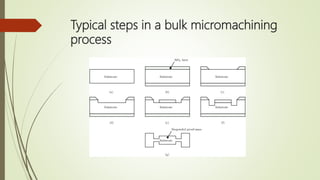
Typical steps in a bulk micromachining
process
 a) Substrate preparation-typically, a 500 to 700 μm thick single silicon (Si)
crystal.
 b) Deposition of a silicon dioxide layer typical thickness: 1 to 2 μm.
 c) Patterning and etching of the SiO2 layer.
 d) Substrate etching.
 e) Deposition of SiO2 layer for a selective area (repetition of step (b)).
 f) Substrate etching for creating deeper trenches (repetition of step (f)).
 g) Creation of a suspended structure after repeating steps (a) to (f) on the
bottom side of the substrate and removing the residual SiO2 at both sides.
Surface Micromachining
 Surface Micromachining is called because instead of crystal silicon substrate as a
functioning material this new technology uses thin film layers deposited on the
substrate surface as functioning material.
 All processing steps in surface micromachining are performed from the front side
of the substrate, thus rendering it more compatible with standard microelectronic
technologies and also with increasing wafer sizes.
 Structural layer- A layer of thin film material that comprises a mechanical device.
This layer is deposited on the sacrificial layer, and then released by etching it away.
 Sacrificial Layer-A layer of material that is deposited between the structural layer
and the substrate to provide mechanical separation and isolation between them.
This is removed after the mechanical components on the structural layer are fully
formed, by release etch. This approach facilitates the free movement of the
structural layer with respect to the substrate.
 So that suitable etchant can be selected to remove the sacrificial layer without
removing the structural layer AND the substrate etc.
Stress free MEMS devices and Airbag
accelerometer by Surface machining
Steps in Surface Micromachining
LIGA micromachining and Steps
 LIGA is the German acronym for lithography, electroplating and moulding
(Lithographie, Galvanik und Abformung). LIGA-process provides high aspect ratio
micro structures in polymers like e.g. PMMA (better known as acrylic glass). Via
electroplating these structures can be replicated in metals like gold, nickel,
magnetic nickel-iron alloys or copper. The steps of Liga is
 Fabrication of an intermediate mask (First an intermediate X-ray absorption mask
(IM) is made by electron beam writing a CAD generated layout into a resist layer)
 Making a working mask (A working mask is an X-ray lithographic copy of an
intermediate mask with the aim to get a mask with a higher X-ray absorption
contrast)
 Producing high aspect ratio resist structures by deep X-ray lithography (In the
deep X-ray lithography step a shadow projection of the working mask into a quite
thick PMMA resist layer (100 µm to 3 mm) is performed)
 Electro forming
 Mass replication by hot embossing or injection molding
LIGA PROCESS
Micro spectrometer, X-ray lenses, gold
gears and gear trains made by LIGA
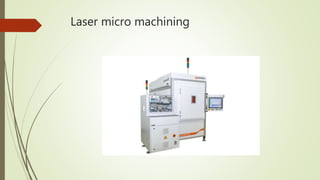
Laser micro machining
 Laser micromachining Process are soaring in the recent days and its potential
merits add a significant impact in its application areas.
 Its high beam quality.
 Portable installation size.
 High laser efficiency.
 Easy to incorporate in the system. It covers the wide utility of its usage in different
fields.
 Laser micromachining is suitable for metals, alloys, transparent and biological
material, ceramics and thin film compound systems.
 Laser uses light radiation with high energy as a machine tool. Focused beam could
allow real 3D shaping by correct motion control
 Laser micromachining provides manufacturing of high-precision, tight-tolerance
parts and features to a wide-range of industries including semiconductor,
electronic, medical, life sciences, and automotive
THANKS

Micro machining

  • 1.
    New trend inManufacturing - Micromachining Dr. K.SIVASAKTHIVEL , M. E, M.B.A, Ph. D,
  • 2.
    Micromachining  ‘Micro-machining’ refersto a machining process by which small(‘microscopic’) bits of material are removed in order to achieve a high geometrical accuracy that otherwise is unattainable.  Micromachining is particularly suited for manufacturing of micro-structures and micro-parts with the dimensions from 1 µm to 500 µm or when the volume of the material removed is at the micro level features size of 100 µm is common in micromachining.  Tool-based micromachining is able to produce high profile accuracy, surface finish, and sub-surface integrity at a reasonable cost, which has been applied to fabricate microstructures on a variety of substrates.  There is a growing demand for industrial products with increased number of functions and of reduced dimensions.  Growing demand for less weight, high accuracy, high precision, meagre lead time, reduced batch size, less human interference are the key drivers for the micromachining than the conventional machining process.
  • 3.
    Need of micromachining In the medical field, diagnosis and surgery without pain is possible through miniaturization of medical tools. The convenience and value of many products can be substantially increased with reduced size and weight.  Rapid growth of Micro Electro Mechanical Systems (MEMS) .  Complex 3D Components.  Nano level surface finish on complex geometrics which are impossible to achieve by any other method.  New developed material with extra ordinary properties.  The global micromachining market size is expected to reach USD 3.3 billion by 2025 from USD 2.4 billion in 2020, at a CAGR of 6.2%. The growth of this market is accelerated by the growing demand for the miniaturization of electronic devices and the rising preference of laser-based micromachining over the traditional approach.
  • 4.
    Challenges in Micromachining The biggest challenges of micromachining is finding cutting tools that offer the long life and repeatability that enables a machine tool to run at high rpms.  Meagre material removal rate (0.6 to 6 mm3/hour) by micro EDM machine.  Nonproductive time and the cost to operate are relatively higher than other process.  Limited to operate only in conductive materials whereas low conductive material and nonconductive material are highly inert to the EDM micro machining.  Environment related factor.  Thermal effect of the laser machining process may reduce surface quality and accordingly the fatigue strength due to the generated HAZ, which deteriorates the performance of micro machined components.
  • 5.
    Application of micromachining Fuel injector nozzle  Biotechnology  Optics  Medical Implants  Micro pumps  Micro engines  Diagnostic devices  Microneedles  Semiconductor  Pressure sensors and inertial sensors
  • 6.
  • 7.
  • 8.
    Turbine impeller madeby Micro EDM process
  • 9.
  • 10.
    Classification of micromachining Micromachining segmented based on type, process, axis and industry.  By Type: Traditional ,Non-traditional ,Hybrid.  By Process: Additive, Subtractive and others.  By Axis: 3-axes ,4-axes ,5-axes and others.  By Industry: Automotive, Semiconductor & Electronics, Aerospace ,Defense Medical & Aesthetics, Telecommunications, Power ,Energy, Plastics,  Polymers, Gems ,Jewelry and Others (Machine tools &  Manufacturing, Watchmaking, Glass)
  • 11.
    Types of Micromachining A.Bulk micromachining  Bulk micromachining builds mechanical elements by starting with a bulk material, and then etching away unwanted parts, and being left with useful mechanical devices.  Bulk micromachining is a set of processes that enable the 3D sculpting of various materials (mainly silicon) to make small structures that serve as components for MEMS devices.  Typically, the substrate is photo patterned , leaving a protective layer on the parts of the substrate that are to be retained. The substrate is then etched using a wet chemical etch process, dry chemical etch process, reactive plasma etch process or photo-etch process.  The etch process “eats away” any exposed substrate material on the substrate. Bulk micromachining is a relatively simple and inexpensive fabrication technology to fabricate a micro machined device.  Bulk micromachining is a relatively simple and inexpensive fabrication technology to fabricate a micro machined device.
  • 12.
    Typical steps ina bulk micromachining process
  • 13.
     a) Substratepreparation-typically, a 500 to 700 μm thick single silicon (Si) crystal.  b) Deposition of a silicon dioxide layer typical thickness: 1 to 2 μm.  c) Patterning and etching of the SiO2 layer.  d) Substrate etching.  e) Deposition of SiO2 layer for a selective area (repetition of step (b)).  f) Substrate etching for creating deeper trenches (repetition of step (f)).  g) Creation of a suspended structure after repeating steps (a) to (f) on the bottom side of the substrate and removing the residual SiO2 at both sides.
  • 14.
    Surface Micromachining  SurfaceMicromachining is called because instead of crystal silicon substrate as a functioning material this new technology uses thin film layers deposited on the substrate surface as functioning material.  All processing steps in surface micromachining are performed from the front side of the substrate, thus rendering it more compatible with standard microelectronic technologies and also with increasing wafer sizes.  Structural layer- A layer of thin film material that comprises a mechanical device. This layer is deposited on the sacrificial layer, and then released by etching it away.  Sacrificial Layer-A layer of material that is deposited between the structural layer and the substrate to provide mechanical separation and isolation between them. This is removed after the mechanical components on the structural layer are fully formed, by release etch. This approach facilitates the free movement of the structural layer with respect to the substrate.  So that suitable etchant can be selected to remove the sacrificial layer without removing the structural layer AND the substrate etc.
  • 15.
    Stress free MEMSdevices and Airbag accelerometer by Surface machining
  • 16.
    Steps in SurfaceMicromachining
  • 17.
    LIGA micromachining andSteps  LIGA is the German acronym for lithography, electroplating and moulding (Lithographie, Galvanik und Abformung). LIGA-process provides high aspect ratio micro structures in polymers like e.g. PMMA (better known as acrylic glass). Via electroplating these structures can be replicated in metals like gold, nickel, magnetic nickel-iron alloys or copper. The steps of Liga is  Fabrication of an intermediate mask (First an intermediate X-ray absorption mask (IM) is made by electron beam writing a CAD generated layout into a resist layer)  Making a working mask (A working mask is an X-ray lithographic copy of an intermediate mask with the aim to get a mask with a higher X-ray absorption contrast)  Producing high aspect ratio resist structures by deep X-ray lithography (In the deep X-ray lithography step a shadow projection of the working mask into a quite thick PMMA resist layer (100 µm to 3 mm) is performed)  Electro forming  Mass replication by hot embossing or injection molding
  • 18.
  • 19.
    Micro spectrometer, X-raylenses, gold gears and gear trains made by LIGA
  • 20.
  • 21.
     Laser micromachiningProcess are soaring in the recent days and its potential merits add a significant impact in its application areas.  Its high beam quality.  Portable installation size.  High laser efficiency.  Easy to incorporate in the system. It covers the wide utility of its usage in different fields.  Laser micromachining is suitable for metals, alloys, transparent and biological material, ceramics and thin film compound systems.  Laser uses light radiation with high energy as a machine tool. Focused beam could allow real 3D shaping by correct motion control
  • 22.
     Laser micromachiningprovides manufacturing of high-precision, tight-tolerance parts and features to a wide-range of industries including semiconductor, electronic, medical, life sciences, and automotive
  • 23.